Dreams are something mysterious, are they? At night you just close your eyes and then you are flying in the air, talking to people who you have never seen, or going to places that exist nowhere. However, the thing is that, in Islam, dreams are not merely movies that are running in your head when you sleep. The interpretation of Islamic dreams has been a sacred practice for over 1,400 years. They are not empty words, and Muslims have attempted to decipher them taking a long time of 1,400 years.
Then we will discuss dreams and interpretation in Islam, what we should do when we encounter various types of dreams. None of this may sound straightforward, at first; I will definitely simplify it, so that even your younger brothers and sisters can understand.
What Are Dreams in Islam?
Images of dreams are like messages. There are good place messages, there are bad place messages and there are also messages of your brain being weird because you ate too much pizza before going to bed (that last one is a bit of a joke, but you will see what I am talking about). We are Muslims and we believe that dreams may have a significant meaning, and the interpretation of dreams Islamic tradition has been practiced since the prophets. The Islamic perspective on dreams views them as potential messages from various sources.
The Quran actually refers to dreams in numerous instances. Allah (God) paid special concern to dreams as they may take us on the right track, warn or inform us of good tidings ahead. Prophet Yusuf (Joseph) (peace be upon him) was known to interpret dreams- so much so that there is a whole chapter of the Quran bearing his name.
This is what Allah claims in the Quran concerning Prophet Yusuf:
وَكَذَٰلِكَ يَجْتَبِيكَ رَبُّكَ وَيُعَلِّمُكَ مِن تَأْوِيلِ الْأَحَادِيثِ وَيُتِمُّ نِعْمَتَهُ عَلَيْكَ وَعَلَىٰ آلِ يَعْقُوبَ كَمَا أَتَمَّهَا عَلَىٰ أَبَوَيْكَ مِن قَبْلُ إِبْرَاهِيمَ وَإِسْحَاقَ ۚ إِنَّ رَبَّكَ عَلِيمٌ حَكِيمٌ
And so shall thy Lord select thee and to thee show the interpretation of dreams and to thee perfect His pleasure, and to the family of Jacob, as He perfected it to thy fathers before, of Abraham and of Isaac. Yes, your Lord is Knowing and Wise, indeed.
(Surah Yusuf, 12:6)
This verse informs us about something rather wonderful. Islamic dream interpretation is a gift that Allah teaches and He bestowed this gift to Prophet Yusuf (AS) in His blessings. Ibn Kathir in his Tafsir (interpretation) explains this verse beautifully. The interpretation of dreams is not an invention of people, in fact Allah explicitly refers to dreams in his Book.
Three Categories of Dreams According to Islam
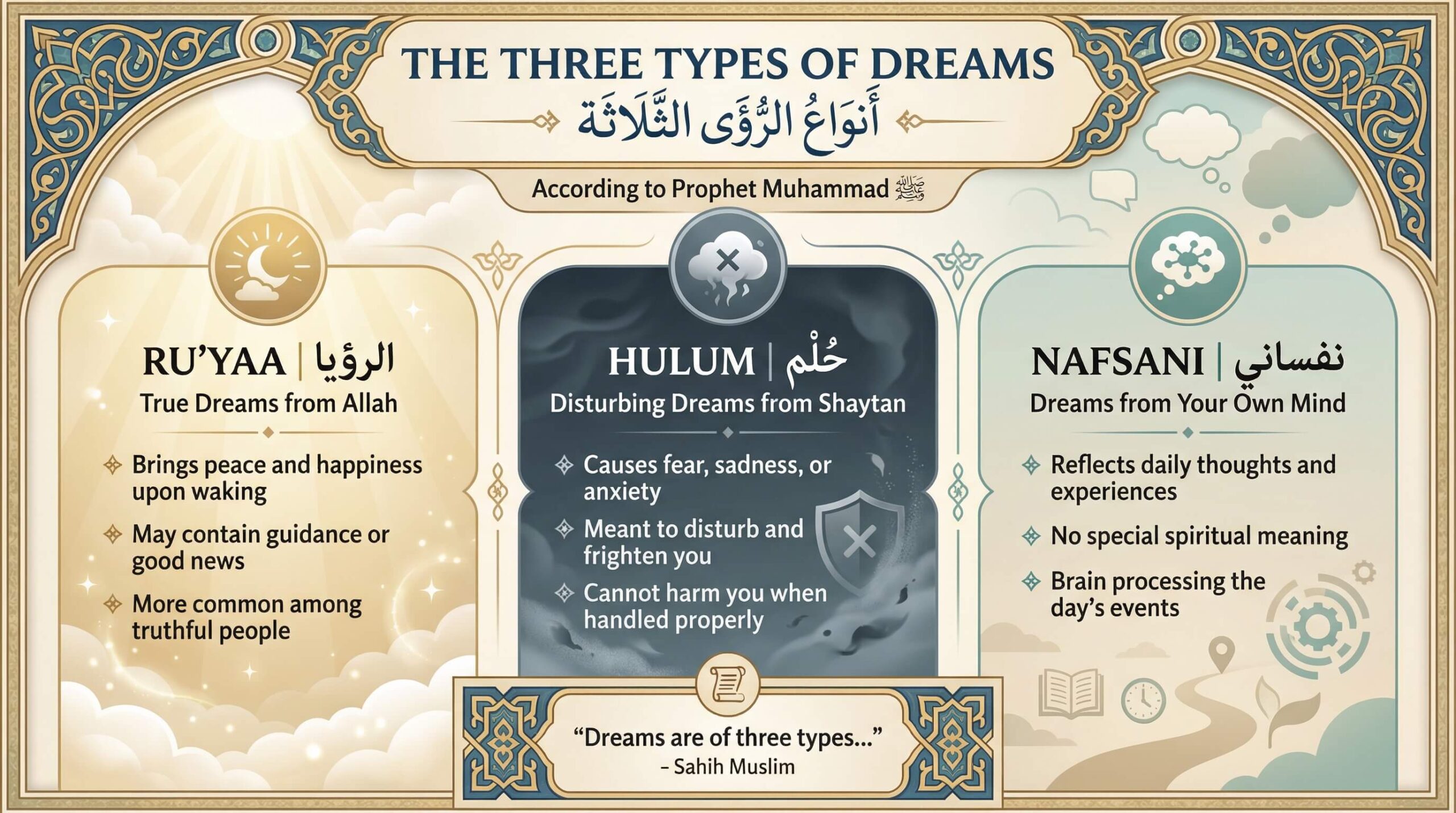
And here is where it becomes really interesting. Prophet Muhammad (peace and blessings be upon him) had instructed us to differentiate between dreams. Understanding the dream categories in Islam is essential. Dreams can be categorized into three, and, once having learned these categories, one will be able to see everything in a much clearer light.
Dreams are of three varieties: a righteous dream is glad tidings of Allah, the dream that makes one sad belongs to Shaitan, and the dream that is of the wandering of the mind.
(Sahih Muslim)
This Hadith from Sahih Muslim teaches us the fundamentals. Understanding these categories is the foundation of dream in Islamic interpretation. I would like to tell you the details of each type.
Dreams from Allah (True Dreams – Ru’yaa)
The former one is known as Ru’yaa (true vision) in Arabic, meaning a vision or good dream. This is central to islamic dream meaning and interpretation. Understanding the spiritual meaning of dreams Islam teaches helps believers recognize divine communication. The dreams are direct messages of Allah and they tend to leave you peaceful, happy or hopeful about life when you awaken. At times they reveal to you something good that will transpire in future. At times they make a mild warning to you on what you ought to right in your life.
Prophet Muhammad (PBUH) declared that these are true dreams, which are a little portion of prophethood. These are what scholars call true dreams in Islam. In dreams Islamic interpretation, these are considered the most significant. These prophetic dreams are glimpses of divine guidance. This does not however make you a prophet because you had a nice dream–this is not how it is done. What it entails is that beautiful dreams may give you minute glimpses of guidance, the kind of guidance received by prophets as sent to them by Allah (albeit, on a much smaller scale). True dreams require spiritual perception to understand properly.
The coolest thing? Such dreams are found to occur more among individuals who are honest when talking in their daily lives. So in order to have more true dreams maybe one of the ways to begin is by telling the truth at all times. Makes sense, right?
Dreams from Satan (Nightmares – Hulum)
The second one, Hulum (nightmare), refers to bad or disturbing dreams. In interpretation dreams Islam, these require specific protective actions. Satan’s influence on dreams is real but manageable. They belong to Shaytan (Satan), and they are all meant to annoy you, frighten you, or leave you experiencing some concern and depression. Shaytan discovers that the human beings are influenced by their dreams that is why he attempts to play around with us during the sleep.
However, there is a positive side to this- Prophet Muhammad (PBUH) also told us precisely what to do when we have a bad dream and when we do this these dreams cannot do any harm to us and when we do this these dreams will not damage us. This is the nightmare protection Islam teaches us. Protection from bad dreams is clearly taught in Islamic tradition. This is one of the things we shall discuss later, but in any case, the dreams of Shaytan are not able to affect us when we manage them properly.
Dreams from One’s Own Thoughts (Nafsani)
The third one is simple… the brain does its job. In islamic dream interpretation, these are called Nafsani (self-thought dreams) and don’t require deep analysis. These are essentially psychological dreams. These daytime thoughts, worries, or things you have been watching or reading are the ones behind these dreams. They do not actually imply anything extraordinary in the message of Allah or antics of Shaytan.
Here is what to put into consideration, when you spend all your day playing a video game, you could even dream of that video game at night. That is not Allah sending you a message about the video games and it is not Shaytan trying to scare you with the controllers and screens. It is simply your brain processing what you had gone through in the day.
The Importance of Dreams in Islam: Quranic Examples
The Quran talks of some significant dreams which transformed history. These stories form the basis of dreams explained in Islam. The Quran shows us divine revelation through dreams throughout history. The news about such dreams makes us know the relevance of this topic in Islam.
The Dream of Prophet Yusuf when he was a child
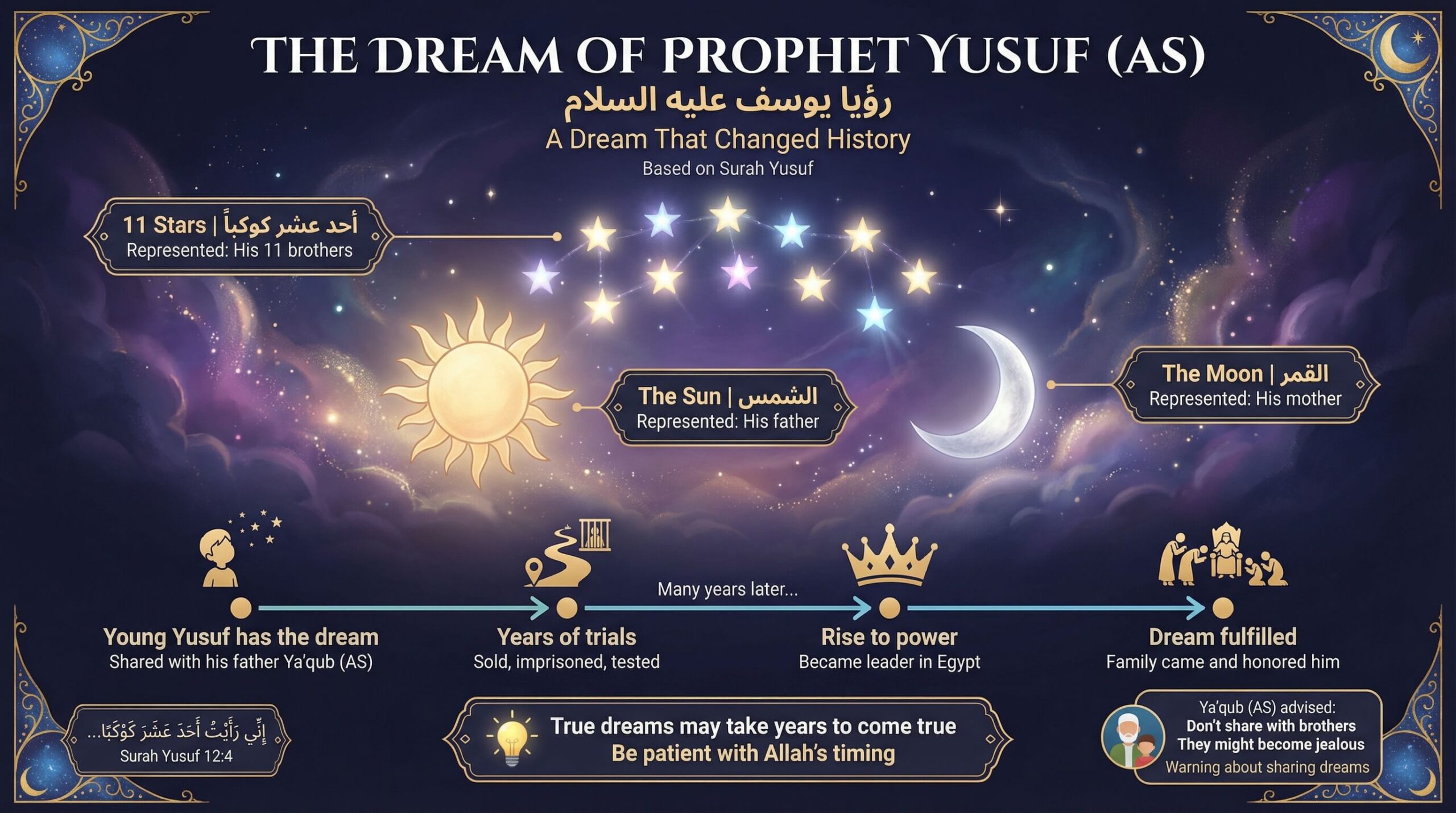
Prophet Yusuf (AS) had witnessed a marvellous dream at a young age. He rushed to his father, Prophet Ya’qub (Jacob) (AS) and informed him about this. Here’s what he saw:
إِذْ قَالَ يُوسُفُ لِأَبِيهِ يَا أَبَتِ إِنِّي رَأَيْتُ أَحَدَ عَشَرَ كَوْكَبًا وَالشَّمْسَ وَالْقَمَرَ رَأَيْتُهُمْ لِي سَاجِدِينَ
And among such tales is this: when Joseph said to his father, O my father, I have indeed seen [in a dream] eleven stars and the sun, and the moon; I saw them fall upon their knees before me.
(Surah Yusuf, 12:4)
This dream was to be fulfilled several years later as Prophet Yusuf (AS) became a great leader in Egypt, and his eleven brothers and even his father came to him and basked in his glory. The dream was symbolic, the stars denoted his brothers, the sun and the moon denoted his parents. Years and years, it was necessary before this dream came true, and it teaches us an important lesson, that not all the true dreams come true at once. The dream fulfillment timeframe can span years or even decades. This account in Surah Yusuf (Chapter 12) is foundational to interpretation of Islamic dreams.
Prophet Ya’qub (AS) also knew the significance of such a dream and he offered some sound advice to his son. He advised Yusuf not to disclose this dream to his brothers since they could become jealous and they could even plot against him. And guess what? This is what has happened afterwards. This is a lesson to us that we need to be cautious of with whom we share our dreams. The sharing dreams guidelines are specific and important.
The Dream of Prophet Ibrahim of his son
The Quran has some of the strongest dream stories, and this one of Prophet Ibrahim (AS). In a dream, he realized that he was sacrificing his son, Ismail (AS). And how hard that must have been to take?
However, Prophet Ibrahim (AS) realized that dreams ordained by Allah are a kind of communication and therefore, he took this dream seriously. He talked about it with his son, and both of them were subjected to the command of Allah. Naturally we are aware of what happens at the end of the story-Allah has substituted Ismail with a ram at the nick of time since it was a test of their obedience and their faith in Allah.
This tale brings to our attention the fact that dreams occasionally have mandates or examinations particularly to those who are very close to Allah. To ordinary human beings like us, dreams tend to be of good news or warning signs and not direct instructions. This is a profound example of dream interpretation Muslim scholars often reference.
Dream Before Battle of Prophet Muhammad
Prophet Muhammad (PBUH) dreamt of the enemy army before a big battle. Allah revealed to him that the enemy was small in number that gave the courage to the Muslim fighters. Had the dream depicted a massive army of the enemy, the Muslims could have been left with no hope and debate on whether to attack or not.
This example presents how Allah may utilize dreams as a way of equipping people on what is about to happen and provide them with the power that they require. This exemplifies how dreams and interpretation in Islam can provide divine guidance.
How to Interpret Dreams Islamically
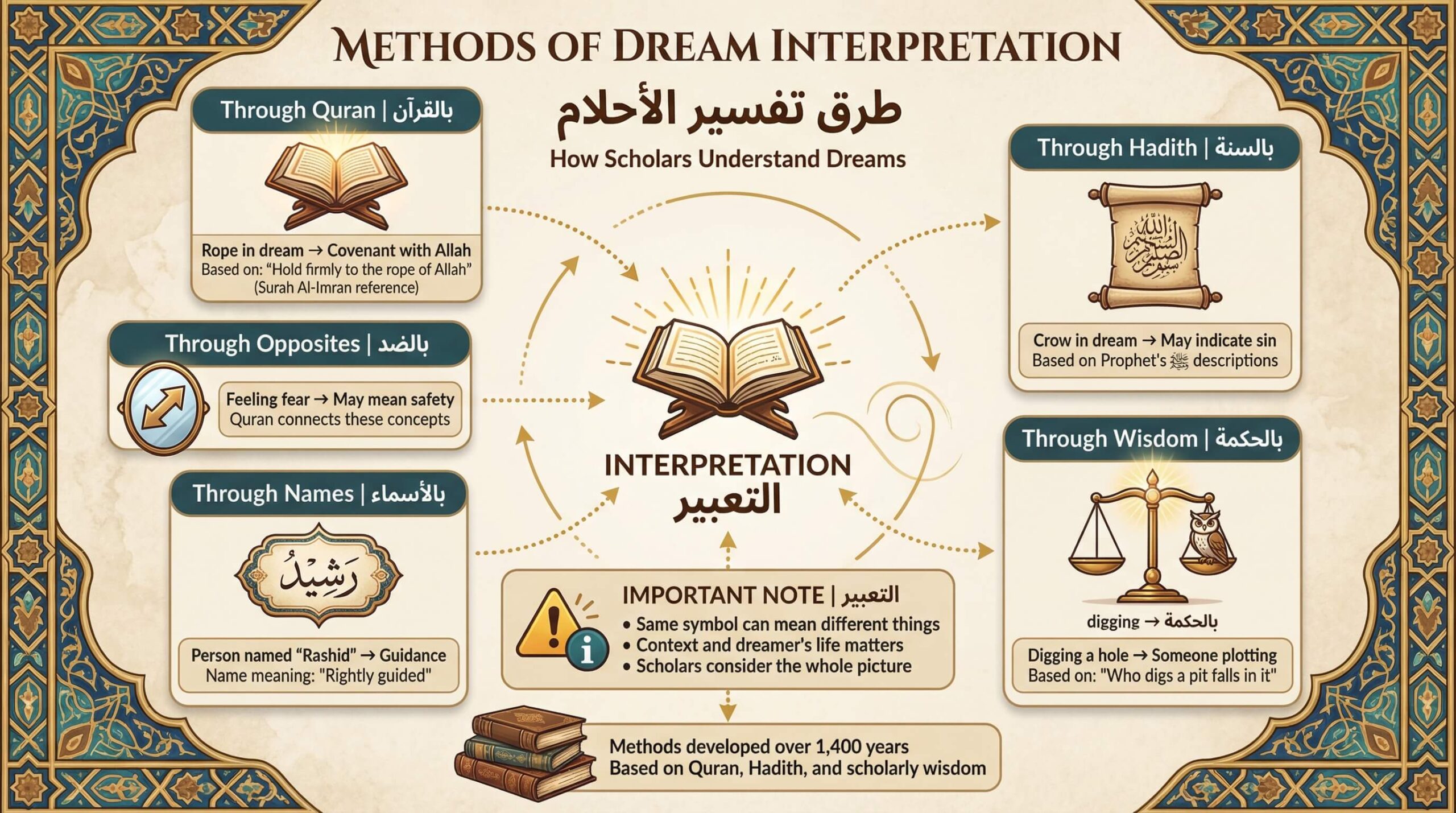
So, this is where you are likely to be asking: how does islamic dream interpretation actually work? How do scholars know what dreams mean? It is not simply guessing and inventing things. It has a system, it has been centuries-old. Religious dream interpretation requires proper knowledge and methodology. The Arabic term Tabir (dream interpretation) specifically means dream interpretation.
One of the renowned Islamic scholars Imam al-Baghawi described dreams as being interpreted in a variety of ways. These are the main dream interpretation methods Islam scholars have used. Muslim dream analysis follows specific principles:
By means of the Quran: Sometimes what you saw in dreams resembles what is said in the Quran. To take one example, when one dreams about a rope then it may be a covenant or a promise, since Allah speaks of the rope of Allah and it is said to cling to it in Surah Al-Imran.
With the help of the Sunnah: The sayings of Prophet Muhammad (PBUH) it is possible to understand the signs of dreams as well. An example of this is that the Prophet (PBUH) termed the crow as an immoral bird and thus a dream about a crow may have a negative connotation concerning sin.
Sometimes the dream is related to wisdom every day. When you have a dream about digging a hole, then somebody is planning something as there is an old saying that whoever digs a hole will fall into it.
With Names: The names of individuals or the names of locations in your dream may carry some meaning. When you dream about someone called Rashid, it may be connected with wisdom, since this is what this name means.
By Opposites: This is one that is interesting. In other occasions, dreams are the reverse of the visuals. Dreaming of fear may just be that you will be safe, as Quran relates these two things.
These methods of interpretation of Islamic dreams have been refined over centuries.
Also Read: How to pray in Islam | Ultimate Guide 2026
Ibn Sirin’s Contribution to Dream Interpretation
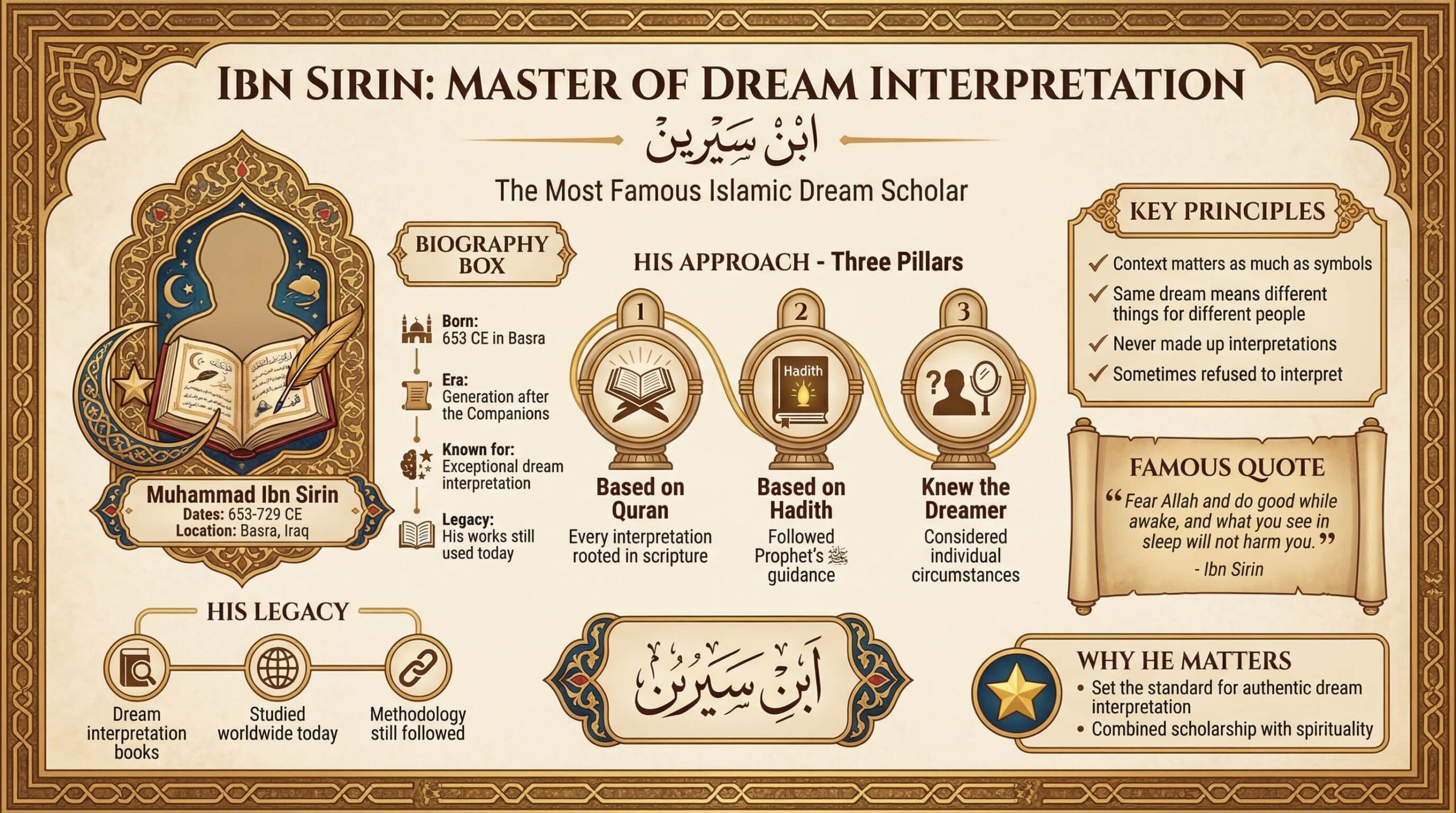
Muhammad Ibn Sirin is the name to remember, as far as the interpretation of Islamic dreams is concerned. He is among the greatest dream interpretation scholars in Islamic history. Islamic scholarship on dreams spans centuries, and Ibn Sirin remains the most influential figure. He existed during the early days of Islam immediately after the generation who met with Prophet (PBUH), and he was so famous with his success in the ability to understand dreams.
Ibn Sirin is one who wrote a list of dreams whose use persists in the contemporary world. His work remains the gold standard for islamic dream meaning and interpretation today. He documented many dream symbols and meanings that scholars still reference. He solely relied on the Quran and Hadith in his approach for authentic dream interpretation- he did not simply make things up or guess. He was of the view that the dream can only be interpreted rightfully when the individual who dreamt is known, his/her life circumstances and individual traits. Context in dream interpretation is crucial according to his methodology. Other scholars like Al-Nabulsi also contributed significantly to this field.
This is one of the most interesting things about Ibn Sirin. When they asked him about their dreams he did not necessarily give an explanation. Bulkily he would simply tell him: Fear Allah and do good whilst you are awake, and things you see in your sleep will not hurt you. This informs us that Ibn Sirin did not believe that every single dream had to be interpreted in a fancy manner. Good person Just be a good person is sometimes the appropriate answer.
Practical Guidance for Dream Interpretation
Prophet Muhammad (PBUH) provided specific guidance on dreams Islamic interpretation and how we should respond to different types. Prophet Muhammad’s dreams teaching gives us clear guidance. There is a specific dream etiquette in Islam we must follow. These are very practical instructions to follow.
What to Do When You See Good Dreams
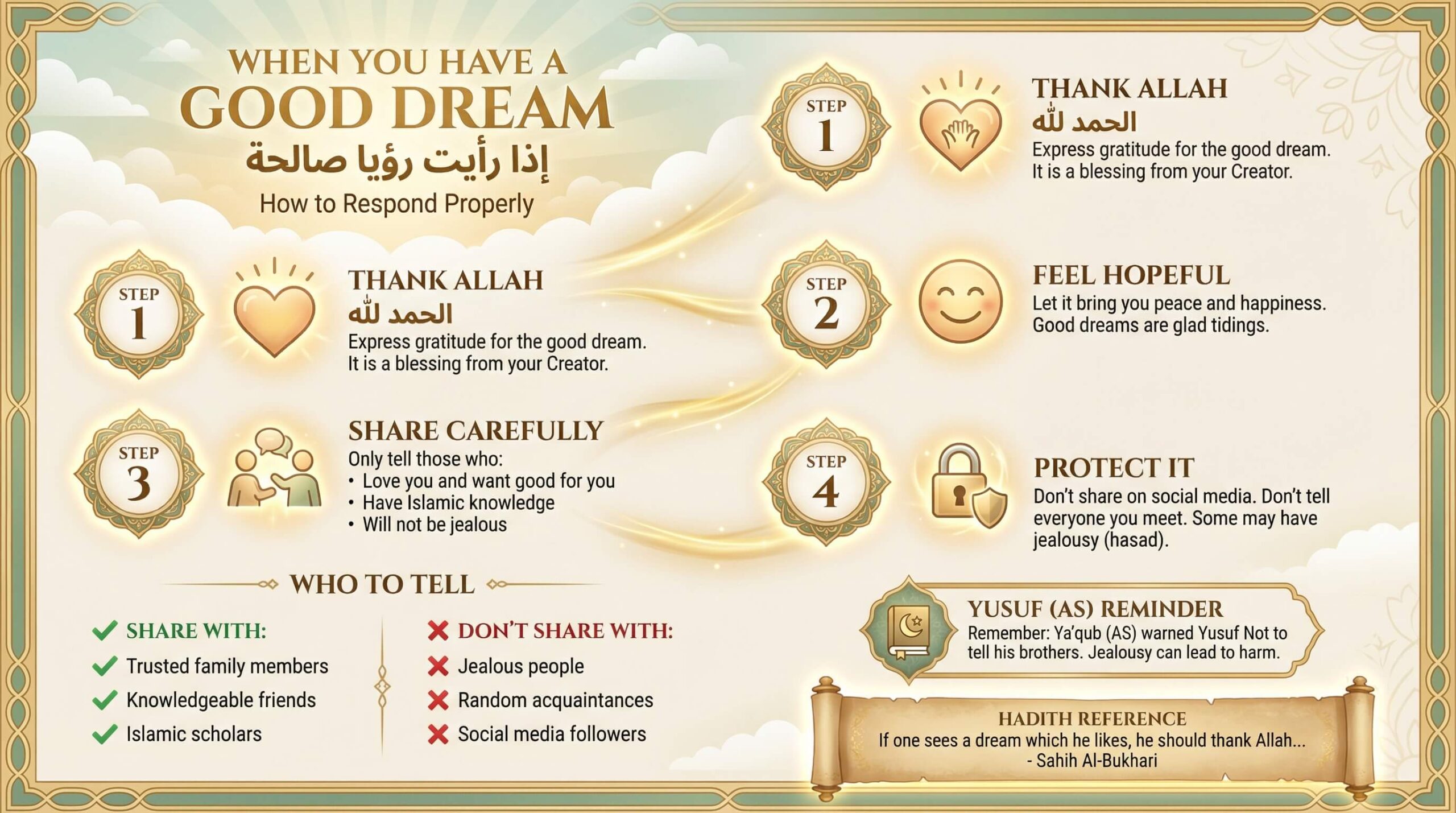
In case you wake up out of a dream and it left you happy, peaceful, or hopeful, then do the following. Following proper dream interpretation Muslim etiquette is important:
When any of you sees a dream which he likes, then it is by Allah, and he should be thankful to Allah which came to him, and they should relate it to others; but when he sees a dream which he dislikes, then it is by Satan, and he should take refuge with Allah against its ill-omen, and he should not tell it to any one, and it is not harmful to him.
This was (Sahih Al-Bukhari, vol. 9, book 87, Number 114).
Thing is, it is very easy: thank Allah, and tell the dream, only to those people, whom you trust and like. This is the same advice prophet Ya’qub (AS) gave to his son Yusuf- do not start narrating your good dreams to other people since some of the people may envy you and turn to plotting against you.
The scholars recommend that you only share your dreams with somebody who is well versed in the Islamic religion or at least with someone who is concerned about your wellbeing. It is not a good idea to tell random people or write what you dream about on social media (yeah, I am looking at you, 2025 culture).
What to Do When You See Bad Dreams (Nightmare Protection)
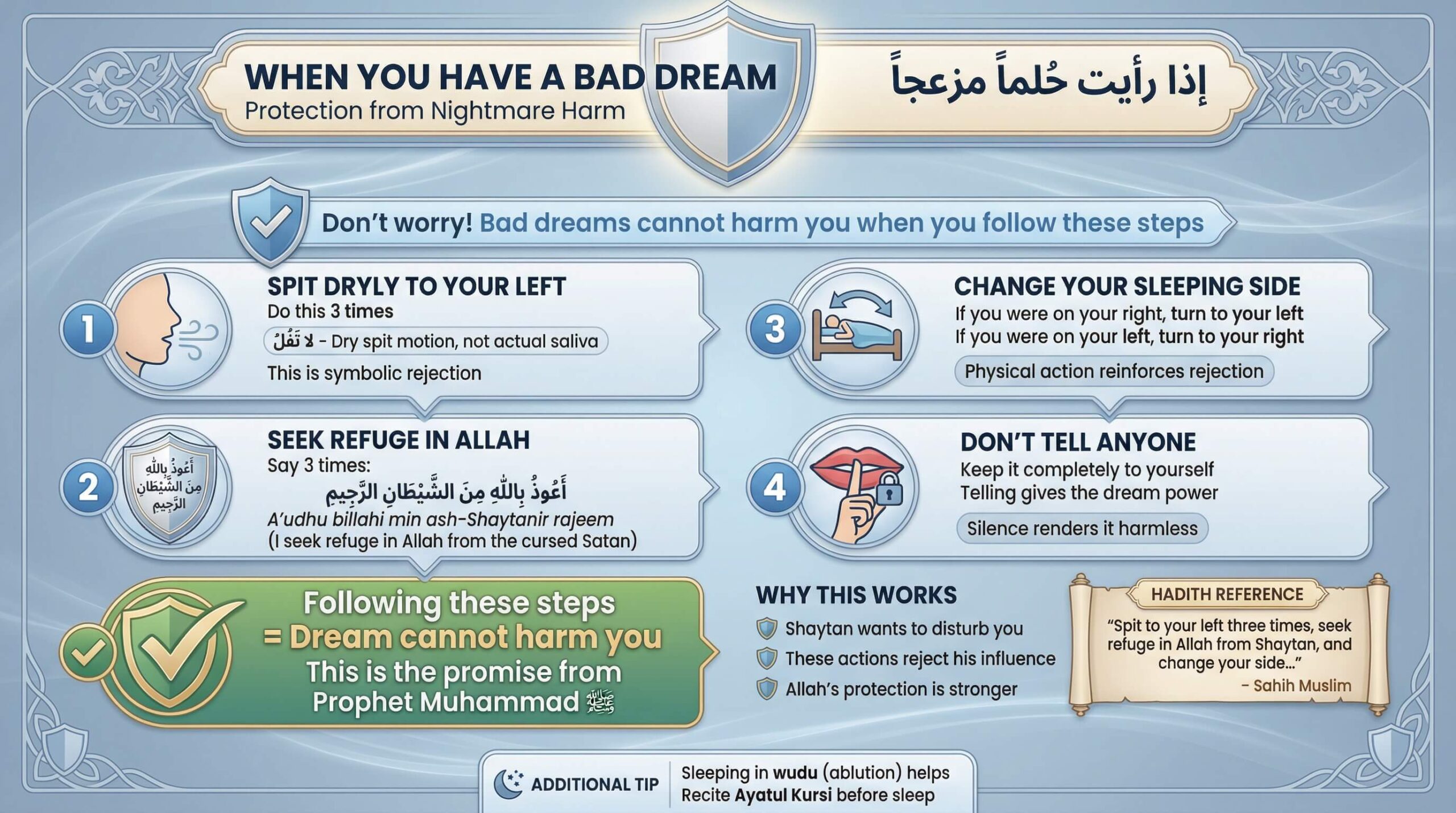
According to interpretation of Islamic dreams teachings, bad dreams must be responded to in a specific way and Prophet Muhammad (PBUH) showed it very clear what to do. Some scholars also recommend reciting Ayatul Kursi before sleep for protection:
And then he said to him, that who ever should see a dream which he were not pleased with; that he would spit three times on his left hand, and that he would take refuge with Allah three times on the side on which he had slept.
(Sahih Muslim, 5864)
Here’s the breakdown:
To begin with, prepare yourself a dry spit (not spit with saliva but the motion) three times to your left. This is an allusion to the denial of the nightmare.
Second, protect oneself against Shaytan by saying Audhu billahi min ash- Shaytanir Rajeem three times.
Third, alternate the side you are lying on- In case you were lying on your right hand, switch to your left side, or the other way around.
Fourth, and this is a point to notice–do not tell anybody about the bad dream. You tell about bad dreams, and somehow you give them power. When you keep them to yourself and obey the dictates of Prophet, they will not hurt you in any way.
This is quite consoling in itself. We can hear Shaytan attempt to frighten us during our sleep and he can do nothing with us as long as we know how to react.
The Relationship Between lying and Dreaming
I said this before, but it is worth returning to since it is very significant. Prophet Muhammad (PBUH) also instructed us that those people who have the clearest dreams are the ones who are the most honest when they are talking in their daily life. This connection between honesty and dreams explained in Islam is significant.
Those who are truest will be the truest in words.
(Sahih Muslim, 4200)
This forms a very cool association between your actual life and your dream life. In order that Allah might speak to you in dreams, even in little matters, to open that door you must be honest and truthful in your every day talk. Lying and dishonesty, however, may interfere with your capacity to get clear advice by dreams.
It is also reported that during the end times, the dreams of Muslims will not often be wrong. This implies that closer to the Day of Judgment we get, the more natural true dreams may seem. Hardly fancy to imagine, is it?
Signs of True Dreams in Islam
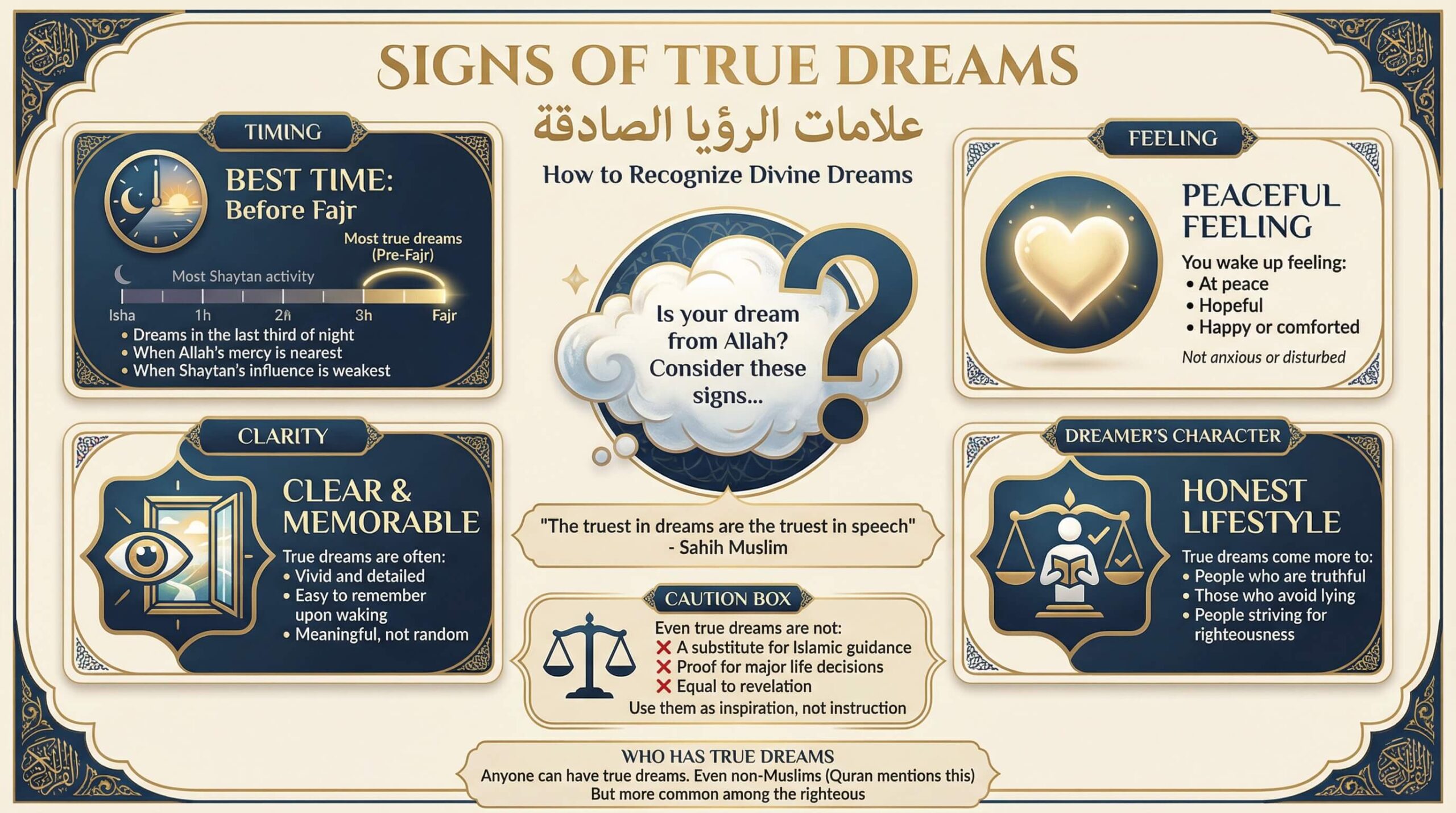
In interpretation dreams Islam, scholars note that timing matters. True vision signs include specific timing patterns. It is an Islamic custom, here is a tip that the most truthful dreams occur during the dawn of the day, which is the suhoor time. This is that period when the mercy and forgiveness of Allah are particularly near, and the silent period of devils.
On the other hand, there are more possibilities that dreams that occur immediately after the sunsets when the dark has set in first could result in more Shaytanic disturbances since at that time the devils are most active.
Then even in case you are recording your dreams (some people keep dream journals) you can record the time of night you had every dream. The ones during the pre-dawn hours may be more important.
Is it possible that Non-Religious People have Real Dreams?
This is a fascinating question and the answer to it may not be as you think. Yes, true dreams may also be observed even by those who are not particularly religious, or not Muslim at all. This aspect of islamic dream interpretation shows Allah’s mercy extends broadly.
The Quran provides us with examples of the same. Two prison mates of Prophet Yusuf had real dreams in Surah Yusuf and they were not believers. There was another renowned dream which was had by the king of Egypt in which he saw seven fat cows and seven skinny cows, which was interpreted by Prophet Yusuf (AS), and he was not even a Muslim.
Having a real dream, therefore, does not necessarily make you a super pious person. Nevertheless, the scholars point out that, the dreams of righteous believers are usually truer and more significant in general than those of other people. Good people normally have true dreams and those who are not living on the righteous ways have more Shaytanic dreams and meaningless dreams.
Wake Up: Dreams are Not evidence
This is one of the most important aspects that most individuals misunderstand. Even with whatever you think you have as a true dream, it does not become a confirmation or showing of taking big decisions. It may fill you with joy as a believer and it should not, through dreams, mislead you that you got some form of revelation.
A scholar narrated an example of a man Sahl ibn Salamah. People would visit him and share with him all the great dreams they had seen about him including dreams of Paradise. However the same Sahl turned against the Muslim ruler and shed blood. The fantasies did not shield him against making ghastly decisions.
This is a beautiful lesson in a very simple way: dreams can inspire you, caution you, or bring you good news, still, they are not a substitute of a proper adherence to the Quran and Sunnah. You cannot sleep to justify doing something that Islamic religion does not allow, and you cannot make great choices in life just because of what you see in your dreams.
It Is Felony to Lie about Dreams
We are about to end now, but there is one more thing Prophet Muhammad (PBUH) cautioned the world about; lying about dreams.
Others who desire attention or merely want to appear special, invent dreams that they have never had. the Prophet (PBUH) told that a person who pretends to have a dream when he had not seen it, he will be punished during the Day of Judgment- they will be commanded to tie two grains of barley, which is not possible. The extent of seriousness of fabricating dreams is demonstrated by this punishment.
So be honest. If you had a dream, you had it. Unless you did, then do not act like you did. And in case you do not know which category your dream belongs to, then it is quite alright to say that you do not know what this means and not to invent something.
Rules and Etiquette for Dreams in Islam
And now a few practical suggestions, quite simple, which I may leave you to consider, in view of everything we have heard:
Be non-hypocritical in your day-to-day life. This gives you more chances of getting real dreams. Sleeping in a state of Wudu (ablution) may also help.
Note the dreams that occur before Fajr in the early morning. They are usually more important.
When you come across a good dream, then thank Allah and tell only those people you are certain of and they want you well.
When you have a bad dream, do what the Prophet did: spit thrice on the left side, take cover in Allah against Shaytan, change your sleeping position and do not tell anyone about it.
Don’t worry about the interpretation of dreams. Dreams do not all require profound analysis. Other ones are mere thoughts in your head.
Do not give your dreams to just anyone to interpret. Just consult a person that knows about Islam and whose interests are in your best.
Huge life decisions should not be made on dreams alone. Exercise them as incentives or mild warnings, but have the appropriate advice of Quran and Sunnah on key issues.
Always tell the truth about dreams or do not overstate what you saw.
Also Watch: Islamic dream interpretations – Sheikh Assim L Alhakeem
Final Thoughts
The interpretation of Islamic dreams is a fascinating topic that links us to our prophets, our tradition, and even guidance by our Allah Himself. What is beautiful is that this knowledge is not a preserve of a scholar, you do not need to be a scholar in order to know the fundamentals.
It should be kept in mind that dreams are one of the few ways Allah may be speaking to us. The primary direction is always in the Quran and the prophecies of Prophet Muhammad (PBUH). Dreams are such a good gratuity as a mild pat on the shoulder to help you remember that Allah knows you are there and that Allah is interested in your progress.
You are ten and you are a hundred, it does not matter, the principles are the same. Tell the truth, be thankful, and find shelter against Shaytan and do not take your dreams too seriously or too lightly. The wisdom of Islam is found in that balance as well as many other things.