Prayer is special. It refers to the way Muslims address Allah, the maker of all that we see and that which we do not see, and it is performed five times in a day. And just in case you have ever wondered how to pray in Islam properly or why praying is so important, you are at the right place. This manual will be your step-by-step guide to all the steps you take and the last words you say.
Why Do Muslims Pray?
This would be to have a phone that links you with the most powerful and loving being in the universe. Learning how to pray namaz in Islam (Salah) is exactly that. It is not only about making demands. Prayer is remembering the one who first made you, thanking God about everything good around, and making sure that no bad thoughts and actions are clogging your heart.
Quran records to us something beautiful about prayer:
إِنَّ الصَّلَاةَ تَنْهَىٰ عَنِ الْفَحْشَاءِ وَالْمُنكَرِ
True, prayer forbids vice and wickedness.
(Surah Al-Ankabut, 29:45)
Something magnificent occurs when you pray regularly. You begin to think twice before committing a bad deed as you know you would be standing before Allah in a short time. It is like having a spiritual compass that continually gets you to get back to the correct track when you have gone astray (and you have, and I have).
There was one great question asked by Prophet Muhammad (peace be upon him) to his companions. He said:
“إِذَا كَانَ نَهْرٌ بِبَابِ أَحَدِكُمْ يَغْتَسِلُ مِنْهُ كُلَّ يَوْمٍ خَمْسًا مَا تَقُولُ ذَلِكَ يُبْقِي مِنْ دَرَنِهِ” قَالُوا لاَ يُبْقِي مِنْ دَرَنِهِ شَيْئًا . قَالَ “فَذَلِكَ مِثْلُ الصَّلَوَاتِ الْخَمْسِ يَمْحُو اللَّهُ بِهَا الْخَطَايَا”
and would you say there were any spots of dirt on him, because he bathed in a river five times a day, at the door of any one of you? They said, “Neither a trace of dirt would be left. The prophet (peace be upon him) remarked, That is the pattern of the five prayers which Allah blots out evil deeds.
(Sahih al-Bukhari and Muslim)
That’s powerful, isn’t it? Any prayer cleanses away our sins. It is as though pressing a restart button five times a day.
Introduction: Preparation Before You Start.
It is not possible to get into prayer wherever, whenever (at least technically, you can in an emergency, but first you have to know how to pray in Islam correctly). You have things that you need to prepare.
Making Wudu (Ablution)
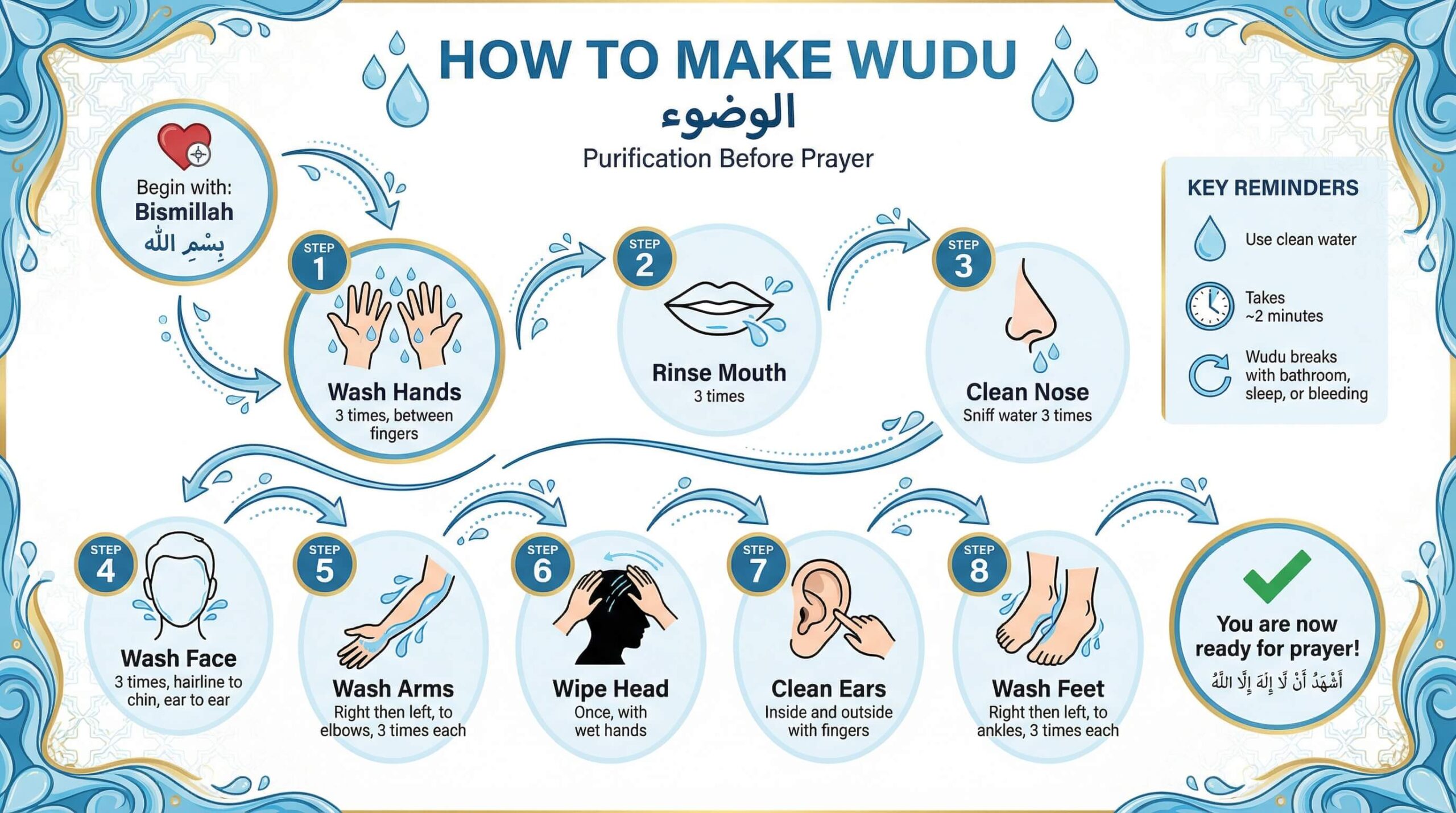
You can imagine that think of wudu as spiritual cleansing, the dust of the day, literally and figuratively you are washing away. This is how you do it; You begin by saying Bismillah (In the name of Allah). Wash hands thrice ensuring that water gets in between your fingers. Rinse your mouth three times.
Clean your nose by sniffing three times of water. Cleanse your face thrice, along the forehead to the chin, along the ears to one another. Wash your right arm unto the elbow after which wash your left arm. Wipe your head with your wet hands once. Use your index fingers to clean the inside and the outside of your ears. Lastly, rinse your right foot with up to ankle three times then your left foot.
It will take approximately two minutes. Otherwise people can either hurry through it as though they were in a race, but attempt to do it slowly, consciously, you are about to meet Allah.
Also Read: Step by step wudu guide with pictures and common mistakes
What to Wear
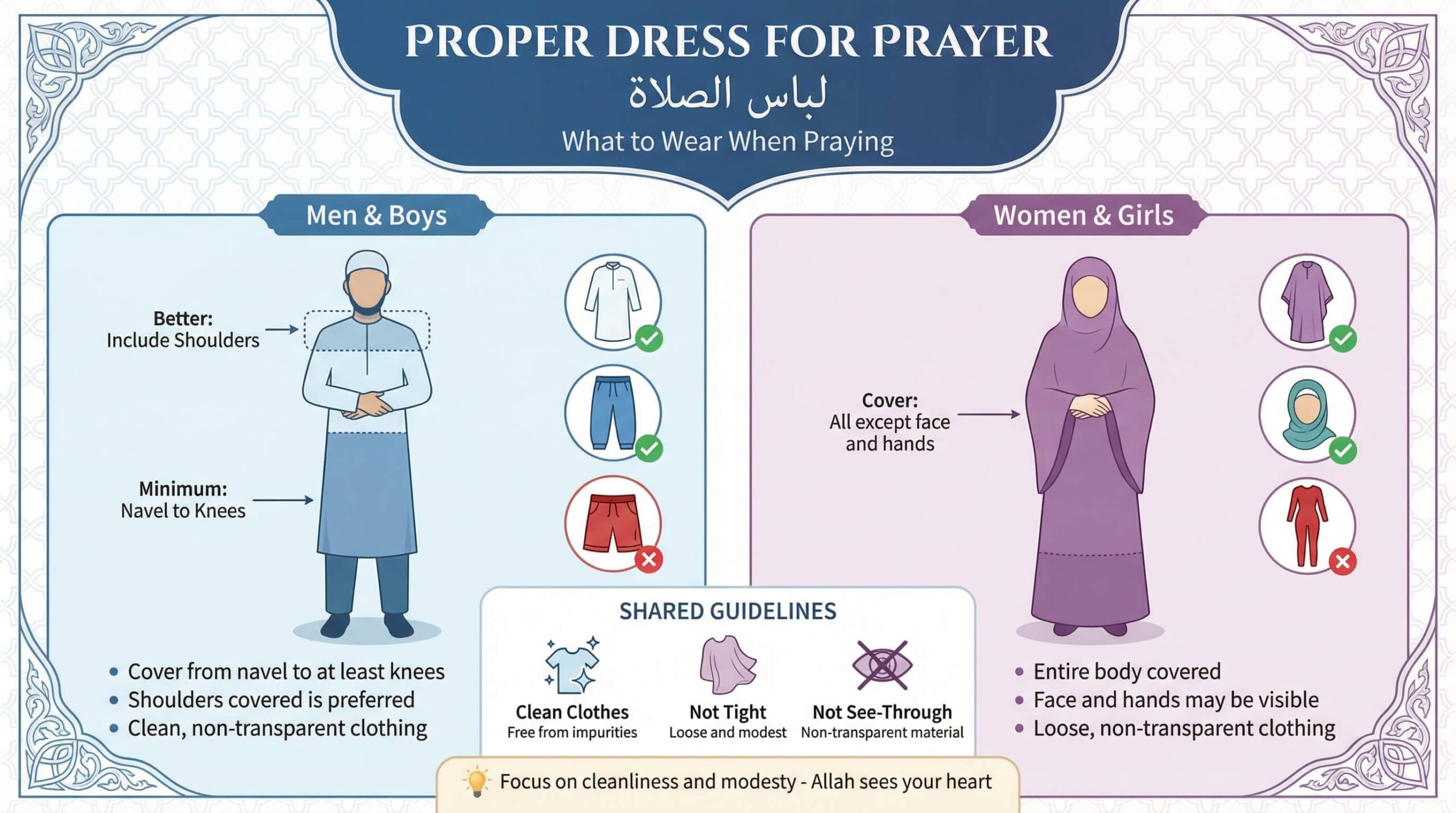
Dressing must be clean and decent. Among boys, and men, cover down to the belly at least (and it is better and preferable to cover in to the shoulders). If you are searching for how to pray in Islam for beginners female rules, note that: In girls/women, all the parts should be covered with the exception of hands and face. The main thing? Please do not wear something transparent or tight fitting. Allah knows it all anyway so there is no use making yourself look fancy when your heart is not in the right place.
Finding a Clean Spot
You need a clean space to pray. They can use a prayer mat, although it is not necessary. You just need not make sure that the floor is not dirty with something real (such as mud, food stains, or anything nasty). Your bedroom floor is quite good enough.
Facing the Right Direction
When Muslim people pray, they face Kaaba in Makkah. It’s in Saudi Arabia. No need to have a compass, nowadays there are applications that tell you the precise direction (Qibla). And of course, when you are fully in the middle of the nowhere, and you have no cell phone, you simply make your best guess. Allah knows your intention.
The Five Daily Prayers

When learning how to pray in Islam, you must know that Muslims are required to make prayers five times a day, with each prayer having a certain window:
Fajr – Before sunrise (2 rakats). This one is hard as you have to wake up early but there is a calmness to praying when no one is up.
Dhuhr – This is after the sun has moved past his highest mark in the sky (4 rakats). Usually around midday.
Asr – In the afternoon (4 rakats). The Prophet indicated that the absence of Asr is quite grave.
Maghrib – Immediately after the sunset (3 rakats). Others believe that you can put it off but you simply can not, it has the shortest time window.
Isha – At night (4 rakats). You may pray at whatever time you wish, when the sky is quite dark.
Worship is divided into each prayer referred to as a different unit known as rakats ( consider it a chapter). It varies according to the prayer you are doing.
How to Pray in Islam Step by Step: The Guide
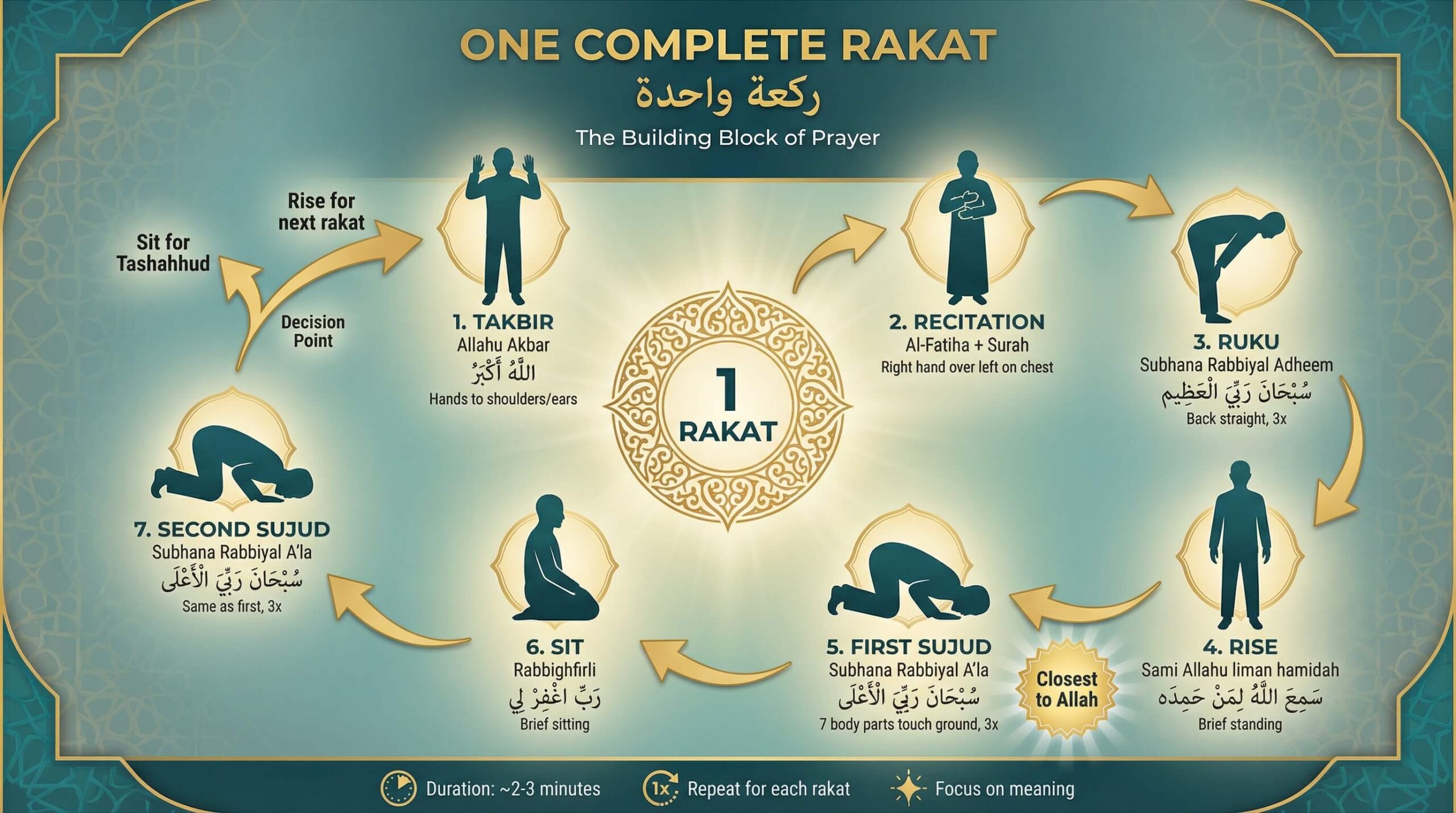
Now then, here we come to the real thing. This is the essential step on how to pray in Islam for beginners: I will walk you through one rakat (unit), and then you need to only repeat it a number of times according to the number of rakats of your prayer.
Step 1: The Opening Takbir
Straight back, towards the Qibla. Lift both hands up in the direction of your shoulders (or even of your ears) with palms towards you. Alluhu Akbar: (Allah is the Greatest). This is where you start–when you say this you have really entered into the prayer mode. No conversation, no glimpsing over, no contemplation of what to have to eat.
Step 2: The Opening Position
Bring your hands down and your right hand on top of left hand on your chest (or slightly below the chest, depending on the school of thought you are in). You have to look where you are going to lay down your forehead on your prostrating position. Reciting a supplication of opening is preferable but not compulsory here. A common one is:
سُبْحَانَكَ اللَّهُمَّ وَبِحَمْدِكَ، وَتَبَارَكَ اسْمُكَ، وَتَعَالَىٰ جَدُّكَ، وَلَا إِلَهَ غَيْرُكَ
Praise to You, O Allah and glory. You are blessed, Your name, And glorified, Your majesty. There is no deity but You.
The 3rd step is the process of seeking refuge and reciting Al-Fatiha.
Mutter:
أَعُوذُ بِاللَّهِ مِنَ الشَّيْطَانِ الرَّجِيمِ
(I take refuge in Allah against the cursed Satan).
Then say:
بِسْمِ اللَّهِ الرَّحْمَٰنِ الرَّحِيمِ
(In the name of Allah, the most gracious, the most merciful).
This is succeeded by the most significant part of all rakats, which is the recitation of Surah Al-Fatiha, the first chapter of Quran. You absolutely have to repeat this word by word in each of the rakats, otherwise no. Take your time with it. Pause after each verse.
بِسْمِ اللَّهِ الرَّحْمَٰنِ الرَّحِيمِ
الْحَمْدُ لِلَّهِ رَبِّ الْعَالَمِينَ الرَّحْمَٰنِ الرَّحِيمِ مَالِكِ يَوْمِ الدِّينِ إِيَّاكَ نَعْبُدُ وَإِيَّاكَ نَسْتَعِينُ اهْدِنَا الصِّرَاطَ الْمُسْتَقِيمَ صِرَاطَ الَّذِينَ أَنْعَمْتَ عَلَيْهِمْ غَيْرِ الْمَغْضُوبِ عَلَيْهِمْ وَلَا الضَّالِّينَ
In the name of Allah, the Entirely Merciful, the Especially Merciful. [All] praise is [due] to Allah, Lord of the worlds – The Entirely Merciful, the Especially Merciful, Sovereign of the Day of Recompense. It is You we worship and You we ask for help. Guide us to the straight path – The path of those upon whom You have bestowed favor, not of those who have evoked [Your] anger or of those who are astray.
(Surah Al-Fatiha, 1:1-7)
Once you are done with Al-Fatiha add ameen (Oh Allah, accept this). You need not fail to recite another short chapter or one or two verses in the Quran after the Al-Fatiha in the first two rakats of each prayer. Any surah is read, but the vast majority of individuals read brief ones, which they have memorized such as Surah Al-Ikhlas, Al-Falaq or An-Nas.
Step 4: Bowing (Ruku)
Say اللهُ أَكْبَرُ and bow down. You need to put your hands on your knees, have your back straight (in the form of an L-shape with your body) and look at the ground. Grant me at least thrice, in this posture, to say:
سُبْحَانَ رَبِّيَ الْعَظِيمِ
(Glory be unto my Lord, the biggest, Most great)
Don’t rush. Be humbled when you prostrate yourself before your Creator.
Step 5: Standing Back Up
Get on the feet again with saying:
سَمِعَ اللهُ لِمَنْ حَمِدَهُ
(Allah hears those who praise Him).
When you are standing on your full strength, then say:
رَبَّنَا وَلَكَ الْحَمْدُ
(Our Lord, to You belongs all praise).
Step 6: Prostration in the beginning (Sujud)
Prostrate yourself and say Allahu Akbar. This is the most physical stance of your body during prayer that is why it is the most spiritually strong moment as well. When sujuding, you should have seven body parts in contact with the ground; forehead, nose, both palms, both knees, both feet.
When saying sujud remember at least three times;
سُبْحَانَ رَبِّيَ الْأَعْلَى
(Glory be to my Lord, the Most High).
Something unbelievable about this position was said by the Prophet (peace be upon him):
“أَقْرَبُ مَا يَكُونُ الْعَبْدُ مِنْ رَبِّهِ وَهُوَ سَاجِدٌ فَأَكْثِرُوا الدُّعَاءَ”
When a slave is in prostration he is closest to his Lord, so take plenty of supplication.
(Sahih Muslim)
This is your moment. And ask Allah, in case something is on your heart, be it school worries, family problems, things you dream about doing. He’s listening.
Step 7: Sitting between Prostrations
Say اللهُ أَكْبَرُ and sit up. Use one left foot and stand on the foot which is the right leg. Put your hands on your knees. During this short sitting, it is possible to say:
رَبِّ اغْفِرْ لِي
(My Lord, forgive me).
It once, other folks say three times. Both are fine.
Step 8: Second Prostration
Just repeat Alluhu Akbar and again prostrate as before. Repeat Subhana Rabbiyal A’la three times or more.
Way to go- you have just finished one rakat.
Continuing the Prayer
Once you have done the second sujud, say Allahu Akbar and rise to the next rakat (when you have more than one rakat in your prayer). Repeat all of the steps 3 through 14, except you do not repeat the initial supplication.
The Sitting (Tashahhud)
It is followed by sitting down and uttering the Tashahhud after every two rakats. This is a testimony of faith. Sit with the left foot in a position that is beneath you and the right foot in an upright position. Lay your hands over your thighs. During the reciting of the Tashahhud, put up your right index finger when uttering the statement of Ash-hadu alla ilaha illallah (I bear witness that there is no deity but Allah).
The Tashahhud goes:
التَّحِيَّاتُ لِلّٰهِ وَالصَّلَوَاتُ وَالطَّيِّبَاتُ، اَلسَّلَامُ عَلَيْكَ أَيُّهَا النَّبِيُّ وَرَحْمَةُ اللهِ وَبَرَكَاتُهُ، اَلسَّلَامُ عَلَيْنَا وَعَلَىٰ عِبَادِ اللهِ الصَّالِحِينَ، أَشْهَدُ أَنْ لَا إِلَهَ إِلَّا اللهُ وَأَشْهَدُ أَنَّ مُحَمَّدًا عَبْدُهُ وَرَسُولُهُ
All compliments, prayers, and pure words to Allah. Peace to thee, O Prophet, and mercy of Allah and his blessings. May the peace of Allah be upon us and upon the righteous servants of Allah. I testify that Allah is one and there is no other deity and I testify that Muhammad was a servant and messenger of Allah.
And when this is a last sitting on your prayer (that is, you have already done the number of rakats), you also include a sending of blessings to the Prophet and occasionally a little supplication that Allah safeguard you against many misfortunes.
Ending the Prayer (Tasleem)
In order to complete your prayer, move your head to the right and recite:
السلام عليكم ورحمة الله
As-salamu-alaykum-wa-rahmatullah
(Peace and mercy of Allah be upon you).
And then turn your head to the left and say the same. That’s it. You’re done.
You can also watch this video: How to Pray Salah | Step by Step
Common Questions and Tips
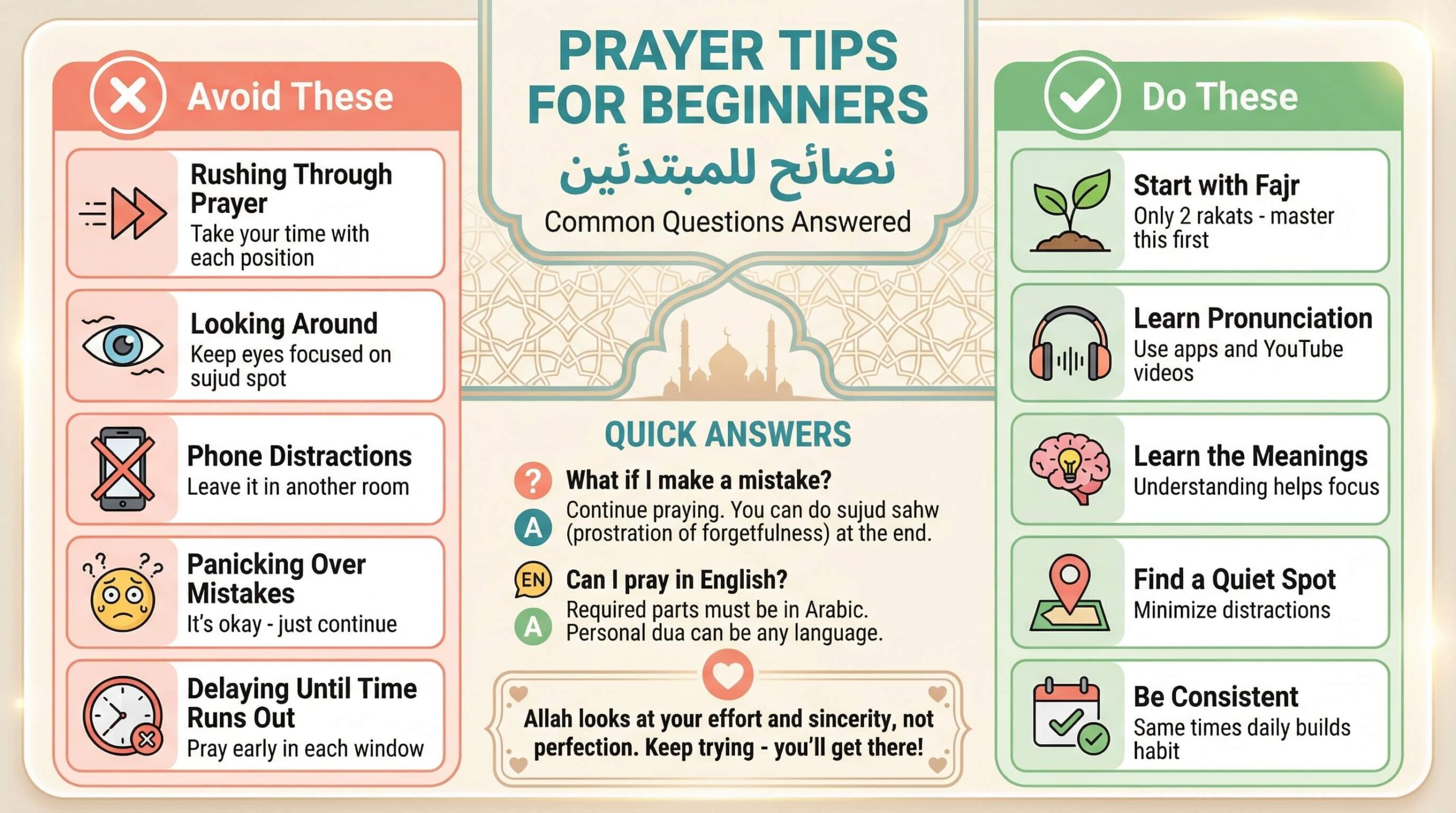
What if I make a mistake? It is not that people do not make mistakes and learn. And in case you forget or you confuse the sequence, do not panic, simply attempt to carry on. You can have a special prostration (sujud sahw) at the end in case you realize that you did something wrong but don’t worry about that when you are still a beginner.
Can I pray in English? While learning how to pray in Islam, note that the Arabic language is required in the particular components of the prayer (such as Al-Fatiha and the words in bowing and prostrating) since that is what the prophet instructed. However, when you are personally supplicating to Allah, particularly in sujud, then you can speak any language. Everything is known to Allah.
What would happen when I can not memorize everything? Start small. Master Al-Fatiha first because it is mandatory in each rakat. Then learn a few short surahs. Use applications or Youtube videos that are pronunciated correctly. You will get there maybe in a few weeks. I promise.
To Memorize or Read Quran Visit our: Quran Page
What do I do when I keep on diverting my mind? This is super common. Attempt to know what you are talking about (learn the words). Pray in a quiet distraction-free place. Leave your cell phone in another room. You must keep in mind that here you stand before the Lord of the universe,–that fact should help to concentrate you.
Do I need a printed guide? It helps! Many people find it useful to download a how to pray in Islam for beginners pdf to keep on their phone or print out so they can read the transliteration while they stand on the prayer mat.
The Beauty of Consistency
This is what the Quran says over and over again:
إِنَّ الصَّلَاةَ كَانَتْ عَلَى الْمُؤْمِنِينَ كِتَابًا مَّوْقُوتًا
Yes, prayer was ordained to the believers at definite times.
(Surah An-Nisa, 4:103)
You see it does not say pray as you please. The timing matters. There is a window in every prayer and timely prayer depicts Allah that you are putting him above all other things in your life. Abdullah ibn Mas addressed the Prophet, what is the most loved action of Allah, and the Prophet told him:
“الصَّلاَةُ عَلَى وَقْتِهَا”
Prayer made at the right time.
(Sahih al-Bukhari 527)
Sometimes you’ll be tired. There are occasions when you will be occupied in your homework or with friends. However, finding those five minutes 5 times a day makes one disciplined, and closer to Allah, and frankly speaking? It provides order to your entire day. It amazes me how clear and peaceful my life is when it is based on prayer sessions instead of just haphazard events.
What Prayer Does to Your Heart
In addition to the physical movement, prayer somehow works on your soul, and it is difficult to explain until one does. When you go in front of Allah and you say that you need His aid, that you need His help, that you are the one who prostrates, that you are the one who requests aid (Iyyaka na’budu wa iyyaka nasta’een You are the only one we serve, and You are the only one we petition) you are admitting something to yourself something deep, that you are not in control of everything, and that it is all right.
There’s comfort in that. Nowadays we are informed that we must be tough, be self reliant, never to be weak. However when we pray, 5 times a day we literally prostrate and declare, I am only a human. I need guidance. I need help. I need forgiveness.” And then we rise again and go on living knowing that we are not all alone.
Practicing praying, people frequently complain that they feel light, less stressed, more stable. This is supported in science as well (enter into Google benefits of meditation and you will have a plethora of research to support this), yet Muslims have known it over 1,400 years. Prayer is our meditation, our therapy session, our time of peace in a very hectic world.
When Prayer Feels Hard
Let’s be real for a second. Prayer is at times a burden. You are not feeling anything special, you are simply going through the motions, and you just wonder what is the point. It is something that occurs to all of us, including the most religious individuals that you can think of.
Pray on during such periods anyway. Not that you will instantly start to feel spiritual each and every time, but because the consistency is more important than the temporary feelings. His final words before his death were that of prayer, which was, as-salah, as-salah (The prayer, the prayer). Think about that. He had much to highlight in his deathbed, but ecstasy, prayer was what he highlighted.
That leaves you something, does it?
Starting Your Journey
When you are looking into how to pray in Islam for beginners, it is better not to think that you have to take a test on it, and do it perfectly on the first attempt. Begin with knowing one prayer well- perhaps Fajr as it is just two rakats. You need to practice until you are familiar with the movements and words. Then add another prayer. Soon all the five prayers will become natural.
Forgive me, Allah is not after perfection. He is scrutinizing your work and your will. It means everything that you are reading this, that you are attempting to learn, that you want to get in touch with your Creator. Every action that you do with Allah, He puts ten steps with you. That is not some inspirational rhetoric, there are hadiths that literally say so.
Final Thoughts
Understanding how to pray in Islam is not viewed as a duty or a box to cross in your spiritual to-do list. It is about establishing a rapport with the Allah, the creator of the stars at night, the air you inhale, the people you adore. It is your personal connection to Him, there is no need of intermediaries.
Will you mess up sometimes? Absolutely. Are there days when you will not feel like praying? For sure. But glad you stuck to it will you be? Without a doubt.
According to the scholars, when your initial action is right on the Day of Judgment (which is what you are praying to be), then all your other actions will also be right. And when that is lacking, then things all go wrong. That is what you place your whole faith in prayer.
So start today. Right now, even. Rise, pray to Qibla, and place your hands up, and say Allahu Akbar. You’ve got this. And more to the point, you are in the hands of Allah.
May Allah accept your prayers and transform them to a source of peace, guidance and blessing in your life. Ameen.