The question is music haram in Islam remains one of the most debated topics among Muslims. The solution is not that simple: both Sunni and Shia scholars, both old and new, have come to a vastly different conclusion. Others prohibit any musical instrument, others permit music on specific conditions of content, context and intent.
The guide (Sunni majority opinion, the established minority opinion, and the Twelver Shia opinion) has brought together the Sunni majority opinion, the accepted minority opinion, and the Twelver Shia opinion in a single place, providing resourceful features, including comparison tables, decision tree, and creator guidance. Each of the claims is referenced to a well-known academic institution or original book. This comprehensive guide answers whether is music haram in Islam from multiple scholarly perspectives.
TL;DR — The Short Answer, With Nuance
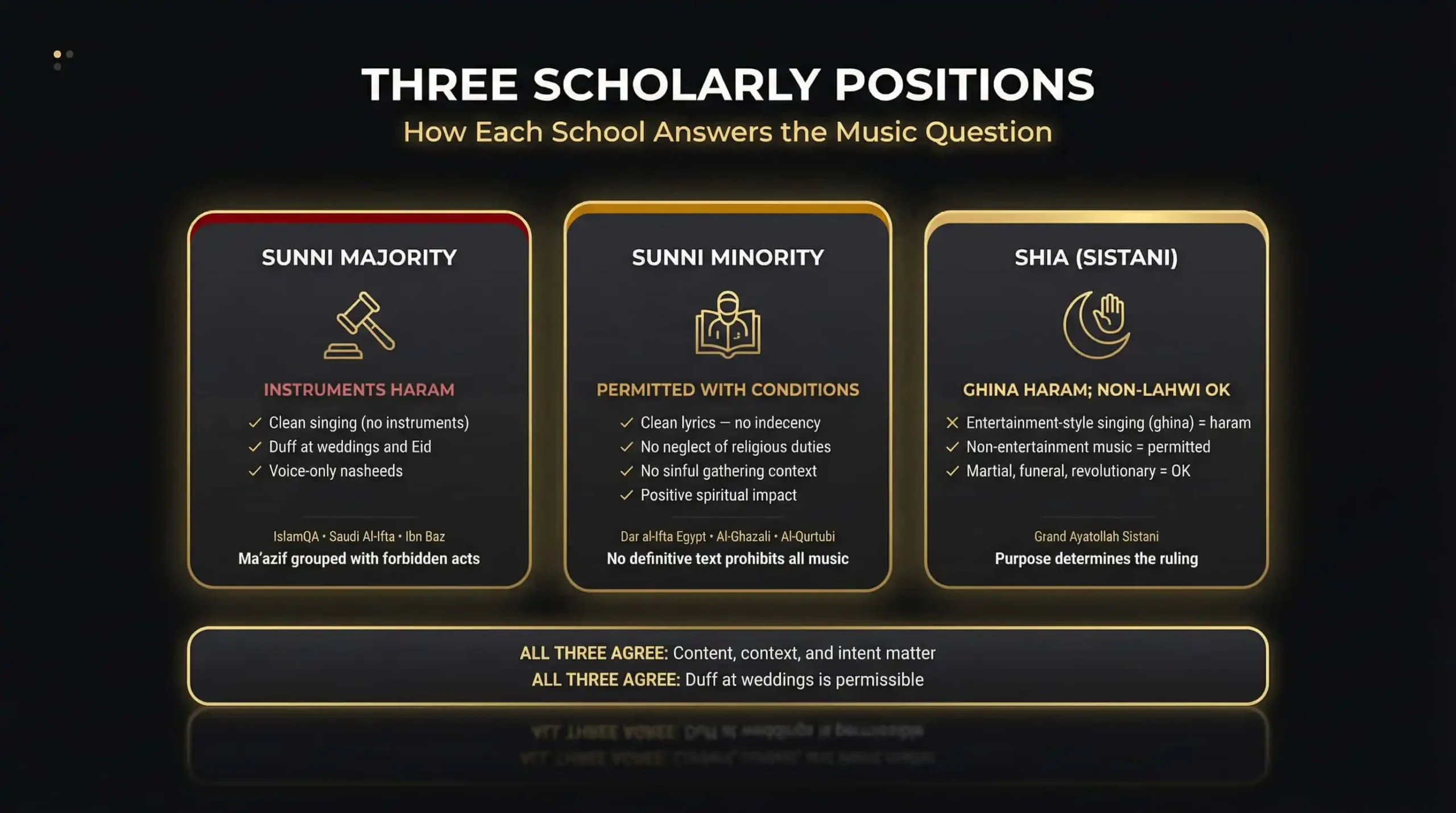
When asking is music haram in Islam, the answer depends on which scholarly opinion you follow:
Sunni majority: The majority of modern Sunni scholars forbid musical instruments (ma’azif), other than the duff (frame drum) during weddings and celebrations. Generally, clean singing without instruments can be permitted in case the lyrics and the context are correct (IslamQA; Saudi Al-Ifta / Ibn Baz).
Sunni minority: According to Egypt, Dar al-Ifta, relying on al-Ghazali, al-Qurtubi and al-Izz ibn ‘Abd al-Salam, there is no definitive text prohibiting all music, provided it is performed under the conditions of pure content, proper worship, and shuns the sinful assemblies (Dar al-Ifta, Fatwa 4866). What constitutes halal music varies by scholarly opinion.
Shia (Twelver): All ghina (entertaining singing) is haram, but music that has other non-entertaining purposes, e.g., martial, funerary, or revolutionary are perhaps acceptable (Sistani, official English rulings).
Summary: Content, context and intent are significant in all schools. See the comparison matrix and decision tree below. Understanding is music haram in Islam requires examining each position carefully.
What Do We Mean by “Music” in Fiqh? Key Terms Explained
To understand is music haram in Islam, Islamic law uses particular Arabic terms; failure to understand them causes confusion.
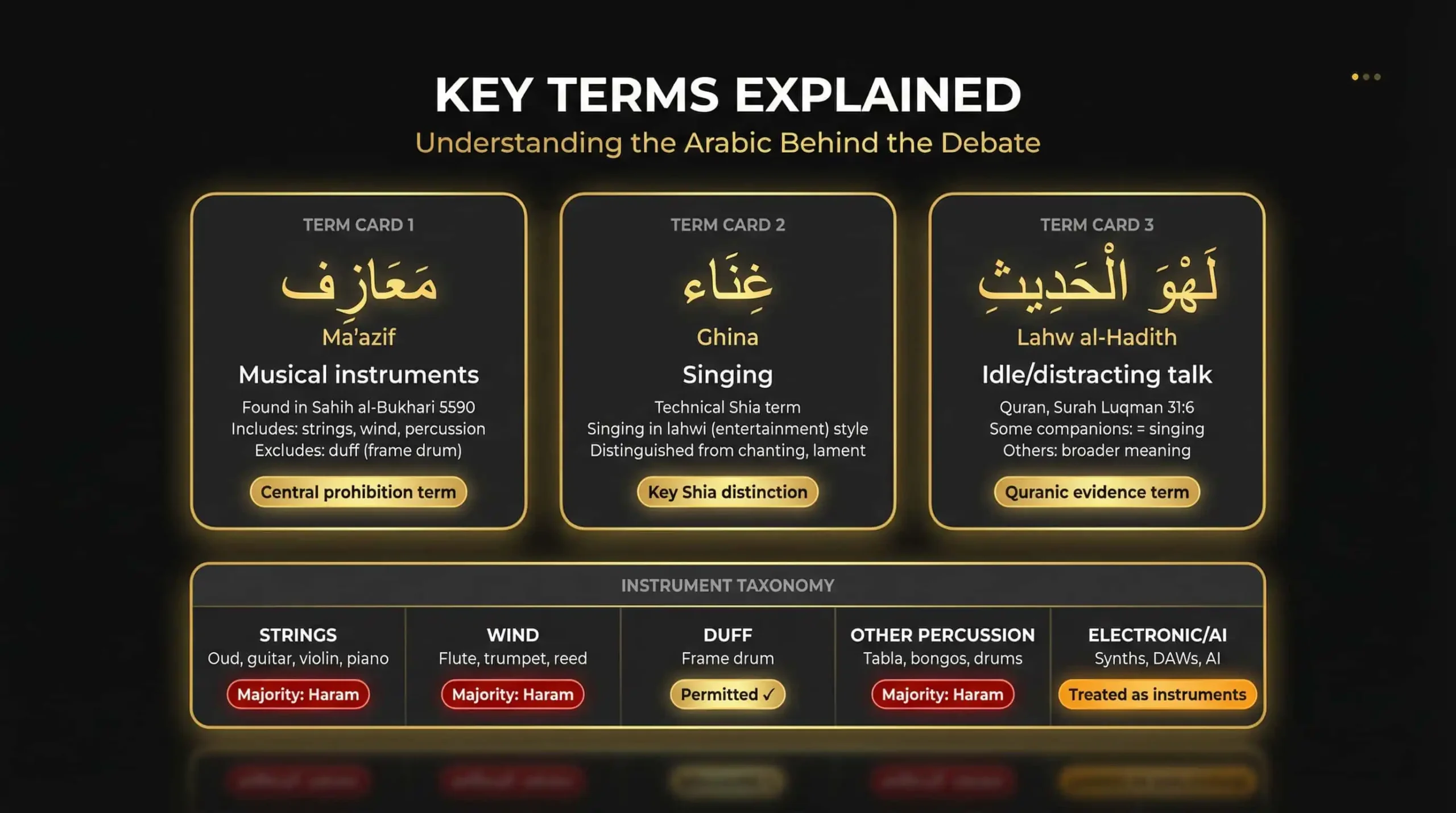
Ma’azif (مَعَازِف)
Understanding ma’azif meaning is essential—this Arabic term refers to musical instruments. It is found in the well known Sahih al-Bukhari hadith and is defined by lexicographers as entertainment instruments which include strings, wind, and percussion (IslamQA; Ibn al-Athir, al-Nihaya). This term is central to understanding is music haram in Islam.
Ghina (غِنَاء)
The ghina meaning in Islamic jurisprudence is technical—literally “singing.” Ghina in the Shia jurisprudence is a technical term: singing in an amusing tune in an environmentally friendly melody (lahwi style). It is not lamentations or athlete praises (Sistani, official Code of Practice among the Western Muslims). The ghina concept is essential when examining is music haram in Islam from the Shia perspective.
Lahw al‑Hadith (لَهْوَ الْحَدِيثِ)
This is a Quranic quotation used in Surah Luqman 31:6 which is the center of the argument. First commentators such as Ibn Mas’ud (may Allah be pleased with him) associated it with singing and music; other commentators gave it a broader meaning.
Arabic:
وَمِنَ ٱلنَّاسِ مَن يَشْتَرِى لَهْوَ ٱلْحَدِيثِ لِيُضِلَّ عَن سَبِيلِ ٱللَّهِ بِغَيْرِ عِلْمٍ وَيَتَّخِذَهَا هُزُوًا ۚ أُو۟لَـٰٓئِكَ لَهُمْ عَذَابٌ مُّهِينٌ
Translation: And among the people is he who purchases idle talk [lahw al-hadith] to mislead [others] from the way of Allah without knowledge, and takes it in ridicule. Those will have a humiliating punishment.
— Qur’an, Surah Luqman (31:6)
This verse is frequently cited in debates about whether is music haram in Islam. The primary reference to music in Quran is Surah Luqman 31:6 (Quran 31:6 music).
According to tafsir note, the treatise of lahw al-hadith was recorded by a number of companions as such singing. But the text of the verse is broad and commentators like al-Ghazali believe that it refers to speech that does not help follow the way of Allah, music may or may not come under this, depending on the content and impact on the listener (Dar al-Ifta; al-Qurtubi, al-Jami’ li-Ahkam al-Qur’an).
Instrument Taxonomy at a Glance
When evaluating is music haram in Islam, instrument classification matters. To answer is music with instruments haram, scholars categorize instruments. Is piano or guitar haram? See the categories below:
| Category | Examples | Majority Sunni Ruling | Notes |
| Stringed instruments | Oud, guitar, violin, piano (struck strings) | Forbidden (IslamQA; Saudi Al-Ifta) | Minority permits with conditions (Dar al-Ifta) |
| Wind | Flute, trumpet, reed pipe | Prohibited (IslamQA) | Same caveat for minority |
| Percussion (Duff) | Frame drum without jingles | Permitted for women at weddings/Eid (consensus) | Some extend to all |
| Percussion (Other) | Tabla, bongos, drum kit | Prohibited by majority | Leniency granted by some minority scholars |
| Electronic/Digital | Synthesizers, DAWs, AI-generated sounds | Treated as instruments in most academic works | Developing field, see Creator’s Corner |
The Sunni Majority View — and Why
The majority opinion on is music haram in Islam comes from the following evidence:
Primary Evidence Cited
The Ma’azif Hadith (Hadith on musical instruments)
Arabic:
لَيَكُونَنَّ مِنْ أُمَّتِي أَقْوَامٌ يَسْتَحِلُّونَ الْحِرَ وَالْحَرِيرَ وَالْخَمْرَ وَالْمَعَازِفَ
Translation: There will certainly be people from my Ummah who will make lawful fornication, silk, wine, and musical instruments (ma’azif).
— Sahih al‑Bukhari, 5590
This hadith forms the primary basis for those who argue is music haram in Islam. Sahih al-Bukhari 5590 remains the central prohibition hadith.
Those who consider music as haram include scholars such as Ibn Taymiyyah, Ibn al-Qayyim, IslamQA, and Saudi Al-Ifta, which relies on this hadith in their claim that instruments are classified together with acts that are universally forbidden, and thus are automatically forbidden.
Another Quran verse 31:6 (Quran 31:6 music) is used as evidence that covers singing and music but its interpretation is different.
Companions statements—They were Ibn Mas’ud, Ibn Abbas and Jabir ibn Abd Allah—they regarded lahw al-hadith to mean singing.
The Duff Exception
Even in the absolute majority opinion the duff (frame drum) is exempted, particularly on the occasion of wedding and feasts of Eid, by a variety of versions. Even scholars who hold that is music haram in Islam make this exception. The concept of duff permissible Islam is near-consensus:
Arabic:
فَصْلُ مَا بَيْنَ الْحَلَالِ وَالْحَرَامِ الدُّفُّ وَالصَّوْتُ فِي النِّكَاحِ
Translation: The distinction between the lawful and the unlawful (marriage) is the duff (frame drum) and the voice in the wedding.
— Sunan al-Tirmidhi 1088; Sunan al-Nasa’i 3369; Sunan Ibn Majah 1896 (graded hasan)
‘A’ishah, Mother of the Believers, narrated:
Arabic:
دَخَلَ عَلَيَّ رَسُولُ اللَّهِ صَلَّى اللَّهُ عَلَيْهِ وَسَلَّمَ وَعِنْدِي جَارِيَتَانِ تُغَنِّيَانِ بِغِنَاءِ بُعَاثَ … فَقَالَ أَبُو بَكْرٍ: مِزْمَارَةُ الشَّيْطَانِ عِنْدَ النَّبِيِّ؟ فَقَالَ رَسُولُ اللَّهِ صَلَّى اللَّهُ عَلَيْهِ وَسَلَّمَ: دَعْهُمَا
Translation: The Messenger of Allah ﷺ entered upon me while two young girls were singing songs of Bu’ath. Abu Bakr al-Siddiq said: ‘The wind instruments of Shaytan in the presence of the Prophet ﷺ?’ The Messenger of Allah ﷺ said: ‘Leave them.’
— Sahih al‑Bukhari 949, 952
This narration is interpreted differently by those debating is music haram in Islam. Both scholars and the prohibitionists also quote this narration: it is, according to the prohibitionists, a narrowed-down Eid exception, with clean poetry (not instruments), whereas, according to the permissibility advocates, it is a fact that the Prophet ﷺ never prevented the singing (IslamQA; Dar al-Ifta; AboutIslam).
Where Scholars Differ (Sunni Minority View)
Not all scholars agree that is music haram in Islam unconditionally.
In Ihya’ ‘Ulum al-Din, Imam al-Ghazali allowed music under certain conditions; al-Izz ibn ‘Abd al-Salam also, al-Qurtubi and al-Shawkani (in Nayl al-Awtar) as well as a large minority of classical and contemporary scholars allowed music with some conditions, or doubted the absolute ban. The summary of Egypt is in Dar al-Ifta:
There is no unanimous text which forbids all music …. It is a question of proper scholarly disagreement (ikhtilaf), and others should not be criticized on the issue of a dispute.
Dar al‑Ifta, Egypt, Fatwa #4866
This nuanced position acknowledges that is music haram in Islam is not a settled matter. Dar al-Ifta, Egypt represents the established minority position.
Conditions generally annexed by the permissibility camp:
- Lyrics should be pure – no indecency and encouragement of sin, ridiculing religion.
- Music should not cause one to neglect religious duties (prayer, fasting).
- The context of listening should not be in a sinful way (drinking, free mixing in the criminal environment).
- The spiritual condition of the listener is also a concern, in case music drives them towards being careless, they must not listen.
These conditions shape how is music haram in Islam is applied practically.
This is the case with articles published by such sites as (Dar al-Ifta; SeekersGuidance; AboutIslam).
The Shia (Twelver) Perspective in Plain English
The Shia approach to whether is music haram in Islam differs significantly. The Shia view on music is distinct from Sunni positions:
The verdicts of Grand Ayatollah Sistani, popular with Twelver Shia, make a distinct distinction between ghina and other music:
- Ghina (singing in an entertainment-gathering style): Categorically haram – performing and listening (Sistani, official English rulings).
- Music unsuitable to entertainment meetings: Authorized. They can be martial/military music, funeral marches, revolutionary anthems, and some devotional recitations that will be performed in a non-lahwi melody (Sistani).
- Learning/teaching music: Haram as long as the music itself is a haram one, haram as long as it is lahwi music (Sistani Q&A).
This categorical approach defines is music haram in Islam by the music’s purpose. Grand Ayatollah Sistani’s rulings define the ghina meaning (entertainment-style singing) as the determining factor.
Sunni vs. Shia — Quick Comparison
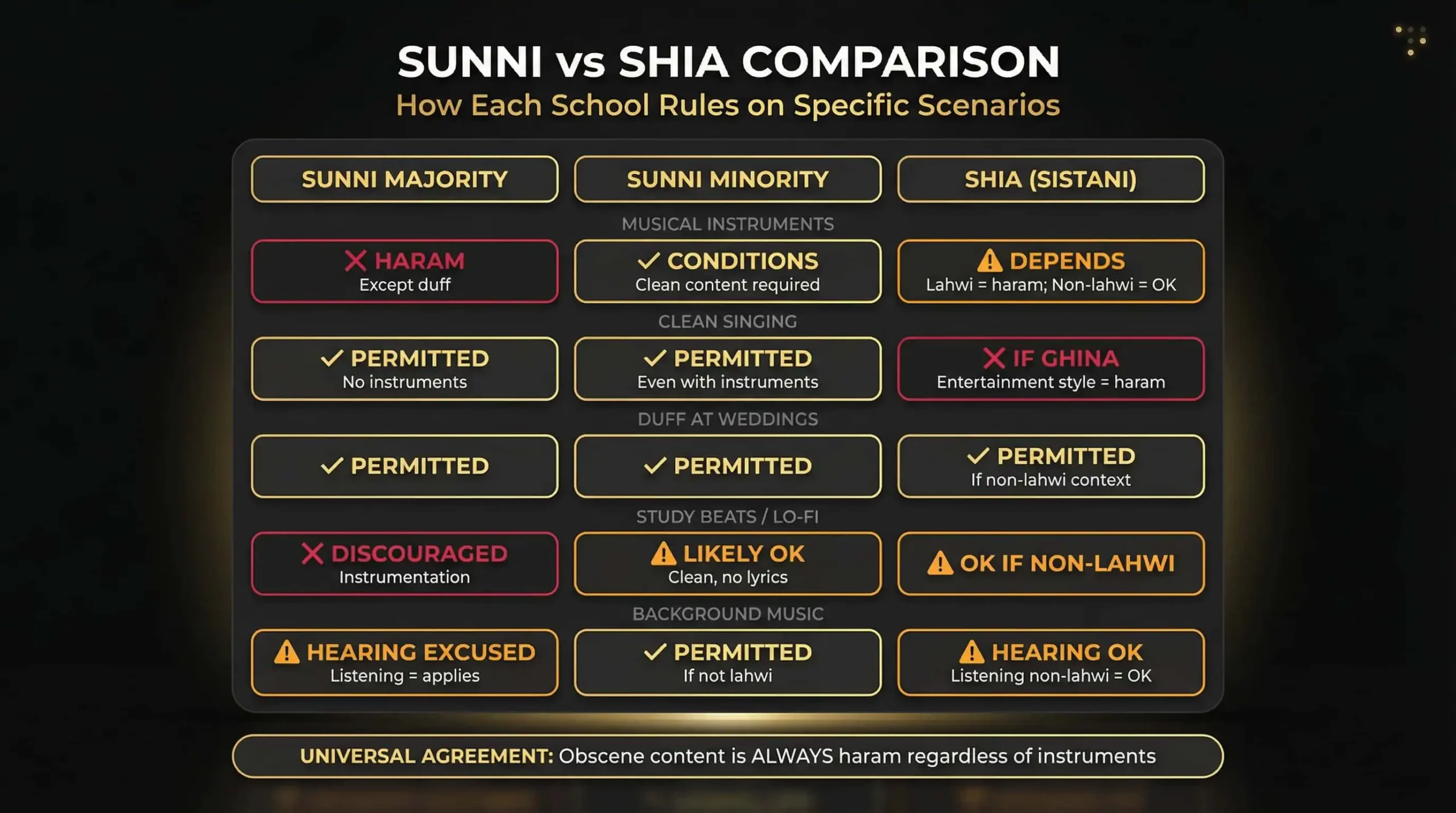
This table summarizes how each school answers is music haram in Islam. Understanding the Shia view on music requires the ghina concept. All schools agree duff permissible Islam at weddings:
| Subject Matter | Sunni Majority | Sunni Minority | Shia (Sistani) |
| Musical instruments | Haram (except duff) | Permitted with conditions | Depends: lahwi instruments haram; other instruments permissible |
| Singing – pure lyrics | Permitted (no instruments) | Permitted (even instruments, with conditions) | Haram if ghina style; otherwise permitted |
| Duff at weddings | Authorized | Authorized | Authorized (unless non-lahwi context) |
| Background/ambient audio | Listening not allowed; hearing excused | Permitted if not lahwi music | Listening not lahwi music allowed |
| Study beats / lo-fi | Generally not accepted (instrumentation) | Probably acceptable (clean, no lyrics) | Acceptable if not lahwi style |
Content vs. Instruments vs. Context — A Practical Matrix
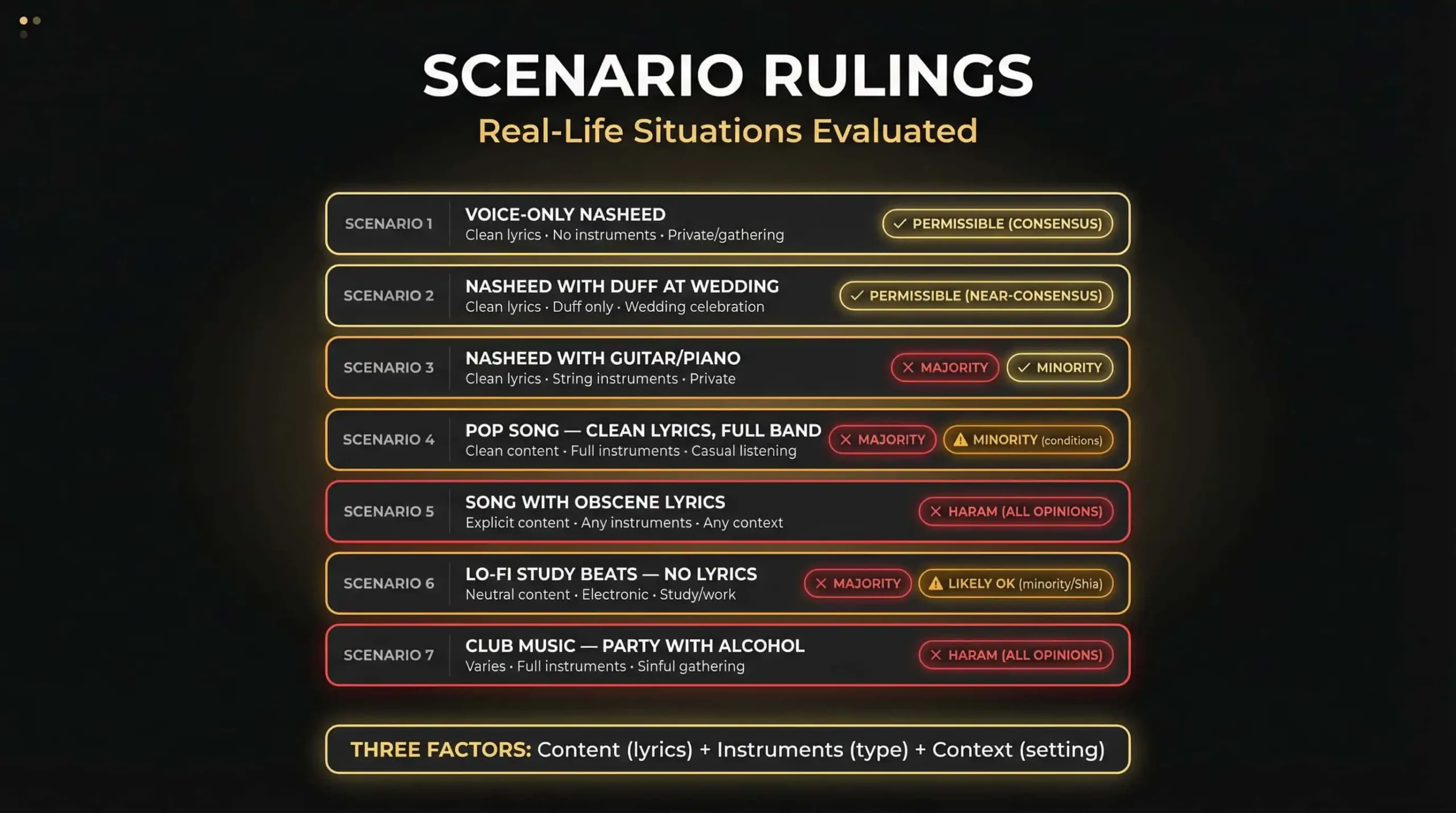
When determining is music haram in Islam for specific scenarios, consider:
| Scenario | Content (Lyrics/Theme) | Instruments used? | Context | Typical Ruling |
| Nasheed, voice alone, praise of the Prophet ﷺ | Clean ✅ | None ✅ | Private/gathering ✅ | Permissible by consensus |
| Nasheed with duff at a wedding | Clean ✅ | Duff only ✅ | Wedding ✅ | Permissible (near consensus) |
| Nasheed with guitar/piano | Clean ✅ | Strings ⚠️ | Private ✅ | Prohibited (majority); Authorized (minority) with conditions |
| Pop song, clean lyrics, full band | Clean ✅ | Full instruments ⚠️ | Casual listening | Prohibited (majority); Permitted with conditions (minority/Dar al-Ifta) |
| Song with obscene lyrics | Obscene ❌ | Any | Any | Prohibited (consensus level) |
| Lo-fi study beats, no lyrics | Neutral ✅ | Electronic ⚠️ | Study/work ✅ | Prohibited (majority); Likely permissible (minority/Shia non-lahwi) |
| Club music, party setting, alcohol use | Varies ❌ | Full instruments ❌ | Sinful party ❌ | Prohibited (all opinions) |
This matrix helps answer is music haram in Islam case-by-case. Rather than a haram music list, scholars provide principles.
Hearing vs. Listening: What If I Can’t Avoid Background Music?
This is among the most widespread real life questions. Many Muslims wonder is music haram in Islam when exposure is involuntary. The question is listening to music haram depends on intent. SeekersGuidance and other authorities differ:
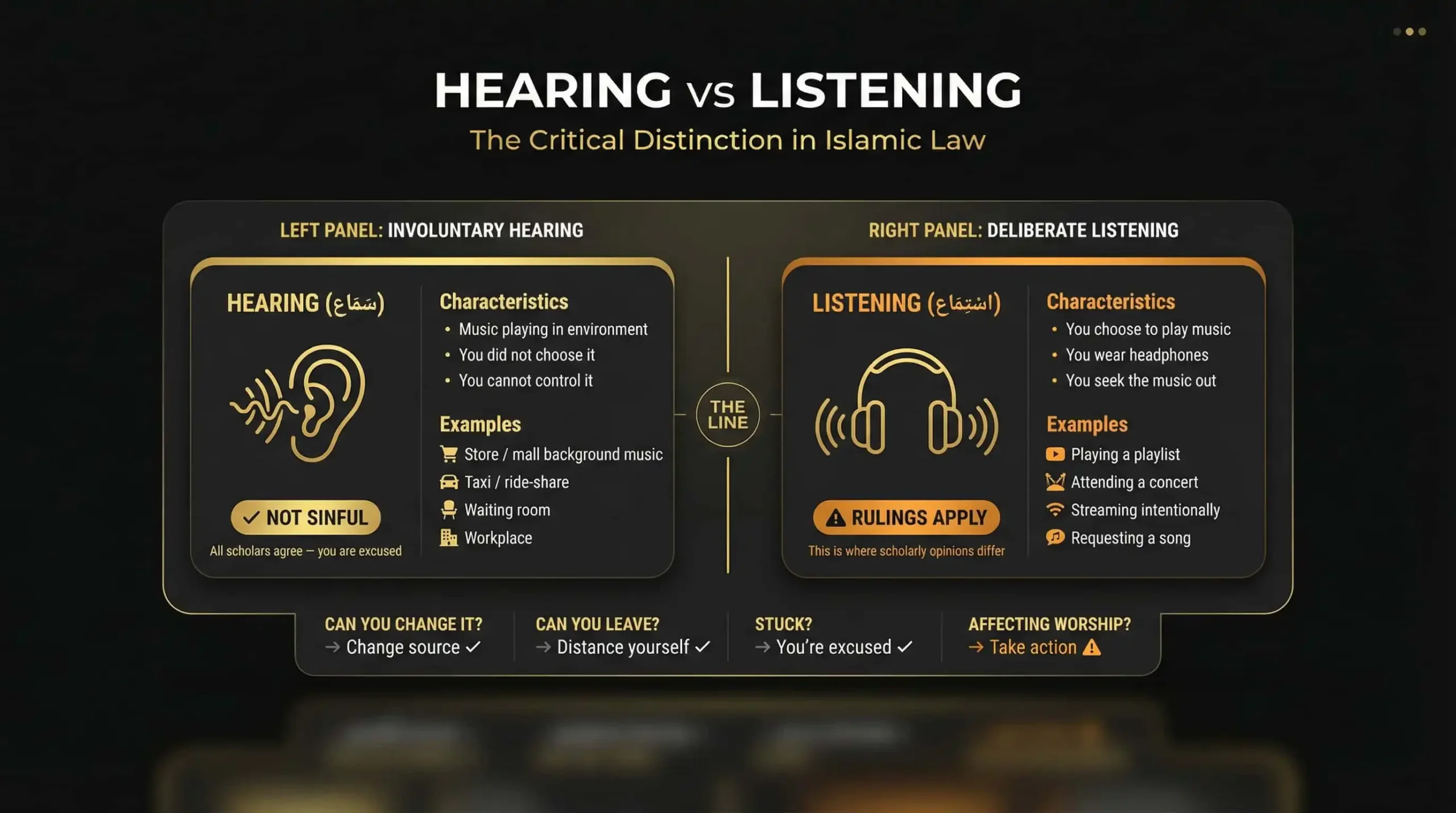
Involuntary hearing (سَمَاع): As you enter a store, get into a taxi or sit in a waiting room, music is playing. You have not chosen it and have no power to control it. Scholars on both ends admit that it is not a sin to listen to music against your will (SeekersGuidance; IslamQA). This addresses background music Islam concerns.
Deliberate listening (اسْتِمَاع): You decide to play a song, or even have some headphones, or be in a certain location to listen to the music. It is in this situation that the above rulings come in.
The hearing vs listening music Islam distinction is crucial to understanding is music haram in Islam practically.
Practical Etiquette Checklist
- Can you change the source? When you are in charge of the speaker, change to something that is allowed.
- Can you leave? When the environment is mostly a music place and is dealing with sin, distancing will help.
- Are you not changeable or movable (e.g., workplace, ride-share) — You are excused. Intend that you are not in search of the music.
- Does it have an impact on your worship or concentration on obligations? When the background music is distracting you off praying or dhikr, make pragmatic choices (earbuds with Quran, ask to play quietly).
Weddings, ‘Eid, and Celebrations — What’s Typically Allowed?
For celebrations, the question is music haram in Islam has clearer answers. The duff permissible Islam ruling applies especially here. Wedding music Islam traditions include:
Every popular opinion recognizes a certain degree of voice and duff celebration:
Do’s:
- The duff (frame drum) should be used on weddings and at Eid – this is sunnah-based (Bukhari; Tirmidhi).
- Sing clean poetry and happy songs, that have no indecency in them.
- Advertise the marriage publicly and have permissible partying (according to the hadith that promotes announcement of nikah).
Don’ts:
- No indecent, sexually explicit, or blasphemous songs — the opinion on this is unanimous.
- Majority opinion: do not use instruments above the duff.
- All opinions: no celebrations or illicit gatherings formats should be mixed with alcohol.
- Think of the volume and the neighborhood disturbance – a general Islamic etiquette rule.
Creator’s Corner: Nasheeds, Instruments, Vocal Effects, and AI Audio
Content creators must understand is music haram in Islam for professional guidance.
When you are creating Islamic content, nasheeds, or me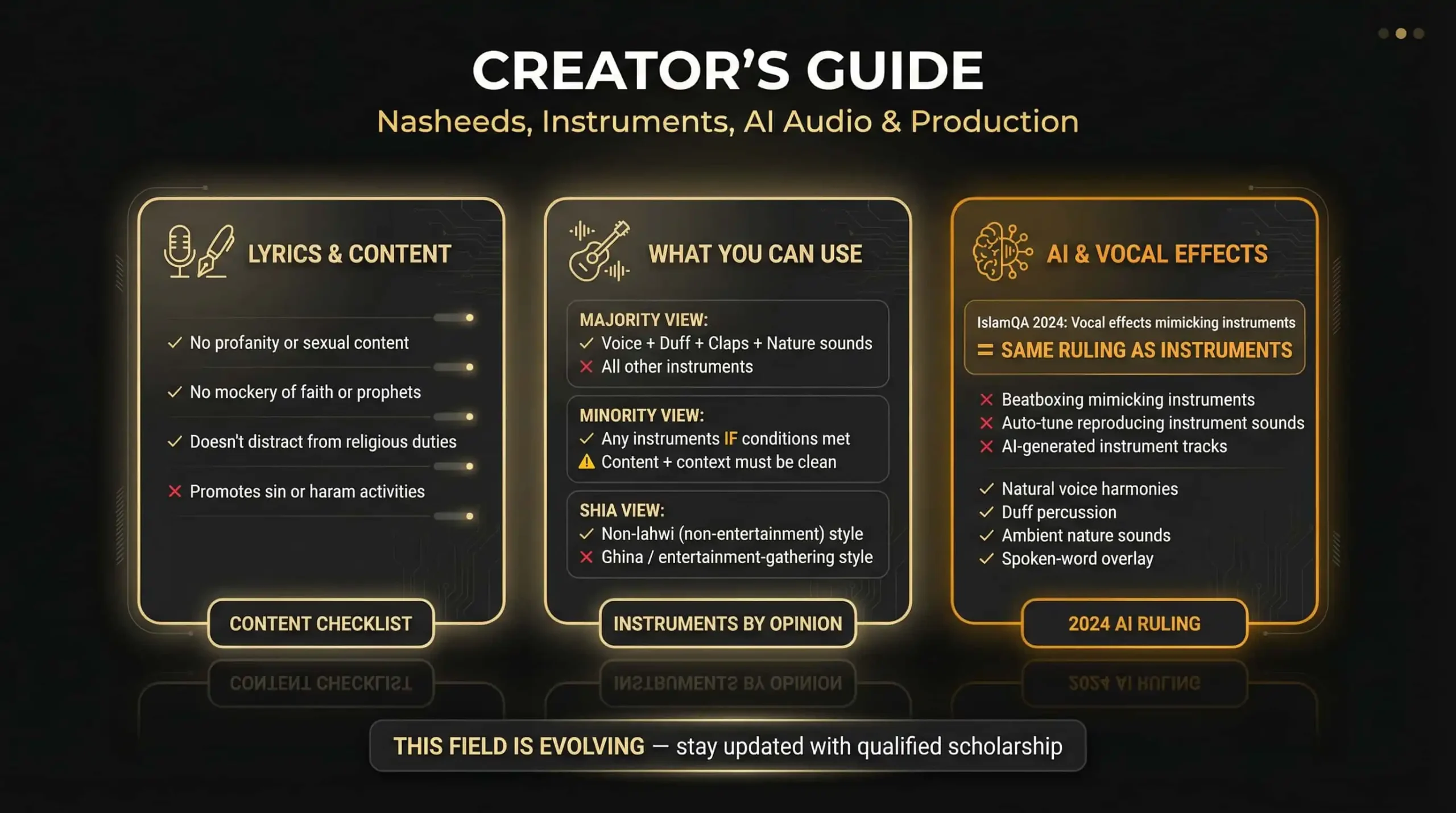 dia, then the question is professional. Here is structured guidance:
Checklist of Lyrics and Content:
- No swearing, sexual or haram advertising.
- No derision of faith, prophets, scholars.
- Religious commitments should not be distracted by the content.
Instruments:
- View of majority of the Sunnis: Limit to voice, duff and natural percussion (claps).
- Minority/Dar al-Ifta approach: The instruments can be used when the content and context conditions are satisfied.
- Shia perspective: This is allowed when the resultant music is not in lahwi/entertainment-gathering style.
- Clean nasheed permissible by near-consensus when voice-only. Nasheed with instruments remains debated.
Also Read: Is Bitcoin Halal or Haram? Scholars Verdicts, Zakat Rules and How to Invest
AI Vocal Effects and Beatboxing — The 2024 Ruling
In 2024, the IslamQA made a ruling that the vocal effects engineered to sound like musical instruments were to be considered music entirely, and the ban was not based on the source, but on the sound (IslamQA, 2024). This ruling expands how is music haram in Islam applies to modern technology. This AI music Islam ruling affects creators significantly. This means:
- Beatboxing Islam concerns: beatboxing, auto-tune, and vocoder effects which reproduce instrument sounds can be governed under the same rule as the instruments.
- Recommended safe alternatives for creators: Natural voice harmonies, applause, duff percussion, ambient nature, spoken-word overlay.
It is an area that is changing fast. The creators adhering to the majority view are to be attentive; the creators adhering to the minority view are to be attentive to the fact that the end product has to be subject to both the content and context requirements.
Decision Tree — “Is This Track OK for Me to Play?”
Use this decision tree to determine is music haram in Islam for any track:
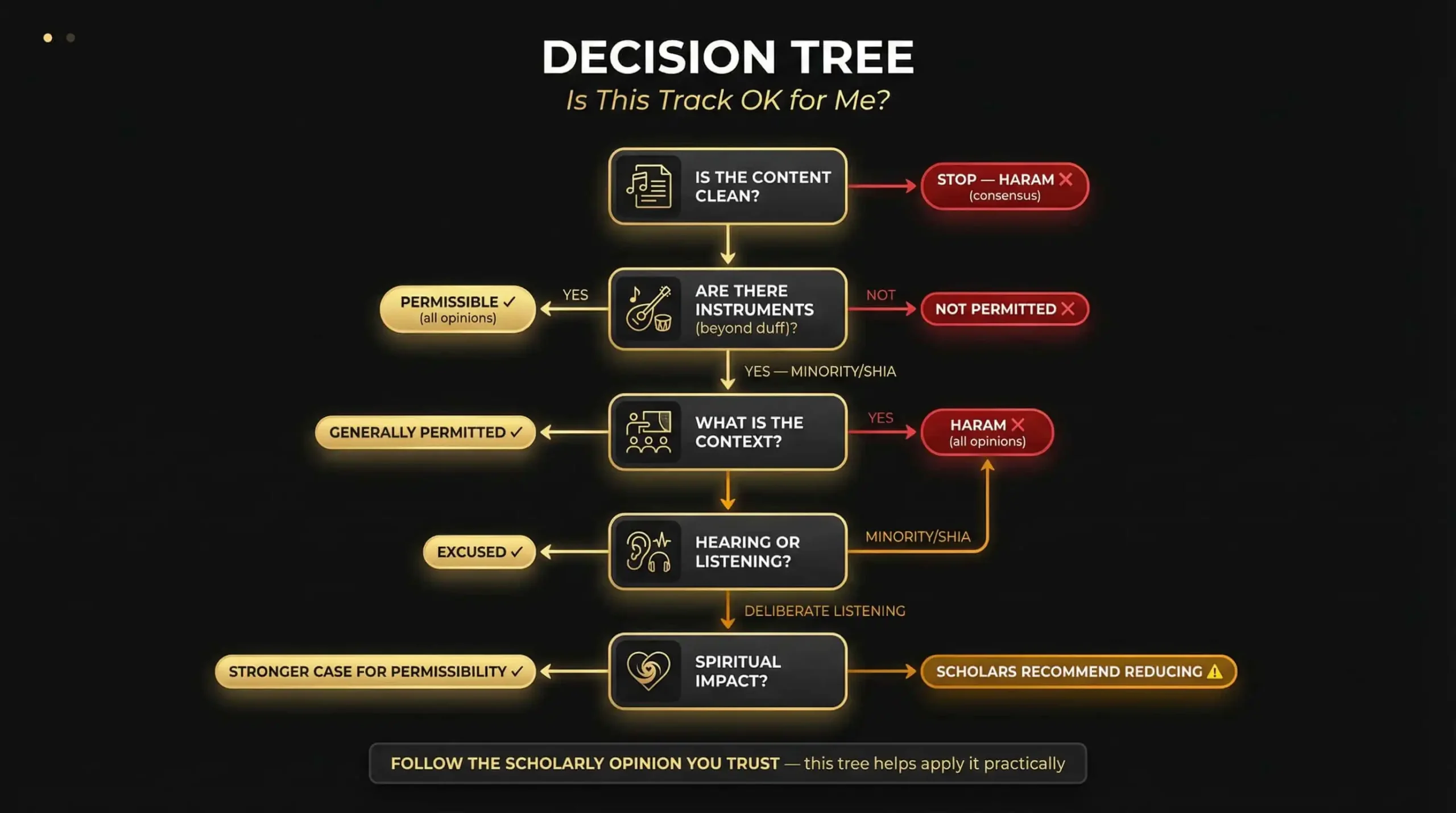
Follow this step wise guideline:
Step 1: Is the content clean?
- In case the lyrics are indecent, then stop here — it is not allowed (consensus). ❌
- In case, the song is clean or has no lyrics, proceed. ✅
Step 2: Is it accompanied by musical instruments (not the duff only)?
- If yes →
- Most Sunni opinion: not acceptable.
- Minority Sunni opinion: pass on to Step 3.
- Shia opinion: should the music be of a kind that is called lahwi (entertainment-style), it is not allowed. If it’s not lahwi, continue.
- No instruments (only voice/duff) → continue. ✅
This step addresses is music haram in Islam regarding instrumentation. Is music with instruments haram depends on which opinion you follow.
Step 3: What is the context?
- Wedding, Eid or a legally permitted gathering → generally permitted (with duff).
- Personal relaxation, study or work → Permissible in private cases of minority/Shia non-lahwi. Most discourage it.
- Sinful congregation (alcohol, illicit mixing) → not allowable in every opinion. ❌
Step 4: Are you hearing or listening?
- Forced hearing = you are not sinful. ✅
- Intentional listening = the verdicts above apply.
Step 5: What is the spiritual impact?
- When it makes you skip prayers, lapse on Quran or grow careless: the scholars recommend lessening or even quitting it. ⚠️
- Raises you, makes you remember Allah, or does not affect you in any negative way, then this is a better case to be allowed (where appropriate). ✅
Evidence At-a-Glance (For Further Study)
For deeper study on is music haram in Islam, consult these sources. The ma’azif meaning (musical instruments) is defined in these references. Sahih al-Bukhari 5590 remains central. Al-Ghazali’s Ihya’ ‘Ulum al-Din provides the minority framework:
IslamQA (comprehensive music ruling): Evidence of comprehensive prohibition – Quran 31:6 music reference, Bukhari 5590, words of the scholars, duff exception, refutation of objections.
Dar al-Ifta, Egypt: Permissible with restrictions, cites al-Ghazali, Qadi al-Iyad, al-Izz ibn ‘Abd al-Salam, al-Qurtubi; insists on ikhtilaf.
SeekersGuidance: Defends the mainstream opinion, but admits deviation; offers useful tips on hearing vs listening music Islam distinction.
Sistani (official English decisions): Ghina/lahwi music distinction; Q&A learning, performing and exposing to the public.
Saudi Al-Ifta (Ibn Baz): Prohibition; duff of weddings to women; authoritative text of rulings of the Gulf group.
Al-Shawkani, Nayl al-Awtar: Critique of the evidence of both sides; historiographical; useful to the student of fiqh.
Frequently Asked Questions
Is all music haram in Islam?
No. Most of the Sunni scholars prohibit music instruments but permit clean singing and duff. An established minority, as with the Dar al-Ifta in Egypt, allows music under certain terms. Shia thinkers differentiate between the music of the haram (lahwi) and the non-haram music (non-lahwi). Dar al-Ifta, Egypt represents the established minority position. The evidence cited includes Sahih al-Bukhari 5590.
Does that mean that all instruments are haram? What about the duff?
Is music with instruments haram? The duff is the exception. Instrument with near-consensus-permissibility on weddings and at Eid is the duff (frame drum). The duff permissible Islam ruling is well-established. The ma’azif meaning includes all entertainment instruments. The Sunni majority rejects other instruments but permits them with conditions by the minority and (non-)lahwi by Shia scholars.
Am I able to listen to study beats or lo-fi music?
This comes under the debate of instruments. Lo-fi beats halal status varies by opinion. It would be discouraged by the Sunni majority (electronic instruments). It could fit in the minority opinion and the Shia non-lahwi category so long as the content is neutral and is not a distraction of obligations. The answer to is music haram in Islam for study beats depends on your followed opinion.
What if a nasheed possesses piano or guitar?
Most people regard this as unacceptable as strings and keys are ma’azif. Strings and keys fall under ma’azif meaning. Nasheed with instruments remains debated. The minority opinion followers would look into whether the content is clean and the context is proper.
Am I sinning when I hear music, and have no intention of listening?
No. There is a distinction between involuntary and deliberate hearing vs listening music Islam scholars make. Incidental exposure in stores, transport and workplaces does not constitute sin. When asking is music haram in Islam, intent matters significantly. Whether is listening to music haram hinges on voluntary choice.
Is it permissible to use AI vocal effects or beatboxing?
In a 2024 decision of IslamQA, instrument-mimicking vocal effects (beatboxing Islam ruling) are considered to be indistinguishable to instruments. This reserved nature implies that creators must also be conscious of this especially when they adhere to the prevailing opinion. AI music Islam ruling continues to develop.
In what ways does the Shia approach differ, in a single sentence?
According to Ayatollah Sistani, ghina (entertainment-style singing) is haram; however the music which does not fit entertainments or amusement gatherings is acceptable (Sistani). This summarizes how Shia scholars answer is music haram in Islam. Ghina meaning entertainment singing—is categorically haram per the Shia view on music.
Can Muslims listen to music?
See our decision tree above for guidance. The answer depends on instruments, content, context, and which scholarly opinion you follow.
Must Watch: Music is Haram in Islam – Assim al hakeem
Final Thoughts and Next Steps
Whether is music haram in Islam or not is not a monolithic question – and even the same is a part of Islamic legal tradition. This point has been debated by legitimate scholars over the course of more than a thousand years and the Quranic and hadith information is viewed in various ways by the bodies in charge all of whom are trying in good faith to determine the truth. Bodies like Dar al-Ifta, Egypt maintain conditional permissibility.
What you should do:
- Know the facts — not only the decision but also the facts so that your practice does not depend on heredity. Understanding is music haram in Islam requires knowing the evidence.
- Determine which school of scholarship you subscribe to (or see your local imam/scholar to get personal advice).
- Use the standards which practically all scholars have determined: pure material, right environment, no slacking at duty, and honest self-evaluation of spiritual effectiveness.
- Be respectful of the position of other people, be they more restrictive or more lenient, provided these are based on accepted scholarship.
- Keep up to date — new questions about AI audio, streaming sites, and the ethics of the creator will keep on bringing out new academic debates. The question is music haram in Islam will continue evolving with technology.
These Islamic music rules guide personal practice.
May Allah lead us all to what brings Him pleasure and bring us wisdom in how we maneuver such things. May your understanding of is music haram in Islam be guided by knowledge.
This article was last reviewed in February 2026. It offers various known academic stands for education and is not a personal fatwa. Individual decisions are encouraged to be made by the reader by referring to qualified scholars.