Is tattoo haram? Absolutely — and the evidence is definitive. Tattoo making is haram in Islam. The basis of this ruling is numerous authentic hadiths where the Prophet Muhammad (ﷺ) condemned the tattoo givers as well as the tattoo takers. This prohibition is accepted in all four major schools of Islamic jurisprudence and they constitute a scholarly consensus (ijma).
This guide is to all those that may have questions regarding tattoos either because you are a Muslim, or you are someone who already has tattoos, or because you are new to the world and have the ink. We will cover the evidence of the true Quran and Sunnah, the theological basis of banning cosmetics, contemporary cosmetic use and microblading, how it affects prayer and wudu and a merciful way to redeem and find halal alternatives to tattoos. Understanding tattoos in Islam requires examining both the evidence and the wisdom behind the ruling.
The Islamic Ruling on Tattoos: What Does Islam Say?
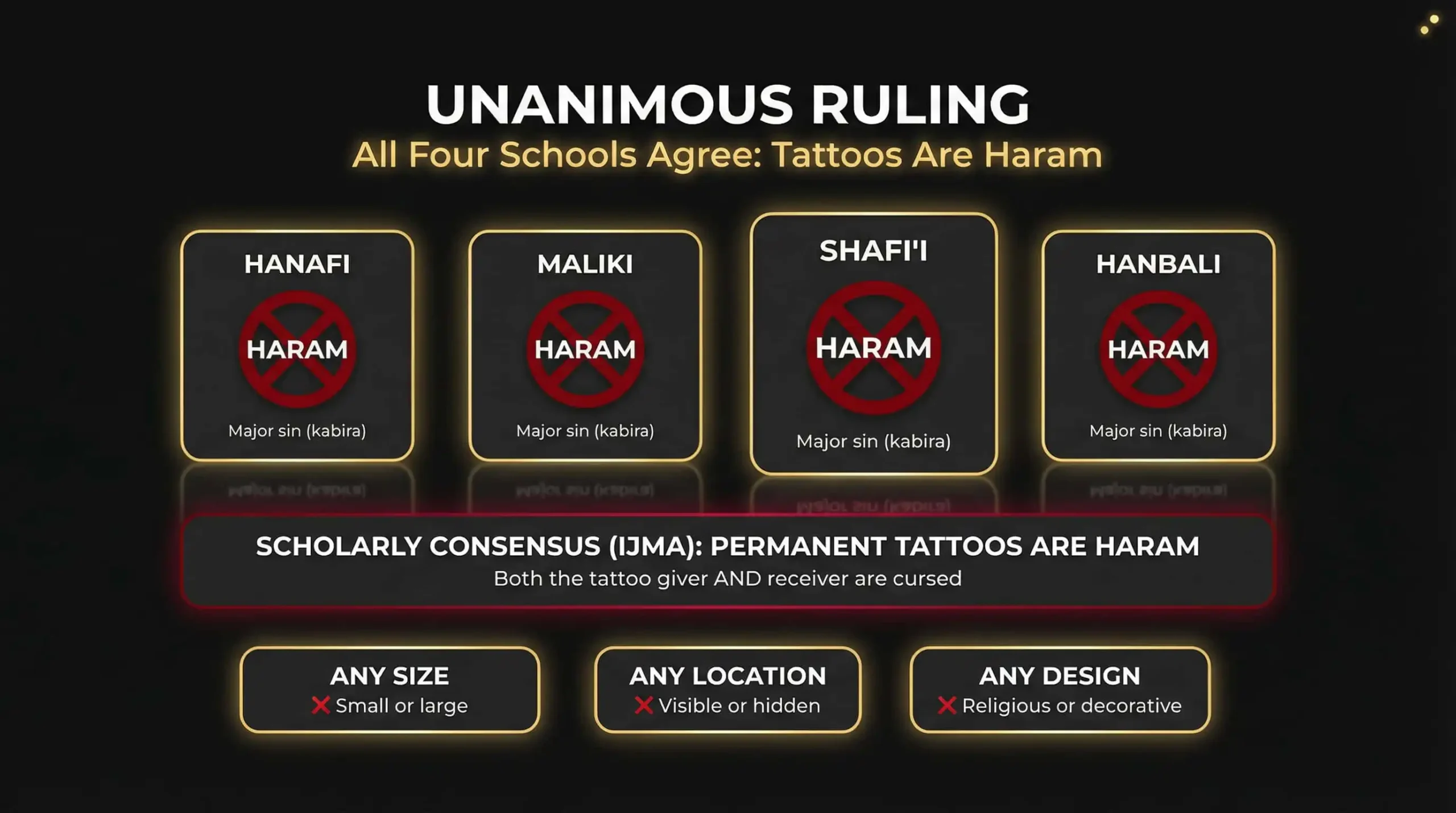
Is tattoo haram? Yes — permanent tattoos are haram. This is not a subjective issue as scholars are not in disagreement. All four schools — Hanafi, Maliki, Shafi’i, and Hanbali — are united in agreeing that one should not voluntarily take a permanent tattoo. Scholars’ opinion on this matter is unanimous.
The ban encompasses the guest and the host. Whether the tattoo is huge or diminutive, overt or covert, ornamental or signifying, it does not matter. The consensus that tattoo is haram in Islam applies universally. Tattooing as a process is also forbidden regardless of the message, size and location.
According to scholars, tattooing is a great sin (kabira). This is not arbitrary. The act is a serious prohibition when the Prophet (ﷺ) swears its prohibition. Tattoos are thus much more serious than an act is not so much liked (makruh); it is a ban unambiguously.
What Exactly Counts as a Tattoo?
A tattoo (al-washm) in Islamic law refers to piercing the skin with a needle and injecting or rubbing a permanent dye, ink or pigment under the skin. The impact is a permanent design that cannot be washed off by normal washing.
Permanence is the key. The ink is in the layer that is beneath the skin, which makes the body permanently altered. This distinction is what sets tattoos apart in comparison to temporary ornaments like henna that are applied on top of skin and dissipate. Any procedure that puts pigment beneath the skin is forbidden, be it the traditional needles or machines or cosmetic tattooing equipment. If the procedure deposits pigment beneath the skin permanently, the answer to ‘are tattoos haram’ is yes. This is why permanent tattoo in Islam is categorically forbidden.
Evidence From Quran and Hadith
The reasons that make tattooing prohibited are due to genuine prophetic beliefs and the Quranic values. This evidence can be understood to explain why this ruling is significant and compelling.
Hadith Evidence
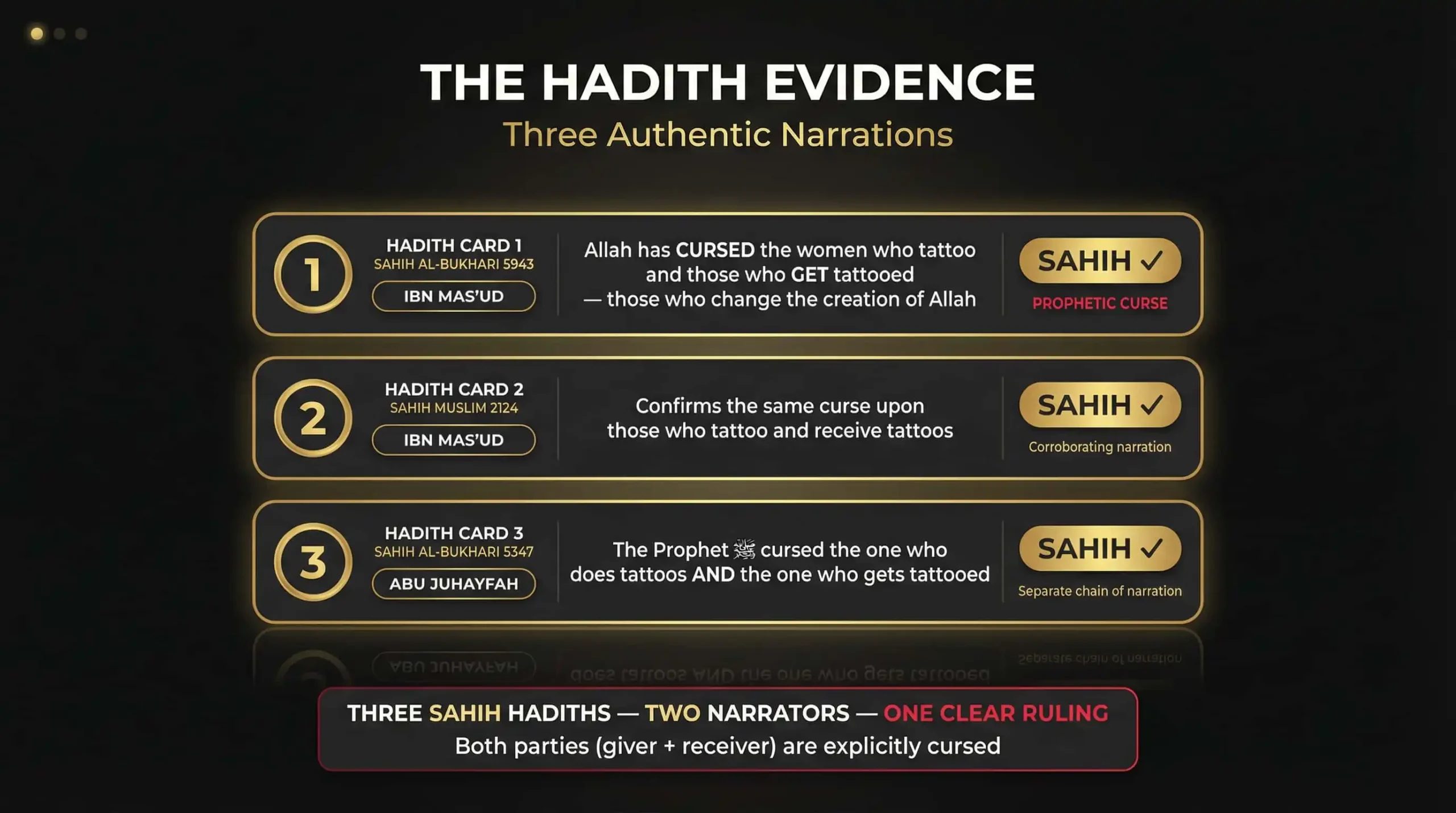
The clearest hadith about tattoos is found in the Prophet’s Sunnah (ﷺ). The primary sources include Sahih al-Bukhari and Sahih Muslim. Key narrators include Abdullah ibn Mas’ud and Abu Juhayfah. A couple of genuine hadiths refer directly to tattoos.
Hadith 1 – Sahih al‑Bukhari (5943):
لَعَنَ اللَّهُ الْوَاشِمَاتِ وَالْمُسْتَوْشِمَاتِ، وَالنَّامِصَاتِ وَالْمُتَنَمِّصَاتِ، وَالْمُتَفَلِّجَاتِ لِلْحُسْنِ، الْمُغَيِّرَاتِ خَلْقَ اللَّهِ
Allah has cursed the women who tattoo and those who get tattooed, those who pluck eyebrows and those who have their eyebrows plucked, and those who file their teeth for beautification — those who change the creation of Allah.
Narrated by Abdullah ibn Mas’ud (رضي الله عنه), who said: ‘Shall I not curse those whom the Prophet (ﷺ) cursed?’ This demonstrates the gravity of the prohibition. This Ibn Mas’ud hadith is the cornerstone of the prohibition. This hadith about tattoos is narrated in the most authentic collection. Those involved are cursed by the Prophet (ﷺ). This hadith is the primary reason tattoo haram rulings exist across all schools.
Hadith 2 – Sahih Muslim (2124):
A corroborating narration in Sahih Muslim (2124) from Abdullah ibn Mas’ud confirms the same curse upon those who tattoo and those who receive tattoos. The Ibn Mas’ud hadith is again confirmed in Sahih Muslim.
Hadith 3 – Sahih al-Bukhari (5347), narrated by Abu Juhayfah:
لَعَنَ النَّبِيُّ صَلَّى اللَّهُ عَلَيْهِ وَسَلَّمَ الْوَاشِمَةَ وَالْمُسْتَوْشِمَةَ
The Prophet (ﷺ) cursed the one who does tattoos and the one who gets tattooed.
Here, another declaration of prohibition. Again, both parties are cursed by the Prophet. This additional hadith about tattoos reinforces the prohibition through a separate chain.
Quranic Principles
Although the Quran does not specifically address tattoos in Islam directly, there are a number of verses that define the rules defending the ban.
Quran 4:119 – The Transformation of the Creation of Allah
وَلَأُضِلَّنَّهُمْ وَلَأُمَنِّيَنَّهُمْ وَلَآمُرَنَّهُمْ فَلَيُبَتِّكُنَّ آذَانَ الْأَنْعَامِ وَلَآمُرَنَّهُمْ فَلَيُغَيِّرُنَّ خَلْقَ اللَّهِ
And I will mislead them, and I will arouse in them false desires, and I will command them so they will slit the ears of cattle, and I will command them so they will change the creation of Allah.
This is the voice of Shaytan, who vows to lead people astray by making them alter Allah’s creation. This verse directly warns against changing Allah’s creation, and the curse by the Prophet goes with it.
Quran 33:36 – To Obey Allah and His Messenger
وَمَا كَانَ لِمُؤْمِنٍ وَلَا مُؤْمِنَةٍ إِذَا قَضَى اللَّهُ وَرَسُولُهُ أَمْرًا أَن يَكُونَ لَهُمُ الْخِيَرَةُ مِنْ أَمْرِهِمْ
It is not for a believing man or a believing woman, when Allah and His Messenger have decided a matter, that they should have any choice about their affair.
Once the Prophet (ﷺ) says something, his believers have no choice but to follow it without necessarily knowing all the details.
Quran 95:4 – The Best of Creation
لَقَدْ خَلَقْنَا الْإِنسَانَ فِي أَحْسَنِ تَقْوِيمٍ
We have certainly created man in the best of stature.
The human body is made in the perfect form by Allah. To alter that by putting on permanent tattoos is in opposition to this divinely willed purpose. Tattooing contradicts this by changing the creation of Allah.
Why Are Tattoos Haram? The Wisdom Behind the Prohibition
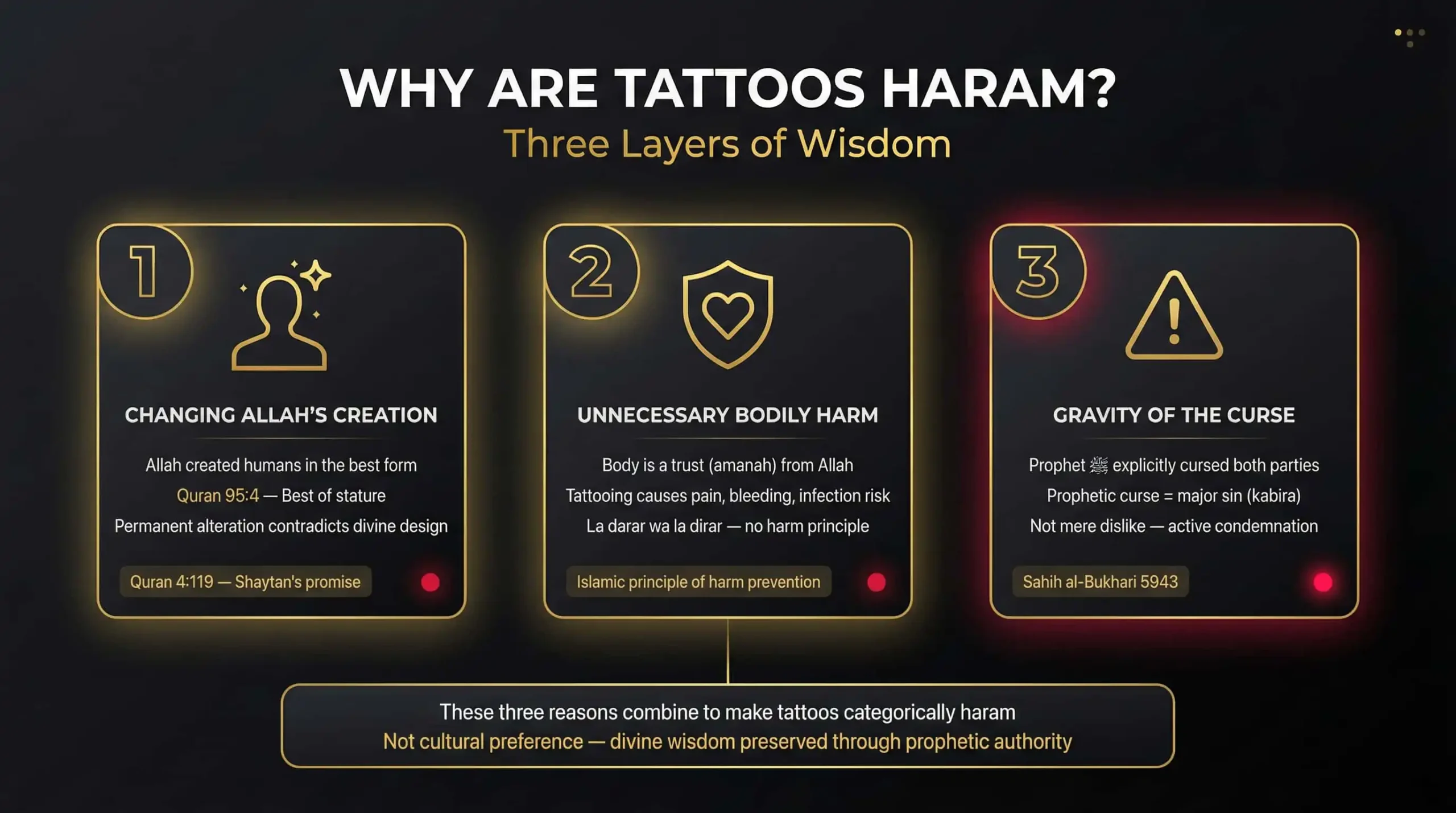
Understanding why are tattoos haram helps believers internalize the ruling. This knowledge will allow the believers to grow in faith and clarify the position to outsiders because Islamic scholars prohibit tattoos. The core issue is changing the creation of Allah. The prohibition is covered with several layers of wisdom. These reasons collectively explain why a tattoo is haram in Islam.
Changing Allah’s Creation
The Ibn Mas’ud hadith explicitly labels tattooers as those who change Allah’s creation. The hadith of Ibn Mas’ud refers to the tattooers as al-mughayyirat khalq Allah. Allah made us with a reason in our bodies. Changing Allah’s creation is explicitly condemned. His design is dissatisfied by adding permanent color to the skin. This is why scholars unanimously declare tattoo haram.
Not every body modification is prohibited. Hair-cutting, nail-clipping, circumcision, and medical surgeries are permitted since they do not violate the natural disposition (fitrah), are healthy, or are associated with Sunnah. The rule is concerned with permanent cosmetic beautification that does not benefit and thus, contradict with the natural order of the body.
Subjecting the Body to Unnecessary Harm
Tattooing involves numerous injuries to the skin which inflict pain, bleeding and infection risk. In Islam, the body is a gift (amanah) of Allah. We are caretakers, not owners. The principle of harm-for-cosmetic-reasons, which is called La darar wa la dirar, disallows harm due to the strictly cosmetic motives.
The Gravity of the Prophet’s Curse
A curse (la’nah) when spoken by the Prophet Muhammad (ﷺ) is an indication of disapproval of paramount degree and a harsh spiritual punishment. Being cursed by the Prophet is among the severest warnings. As the Ibn Mas’ud hadith demonstrates, the severity is undeniable. As recorded in Sahih al-Bukhari, the curse is severe. A prophetic curse categorizes the act as a major sin (kabira), too much greater than the personal preference. Every hadith about tattoos carries the weight of prophetic authority.
Also Read: Is Smoking Haram? The Islamic Decision on Cigarettes, Vapes, Hookah and Weed
Permanent vs. Temporary: What’s Actually Forbidden?
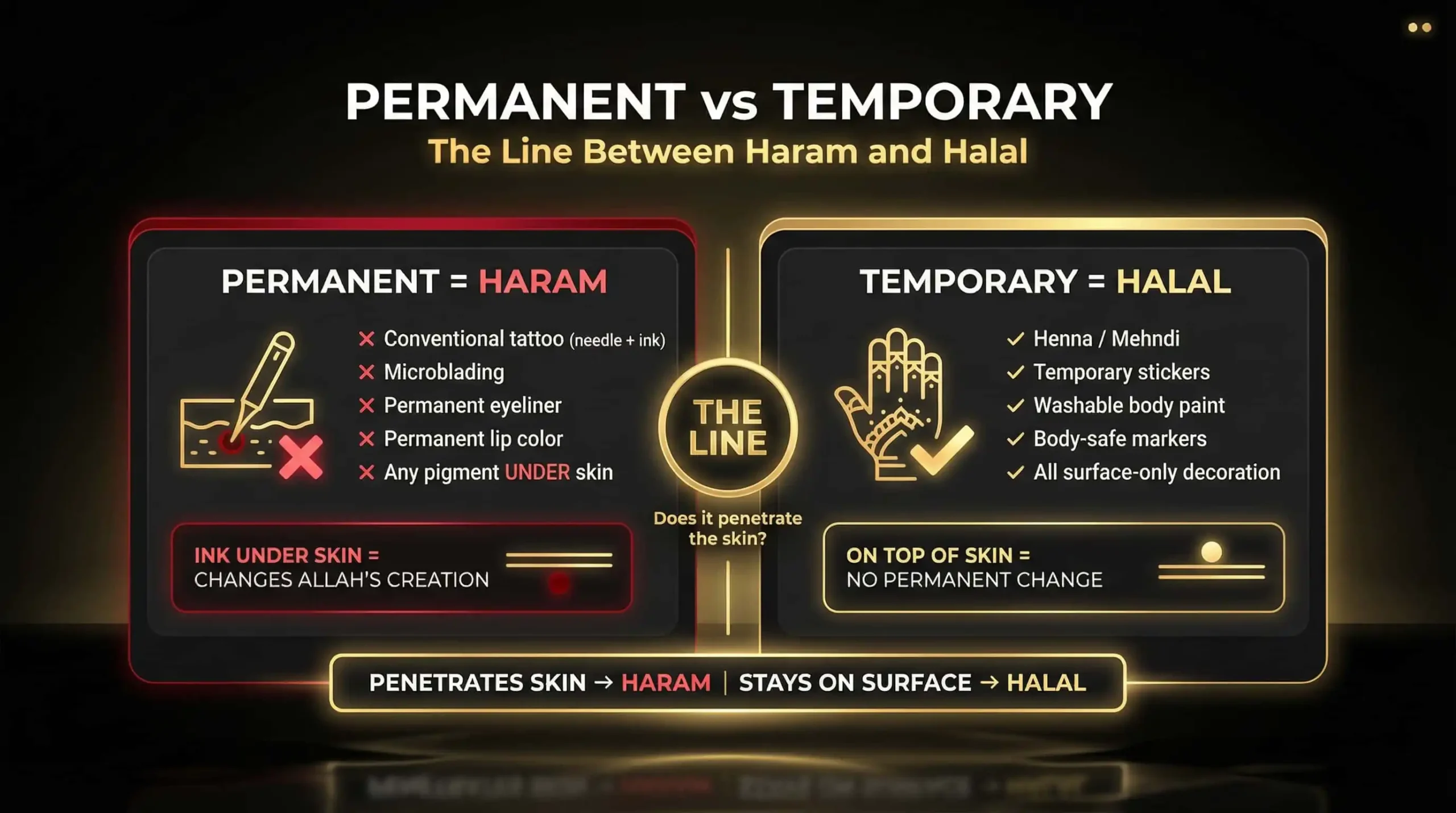
The most important one is permanence. Islam does not prohibit body art as such, but permanent modification.
Permanent Tattoos — Haram
The ruling on permanent tattoo in Islam is unambiguous. Any form of putting ink in the skin that leaves a permanent mark makes the tattoo haram. This takes into consideration traditional needles, machines or novel techniques that attain same permanent change. So are tattoos haram in every form? When permanent — without exception. Even asking ‘is a small tattoo haram’ receives the same answer — yes.
Temporary Body Art — Permissible
A temporary tattoo in Islam is permissible as long as it meets certain conditions. The ones placed on the skin surface and washed off are halal. The distinction of henna vs tattoo in Islam is fundamental. The most common example is the henna (mehndi) which is very acceptable in the Islamic culture. Washable body paints and temporary stickers are not an exception.
Important Conditions for Temporary Decoration
Even temporary art has to be Islamic: it should avoid the depiction of living beings, other religions symbols, and be modest. The key rule for a temporary tattoo in Islam is that it must not penetrate the skin. Prophet Muhammad (ﷺ) allowed henna and temporary adornment. These forms are permissible as long as guidelines are followed.
| Type | Method | Ruling | Reason |
| Conventional tattoo | Needle + coloring matter under the skin | Haram | Changing Allah’s creation permanently. |
| Henna / Mehndi | Natural color on the skin surface | Halal | Temporary, and natural. |
| Stickers on skin designs | Adhesive designs | Halal | No penetration. Temporary tattoo in Islam — halal. |
| Washable body paint | Surface paint | Halal | Completely washed off. |
| Microblading | Semi permanent pigment under skin | Haram | Causes permanent change under the skin. Permanent tattoo in Islam = haram. |
| Permanent makeup | Cosmetic pigment injected under skin | Haram | Permanent pigment placement makes it haram. |
The henna vs tattoo in Islam comparison shows a clear dividing line: skin penetration.
Modern Cosmetic Procedures: Microblading, Permanent Makeup, and Medical Tattoos
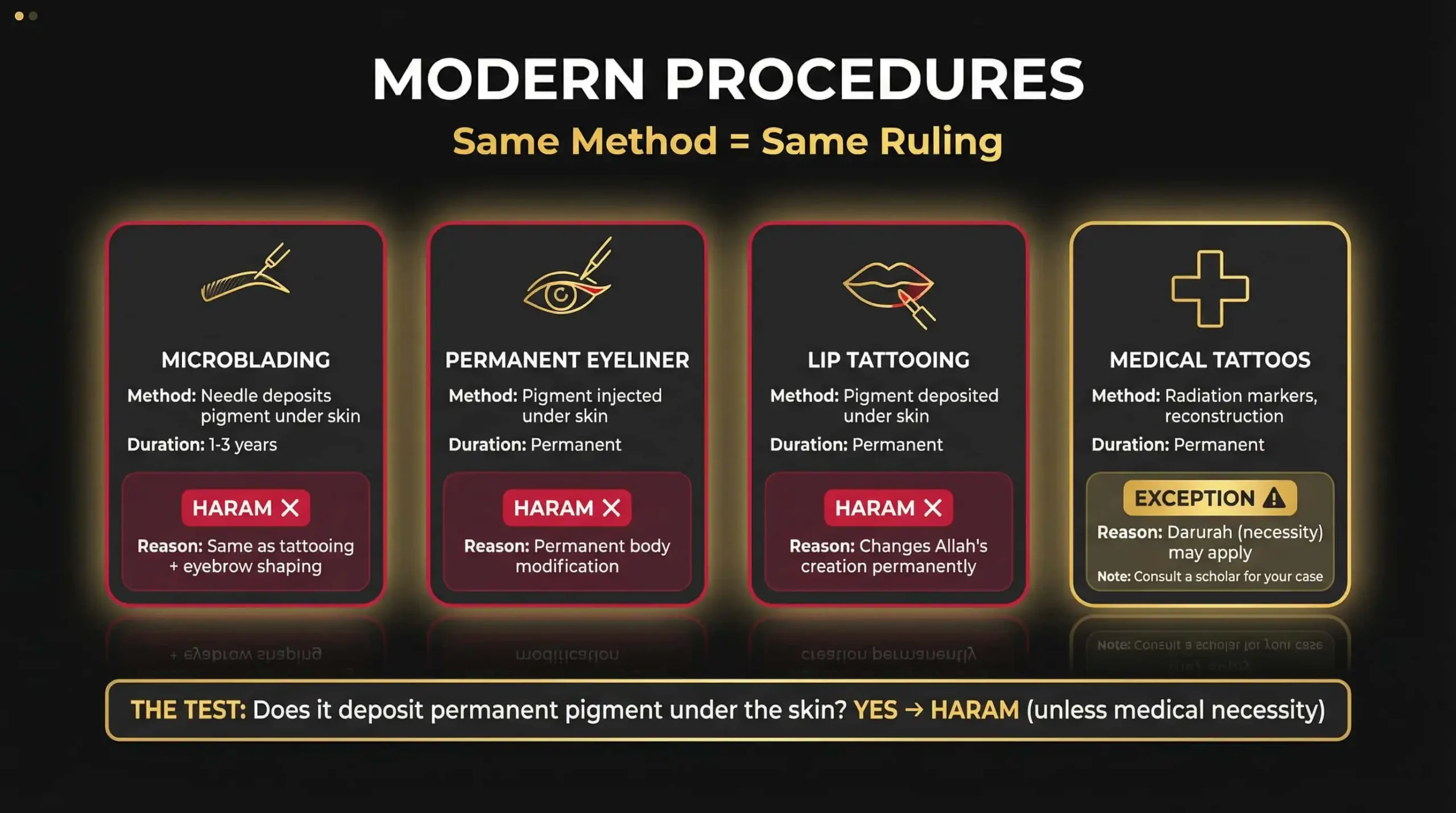
Modern cosmetic procedures often mirror traditional tattooing methods. The majority of contemporary practices employ the same basic method as the older tattooing, which is confusing. They carry the same ruling.
Is Microblading Haram?
Yes, microblading is haram. Microblading uses a fine needle to deposit semi-permanent pigment under the skin and forms hair-like lines, which last one to three years. Eyebrow tattooing through microblading is haram because it changes the skin by penetrating it. It is also associated with the shaping of the eyebrows which the hadith is concerned with. Whether for eyebrows or any area, microblading is haram.
Permanent Lip and Eyeliner Tattooing
Permanently tattooed lips or eyeliner is no different on that one is considered haram as it changes the body permanently. The permanent pigment placement makes it haram. These cosmetic procedures fall under the same ruling.
Medical Tattoos and Reconstructive Procedures
On medical grounds, particularly when tattoos are used as radiation indicators or to rebuild the areolae when the breast is mastectomized, they do not belong in the same category and are not forbidden.
Darurah or necessity is a principle that is considered in Islamic jurisprudence as circumstances that provide authorization to otherwise banned actions when the medical need is in genuine need. The principle of necessity (darurah) may apply in genuine medical cases. Scholars’ opinion varies slightly on medical necessity. Other researchers allow medical tattoos based on this principle, particularly in cases where there is no alternative option and the objective of the procedure is restorative, and not cosmetic. Nevertheless, people in such cases are supposed to seek a fatwa from a qualified Islamic scholar so that they would get advice depending on their particular case.
Do Tattoos Affect Prayer and Wudu?
This is a question of ritual purity (tahara). The relationship between tattoo and wudu is one of the most common concerns. This is one of the major fears of Muslims with tattoos and the response is very relieving.
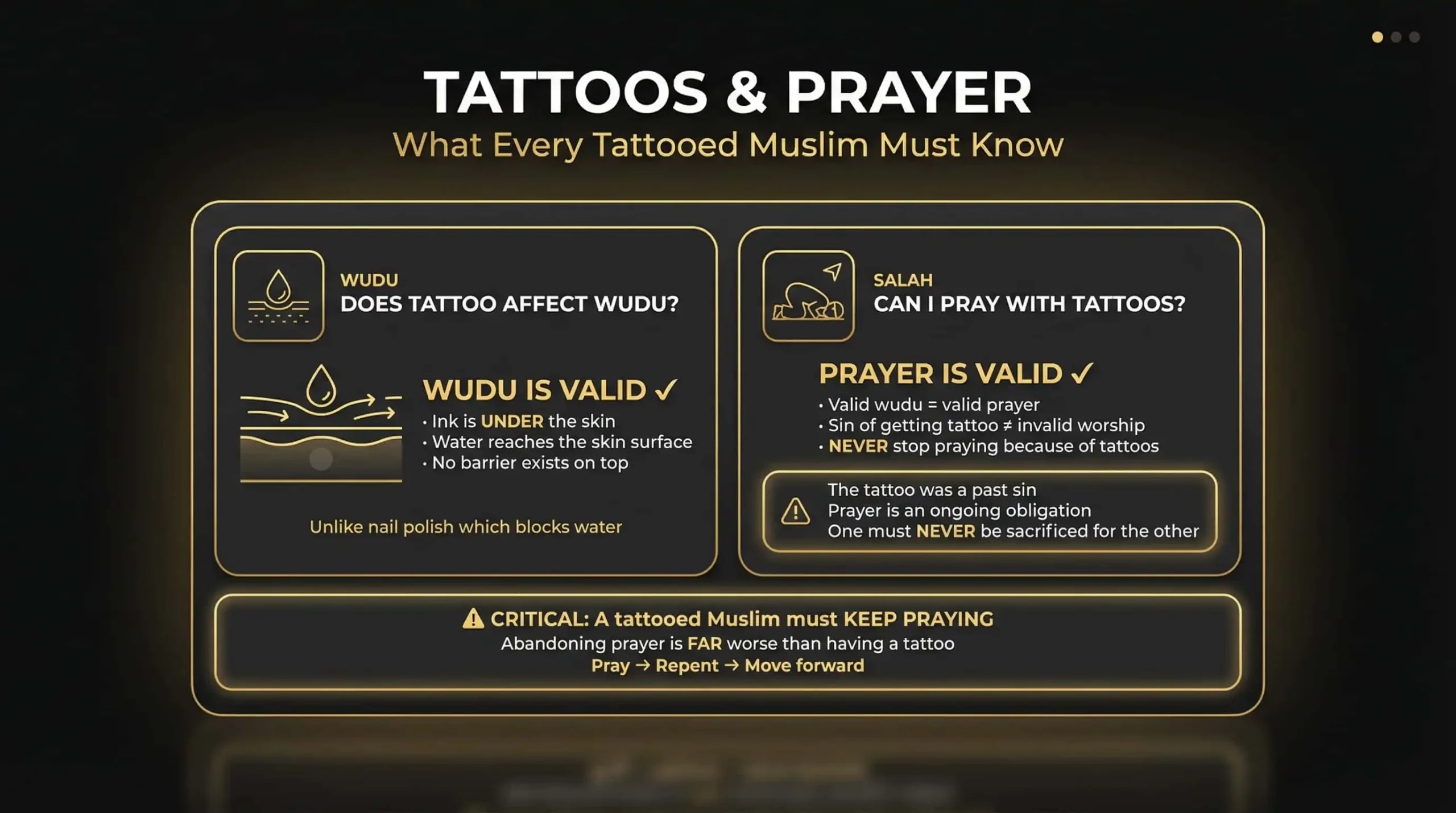
Tattoos have no effect on wudu (ablution). The color of a tattoo is placed under the skin. It does not form a layer over the skin whereby water is not absorbed by the skin during wudu. The tattoo and wudu question is settled: wudu remains valid. This is unlike the cases of substances such as nail polish or thick layers of cosmetics which lie on the surface of the skin and can keep the water off.
Tattoos do not nullify the prayer (salah). Yes, you can pray with a tattoo. The wudu has not been annulled thus, prayer with correct wudu is also valid. The sin of receiving the tattoo is a different thing all together and the validity of one worship.
Can I pray with a tattoo? Absolutely. This difference is of paramount importance. Understanding the tattoo and wudu ruling should bring relief. A Muslim with tattoos should not give up praying due to tattoos. One of the five pillars of Islam is prayer and dropping them is much more grave than the sin of tattooing. The tattoo is a reminder of some past error. Prayer is a continuous responsibility and bondage with Allah. The one should never be sacrificed at the expense of the other.
The tattoo ink that was under the skin will not in any way interfere with the ritual purity of a person (tahara). The requirement is met when water is used during ablution on the skin surface. So tattoo and wudu do not conflict. This is completely unlike a physical barrier that is located on top of the skin.
What If You Already Have Tattoos?
This part is aimed at the audience who already has tattoos, and they want to know what Islam has to say about it. In the response, the answer is full of hope and mercy.
Tattoos Gotten Before Knowledge or Before Accepting Islam
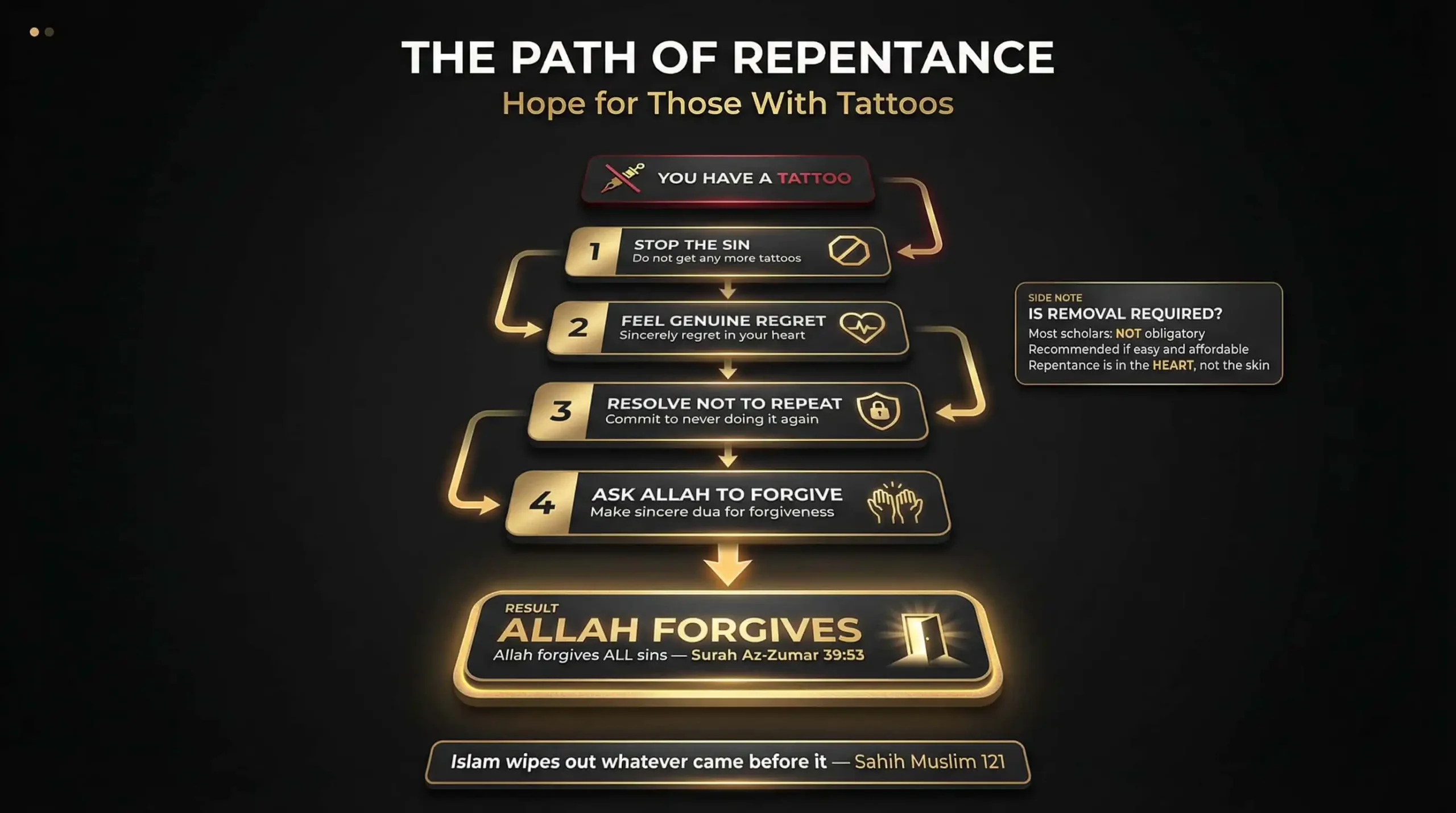
In case you got tattoos before you even knew they were haram, or before you joined Islam, then you have no sin on account of those things that you did. The Islam religion teaches that an individual is not answerable to what he or she was unaware of. By one accepting the Islamic faith, all the past sins are absolved. The Prophet Muhammad (ﷺ) said:
الإِسْلاَمُ يَجُبُّ مَا كَانَ قَبْلَهُ
Islam wipes out whatever came before it.
— (Sahih Muslim, 121)
It is not mandatory that you remove your already existing tattoos, particularly when doing so would result in pain, scarring, high cost and health complications.
The Path of Repentance (Tawbah)
Tattoo forgiveness in Islam is fully attainable through sincere repentance. To the people who had tattoos and were aware of the ruling, the gate of repentance is very open. Allah says in the Quran:
قُلْ يَا عِبَادِيَ الَّذِينَ أَسْرَفُوا عَلَىٰ أَنفُسِهِمْ لَا تَقْنَطُوا مِن رَّحْمَةِ اللَّهِ ۚ إِنَّ اللَّهَ يَغْفِرُ الذُّنُوبَ جَمِيعًا ۚ إِنَّهُ هُوَ الْغَفُورُ الرَّحِيمُ
Say, ‘O My servants who have transgressed against themselves, do not despair of the mercy of Allah. Indeed, Allah forgives all sins. Indeed, it is He who is the Forgiving, the Merciful.’
— (Surah Az-Zumar, 39:53)
This verse is the ultimate proof that tattoo forgiveness in Islam is real. The terms of hearty repentance are simple. Quit the sin, i.e. do not take any more tattoos. Regret it in your heart that you did it. Determine never to do the same again. And repent Allah with hearty supplication entreating his forgiveness. Tattoo repentance in Islam follows the same conditions as repentance for any sin. Allah is Al-Ghafoor (the Most Forgiving) and At-Tawwab (the Acceptor of Repentance).
Is Tattoo Removal Required?
The question of tattoo removal in Islam comes up frequently. The experts are divided on the issue of whether removal is compulsory, although most stand is that removal is not compulsory when doing so would cause great harm, cost, suffering or scarring. Scholars’ opinion is that removal is recommended but not obligatory. Laser-related modern tattoo removal is costly, involves numerous procedures, is painful, and may cause permanent scarring. Any kind of coercion to have such a procedure would result in more harm than the tattoo.
When removal is not difficult to get, cheap and does not impose harm then it is recommended but not an obligation as perceived by most scholars. Tattoo removal in Islam is recommended when feasible but not obligatory. It must be focused on genuine internal repentance. The process of acquiring the tattoo was a sin. That sin is washed out by true tawbah (repentance), not necessarily by carnal peel. Tattoo forgiveness in Islam depends on the heart, not on removal.
Tattoos do not render a person a bad Muslim and ostracize him/her out of the Muslim community. All humankind commits sins, and the largest and the greatest of sinners is the one who repents. The gate of repentance is never closed and Allah is merciful of everything.
Halal Alternatives to Tattoos
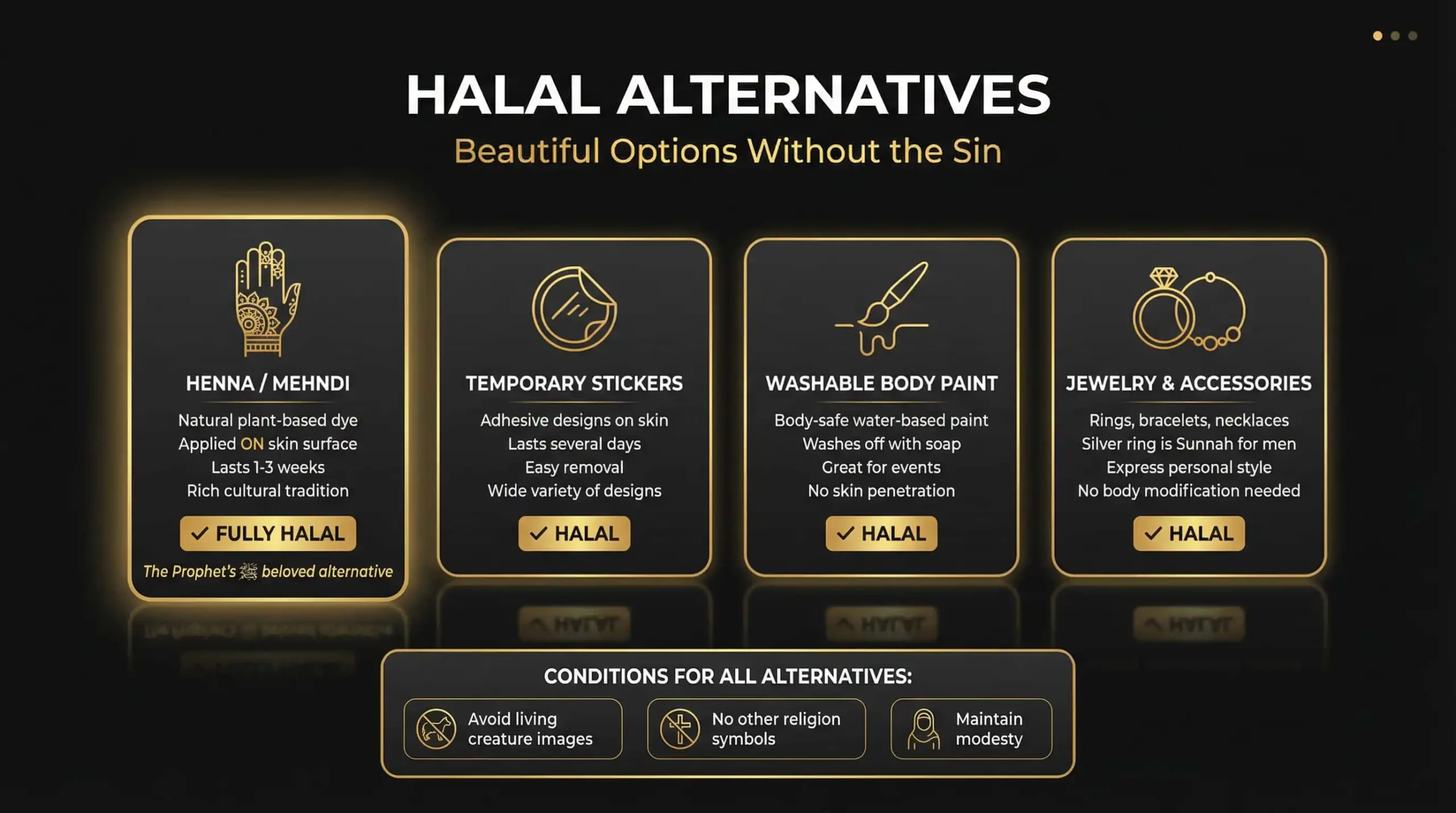
For those seeking beautification, there are permissible options. In the cases of Muslims who feel like decorating their bodies and expressing themselves, there are a number of acceptable options that do not entail permanent body modification.
The most favored and cultural alternative is henna (mehndi). Henna is fully permissible in Islam and has been in Muslim culture since centuries particularly during weddings and other celebrations. When comparing henna vs tattoo in Islam, henna wins on every count. It comes in different natural colors, lasts one to three weeks and leaves no traces after the expiry. The henna designs that can be made are elaborate and provide a form of art that can compete with a tattoo.
There are also temporary tattoo stickers that are easily found with numerous designs. These represent the safest form of temporary tattoo in Islam. They are stuck to the surface of the skin, have a duration of several days and are repelled with the help of rubbing alcohol or baby oil. Do not have the design of a living creature or any religious icons of other religions.
An alternative to this could be body-safe washable markers and paints that can be used in case of an event or self-indulgence. They entirely cleanse themselves in soap and water and have no problems in terms of an Islamic view.
There is no permanent body modification because jewelry and accessories create a permanent self-expression. Personal style can be given through rings, bracelets, necklaces, and anklets, although within Islamic guidelines. To men, a silver ring is a Sunnah of the Prophet Muhammad (ﷺ).
In any case of the alternative adopted, Islamic principles should be upheld on modesty, suitability of contents and evasion of emulating other religions.
Must Watch: Are Tattoos permissible in Islam? What to do if we already have Tattoos? – Assim al hakeem
Frequently Asked Questions
Is a small tattoo still haram?
Is a small tattoo haram? Yes. The ruling is not influenced by the size of the tattoo. It has been banned permanently as to permanently tattooing the body with injected color, whether it is a single dot or a full sleeve. No size makes a permanent tattoo permissible. The question ‘is tattoo haram’ applies regardless of size.
Is the big or little sin in Islam, the tattoos?
Researchers view tattoos as a great sin (kabira). This is due to the fact that the Prophet Muhammad (ﷺ) cursed those who believed in it. The act is cursed by the Prophet, confirming its gravity. One of the obvious criteria of a major sin (kabira) is the existence of a prophetic curse. Therefore, the ban is no frivolous taste, but a grave one. This also explains why are tattoos haram at such a serious level.
Can I pray if I have tattoos?
Yes, absolutely. Tattooing is not a contradiction of wudu or prayer. The ink does not affect ablution (wudu). The ink is placed under the skin and water does not prevent percolating to the skin surface during ablution. Ritual purity (tahara) is maintained with tattoos. You can pray with a tattoo and your prayer is fully valid. A tattooed Muslim must never drop his prayer. Keep on with the duty to Allah and repent the tattoo at another time.
Does Islam have a henna like a tattoo?
No. There is a fundamental difference between henna and tattoos. Henna (mehndi) is the traditional and beloved alternative. Henna is a natural dye used on the surface of the skin and it fades and does not leave within few weeks. It does not enter under the skin and make an indelible mark. The henna vs tattoo in Islam debate is settled by the method of application. The henna is fully acceptable and has a long history within the Muslim cultures.
Eyebrow tattoos and microblading?
Both eyebrow tattooing and microblading are haram. They insert pigment beneath the skin with needles which is functionally similar to tattooing. Both are classified the same way — microblading is haram. They also include carving the eyebrows which is also prohibited in the same hadith that prohibits tattoos. The hadith also addresses eyebrow tattooing (nams).
My tattoo contains the name of Allah or one of the verses of the Quran. Is that acceptable?
This, in fact, is worse than an ordinary tattoo. Besides the general taboo, by writing sacred names or Quranic verses on the body, one is importing them to the impurity of the bathroom. This is a lack of respect to the holy book. Though it may be a devotional intention, the act leads to greater rather than lesser sin.
Does tattooing Muslims put them out of the religion?
No. Tattooing is a sin but it does not amount to kufr (disbelief) and it does not disaffiliate an individual to Islam. A Muslim with tattoos is still a Muslim and would still be required to perform all the Islamic functions. Nevertheless, when one says that the prohibition of the Prophet is unjust or wrong, it may be a worse problem with such attitude to prophetic authority.
Summary
The Islamic ruling on tattoos is evident and well developed. Tattoos on the body are haram as there are several authentic hadiths where the Prophet Muhammad (ﷺ) swore at the tattoo maker and a tattoo taker as well. Authentic collections including Sahih al-Bukhari confirm the prohibition. The ruling on tattoos in Islam is built upon multiple layers of evidence. The ban has its foundation on the wisdom of safeguarding the creation of Allah, not mutilating the body in a negligent manner, and adhering to the instructions of the prophets.
The prohibition rests on the gravity of changing the creation of Allah. Tattooing is classified as a major sin (kabira). A permanent tattoo in Islam remains prohibited regardless of intention. This decision is applicable to the contemporary cosmetic procedures, including microblading — microblading is haram as confirmed by scholars — and permanent makeup, which require the same fundamental method of permanent pigment deposition under the skin. Every Muslim should understand that tattoo is haram in Islam based on authentic evidence.
In the meantime, it is not forbidden to use alternative options like henna, as they provide Muslims with a beautiful and culturally-oriented manner of body decoration. Halal alternatives like henna and mehndi remain the most popular permissible options. Those who already had tattoos have nothing to despair. Tattoo and wudu are not in conflict — ablution and prayer remain valid. Those who pray with a tattoo should know their worship is accepted. Tattoo removal in Islam is not a prerequisite for repentance. The door of repentance (tawbah) is always open. Tattoo repentance in Islam is always available through Allah’s mercy. The mercy of Allah is immense and He is the Most Forgiving. Both the Quran and Sunnah support this ruling.
In case you have tattoos, do not allow them to separate you and your religion. Continue praying, continue to grow and have faith in infinite mercy of Allah. In case of any doubt regarding a certain personal situation, contact a competent scholar, he/she can advise you in your case.