Over two billion individuals on the planet consider themselves Muslim, and the majority of lists found online about interesting facts of Islam are repeating the five superficial bullet points. The religion which gave rise to algebra, created the first university in the world, and who praises Jesus as a prophet is worth a closer examination. If you have ever searched for interesting facts about Islam religion or fun facts about Islam religion, you will find that most results barely scratch the surface.
The material of this collection unites more than fifty thought-provoking and interesting facts of Islam covering beliefs, history, science, culture and modern life, all of which are supported by the Quran, hadith that is recognized, or by the accepted scholarship. Whether you are looking for interesting things about Islam for a research project, trying to understand the Muslim family living next door, or you simply love learning, this information is going to redefine what you knew. By the time you finish reading, you will have encountered more Islam interesting facts than any other single resource provides.
Quick Answer: Islam is a monotheistic Abrahamic faith and it has a population of over two billion. Islam is a term that is translated from Arabic to mean voluntary submission to God. Muslims also have the Five Pillars, that are Shahada, Salah, Zakat, Sawm, Hajj, and consider Quran to be the last revelation of God to all humanity through Prophet Muhammad (ﷺ).
All the claims below are Quranic and are cited with chapter and verses, validated collections of hadith with reference and grading or research by peers, which is the standard no other article on the subject has reviewed yet. All data reflects 2026 figures. When you come across fun facts about Islam religion elsewhere, check whether they come with sourcing this thorough — most do not.
This article includes: 🕌 Beliefs 📖 Quran ⭐ Pillars 👤 Prophet Muhammad 👩 Women 🔬 Science and Innovation 🤝 Interfaith 📊 Modern World.
What Is Islam? Quick Facts to Start With
Understanding Islam begins with three foundational questions and they include: what the word actually means, the size of the faith community, and the location where the Muslims reside all over the world. The responses to the three are generally shocking and form some of the most interesting Muslim facts you will encounter.
The Real Meaning of the Word Islam
The Arabic term Islam has a twofold meaning which is lost by most English versions. It comes out of the root s-l-m which renders us salam (peace). Religiously, Islam is translated to mean the voluntary submission of his or her will to God in a bid to find peace. The term Muslim, per se, simply means someone who is submissive to God.
That two-fold notion, peace by submission, is the core of all the Islamic activities. As-Salamu Alaikum (السلام عليكم) (peace be upon you), the usual Muslim greeting, is a derivative of the same word. Thus whenever two Muslims meet, they are greeting each other with a word which is entwined in the name of their religion. Among all the interesting facts of Islam, this linguistic connection between peace and submission is often the first one that truly resonates with newcomers.
Fast Fact: The word Islam, Muslim, and Salam all contain the same three-letter Arabic root: س‑ل‑م (s‑l‑m). The religion literally builds peace within the words.
What Will Be the Number of Muslims in the World in 2026?
The current world population of Muslims is more than two billion persons or about every fourth human being on earth. The Islamic religion is the second-largest religion in the world after Christianity and is generally considered to be the fastest-growing.
According to projections made by Pew Research Center, by the year 2050, Muslims will be the same as Christians in the number of people across the world. The Future of World Religions In a 2025 Pew study on religious switching, of thirteen nations studied, almost all adults who were raised Muslim still identify as Muslim, thus making Islam one of the highest retention rates of any major religion. Religious Switching Study 2025
| Religion | Estimated Followers (2026) | Share of World Population |
| Christianity | ~2.4 billion | ~30 % |
| Islam | ~2 billion | ~25 % |
| Hinduism | ~1.2 billion | ~15 % |
| Buddhism | ~500 million | ~6 % |
| Judaism | ~15 million | ~0.2 % |
The vast majority of opposing sources continue to refer to 1.5 to 1.8 billion — years-old numbers. This demographic reality alone qualifies as one of the most interesting Muslim facts available today.
Where Do Most Muslims Live? (Hint: It’s Not the Middle East)
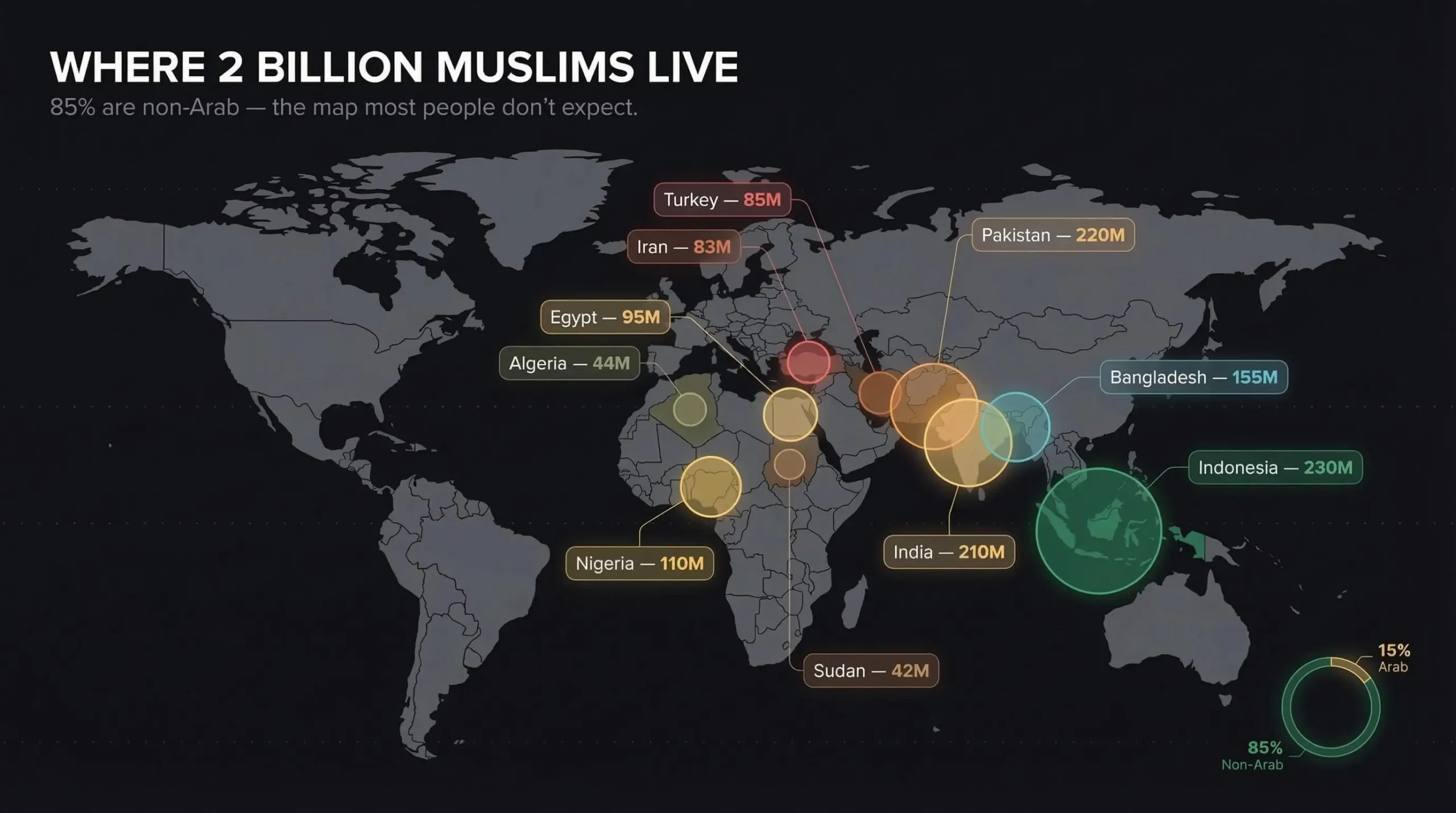
Indonesia is the single largest Muslim-majority country and is an archipelagic state of Southeast Asia in the form of more than 17,000 islands. Pakistan, India and Bangladesh follow close behind. Arabs are only approximately 20 percent of the number of Muslims in the world, that is, 85 percent of the Muslims are non-Arabs. Anyone compiling Islam interesting facts must start with this geographic reality, because it corrects the most widespread misconception about the faith.
| Rank | Country | Estimated Muslim Population (2026) | Region |
| 1 | Indonesia | ~230 million | Southeast Asia |
| 2 | Pakistan | ~220 million | South Asia |
| 3 | India | ~210 million | South Asia |
| 4 | Bangladesh | ~155 million | South Asia |
| 5 | Nigeria | ~110 million | West Africa |
| 6 | Egypt | ~95 million | North Africa |
| 7 | Turkey | ~85 million | Europe/Western Asia |
| 8 | Iran | ~83 million | Western Asia |
| 9 | Algeria | ~44 million | North Africa |
| 10 | Sudan | ~42 million | East Africa |
That table alone demolishes one of the longest-held myths about the faith — a subject that is discussed in depth in the myths section below.
Interesting Facts About Islam Religion: Muslim Beliefs
The theology of Islam is based on a rather concise system of fundamental beliefs. Imagine that Tawhid (the oneness of God) is a house, all the other beliefs and practices are constructed upon it. This section covers the most interesting things about Islam when it comes to what Muslims actually believe.
The Concept of One God (Tawhid) — The Most Important Belief in Islam
The complete oneness and uniqueness of God is known as Tawhid. Surah Al-Ikhlas which is one of the shortest chapters of Quran describes it in four verses:
“Say: He is Allah, the One. Allah, the Eternal Refuge. He neither begets nor is born, nor is there to Him any equivalent.” (Quran, Surah Al-Ikhlas, 112:1–4)
This is an indisputable concept in Islam, and Islam’s entire theological structure rests upon it. God is without partners, without children and without a body. The Arabic term Allah (الله) is simply the Arabic word for God — the same word Arabic-speaking Christians and Jews use in their prayers and scriptures. The distinction between cultural Islam and Islam as taught in the Quran begins here: Tawhid is non-negotiable.
The 99 Names of Allah — One Story in Every Name
Muslims are of the opinion that there are ninety-nine beautiful names of God (Asma ul-Husna, أسماء الله الحسنى) which characterize God in some way. The Prophet Muhammad (ﷺ) said:
“Allah has ninety-nine Names, one hundred minus one; whoever memorizes them all will enter Paradise.” (Sahih al-Bukhari, Hadith No. 2736 — graded Sahih/authentic)
Ar-Rahman (The most gracious), Al-Hakeem (The all wise), Al-Adl (The just), As-Sabur (The patient), Al-Wadud (The most loving). Every name makes the Muslims understand their relationship with God. This practice of knowing God through His names is among the interesting Muslim facts that often surprises people from other faith traditions.
Muslims Have Faith in All the Biblical Prophets
The Islam preaches that believers are supposed to honor, respect and believe in all the former prophets who existed before them: Adam, Noah (Nuh), Abraham (Ibrahim), Moses (Musa) and Jesus (Isa). The Quran says:
“The Messenger has believed in what was revealed to him from his Lord, and so have the believers. All of them have believed in Allah and His angels and His books and His messengers.” (Quran, Surah Al-Baqarah, 2:285)
The Quran mentions twenty-five prophets. Prophet Muhammad (ﷺ) is regarded to be the last messenger, not the sole messenger in this series. For anyone exploring interesting facts about Islam religion, this shared prophetic heritage is one of the most eye-opening revelations.
Every Muslim Has 6 Central Articles of Faith
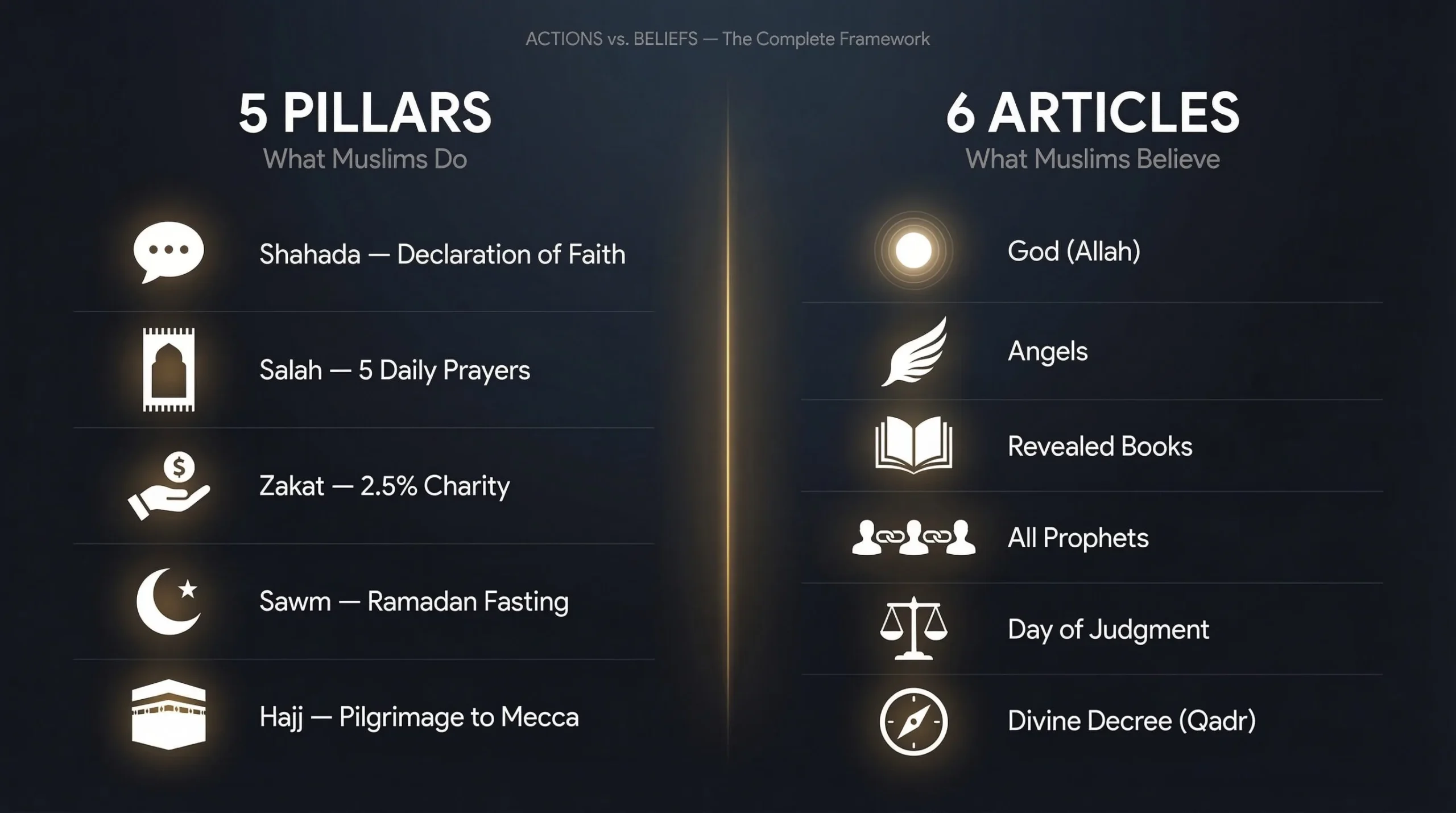
One of the more practical contrasts which most are unaware of: the Five Pillars demonstrate what Muslims practice; the Six Articles of Faith demonstrate what Muslims are certain of.
| Five Pillars (Actions) | Six Articles (Beliefs) |
| Shahada (Declaration of faith) | Belief in God (Allah) |
| Salah (Prayer) | Belief in Angels |
| Zakat (Charity) | Belief in Revealed Books |
| Sawm (Fasting) | Belief in Prophets |
| Hajj (Pilgrimage) | Belief in the Day of Judgment |
| Belief in Divine Decree (Qadr, قدر) |
These 6 beliefs are based on the well-known Hadith of Jibril in which the Angel Gabriel (Jibril) had appeared in human guise and inquired of the Prophet about the faith (Sahih Muslim, Hadith No. 8 — graded Sahih/authentic).
What Islam Teaches of Life After Death
Muslims are the believers of the Day of Judgment, everyone will be reckoned on his/her deeds, intentions, and decisions. The Quran says:
“Whoever does an atom’s weight of good will see it, and whoever does an atom’s weight of evil will see it.” (Quran, Surah Az-Zalzalah, 99:7–8)
Paradise (Jannah, جنة) is explained as a land of everlasting peace, meeting and fellowship with God. The fact that the weight of an atom matters makes Muslims think over every action, even the smallest. Among all the interesting facts of Islam regarding belief, this idea of atomic-level accountability stands out.
Fascinating Things About the Quran
The most discussed and least known aspect of Islam to most non-Muslims is the Quran. Here are some quick fun facts about Islam religion centered on the holy book:
| Detail | Fact |
| Total Chapters (Surahs) | 114 |
| Total Verses (Ayahs) | 6,236 |
| Revelation Period | 23 years (610–632 CE) |
| Original Language | Arabic |
| First Word Revealed | Iqra (اقرأ — Read) |
| Chapter with the largest number of verses | Al-Baqarah (286 verses) |
| Chapter Minimal Length | 3 verses, in Al-Kawthar |
How Long to Reveal the Quran?
The Quran was not provided at once. The revelation was initiated by Prophet Muhammad (ﷺ) when he was forty years old in 610 CE and completed in 632 CE in a total of twenty-three years. Muslims believe the first verses arrived on Laylat al-Qadr (ليلة القدر — the Night of Power), a night the Quran itself says is “better than a thousand months.” Verses were also based on response to certain situations and hence scholars analyze the asbab al-nuzul (occasions of revelation) and tafsir (Quran commentary) in order to have context.
The initial words that God told the Prophet were a command to read:
“Read! In the name of your Lord who created — created man from a clinging substance. Read, and your Lord is the Most Generous.” (Quran, Surah Al-Alaq, 96:1–3) quran.com/al-alaq/1-5
This order was issued to a man who could neither read nor write and hence it was a critical moment in the history of Islam. This single event often tops any list of interesting facts of Islam because it frames the entire religion’s relationship with knowledge.
The Quran Has 114 Chapters — But How Many Verses?
The Quran is composed of 114 chapters (surahs) which have 6,236 verses (ayahs). The name of each chapter is distinctive — Al-Fatiha (The Opening), An-Nas (Mankind), Ar-Rahman (The most gracious) — where the number of verses ranges between three and 286. These details rank among the most commonly searched Islam interesting facts.
There Are Millions of People Who Know the Whole Quran by Heart
The one who learns the Quran by heart is referred to as a Hafiz (plural: Huffaz). There are millions of Hafiz among Muslims worldwide. Prophet Muhammad (ﷺ) said:
“The best among you are those who learn the Quran and teach it.” (Sahih al-Bukhari, Hadith No. 5027 — graded Sahih/authentic)
Imagine learning to memorize a book like Harry Potter and the Sorcerer’s Stone and that you could memorize it word-to-word in a language of which most of these memorizers do not even speak as their first language. This oral tradition has preserved the Quran in its near-original form for more than fourteen centuries. When people ask for interesting things about Islam that they can verify, this living tradition of mass memorization is among the most remarkable.
Surah Maryam — An Entire Chapter in the Name of Mary
Surah Maryam is the 19th chapter of the Quran. It is named after the mother of Jesus, Mary. More frequently mentioned in the Quran than in the rest of the New Testament, Mary (Maryam) is the only woman referred to by name in the Quran (Quran, Surah Maryam, 19:16–34).
This fact usually catches the attention of Christians and Muslims who have never related the two texts with each other. It consistently appears in collections of interesting facts about Islam religion for precisely that reason.
Five Pillars of Islam: Simple Quick Facts Explained
These five pillars are the main activities which every Muslim ought to perform. Prophet Muhammad (ﷺ) said:
“Islam is built upon five [pillars]: the testimony that there is no god but Allah and that Muhammad is the Messenger of Allah, establishing prayer, giving zakat, performing Hajj, and fasting Ramadan.” (Sahih al-Bukhari, Hadith No. 8; Sahih Muslim, Hadith No. 16 — graded Sahih/authentic) sunnah.com/bukhari/2/1
Shahada — The Confession of Faith (One Sentence That Defines Islam)
Shahada is a sentence, in one word, which is: La ilaha illallah, Muhammadur Rasulullah (لا إله إلا الله محمد رسول الله) — “There is no God but God, Muhammad is the Messenger of God.” This is all that needs to be said sincerely and with faith to become a Muslim. No ceremony, no intermediary, no charge. The simplicity itself is one of the most unusual yet unique interesting facts of Islam that surprises first-time visitors.
Salah — The Five Times of Muslim Prayer
Salah (five daily prayers) will be performed at dawn, noon, mid-afternoon, sunset, and night. All the two billion Muslims of the world who pray face the same direction — Mecca, which is the Kaaba. The prayers vary daily depending on the position of the sun which provides a definite astronomical time to each prayer. The bodily gestures — standing, bowing, prostrating — do not differ between the king and the worker and the CEO and the street vendor. An imam (prayer leader) guides congregational prayers, though any knowledgeable Muslim can lead.
Before each prayer, Muslims perform wudu (ritual washing of hands, face, and feet), a practice that merges physical cleanliness with spiritual readiness. Outside the five daily prayers, Muslims also make personal supplications called dua — informal conversations with God at any time. This prayer structure reflects Islam and leadership in daily spiritual practice, as every congregation selects a leader based on knowledge rather than wealth or status.
Zakat — Giving 2.5% Wealth to the Poor Each Year
Zakat (obligatory charity) requires the Muslim who has sufficient wealth to donate 2.5 percent of his or her savings annually to the needy. This is not the charity of the generous — it is a foundation of the religion and the systematic method of the redistribution of wealth, which is more ancient than the welfare of the present day by many centuries. Beyond Zakat, the waqf (وقف — charitable endowment) system funded mosques (masjid), schools, and hospitals for centuries — a model of sustainable Islamic philanthropy.
Did You Know? 💡 If every able Muslim paid Zakat right, some economists claim it would generate between $200 billion and $1 trillion a year for poverty relief throughout the world.
Sawm (صوم) — Fasting During Ramadan (and What 2026 Ramadan Looks Like)
Muslims also fast between day and night during Ramadan; there is no food, no water, no smoking. The reason is explained in the Quran:
“The month of Ramadan [is that] in which the Quran was revealed, a guidance for the people.” (Quran, Surah Al-Baqarah, 2:185)
Ramadan 2026 will start on the 18th of February, 2026. The Islamic calendar is based on the lunar cycle which means that Ramadan changes approximately eleven days earlier every year. Muslims in the northern cities such as London and New York will be fasting about twelve hours a day in the month of February and the Muslims towards the equator will be fasting approximately the same hours throughout the year. The present Islamic year is 1447 AH.
Hajj — The Largest Yearly Congregation on Earth
Hajj is the annual pilgrimage to Mecca that all Muslims have to make at least once in their life as long as they are physically and financially able to do it. Approximately two or three million Muslims converge in Mecca annually, as though the Super Bowl and Glastonbury and the Olympics were all one big festival, and everybody is dressed exactly alike. The pilgrims are dressed in plain white clothes (called ihram, إحرام) with no logos, no brands and no evidence of wealth. One of the richest people is next to a farmer. Hajj 2026 is supposed to be held between May 25 and May 30.
The Kaaba is in the middle of this assemblage, inside Masjid al-Haram (المسجد الحرام), the Grand Mosque in Mecca, and here is a curious circumstance — the interior of the building is essentially empty — a marble floor, a few columns, and lights suspended. The building is not worshiped by Muslims; it is merely used to indicate the direction (qibla, قبلة) to pray. That emptiness reminds worshippers to direct all focus toward God alone. The entire Hajj experience is a powerful illustration of Islam and leadership through service, humility, and equality.
Prophet Muhammad: Facts That May Surprisingly Amaze You
Prophet Muhammad (ﷺ) is the focal human character of the Islam religion but most non-Muslims and even some Muslims know very little about his life other than that he was a messenger. Below are interesting facts of Islam centered specifically on his biography.
He Could Not Read or Write
According to the Quran Muhammad (ﷺ) is referred to as the unlettered Prophet (an-nabiyy al-ummi, النبي الأمي) (Quran, Surah Al-Araf, 7:157). The very initial word of revelation was Iqra (اقرأ) — read! — to a man who had never known how to read (Quran, Surah Al-Alaq, 96:1). The learned have indicated that this further makes the literary quality of the Quran even more striking as a testament to its divine revelation.
His First Wife Was a Successful Businesswoman
Khadijah bint Khuwaylid was a well-off and a well-respected businesswoman in Mecca. She employed the young Muhammad as a trade caravan manager, was fifteen years his senior, and proposed marriage to him. He was twenty-five years of age; she was forty. Khadijah was the first person to accept Islam, and they got married and had twenty-five years together, after which she passed away. She is still one of the most respected women in the history of Islam. Her story is a clear example of Islam and leadership exercised by women from the very inception of the faith.
His Good Nature to Animals Is Well Recorded
There are numerous reports on the kindness of the Prophet to animals. One of the narrations states that a woman was told all her sins were pardoned because she gave water to a dog that was thirsty (Sahih al-Bukhari, Hadith No. 3321 — graded Sahih/authentic). There is another tale that proscribed overloading of animals or sporting on those.
Did You Know? 💡 The Islamic law has specifications on animal welfare: no cruelty, animals should have enough food and water, and hunting for fun is prohibited. These teachings also extend to the treatment of livestock, and scholars note that regulations covering everything from humane slaughter methods to the permissibility of products like dry beef bones powder and liver use in Islam demonstrate how thoroughly the faith addresses animal-related matters.
His Farewell Sermon Concerned Human Rights
The Prophet preached to more than 100,000 people in 632 CE during his last pilgrimage. He preached of racial equality (“No Arab is superior to a non-Arab, and no non-Arab is superior to an Arab”) and the rights of women, and the sanctity of life and property, and the prohibition of usury — topics on which the modern world would not legislate until thirteen centuries later. The sermon remains one of the most studied examples of Islam and leadership, showing how the Prophet used his final public address to enshrine universal human rights.
Surprising Truths: Women in Islam
Eight of the top ten articles about interesting facts of Islam do not mention anything about women. Even the silence is distorted.
The World’s First University Was Founded by a Woman
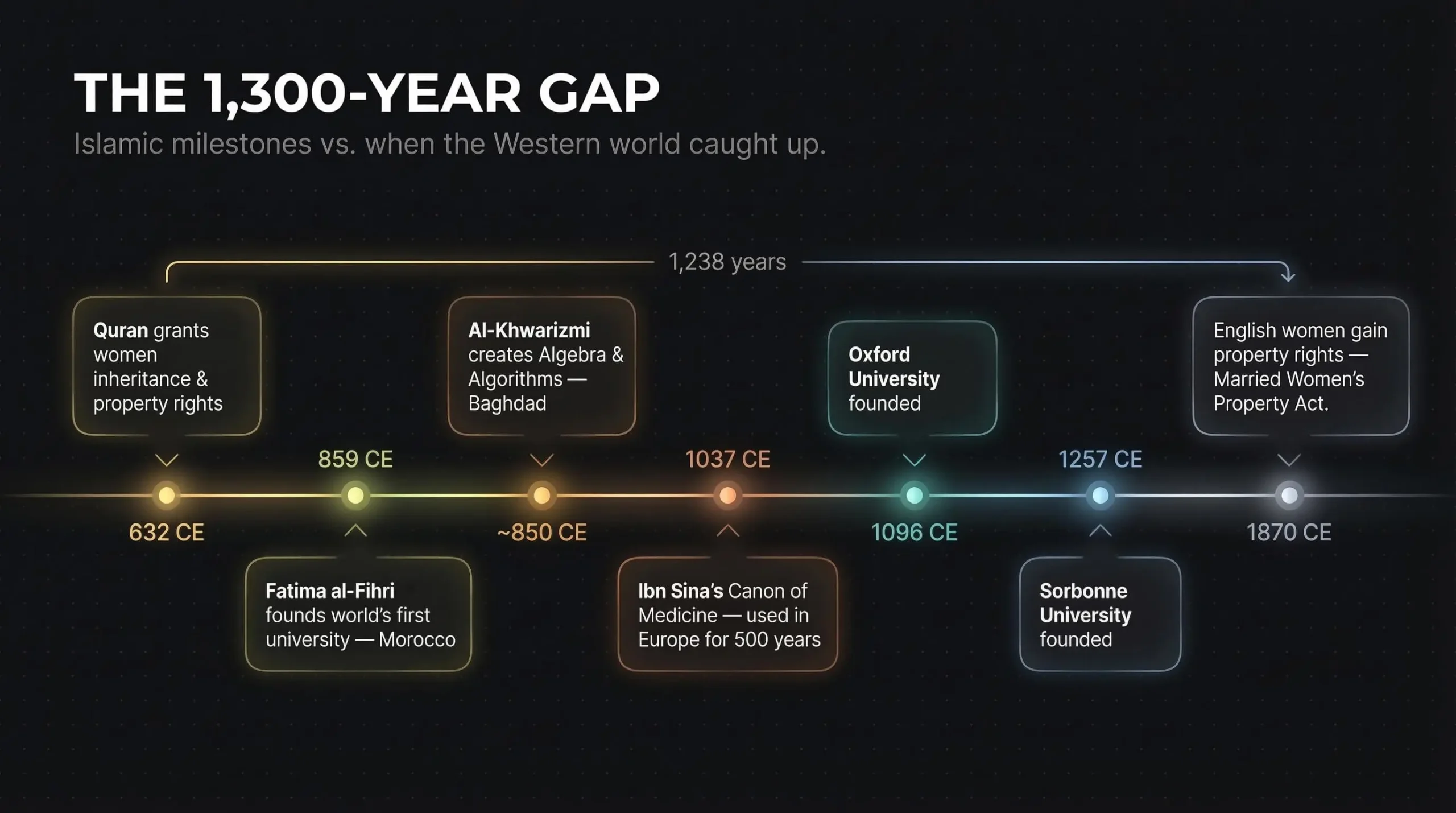
Fatima al-Fihri opened the University of al-Qarawiyyin in Fez, Morocco in 859 CE. According to UNESCO and Guinness World Records, it is the oldest university that has continued to issue degrees ever: University of al-Qarawiyyin. It had pupils, and awarded degrees far earlier than Oxford in 1096, or the Sorbonne in 1257.
When one speaks about Islam oppressing women, then this fact begins another debate entirely. It is also a vivid case study in Islam and leadership, proving that women held institutional authority at the dawn of higher education.
Islam Provided Women with Property Rights 1,300 Years Before the West
The Quran indicates that women are also able to inherit and possess property:
“For men is a share of what the parents and close relatives leave, and for women is a share of what the parents and close relatives leave.” (Quran, Surah An-Nisa, 4:7)
This was happening in the 7th century. It was not until 1870 that English women were allowed to own property independently through the Married Women’s Property Act, some 1,300 years later. This timeline gap is one of the most powerful interesting facts of Islam regarding gender.
Aisha Was One of the Greatest Scholars in the Islamic Faith
Aisha bint Abu Bakr narrated approximately 2,210 hadith, making her one of the most prolific hadith transmitters in Islamic history. Senior male companions of the Prophet sought her advice on law, theology and medicine. According to modern standards, she was a popular philosopher and a law expert. Her scholarly authority is among the interesting Muslim facts that challenge stereotypes about women in the religion.
The Mind-Boggling Facts of the Islamic Golden Age
The period of the Islamic Golden Age lasted between approximately the 8th century and the 14th century. It resulted in numerous discoveries of science, medicine, and math that formed the modern world. It is not that they were small side projects — they were foundational. Anyone collecting Islam interesting facts must devote serious attention to this era.
“Seeking knowledge is an obligation upon every Muslim.” (Sunan Ibn Majah, Hadith No. 224 — graded Hasan/good by some scholars)
That spirit caused the entire society to invest in education.
Muslim Scientists Earned Wages Similar to Modern-Day Professional Sportsmen
The House of Wisdom (Bayt al-Hikmah, بيت الحكمة) in Baghdad, which employed scholars, translators, and scientists in the Abbasid Caliphate, paid the same wages to its workers as athletes are paid today. Caliphs used money to translate Greek, Persian, and Indian books and they would then urge scholars to produce new books. This caused a spurt in math, astronomy, medicine and philosophy. The caliphal investment model is a frequently cited example of Islam and leadership in intellectual patronage.
Algebra, Algorithms, and Chemistry — Words of Arabic Origin
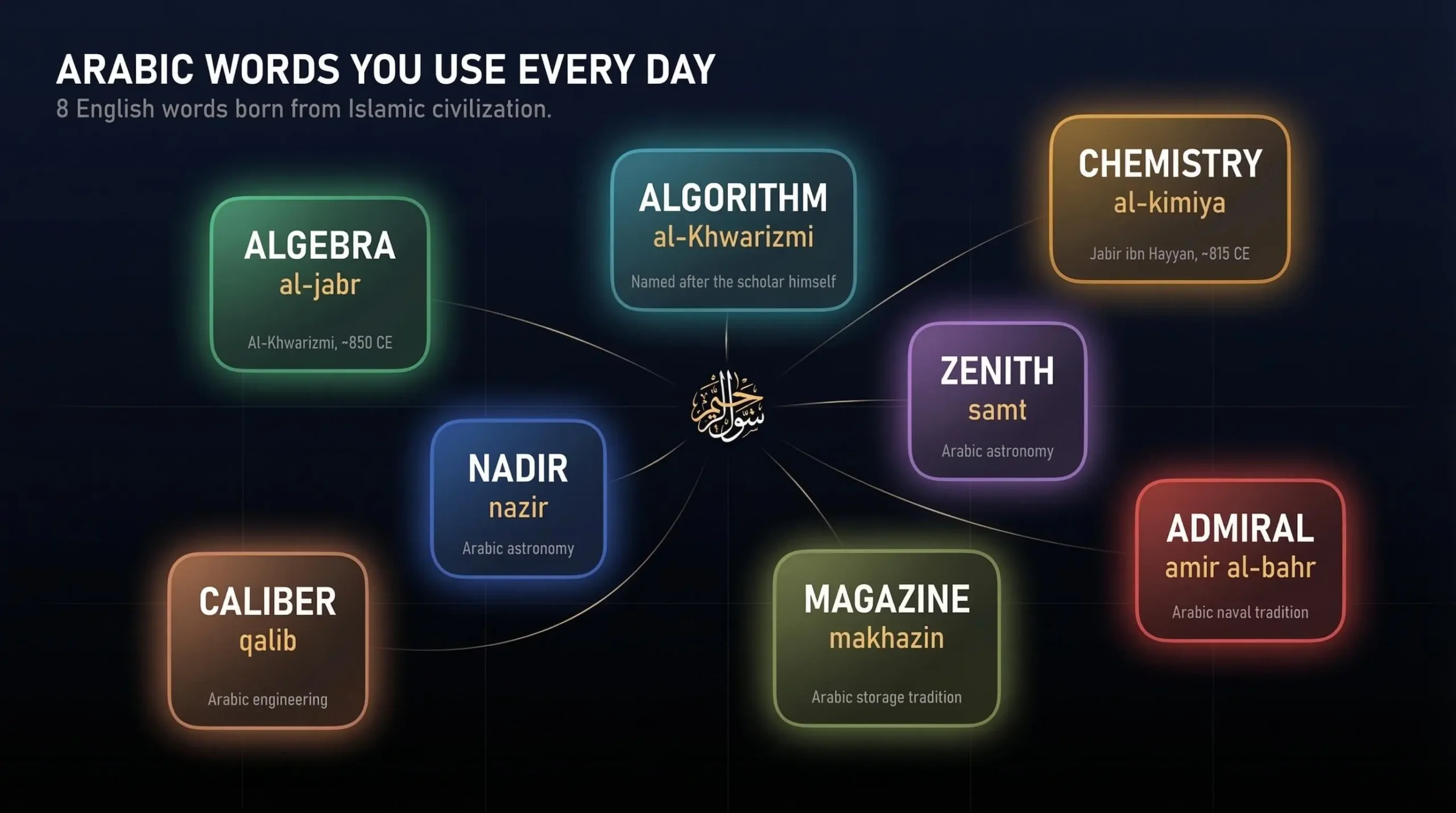
Scientific English has a great number of words of Arabic origin:
| English Word | Arabic Origin | Scholar Behind It |
| Algebra | al-jabr | Al-Khwarizmi (d. ~850 CE) |
| Algorithm | al-Khwarizmi (his name) | Al-Khwarizmi (d. ~850 CE) |
| Chemistry | al-kimiya | Jabir ibn Hayyan (d. ~815 CE) |
| Zenith | samt | Arabic astronomy tradition |
| Nadir | nazir | Arabic astronomy tradition |
| Caliber | qalib | Arabic engineering tradition |
| Magazine | makhazin | Arabic military/storage tradition |
| Admiral | amir al-bahr | Arabic naval tradition |
These etymological connections are among the most interesting things about Islam for students of language and history alike.
Islamic Innovations — The First Hospitals and Pharmacies
The first hospitals were constructed in the Islamic world by the name bimaristan way before Europe did. Hospitals in Baghdad and Cairo provided free treatment to all, regardless of religion and social status. Ibn Sina (Avicenna, d. 1037 CE) authored The Canon of Medicine that served as the text in European universities throughout the next 500 years. The Islamic world also produced the first trained pharmacists, who prepared their own medicines and worked together with doctors.
Pharmacists also catalogued the medicinal properties of animal-derived substances, and modern researchers note that topics such as dry beef bones powder and liver use in Islam trace their roots back to these early pharmaceutical traditions where every edible and medicinal substance was classified according to Islamic dietary law.
Coffee, Cameras, and Clocks — Muslim World Inventions
Coffee originated in Ethiopia and Yemen and Sufi monks were also early drinkers. The father of modern optics, Ibn al-Haytham (d. c. 1040 CE), wrote of the camera obscura and pioneered the experimental scientific method, which later benefited Roger Bacon and the Renaissance. In the 12th century, al-Jazari constructed sophisticated clocks and automatic machines that were constructed using mechanics.
Whenever you brew coffee, set a camera or the clock, you apply concepts that went through the hands of Muslims. These fun facts about Islam religion connect the ancient world to your morning routine.
Did You Know? 💡 One of the oldest universities which continues to operate and is the most renowned centre of Sunni Islamic learning is Al-Azhar University in Cairo, established in 970 CE.
Facts About Islam and Other Religions
There are numerous roots that are common to Islam, Christianity, and Judaism. Comparing Islam with its Abrahamic siblings reveals deep common ground. These comparative interesting facts of Islam show what they have in common and what they differ in.
The Abrahamic Connection Map
| Topic | Islam | Christianity | Judaism |
| Core Belief | Strict monotheism (Tawhid) | Trinitarian monotheism | Strict monotheism |
| Name for God | Allah (الله) | God / Yahweh / Jehovah | Yahweh / HaShem / Elohim |
| Founding Figure | Muhammad (ﷺ) | Jesus Christ | Abraham / Moses |
| Holy Book | Quran | Bible (Old and New Testament) | Torah / Tanakh |
| Role of Abraham | Father of prophets; built the Kaaba with Ishmael | Patriarch of faith | Patriarch of the Jewish people |
| Role of Jesus | Great prophet, Messiah (not God) | Son of God, Savior | Not recognized as Messiah |
| Most Mentioned Prophet in Quran | Moses (Musa) — approximately 136 times | Prophet and lawgiver | Greatest prophet; received Torah |
| Mary (Maryam) | Only female mentioned by name in Quran; entire chapter dedicated to her | Mother of Jesus | Not a major figure |
| Holy Sites | Mecca, Medina, Jerusalem (Al-Quds, القدس) | Jerusalem, Bethlehem, Rome | Jerusalem |
| Afterlife | Day of Judgment, Paradise (Jannah) and Hell | Heaven and Hell | Olam Ha-Ba (World to Come) |
| Dietary Laws | Halal/Haram system | Varies by denomination | Kosher laws |
| Direction of Prayer | Towards the Kaaba (Mecca) | No fixed direction | Towards Jerusalem |
| Shared Value | Charity as obligation (Zakat) | Charity as virtue (tithing) | Charity as obligation (Tzedakah) |
Islam, Christianity and Judaism — Three Religions, One God
The three religions trace their origin to Abraham (Ibrahim). They are the worshippers of the same God, the God of Abraham. The dissimilarities exist, yet the common origin is evident. Understanding the relationship between Islam and Islam’s Abrahamic counterparts is essential for anyone seeking a nuanced view of world religion.
Jesus (Isa) Is One of the Most Respected Prophets of Islam
Muslims hold the belief that Jesus (Isa) was a great prophet, the Messiah who was sent to Children of Israel, and was born of a virgin. He is not divine and is not a son of God. A whole Quran chapter (Surah Maryam, Chapter 19) is called after his mother.
Checkout: “Jesus in Islam” → Comprehensive guide on Jesus in Islamic theology
Moses Is the Prophet Who Has Been Mentioned Most in the Quran
Prophet Moses (Musa) appears by name approximately 136 times in the Quran, more than any other prophet including Muhammad. His account on liberation, leadership and law-giving is echoed all over the Islamic scripture. When people compare Islam and Islam’s prophetic narratives with those of Christianity and Judaism, Moses stands out as the bridge figure across all three traditions.
Christians and Jews Hold a Special Status — “People of the Book”
Christians and Jews are referred to by the Quran as Ahl al-Kitab (أهل الكتاب) or the People of the Book. They are known as societies which received previous religious texts. In an Islamic form of government, this position places upon them special theological and legal protections. This interfaith framework is among the most underappreciated interesting facts of Islam.
Interesting Facts of Islam: Culture, Daily Life, and Dietary Traditions
Billions of everyday lives, salutations, and customs are influenced by Islam in a way so that most of the people outside the religion are not aware. Below are interesting facts of Islam that touch on culture, food, and the rhythms of Muslim life around the world.
The Islamic Calendar Runs on Moonlight (Literally)
The Islamic (Hijri, التقويم الهجري) calendar is a purely lunar calendar. Every month begins each time that a new crescent moon appears and this makes the Islamic year roughly eleven days shorter than the Gregorian solar year. This is 1447 AH since the time the Prophet left Mecca and went to Medina in 622 CE.
Check Our: “Islamic calendar explained” → How the Hijri calendar works
The Quran itself references this system:
“Indeed, the number of months with Allah is twelve months in the register of Allah.” (Quran, Surah At-Tawbah, 9:36)
Muhammad Is the Most Popular Name on Earth
This is the most widely used given name in the world including all the spellings: Muhammad, Mohammed, Mohamed, Mohammad. In Arabic it means “the one that was praised.” For those compiling interesting Muslim facts, the global popularity of this single name is a testament to the religion’s cultural reach.
Arabic Calligraphy Is a Type of Art Considered to Be Holy
Since the Islamic doctrine does not encourage the depiction of living creatures in the religious context, Muslim artists dwell on calligraphy, geometric forms, and arabesques. The patterns are elaborate, and are found in mosques from Istanbul down to Córdoba to Isfahan, as a kind of worship by expressing mathematical accuracy. The minaret, the tall tower from which the call to prayer is given, is one of the most recognizable symbols of Islamic architecture.
The Interior of the Kaaba Is In Truth Empty
The Kaaba is a black cloth cube-shaped structure in the centre of the Grand Mosque of Mecca. Muslims do not worship the Kaaba per se but it is the direction of prayer (qibla). The inside is practically bare — a marble floor, several pillars, and suspended lamps — reminding worshippers to put their eyes upon God alone.
The Greeting: As-Salamu Alaikum, Translates to Peace Be Upon You
The greeting the typical Muslim will use is As-Salamu Alaikum (السلام عليكم), which literally means peace be upon you. The answer is Wa Alaikum As-Salam (وعليكم السلام): and on you, peace. The first word that exchanges between Muslims is peace which is based on the same root as the word Islam. Prophet Muhammad (ﷺ) said:
“He who believes in Allah and the Last Day should be hospitable to his guest.” (Sahih al-Bukhari, Hadith No. 6018 — graded Sahih/authentic)
Islamic Dietary Laws: Halal, Haram, and Everyday Questions
One of the areas of Islam that generates constant curiosity involves dietary regulations. The halal (حلال — permissible) and haram (حرام — forbidden) system governs what Muslims eat and drink. Pork and alcohol are prohibited, and meat must be slaughtered according to specific guidelines that include invoking God’s name. Beyond the well-known rules, Muslims frequently consult scholars on niche dietary questions. Searches about dry beef bones powder and liver use in Islam, for instance, reflect how thoroughly observant Muslims investigate ingredient sourcing, gelatin origins, and by-product permissibility to ensure compliance with Quranic and hadith-based guidelines. These everyday dietary considerations are among the interesting things about Islam that reveal how deeply the faith integrates into the mundane.
Myth vs. Fact: Common Misconceptions About Islam
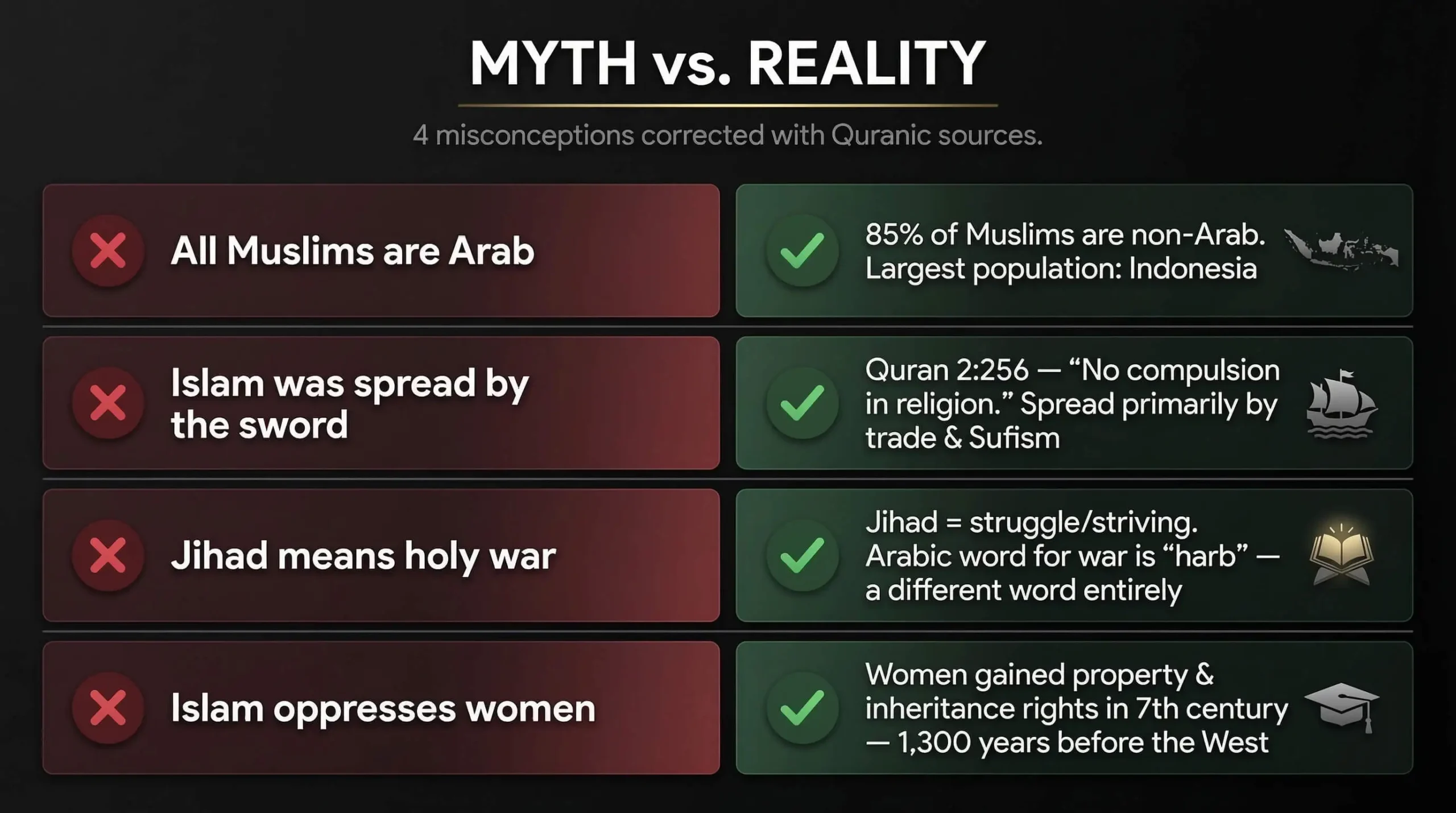
The Islamic religion is more than 1,400 years old and consists of numerous schools of thought. There has been a tendency to disagree among the scholars although the below opinions represent the mainstream point of view. For personal religious guidance, readers are encouraged to consult a qualified local scholar.
The Myth-Reality Matrix
| Myth | What Many People Believe | What Islam Actually Teaches (with Source) |
| All Muslims are Arabs | Islam is a religion of the Middle East | More than 85 percent of Muslims are not Arabs; the largest Muslim population is in Indonesia (Quran 49:13) |
| Islam was spread by the sword | Islam depends on forced conversion | “No compulsion in religion” (Quran 2:256); Islam was predominantly spread by trade, Sufism and migration |
| Jihad means “holy war” | Jihad is about violence | Jihad means “struggle” or “striving”; the Arabic word for war is harb (حرب) — a completely different term |
| Islam oppresses women | Women have no rights in Islam | Islam gave women the right to inheritance, property, and divorce in the 7th century (Quran 4:7) |
“None of you truly believes until he loves for his brother what he loves for himself.” (Sahih al-Bukhari, Hadith No. 13 — graded Sahih/authentic) sunnah.com/bukhari/2/6
Myth: All Muslims Are Arab
Reality: About 85 percent of the world’s Muslims are not Arab. The four largest Muslim-majority countries — Indonesia, Pakistan, India, and Bangladesh — are all in South and Southeast Asia. Significant Muslim communities exist in China, Nigeria, Turkey, Iran, and across Eastern Europe. The gap between popular perceptions of Islam and Islam’s actual demographic reality is vast. The Quran itself addresses this diversity:
“O mankind, indeed We have created you from male and female and made you peoples and tribes that you may know one another.” (Quran, Surah Al-Hujurat, 49:13)
Myth: Islam Was Spread by the Sword
Reality: The Quran explicitly states:
“There shall be no compulsion in religion.” (Quran, Surah Al-Baqarah, 2:256)
The massive expansion of Islam after the twelfth century was driven largely by Sufi mystics, trade networks, and migration — not military conquest. Islam spread across Southeast Asia, West Africa, and Central Asia primarily through merchants and scholars.
Myth: Jihad Means “Holy War”
Reality: The Arabic word jihad means “struggle” or “striving” — not “holy war.” According to scholars, it initially refers to the fight against weaknesses in oneself — the greater jihad. The Arabic word for war is harb (حرب), which is a completely different term. Reducing jihad to “holy war” strips it of its primary meaning and misleads concerning the Quran and the hadith tradition. This is among the most important interesting facts of Islam to correct, because the distortion has shaped decades of media coverage.
Myth: Islam Oppresses Women
Reality: Islam in the seventh century granted women rights to inherit property, possess property and demand divorce. These were not received by European women until a thousand years later. Fatima al-Fihri was the founder of the oldest university in the world. One of the most quoted hadith scholars was Aisha bint Abu Bakr. One should not confuse what is said in the texts and what is practiced by some cultures. Mixing them distorts both.
According to the Quran, the life of any human being is sacred:
“Whoever saves a life, it is as if he saved all of humanity.” (Quran, Surah Al-Ma’idah, 5:32)
The World in 2026 — Modern Facts About Islam
This part presents the recent figures which are not provided in many other sources. If you have been searching for interesting facts of Islam backed by current data, this section delivers exactly that.
Islam — The Quickest-Diffusing Religion on the Face of the Earth
According to many studies, Islam is booming. According to Pew, the number of Muslims will be the same as that of Christians in the world by the middle of this century. The largest growth is through the increase in births, although there are occasional conversions into Islam. A 2025 Pew research demonstrated that having become Muslim, people seldom leave it. These growth patterns are among the most frequently cited Islam interesting facts in demographic studies.
The Oldest Mosque in America Is in Iowa
Mother Mosque of America was constructed in 1934 at Cedar Rapids, Iowa. It is the pre-eminent mosque still existing in the United States. Most people are shocked since they believe that Islam is a new religion in America yet Muslims have been living in America for more than a hundred years.
The United States Has an Estimated 6 Million Muslims
According to the estimates of the Institute for Social Policy and Understanding and other groups as of 2025, there are approximately six million Muslim Americans in all 50 states. They serve in congress, the army, colleges, hospitals and in a vast array of other occupations. The presence of Islam and Islam’s contributions to American civic life continue to grow year over year.
Ramadan 2026 and Hajj 2026 — Key Dates
| Event | Expected 2026 Dates |
| Ramadan (first day of fasting) | Wednesday, February 18, 2026 |
| Eid al-Fitr | ~March 20, 2026 |
| Hajj | Monday, May 25 – Saturday, May 30, 2026 |
| Eid al-Adha | ~May 31, 2026 |
By the year 2026, over two billion Muslims will be celebrating Eid al-Fitr as an end to Ramadan. This global community, called the ummah (أمة), spans every continent. These dates were based on astronomy yet actual dates are based on the moon being seen in most of the communities.
Fast Fact: Islamic year 1447 AH began approximately in June 2025 and finishes in June 2026. The solar year is approximately 11 days more than the lunar year and therefore the Islamic holidays pass through the seasons in a 33-year cycle.
The Most Common Questions About Islam
What are 5 basic facts about Islam?
Islam translates to submission to God and is a derivative of the Arabic word that translates to peace. Muslims consider that there is only 1 God (Allah), and the last messenger of Allah is Prophet Muhammad. This religion rests on the five pillars of the religion which include the testimony of faith, daily prayers, charity, fasting and pilgrimage. The Quran is the sacred book of Islam and it consists of 114 chapters. Islam is the second-largest religion in the world with more than two billion followers. These five points represent the most essential interesting facts of Islam for anyone learning about the faith for the first time.
So What Is the Meaning of Islam in English?
Islam is a product of a root that signifies peace. In religious usage it is voluntarily handing over your will to God. Muslim is an individual who surrenders. The two words demonstrate the intention to attain inner peace by submitting to God.
Will Islam Be the Fastest Growing Religion in 2026?
Yes. Pew indicates that Islam is the fastest-growing major religion, primarily due to births, as well as because many of them remain Muslim. By approximately 2050, the figure of Muslims will be equal to that of Christians.
What Are the Five Pillars of Islam?
These five pillars include the profession of faith (Shahada), the prayers made five times a day (Salah), charity (Zakat), fasting during the month of Ramadan (Sawm), and pilgrimage to Mecca (Hajj).
What Is the Holy Book of Islam?
The sacred text of Islam is the Quran. It has 114 chapters and 6,236 verses. According to Muslims, God revealed the Quran to the Prophet Muhammad through the Angel Gabriel between 610 and 632 CE.
What Is the Age of Islam?
The origin of Islam can be traced to the time when Prophet Muhammad received revelation in 610 CE. That is about 1,416 years ago as of 2026. Another core concept Muslims hold was the monotheism which was taught by all the prophets since Adam.
How Do Muslims View Jesus?
Muslims perceive Jesus (Isa) as an immensely great prophet and the Messiah, who was born to a virgin. He is not a son of God or divine. The Quran refers to him numerous times and even has a whole chapter bearing the name of his mother, Mary.
Sunni and Shia: What Is the Difference?
The division was concerning who took over from Prophet Muhammad after his demise. The first leader according to Sunnis (approximately 85%) was Abu Bakr. According to Shia Muslims (approximately 15 percent), Ali, the cousin of the Prophet, was supposed to lead. The two groups of people have beliefs that are similar in nature such as the five pillars.
Read More: “Sunni and Shia differences” → Detailed comparison guide
What Is Ramadan and Why Do Muslims Fast?
The ninth month of the Islamic calendar is Ramadan. Muslims do not consume food or drink from sunrise to sunset. The reason is that they do this to exercise self-control, to feel closer to God and to consider those people who lack food. The year 2026 is expected to begin on February 18.
What Is Hajj?
Hajj is an annual pilgrimage to Mecca which all Muslims have to visit at least once in their lives provided that they are able to travel and afford it. Approximately two to three million attend every year. They are dressed in plain white attires so that no one can tell who is a rich or poor individual.
What Is the Number of Muslims in the World?
Approximately two billion Muslims around the world identify themselves as Muslim in 2026. The largest Muslim communities are found in Indonesia, Pakistan, India and Bangladesh.
What Does “Allah” Mean?
God is the Arabic word Allah (الله). It is not a different god. The word Allah is also used by Arabic-speaking Christians and Jews as God. All Muslims, Christians and Jews believe in the same God that was worshiped by Abraham.
What Is Sharia Law?
Sharia (شريعة) literally refers to the way or the path. It is the collection of rules and guidelines that are derived from the Quran and the words and deeds of Muhammad. Sharia deals with worship, family, business and other matters. It has various meanings to different scholars and countries. Qualified teachers are good to learn from so consider studying with them.
What Is the Islamic Golden Age?
The period of the Islamic Golden Age was circa 8th–14th century. Muslims during that period achieved a lot in the fields of science, culture, and trade. They advanced algebra, optics, medicine, astronomy and philosophy. A lot of words used in English like algebra, algorithm and chemistry are creations of Arabic. These achievements remain among the most celebrated interesting facts of Islam in academic circles.
What Are the Common Dietary Questions, Including the Use of Animal By-Products?
Islamic dietary law (halal and haram) governs all food and drink. Common questions range from the permissibility of specific food additives to whether gelatin and bone-derived supplements are halal. For example, many Muslims search specifically about the ruling on dry beef bones powder and liver use in Islam to ensure that the source animal was slaughtered Islamically and that no haram additives were introduced during processing. Scholars generally advise consulting a certified halal authority for such niche product questions.
What Are Some of the Stereotypes About Islam?
Many wrong ideas exist. Others believe that all Muslims are Arab (85% are not). They say that the spread of Islam was by the sword (according to the Quran, nothing can force the religion). Others believe that jihad is a holy war (it literally means struggle). It is said that Islam is an oppressive force to women (women were allowed to possess property and inheritance in the seventh century).
Concluding Remarks — The Importance of Learning About Islam
With one in four people on the Earth practicing a religion, it is time to come to terms with it and look beyond the headlines and stereotypes it is believed to have. The 50+ interesting facts of Islam mentioned above are rooted in the Quran, credible hadith and research like Pew Survey statistics, making them correct.
Certain interesting facts of Islam — such as the woman who founded the first university in the world or the Quran dedicating a chapter to Mary — are some things that defy expectations. That is the point. The rumor has been replaced by knowledge, and generalization has been replaced by detail. If you came here searching for interesting facts about Islam religion, fun facts about Islam religion, or general interesting things about Islam, we hope every section delivered something you did not already know.
Prepare to share with someone — someone who may not be aware of this information — one fact from this article. Bookmark this page; it has new data regularly. To study further, see the guides on “Five Pillars of Islam explained” → Detailed guide on Five Pillars, “Ramadan 2026” → Ramadan guide with dates and practices and “Sunni vs. Shia differences” → Detailed comparison guide to find comprehensive and sourced information.
All arguments are based on primary writing in the Islamic religion and peer-reviewed studies. Updated March 2026.