The total population of Muslims across the world is nearly 2 billion. With the increasing rate of cryptocurrency adoption around the globe, the most apparent question is given at the intersection of religion and money: can Muslims invest in Bitcoin? The place of digital currency in Islam is no simple yes or no question. Scholars in the Muslim world have come up with mixed verdicts and the common man in the investment industry feels thrilled about a new investment and concerned about contravening the Islamic dictates.
The bitcoin halal or haram debate has intensified as adoption grows. Beyond Bitcoin specifically, is cryptocurrency halal in Islam is a question affecting all digital tokens. According to some scholars, Bitcoin is entirely allowed by the Shariah law. Others outlaw it outright. Others are cautious and will only permit some of the uses under very stringent circumstances. Is Bitcoin halal? There is no single cryptocurrency fatwa that applies universally.
This manual is to create clarity. Rather than offering a single answer to “is Bitcoin halal,” it presents every major position. Instead of imposing any single opinion, it offers the entire academic terrain — who says halal, who says haram, their logic, and any conditions they may have. Outside the theory, you will get some practical advice: How to invest in Bitcoin without breaking Islamic limits, how to pay zakat on your investments, what crypto operations are universally prohibited, and which cryptocurrencies other than Bitcoin should be examined separately.
The rulings mentioned here represent the evolving islamic ruling on cryptocurrency from designated scholars and established fatwa authorities. There are no anonymous opinions and unqualified influencers. This is Islamic finance studies in relation to the current technology, in a format that will enable you to make informed choices — because answering “is Bitcoin halal” requires both religious knowledge and financial literacy. This guide bridges muslim wealth management with emerging technology. For the Muslim bitcoin investor, understanding both the Islamic perspective on cryptocurrency and the financial mechanics is essential.
Understanding Islamic Finance Principles
Your assessment of Bitcoin requires a solid understanding of the principles that Islamic scholars apply in the assessment of any financial instrument before you can be able to evaluate it. Any islamic ruling on cryptocurrency begins with the core principles of Shariah. All the rulings on cryptocurrency are based on these concepts.
The Core Prohibitions in Islamic Finance
The Islamic finance is based on three major prohibitions which are directly applicable to the Bitcoin debate:
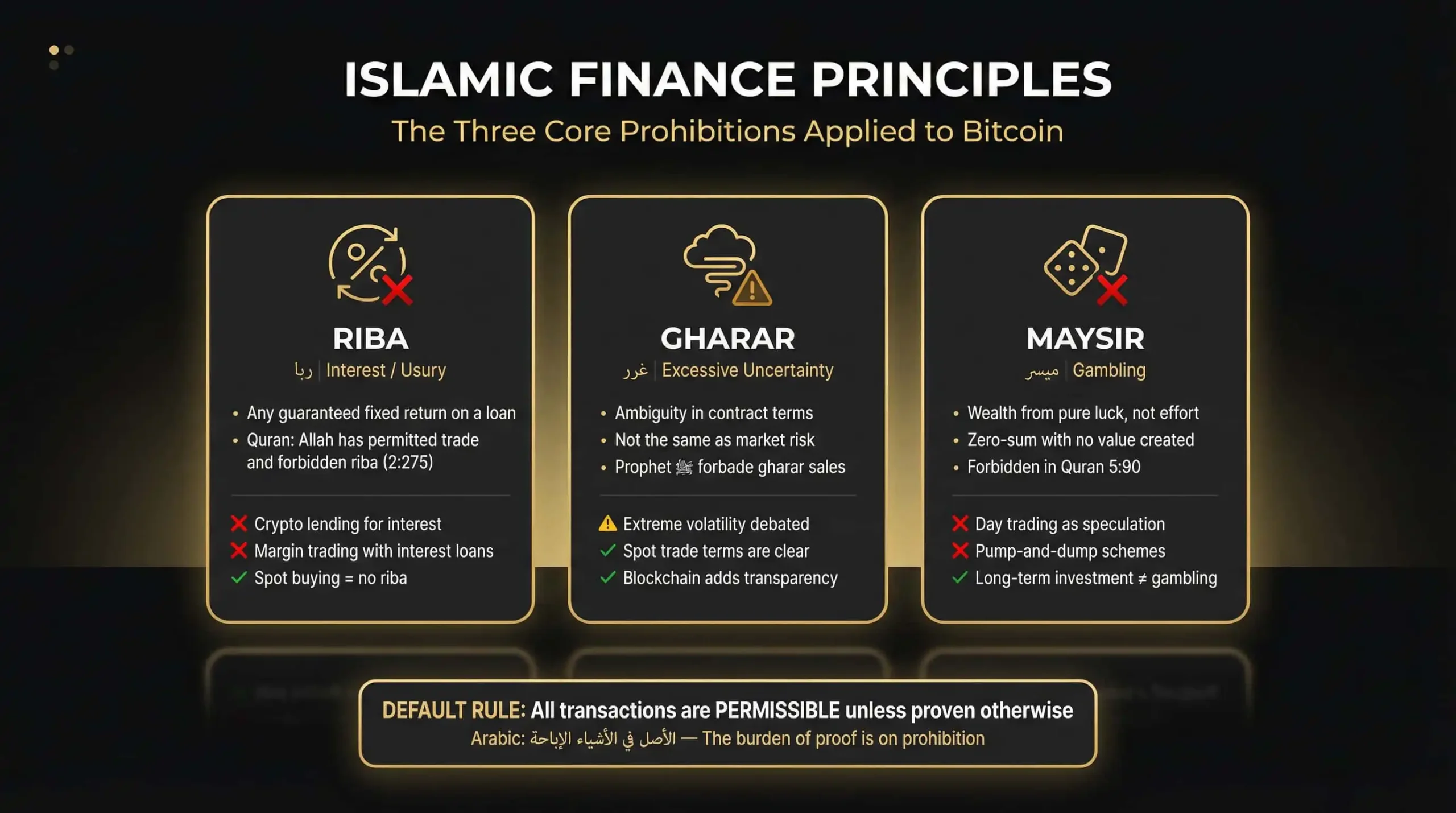
Riba (Interest/Usury)
According to the Quran, Allah has legalized trade and prohibited riba (Al-Baqarah 2:275). Riba pays any assured, fixed yield on a financial loan. Any financial product that is an income or an interest-earning product or one that involves the payment of interest contravenes this absolute prohibition. In crypto, the riba is generated when deposits on sites attract so-called interest, or traders when they trade on margin using loans at interest.
Gharar (Unreasonable Uncertainty)
The Prophet Muhammad ﷺ forbade buying and selling of a particular uncertain transaction that has a lot of uncertainty in its terms, subject matter, or delivery. Gharar is not risk, but false ambiguity of the contract itself. The classic examples are the sale of unborn animals or fish which is still at the sea. Opponents use gharar to Bitcoin due to its extreme volatility in its price but its proponents have responded that it was a market risk rather than contractual misrepresentation. Together, bitcoin gharar and riba are the two primary concerns scholars raise.
Maysir (Gambling)
Islam does not allow one to make money through mere luck as opposed to diligent work. Maysir is applicable in an outcome where an activity becomes a zero-sum bet where there is no economic value. Maysir concerns are prompted by speculative trading and day trading whereby one party gains at the expense of another party and the trader is gambling instead of analysing their market.
These three bans — these core prohibitions — constitute the analytical prism with the help of which any scholar considers Bitcoin. It is unfeasible to learn about disagreements among scholars without comprehending them. These principles form the benchmark for evaluating any shariah compliant cryptocurrency.
The Default Rule: Permissibility in Transactions
An essential principle of the Islamic jurisprudence is that the default decision on worldly transactions — the domain of fiqh al-muamalat (فقه المعاملات) — is permissibility. This is rooted in the foundational maxim al-aṣl fi’l-ashyā’ al-ibāḥah (الأصل في الأشياء الإباحة) — the default in all matters is permissibility. As opposed to worship that must be authorized expressly, worldly transactions need not be prohibited, unless they are shown to be so by special evidence. It implies that responsibility of proving that Bitcoin is haram will be imposed on the people who claim so. They have to prove that Bitcoin obviously commits one or more prohibitions that exist in place.
In the case where the pieces of evidence are doubtful or contentious, the default-judgment of admissibility takes effect. All four major Sunni schools of jurisprudence agree with this principle and form the basis of the arguments made by those who consider Bitcoin halal. The principle is permissible unless proven otherwise.
Is Bitcoin Halal? The Scholarly Verdict
So, is Bitcoin halal according to the scholars? The level-headed answer is that the learned scholars differ. The bitcoin halal or haram question does not have a simple answer, and the Muslim investor has to consider both parties and make up his mind. The bitcoin halal or haram scholars’ debate reveals genuine disagreement. The major voices say the following.
Also Read: Is Tattoo Haram? The Complete Islamic Ruling on Tattoos With Evidence
Scholars Who Rule Bitcoin Halal (Permissible)
Scholars associated with the Fiqh Council of North America — Sheikh Monzer Kahf
One of the most authoritative Islamic jurisprudential authorities in the Western world, scholars associated with the Fiqh Council of North America, including Sheikh Monzer Kahf, have argued that Bitcoin is permissible. In the cryptocurrency fatwa discussions from this body, they base their arguments on Bitcoin fulfilling the functional demands of a medium of exchange, being used by its users, having a monetary value, and not necessarily involving riba, gharar, or maysir in its simple form of purchase and hold. The Council conditions are the following, transactions should be made by spot trading (immediately), and Bitcoin should not be spent on forbidden purchases.
Sheikh Yasir Qadhi
Sheikh Yasir Qadhi, a prominent American scholar, has independently argued that Bitcoin can be considered permissible based on similar reasoning — that it functions as a medium of exchange and is not inherently prohibited.
Mufti Muhammad Abu-Bakar
Mufti Abu-Bakar, in his popular research article, performed an analytical basis of Shariah on Bitcoin in comparison to the classical definition of māl (wealth/property). He determined that Bitcoin fulfills the criteria of māl since it has taqawwum (legal value), or it is desirable, storable, and possessible. It is property and therefore it can be traded as much as other commodities can be traded.
Mufti Faraz Adam — Amanah Advisors
Mufti Faraz Adam, an Islamic fintech expert, says that Bitcoin can be permitted by the fact that it is being based on the principle of ‘urf (عرف — customary practice). Islamic law acknowledges the acceptance when something is accepted by the community as something that bears a monetary value. His concept of Bitcoin is mainly just a utility that is Shariah permissible as long as users do not engage in any of the forbidden applications and speculative waste.
Shaykh Ziyaad Danka
Shaykh Ziyaad has a tentatively optimistic stand. He confirms that it is fundamentally permissible but highly discourages excessive speculation in Bitcoin. He tells Muslims that Bitcoin is a serious type of investment but not a get-rich-quick scheme, and only to invest in Bitcoin what they can comfortably afford to lose.
Scholars Who Rule Bitcoin Haram (Prohibited)
Several bitcoin halal or haram scholars argue it should be prohibited.
Grand Mufti of Egypt — Dar Al Ifta
In the cryptocurrency fatwa published via Dar Al Ifta, the Grand Mufti of Egypt declared cryptocurrency haram. The argument refers to excessive volatility that poses intolerable gharar, utilizing cryptocurrency in illicit activities, lack of government regulation, or central authority support, and exposing novices to financial losses.
Turkish Diyanet (Directorate of the Religious Affairs)
The state religious power of Turkey made the trading of cryptocurrencies illegal. Their most important issue has been the lack of the central regulatory authority, which they consider to be a prerequisite to a legitimate currency. They also claim that the volatility of crypto does not allow it to comply with the Islamic monetary exchange stability.
Shaykh Haitham al-Haddad
Shaykh Haitham, who is based in the UK, believes that there is no real-world asset or commodity that supports Bitcoin, making it essentially dissimilar to gold, silver, or fiat money backed by the government — it has no intrinsic value backing it. He considers it a speculative tool lacking genuine necessity (ḥājah, حاجة) to justify its permissibility.
Shaykh Sulayman ar-Ruhayli
Shaykh ar-Ruhayli has provided a detailed argument that focuses mainly on gharar, asserting that this level of volatility crosses into territory that makes bitcoin haram. He claims that the price of Bitcoin has been largely influenced by the sentiment of speculative trading and not value, which means that all the transactions are inherently ill-fated in a manner that contravenes the Shariah teachings. He also questions the fact that Bitcoin anonymity is allowing money laundering and illegal transactions.
Academic Institutions That Are Yet to Make Decisions
International Islamic Fiqh Academy (IIFA) — Jeddah
The IIFA is one of the most reputable transnational Islamic jurisprudential institutions that have debated cryptocurrency on several occasions but has not rendered a definitive and binding decision to date. The absence of a binding islamic ruling on cryptocurrency from the IIFA shows the complexity. They admit questions that have no answers regarding the classification of Bitcoin, as it is money, property, or something with no precedent in fiqh. The fact that they deliberate is an indication that the question is really complicated and cannot be dismissed easily either way. A number of member scholars have produced single opinions, but an Academy as an institution still proceeds with its review.
Comparison Table: The Positions of the Major Scholars

The following table summarises how leading scholars answer the question: is Bitcoin halal? Below is a summary of the main bitcoin halal or haram scholars and their positions.
| Scholar / Body | Ruling | Key Reasoning | Conditions Stated |
| Sheikh Monzer Kahf (FCNA) | Halal | Functions as medium of exchange; permissible by default | Spot trading only; no haram use |
| Sheikh Yasir Qadhi | Halal | Functions as medium of exchange; permissible by default | Spot trading only; no haram use |
| Mufti Muhammad Abu-Bakar | Halal | Bitcoin is considered as māl (legal value property) | Necessary usage in Shariah-compliant form |
| Mufti Faraz Adam | Halal | Customary acceptance (‘urf) instituting monetary value | Speculation is to be avoided; spend intelligently |
| Shaykh Ziyaad Danka | Halal with caution | Essentially permissible | Invest doing so at your own peril |
| Grand Mufti of Egypt | Haram | Too volatile, outlawed, not supervised | N/A |
| Turkish Diyanet | Haram | No overarching authority; too much risk | N/A |
| Shaykh Haitham al-Haddad | Haram | Not secured by real asset; no requirement | N/A |
| Shaykh ar-Ruhayli | Haram | Gharar-driven speculation; anonymity risk | N/A |
| IIFA (Jeddah) | Case under consideration | Case awaiting ruling | — |
Key Questions Determining Bitcoin’s Halal Status
The academic debate is reduced to three basic questions. These questions revolve around bitcoin gharar and riba — whether Bitcoin inherently involves either. Also rooted in the maxim al-aṣl fi’l-ashyā’ al-ibāḥah (الأصل في الأشياء الإباحة), the scholarly debate over whether is Bitcoin halal reduces to these fundamental points. Their ruling is decided by the way every scholar responds to them.
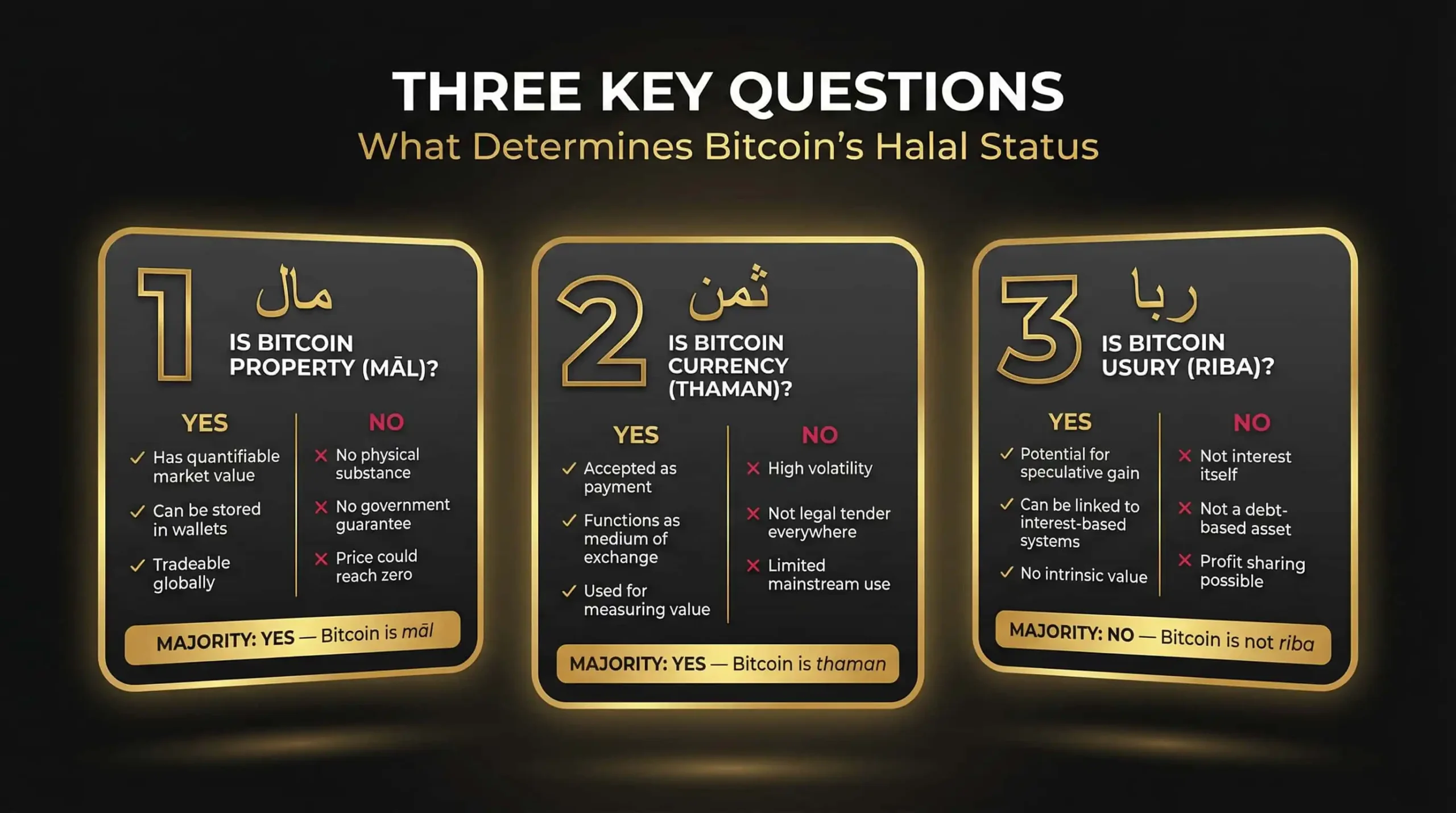
Is Bitcoin Māl (Wealth/Property)?
In the Islamic jurisprudence māl is everything that can be owned, which has a value and which can be benefited in a legal way. Classical scholars established certain requirements: the item has to be desirable (raghba), storable (iddikhār), and has to be of a legal value (taqawwum). The debate hinges on whether Bitcoin possesses taqawwum — recognised legal value.
It has been argued that Bitcoin should be considered as māl:
Bitcoin has quantifiable market value that has been developed by millions of willing buyers and sellers across the world. It can be stored — it is safely kept in digital wallets through time. It is movable and can be traded against goods, services and fiat currencies all over the globe. The analysis conducted by Mufti Abu-Bakar found that Bitcoin meets all classical criteria of māl and its trade is acceptable as a property exchange.
Reasons that Bitcoin is not qualifying:
According to critics, māl must have physical substance or at least a government guarantee. Critics argue Bitcoin lacks intrinsic value. Bitcoin is nothing more than an algorithm on a decentralized registry. It does not take physical shape, does not have a political sponsor, and its price may even reduce to zero. This, Shaykh al-Haddad claims, renders it incompetent to have māl status in more stringent interpretations.
Of the most importance is probably the māl question. When Bitcoin is māl, it is subject to the default rule of permissibility to trade in it. Otherwise, it has no reason to exchange it as property (māl).
Is Bitcoin a Currency?
The question of digital currency in Islam has no classical precedent. Another, although slightly different question is whether Bitcoin is thaman (currency/money). Currency has always needed three functions: medium of exchange, unit of account and store of value.
Thousands of enterprises around the world accept Bitcoin as their payment — it is a medium of exchange. It serves as a measure of value of the crypto world. Its ability to be used as a store of value is less agreeable since it is volatile, but long-term investors report that it has risen by astronomical amounts over 10-year timeframes.
Critics of Bitcoin as a currency can refer to the fact that it is not a legal tender in most countries and there is no central bank. Yet, the Fiqh Council of North America and others observe that in the history of Islam, different communities used different things as currency depending on their mutuality — such as gold and silver, dates, and wheat — all serving as a medium of exchange. Classical fiqh never required that a government issue had to occur.
Is Bitcoin Associated with Too Much Gharar?
The question of bitcoin gharar and riba is central to the haram argument. This is what the haram argument is all about. The price of Bitcoin can change by 10–20 percent within one day — such volatility is significant. Is this the type of gharar that Islam does not allow?
Proponents argue that bitcoin gharar and riba are not inherent to the technology itself. Those who claim that gharar is nonexistent in spot trading make an important point: the concept of gharar in an Islamic contract is used to denote uncertainty about the terms of a contract rather than the riskiness of a market price. With spot trading, you are fully aware of what you are buying, what price you are buying it at, and you receive it instantly.
The terms of the contract are not ambiguous. It is possible that the price can increase or decrease in the future, and this is market risk, which is inherent in all the stocks, commodities, and real estate deals that have ever been made.
The yes scholars assert that Bitcoin is indeed volatile to the point that it has hit the gharar boundary separating a normal market risk and a gharar — scholars assert that this level of volatility crosses into territory that makes bitcoin haram. They claim that, when a thing can be halved in a matter of weeks, buying it will cause the uncertainty that the Prophet ﷺ discouraged.
From a blockchain Shariah perspective, this transparency reduces contractual ambiguity. Blockchain technology is more transparent than ever.
A Bitcoin transaction is chronologically saved in a public registry that is unchangeable.
The amount and the timestamp as well as the sender and the recipient can be permanently verified.
In such a way, Bitcoin deals have less gharar than a lot of conventional financial goods.
Halal Rules for Bitcoin Investment & Trading
Is crypto trading halal? Among Muslims who adhere to the majority view, who believe that Bitcoin should be allowed, the answer depends on how you trade. Among Muslims who conclude that is Bitcoin halal in principle, there are strict guidelines as to which operations are considered halal and which verge into prohibition. The following rules exist specifically to avoid bitcoin gharar and riba in practice.
Spot Trading Requirements
Spot trading is the clearest answer to “is crypto trading halal.” The most acceptable halal way of Bitcoin transaction is spot trading.
It entails the purchase or sale of Bitcoin at the prevailing market rate and at immediate settlement.
Spot trading under Islamic laws is similar to a typical sale contract (bay’, بيع): the two parties are willing to buy and sell, and their agreement takes place immediately.
As a spot trader, you should follow the following steps:
- Place an order known on an established exchange.
- Bitcoin is deposited into your purse instantly (or within the customary period of repayment).
- Pay the entire prevailing cost — no interest-bearing borrowed money, no grace period.
- The amount and rate of exchanges is clearly known to both parties.
Great exchanges of cryptocurrencies accept spot trading.
You end up spot trading by default when you open a regular account and purchase the Bitcoin using deposited funds.
What Makes Bitcoin Trading Haram
The following activities answer “is crypto trading halal” with a clear no. Some activities may be on the wrong side of the Shariah whether one thinks that Bitcoin is permissible in its essence.
Trading in Futures and Derivatives
One is not allowed to buy or sell Bitcoin futures contracts, a contract to trade Bitcoin at a specific price in the future.
It implies selling what you do not yet have and speculative trading about the future which falls within gharar and maysir bans as well. This view is near-universal.
Interest Margins Trading with Interest
Most exchanges provide leverage trading in which the exchange provides you with money (at interest) to increase your leverage.
Although the trade behind the Bitcoin may be lawful, the interest-charging loan is not, as it includes riba. Muslims must seek interest-free crypto trading options.
Pump-and-Dump Schemes
Artificial inflation of the price of a cryptocurrency through coordination to sell it is a type of fraud (ghish, غش) and market manipulation (najash, نجش), which are both outlawed in Islamic law.
Prohibited Purchases using Bitcoin
Purchasing alcohol, gambling, or any haram product or service via Bitcoin makes the prohibition apply to the action as well.
Holding Bitcoin as a Long-Term Investment
The simplest halal strategy that scholars who allow it to be used can take in the purchase of Bitcoin and keeping it long-term is a form of crypto investment halal approach.
Bitcoin is likened to digital gold; in Islam, gold has been an acceptable store of value throughout Islamic history.
When the same happens to Bitcoin, its possession also has a similar purpose and serves as a store of value.
Important caveats:
Scholars recommend that you should only invest in amounts of money that you can completely lose.
Placing a vital family savings or loaned funds into a risky investment is harmful (darar) that Islam aims to avoid.
The point of intention: a long-term rational approach is not the same as betting on price fluctuations due to social media hype.
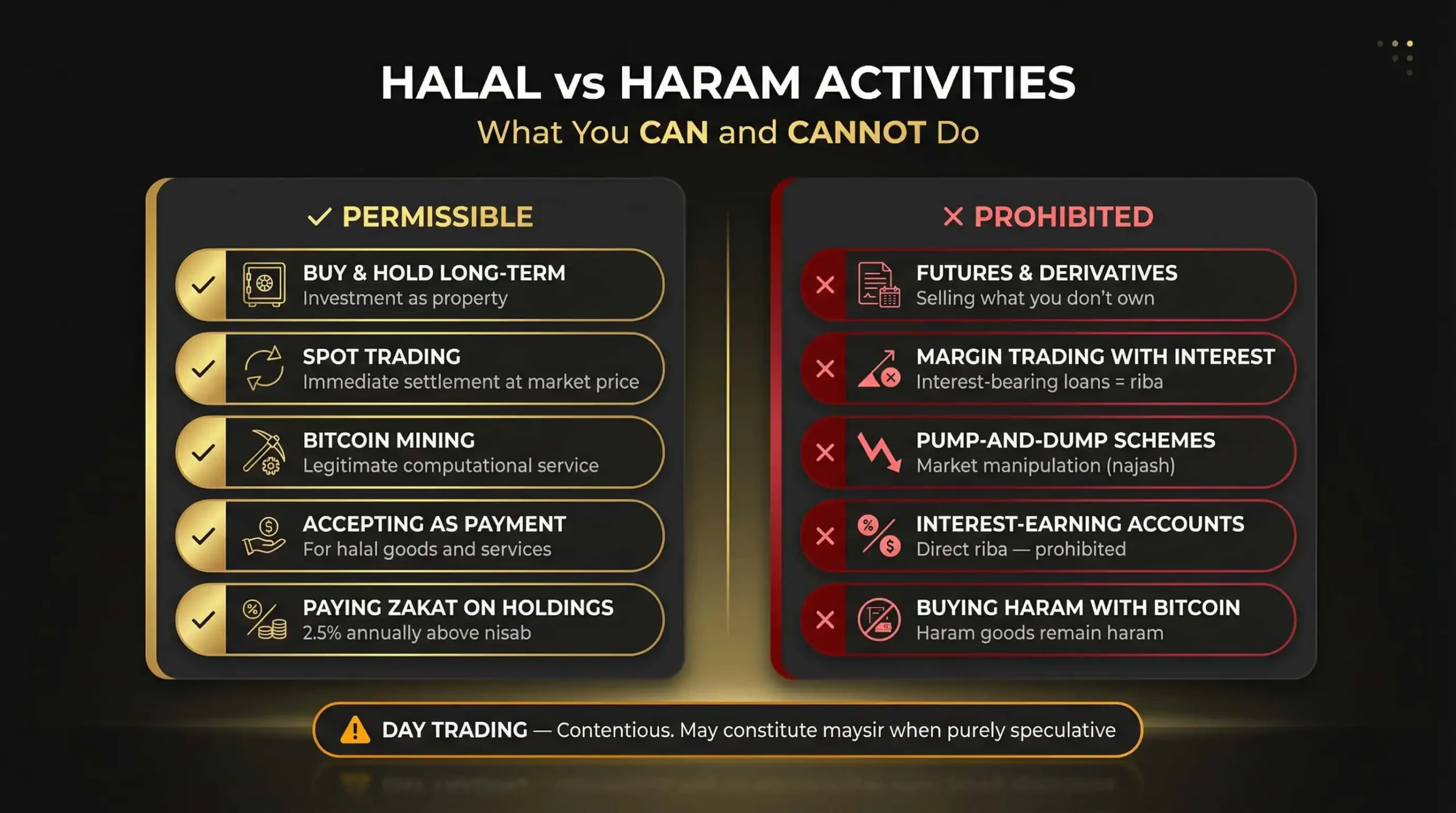
Bitcoin Halal vs Haram Activities
Quick reference: is crypto trading halal? It depends on the activity.
| Activity | Ruling | Reasoning |
| Buying and holding | Halal (majority view) | Investment of property/asset is permissible |
| Spot trading | Halal (with conditions) | Immediate exchange at agreed price |
| Futures trading | Haram (consensus) | Selling what you do not own; speculative trading |
| Margin/leveraged trading | Haram | Involves interest-bearing loans (riba) |
| Quick-profit day trading | Contentious | May constitute maysir when merely speculative trading |
| Mining | Halal (majority); bitcoin mining is permissible | Legitimate computational service |
| Staking | Needs analysis | It is dependent on the specific mechanism |
| Interest-bearing crypto accounts | Haram | Direct riba — prohibited |
Is Bitcoin Mining Halal?
The topic of Bitcoin mining is not related to purchasing, selling, and keeping Bitcoin.
Complex mathematical problems are solved by powerful computers by miners, which are used to validate transactions on the blockchain.
Bitcoin is a newly created reward to successful miners.
Permissible View (Majority)
Is bitcoin mining halal? The majority of scholars say yes. Bitcoin mining is permissible according to the majority. The majority of scholars who have addressed mining specifically do believe that it is halal.
- The miner offers a real productive service processing and securing transactions on the network.
- The compensation of the Bitcoin obtained is akin to wages.
- No riba, no gharar, and no maysir. Mining itself does not involve bitcoin gharar and riba.
Prohibited View (Minority)
A minority questions whether is bitcoin mining halal, arguing it creates money from nothing — few scholars doubt mining; it produces money out of nothing, they say, whereby electricity and working power are transformed into money and no goods are produced. A minority considers that this aspect could make bitcoin haram, though this remains a philosophical critique, as opposed to a ban on the activity itself.
Environmental Stewardship
- Islam focuses on the stewardship of the earth (khilāfah, خلافة).
- The mining of bitcoin is an energy-consuming activity.
- Muslim miners are expected to think about environmental effects and whenever possible, use renewable energy. The digital gold analogy in Islam extends to mining.
- This is not a halal/haram decision but rather complies with the larger Islamic inclinations.
The advice that Muslim miners should follow in practice:
- Mining as such is permissible.
- The earned Bitcoin should be directed as per the rest of the Shariah provisions — this should be done by spot trading only, zakat should be paid and there should be no illegal application of the Bitcoin.
Zakat on Bitcoin: Calculation Guide
Provided that you own Bitcoin, you are likely to have a zakat duty.
The bitcoin zakat calculation is another topic that is generally accepted but given little attention.
Is Zakat Due on Bitcoin Holdings?
Yes. The scholars in the whole spectrum of permissibility are in agreement that when Bitcoin qualifies as wealth, it falls under zakat.
Bitcoin is not exempt personal property (home, primary vehicle), it is treated as cash or other financial resources. Before performing any bitcoin zakat calculation, confirm the three conditions are met.
The applicability conditions of zakat are:
- Full ownership — you own the Bitcoin on your wallet or account of exchange.
- Nisab threshold — your cumulative zakatable wealth (including Bitcoin) is more than the nisab.
- Hawl — you have carried the Bitcoin a whole year round.
- Bitcoin as a tradeable asset in itself meets this requirement.
How to Calculate Bitcoin Zakat
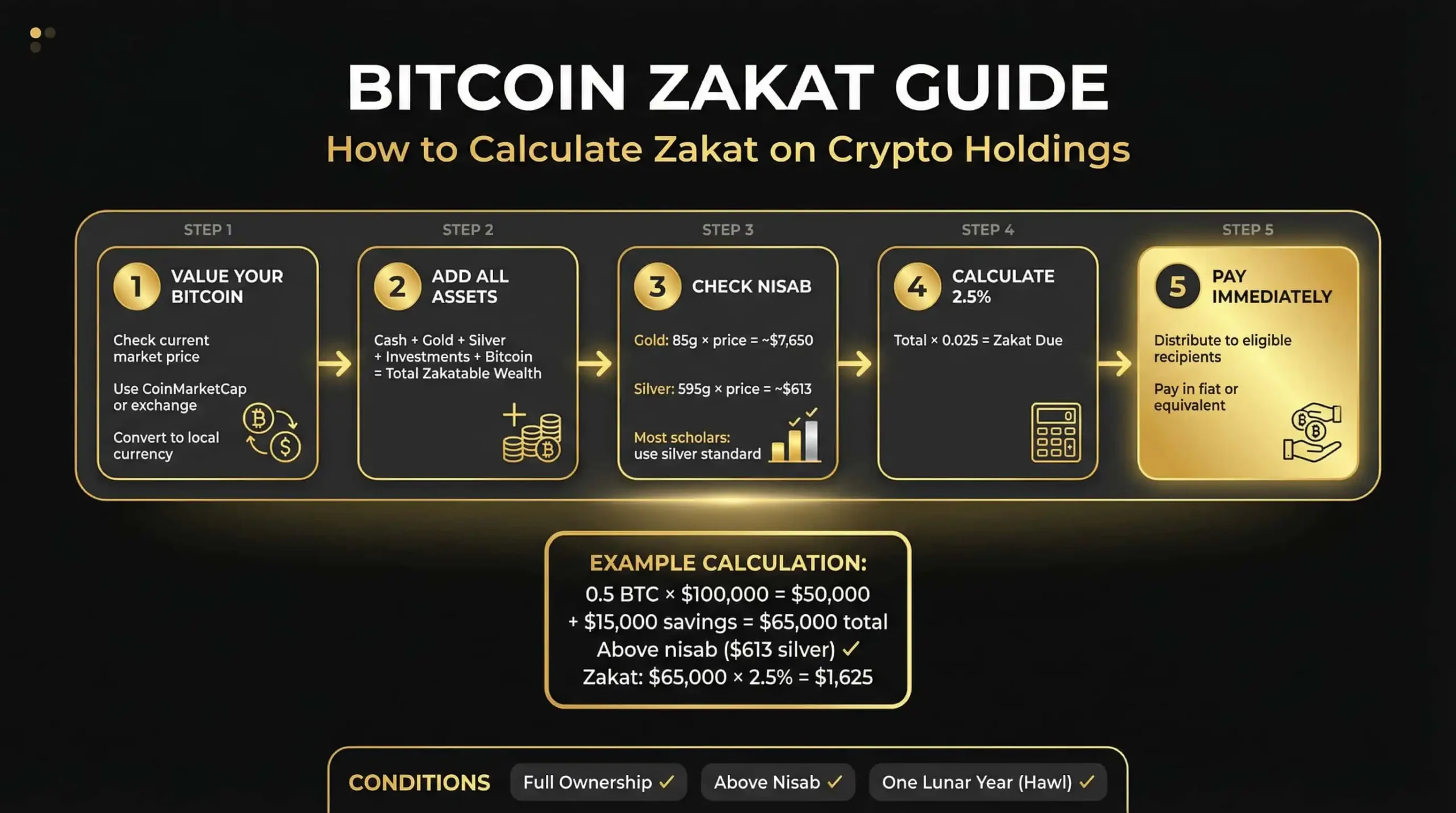
The bitcoin zakat calculation follows a straightforward process.
- The first step in your bitcoin zakat calculation is determining current market value — calculate the sum value of your Bitcoin in present currency.
- Confirm that the value is above the nisab (which is usually pegged on the price of gold or silver).
- Multiply by the zakat rate of 2.5% (i.e., 0.025).
- Send the computed amount to recipients that are qualified.
These are steps to be adopted on a yearly basis to complete your zakat obligation.
The process of calculating it is clear. The problem is only in the fact that Bitcoin is not a constant value.
Step 1: Take care of the value of your Bitcoin in the market on the date of your zakat.
Take any reliable source of price (CoinMarketCap, CoinGecko or the listed price on your exchange). Otherwise change that in local currency.
Step 2: This should be included in your other zakatable assets.
All the cash assigned to bank accounts, the gold, silver, investments, business inventory, and receivables get added to your Bitcoin value.
Step 3: Ensure that it is more than nisab.
The minimum level of wealth is known as Nisab. It is computed on the price of about 85 grammes of gold or 595 grammes of silver. It is suggested by most of the scholars that the silver standard should be used in calculating zakat since the standard will lead to a low threshold, and will hence enable a larger group of people to pay and will also increase the needy to pay the obligation.
Step 4: Estimate 2.5 percent of your total zakatable income.
Step 5: Pay zakat using your local currency or its equivalent. Tracking holdings is essential for an accurate bitcoin zakat calculation.
Nisab Threshold in Bitcoin Terms
Due to the variation of the price of Bitcoin at any moment, the nisab cannot be pegged in terms of BTC. No bitcoin zakat calculation is complete without determining whether your wealth exceeds nisab. Calculating the nisab for bitcoin requires converting to fiat. Rather (calculate by value of gold):
An illustrative calculation will be provided below:
- Nisab based on gold: 85 grams × ~$90/gram (≈ $2,800/troy oz ÷ 31.1 g) = ~$7,650 (gold standard)
- Nisab (silver standard): 595 grams × ~$1.03/gram (≈ $32/troy oz ÷ 31.1 g) = ~$613
- You hold 0.5 BTC at $100,000/BTC = $50,000 in Bitcoin
- $15,000 in bank savings = $65,000 zakatable wealth.
- $65,000 is more than ~$613 nisab (silver standard) ✓
- Zakat due: $65,000 × 2.5% = $1,625
In case of your particular zakat anniversary, always take the valuation. The nisab for bitcoin fluctuates with its market price. Always verify your nisab for bitcoin on your zakat anniversary. Do not average it or take the purchase price, but take the current market value on the day on which your hawl is at.
Are Other Cryptocurrencies Halal?
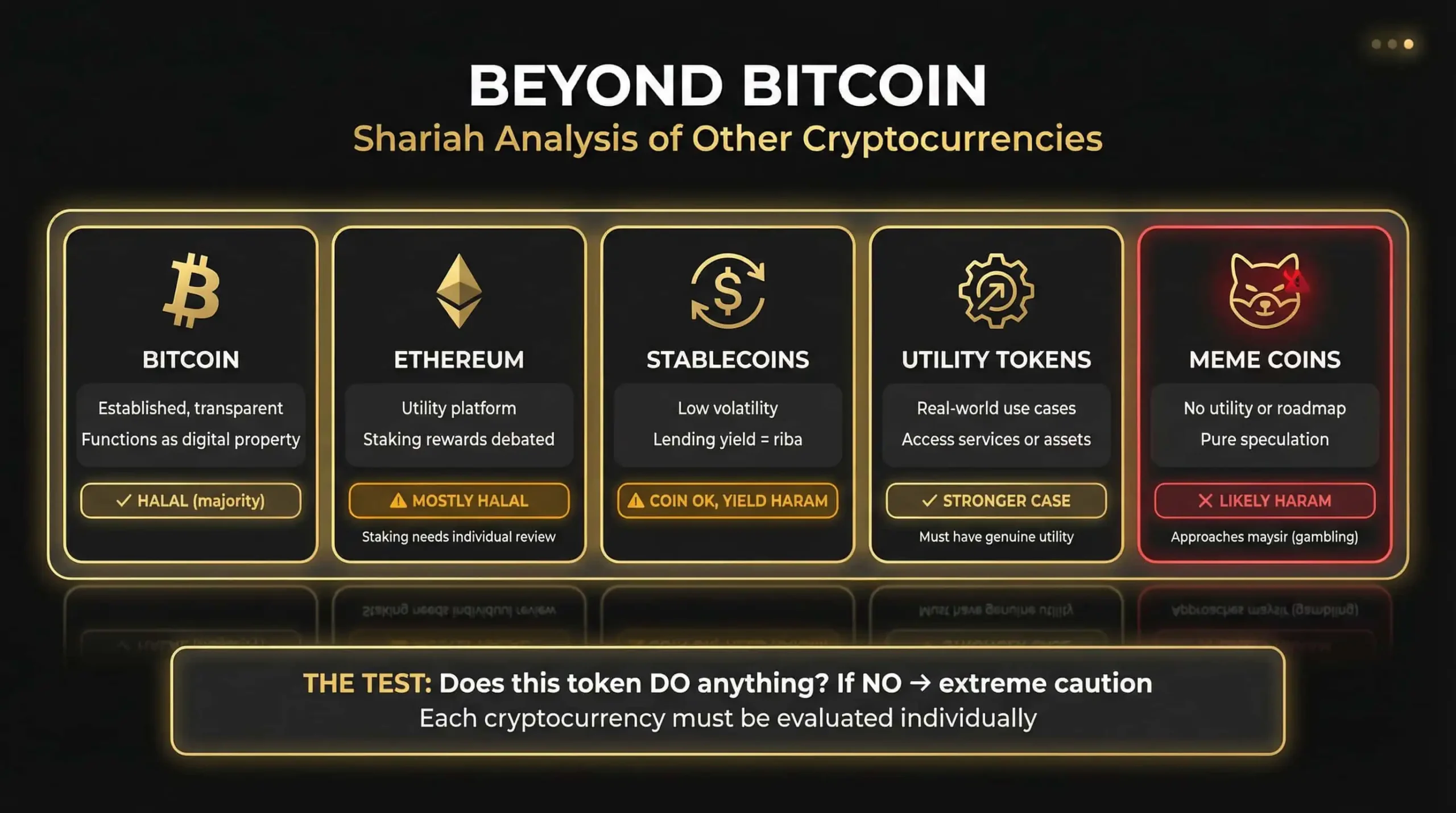
The broader question — is cryptocurrency halal in Islam — requires evaluating each token individually. The most academic focus is paid to Bitcoin, but the principles defined thereof are applicable on a wide basis. Each token must be independently assessed to qualify as a shariah compliant cryptocurrency. Identifying halal crypto coins requires applying the same Shariah analysis used for Bitcoin. The cryptocurrencies should be assessed individually.
Ethereum and Major Altcoins
The māl and gharar analysis that is applicable to Bitcoin can also be applied to Ethereum and other significant cryptocurrencies that have an established presence on the market. Is Ethereum halal? Ether needs an individual analysis but the same principles work. Nonetheless, the issue of staking in Ethereum, following the Post-Merge shift to Proof of Stake, is a different matter: is crypto staking halal?
- Staking is a mechanism of Ethereum lock-up to assist in the authentication of transactions, and new ETH is issued as a reward. Scholars are divided on whether ethereum halal status extends to staking rewards.
- Staking as a profit-sharing in productive enterprise (muḍārabah-like) is seen as acceptable by those who think of it as such. Is crypto staking halal? Scholars are divided.
- The ones who consider the fixed percentage return as similar to interest income are raising concerns over riba.
- The process is more than the naming, namely, Muslim investors must look at the particular way in which rewards are created on a specific platform. The broader question of decentralized finance halal status remains under scholarly review.
Utility tokens, which can be shown to have real-world usefulness, such as utility tokens to access services, utility tokens to purchase computer processing, or utility tokens representing fractional ownership of real-world assets have more permissible arguments than utility tokens with no underlying utility.
Meme Coins and Speculative Tokens
When asking is cryptocurrency halal in Islam, meme coins present the weakest case. Meme coins are unlikely to qualify as halal crypto coins given their speculative nature. The strongest argument in favor of being prohibited is that tokens are produced more due to a joke or social media trend than a piece of technology or a roadmap. When one can only purchase a token in hope that some other will pay more of it at another time — and no productive value is produced in the meantime — the practice approaches maysir (gambling) and constitutes speculative trading. Meme coins like Dogecoin, Shiba Inu, and so on have significantly more gharar and maysir issues than Bitcoin or Ethereum do.
The question that Muslim investors need to ask is: Does this token do anything? In case the answer is no, it should be cautioned.
NFTs in Islamic Perspective
- NFTs from an islamic perspective on cryptocurrency are not necessarily halal or haram and the decision will hinge on what the NFT depicts.
- NFT of digital art should be based on Islamic regulations regarding art.
- A NFT that grants membership or verifiable ownership of an asset in the real world causes less concerns.
- NFTs that are typically utilized to speculate on flipping are subject to the gharar and maysir issue as speculative tokens.
Stablecoins
- Stablecoins shift the “is cryptocurrency halal in Islam” analysis away from volatility toward the mechanics of yield. Volatility-based gharar in fiat-backed stablecoins (USDT, USDC) is eliminated since the value of these coins is relatively constant. The mechanism of the stability is however, of concern.
- Fiat backed stablecoins secured by real dollar reserves have fewer problems than algorithmic stablecoins where the stability is determined by complicated algorithms that may fail.
- The act of collecting yield on stablecoins by means of lending platforms is almost surely riba, notwithstanding whether the stablecoin is lawful.
Useful Guide: How to Invest in Bitcoin the Halal Way
Can Muslims invest in Bitcoin? For those who have concluded yes based on scholarly advice, here is a step-by-step process of doing it right. This is a crypto investment halal approach for those who follow the permissible ruling.
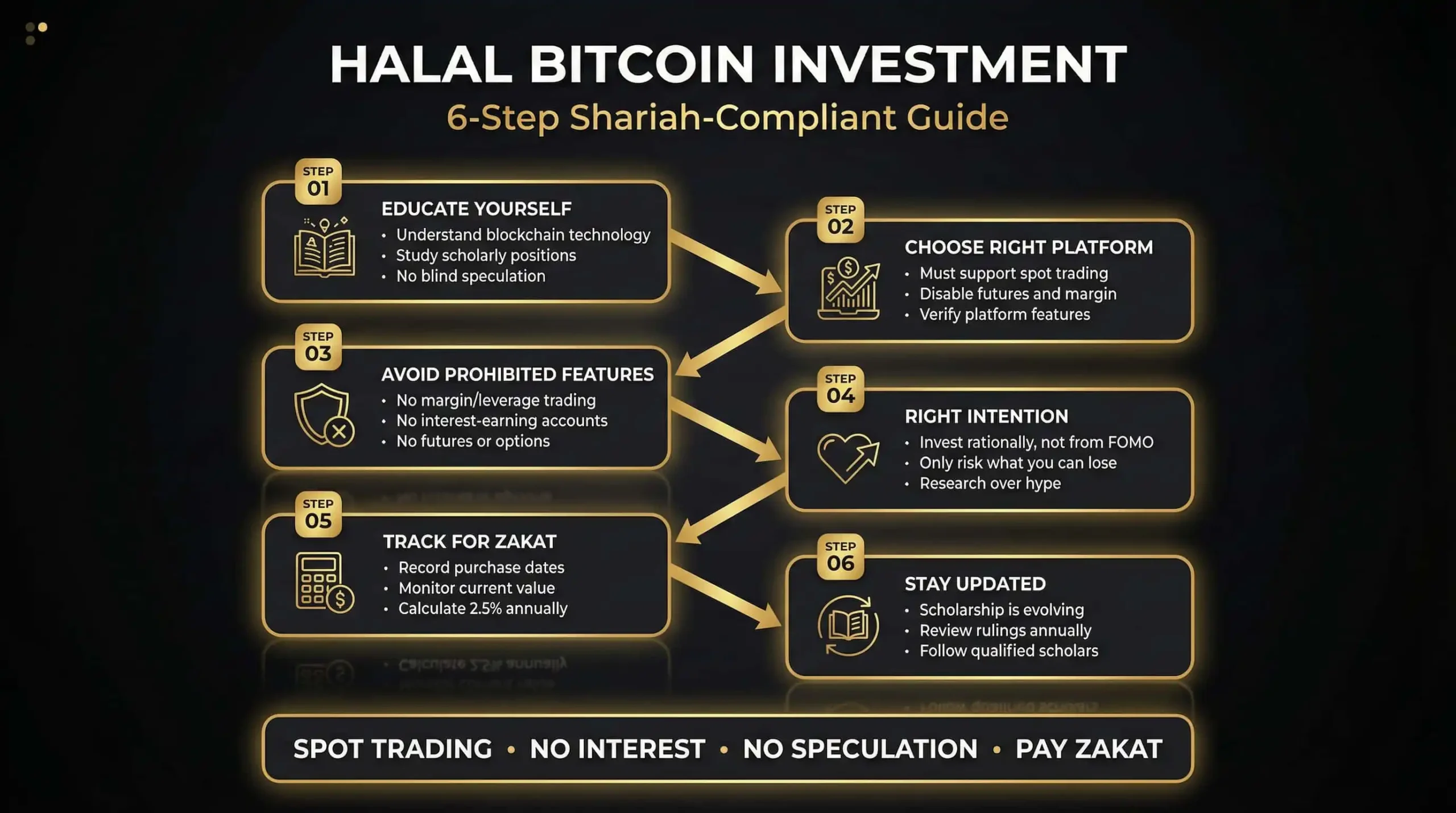
Step 1: Educate Yourself Thoroughly
- Before asking can Muslims invest in Bitcoin, educate yourself thoroughly.
- Islam does not allow any type of transactions when one party has no idea of what they are dealing with.
- Find out what a blockchain technology is, how Bitcoin functions, what influences its value, and what are the risks before purchasing it.
- No matter how permissible the underlying asset is, blind speculation — buying because someone said on social media that the price would go up — is maysir.
Step 2: Select an Adequate Trading Platform
The exchange must facilitate easy spot trade. Choose a halal trading platform that supports spot trading. Spot trading is available in all major exchanges such as Coinbase, Kraken and Binance. It is always advisable to turn off the futures, margin, and leveraged trading options when registering. Some platforms brand themselves as offering shariah compliant cryptocurrency services. Consider an islamic crypto exchange that has Shariah board certification — but they should be independently checked.
Step 3: Avoid Prohibited Features
- Once on a platform, it is necessary to be disciplined. Ensure all your activity remains interest-free crypto practice:
- Never margin/leverage trade.
- Do not open futures or options positions.
- Do not leave Bitcoin in any interest earning “earn” or savings programs.
- Bitcoin should never be used to buy haram goods and services.
- These features can be provided by the very exchange. It is your duty not to get involved. These are all prohibited activities.
Step 4: Maintain Proper Intention and Discipline
The question of can Muslims invest in Bitcoin is as much about intention as it is about the asset itself. Investing is not the same as gambling with regard to the intent, process, and action. A Muslim bitcoin investor performs his/her research, makes rational allocation, embraces profit and loss as a consequence of justifiable risk-taking, and is not overly chart-obsessed because of greed or fear. When spending, avoid money that is spent towards family needs, debt repayment and emergency savings.
Step 5: Monitoring Holdings for Zakat Purposes
Since the time you bought Bitcoin, you started to follow:
- Date of purchase
- BTC and fiat value of purchase.
Anniversary of your zakat (one lunar year since the date of the time when you had a total zakatable wealth which first surpassed nisab)
Always verify your nisab for bitcoin on your zakat anniversary. Go through a spreadsheet or special Islamic finance application. Your annual bitcoin zakat calculation should use the market value on your zakat anniversary date. Once your hawl is done calculate and pay zakat immediately.
Step 6: Stay Informed on Evolving Scholarship
The cryptocurrency fatwa landscape in Islam is yet to be settled. The International Islamic Fiqh Academy is still in the process of review and the individual scholars are working on their positions as the technology becomes more mature and laws and regulations are formulated. There is no single, universal islamic ruling on cryptocurrency. What is deemed today to be guardedly acceptable may come to be more obviously halal or more obviously bitcoin haram with the progress of scholarship. Revisit the reputable sources of Islamic finance on a yearly basis.
Common Mistakes Muslims Make with Crypto
Even well-intentioned Muslim bitcoin investors often trip on the following fronts:
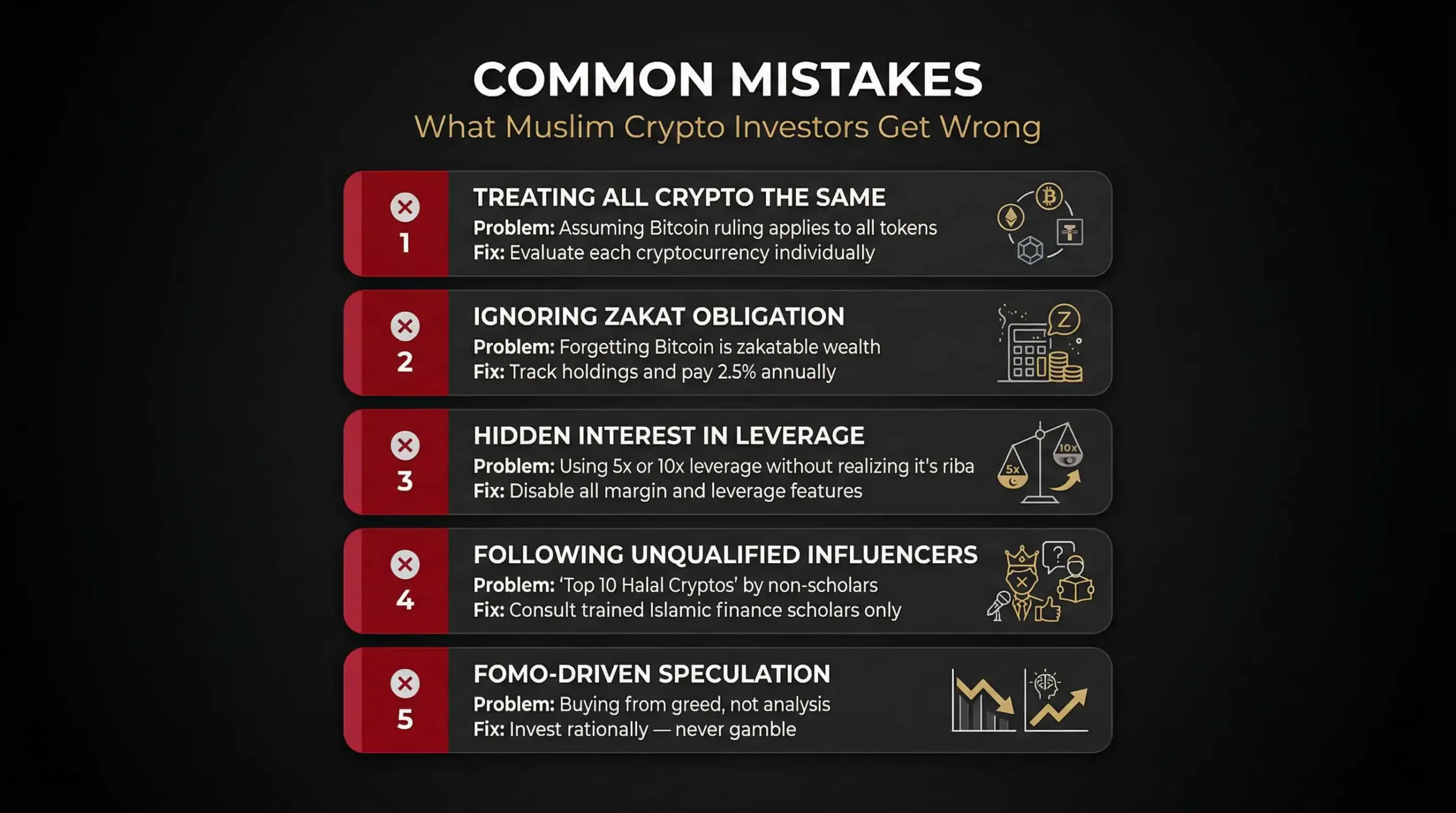
Indiscriminate treatment of the cryptocurrencies. Treating all tokens as halal crypto coins without individual analysis is a common error. Compared to a new meme coin, Shariah considerations associated with Bitcoin and Ethereum are significantly different. They both have to be evaluated separately. The blanket fact that “crypto is halal” or “crypto is haram” overlooks the subtlety that scholars always stress.
A complete neglect of zakat. Most crypto Muslim investors lapse or become unaware of the fact that Bitcoin is zakatable. The obligation of paying zakat on qualifying holdings as a religious obligation is not a minor one that should be neglected.
Leveraging without knowing it entails interest. An exchange with 5x leverage or 10x leverage is lending you money and this loan is subject to interest. The mechanism of interest is still riba even though the word “interest” is not showing up on the interface. Muslims must seek interest-free crypto trading options.
Following so-called halal crypto influencers. The social media has been laden with people who have claimed that one coin or the other is halal without any academically bred credential. The religion should not be based on a YouTube video where the person who made it has no training in Islamic jurisprudence, entitling them to call themselves “Top 10 Halal Cryptos.” Consult the advice of learned people — the bitcoin halal or haram scholars whose methodology you trust.
Being permitted to be forced by FOMO. The greed of not taking part in fast price increase may drive otherwise intelligent Muslims into the highly risky act of speculative trading that is virtually indistinguishable from gambling. When the drive behind the activity turns into a desperate hope of finding a quick fortune, the nature of the activity changes, and what might otherwise be permissible drifts toward bitcoin haram territory — the issues of maysir will become a reality.
Frequently Asked Questions
Is Bitcoin halal according to all scholars?
No. There is actual scholarly division. Leading bitcoin halal or haram scholars include figures on both sides. Most modern theorists such as the Fiqh Council of North America, Mufti Muhammad Abu-Bakar and Mufti Faraz Adam tend to lean towards conditional permissibility. Nevertheless, it is haram under the rule of important authorities like the Grand Mufti of Egypt, the Turkish Diyanet and Shaykh Haitham al-Haddad. The International Islamic Fiqh Academy is yet to give a final decision. The Muslims are supposed to adhere to the scholarly opinion that they consider the most convincing after their real research, or to the scholar whom they trust.
Is it possible to trade Bitcoin and still be halal?
Spot trading is acceptable; futures and margin are not. Spot trading, or buying or selling Bitcoin at the current market price, and is immediately settled, is acceptable under the ruling of those scholars that Bitcoin is halal. The nature of trading matters even more than whether is Bitcoin halal as an asset. Trading of futures, options, and trading with interest based on margin trade is not allowed on virtually all scholarly opinions, including those that otherwise allow Bitcoin. Is crypto trading halal only when conducted through spot trades, free of riba and maysir.
Should I pay zakat on Bitcoin?
Yes. Suppose that you have held Bitcoin at the end of one lunar year, and your total zakatable wealth (including the value of Bitcoin at current market price) is above the nisab threshold, then you are to pay zakat on qualifying assets at 2.5%. Your annual bitcoin zakat calculation should use the market value on your zakat anniversary date. Bitcoin falls in the category of cash and monetary investments to be used as zakat. The nisab for bitcoin fluctuates with its market price. You should record your holdings and determine zakat based on the market value of your holding on the day when the zakat becomes due.
Is Bitcoin mining halal?
Most scholarly opinion says mining is acceptable. Bitcoin is paid to miners who offer a valid computational service, which is authentication and security of network transactions. One of the minority opinions is that computing new digital money is not homogenous value creation. To the majority of scholars however, mining is halal because the earned Bitcoin is later to be used in a Shariah compliant context.
Must Watch: Is Bitcoin / Cryptocurrency halal in Islamic point of view? – Assim al hakeem
Is Ethereum halal?
Ether needs an individual analysis but the same principles work. Its usefulness as a platform for decentralized applications could be a stronger argument on permissibility as opposed to tokens that have no operational use. The particular issue of ethereum halal status regarding staking rewards (making money by confirming transactions) continues to be actively discussed in scholarly circles, with some authors considering it acceptable profit-sharing and others doubting that it is similar to interest. Is cryptocurrency halal in Islam beyond Bitcoin? Each token must be evaluated on its own merits.
Staking rewards — are they halal?
It depends on the mechanism. When staking is that is, holding your cryptocurrency to authenticate network transactions and receiving a portion of transaction fees as payment, some scholars see this as a type of productive participation as it is in a muḍārabah (profit-sharing) scheme. In case the yield is expressed in a constant percentage irrespective of network transaction, the similarity to interest increases and riba issues arise. The staking mechanism of every cryptocurrency is a matter on which there is no consensus among the scholars, and Muslim investors need to look into the peculiarities of staking in this or that cryptocurrency.
Does it have Shariah compliant crypto exchanges?
A number of exchanges and platforms are selling themselves as Shariah-compliant and a few have been certified by well-known Shariah advisory boards. A truly shariah compliant cryptocurrency exchange must at minimum offer spot trading without interest features. An islamic crypto exchange should be independently verified. Nevertheless, the situation with compliance is changing and certifications are to be checked independently. A halal trading platform that a Muslim investor trades in must, at least, have available spot trading without necessarily involving itself in the use of interest-bearing features. The issue of compliance in the platform is not as important as the actions of the investor in the platform.
Can Bitcoin be accepted as a form of payment for services or goods?
By accepting Bitcoin as payment, there is absolutely no distinction between accepting any other form of compensation according to scholars who categorize Bitcoin as māl (property). The commodity or service sold should be halal. There is nothing wrong with accepting Bitcoin as a payment of authorized work or products, which is the same line of thinking as holding and trading it. Bitcoin does not inherently involve bitcoin gharar and riba, but certain trading activities do.
Conclusion
The question “is Bitcoin halal” does not have a universally accepted answer, but it does have a well-argued majority position. The bitcoin halal or haram question has a well-argued majority answer. The overwhelming majority of the modern researchers who have analyzed the problem in detail find that Bitcoin is a permissible (halal) practice under certain conditions: the transactions should be made through spot trading, the investment should not be made with riba and maysir, and the usual Islamic requirements, such as zakat, have to be paid on the holdings. Bitcoin may be among viable halal investment options when traded correctly. Crypto investment halal practice is achievable within these parameters.
There are notable dissenters, and their arguments, based on gharar, volatility and the lack of a central authority, are worth attention. The fact that the International Islamic Fiqh Academy is still discussing this question serves to emphasize the fact that this question is still an active field of academic research.
To the Muslim investor, there are three main commitments, which include: first, ensure that you educate yourself on the technology and the academic discourse; second, take the counsel of the reputable scholars — consult the bitcoin halal or haram scholars whose methodology you trust; third, should you decide to invest — having satisfied yourself that is Bitcoin halal under your chosen scholarly framework — you must only do this within the definite parameters of this guide; that is, spot trading, no interest, no speculative trading and respectfully pay zakat — avoiding bitcoin gharar and riba, and fulfilling zakat obligations. Can Muslims invest in Bitcoin? Yes — provided they follow the Shariah-compliant parameters outlined in this guide.
Islamic muamalat has always adapted to new realities without forgetting about traditionally important principles. The latest episode of this tradition is cryptocurrency. Look upon it as Islam demands in the conduct of riches — care, knowledge and God-consciousness.
The article is purely educational. It is neither a fatwa, nor a personal religious pronouncement. This cryptocurrency fatwa disclaimer applies: qualified scholars should be consulted by the readers depending on their unique situations.