Anxiety is a condition that cuts across the globe and the Muslims are not an exception. In this complete guide, we share the most powerful dua for anxiety and stress from authentic Islamic sources. Our busy hectic life may lead to worry, stress, and fear which have the tendency of creeping in our hearts and make us feel helpless and disconnected. You may have had this experience of that racing heartbeat, the night after restless night, as you worry about what tomorrow will bring, had you been reading this. You have to know that you are not alone, that Islam has many solutions to these challenges.
Anxiety or depression will not spare you as a Muslim. The fact that you go through such struggles does not imply that you are not a believer. Quite on the contrary, an individual who experiences difficulties in trusting Allah reveals the power of his or her devotion.
Islam has coping strategies that are practical. It focuses on religious happiness, community connection and harmonious life. Muslim mental health is a topic that Islam addresses comprehensively. Research published in various medical journals suggests that integrating Quranic recitation with conventional therapy can be beneficial for Muslim patients dealing with mental health challenges.
Notable Exception: The services of this guide (duas and spiritual practices) are designed to be complementary rather than substitutive of professional mental health assistance. In the event that you feel overwhelmed with anxiety or depressed, then consult experienced mental health professionals in addition to spiritual activities.
Understanding Anxiety from an Islamic Perspective
It is important to understand how Islam perceives anxiety and stress before getting into the deep waters of religion-based practice of dealing with these emotional conditions.
What Is Anxiety (Al-Hamm) and Grief (Al-Huzn)?
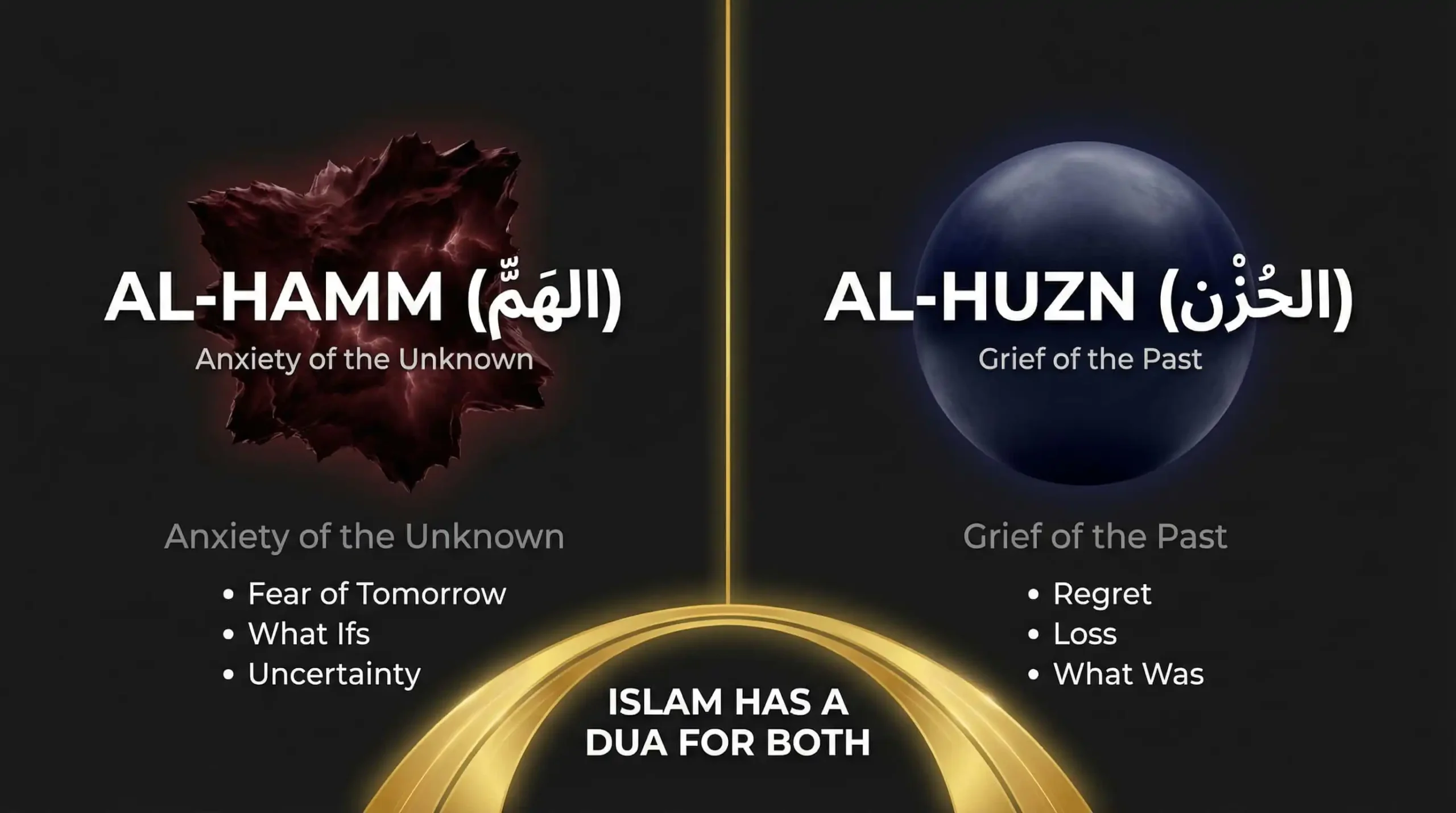
The Prophet Muhammad ﷺ differentiated two related yet different states in the Arabic language:
Al-Hamm (الهَمّ) – the feeling of fear of the unknown, fear of uncertainty of something and worry of what has not yet come.
Al-Huzn (الحُزْن) – sadness and depression regarding what has already been, unhappiness with what has already occurred, losses and regrets.
Ibn al-Qayyim said, sadness softens the heart and reduces the will to forge ahead and the wish to act. This difference is what makes us select the appropriate dua to use in our circumstances.
Islam Acknowledges Mental Health Struggles
Anxiety to Muslims is not only a psychological issue but also a spiritual one. Islam is not deaf to our emotional problems and as such, it is able to provide us with emotional support in terms of prayer and duas. Feeling anxious does not imply that you are not bonded to Allah well and that you are not a good Muslim. There is no blame on you that you have a mental health disorder and there is nothing you can do easily to stay in control. According to the recent studies, the recitation of the verses of Quran is an easy, practical, and also cost-effective method of decreasing anxiety and depression.
15 Powerful Duas for Anxiety and Stress
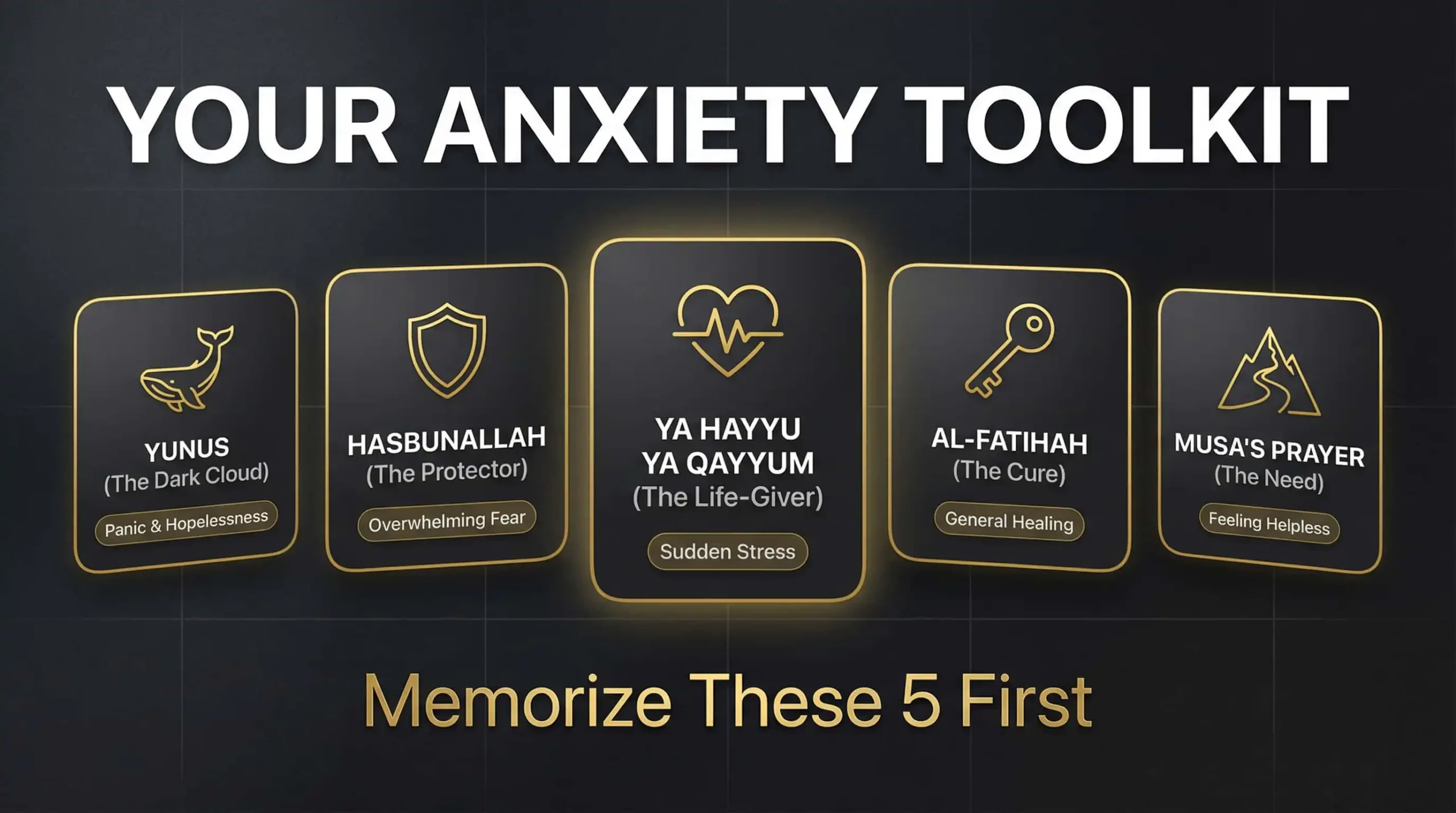
Dua #1: The Prophet’s Comprehensive Dua Against Anxiety and Sorrow
Arabic:
اللَّهُمَّ إِنِّي أَعُوذُ بِكَ مِنَ الْهَمِّ وَالْحَزَنِ، وَالْعَجْزِ وَالْكَسَلِ، وَالْبُخْلِ وَالْجُبْنِ، وَضَلَعِ الدَّيْنِ، وَغَلَبَةِ الرِّجَالِ
Transliteration:Allahumma inni a’udhu bika min al-hammi wal-hazani wal-ajzi wal-kasali wa al-bukhli wal-jubni wa dala’id-dayni wa ghalabatir-rijal.
Translation: O Allah, I take refuge to You against anxiety and sorrow, weakness and laziness, miserliness and cowardice, burden of debts, and being overcome by men.
Source: Sahih al‑Bukhari (6369)
Reason: This dua prevents eight states of debilitation, which include anxiety, sadness, weakness, laziness, miserliness, cowardice, debt and domination one. It is a whole prayer that takes into account all aspects of stress.
Time of Reciting: Everyday, morning and evening in adhkan, or at the time of anxiety.
Dua #2: Make the Quran the Spring of the Heart
Arabic:
اللَّهُمَّ إِنِّي عَبْدُكَ، ابْنُ عَبْدِكَ، ابْنُ أَمَتِكَ، نَاصِيَتِي بِيَدِكَ، مَاضٍ فِيَّ حُكْمُكَ، عَدْلٌ فِيَّ قَضَاؤُكَ، أَسْأَلُكَ بِكُلِّ اسْمٍ هُوَ لَكَ، سَمَّيْتَ بِهِ نَفْسَكَ، أَوْ أَنْزَلْتَهُ فِي كِتَابِكَ، أَوْ عَلَّمْتَهُ أَحَدًا مِنْ خَلْقِكَ، أَوِ اسْتَأْثَرْتَ بِهِ فِي عِلْمِ الْغَيْبِ عِنْدَكَ، أَنْ تَجْعَلَ الْقُرْآنَ رَبِيعَ قَلْبِي، وَنُورَ صَدْرِي، وَجَلَاءَ حُزْنِي، وَذَهَابَ هَمِّي
Transliteration:
Allahumma inni ‘abduka, ibnu ‘abdika, ibnu amatika, naasiyati biyadika, maadin fiyya hukmuka, ‘adlun fiyya qadaa’uka, as’aluka bikulli ismin huwa laka, sammayta bihi nafsaka, aw anzaltahu fi kitabika, aw ‘allamtahu ahadan min khalqika, aw ista’tharta bihi fi ‘ilmil-ghaybi ‘indaka, an taj’alal-Qur’ana rabee’a qalbi, wa noora sadri, wa jalaa’a huzni, wa dhahaba hammi.
Translation: “O Allah, I am your servant, the son of your servant, the son of your maidservant. My forelock in thy hand and everlasting and right in thy command which I have. I say by all the names that appertain to You, whether You called it Yourself, and proclaimed it in Your Book, and instructed it to some one of your creatures, and retained it in the memory of the invisible, that the Qur-an shall be the fountain of my breast, the radiance of my chest, the medicine of my affliction, and the withdrawal of my concern.
Source: Musnad Ahmad (3712) – Sahih. This dua was narrated by Abdullah ibn Mas’ud رَضِيَ ٱللَّٰهُ عَنْهُ.
Explanation: The person who recites this dua in the state of anxiety will have his/her anxiety turned to happiness. Probably, it is the most thorough request in case of stress, anxiety, and depression.
When you should recite: Reciting is done when you are in great distress or when this is a part of your day to day life.
Dua #3: The Dua of Prophet Yunus (Jonah) عَلَيْهِ ٱلسَّلَامُ
Arabic:
لَا إِلَٰهَ إِلَّا أَنتَ سُبْحَانَكَ إِنِّي كُنتُ مِنَ الظَّالِمِينَ
Transliteration: La ilaha illa Anta, Subhanaka, inni kuntu minaz-zalimin.
Translation:
There is no deity except You; exalted are You. Indeed, I have been of the wrongdoers.
Source: Sunan al-Tirmidhi (3505), Quran (21:87).
Explanation:
It is the prayer that Prophet Yunus gave when he was travelling in the belly of the whale when he was engulfed in darkness and hopelessness. Prophet Muhammad (ﷺ) said:
No Muslim ever supplicates with it on anything, never, unless Allah answers him.
When to Recite:
And when you need to feel confined, despairing, troubled.
It works as one of the strongest duas for anxiety and panic attacks.
Dua #4: Dua for Worry and Distress
Arabic:
اللَّهُمَّ إِنِّي أَعُوذُ بِكَ مِنَ الْهَمِّ وَالْحَزَنِ، وَأَعُوذُ بِكَ مِنَ الْعَجْزِ وَالْكَسَلِ، وَأَعُوذُ بِكَ مِنَ الْجُبْنِ وَالْبُخْلِ، وَأَعُوذُ بِكَ مِنْ غَلَبَةِ الدَّيْنِ وَقَهْرِ الرِّجَالِ
Transliteration:
Allahumma inni a’udhu bika min al-hammi wal-hazan,
wa a’udhu bika minal-‘ajzi wal-kasal,
wa a’udhu bika minal-jubni wal-bukhl,
wa a’udhu bika min ghalabatid-dayni wa qahrir-rijal.
Translation:
O Allah, I take refuge with You against worry and grief,
from weakness and laziness,
from cowardice and miserliness,
and from being overcome by debt, and being overpowered by men.
Source: Sunan Abi Dawud (1555)
Explanation:
This dua is based on a touching event in which the Prophet (ﷺ) sat in the mosque and encountered Abu Umamah (رَضِيَ ٱللَّٰهُ عَنْهُ) sitting in the mosque, full of concerns and debts. These are the words that the Prophet instructed him to use as a cure.
When to Recite:
During the moments of financial pressure, future concerns or being overwhelmed by the situation.
Dua #5: Dua During Major Crises
Arabic:
لَا إِلَهَ إِلَّا اللَّهُ الْعَظِيمُ الْحَلِيمُ، لَا إِلَهَ إِلَّا اللَّهُ رَبُّ الْعَرْشِ الْعَظِيمِ، لَا إِلَهَ إِلَّا اللَّهُ رَبُّ السَّمَوَاتِ وَرَبُّ الْأَرْضِ وَرَبُّ الْعَرْشِ الْكَرِيمِ
Transliteration:
La ilaha illallahul-‘Azimul-Halim, la ilaha illallahu Rabbul-‘Arshil-‘Azim, la ilaha illallahu Rabbus-samawati wa Rabbul-ardi wa Rabbul-‘Arshil-Karim.
Translation:
No other god there is, but Allah, the most great, the most forbearing.
No God exists but Allah is the Lord of the exalted Throne.
Allah is the only deity whose name is Allah, Lord of the heavens and Lord of the earth, Lord of the Noble Throne.
Source: Sahih al‑Bukhari (6346)
Explanation:
Prophet (ﷺ) would repeat this dua when he was in a state of extreme suffering. It puts into perspective the problems we have by putting the heart on the greatness and sovereignty of Allah.
When to Recite:
Through panic attacks, when you are in situations of extreme stress, or when faced with significant life challenges.
Dua #6: Hasbunallahu wa Ni’mal Wakeel
Arabic:
حَسْبُنَا اللَّهُ وَنِعْمَ الْوَكِيلُ
Transliteration:
Hasbunallahu wa ni’mal wakeel.
Translation:
Allah is enough for us and He is the most excellent disposer.
Source: Quran (3:173) Sahih al-Bukhari (4563).
Explanation:
This is an effective expression, which Prophet Ibrahim (عَلَيْهِ ٱلسَّلَامُ) pronounced when he was thrown into the fire, and when they said this phrase when they were greatly outnumbered. It is a statement of utter faith in Allah.
When to Recite:
In the situations when it seems impossible, when you are terrified or when you have to leave your concerns to Allah.
Dua #7: Ya Hayyu Ya Qayyum
Arabic:
يَا حَيُّ يَا قَيُّومُ بِرَحْمَتِكَ أَسْتَغِيثُ
Transliteration:
Ya Hayyu Ya Qayyum, bi rahmatika astaghith.
Translation:
O Ever-living, O Self-sustaining, All-sustaining, I beg, I pray, With thy mercy!
Source: Sunan al‑Tirmidhi (3524)
Explanation:
Anas bin Malik (رَضِيَ ٱللَّٰهُ عَنْهُ) stated that whenever the Prophet (ﷺ) would be beset with a stressful trial he would utter the following words. The address as Allah, Al-Hayy, and Al-Qayyum also links us with the power of Allah as eternal.
When to Recite:
On the spot when panic or stress hits; at panic times.
Dua #8: Dua of Prophet Musa (Moses) عَلَيْهِ ٱلسَّلَامُ
Arabic:
رَبِّ إِنِّي لِمَا أَنزَلْتَ إِلَيَّ مِنْ خَيْرٍ فَقِيرٌ
Transliteration:
Rabbi inni lima anzalta ilayya min khayrin faqir.
Translation:
My Lord, yes, I am, in need, whatever good You would send down to me.
Source: Quran (28:24)
Explanation:
Prophet Musa (عَلَيْهِ ٱلسَّلَامُ) made this dua by himself, being a stranger with nothing. It is a lovely phrase that shows that we have absolutely nothing to offer but rely on the provision and mercy of Allah.
When to Recite:
In the hopeless state, neediness or to seek the guidance and provision of Allah.
Dua #9: Dua of Prophet Ayub (Job) عَلَيْهِ ٱلسَّلَامُ
Arabic:
أَنِّي مَسَّنِيَ الضُّرُّ وَأَنتَ أَرْحَمُ الرَّاحِمِينَ
Transliteration:
Anni massaniyad-durru wa Anta arhamur-rahimin.
Translation:
Yes, misfortune has befallen me, and You are the Most Merciful of the merciful.
Source: Quran (21:83)
Explanation:
This was the dua that Prophet Ayub (عَلَيْهِ ٱلسَّلَامُ) made following years of great sickness and devastation. He still had absolute faith in the mercy of Allah despite his plight. This dua for depression in Islam is one of the Islamic prayers that teaches us that it is not a reflection of low faith to tell Allah that we are in pain.
When to Recite:
When the hardship is long lasting or when one falls ill or when one is depressed.
Dua #10: Dua of Hope
Arabic:
اللَّهُمَّ رَحْمَتَكَ أَرْجُو فَلَا تَكِلْنِي إِلَى نَفْسِي طَرْفَةَ عَيْنٍ وَأَصْلِحْ لِي شَأْنِي كُلَّهُ لَا إِلَهَ إِلَّا أَنْتَ
Transliteration:
Allahumma rahmataka arju fala takilni ila nafsi tarfata ayn, wa aslih li sha’ni kullahu, la ilaha illa Anta.
Translation:
O, Allah, to Thee I hope I may be merciful, and leave me not a moment in the regulation of my problems,
and set my matters straight to me.
No other deity is worth worship but You.
Source: Sunan Abi Dawud (5090)
Explanation:
This prayer admits that we are totally dependent on Allah. The Prophet (ﷺ) had instructed his daughter Fatima (رَضِيَ ٱللَّٰهُ عَنْهَا) to repeat it in the morning and evening. It is very potent especially among individuals who find it hard to deal with anxiety using the Islamic way.
When to Recite:
Morning and evening, or when I am overwhelmed by the responsibilities of life.
Dua #11: La Hawla wa La Quwwata illa Billah
Arabic:
لَا حَوْلَ وَلَا قُوَّةَ إِلَّا بِاللَّهِ
Transliteration:
La hawla wa la quwwata illa billah.
Translation:
There is neither power nor strength except with Allah.
Source: Sahih al-Bukhari (6384), Sahih Muslim (2704).
Explanation: The Prophet ﷺ named this phrase a treasure among the treasures of Paradise. A deep recognition that everything is in the hands of Allah is a source of peace when we are helpless.
When to Recite: You can recite all day long, and especially when you are going through difficult times that you can do nothing about.
Dua #12: Innalillahi wa Inna Ilayhi Raji’un (Extended)
Arabic:
إِنَّا لِلَّهِ وَإِنَّا إِلَيْهِ رَاجِعُونَ، اللَّهُمَّ أْجُرْنِي فِي مُصِيبَتِي، وَأَخْلِفْ لِي خَيْرًا مِنْهَا
Transliteration:
Inna lillahi wa inna ilayhi raji’un. Allahumma-jurni fi musibati, wa akhlif li khayran minha.
Translation:
To Allah we belong and to Him we shall return. O Allah, reward me in my calamity and replace it with something better.
Source: Sahih Muslim (918)
Explanation: This is a supplication used for any form of disaster or distress. The Prophet ﷺ showed a promise that whoever recites this in earnestness, Allah will definitely compensate his loss with a better one.
When to Recite: After every loss, disappointment or any painful news.
Dua #13: Dua for Ease in Hardship
Arabic:
اللَّهُمَّ لَا سَهْلَ إِلَّا مَا جَعَلْتَهُ سَهْلًا، وَأَنْتَ تَجْعَلُ الْحَزْنَ إِذَا شِئْتَ سَهْلًا
Transliteration:
Allahumma la sahla illa ma ja’altahu sahla, wa Anta taj’alul-hazna idha shi’ta sahla.
Translation:
O Allah, nothing is easy except what You have made easy, and You make the difficult easy if You wish.
Source: Ibn Hibban (2427)
Explanation: This lovely dua is an acknowledgement that only Allah can bring one ease. It is a cry of concern and remorsefulness.
When to Recite: When one is faced with tough things to do, decisions to make or situations that overwhelm.
Dua #14: Hasbiyallahu La Ilaha Illa Huwa
Arabic:
حَسْبِيَ اللَّهُ لَا إِلَٰهَ إِلَّا هُوَ ۖ عَلَيْهِ تَوَكَّلْتُ ۖ وَهُوَ رَبُّ الْعَرْشِ الْعَظِيمِ
Transliteration:
Hasbiyallahu la ilaha illa Huwa, ‘alayhi tawakkaltu, wa Huwa Rabbul-‘Arshil-‘Azim.
Translation:
Allah is sufficient for me. There is no deity except Him. Upon Him I have relied, and He is the Lord of the Great Throne.
Source: Quran (9:129), Sunan Abi Dawud (5081)
Explanation: Allah will provide him with whatever concerns him to whoever recites this seven times in the morning and evening said the Prophet ﷺ. It is one of the pillars of dua that calms down the stress.
When to Recite: Seven times in the morning and evening.
Dua #15: Istighfar (Seeking Forgiveness)
Arabic:
أَسْتَغْفِرُ اللَّهَ الَّذِي لَا إِلَٰهَ إِلَّا هُوَ الْحَيُّ الْقَيُّومُ وَأَتُوبُ إِلَيْهِ
Transliteration:
Astaghfirullaha alladhi la ilaha illa Huwal-Hayyul-Qayyum wa atubu ilayh.
Translation:
I seek forgiveness from Allah, there is no deity except Him, the Ever-Living, the Self-Sustaining, and I repent to Him.
Source: Sunan Abi Dawud (1517)
Explanation: Ibn Abbas (رَضِيَ ٱللَّٰهُ عَنْهُ) has reported that the Prophet ﷺ said: Whoever is constant in seeking forgiveness of Allah, He will provide him with a way out of all hardships, a relief from all worries, and will bring him sustenance from where he does not expect.
When to Recite: Often during the day, in particular, 100 times a day as promoted by the Prophet ﷺ.
Quranic Verses That Bring Peace During Anxiety
The Holy Quran gives us many verses that give us solace and assurance, when we are anxious and depressed.
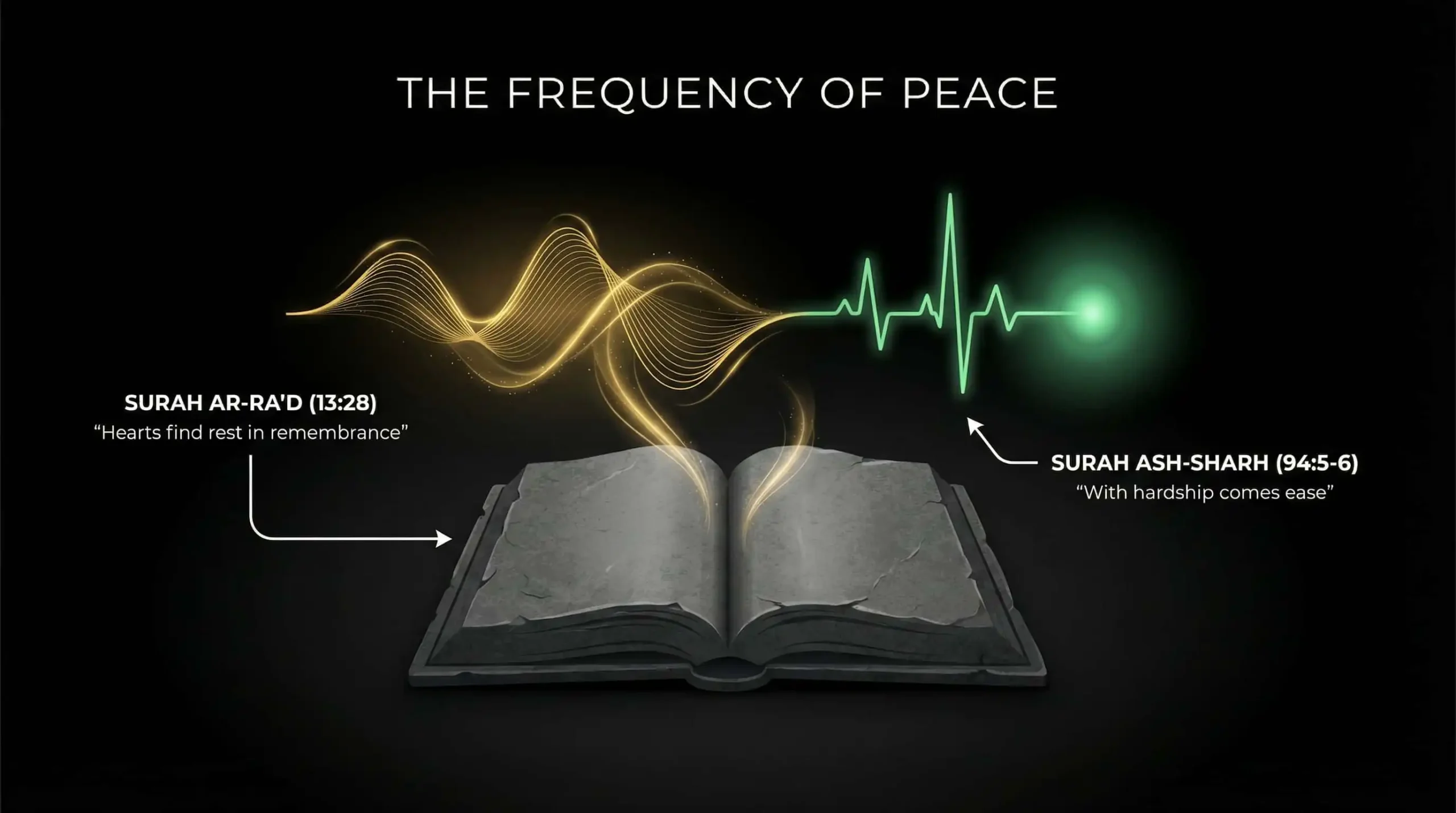
Surah Ash-Sharh (94:5-6)
Arabic:
فَإِنَّ مَعَ الْعُسْرِ يُسْرًا ﴿٥﴾ إِنَّ مَعَ الْعُسْرِ يُسْرًا ﴿٦﴾
Translation:
Indeed, with hardship comes ease. Indeed, with hardship comes ease.
Reference: Surah Ash-Sharh (94:5-6)
Reflection: Allah makes this promise twice to stress it. However dark the night, sunrise will come.
Surah Al-Baqarah (2:286)
Arabic:
لَا يُكَلِّفُ اللَّهُ نَفْسًا إِلَّا وُسْعَهَا
Translation:
Allah does not burden a soul beyond that it can bear.
Reference: Surah Al-Baqarah (2:286)
Reflection: Whatever you are going through, Allah knows that you can handle it.
Surah Ar-Ra’d (13:28)
Arabic:
أَلَا بِذِكْرِ اللَّهِ تَطْمَئِنُّ الْقُلُوبُ
Translation:
Verily, in the remembrance of Allah do hearts find rest.
Reference: Surah Ar-Ra’d (13:28)
Reflection: This is the source of dhikr for anxiety—remembering Allah is the supreme pacifier of the anxious heart.
Surah At-Talaq (65:3)
Arabic:
وَمَن يَتَوَكَّلْ عَلَى اللَّهِ فَهُوَ حَسْبُهُ
Translation:
And whoever relies upon Allah, He will be sufficient for him.
Reference: Surah At-Talaq (65:3)
Reflection: Tawakkul (trust in Allah) is the cure of future anxiety.
Also Read: Is Music Haram in Islam? Rulings, Instruments, and Everyday Scenarios
How Anxiety Affects Your Body: The Islamic & Medical Perspective
Knowing the physical symptoms of anxiety will enable us to treat it as a whole and this is the way according to the Islamic approach to health.
Can Stress and Anxiety Cause Heart Palpitations?
Yes. The most frequent cause of the heart palpitations, which is not connected with a heart problem, is the feeling of anxiety. Under the influence of stress, your body discharges chemicals such as adrenaline and cortisol ready you to respond to danger the fight or flight reaction. These hormones speed your heart rate, cause your blood vessels to tighten and the blood pressure rises causing palpitations.
It is the debilitating physical effects of hamm that made the Prophet ﷺ seek refuge against it. Islam identified the mind body relationship more than 1,400 years ago.
Does Stress and Anxiety Cause Nausea?
Yes. Fear may cause nausea and other stomach issues. The second-largest number of nerves in your body are in your digestive system some scientists refer to your gut as your second brain. The gut-brain axis is dualistic as it is a two-way communication system, and, in case of anxiety, brain signals may interfere with digestion.
That is why the Prophet ﷺ accentuated the idea of moderation in the eating process and the holistic approach to health since all three elements, body, mind, and spirit, are interrelated.
A Daily Spiritual Routine for Managing Anxiety
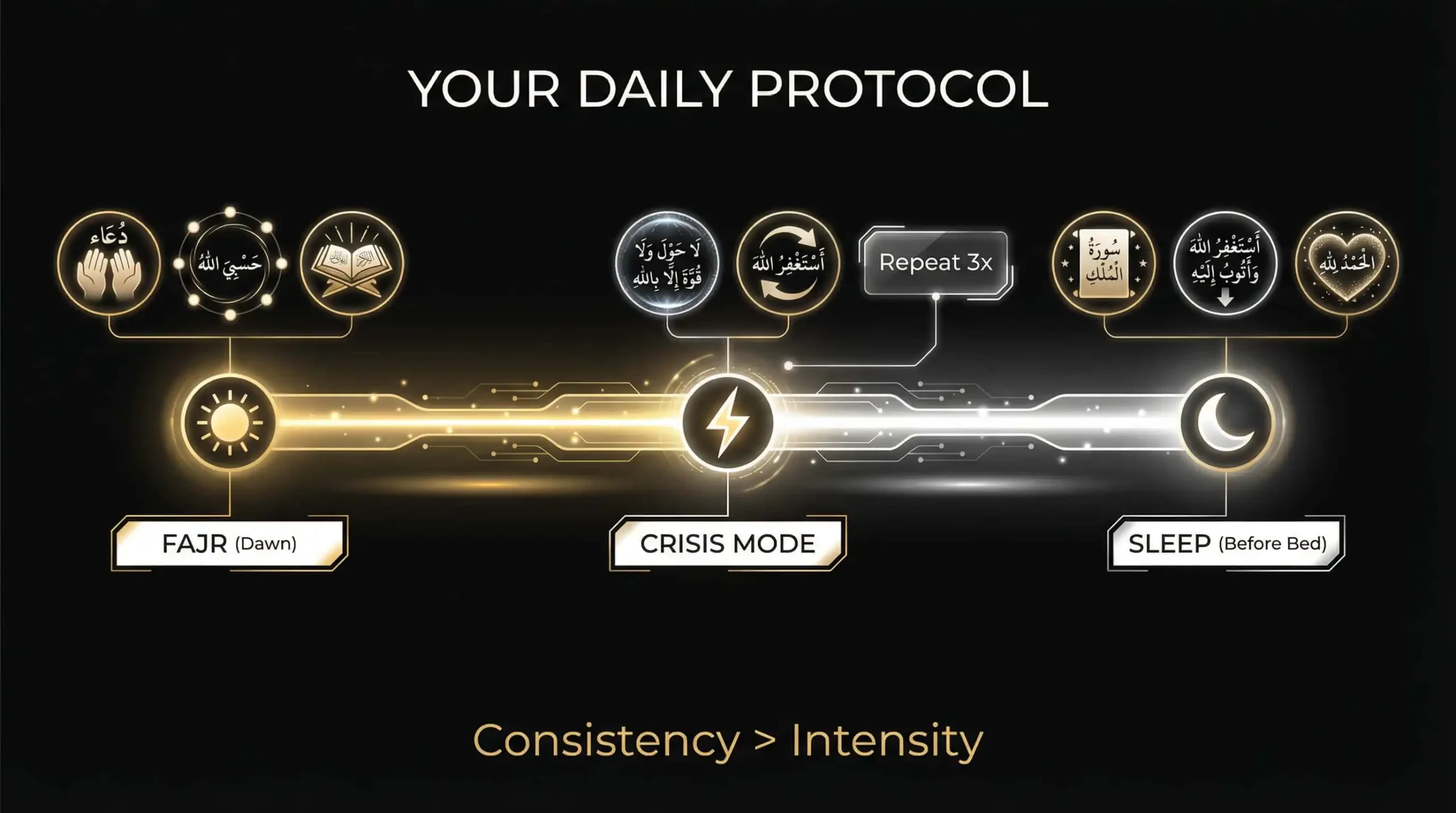
Morning Routine (After Fajr)
- Once repeat Dua #1 (anxiety and sorrow).
- Say: Hasbiyallahu la ilaha illa Huwa…. 7 times.
- Recite Surah Al-Duha and Surah Ash-Sharh.
- 5 minutes dhikr: SubhanAllah (33 times), Alhamdulillah (33 times), Allahu Akbar (34 times).
During the Day (When Anxiety Strikes)
- Repeat Ya Hayyu Ya Qayyum bi rahmatika astaghith.
- Use the dua of Prophet Yunus.
- Breathe in and out deeply repeating the phrase La ilaha illallah when breathing out.
- In the event that it is possible, pray 2 rak’ahs voluntarily.
Evening Routine (Before Sleep)
- Repeat Dua #2 (the all-encompassing dua of Musnad Ahmad)
- Make istighfar 100 times
- Read Surah Al-Mulk (or the final 3 surahs: Al-Ikhlas, Al-Falaq, An-Nas).
- Reflect on 3 things that occurred good in the day (practicing shukr)
Beyond Dua: Holistic Islamic Approaches to Anxiety
Tawakkul: The Islamic Framework for Letting Go
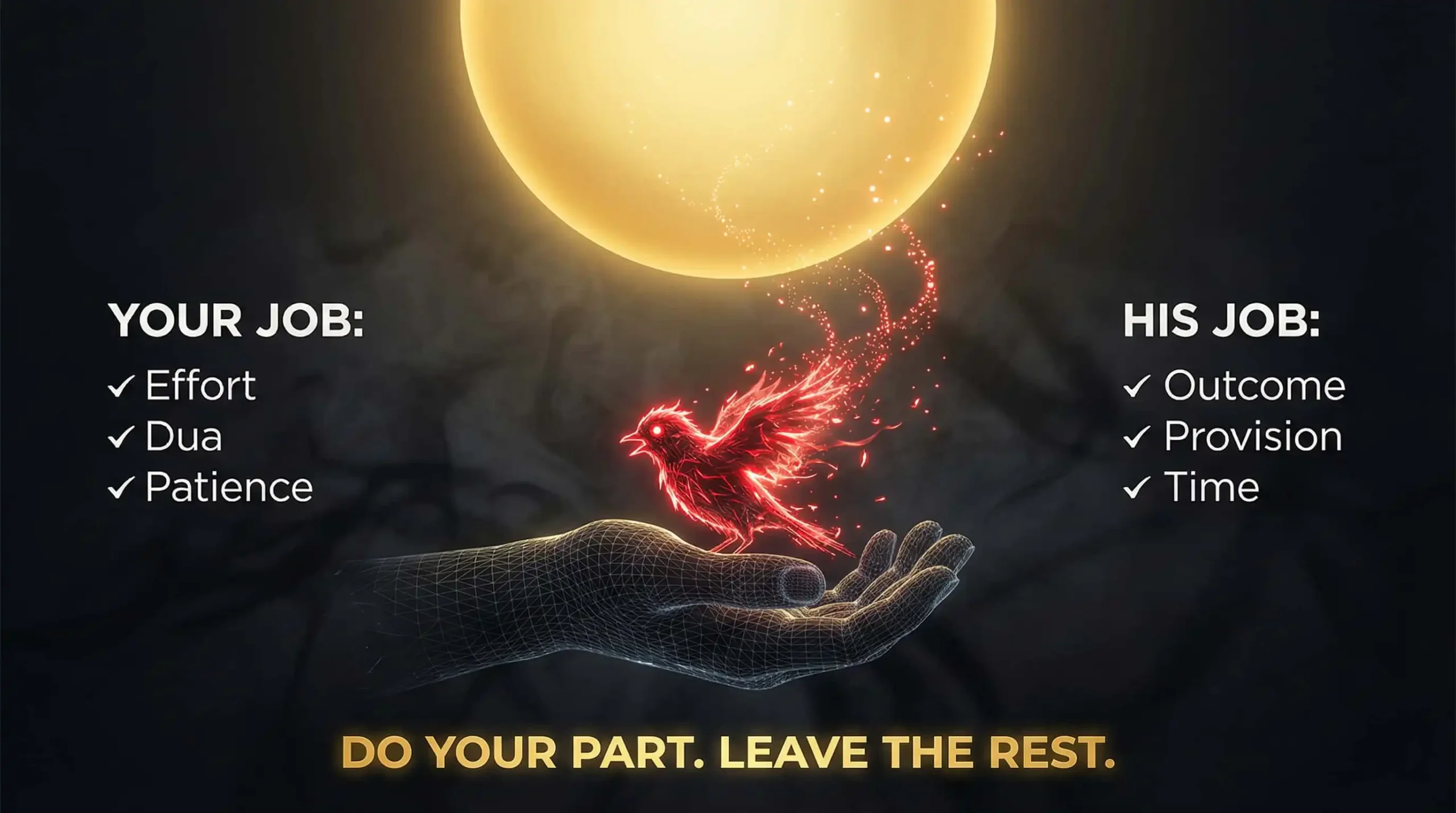
The truth that you cannot control everything is a very potent means of coping with anxiety. This is facilitated with the realization that Allah has a greater plan. Tawakkul is not the call to inactivity; it calls you on to do your best, and leave the result to Allah. Combined with sabr (patience), tawakkul becomes a powerful framework for managing anxiety.
This concept is quite consistent with cognitive behavioral therapy (CBT), which teaches one to re-label negative thoughts and live with uncertainty.
Lifestyle Factors the Prophet ﷺ Emphasized
- Eat in moderation and have a healthy nutritional balance.
- Use a lot of physical exercise; the Prophet used to walk a lot.
- Strive to sleep on a regular basis.
- Remain affiliated to your community and do not feel isolated.
- Give charity (sadaqah) as a way of relieving anxiety.
When to Seek Professional Help
Although spiritual practices are effective, Islam does not oppose seeking professional assistance. Prophet ﷺ has said: Use medical treatment, as Allah has not sent a disease without a cure.
While some seek stress and anxiety medication over the counter, Islamic spiritual practices offer a complementary approach. However, professional help may be necessary.
If your anxiety is:
- Constant and disrupting normal life.
- Bringing about physical symptoms that are not beneficial.
- Causing suicidal ideation.
- Making it difficult to fulfill basic responsibilities.
In case you encounter any of the above, it is worth talking to a qualified professional in the field of mental health. Most Muslim therapists have adopted evidence-based therapies like cognitive behavioral therapy (CBT) along with Islamic principles.
Must Watch: How to deal with anxiety regarding health or fear of death? (Belief in qadr / predestination) Assim
Frequently Asked Questions
Which is the strongest dua for anxiety and stress to recite?
The most detailed dua is the one of Musnad Ahmad (Dua #2). Anxiety will be substituted with joy through the integrity of recitation by the Prophet.
Is it possible to make dua in English with regard to anxiety?
Yes. Even though it is preferred to use Arabic because of its authenticity, Allah knows all languages; however, the purity of your heart counts the most.
What is the surah for anxiety relief?
Surah Al-Duha, Surah Ash-Sharh and Surah Al-Fatiha are the ones that are highly recommended. Surah Al-Duha was revealed as a source of consolation to the Prophet in a hard time.
Does it mean that I am weak in faith because I have anxiety?
Absolutely not. The fact that one is mentally ill does not mean that one lacks faith. Much to the point, even the Prophet ﷺ felt sad and has taught these duas because he knew what humans go through.
Conclusion
The duas and practices shared in this guide represent the authentic Islamic tradition of addressing anxiety, stress, and emotional difficulties through connection with Allah. Remember that seeking help—both spiritual and professional—is a sign of wisdom, not weakness.
May Allah grant you peace of heart, tranquility of mind, and relief from all your worries and anxieties. Ameen.