Introduction: Understanding Why Islamic Women Wear Hijab
The hijab is much more than a garment to more than 1.8 billion Muslims across the globe. It is a profound comprehension of religion, identity and personal belief. Nevertheless, it is still misunderstood or even criticized by a number of people. By posing a question like why do Islamic women wear a hijab, we create an opening into the most apparent icon of Islamic Faith in our age.
The hijab has drawn millions of discourses, academic, workplace, social media, legislative. Although it is very prominent, its real meaning is usually concealed behind stereotypes, misunderstandings and simplified narratives.
This guide will take you through the religious underpinnings, personal reasons, and contemporary settings that inform the reasons behind why do Islamic women wear a hijab and cover modestly. We will also examine verses in the Quran that form the foundation of hijab, academic consensus of being modest in dress, and the voices of women who are empowered, identified, and have a connection to this practice. The hijab religious significance extends beyond mere clothing to represent faith expression and taqwa (God-consciousness).
This guide is a combination of genuine Quranic text, academic interpretation as well as autobiography by Muslim women across the globe, unlike superficial explanations. It can be helpful both in case you are a Muslim who wants to understand what is really going on with Islam and why hijab is a significant part of it, or a non-Muslim who wants to study Islamic traditions and practices and see the complete picture of what Islamic hijab is.
What Does “Hijab” Really Mean? – The Hijab Meaning in Islam
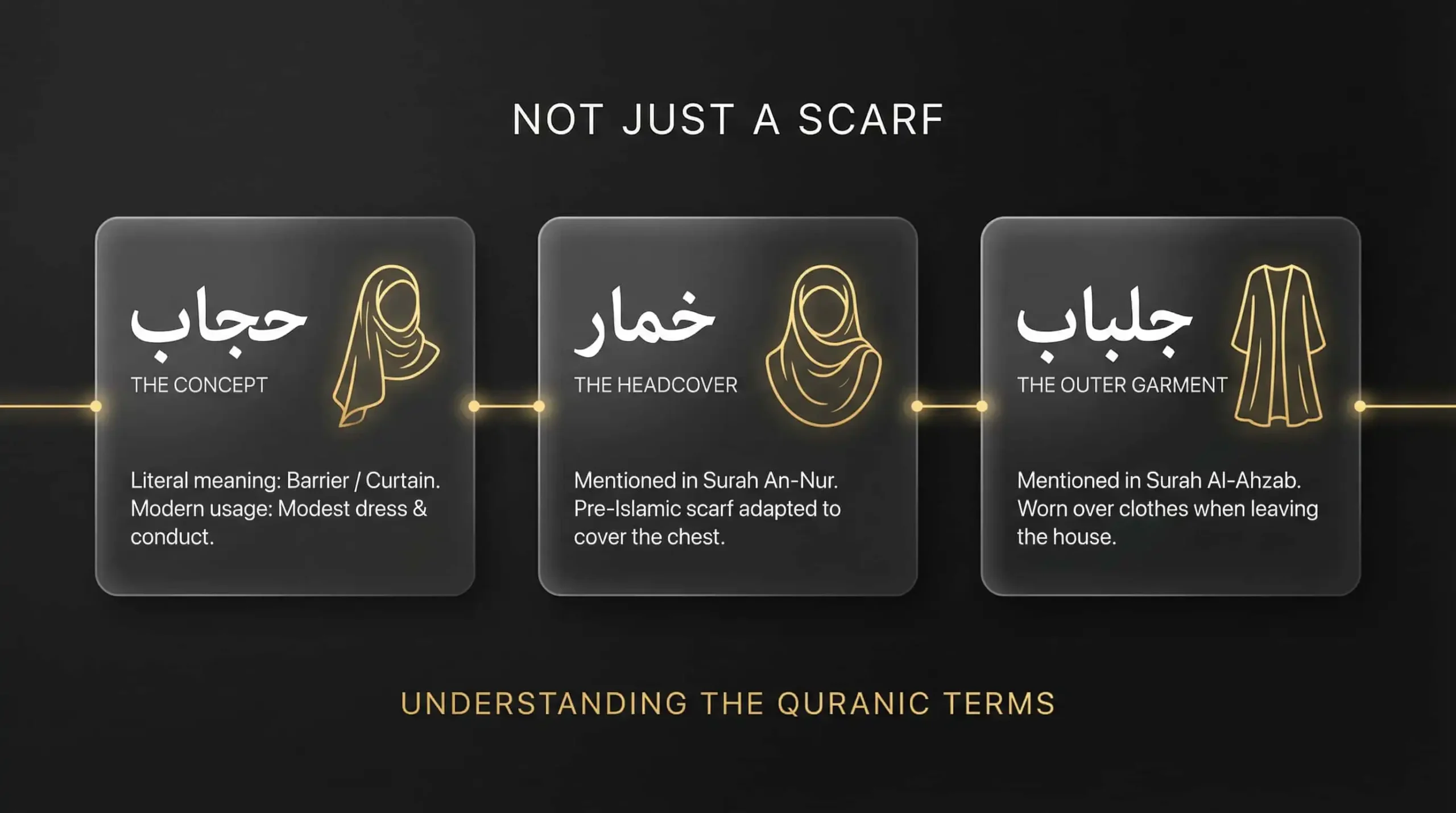
We cannot explain the reasons why women wear it until we know what hijab really is. The hijab (حجاب) in Arabic is the derivation of the verb حجَبَ (hajaba) and it develops out of the root ح ج ب (H J B). This root forms a family of words that is related to hiding, concealing or blocking.
The Literal and Spiritual Meaning
Hijab literally translates to a barrier, a partition, a curtain or a covering. Traditionally it was used as a screen or a partition. The meaning of hijab extends much deeper than a physical object today because it is used most commonly to refer to the head covering worn by Muslim women.
In another deeper meaning, hijab is a broad phrase that implies modest dressing and modest conduct. This difference counts: even wearing a scarf does not necessarily complete the entire hijab requiring one to still swear foul words or carry himself/herself immodestly. The physical veil is only part of a greater devotion to decency in all behavior.
Related Terms in Islamic Dress (Khimar, Jilbab, Awrah)
Understanding the Islamic dress code requires familiarity with specific Arabic terms. The Quran refers to certain Arabic words which are associated with covering of women:
- Khimar (خمار): It appears in Surah An-Nur that describes a head cover. Women in pre-Islamic Arabia wore khimars but covered them behind their shoulders without covering the neck and chest area.
- Jilbab (جلباب): This is what is stated in Surah Al-Ahzab and is a type of outer garment or cloak that women are expected to wear when they are out.
An understanding of these terms will help one to understand that the command by Allah to cover extends to include the head and that the distinction between the terms hijab as we use it currently and these words in the Quran is more a matter of semantics and not substance.
Also Read: 15 Powerful Dua for Anxiety and Stress
The Primary Reason Why Islamic Women Wear a Hijab—Obedience to Allah
The main reason of wearing hijab is the submission to Allah, the creator of heavens and earth. Hijab is a fardh (فرض) a compulsory practice, a command given by God. To believing Muslim women, wearing a hijab, however, is first and foremost, one of the acts of worship and acknowledgement of Allah will.
The Essence of Islam: Submission to Divine Will
Islam itself is the name that implies submission to the will of God. Once Allah orders something in the Quran, good Muslims would seek to follow it out of their obedience to his wisdom even when the complete argument might not make sense.
Think of this analogy, You take a prescription that a doctor gives you although it may taste bad, because you believe that the doctor can help you be cured. When the Ultimate Healer, Allah, tells them to do something, which is beneficial to them, they believe him.
The majority of the women who wear veils among Muslims are doing so as a way of obedience to God and to be honored as the Quran states. This is more of a push as compared to culture, fashion and social pressures.
Scholarly Consensus on the Obligation
Several mainstream Islamic scholars are of the opinion that wearing the head is compulsory to Muslim women. The question of is hijab mandatory has been addressed by scholars, and this agreement is one of the best pieces of legal evidence of the obligatory character of hijab as a religious obligation. In instances where the scholars representing the four major schools of the Hanafi, Maliki, Shafi, and Hanbali schools reach a unanimous decision, this becomes a ruling that is a binding principle of the Islamic law.
Even though there are modernist intellectuals who have opined against the compulsory wear of the hijab, the vast majority of classical and present-day thinkers affirm the practice as it has been practiced by women when the Prophet Muhammad (peace be upon him) was alive.
The scholars, like Khaled Abou El-Fadl and Javed Ahmad Ghamidi, hold minority views. They are the exceptions but not the mainstream and the academic tradition has been taking the same position over a period of 1,400 years.
Quranic Foundations—Key Verses Explained
There are six verses in the Quran that direct the dressing, modesty, and behavior of women in the society. Yes, hijab is mentioned in the Quran through these Quran verses about hijab. In this case we look at the two most significant ones that form the foundation of hijab.
Verse 1: Surah An-Nur (24:31)
Arabic:
وَقُل لِّلْمُؤْمِنَاتِ يَغْضُضْنَ مِنْ أَبْصَارِهِنَّ وَيَحْفَظْنَ فُرُوجَهُنَّ وَلَا يُبْدِينَ زِينَتَهُنَّ إِلَّا مَا ظَهَرَ مِنْهَا ۖ وَلْيَضْرِبْنَ بِخُمُرِهِنَّ عَلَىٰ جُيُوبِهِنَّ
And tell the believing women to lower their gaze and guard their chastity, and not to reveal their adornments except what normally appears, and let them draw their head-coverings (khumur) over their chests.
— (Quran 24:31)
Verse 2: Surah Al-Ahzab (33:59)
Arabic:
يَا أَيُّهَا النَّبِيُّ قُل لِّأَزْوَاجِكَ وَبَنَاتِكَ وَنِسَاءِ الْمُؤْمِنِينَ يُدْنِينَ عَلَيْهِنَّ مِن جَلَابِيبِهِنَّ ۚ ذَٰلِكَ أَدْنَىٰ أَن يُعْرَفْنَ فَلَا يُؤْذَيْنَ ۗ وَكَانَ اللَّهُ غَفُورًا رَّحِيمًا
O Prophet, tell your wives and your daughters and the women of the believers to bring down over themselves [part] of their outer garments (jalabib). That is more suitable that they will be known [as respectable Muslim women] and not be harassed. And Allah is Forgiving and Merciful always.
— (Quran 33:59)
Scholarly Analysis:
The most significant word of the first verse is: bikhumurihinna (بِخُمُرِهِنَّ) or their head coverings. Khimar was a garment, which was familiar with Arab women, it was used to cover the head. The verse teaches the faith-affirming women to pull these head coverings around their breasts (juyub). Classical scholars indicate that it would be ridiculous to think that the Quran will refer to the word khimar meaning cloth covering the head to teach covering the chest and leaving the head out. The command will require the head to be covered and then it will be extended to cover the bosom. This verse goes on to share the mahram- male relatives in the presence of whom the hijab is not mandatory:
Arabic (continuation of 24:31):
وَلَا يُبْدِينَ زِينَتَهُنَّ إِلَّا لِبُعُولَتِهِنَّ أَوْ آبَائِهِنَّ أَوْ آبَاءِ بُعُولَتِهِنَّ أَوْ أَبْنَائِهِنَّ أَوْ أَبْنَاءِ بُعُولَتِهِنَّ أَوْ إِخْوَانِهِنَّ
except to their husbands, their fathers, their fathers-in-law, their sons, their stepsons, their brothers…
Scholarly Analysis:
In the second verse, there is clear justification on the commandment: in order that believing women shall be known and not to be abused. The hijab is a symbolic sign of religion and a point of defense. Jalabib (جَلَابِيبِھِنَّ) means exterior clothes or cloaks, which women are expected to pull towards the body on the occasions that they are outside.
Modesty Requirements for Men
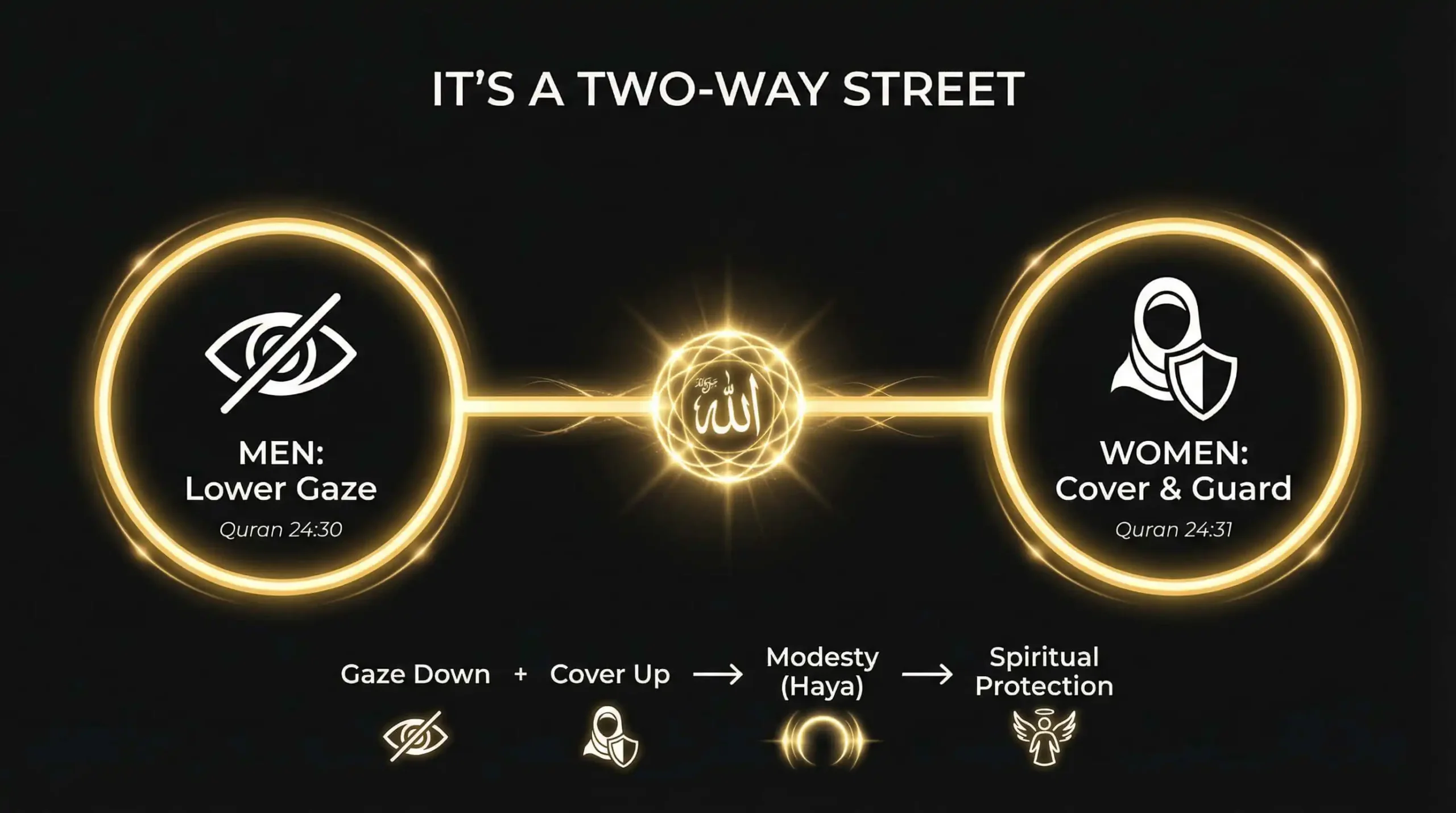
Islam does not enforce the issue of modesty to women only. The four verses just before the instruction to women (24:31) speak to men:
Arabic:
قُل لِّلْمُؤْمِنِينَ يَغُضُّوا مِنْ أَبْصَارِهِمْ وَيَحْفَظُوا فُرُوجَهُمْ ۚ ذَٰلِكَ أَزْكَىٰ لَهُمْ ۗ إِنَّ اللَّهَ خَبِيرٌ بِمَا يَصْنَعُونَ
Tell the believing men to lower their gaze and guard their private parts. That is purer for them. Indeed, Allah is Knowledgeable of what they do.
— (Quran 24:30)
This indicates that modesty in Islam is mutual between the two genders and is not a weight that is forced on women.
10 Reasons Why Do Islamic Women Wear a Hijab
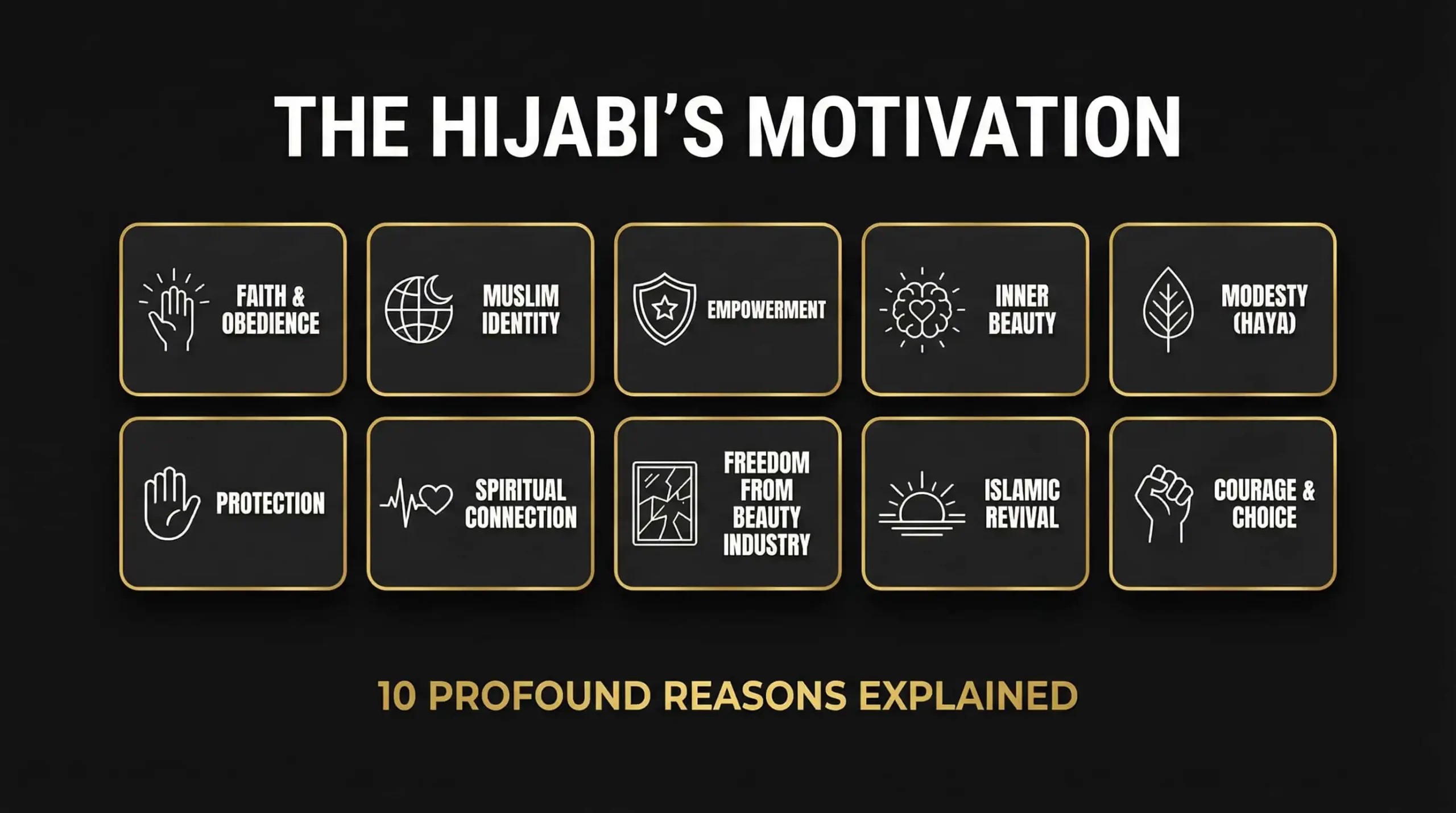
Although the most important motive is obedience to Allah, Muslim women declare numerous personal, spiritual, and social reasons of wearing hijab. The benefits of wearing hijab spiritually and socially are numerous. The ten deep motivations are as follows:
1. Faith and Obedience to Allah
Hijab is an act of faith. It is the reason as to why Allah spoke of women who believe when He gave the command. Being a hijab depicts the submission of a woman to her Creator and devotion to the leadership of her Creator. Whenever she wears it she makes a fresh resolution to please Allah.
2. Expression of Muslim Identity
The Hijab is an apparent symbol of Islam. It is very fast becoming the sign of women faith in a world of diversities and it also gives her a feeling of belonging to the world Muslim ummah (community). It is a boastful statement of religious belonging which ties women together regardless of culture and continents.
3. Empowerment and Control over Self
A large number of Muslim women claim that hijab makes them powerful and strong. One of the hijabis said: No one has permission to my body. Whether to show something or not, it is my decision, and I make it myself. Hijab is empowering as it grants authority to the physical self of a woman and refutes mainstream Western images of empowered women.
4. Pay Attention to Inner Beauty and the Spiritual Rather than the Physical
By wearing the appropriate hijab, women note that people are interested in their minds, skills, and personality and not about their appearance. The hijab shifts the focus beyond the surface and desexualizes her, making her unique.
5. Modesty as the Fundamental Islamic Ideal
The hijab is a representation of humility (haya), which is one of the main Islam values. The Prophet Muhammad (peace be upon him) said:
Arabic:
الْحَيَاءُ شُعْبَةٌ مِنَ الإِيمَانِ
Modesty (haya) is a branch of faith.
— (Sahih Bukhari 9, Sahih Muslim 35)
This is a fundamental virtue because Hijab gives women the opportunity to be judged by their personal traits and not their appearance as a form of appreciation.
6. Protection from Harassment and Objectification
Hijab women have discovered that wearing modest clothing lessens the undesirable attention and harassment, providing protection from objectification. According to the Quran itself: “That is more appropriate that they will be identified and not persecuted” (33:59). Hijab provides a respectable boundary that conveys that a woman wants not to be objectified but rather respected.
7. Spiritual Connection with Allah
The hijab spiritually helps to keep a woman attached to her religion throughout the day, strengthening spiritual connection with Allah. Every cover reminds her of her desire to become an Islamic follower. It is a reminder to her of her devotion to her Creator and makes the external practice internal, a pilgrimage of devotion.
8. Freedom from Beauty Industry Tensions
The contemporary society tends to appreciate women largely because of their appearance. A whole industry fosters a sense of incompetence regarding looks. Hijab can provide an escape of these pressures. To most people, the headscarf is a challenge to the ideals of beauty which seek more visibility. According to their argument, they contend that taking off of clothes to be stared at by others is not liberation; and real liberation is to make oneself on oneself.
9. Islamic Revival and Consciousness
The hijab has emerged as a conspicuous sign of Islamic identity ever since the 1970s. A good number of women perceive it as an indication of their desire to become part of an Islamic revival movement known as Sahwah. In mid-1970s, the Muslim college students began a movement of re-awakening and devotion towards their religion, and the hijab became a strong reminder of this awakening which has remained the same even today.
10. A Personal Choice that Involves Courage
Wearing a hijab is a choice that happens when a person feels deep in his or her desire to satisfy God and honor His teachings. Women who opt to cover do so at their own choice. This opposition to it has been strongly expressed by many, and by both Muslim and non-Muslim relatives. It is a daily exercise of dignity, strength and purpose to every woman who wears a hijab.
Hijab vs Niqab vs Burqa—Understanding the Types of Islamic Covering
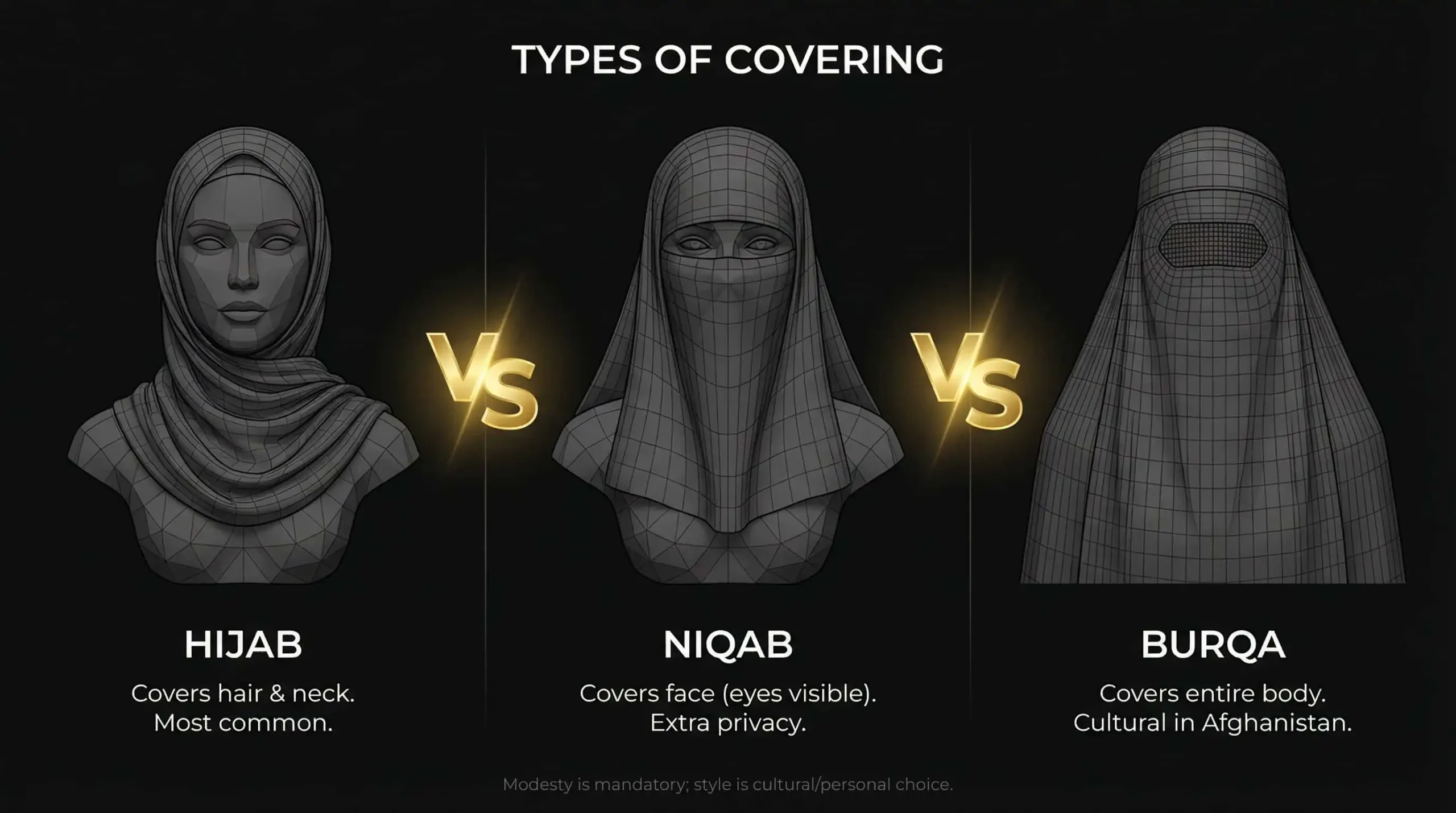
The most frequent question is: what is the difference between the hijab, niqab, and burqa? Below is a quick comparison.
Comparison Table
| Covering | What It Covers | Face Visible? | Common Regions |
| Hijab | Hair, neck, shoulders | Yes | Global |
| Niqab | Face (except eyes) + head | Eyes only | Middle East, South Asia |
| Burqa | Entire body + face (mesh) | No | Afghanistan, Pakistan |
Hijab
Hijab is a headscarf that covers the hair, neck and shoulders but leaves the face fully exposed. It is the most common Islamic wrapping in all parts of the world and it is usually accompanied by modest clothing that covers the legs and arms. Hijab is a fashion among universities, workplaces, and other contemporary environments as it is a religious obligation and personal statement of decency.
Niqab
Another type of the modest Islamic dress is the niqab as the dress that includes the face but leaves the eyes uncovered. It is normally worn when accompanied by a hijab and covers everything but the eyes. Generally women who wear niqab use greater modesty and privacy as their excuse. The niqab is prevalent in the Gulf countries, some sections of South Asia and in some communities of the world.
Burqa
The burqa is the most concealing of all; it covers the face and the whole body including the eyes that may only be shown through a net known as a chadri. It is primarily related to the cultural tradition of Afghanistan and parts of Pakistan. Burqa is the least popular of the three coverings in the world.
Other Styles of Islamic Covering
- Al-Amira: This is a two-piece veil design with a tight cap and a scarf tube-like covering that envelops the neck; which is mostly used in Southeast Asia.
- Shayla: This is a long, rectangular scarf, in use in the gulf countries and is wrapped around the head and is pinned at the shoulders.
- Khimar: A type of veil that is a cape, which reaches down to the waist or even lower, and covers the hair, neck, and shoulders.
- Chador: This is a full body cloak worn over indoor clothing and is used in Iran, this is sealed at the front by hand or underarm.
Personal Choice and Regional Variation
Modesty is an Islamic dressing code that is universally directed but the application differs greatly. The niqab and burqa are among the styles opted by women depending on their personal faith, academic advice, cultural background and their insights on modesty. There is no correct way of style. The most important concepts are to cover the awrah (the body parts which are to be hidden) and to wear the modest and decent clothes.
Debunking Myths—Is Hijab Oppression or Empowerment?
There is hardly any issue that can be discussed as much as the question whether the hijab can be seen as the oppression or empowerment of women. These are the most widespread misunderstandings, often confused with cultural tradition rather than religious teaching.
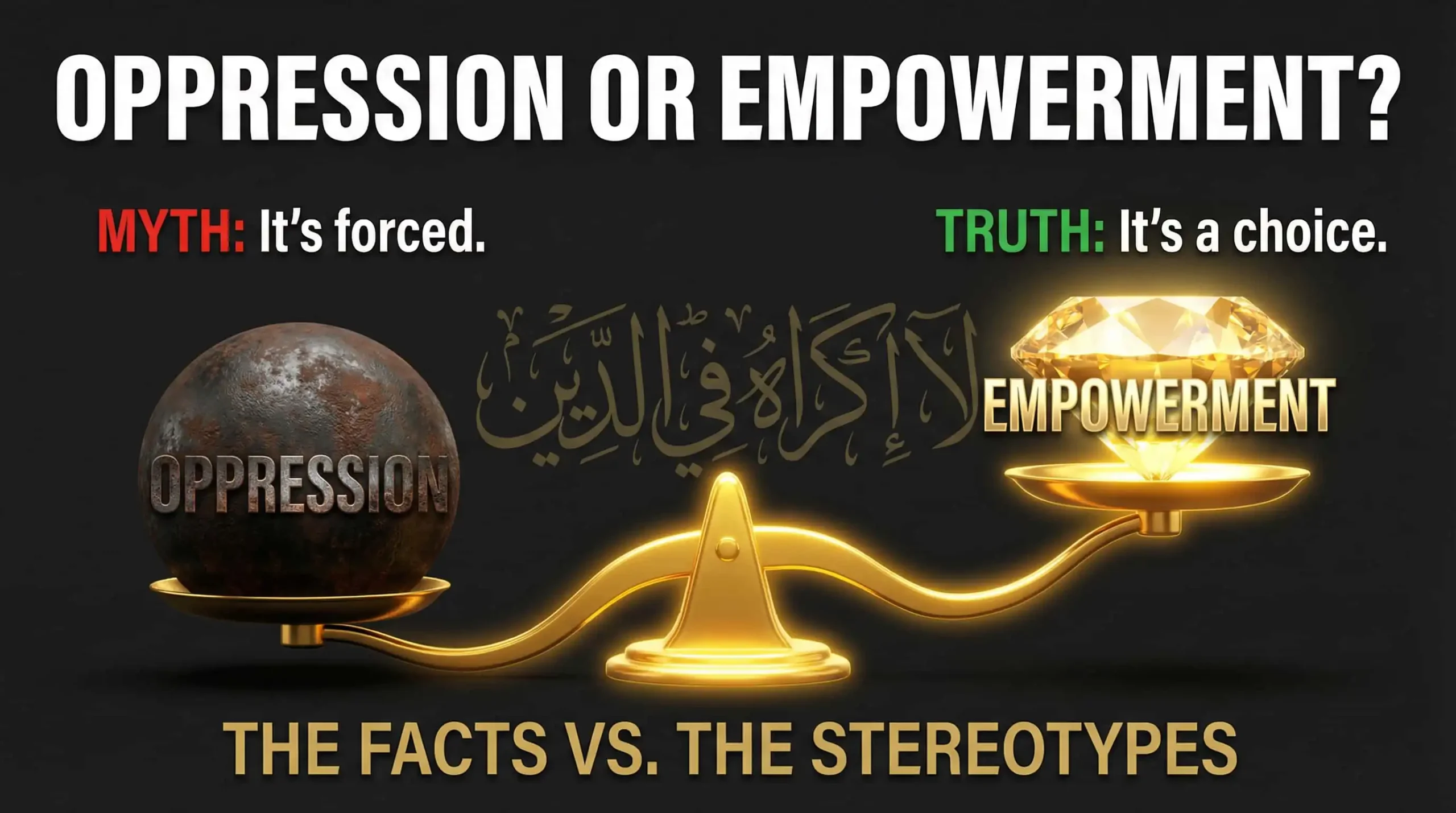
Myth 1: Muslim women are subjected to the force of wearing hijab.
Most people have wrongly believed that all Muslim women are forced to wear a hijab. This concept goes against the Islamic teachings which state:
“لَا إِكْرَاهَ فِي الدِّينِ” — “There is no compulsion in religion.” (Surah Al-Baqarah 2:256)
Prophet Muhammad (peace be upon him) did not coerce anybody to a religion. When a woman is coerced into covering, it is either because of culture or social coercion and not because of religious requirement. The wearing of a hijab voluntarily is a service to God; whereas forcefully, it becomes secularized.
Myth 2: “Hijab oppresses women.”
Even the hijab is not an oppressive symbol. The women are oppressed by socio-economic, political and cultural factors, which in most cases are not referred to in the societies where the hijab is not discussed at all. Oppression is a feature of any religion and any culture; it is not the Islam that does it. Some Western feminism perspectives misunderstand this concept. The fact is that a lot of Muslim women have the empowerment feeling that the hijab gives them because it allows them to establish their identity based on their intelligence, character, and accomplishments and not on how they look.
Myth 3: The Hijab denies women a chance of succeeding.
Instead, Muslim women in politics, science, business, sports and media are making it as they wear hijabs. Examples include:
- Ilhan Omar is a congresswoman in the U.S. who wears a hijab.
- Halima Aden, the first hijabi model ever to feature on the cover of a big fashion magazine.
- Ibtihaj Muhammad is an Olympic fencer and a bronze athlete who participated wearing a hijab.
- Dalia Mogahed, the director of research of the Institute of Social Policy and Understanding.
These women, and many others, demonstrate that the hijab does not make one unsuccessful or avoidable in the public.
Historical Context: Islam and Women’s Rights
What is not reported much is that Islam used to fight the rights of women. Islam abolished infanticide of females, permitted women to possess property, select their marriage partners, and engage in community activities and ensured rights to inheritance in 7th-century Arabia. Such reforms were much more progressive than the one of the Western society that would not take such steps one millennium later.
The Iran Context
One should speak about the protests in Iran following the death of Mahsa Amini in the year 2022. The morality police arrested Amini and she died in custody on the grounds of her allegedly breaking the law of wearing hijab. The events that occurred in these tragedies illustrate what can happen to having covering that is not a personal choice but a requirement imposed at a state level.
The idea of the absence of compulsion in religion (Surah Al-Baqarah 2:256) implies that when a government imposes the Islamic law, it is going against the essence of the spirit of the law. The hijab becomes defiled when forcefully taken. Hijab is supposed to come with the heart.
When Should a Muslim Girl Start Wearing Hijab?
When to start wearing hijab is a practical and spiritual question that can be asked to a Muslim girl.
The Islamic Guideline
Once a Muslim girl enters her puberty, she starts wearing hijab. The term woman (nisa) is not used in the Quran to refer to the girl as girls (banat) but shows that once the girl enters the womanhood and becomes a woman in terms of religious responsibility like praying, fasting, dressing in a modest manner, and so forth.
This is in line with the way Islamic jurisprudence views obligations in general: they come into existence when one reaches puberty, which also depends on the person but generally is between 9 and 15 years old.
No Specific Age Mandated
Hadith or the Quran does not provide a particular age in which hijab should begin. The guideline is not pegged to a number but to physical and spiritual maturity that is flexible depending on the maturity.
Gradual Introduction
Most of the scholars suggest a step by step introduction. The parents can advise the girls to don hijab at times when they are going to pray or attend mosque so that when they reach puberty; the habit becomes more of a nature than a shock or a load.
Individual Belief Is Necessary
Hijab is not motivated by external forces to wear the veil, but it is an inner desire to be intimate with Allah. Wearing hijab as a source of strength and identity is achieved when a young woman wears it due to true faith. This realization should be fostered by parents and communities instead of dictating rules without clarifying to the child why they are mandatory.
The Prophet Muhammad (peace be upon him) recommended:
Arabic:
مُرُوا أَوْلاَدَكُمْ بِالصَّلاَةِ وَهُمْ أَبْنَاءُ سَبْعِ سِنِينَ
Translation: Teach your children to pray at seven years old. — (Sunan Abu Dawud 495).
On the same note, the modesty and hijab ideas that are introduced at an early age equip the girls with the reality when they grow up.
Hijab in the Modern World
The hijab is in the cross-section of religion and modernity. Muslim females negotiate this territory with impressive strength.
Hijab in the Workplace
Hijab may be a strength and a weakness in the workplace. It has been proven that, women wearing hijabs are judged not by their beauty but by their qualification; the hijab has created a playing field by excluding the physical appearance in making a judgment.
In most western nations though, a head covering makes recruitment more difficult. Hijab discrimination is still a fact. According to the Council on American-Islamic Relations (CAIR) Civil Rights Report 2020, anti-Muslim hate cases were up by 15 per cent in the year 2020, and women wearing hijabs were disproportionately targeted with harassment, discrimination, and violence.
In spite of these, Muslim women have succeeded in doing well in such areas as medicine, law, technology, education, and politics without abandoning their religion, wearing modest clothing professionally.
Hijab Fashion
The rise of modest fashion industry has made the hijab a major statement owing to the trends in fashion. The small fashion market has grown to over 300 billion dollars in the world market and big brands are appreciating the purchasing and fashion influence of Muslim people.
Other Muslim women fear that too much attention to fashion will result in the spiritual dimming of the hijab. According to one hijabi: this is something that makes it more difficult to be true since hijab is now more of a statement than a sort of faith and proximity to Allah.
The issue of personal style and modesty among Muslims is a continuous debate across the world.
World Hijab Day
February 1 is the World Hijab Day, which was established in 2013 by Nazma Khan, a Bangladeshi-American who was discriminated against because of her hijab after 9/11. The day challenges everyone, Muslim and non-Muslim to put on hijab one day; this helps in creating awareness, dispelling stereotypes and also expressing their unity with Muslim women who are victims of discrimination.
The 2026 theme, Hijabis Unsilenced, draws on the strength, empowerment, and success of hijab-wearing women and seeks to resolve issues of globalism like Islamophobia and gender equity. The movement has evolved into a global movement that comprises more than 140 countries.
Practical Guide—Starting Your Hijab Journey
To the wearers of hijab, understanding the hijab rules in Islam is essential. The following is a useful tip:
Begin with Intention (Niyyah)
Put concentration towards the satisfaction of Allah, not the acceptance of any other person. Your hijab is talking to your Creator. Reflection and boldness are heavy elements in this choice–no one ever makes it lightly.
Seek Knowledge
Know the provisions of correct hijab:
- Cover the hair, neck, and chest.
- Garments must not be transparent or slim.
- Generally lay across the whole body minus, the face and hands.
Dignified, non-attention seeking styles should be chosen.
Start Gradually
Wear hijab in the house, then in relaxing environments. Test and experiment with various styles to discover your style. There are women who start with wearing hijab to the mosque and then start applying it to other places gradually.
Find Community Support
Connect with other hijabis who will hear your stories and provide you with motivation. Go to local Islamic centres or Internet groups. It can be helpful to find sisters that you can relate to, who are going through what you are going through.
Prepare for Challenges
Katherine Bullock, who had converted to Islam, remarked that the time leading to the decision to wear hijab was more challenging than the wearing of the same. Ask questions, a certain degree of negativity and doubt. Prepare in advance what you are going to say, and remember why you are doing it.
Remember Your “Why”
It is a daily decision of all women who wear the hijab to live a dignified, strong and meaningful life. When you have a bad day, go back to understand why you did it. Hijab is not a curse, it is an honour.
Must Watch: Is not wearing the hijab a Major sin? Punishment for women who display themselves – Assim al hakeem
FAQ—Common Questions Answered
Q1: Why do Islamic women wear a hijab – is it compulsory?
A: According to the mainstream scholars, the Muslim women are obliged to cover their head, with reference of the evident Quranic verses (24:31, 33:59) and consensus of scholars (ijmā). Most of them believe that Hijab is a religious obligation, although some modernists claim otherwise.
Q2: Do Muslim women reveal their hair to anyone?
A: Yes, women can also reveal their hair before mahrams, who are immediate family members, i.e. husbands, fathers, fathers in law, sons, brothers, nephews and grandfathers, as the following list indicates: Surah An-Nur (24:31).
Q3: Are there Islam modesty requirements among men as well?
A: Yes. Quran instructs men that they should lower their gaze and that they should guard their modesty (24:30). Men too should dress decently and cover at least below belly to knee and should not wear tight and provocative clothes. Modesty is the responsibility of both genders.
Q4: What is the distinction between hijab and niqab?
A: Hijab covers the neck, shoulders, that is, and the face is not covered. Niqab covers the whole head, and the eyes are the only visible parts. Burqa is a garment that envelops the whole body including the face covered by a net.
Q5: Do Muslim women feel compelled into wearing hijab?
A: Quran states that there is no constraint in religion (Surah Al-Baqarah 2:256). Coercing a person to wear hijab goes against the Islamic values. Although cultural pressure may be there, the real hijab must be voluntary.
Q6: What was the time when hijab became widespread in the Muslim women of the world?
A: Hijab is a practice that has been in practice since the Prophet Muhammad (peace be upon him). It was introduced on a global scale after the 1970s as women reverting to wearing it as a symbol of their belief and identity during the Islamic revival (Sahwah) movement.
Q7: Are non-Muslim women allowed to wear hijab?
A: Numerous non-Muslim women have put on hijab as a sign of solidarity, trend, curiosity, or personal decency. Such activities as World Hijab Day open an invitation to non-Muslims to join and understand each other.
Conclusion
To understand why do Islamic women wear a hijab, one needs to go beyond the facade to the faith, identity, and conviction behind the same.
In its most simple essence, hijab is obedience to Allah- a fulfilment of divine command that has a certain basis in the clear verses of Quran. Nonetheless, it is also a foreclosure of Muslim identity and a strength source, a form of spirituality, a response to being reduced to an object, and a decision to live each day with dignity and meaning. Hijab remains a religious obligation and a personal choice for millions worldwide.
The hijab is not merely a covering to the faithful Muslims. It represents modesty, chastity and faith depicted in a garment that says a lot without saying anything. What does hijab symbolize? It represents modesty, faith, and identity.
The hijab provides a solution to this issue of women being judged by their looks in a world where most people judge women by their looks, rather than the kind of work they do, their character, and their faith. The same message rings way beyond the Muslim community.
Wear hijab, or otherwise think about it, or just want to know, this guide can make you see how much deeper the one of the most obvious symbols of Islam is. Transfer this article to raise awareness and allow the discussion to proceed respectfully, inquisitively and with open hearts.