The agendas and background behind the Shia vs Sunni conflict, as well as their differences and commonalities.
The division between Shia and Sunni began in 632 CE when individuals disputed on who was to succeed Prophet Muhammad. Sunnis elected those leaders who began with Abu Bakr. In the opinion of Shia, Ali ibn Abi Talib and his family should be the leader. Nowadays there is approximately 85% Sunni Muslims and 15% Shia Muslims. The Shia vs Sunni question remains the most discussed division in Islam.
The issue of Sunni vs Shia is one of the most popular questions in the religious literacy of the world, and the most accessible explanations do not mention the primary sources of Islam, do not ascribe the scholarly positions, and raise both traditions in the way that they should be. Understanding Shia vs Sunni requires consulting primary sources among the global Muslim population.
This guide changes that. It treats the Shia vs Sunni topic with full scholarly attribution.
Next, a detailed and source-referenced contrast of the two largest branches of Islam, their common roots, their differences in theology, as well as their differences in practice, and what has led both branches to follow different directions almost 1,400 years ago are described. Every Shia vs Sunni claim in this article is attributed. Each decision has an academic source. The two traditions are laid out equally with respect.
There are diverse academic views in each school. This article is mainstream; a practice at a personal level might vary. Use the services of religious scholars to seek individual religious advice. This Shia vs Sunni overview represents mainstream positions.
What Caused the Shia-Sunni Split?
One of the most asked questions in religious literacy is why did Islam split into Sunni and Shia. The Shia vs Sunni division traces to a single pivotal moment. The Shia Sunni split among Sunni and Shia Muslims can be dated to one event — the death of Prophet Muhammad in 632 CE in the city of Medina. The Prophet did not have a truly universal, written and explicit edict that nominated an heir to the political aspect and the community was virtually cut in two almost on the issue of who was supposed to be the head of the Muslim ummah (community).
The Saqifa Meeting
Several hours after the death of the Prophet — as Ali ibn Abi Talib and the Banu Hashim clan were about to recoil the burial — a number of the prominent companions (Sahaba) assembled in Medina in Saqifa Banu Sa’idah, a roofed hall of meeting. Their first leader was proposed by the Ansar (Medinan Muslims), Sa’d ibn Ubadah, but following an acrimonious debate, Abu Bakr al-Siddiq was elected as the first caliph — the close companion of the Prophet, and his father-in-law — the father of Aisha (bint Abi Bakr), one of the Prophet’s wives — (i.e. community consensus as defined by Sunni scholars). Umar ibn al-Khattab played a decisive role in rallying support for Abu Bakr during the Saqifa deliberations.
This point of choice turned out to be the theological fault line. This moment is the origin point of the Shia vs Sunni divergence. To understand why are there Shia and Sunni, one must return to 632 CE.
Two Competing Claims
Those in support of the appointment of Abu Bakr claimed that since the companions of Prophet (Sahaba) were the ones close to him, they were in the best position to appoint a competent leader through consultation — shura (الشورى). This sect came to be identified as Ahl al-Sunnah wa al-Jama’ah — that is, the people of Prophetic Tradition and the Community — or Sunnis. The Shia Sunni split took shape around this very question.
There was a dissent movement who felt that Prophet Muhammad had already nominated Ali ibn Abi Talib — his cousin, son-in-law, and one of the first converts to Islam — to replace him. They cited things such as the meeting at Ghadir Khumm, when the Prophet declared, “Man kuntu mawlahu fa hadha Aliyyun mawlahu” — “Whoever regards me as his master, Ali is his master” (Sunan al-Tirmidhi, Hadith 3713). This sect came to be referred to as Shi’at Ali — the partisans of Ali — or Shia.
The Shia vs Sunni split thus began as a question of rightful succession.
From Dispute to Permanent Division
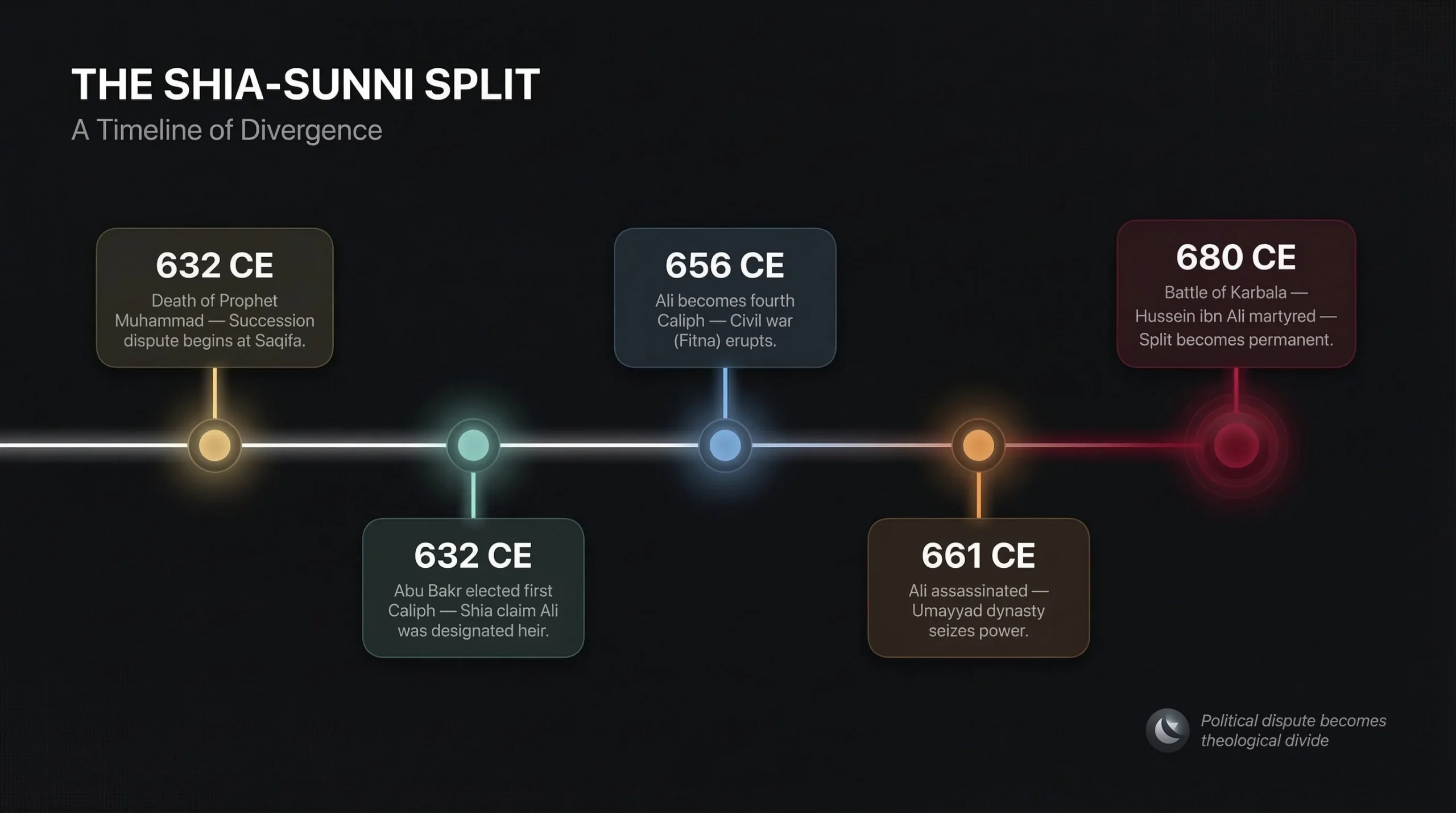
In 656 CE Ali was eventually elected the fourth caliph, but his caliphate was tainted by civil war — fitna (الفتنة). His murder in 661 CE widened the divide. The most characteristic tragedy, however, was the one that occurred in 680 CE in the Battle of Karbala when Hussein ibn Ali, the grandson of Prophet Muhammad, was killed along with a small group of his followers at the hands of the forces of the Umayyad Caliph Yazid I.
The martyrdom of Hussein was converting a political conflict into a theological and emotional rift. Martyrdom veneration became central to Shia identity after this event. What had been political became the permanent Shia vs Sunni divide. The Shia Sunni split was now irreversible. To the Shia people, Karbala was a cry of good resistance against oppression. It was the end of the road to the rest of the Muslim world.
Core Beliefs Shared by Sunni and Shia Muslims
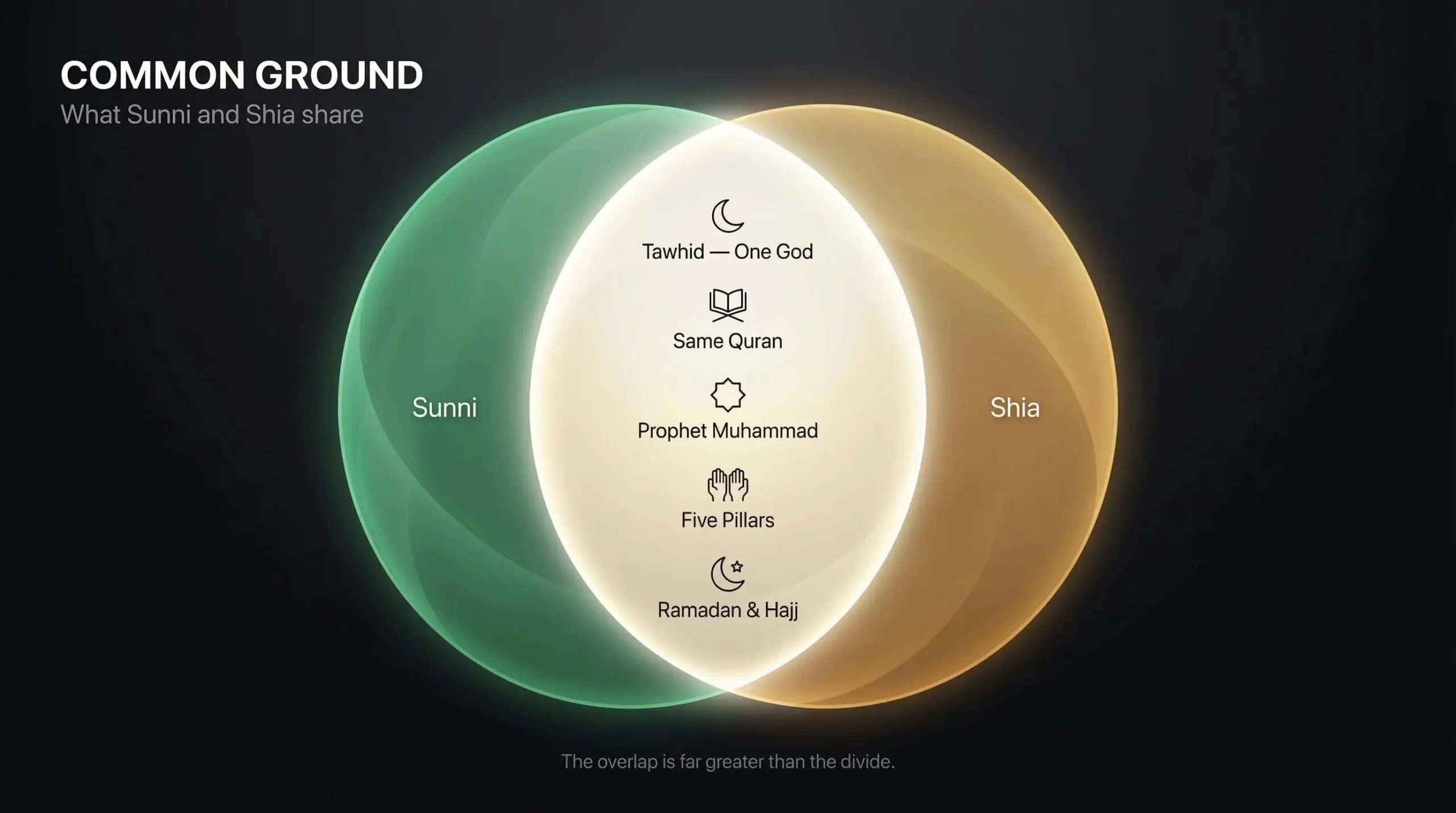
Before examining where Shia vs Sunni traditions diverge, their shared ground is substantial. In order to look into the point of divergence between these two traditions, it is imperative to first identify the huge overlap between them. Both the Sunni and the Shia Muslims have common pillars of the Islamic faith, that worship the same God, the same prophet and the same holy scripture. The differences though being theologically important coexist in a common monotheistic context. Both traditions revere the Sunnah (Prophetic tradition) as the second source of Islamic law after the Quran. Institutions such as Al-Azhar University and Shia hawza seminaries affirm these shared foundations.
The Five Pillars of Islam
The Sunni and the Shia Muslims practice the five acts of worship foundations:
- Shahada — The statement of faith: “There is no God but Allah, and Muhammad is His Messenger.” Shahada is the statement of faith, and the versions that add Ali as the Wali (friend/guide) of God are not regarded as part of the obligatory testimony by all Shia scholars.
- Salat — Daily ritual prayer.
- Zakat — Compulsory altruistic contributions on the basis of wealth.
- Sawm — Fasting in the month of Ramadan.
- Hajj — Pilgrimage to Mecca at least once in a life of the people who are physically and economically fit.
Other principles (the Usul al-Din, Roots of Religion and Furu al-Din, Branches of Religion) are combined with Shia theology but the main five are also still practiced across the board. On these five foundations, the Shia vs Sunni consensus is virtually complete.
Check: Five Pillars of Islam — Home
Belief in One God (Tawhid)
Both schools are strict monotheists — Tawhid (التوحيد) being the unquestioning authority of Islamic theology. The Quran says:
“Say: He is Allah, the One. Allah, the Eternal Refuge. He neither begets nor is born, nor is there to Him any equivalent.”
— Surah Al-Ikhlas (112:1–4)
The Sunni and the Shia Muslims do not disagree on the oneness and transcendence of God. Where subtle distinctions arise — like arguments over the divine nature — they are at the medium, theological, level (kalam), as opposed to basic creed. Monotheism is not a Shia vs Sunni issue; it is the shared bedrock.
The Quran as Divine Scripture
The two communities believe in the Quran as the word of Allah that is unaltered and revealed to Prophet Muhammad through the Angel Jibreel (Gabriel) during the course of a duration of about 23 years.
“The Messenger has believed in what was revealed to him from his Lord, and so have the believers. All have had faith in Allah and His angels and His books and His messengers.”
— Surah Al-Baqarah (2:285)
Another misconception is that the Shia Muslims have a different Quran. This is categorically false. Both the traditions refer to the same Quranic text — the Uthmanic codex that was assembled under the reign of Uthman ibn Affan. The differences do not exist in the Quran, but on how the verses in the Quran should be interpreted, and more importantly, which hadith collections are beneficial. The Quran itself is never a Shia vs Sunni point of contention.
Key Theological Differences Between Shia and Sunni
This is where the Shia vs Sunni divergence becomes theologically material. This is what makes the difference between Shia and Sunni Muslims theologically significant. Although the two traditions have a common scripture and prophetic tradition — the Sunnah — their systems of interpreting the authority and leadership of religion, as well as the eschatology, are fundamentally different.
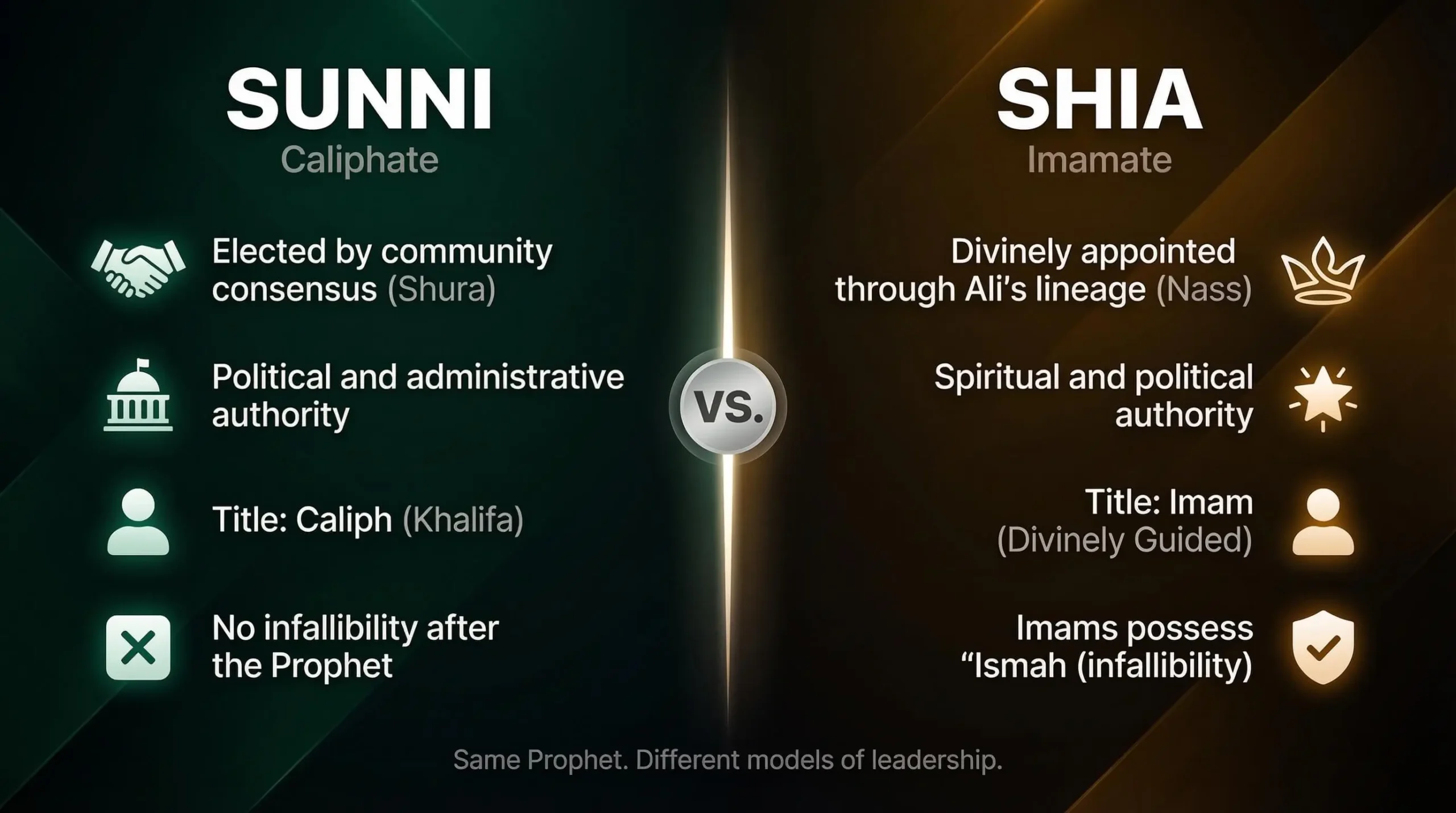
Leadership and Succession (Caliphate vs Imamate)
| Aspect | Sunni Position | Shia Position |
| Mode of succession | Elected by community consensus (shura/ijma) | Divinely appointed by the lineage of Ali (nass) |
| Title of leader | Caliph (khalifa — successor) | Imam (divinely guided leader) |
| Character of authority | Political and administrative; not inherently spiritual | Both spiritual and political; interpreter of divine law |
| Infallibility | Rejected for all human leaders after the Prophet | Imams possess ‘ismah (عصمة) — divine protection from error |
| Legitimate successors | Four Rightly Guided Caliphs, then dynastic rule | Twelve Imams in the Twelver Shia tradition |
The Sunni viewpoint is that the legitimate caliphs were Abu Bakr, Umar ibn al-Khattab, Uthman ibn Affan and Ali ibn Abi Talib — the Khulafa al-Rashidun (Rightly Guided Caliphs). This perspective is upheld by the hadith in Sahih al-Bukhari (Hadith 7220) that insists on obedience to the leader chosen by the community and the aspect of consultation.
Classical Sunni theologians such as Imam al-Ghazali (d. 1111 CE) wrote in his treatise, Al-Iqtisad fi’l-I’tiqad, that the office of caliph is not a divinely ordained one and that it was a practical need to govern and that the office did not need to be occupied by the offspring of a particular lineage.
According to the Shia view, Ali ibn Abi Talib was directly appointed by the Prophet at Ghadir Khumm. The primary textual evidence of this assertion is the hadith called “Man kuntu mawlahu fa hadha Aliyyun mawlahu” (“Whoever considers me as his master”) and is found in several Sunni and Shia collections such as Sunan al-Tirmidhi.
One of the most influential early Shia theologians was Sheikh al-Mufid (d. 1022 CE) who in his Kitab al-Irshad expounded that the Imamate was a divine covenant and not something open to human appointment. Sheikh al-Mufid’s work remains a foundational text in Shia seminaries today.
The Shia vs Sunni divide over leadership remains the foundational disagreement.
The Role of Imams
To the Sunni Muslims, an imam is merely the one who leads the congregational prayer. Any qualified Muslim who has enough knowledge can perform the role of an imam. No any doctrinal prerequisite of exceptional spiritual rank.
To Shia Muslims, especially the Twelver Shia who are the vast majority of Shia, the Imams (capitalized to indicate uniqueness) are the twelve particular descendants of Ali and Fatimah (the daughter of the Prophet). These Imams are supposed to have:
- ‘Ismah — Divine protection and infallibility.
- ‘Ilm — Divinely endowed knowledge of the inner meanings of the Quran.
- Spiritual authority over the Muslim community.
- Intercession (shafa’ah) — the belief that the Imams can intercede with God on behalf of believers.
Shia scholarship is centered in the hawza seminaries of Najaf and Qom, where Ja’fari jurisprudence is taught and developed.
The Sunni theology does not have an equivalent of this idea. The Sunni scholar Ibn Taymiyyah (d. 1328 CE) stated explicitly that he denied infallibility of human leadership in his Minhaj al-Sunnah al-Nabawiyyah, arguing that it is contradictory to apply the concept of ‘ismah to a human following the Prophet.
The doctrine of Imam infallibility is among the sharpest Shia vs Sunni theological boundaries.
Beliefs About the Mahdi
The Sunni and Shia traditions believe in the arrival of the Mahdi — a messianic leader who will bring justice before the Day of Judgment — they are however vastly different on who this person could be.
Sunni belief: The Mahdi will be a future descendant of Prophet Muhammad by the same name Muhammad, whose coming is predicted in hadith (see e.g. Sunan Abu Dawud, Hadith 4282). He has not yet been born.
Shia (Twelver) doctrine: The Mahdi is Muhammad al-Mahdi, the twelfth and last Imam, born in 869 CE, who went into occultation — ghayba (الغيبة) — in 874 CE. He is alive, and he is lurking, and is destined to appear at the designated time. According to the Twelver Shia view of occultation, an overview of the traditions of the twelfth Imam, the Bihar al-Anwar, by Allamah Majlisi (d. 1699 CE) is a monumental compilation of the traditions credited to the Imams. Allamah Majlisi’s work systematically documents the Twelver Mahdi doctrine.
The Ismaili Shia Muslims are in a different situation as they acknowledge a current, living Imam, Aga Khan, that is the rightful Imam.
Eschatology thus represents another significant Shia vs Sunni distinction.
Differences in Religious Practices
The Shia vs Sunni difference extends to everyday religious practice. The Shia and Sunni difference extends beyond theology into everyday religious life. Such distinctions are noticed and they often give rise to queries among the Muslims and the non-Muslims.
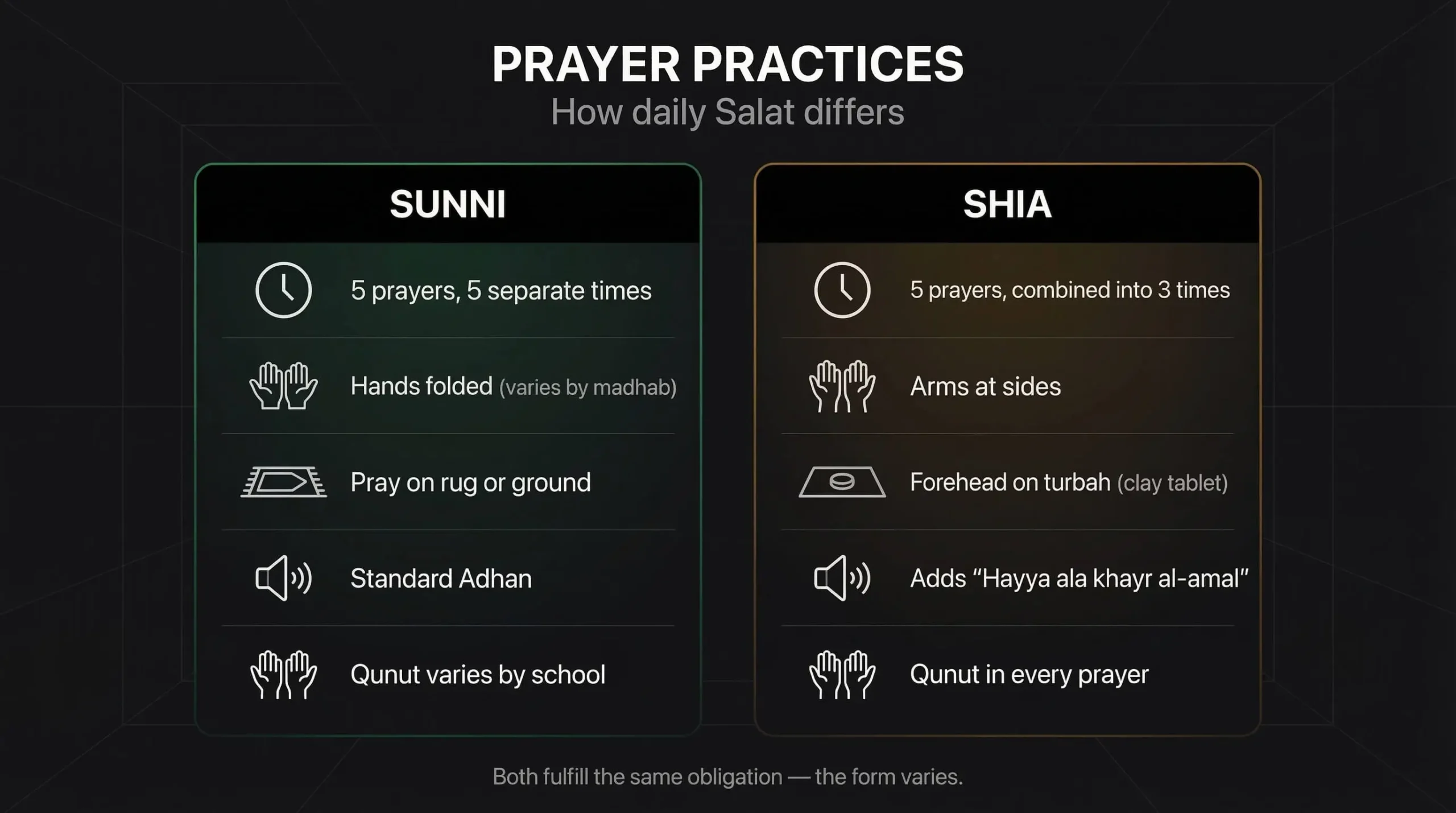
Prayer (Salat) Differences
| Practice | Sunni | Shia |
| Daily prayers | 5 prayers at 5 separate times | 5 prayers at 3 sessions (Dhuhr+Asr, Maghrib+Isha) |
| Hand position | Hands folded across chest or belly (depending on madhab: Hanafi below belly; Shafi’i and Hanbali on chest) | Arms at sides |
| Prostration surface | Directly on prayer rug or ground | Forehead on a clay tablet — turbah (التربة), usually Karbala soil |
| Adhan (call to prayer) | Standard formula without additional phrases | Adds Hayya ‘ala khayr al-‘amal (Come to the best of deeds); some add testimony regarding Ali |
| Qunut (supplication) | Depends upon madhab; Shafi’i school includes it in Fajr prayer | Recited in every daily prayer |
It is worth considering that in the Sunni Islamic faith, the four significant madhabs — which are Hanafi, Shafi’i, Maliki, and Hanbali — disagree with each other about the specifics of prayer. The Maliki school, such as, has historically allowed praying whilst holding weapons by their sides as was the case with Shia Muslims.
Commemorating Ashura
The 10th of Muharram (Ashura) has very different meanings by either tradition. Martyrdom veneration shapes the Shia observance profoundly:
Sunni practice: In the Hadith of Sahih al-Bukhari (Hadith 2004), the Prophet noticed the Jewish fast during the Day of Atonement and advised Muslims to fast. Although Karbala tragedy is recognized by Sunni Muslims, in Sunni tradition the day is not mainly the mourning one.
Shia practice: Ashura is a highly sensitive day to the Shia Muslims. It recalls the killing of Hussein ibn Ali at Karbala in 680 CE. During this day, people do a number of things:
- Funeral grieving (majalis) during which they recited elegies.
- Chest-banging processions (latmiyyah).
- Reenactment of the battle: passion plays (ta’ziyeh).
- The pilgrims come to the shrine of Hussein in Karbala, Iraq.
- Some communities practice ritual self-flagellation (tatbir), although most of the prominent Shia scholars, including Ayatollah Sistani and Ayatollah Khamenei, have discouraged or prohibited it.
Ashura is perhaps the most visible Shia vs Sunni difference in the ritual calendar.
Checkout Our: Islamic Calendar 2026
Temporary Marriage (Mut’ah)
The fact that people see temporary marriage — Nikah mut’ah (المتعة) — is one of the big differences.
- Shia position: It is permissible as a temporary marriage with dowry and fixed term. They refer to Surah An-Nisa (4:24) and Ahl al-Bayt (أهل البيت) sayings.
- Sunni position: It is forbidden according to all the four Sunni madhab schools of thought (Hanafi, Shafi’i, Maliki, Hanbali), with the aid of a hadith in Sahih Muslim of the Prophet, who said it was forbidden at the Battle of Khaybar.
- The Sunnis are also the general consensus of Ismaili and Zaidi Shia and they discourage it.
This informs us that Sunni and Shia do not represent each other; they have numerous internal dissimilarities. Mut’ah (المتعة) illustrates that Shia vs Sunni is not monolithic; internal diversity exists on both sides.
Hadith Sources and Religious Texts
Another key Shia vs Sunni distinction lies in which hadith collections each tradition trusts. One of the differences is which hadith collections a particular group of people trusts after the Quran.
Sunni Canonical Collections (Al-Kutub al-Sittah)
There were 6 key collections, which were assembled in the 9th century CE:
- Sahih al-Bukhari — the most genuine, and was compiled by Imam al-Bukhari (d. 870).
- Sahih Muslim — Imam Muslim ibn al-Hajjaj (d. 875).
- Sunan Abu Dawud — a collection of sayings of Abu Dawud al-Sijistani (d. 889).
- Jami al-Tirmidhi — a collection of Imam al-Tirmidhi (d. 892).
- Sunan al-Nasa’i — Imam al-Nasa’i (d. 915).
- Sunan Ibn Majah — was collected by Ibn Majah (d. 887).
These sets are based on the chains which involve the companions of Prophet (Sahaba) who are regarded as truthful by the Sunnis.
Shia Primary Collections (Al-Kutub al-Arba’ah)
There exist four foundational collections:
- Al-Kafi — the most comprehensive, collected by al-Kulayni (d. 941).
- Man La Yahduruhu al-Faqih — is a compilation of Sheikh al-Saduq (d. 991).
- Tahdhib al-Ahkam — edited by Sheikh al-Tusi (d. 1067).
- Al-Istibsar — a collection by Sheikh al-Tusi.
Why the Collections Differ
The Shia scholars are not necessarily inclined to believe all the companions (Sahaba) of the Prophet. Prominent narrators in Sunni collections include Aisha (bint Abi Bakr) and Abu Hurairah, whose reliability Shia scholars critically evaluate.
They pay attention to Ahl al-Bayt (household of the Prophet) narrations, mostly Ali, Fatimah, Hasan and Hussein and subsequently Imams. Due to these disparate standards of Islamic jurisprudence, the Shia collections and the Sunni collections have little overlap in the collections of traditions.
These different evidentiary standards are a core reason the Shia vs Sunni traditions developed distinct legal rulings.
Check Our Hadith Page: Guide to Authentic Hadith Sources
Geographic Distribution and Demographics
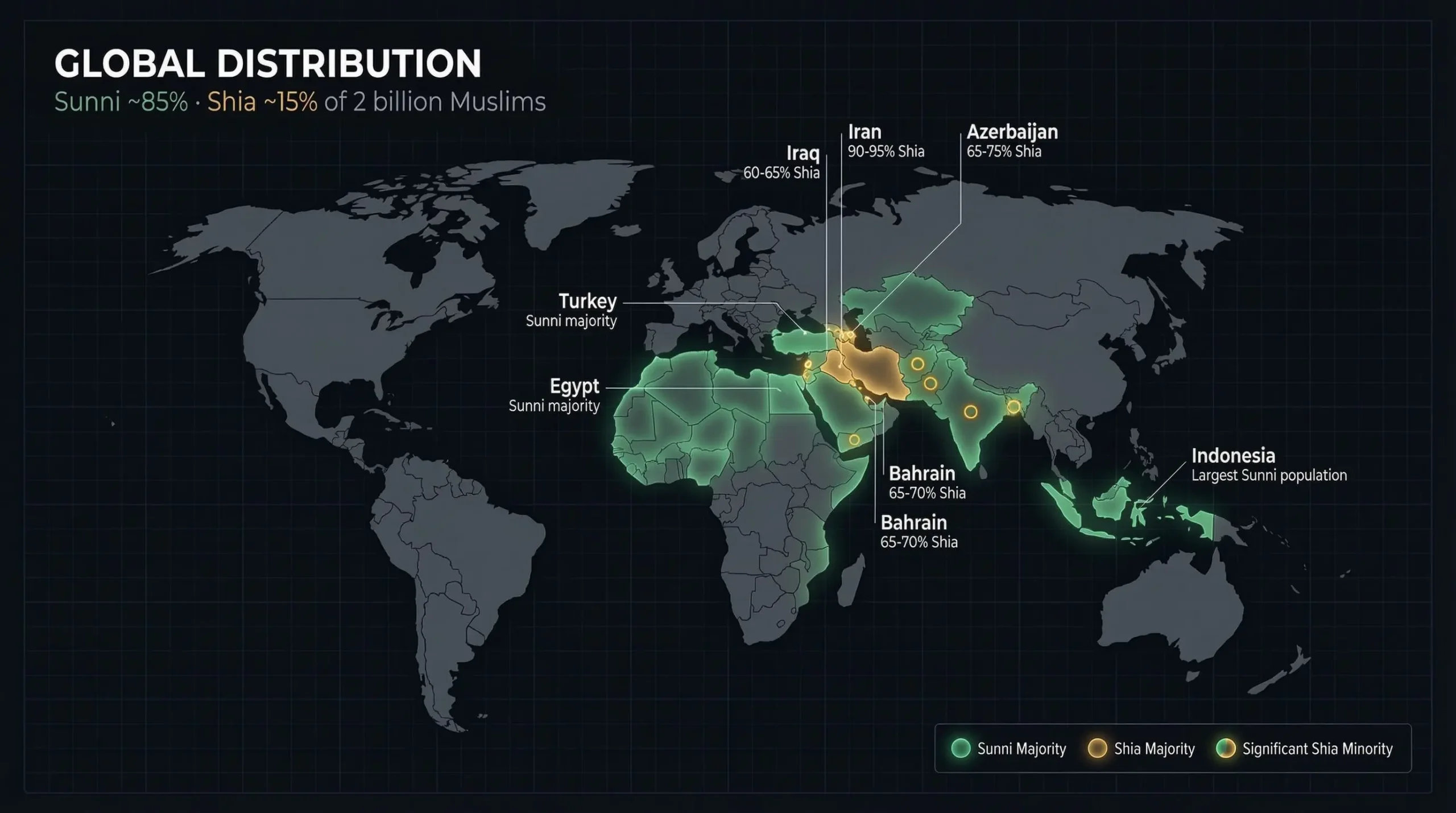
It is important to put the Shia vs Sunni landscape in perspective. The Muslim population, estimated at 2 billion by the year 2025–2026, is not evenly distributed.
Sunni Muslims (around 85 percent of the world Muslim population):
- Primarily based in Saudi Arabia, Egypt, Turkey, Indonesia, Malaysia, Pakistan, Bangladesh, Jordan and majority of North and West Africa.
- They belong to one of the four large madhab schools of thought — Hanafi (widest as well), Shafi’i, Maliki, or Hanbali.
Shia Muslims (15% of all Muslims in the world):
- Primarily live in Iran (90 to 95 per cent Shia), Iraq (60 to 65 per cent), Bahrain (65 to 70 per cent) and Azerbaijan (65 to 75 per cent).
- In Lebanon (30–35 per cent), Yemen (35–40 per cent, including a notable Zaidi presence), Kuwait, Pakistan, India and Afghanistan there are big minorities.
- Their domestic law predominantly is Ja’fari (Twelver) jurisprudence, with minor Ismaili and Zaidi groups.
The sectarian questions carry sectarian tensions of significant geopolitical significance since a considerable number of Shia Muslim population resides around large oil-producing regions, in particular, Iran, Iraq, Bahrain, and sections of Saudi Arabia.
Historical Relations and Modern Context
The Shia vs Sunni relationship has oscillated between coexistence and conflict over 1,400 years. The connection between Sunni and Shia individuals has changed the peaceful coexistence and learning to the bloody confrontation.
Historical Conflicts
One of the most important conflicts was Ottoman-Safavid wars (16th–18th centuries). The Ottoman Empire under Sunni leadership engaged in war with the Shia Safavid rule of Iran that established Twelver Shiism as the official religion.
Shah Ismail I (r. 1501–1524) had no option but to compel the Safavid region, which was normally Sunni, to be transformed into a Shia nation. He imported Shia thinkers from Lebanon and Bahrain and repressed the Sunni institutions.
Modern Unity Efforts
Even after the tension in the past, reconciliation has been attempted:
- 1959: Sheikh Mahmoud Shaltut, the Grand Imam of Al-Azhar University (in Cairo, a Sunni institution), issued a landmark fatwa officially accepting Ja’fari (Twelver Shia) law as a fifth school of Islamic jurisprudence.
- The fatwa issued by Ayatollah Khomeini enabled the Shia Muslims to worship in the presence of Sunni imams — demonstrating that Shia and Sunni can pray together when the intention is unity.
- 2004 Amman Message: More than 200 scholars on each side issued a statement stating that eight schools of thought (four Sunni, two Shia, Ibadi, and Zahiri) were all true, and that declaring another Muslim an apostate (takfir) against the known schools is prohibited.
These initiatives demonstrate that the Shia vs Sunni divide is not inevitably hostile.
Contemporary Sectarian Tensions
The sectarian tensions today are more politically oriented than religious. Vali Nasr writes in his book The Shia Revival (2006) that the concept of secular nation was forgotten in the Middle East ever since the end of the colonial rule. This created a vacuum that was occupied by other religious organizations and the governments took advantage of those disparities in order to get power.
In places such as Iraq, Syria, Yemen, and Bahrain, the conflicts revolve around sectarian lines, yet identifying it as simply Shia vs Sunni conceals the politics, finances and tribesmanship, which result in the violence. It is important to be careful not to confuse political wars with religious arguments, as Martin Kramer cautions us. As Vali Nasr observed, the sectarian framing often obscures the underlying political competition for state power.
Majority of the Sunni and Shia Muslims reside in harmony all over the world. Sectarian tensions in the form of violence are uncommon and a respite to the history of peaceful coexistence in Islam.
Frequently Asked Questions
Can Sunni and Shia Marry Each Other?
Yes, majority of scholars declare that it is permitted. Sunni and Shia wedlocks are legal since they are all Muslims. Ayatollah Khomeini also allowed it. However, in areas where religion is used to get individual status and with other practices, family consideration and laws may become problematic.
In Sunni schools of thought such as Hanafi, Shafi’i, and Hanbali, marriage is generally permitted provided the normal Islamic requirements — namely gift, witnesses and consent — have been fulfilled.
Must Watch: Can a Sunni marry a Shia? – assim al hakeem
Do Shia and Sunni Read the Same Quran?
Yes. They both shared the same Quran — the Uthmanic version maintained in Arabic since the 7th century. The words, sequence and numbers are alike. Al-Azhar University has confirmed that both communities use the identical Quranic text. The assertions that it has an alternative Shia Quran are not true and most scholars of the Shia reject it.
Differences have been manifested in the explanation of verses in each group as well as the collections of hadiths they rely on.
Which Came First, Sunni or Shia?
Neither came first. Both began following the leadership row over Muslims when Muhammad passed on in 632. The terms Sunni and Shia were further created, but the succession dispute emerged at the beginning. The twelfth Imam’s occultation and the development of the Sunni caliphate both evolved over subsequent centuries.
The important point is that the laws, theology, and methods of hadith of each of the traditions had evolved gradually during the first three centuries of Islamic jurisprudence.
Why Do Shia Muslims Mourn on Ashura?
The Shia Muslims lament during Ashura on the 10th of Muharram to commemorate Hussein ibn Ali, the grandson of Muhammad who was killed at Karbala in 680. Hussein had 72 followers and was killed by the Umayyad army since he was not willing to help a leader he considered wrong. To Shia believers, the death of Hussein demonstrates the necessity to struggle against injustice to lose your life in the process. They have a strong spiritual and political meaning of this story. Martyrdom veneration is at the heart of how Shia Muslims remember this day.
Is One Branch More Correct Than the Other?
Whether a branch is right or not is a question of faith — the Sunni vs Shia question has no neutral resolution. There cannot be a neutral study that can assert that one is right. Both Sunnis and Shia believe they are taking the correct Islam as taught by Muhammad. Both are profoundly learned and old.
It is more constructive to learn the Shia vs Sunni traditions on both sides with the respect of each other and with the right facts than to argue. Ayatollah Khomeini’s call for Muslim unity remains a reference point in Shia vs Sunni ecumenical dialogue.
Conclusion
The Shia vs Sunni problem is not a black and white one. The Shia and Sunni difference encompasses a 1,400-year discussion on leadership, law, grief, justice and organization of religion following the death of Muhammad. The succession dispute at Saqifa in 632 opened two ways: one, which stressed on communal consensus and shared wisdom of the companions (Sahaba), the other one which stressed on a God-appointed leader through the family of Muhammad.
The two ways gave rise to immense civilizations and personalities across all madhab traditions. The differences are important, yet it is the enormous common base — rooted in Tawhid, the Quran, and the Sunnah — that defines both. They have a common God, Prophet, Quran and common practices. Ecumenical efforts by institutions like Al-Azhar University point toward a future of informed coexistence. As Imam al-Ghazali wrote, the pursuit of knowledge and understanding is itself an act of devotion.
Acquaintedness on the part of both parties is more than learning. Good knowledge is a moral responsibility when it is employed as a weapon in sect labeling. The sectarian tensions that persist are overwhelmingly political, not theological.
This paper gives mainstream academic opinions of both traditions. There may be a difference in individual practice and belief. Personal direction: use the advice of competent scholars in your school.