The question is masturbation a sin depends on the faith tradition you follow. Most of the scholars in Islam believe that it is not allowed or disliked according to a Quran verse. The connection of lust with this makes it sinful in Christianity. Physicians affirm that moderate masturbation does not have any physical harm.
Majority of the individuals that are searching is masturbation a sin are not simply searching to define it. They wonder is it a sin to masturbate and search for deeper answers: Am I a bad person? Will God forgive me? How can I stop feeling guilty?
Whether phrased as “is self-pleasure a sin” or “is masturbation wrong,” the underlying concern is the same. This manual provides sincere, comprehensive, and gracious responses. Whether your concern is masturbation sin or not, the answer requires examining religious texts carefully. We do not provide a fast sentence, but elucidate the Islamic law, Christian doctrine and medical facts so that you are aware of what your religion actually says and what action could be taken next.
What Is Masturbation? A Neutral Definition
Masturbation is touching and rubbing your own organs in order to achieve sexual enjoyment, arousal, or discharge and normally ends with the emission of orgasm. The term in Arabic is istimna (استمناء), and the masturbation meaning in Urdu is musht zani (مشت زنی) or jalq (جلق). According to the World Health Organization and leading medical organizations it is a normal aspect of human sexuality and is done by people in all cultures, ages and genders.
Masturbation in the clinic is purposely controlled self-touch which emits hormones like dopamine, oxytocin, endorphins, which provide short term gratification and rest. It is not similar to involuntary nocturnal emissions which occur in sleep without any conscious thinking.
The ethical issue is the place where the concrete problem is. Religions do not merely judge masturbation based on its physicality, but its spirituality, sexual morals and God. In the following sections, the answer to what Islam, Christianity, and science say about sexual purity is explained with complete references.
Also Read: Is Music Haram in Islam? Rulings, Instruments, and Everyday Scenarios | Best Guide
Is Masturbation a Sin in Islam? The Complete Fiqhi (فقه) Analysis
To answer is masturbation a sin in Islam, one must examine the Quran, the Prophet’s words, and scholarly rulings. The central question — is masturbation haram — receives different answers depending on the school. Not all scholars agree with it; some of them affirm that it is outlawed, some permit it on certain conditions.
We shall go in the common sequence, the Quran, the prophets sayings and the opinions of the scholars.
What the Quran Says About Sexual Purity
Is masturbation mentioned in the Quran explicitly? No — the word istimna (استمناء) does not appear, but scholars derive the ruling from Surah Al-Mu’minun 23:5-7. To understand what does the Quran say about masturbation, scholars examine several key verses. The primary verse the scholars of the Quran use is in Surah Al-Mu’minun (23:5-7):
Arabic:
وَالَّذِينَ هُمْ لِفُرُوجِهِمْ حَافِظُونَ ﴿٥﴾ إِلَّا عَلَىٰ أَزْوَاجِهِمْ أَوْ مَا مَلَكَتْ أَيْمَانُهُمْ فَإِنَّهُمْ غَيْرُ مَلُومِينَ ﴿٦﴾ فَمَنِ ابْتَغَىٰ وَرَاءَ ذَٰلِكَ فَأُولَٰئِكَ هُمُ الْعَادُونَ ﴿٧﴾Translation (Sahih International): “And they who guard their private parts (5) Except from their wives or those their right hands possess, for indeed, they will not be blamed (6) But whoever seeks beyond that, then those are the transgressors (7)”
Surah Al-Ma’arij (70:29-31) is another verse that is similar:
Arabic:
وَالَّذِينَ هُمْ لِفُرُوجِهِمْ حَافِظُونَ ﴿٢٩﴾ إِلَّا عَلَىٰ أَزْوَاجِهِمْ أَوْ مَا مَلَكَتْ أَيْمَانُهُمْ فَإِنَّهُمْ غَيْرُ مَلُومِينَ ﴿٣٠﴾ فَمَنِ ابْتَغَىٰ وَرَاءَ ذَٰلِكَ فَأُولَٰئِكَ هُمُ الْعَادُونَ ﴿٣١﴾The most important one is “whoever seeks beyond that.” Classical mufassirun (Quran commentators) examined this verse extensively. This was interpreted by most scholars to imply that anything that is pleasurable in the context of sex outside of marriage is a sin. Ibn Kathir in Tafsir al-Quran al-Azim explains that “whoever seeks beyond that” encompasses all sexual gratification outside the two lawful categories. Similarly, Al-Qurtubi in Al-Jami’ li Ahkam al-Quran states that the verse establishes a clear boundary for permissible sexual outlet. Since masturbation is self-gratification not in marriage, most of them consider it in that category.
Other verses that substantiate this point are Surah An-Nur (24:30), which instructs the believing men to lower their gaze and guard their private parts:
Arabic:
قُل لِّلْمُؤْمِنِينَ يَغُضُّوا مِنْ أَبْصَارِهِمْ وَيَحْفَظُوا فُرُوجَهُمْ ۚ ذَٰلِكَ أَزْكَىٰ لَهُمْ ۗ إِنَّ اللَّهَ خَبِيرٌ بِمَا يَصْنَعُونَTranslation (Sahih International): “Tell the believing men to reduce [some] of their vision and guard their private parts. That is purer for them. Indeed, Allah is Acquainted with what they do.”
And Surah Al-Isra (17:32) that warns that one should avoid intimate relations to unlawful acts of sexual behavior:
Arabic:
وَلَا تَقْرَبُوا الزِّنَا ۖ إِنَّهُ كَانَ فَاحِشَةً وَسَاءَ سَبِيلًاTranslation (Sahih International): “And do not approach unlawful sexual intercourse. Indeed, it is ever an immorality and is evil as a way.”
According to scholars, the term “do not approach” can be used in the sense of shunning all the ways that lead to the sexual sin, others to masturbation.
Hadith Evidence on Masturbation (Istimna — استمناء)
None of the genuine hadiths states masturbation in its name. The best hadith is the widely-known narration which is reported by Abdullah ibn Mas’ud:
Arabic:
يَا مَعْشَرَ الشَّبَابِ، مَنِ اسْتَطَاعَ مِنْكُمُ الْبَاءَةَ فَلْيَتَزَوَّجْ، فَإِنَّهُ أَغَضُّ لِلْبَصَرِ وَأَحْصَنُ لِلْفَرْجِ، وَمَنْ لَمْ يَسْتَطِعْ فَعَلَيْهِ بِالصَّوْمِ فَإِنَّهُ لَهُ وِجَاءٌTranslation: “O young men, whoever among you can afford marriage, let him marry, for it lowers the gaze and guards the private parts. And whoever cannot afford it, let him fast, for it will be a shield (wija’) for him.” (Sahih al-Bukhari 5066; Sahih Muslim 1400)
Their key arguments are: marriage is the proper solution to sexual desire and fasting is the other solution to the people who are unable to marry. The Prophet Muhammad ﷺ suggested that people should not use masturbation and rather fast meaning it must not be a sanctioned means of alleviating passion. Had it been allowed, the Prophet Muhammad ﷺ would have referred to it as an easier option.
Other researchers indicate that the silence surrounding masturbation does not imply that it is prohibited and that need can permit it in extenuating circumstances.
The Four Madhab (مذهب — School of Law) Positions Compared
Understanding what scholars say about masturbation requires examining each school individually. All four Sunni schools of Islam law (Hanafi, Maliki, Shafi’i, Hanbali) do not have a single rule. The question is whether masturbation can ever be considered halal (حلال — permissible). It is better to know how every school is considered in relation to masturbation so that the person who needs to be guided can choose the direction that suits her tradition.
| Madhab | Base Ruling | Exception of Fear of Zina | Primary Evidence | Key Scholar |
| Hanafi | Makruh (مكروه — disliked) | Justifiable as lesser evil | Minor evil principle — akhaf al-dararayn (أخف الضررين) | Imam Abu Hanifa; Ibn Abidin (Radd al-Muhtar) |
| Shafi’i | Haram (حرام — forbidden) | Not permitted | Quran 23:5-7 strictly interpreted | Imam Al-Shafi’i (Al-Umm); Imam Al-Nawawi (Al-Majmu’) |
| Maliki | Haram (حرام — forbidden) | Prohibited | Quran 23:5-7 literally followed | Imam Malik; Ibn Rushd. Scholars like Al-Qurtubi from the Maliki tradition upheld the prohibition |
| Hanbali | Haram (حرام — forbidden) | Permissible under genuine necessity — darurah (ضرورة) | Contextual license | Ibn Qudamah (Al-Mughni); Ibn Taymiyyah (Majmu’ al-Fatawa) |
The most liberal is the Hanafi view. It is anchored in the notion that where an individual must decide between bad two things, that is, to commit zina (زنا — fornication/adultery) or to masturbate, he should be able to make the decision that is less harmful. According to Radd al-Muhtar by Ibn Abidin, in case a person genuinely cannot marry, and he is so overcome by the desire that it leads to fornication, masturbation may be endured as a lesser evil. The Arabic term istimna in Islam refers specifically to self-stimulation for sexual release.
The Shafi’i and Maliki schools are more authoritative. Imam Al-Nawawi’s position in Al-Majmu’ remains the standard Shafi’i reference — masturbation is haram due to the Quran 23:5-7, and he does not grant the necessity outside the marriage.
Hanbali school has an intermediate stance. Ibn Qudamah in Al-Mughni writes that the rule of default is an injunction, but a true fear of committing zina may temporarily permit masturbation. This falls under the principle of darurah (ضرورة — necessity). Ibn Taymiyyah shares the same thought in Majmu’ al-Fatawa by stating that this permission must never be in habit.
Madhab Decision Framework:
- You do not risk committing zina (fornication)?
- No → The majority in all schools say it is haram or makruh (مكروه). Avoid it.
- You do not risk committing zina (fornication)?
- Yes →
- Hanafi perspective: It can be permitted as the lesser evil (makruh)
- Hanbali opinion: It may be permitted in case it is really necessary to avoid zina
- Shafi’i and Maliki opinions: Prohibition stands — marry or fast rather
Contemporary Fatwa (فتوى) Positions
Islamic organizations of the modern world have expressed varying views on what scholars say about masturbation in Islam:
- Dar al-Ifta al-Misriyyah (Egypt) generally states that masturbation is haram, though it allows the Hanafi exception of extreme necessity.
- IslamQA (Saudi, lean towards Hanbali) retains the prohibition firm but observes the contextual concession of Ibn Taymiyyah.
- Sheikh Yusuf al-Qaradawi in The Lawful and the Prohibited in Islam says that masturbation is a sin but some scholars permit it to those who are afraid of committing a more serious sin as long as it is not a habit.
- Islamic Fiqh Council (OIC-affiliated) mainly focuses on marriage and fasting as a solution, in line with the majority prohibition.
The above represents the common academic opinions. This may require another decision in your case. Counsel personal advice to a qualified Islamic scholar.
[Internal Link: What Islam Teaches About Sexual Purity]
Is Masturbation a Sin in Christianity? Biblical Analysis
The question is masturbation a sin receives a clear answer from most Christian traditions: yes, primarily because of its association with lust. The Christian masturbation in Christianity perspective is founded on more biblical concepts other than a single straight rule. The majority of the Christian groups declare it as sinful.
What Does the Bible Say About Masturbation?
Is masturbation mentioned in the Bible? Not by name — but the principles it establishes make the teaching clear to most scholars.
- Matthew 5:27-30 — Jesus tells us that, by looking at a woman lustfully, one is committing adultery with your heart. Since masturbation is most likely to be accompanied by sexual fantasies, most Christians believe that masturbation is a part of this teaching.
- 1 Corinthians 6:18-20 — Paul is telling us not to engage in sexual misconduct, and that our bodies are consecrated. Paul’s teaching that the body is a temple of the Holy Spirit means the indulgence of self-pleasure using the body is a disgrace to God.
- 1 Thessalonians 4:3-5 — According to Paul, God desires that we be clean and exercise mastery over our bodies and not be slaves to lustful passion. Paul describes this as part of sanctification — the process of becoming holy. This is taken to justify that it is not good to masturbate.
- Genesis 38:9-10 — This is the story that has been used to state that masturbation is not allowed but modern scholars widely agree that Onan’s sin was his refusal to fulfill the levirate marriage duty by providing offspring for his deceased brother’s wife — not the physical act itself. This is observed by the modern Catholic and Protestant scholars.
- Galatians 5:19-21 — Paul enumerates sinful acts that include sexual misconduct. Masturbation is not mentioned but many teachers perceive it as one of the sinful works of the flesh.
Catholic Church Teaching
The most precise one is the Catholic Church. According to the Catechism, masturbation is the deliberate stimulation of the genital organs in order to derive sexual pleasure. Both the Magisterium of the Church, in the course of a constant tradition, and the moral sense of the faithful have firmly maintained that masturbation is an intrinsically and gravely disordered act (CCC 2352).
According to the Catholic moral theology, masturbating constitutes grave matter — a serious problem. This turns into a mortal sin when you are aware that it is a sin and commit it deliberately. For a mortal sin, three conditions must be met: grave matter, full knowledge, and deliberate consent. The Catechism also claims that being immature, having a habit, feeling anxious or other mental or social ills can diminish the degree to which you are at fault. The Catechism further lists masturbation among sins gravely contrary to chastity (CCC 2396).
Protestant and Evangelical Perspectives
The Protestants and Evangelicals lack a single rule book and hence opinions vary. The majority of individuals though believe that masturbation is sinful.
John Piper is a famous Reformed preacher and he mentions that it is sin because it demonstrates lust about which Jesus preaches and turns people to desire sex outside marriage.
Another argument put forward by John MacArthur is that the act is connected to lust and thus evil.
In his personal letters, C.S. Lewis cautioned that masturbating may cause a man to believe he is in charge of an imaginary harem, which is not the love God desires during sex.
Some liberal Protestants, mostly in mainline churches, indicate that when a person masturbates without lustfulness, it is not strictly prohibited by the Bible. This is a minority view. Most Evangelical leaders share this view that masturbation is sinful.
The Lust Question: Can You Masturbate Without Sinning?
It is a popular question: whether one can masturbate without lust and be alright in case the sin comes out of lust. This leads to a related concern: is masturbation a sin for single people who have no marital outlet?
Individuals who believe that it is always sin claim that one would hardly ever masturbate without lustful thoughts and the act itself is wrong regardless of the thoughts since it is not carried out within marriage relationship. As John Piper argues, the act and the lust are functionally inseparable for most people. Paul’s list of the “works of the flesh” in Galatians 5:19-21 further supports this position. The teaching of Matthew 5:27-30 on lust as adultery of the heart applies directly here.
Nuanced persons with a small number of representatives believe that a true release without fantasy or porn could be in a gray zone, not an outright sin. They mention that the Bible is silent about this particular act.
This distinction is not very convincing to most Christian leaders; they argue that wavering after solo sex will make the mind concentrated more on self rather than God or a partner.
[Internal Link: Christian Attitudes to Sexual Sin]
Comparative Analysis: Islamic vs. Christian Views on Masturbation
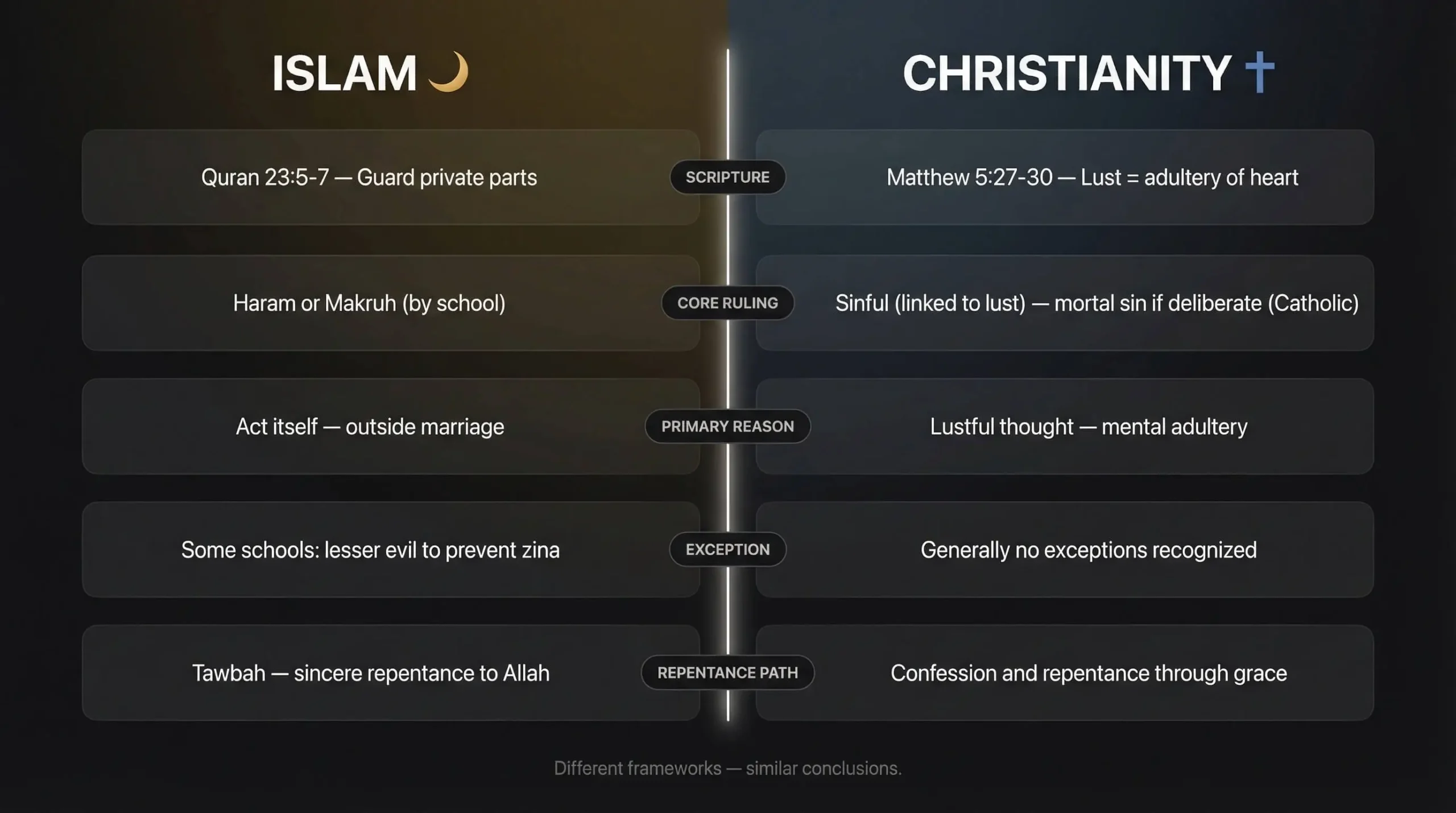
Both Islam and Christianity address whether is masturbation a sin, but they arrive at their conclusions through different theological frameworks. The question of masturbation sin or not ultimately depends on which theological framework you apply. The Islamic Fiqh Council (OIC-affiliated) aligns with the majority prohibition. Classical commentators like Ibn Kathir reinforced this interpretation.
| Aspect | Islamic View | Christian View |
| Direct Scripture Reference | No mention by name | No mention by name |
| General Classification | Haram (حرام) or makruh (مكروه), according to school | Sinful (linked to lust). Classified as mortal sin when committed with full knowledge and deliberate consent (Catholic Church) |
| Main Principle | Guard the private parts (Quran 23:5-7); avoid approach to zina (زنا) | Avoid lust; exercise self-control; honor God with the body |
| Exceptions Recognized | Only permitted to prevent a greater sin (some schools) | Generally no exceptions recognized |
| Connection to Lustful Thoughts | Not the primary basis but considered an aggravating factor | Central basis — lust is the primary reason masturbation is considered sinful |
| Path of Repentance | Tawbah (توبة — sincere repentance to Allah), repentance | Confession, repentance by the grace and mercy of God |
| Marriage as Solution | Strongly stressed (Prophetic guidance from the Quran and hadith) | Strongly stressed (1 Corinthians 7) |
| Scholarly Methodology | Quran → Hadith → Ijma (إجماع) → Qiyas (قياس) | Scripture → Tradition → Magisterium (Catholic) / Sola Scriptura (Protestant) |
The large disparity is why both religions declare it sinful. The Christians emphasize lust within the mind. Islam lays emphasis on the extramarital act. Both traditions position masturbation before marriage as problematic — Islam offers fasting as an alternative, while Christianity emphasizes prayer and accountability. They both arrive at the same conclusion in their various ways.
What Does Medical Science Say About Masturbation?
While religious traditions debate is masturbation a sin, medical science evaluates it purely through health outcomes. One should consider scientific facts independent of the religious concepts. Masturbation has been examined in medicine and not morally ideally.
Documented Health Benefits
- De-stressing and anxiety alleviation. The chemicals released as a result of orgasm make you feel better and relax. Research supported by the NIH suggests that moderate masturbation poses no significant health risks.
- Improved sleep quality. The hormone prolactin assists in helping you to sleep after orgasm.
- Possible risk mitigation of prostate cancer. A large-scale cohort study published in European Urology (2016) found that men who ejaculated frequently may have a lower risk of prostate cancer, though researchers emphasized this was a correlation, not a causal link.
- Pain relief. It may provide a temporary relief of headaches and cramps due to endorphins.
- Sexual self-awareness. It assists individuals to know more about their bodies, something that can aid them in making their relationships in sex healthier.
Potential Concerns and Limitations
But there are also other concerns like overuse or addiction and disruption of the normal life. These are problems that are under investigation.
Patterns of compulsive behavior: In individuals whose coping strategies with stress, loneliness, and emotional pain involves masturbation, it may be turned into a compulsive habit that is disruptive in everyday life, relationships, and employment. Chronic masturbation that becomes compulsive can disrupt daily life, relationships, and work. Masturbation often serves as a coping mechanism for unmet emotional needs. International Classification of Diseases (ICD-11) categorises compulsive sexual behaviour disorder.
Guilt and mental trauma: Research indicates that individuals who believe their masturbation is conflicting with their religious or moral beliefs experience much of psychological distress. The negative mental-health effects are caused more by the guilt rather than the act itself.
Loss of sensation: Excessive or aggressive masturbation can cause loss of sensation with time and this may decrease sexual pleasure in the partner. Additionally, the benefits of giving up prone masturbation (face-down masturbation) include improved sexual response and reduced risk of sexual dysfunction, as this position can desensitize nerve endings over time.
Identification with use of pornography: Many people combine masturbating to porn, which introduces additional psychological and relational risks beyond masturbation alone.
Debunked Myths
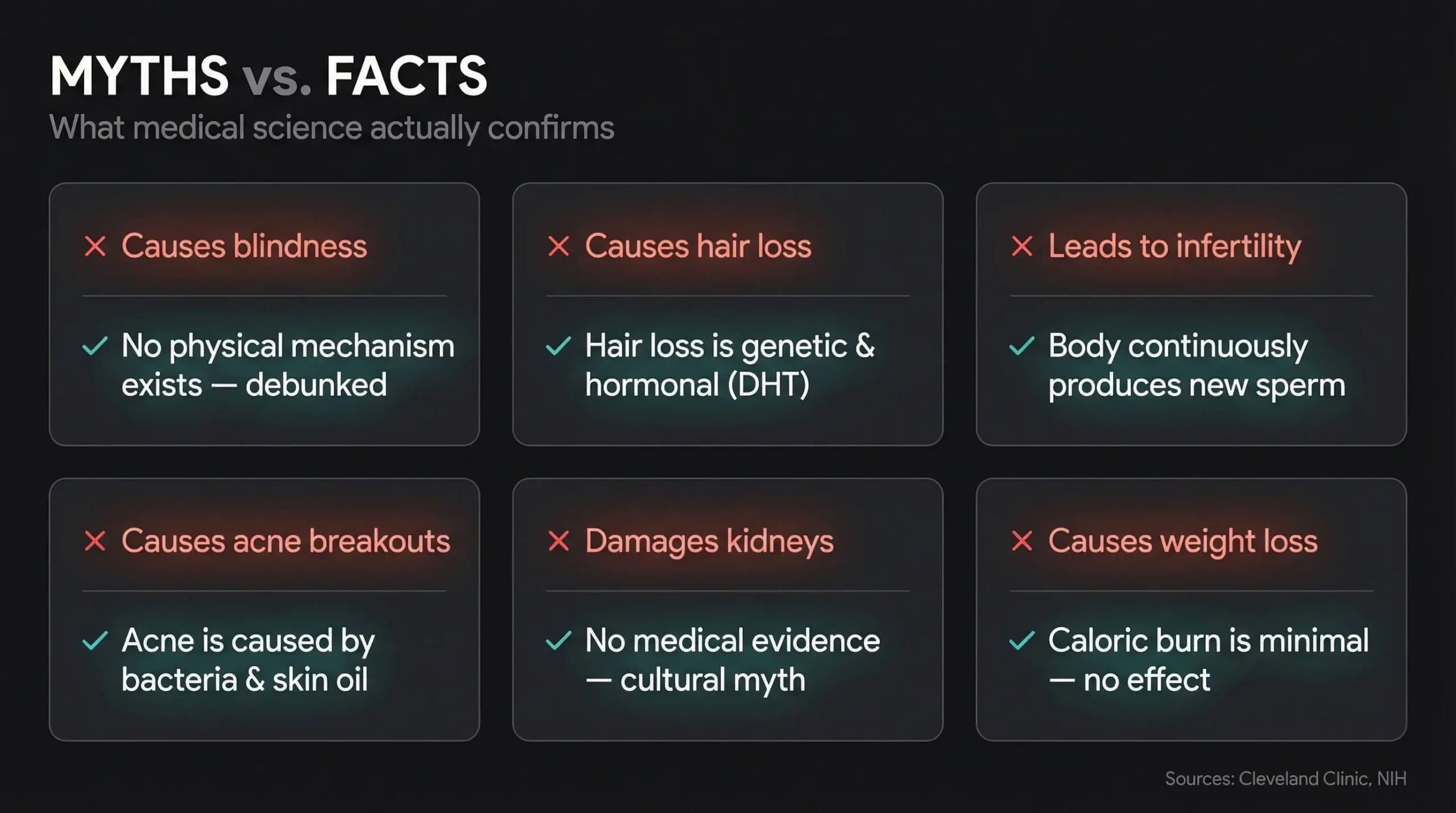
Medical experts confirmed that the numerous myths regarding masturbation are untrue. The Cleveland Clinic confirms that none of these myths have medical support:
- It does not leave one blind as there is no physical cause.
- Can masturbation cause hair loss? No — hair loss is determined by genetics and hormones (DHT), not by sexual activity.
- It cannot make one infertile — the body continues to produce new sperm and bodily fluids.
- Does masturbating make you break out? No — acne is caused by hormonal changes, bacteria, and skin oil, not sexual activity.
- It does not lead to erectile dysfunction, on the contrary, normal sexual intercourse, even masturbation, maintains sexual activity.
- It does not damage the kidneys — there is no medical evidence linking masturbation effects on kidney function. This is a cultural myth with no scientific basis.
- Does masturbation cause weight loss? No — the caloric expenditure during masturbation is minimal and has no meaningful effect on body weight.
The Psychology of Guilt: When Religious Beliefs Meet Sexual Health
This section discusses the feeling of the person which most of the articles overlook.
A large number of individuals who type in the question: is masturbation a sin are not performing a neutral research. They are confused between their faith and a way of behaviour they believe they cannot prevent. This leads to a guilt-shame loop that may cause damage to their mental well-being in some cases more than the act itself. C.S. Lewis’s warning about the “imaginary harem” speaks directly to how masturbation can distort one’s understanding of real intimacy.
Religious belief, which is healthy, can compel an individual to make an improvement. It may appear as: “I believe this is not right and I want my behavior to correspond to my values. I will get assistance and take actual actions.”
Unhealthy shame prevents an individual to leave the state of self-hate and despair. It may sound as: “I am disgusting. God hates me. I will never change. There’s no point in trying.”
Studies indicate that feeling guilty about an action that has been taken (that is “I did something wrong”) is a lot smaller than feeling guilty about who you are (that is “I am bad”). Guilt can motivate change. Chronic guilt can erode self-esteem and compound the shame cycle. Shame is known to bring about depression, isolations and it can even lead to an individual engaging in the behaviour more.
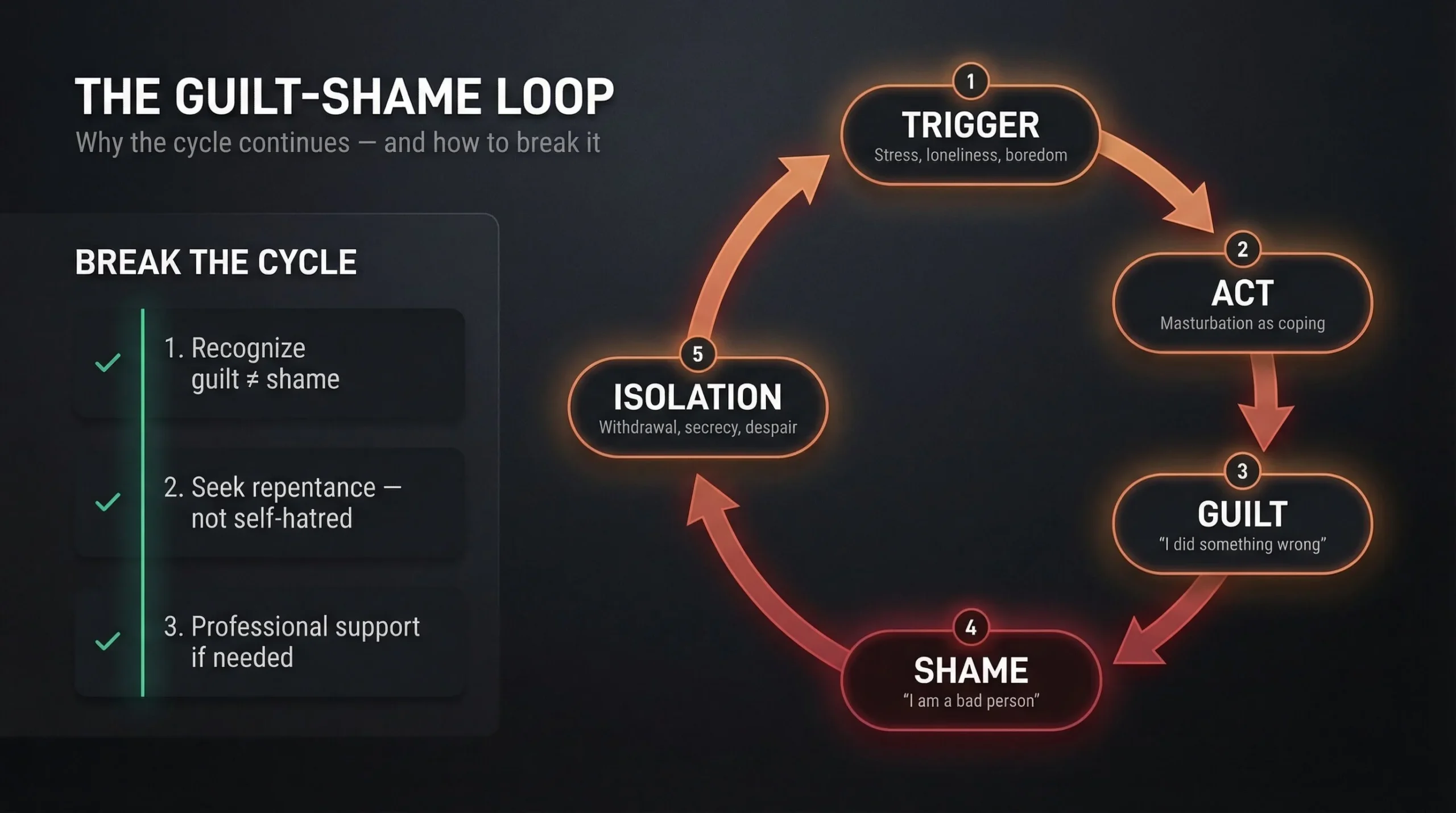
In the case of believers who are struggling with this, the primary distinction is: your religion most likely has a clear path to repentance and recovery. Both traditions affirm: can God forgive masturbation? Yes — through sincere repentance. Considering that in your tradition masturbation is a sin does not mean that you are worthless or alien to God. Islam and Christianity discuss mercy, forgiveness and real renewal.
In case the guilt is depressing, anxiety-inducing, self-hating, or isolating, consider seeking the services of a counselor who can appreciate your religious beliefs. They will be able to assist you to integrate your spiritual values and mental health.
How to Stop Masturbating: A Faith-Based Recovery Framework
For those who have concluded that is masturbation a sin according to their faith, this section provides a practical recovery framework. Repentance for masturbation follows clear paths in both Islam and Christianity. Recovery does not just happen to be about will power. It is about understanding what triggers the habit, creating healthier habits and applying spiritual resources.
Islamic Approach to Overcoming Desire
The teaching of the Prophet Muhammad ﷺ presents a clear outline:
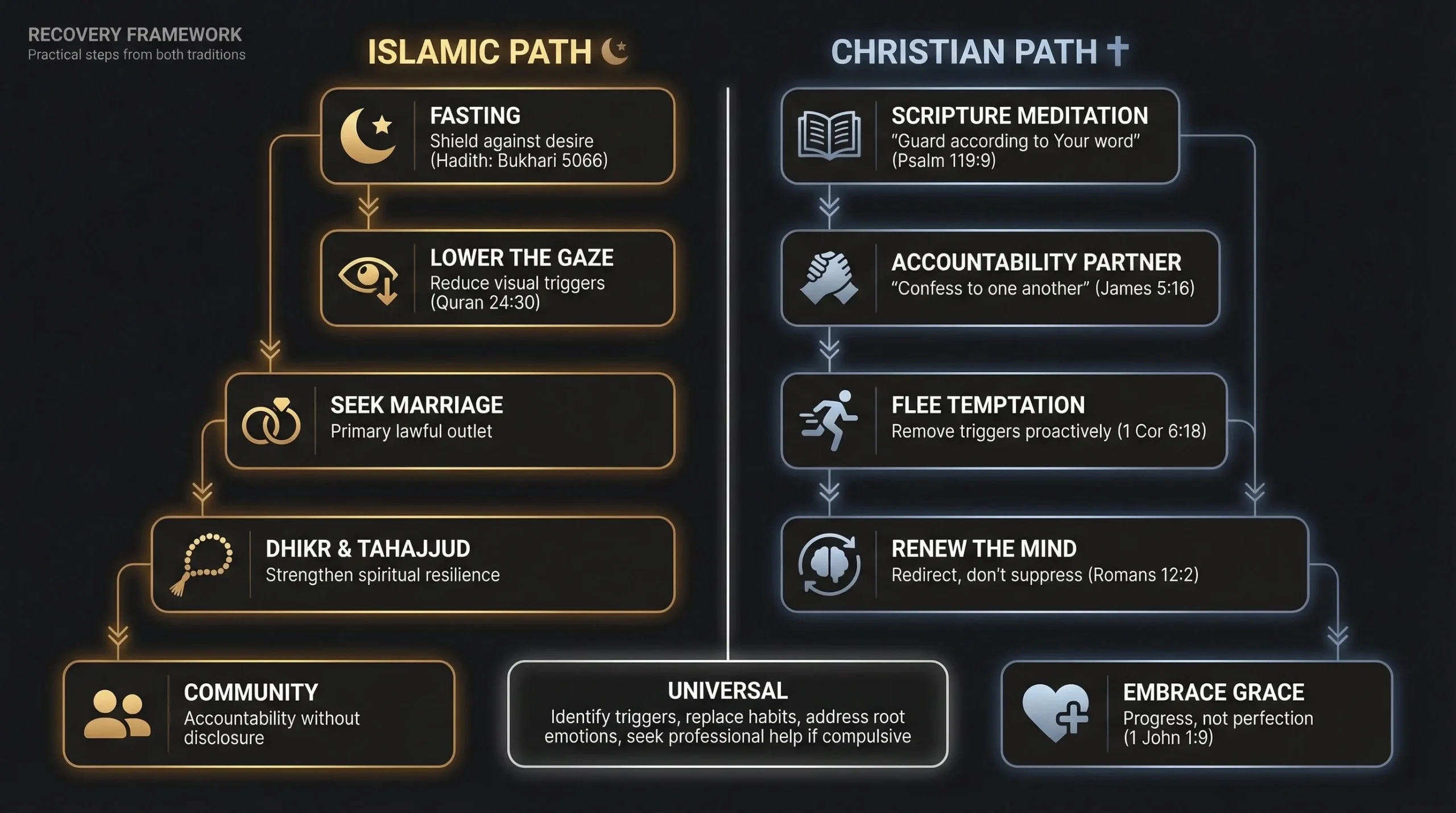
- Fasting — Prophet Muhammad ﷺ said that those who cannot get married should fast; this will keep passion in check (Sahih al-Bukhari 1905; also narrated in Sahih al-Bukhari 5066 and Sahih Muslim 1400). It helps in voluntary fasting more so on Mondays and Thursdays or on other days after prayers.
- Lowering the gaze — Surah An-Nur (24:30) instructs followers to keep the eyes down, that is, to restrict what may excite you, such as social media, television, or some websites.
- Seeking marriage — In an event of possibilities, the key solution is to marry. It can be assisted by the family and community.
- Dhikr (ذكر — Remembrance of Allah) and spiritual practices — Constant remembering of Allah, Quran reading and night prayer (Tahajjud — تهجد) will aid in the development of resilience towards desires. As Yusuf al-Qaradawi noted, the permission is strictly conditional and must never become habitual.
- Community and accountability — Surround yourself with good people without telling what you did to help you with positive change.
Prophet Dawud (David), despite being described as a man after God’s heart, demonstrated that even prophets sought repentance — a model for anyone struggling with desire.
Must Watch: LEARN THIS – Simple Steps to Seek Forgiveness – Mufti Menk
Christian Approach to Sexual Purity
The plan is similar with Christian traditions and is based on Scripture and the Bible:
- Prayer and Scripture meditation — In Psalm 119:9-11, it says, “How can a young person stay on the path of purity? By guarding it according to Your word.” Bible reading everyday empowers determination.
- Accountability partners — James 5:16 asks individuals to confess to one another and pray. The practice of confession — sharing struggles with trusted believers — breaks the isolation cycle. Reliable friends are the source of support. John MacArthur recommends Scripture meditation and accountability as primary tools for overcoming sexual sin.
- Avoiding temptation — 1 Corinthians 6:18 states, “Flee from sexual immorality.” Proactively prevent triggers, content filters, and routines.
- Renewing the mind — Romans 12:2 requires change through renewing your mind. Substitute sexual thoughts with productive activities not through suppressing them but rather by redirection.
- Parting with shame — Rehabilitation programs train that progress, and not perfection, counts. Recovery is sustained by grace, not perfection. Relapsing is not the rejection of God. 1 John 1:9 assures us: “If we confess our sins, He is faithful and just to forgive us our sins and to cleanse us from all unrighteousness.”
[Internal Link: Biblical Self-control and Spiritual Disciplines]
Practical Steps for Anyone
No matter which side of the religious divide an individual is on, the following evidence-based measures may assist those who aim at changing their behavior:
- Determine what triggers your urge: When and how do you feel the urge? Boredom, loneliness, stress, times of the day, and digital environments are some of the common triggers.
- Routine approach: It is more convenient to change a habit than to give up. Review it with an exercise, something creative, social relationship or prayer.
- Avoid isolation: When you are on your own you tend to have the urge to masturbate. Make an arrangement of your day and the environment so that you do not have to spend much time alone.
- Meet root causes of emotions: Masturbation can commonly serve as a coping mechanism concealing unfulfilled needs such as loneliness, anxiety or inadequacy. Organize the root of the problem and not the symptom.
- Get professional assistance when necessary: When the behavior is compulsive, when you have tried to quit on numerous occasions with no avail or when it is extremely distressing, a therapist who specializes in sexual behavior can be used. This does not indicate a show of weakness but rather wisdom.
Frequently Asked Questions
Below we answer the most common questions people ask, including is masturbating a sin in specific situations.
Is Masturbation a Sin If You’re Married?
Both Islamic and Christian cultures usually tell that sex is meant to be within marriage. The vast majority of Islamic thinkers indicate that even married couples are prohibited to masturbate as the partner is the right release. Marital intimacy is also mentioned in Christian teachings. Certain analysts in both the religions would permit the mutual stimulation between spouses, most ones state that the solo masturbation in marriage would be contrary to the nature of having a marriage sex.
Is Masturbation a Mortal Sin in Catholicism?
According to the Catechism (CCC 2352), masturbation is a so-called gravely disordered act and is mortal sin when you know it is wrong and when you willfully commit it. For a mortal sin, three conditions must be met: grave matter, full knowledge, and deliberate consent. Another statement made in the Catechism is that emotional immaturity, habit, anxiety, and other circumstances can facilitate a reduction in moral blame, potentially turning the sin committed into a venial rather than a mortal sin. The Catholic Church maintains this as consistent teaching.
Does God Forgive Masturbation?
Both Christianity and Islam add that God is forgiving. In Islam, Allah accepts true repentance (tawbah — توبة), which is an acknowledgment of the sin, remorse, cessation of the act and a decision not to repeat the sin. According to the Quran:
Arabic:
قُلْ يَا عِبَادِيَ الَّذِينَ أَسْرَفُوا عَلَىٰ أَنفُسِهِمْ لَا تَقْنَطُوا مِن رَّحْمَةِ اللَّهِ ۚ إِنَّ اللَّهَ يَغْفِرُ الذُّنُوبَ جَمِيعًا ۚ إِنَّهُ هُوَ الْغَفُورُ الرَّحِيمُTranslation (Sahih International): “Say, ‘O My servants who have transgressed against themselves [by sinning], do not despair of the mercy of Allah. Indeed, Allah forgives all sins. Indeed, it is He who is the Forgiving, the Merciful.'” (Quran 39:53)
According to Christianity, 1 John 1:9 states that, in case we confess our sins, he is faithful and just to forgive us. God’s grace covers all who sincerely repent. Can you repent for masturbation? Absolutely — both traditions provide a clear path to restoration. The two traditions stress the fact that the mercy of God is greater than sins.
Is Masturbation Haram in All Cases in Islam?
The majority of scholars in the Shafi’i, Maliki, and Hanbali traditions believe that it is haram in all the cases. Dar al-Ifta al-Misriyyah confirms the majority prohibition while acknowledging the Hanafi exception. Some Hanbali jurists and a small number of Hanafi scholars say it is disliked (makruh — مكروه) when an individual is actually afraid of committing fornication (zina — زنا) and has no opportunity to get married. This opinion is based on a notion of doing the lesser of two evils. This should not be a habit even then.
Can Masturbation Cause Health Problems?
Studies from the Cleveland Clinic and NIH provide evidence that moderate masturbation is not a major health hazard. It does not cause infertility, blindness, loss of hair or physical weakness. The psychological concerns are the main ones, especially the guilt, and the behavioral ones, in case the practice acquired the compulsiveness and affects everyday life, relationships, or responsibilities.
Is Masturbation Mentioned in the Bible or Quran?
The Bible does not refer to masturbation directly, neither does the Quran. Neither text uses the word “masturbation,” which is why the question is masturbation a sin requires scholars to derive rulings from broader principles. The religious judgments are based on general principles. What does the Bible say about masturbation directly? Nothing explicitly — the teaching is derived from broader principles. The Quran states “guard your private parts” (Surah Al-Mu’minun 23:5-7). The Bible teaches on lust (Matthew 5:27-30), bodily purity (1 Corinthians 6:18-20), and self-control (1 Thessalonians 4:3-5).
What If I Can’t Stop Masturbating?
When there is no success in personal efforts that have been repetitive, this does not imply that you are not helpful and you are not worthy of being helped by God. The problem of compulsive sexual behavior is a known clinical problem and professional assistance either through faith-based counseling or secular counseling can provide systematic approaches. Resources like IslamQA provide detailed scholarly guidance on overcoming this habit. The combination of spiritual practice and therapy is found to be effective by many people. If you want to learn how to stop masturbating, the faith-based framework above provides structured guidance. Asking for assistance is a way of being strong and not weak.
Important Disclaimer
The article is based on education to provide scholarly and medical information. It is neither a self-improved fatwa (فتوى), religious decree, nor professional alternative.
Religious Disclaimer
There are intra- and inter-traditional scholarly opinions. The stated positions are mainstream, yet individual situations might require a different conclusion. Individual guidance should be sought by the reader through a qualified scholar of his or her tradition.
Medical Disclaimer
The medical advice is not substituted by health information here; it is a consequence of the research. The use of personal health issues is to consult a licensed healthcare provider.
Diversity Acknowledgment
The opinions in each religious tradition are more diverse than any one article is able to reflect. We have attempted to describe the most commonly known academic standpoints in a fair and reasonable way.