| Editorial Policy: islamshub.com presents multiple valid scholarly perspectives without making independent fiqh rulings. All madhab positions are drawn from classical texts and contemporary fatwa bodies. Readers with specific personal situations are encouraged to consult a qualified scholar of their preferred madhab. |
It’s 6:45 PM. You’re holding an imported chocolate-cream biscuit at Imtiaz — or Carrefour, Chase Up, or Metro. Your WhatsApp halal group is open. One contact says E471 is fine. Another says it’s haram. A third sends a screenshot — no source, no scholar — declaring all E-codes forbidden. The packet goes back on the shelf, and you leave uncertain.
This is the daily reality for millions of Pakistani Muslims in 2026. Knowing how to check food ingredients for halal certification in Pakistan has never been more complicated — or more urgent — as processed and imported packaged foods flood supermarket shelves, making the old assumption that ‘Pakistani-made equals halal’ genuinely unreliable.
This guide gives you: the Quranic and Prophetic basis for halal food scrutiny, Pakistan’s official regulatory framework in plain language, madhab-specific rulings on the 15 most common suspicious ingredients (E471, gelatin E441, E120 carmine, E920 L-Cysteine, rennet, whey, shellac, and more), and a step-by-step checklist grounded in scholarly evidence.
Quick-Start Halal Decision Guide
Use this table at the supermarket before reading the full analysis below. It summarises the most common scenarios you will encounter on Pakistani shelves.
| STATUS | INGREDIENT / LABEL SIGNAL | MADHAB CONSENSUS | CONSUMER ACTION |
|---|---|---|---|
| ✔ HALAL | Vegetable-origin E471 / Soy or Sunflower Lecithin / Fish Gelatin / Microbial Rennet / FPC Chymosin | All 4 madhabs agree: permissible | Buy freely. No further investigation needed. |
| ✔ HALAL | PHA / PNAC-accredited certifier logo clearly printed (not just ‘Halal’ text) | Certification covers full supply chain | Verify certifier at pakistanhalalauthority.gov.pk then buy. |
| ✔ HALAL | E330 Citric Acid / E300 Vit C / E100 Curcumin / E440 Pectin / E415 Xanthan Gum / E140 Chlorophyll / E160a Beta-Carotene | Plant-derived. All 4 madhabs: halal | Always safe. No investigation needed. |
| ⚠ MUSHBOOH | E471 (source not declared) / ‘Lecithin’ (no source) / ‘Natural Flavors’ / Vanilla Extract (natural) / Whey Powder / Cheese (rennet type unspecified) | Source unknown — all madhabs require verification before ruling halal | Contact manufacturer for origin documentation OR choose PHA-certified alternative OR apply ihtiyat (precaution) and avoid. |
| ✖ HARAM | Gelatin (E441) — porcine / Non-zabiha bovine gelatin / L-Cysteine E920 (porcine) / E120 Carmine / E904 Shellac / Lard / Animal shortening | Mainstream Hanafi, Shafi’i, Hanbali: haram. Maliki: mostly same. See table for detail. | Do NOT purchase unless halal-certified supply chain explicitly confirmed by accredited certifier. |
| VARIES | Medicine in gelatin capsules / Gelatin in essential prescription drugs | Darurah (necessity) exception applies under specific conditions — see Section 8 | Ask pharmacist for tablet/liquid/HPMC capsule alternative first. Consult your scholar if unavailable. |
For full madhab-by-madhab analysis and practical steps, continue reading.
Why ‘Made in Pakistan’ No Longer Guarantees Halal Status
| The myth that domestic manufacturing equals halal status was perhaps reasonable fifty years ago. In 2026, it is demonstrably false — and acting on it uncritically exposes Pakistani consumers to genuine halal uncertainty. |
Three categories of imported inputs are particularly concerning in Pakistani manufacturing:
- Emulsifiers (E471): Used in virtually every domestic biscuit, bread, and confectionery brand. Sourced from European suppliers whose base stock may be animal-derived tallow — including non-zabiha cattle fat or porcine fat.
- Flavours (‘Natural Flavors’): Often originate from US suppliers whose formulations may include ethanol-based extracts or animal-derived compounds, none of which are visible from a ‘Made in Pakistan’ label.
- Enzymes (E920 L-Cysteine): Bread conditioners that can originate from Chinese suppliers using porcine raw materials, legally used in products manufactured in Pakistan.
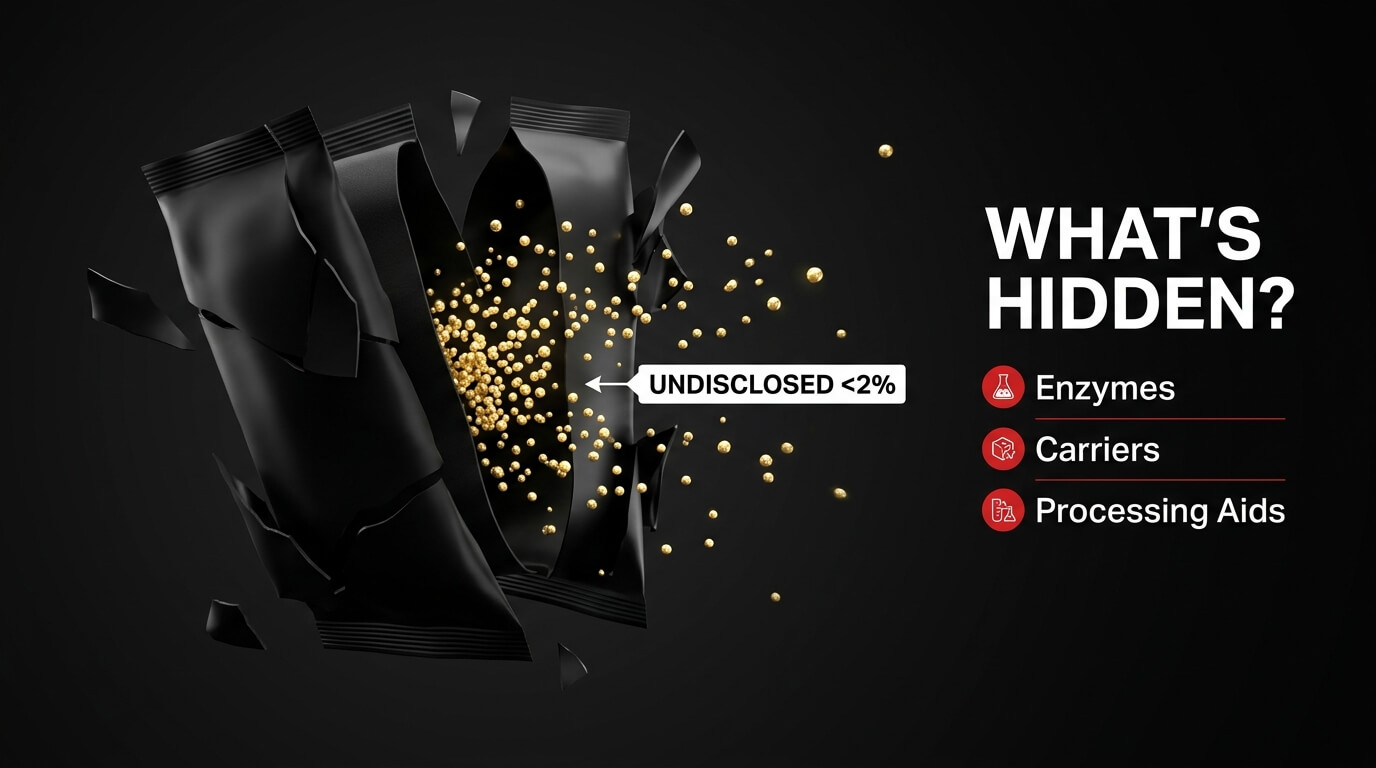
Under international food labeling standards (Codex Alimentarius and FDA conventions), substances present below 2% as functional processing aids may not require full label disclosure under the rules of the product’s country of origin. A Pakistani consumer purchasing an imported product may — in certain circumstances — be consuming undisclosed animal-derived processing enzymes with no visible indication on the packaging.
Halal certification that covers the full ingredient supply chain, not merely the finished product, is the only reliable protection against this gap.
The Fake ‘Halal’ Stamp Problem
A Pakistani manufacturer can legally print the word ‘Halal’ on its packaging without any accredited certification. Under PS:3733-2022(R) — Pakistan’s national halal food standard — a self-declared ‘Halal’ text carries no regulatory weight unless backed by a certification body accredited through the proper institutional hierarchy.
The Punjab Food Authority’s 2024 mandatory notification (pfa.gop.pk) made PS:3733-2022(R) compliance mandatory for specified food categories sold in Punjab — the country’s most enforcement-active province. However, enforcement capacity does not reach every manufacturer on every shelf. The consumer’s due diligence remains essential.
Pakistan’s Official Halal Certification Framework
Three Institutions Every Pakistani Shopper Must Know
- Pakistan Halal Authority (PHA): The apex regulatory body under the Ministry of Science and Technology. Oversees the national halal framework, accredits certification bodies, and provides the regulatory mandate for halal compliance.
- PSQCA (Pakistan Standards and Quality Control Authority): Develops, publishes, and maintains Pakistan Standard (PS) specifications — including PS:3733-2022(R), the national halal food standard.
- PNAC (Pakistan National Accreditation Council): Evaluates and formally recognises the third-party certification bodies that conduct halal inspections and issue certificates to food manufacturers.
What PS:3733-2022(R) Actually Requires
Pakistan’s national halal food standard (adopted from OIC/SMIIC 1:2019) mandates:
- Only halal animal species may be used as food ingredients.
- All animal-sourced ingredients must come from zabiha-slaughtered animals.
- No cross-contamination with haram substances at any stage — including shared equipment, transport, and storage.
- Full traceability of ingredients from source to finished product.
- Alcohol is prohibited as a direct ingredient (ongoing scholarly/regulatory discussion on trace processing amounts).
What PS:3733-2022(R) Does NOT Adequately Address
- Unverified imported raw materials: A certification may cover the finished product at a Pakistani facility without independently auditing the foreign supplier of each ingredient.
- No real-time consumer verification: Unlike Malaysia’s JAKIM barcode portal, Pakistan has no functioning public barcode-scan database as of April 2026.
- Enforcement gaps: While the Punjab Food Authority’s 2024 notification is significant, the capacity to audit every producer across every product category remains limited.
| Note on regulatory information: This guide reflects the regulatory landscape as of April 2026. Requirements under the Pakistan Halal Authority and Punjab Food Authority are subject to revision. Verify current standards directly at pakistanhalalauthority.gov.pk. |
Halal Certification Trust Hierarchy for Pakistani Consumers
| TIER | CERTIFIER | WHAT IT MEANS FOR YOU |
|---|---|---|
| Tier 1 — Strongest | PHA-accredited certification body (logo + certifier name on pack) | Full supply-chain audit by a PHA-recognised body. Verify at pakistanhalalauthority.gov.pk |
| Tier 2 | PNAC-accredited certifiers (cross-check at pnac.org.pk) | Strong institutional credibility. Cross-verify PNAC registration. |
| Tier 3 | CEHA, SANHA, IFANCA, JAKIM (Malaysia), ESMA (UAE) logos on imported products | Widely recognised in Pakistan under OIC bilateral agreements. Confirm specific product version was certified. |
| ⚠ No weight | Self-printed ‘Halal’ text (no named certifier, no logo) | Zero regulatory standing under PS:3733-2022(R). Manufacturer has made a self-declaration only. |
How to Verify Halal Certification in Pakistan: Step-by-Step
- Identify the certification body logo. Look for a named certifier’s logo — not a self-printed ‘Halal’ text. Note the exact organisation name as it appears on the packaging.
- Verify the certifier at PHA. Navigate to pakistanhalalauthority.gov.pk. Confirm the named certifier appears on the list of recognised and accredited certification bodies.
- Cross-check at PNAC. For PNAC-accredited certifiers, verify at pnac.org.pk. Cross-referencing both databases provides the strongest consumer-level assurance.
- Contact the certifier directly. Reputable certifiers (CEHA, SANHA, IFANCA) maintain certificate verification services. With the product’s batch number or certificate reference number, you can request confirmation that a valid current certificate exists for that specific product.
- Assess bilateral recognition for imported products. Pakistan recognises OIC member state halal certifications (JAKIM Malaysia, ESMA UAE). These generally carry recognised standing in Pakistan for import purposes. Verify which specific product formulation was certified.
| Important: The PHA website interface has been noted as difficult to navigate by Pakistani consumers. Direct phone or email contact with the PHA or the relevant certifier remains a valid verification route when the website is unclear. |
The Quranic and Prophetic Foundation for What We Eat
Islamic food law is not bureaucratic compliance. It is an act of worship, rooted in taqwa — God-consciousness — and the recognition that what enters our bodies has consequences for our spiritual receptivity.
Al-Baqarah 2:168 — Halal AND Tayyib
يَا أَيُّهَا النَّاسُ كُلُوا مِمَّا فِي الْأَرْضِ حَلَالًا طَيِّبًا
“O mankind, eat from whatever is on earth [that is] halal and tayyib (lawful and good)…” [Al-Baqarah 2:168 — Sahih International]
Tafsir: Imam Ibn al-Sa’di (Taysir al-Karim al-Rahman) explains that Allah’s pairing of halal with tayyib is deliberate: tayyib encompasses physical wholesomeness, ethical sourcing, and freedom from spiritual harm — beyond mere chemical permissibility.
Al-Baqarah 2:173 — The Four Explicit Prohibitions and the Darurah Exception
إِنَّمَا حَرَّمَ عَلَيْكُمُ الْمَيْتَةَ وَالدَّمَ وَلَحْمَ الْخِنزِيرِ وَمَا أُهِلَّ بِهِ لِغَيْرِ اللَّهِ ۖ فَمَنِ اضْطُرَّ غَيْرَ بَاغٍ وَلَا عَادٍ فَلَا إِثْمَ عَلَيْهِ ۚ إِنَّ اللَّهَ غَفُورٌ رَّحِيمٌ
“He has only forbidden to you dead animals (maytah), blood, the flesh of swine, and that which has been dedicated to other than Allah. But whoever is forced [by necessity], neither desiring [it] nor transgressing [its limit], there is no sin upon him. Indeed, Allah is Forgiving and Merciful.” [Al-Baqarah 2:173 — Sahih International]
Tafsir: Imam al-Qurtubi (Al-Jami’ li-Ahkam al-Quran) enumerates four conditions for the darurah exception: genuine threat to life/health; no halal alternative available; only the minimum necessary quantity; no willful indulgence. These conditions are directly relevant to medicine-with-gelatin questions addressed in Section 8.
Al-Ma’idah 5:3 — The Definitive Prohibition List
| “Prohibited to you are dead animals, blood, the flesh of swine, and that which is dedicated to other than Allah, and those animals killed by strangling or by a violent blow or by a headlong fall or by the goring of horns…” [Al-Ma’idah 5:3 — Sahih International, excerpt] |
Note: Revealed during the Farewell Pilgrimage — among the final Quranic revelations — this verse’s comprehensive enumeration carries the weight of a definitive, late-stage divine ruling, forming the foundation of all four madhab positions on haram ingredients.
Al-Nahl 16:115–116 — The Two-Sided Warning
| “…And do not say about what your tongues assert of untruth, ‘This is lawful and this is unlawful,’ to invent falsehood about Allah.” [Al-Nahl 16:116 — Sahih International] |
This verse prohibits both: consuming haram food AND declaring something haram without scholarly evidence. Declaring all E-codes forbidden, all imported food suspect, all Western products haram — without evidence — is itself a religious transgression. This is precisely why this guide presents evidence rather than blanket prohibitions.
Al-Ma’idah 5:90 — Intoxicants as Rijs
يَا أَيُّهَا الَّذِينَ آمَنُوا إِنَّمَا الْخَمْرُ وَالْمَيْسِرُ وَالْأَنصَابُ وَالْأَزْلَامُ رِجْسٌ مِّنْ عَمَلِ الشَّيْطَانِ فَاجْتَنِبُوهُ
“O you who have believed, indeed, intoxicants, gambling, [sacrificing on] stone altars [to other than Allah], and divining arrows are but rijs (defilement) from the work of Satan, so avoid it…” [Al-Ma’idah 5:90 — Sahih International]
The Quran’s characterisation of khamr as rijs (defilement) provides the spiritual foundation for the alcohol prohibition extending into contemporary discussions of vanilla extract, flavour carriers, and fermentation-derived additives.
The Du’a Rejection Hadith — The Spiritual Stakes (Sahih Muslim 1015)
The Prophet ﷺ described a man travelling far, hands raised, calling ‘Ya Rabb, Ya Rabb!’ — yet remarked:
وَمَطْعَمُهُ حَرَامٌ، وَمَشْرَبُهُ حَرَامٌ، وَمَلْبَسُهُ حَرَامٌ، وَغُذِّيَ بِالْحَرَامِ، فَأَنَّى يُسْتَجَابُ لِذَلِكَ
“His food is haram, his drink is haram, his clothing is haram, and he has been nourished by haram — so how can his supplication be answered?” [Sahih Muslim, No. 1015 — Grade: Sahih]
Ibn Rajab al-Hanbali (Jami’ al-Ulum wal-Hikam) comments that haram in the stomach creates a barrier between the servant and his Lord that renders even the most outwardly sincere worship spiritually blocked. This is not a minor concern — it is a central theological reality the Prophet ﷺ chose to emphasise explicitly.
The Mushbooh Hadith — Islam’s Three-Tier Framework (Sahih Bukhari 52)
| “Halal is clear, and haram is clear, and between them are doubtful matters (mushbooh) which many people do not know. Whoever avoids the doubtful matters has protected his religion and his honor. Whoever falls into the doubtful matters will fall into the haram, as a shepherd who grazes his flock around a sanctuary — he is likely to stray into it.” [Sahih Bukhari No. 52; Sahih Muslim No. 1599 — Grade: Sahih, Mutawatir] |
The mushbooh category is not an invention of modern certification bodies — it is a Prophetic framework established fourteen centuries ago. Every contemporary Islamic food law framework traces directly to this hadith.
The Intoxicants Hadith — Basis for Vanilla Extract and Alcohol Rulings
| “Whatever intoxicates in large quantities, even a small amount of it is haram.” [Sunan Abu Dawud; Sunan an-Nasa’i — Grade: Hasan Sahih, authenticated by Sheikh al-Albani] |
The Mushbooh Framework — Navigating Grey-Zone Ingredients
The Three Categories Every Pakistani Shopper Must Understand
- Halal — Presumptively Permissible
Per the usool al-fiqh principle of ibaha (documented in both Hanafi and Maliki tradition): “Al-asl fi’l-ashya’ al-ibaha” — “The default ruling of all things is permissibility.” Every ingredient begins as presumptively halal. A Pakistani consumer does not need to investigate every ingredient on every label — only those appearing on a specific watch list of known concern triggers.
- Haram — Two Critical Subcategories
- Haram li-dhatih (intrinsically prohibited): The substance itself is forbidden regardless of context or processing. Examples: pork, blood, carrion, khamr. (Ibn Qudamah, Al-Mughni; Ibn Abidin, Radd al-Muhtar)
- Haram li-ghayrih (prohibited by external factor): The substance belongs to a permissible category, but an extraneous factor renders it haram. Example: beef from a cow not slaughtered according to zabiha requirements. The cow is halal li-dhatih; the slaughter method renders this specific instance haram li-ghayrih. This distinction is critical for understanding gelatin, whey powder, and rennet rulings.
- Mushbooh — The Doubtful Category and How to Navigate It
Mushbooh = that whose halal/haram status is unclear due to uncertain origin, unverifiable processing, or genuine scholarly ikhtilaf. The Prophet’s guidance [Sahih Bukhari 52] was to avoid mushbooh items as an act of protecting one’s deen. Importantly, scholars clarify this avoidance is a recommendation of ihtiyat (precaution), not a ruling of prohibition.
Three legitimate responses to mushbooh ingredients:
- Investigate: Contact the manufacturer to request ingredient origin documentation.
- Substitute: Seek a halal-certified alternative where the certifier has audited the supply chain.
- Apply madhab position: Because scholarly ikhtilaf means different madhabs may reach different conclusions, following one’s madhab is a valid resolution.
Two errors to avoid:
|
The Comprehensive Ingredient Comparison Table: 15 Common Suspicious Ingredients
Methodology: Analyses below present all four major madhab positions. islamshub.com acknowledges and celebrates scholarly ikhtilaf (legitimate difference of scholarly opinion). Different scholars have reached different conclusions based on their usool (methodological principles). We present these positions to inform, not to arbitrate.
| INGREDIENT (E-CODE) | COMMON USE IN PAKISTAN | HANAFI (SUBCONTINENT) | MALIKI | SHAFI’I | HANBALI | PRACTICAL ADVICE |
|---|---|---|---|---|---|---|
| E471 — Mono & Diglycerides of Fatty Acids | Biscuits, bread, chocolate, margarine, processed snacks — nearly universal | HARAM/MUSHBOOH if animal-origin unknown. Ihtiyat required. Vegetable origin: halal. (Ibn Abidin, Radd al-Muhtar; Darul Uloom Deoband) | Requires source verification; accepts istihalah if complete transformation established | HARAM if from non-zabiha animal or porcine; halal only if plant-derived or zabiha confirmed (Al-Muhadhdhab) | HARAM if porcine/non-zabiha. Halal if vegetable-origin. (Al-Mughni) | Look for ‘vegetable-origin emulsifier’ or ‘palm-derived E471’ on label. Prefer PHA-certified product. Contact manufacturer if source unclear. |
| E441 — Gelatin (Porcine) | Gummy candies, marshmallows, biscuit fillings, capsule shells, yogurts, supplements | HARAM (porcine). Istihalah NOT accepted for food per Darul Uloom Deoband, Mufti Taqi Usmani. Ihtiyat applies. (Radd al-Muhtar) | Some scholars accept istihalah if truly complete (minority); ECFR fatwa accepts; mainstream still cautious | HARAM — porcine is najs al-ayn; no transformation changes ruling (Al-Majmu’, Al-Muhadhdhab) | HARAM (mainstream). Ibn Taymiyyah accepted broader istihalah — minority view not adopted by Saudi scholars | Avoid porcine gelatin in all food. Look for ‘fish gelatin’ or ‘halal bovine gelatin’ explicitly stated. Choose halal-certified gummies/supplements. |
| E441 — Gelatin (Bovine, non-zabiha) | Same as above but bovine source from non-Islamic slaughter (common in Western imports) | HARAM per mainstream subcontinent Hanafi. Non-zabiha bovine = haram li-ghayrih | Stricter scholars: haram. Some apply istihalah conditionally | HARAM — non-zabiha slaughter renders derivative haram | HARAM mainstream. Same as porcine for practical purposes without zabiha verification | Same action as porcine gelatin. Only ‘halal zabiha certified gelatin’ or ‘fish gelatin’ is safe. |
| E441 — Gelatin (Fish / Zabiha Bovine) | Halal-certified gummies, supplements, some yogurts — increasingly available | HALAL — fish gelatin confirmed halal by all madhabs per Al-Ma’idah 5:96 | HALAL | HALAL | HALAL | Positive halal indicator. Look for explicit ‘fish gelatin’ or ‘halal certified bovine gelatin’ on label. |
| E120 — Carmine / Cochineal | Strawberry yogurts, red/pink candies, fruit drinks, cosmetics — hidden in colourings | HARAM — land insect; locusts only are permitted by hadith. Majority Deoband/Binoria position. Istihalah minority view not accepted | HARAM mainstream — land insect not permitted; some debate istihalah but majority lean haram | HARAM — insects not explicitly permitted are impermissible (Al-Majmu’) | HARAM — same basis as Shafi’i (Al-Mughni) | Check pink/red coloured products: yogurt, candy, drinks. ‘Carmine’, ‘cochineal’, ‘natural red 4’, or E120 = avoid. Choose products using E160c (paprika) or E162 (beetroot) instead. |
| E322 — Lecithin | Chocolate, baked goods, spreads, infant formula | HALAL if soy/sunflower/egg. MUSHBOOH if source unstated. (Ihtiyat applies when uncertain) | Same as Hanafi — source determines ruling | Same — plant/egg lecithin halal; animal-origin requires verification | Same as Shafi’i | Soy lecithin / sunflower lecithin = buy freely. Plain ‘lecithin’ = contact manufacturer or choose certified alternative. |
| E920 — L-Cysteine | Bread improver/dough conditioner in imported bread mixes, fast-food buns | HARAM if porcine. HALAL if synthetic or poultry-feather origin is debated (mushbooh). Ihtiyat: avoid unless certified | Same as Hanafi on pig-derived; feather-derived debated | HARAM if porcine. Halal if synthetic. Feather-derived mushbooh | HARAM if porcine. Synthetic halal. Feather mushbooh | Halal certification confirming synthetic or verified halal source is the only reliable resolution. Particularly check imported bread mixes. |
| Rennet — Animal | Hard/semi-hard cheeses (cheddar, mozzarella, parmesan) — imported and some local | HARAM if non-zabiha animal rennet (haram li-ghayrih). Halal if zabiha. (Ibn Abidin) | Classical Maliki scholars apply istihalah — more flexible; some permit. Debate ongoing | HARAM if non-zabiha animal (Al-Shirazi). Zabiha = halal | HARAM if non-zabiha (Ibn Qudamah). Zabiha = halal | Contact Haleeb, Nurpur, or imported brand directly for rennet type. Prefer ‘microbial rennet’ or ‘vegetable rennet’ explicitly stated on label. |
| Rennet — Microbial / FPC | Halal-friendly cheese production; many modern manufacturers use this | HALAL across all madhabs — plant/fermentation-derived | HALAL | HALAL | HALAL | Positive indicator. Look for ‘microbial rennet’ or ‘fermentation-produced chymosin (FPC)’. These are always safe. |
| Whey Powder | Biscuits, confectionery, infant formula, protein supplements, processed foods | HARAM if derived from cheese made with non-zabiha rennet. Halal if microbial rennet used | Same — linked to parent cheese rennet source | Same as Hanafi | Same as Hanafi | Status inseparably linked to the cheese it came from. Ask manufacturer: ‘What type of rennet was used in the cheese that produced this whey?’ |
| Vanilla Extract (Natural) | Biscuits, cakes, ice cream, dairy desserts — extremely common | MAJORITY Hanafi (contemporary): Permits as flavour agent if product non-intoxicating. Sheikh Munajjid’s ruling cited. Some Hanafi scholars caution | CAUTIOUS — ethanol presence makes Maliki scholars prefer synthetic vanillin | Ranges from caution to restriction. ‘Vanilla flavour’ (synthetic) preferred | Similar range — caution to restriction on ethanol-based extract | Safest choice: ‘vanilla flavour’ (synthetic vanillin) carries no ethanol concern. If label says ‘natural vanilla extract’, follow your madhab’s position or choose alternative. |
| E904 — Shellac | Glazing agent on candy coating, dried fruits, some tablet coatings | HARAM — insect-derived from land insect (same ruling as E120 carmine per mainstream subcontinent position) | DEBATED — broader istihalah discussion; majority lean haram | HARAM — land insect not permitted (Al-Majmu’) | HARAM — same basis as Shafi’i | Check glazed candies and fruit confectionery. E904 or ‘shellac’ on label = avoid unless certified halal by supply-chain auditor. |
| Natural Flavors | Almost every processed/imported food product — catch-all label term | MUSHBOOH — may include ethanol extracts, castoreum, or animal compounds. Ihtiyat: seek manufacturer confirmation | Same concern — source must be verified | Same — without source confirmation, mushbooh | Same as Shafi’i | Contact manufacturer: ‘Are your natural flavors free from alcohol-based extracts and animal-derived compounds? Is the flavor supplier halal certified?’ Only full supply-chain certification resolves this. |
| E542 — Bone Phosphate | Flour treatment agent, some processed meats and bakery products | HARAM if from non-zabiha or porcine bone (haram li-ghayrih / li-dhatih). Halal if plant-derived calcium phosphate (E341) | Same — source determines ruling | HARAM if porcine/non-zabiha bone | HARAM if porcine/non-zabiha bone | Look for E341 (calcium phosphate) as halal alternative. E542 without halal certification = avoid. |
| E422 — Glycerol / Glycerine | Humectant in baked goods, sweets, confectionery, pharmaceutical syrups | MUSHBOOH if animal-derived. HALAL if plant-derived (palm/soy glycerol). Ihtiyat applies when source unknown | Same — source determines ruling | Same — plant-derived halal; animal-derived requires zabiha verification | Same as Shafi’i | Look for ‘vegetable glycerine’ or ‘palm glycerol’. Plain ‘glycerol’ or ‘glycerine’ = contact manufacturer. Most commercial glycerol today is palm-derived but verify. |
Istihalah — The Usool Principle That Divides Scholars
Al-istihalah (الاستحالة) means ‘transformation’ or ‘transmutation.’ As a fiqhi concept, it refers to a complete transformation of a substance whereby its name, physical properties (smell, colour, taste, texture), and chemical characteristics are so thoroughly altered that it becomes a genuinely new substance.
The classical example cited across all four madhabs: khamr (wine) that naturally transforms into khal (vinegar). The resulting vinegar is halal because it is, in the view of classical scholars, a genuinely new substance with a new name and new properties. [Sahih Muslim 3/3640; Abu Dawud]
The Critical Scientific Question
The practical question behind every istihalah debate is scientific as much as juristic: Has a complete transformation actually occurred?
| The Islamic Organisation for Medical Sciences (IOMS, Kuwait) — an OIC-recognised scholarly-scientific body — conducted formal laboratory analysis and concluded that porcine gelatin retains identifiable molecular markers of its porcine source. According to the IOMS Kuwait’s scientific analysis, complete istihalah has NOT occurred for gelatin as commercially produced. This scientific finding provides empirical support for the Shafi’i and mainstream Hanafi subcontinent positions. |
Madhab-by-Madhab on Istihalah
- Hanafi (Subcontinent Mainstream): Ibn Abidin (Radd al-Muhtar) discusses istihalah through the example of a pig decomposing completely into salt — theoretically, the salt becomes halal. However, Mufti Taqi Usmani (Pakistan) — the most widely consulted contemporary Hanafi scholar on food additives globally — has concluded that gelatin extraction does not meet conditions for complete istihalah under Hanafi fiqh: protein structure remains traceable to its source; ihtiyat weighs heavily when haram li-dhatih is involved; istiqzaz (natural Muslim revulsion) is also a Hanafi consideration.
- Maliki: Ibn al-‘Arabi (Ahkam al-Quran) and classical Maliki jurists accept istihalah more broadly — complete transformation removes prohibition. The European Council for Fatwa and Research (ECFR), which includes Maliki-influenced scholars, issued a fatwa accepting istihalah for gelatin when genuine complete transformation is established. This remains conditional on scientific verification — an open question given IOMS Kuwait’s findings.
- Shafi’i (Strictest): Imam al-Shirazi (Al-Muhadhdhab) and Imam al-Nawawi (Al-Majmu’) explicitly reject istihalah for substances categorised as najs al-ayn (intrinsically impure). Pork is najs al-ayn. Therefore, in the Shafi’i usool framework, any derivative of pork — regardless of processing degree — retains the original ruling. The IOMS Kuwait scientific findings align with this position.
- Hanbali: Ibn Qudamah (Al-Mughni) parallels the Shafi’i approach for mainstream Hanbali fiqh. Notable exception: Ibn Taymiyyah and Ibn al-Qayyim al-Jawziyyah (Majmu’ al-Fatawa) accepted broader istihalah — a minority position. The contemporary Saudi Committee of Senior Scholars has not adopted this minority view for commercially manufactured food products.
| Practical conclusion across madhabs: A Muslim should follow the view of their own madhab and the scholars they trust. For those following mainstream subcontinent Hanafi, mainstream Shafi’i, or mainstream Hanbali positions: seek halal-certified products where a reputable certifier has verified the full ingredient supply chain. |
Darurah — When Consuming Haram Becomes Permissible (Medicine & Gelatin Capsules)
| The Most Urgent Household Question: “My doctor prescribed a medicine that comes in gelatin capsules. Is it haram? Can I just open the capsule?” |
Darurah (ضرورة) means necessity — specifically, a condition in which a person faces genuine harm to life, health, or essential welfare if they cannot access the prohibited substance. Allah establishes this exception explicitly in Al-Baqarah 2:173 as explained by Imam al-Qurtubi.
The Four Conditions of Darurah — Agreed Across All Four Madhabs
- Genuine necessity — an actual threat to health or life, not mere preference or inconvenience.
- No halal alternative available — the consumer has genuinely verified no halal-compliant substitute exists.
- Minimum necessary amount — only the quantity required to address the necessity is permitted.
- No desire or willful indulgence — the consumption is compelled, not chosen as a preference.
Application to Pakistani Medicine: The Scholarly Consensus
The Islamic Fiqh Academy (IFA, OIC) — whose rulings are widely respected globally — permits porcine gelatin capsules in medicine when: (a) no halal capsule alternative exists for that specific medication, and (b) the medicine is genuinely medically necessary.
Contemporary scholars including Sheikh Abd al-Aziz ibn Baz (Hanbali) and Mufti Taqi Usmani (Hanafi, Pakistan) have both addressed medicine with haram-derived ingredients under darurah conditions, reaching substantively similar conclusions.
The ‘Can I Open the Capsule?’ Protocol — Sequenced Answer
- First: Ask your pharmacist whether the same medication is available in tablet or liquid form — both avoid the gelatin capsule entirely.
- Second: Ask whether an HPMC (hydroxypropyl methylcellulose) vegetarian capsule version exists — many pharmaceutical manufacturers now produce both versions.
- If neither alternative exists and the medication is genuinely medically necessary: the darurah exception applies per mainstream scholarly consensus across all four madhabs.
| Critical Distinction: Mainstream subcontinent Hanafi scholars (Darul Uloom Deoband) clearly distinguish between food and medicine in the application of istihalah and darurah. Istihalah for porcine gelatin is NOT accepted for recreational food. It may be accepted for medicine under genuine darurah. This distinction is frequently collapsed in WhatsApp forwards — and the collapse is a scholarly error. |
The 5-Step Supermarket Checklist — Grounded in the Prophetic Method
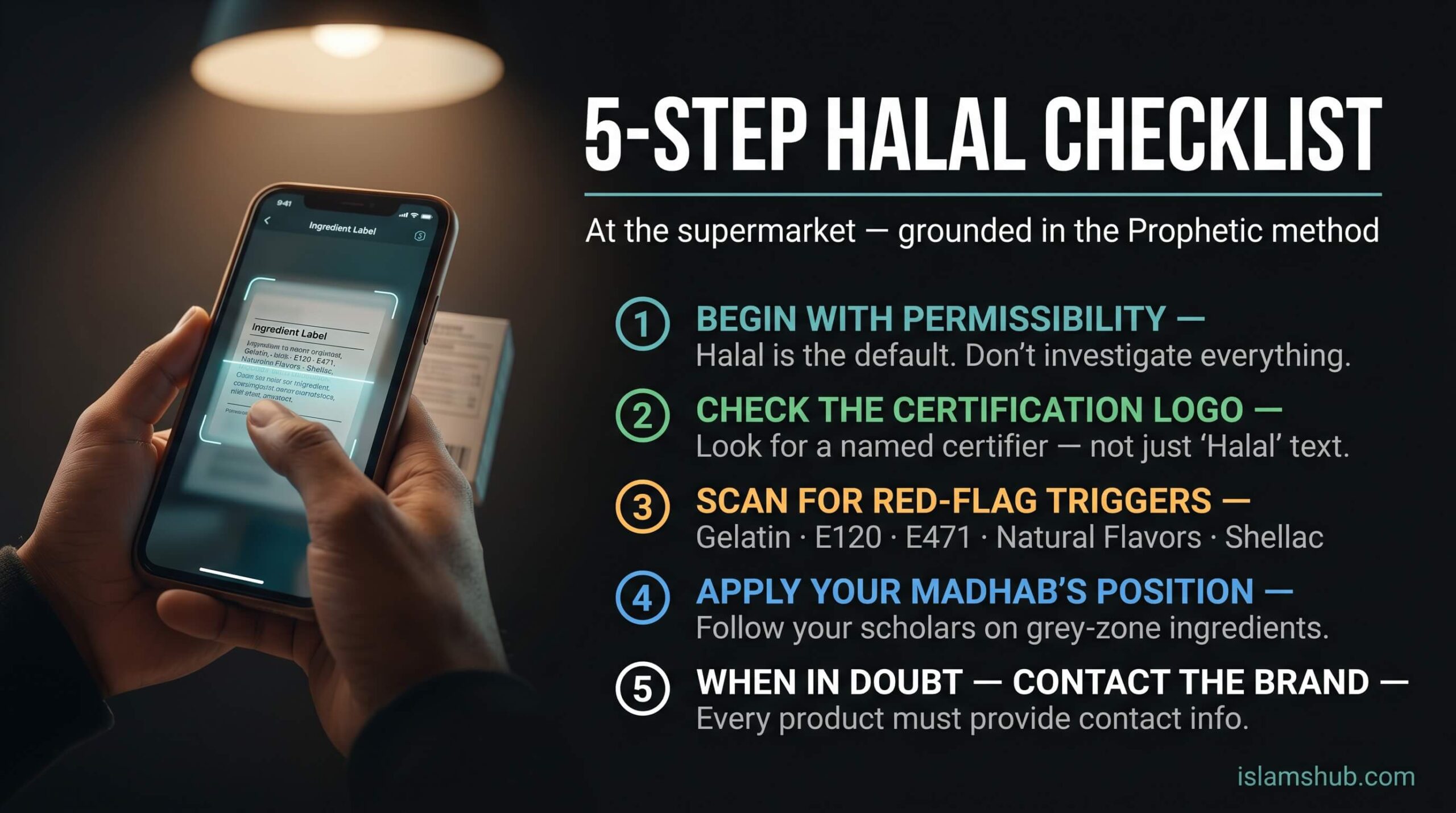
Everything above converges on this actionable checklist. Use it at Imtiaz, Carrefour, Chase Up, or Metro — phone in hand.
| Step 1 — Begin with the Prophetic Default: Halal is Clear “Halal is clear, haram is clear, and between them are doubtful matters.” [Sahih Bukhari, No. 52] Begin with the assumption of permissibility — not suspicion. You do not need to investigate every ingredient on every label. Only investigate when a specific red-flag trigger appears. This is not laziness — it is the Prophetic method. |
| Step 2 — Check the Certification Body Logo, Then Verify It Look for a halal certifier logo — not a self-printed ‘Halal’ text. Trust hierarchy: PHA-accredited → PNAC-accredited → CEHA → SANHA → IFANCA → JAKIM/GCC logos → Self-declared ‘Halal’ text (no regulatory weight) |
| Step 3 — Scan Ingredients for Red-Flag Triggers 🔴 ALWAYS INVESTIGATE before purchasing: Gelatin (E441) | L-Cysteine (E920) | Carmine (E120) | Shellac (E904) | Rennet (animal, unspecified) | Lard | Animal shortening | Pork/pig derivatives 🟡 MUSHBOOH — check source or seek certification: E471 (source undeclared) | Natural Flavors | Vanilla Extract (natural) | Whey Powder | Cheese (rennet type unstated) | E322 Lecithin (source unstated) | Glycerol (source unstated) 🟢 ALWAYS SAFE — no investigation needed under any madhab: E330 Citric Acid | E300 Vitamin C | E100 Curcumin | E140 Chlorophyll | E415 Xanthan Gum | E440 Pectin | E160a Beta-Carotene | E410 Locust Bean Gum | Soy/Sunflower Lecithin (stated) | Fish Gelatin (stated) | Microbial Rennet |
| Step 4 — Apply Your Madhab’s Position to Grey-Zone Items For any ingredient on the Mushbooh list, refer to the multi-madhab analysis in Section 8 above. Identify which madhab’s methodology you follow and apply that position. If genuinely uncertain, applying ihtiyat (precaution) — choosing an alternative — is the Prophetically endorsed default. |
| Step 5 — When in Doubt, Contact the Manufacturer Every product sold in Pakistan legally must provide consumer contact information. Send this message: “As-salamu Alaykum / Dear [Brand Name] Customer Service — I am a Pakistani Muslim consumer purchasing your [product name]. Could you please confirm: (1) What is the source of [E471/gelatin/lecithin/natural flavors] in this product — is it plant-derived or animal-derived? (2) If animal-derived, was the source animal slaughtered according to Islamic zabiha requirements? (3) Does this product hold halal certification for its full ingredient supply chain? Please provide the certifier name and certificate number. JazakAllah Khair.” |
| Bonus — Imported Products Hidden Ingredient Warning: Imported products may contain processing aids not listed on the label under origin-country regulations (the international ‘2% processing aid’ non-disclosure convention). Only halal certification covering the full supply chain closes this gap. |
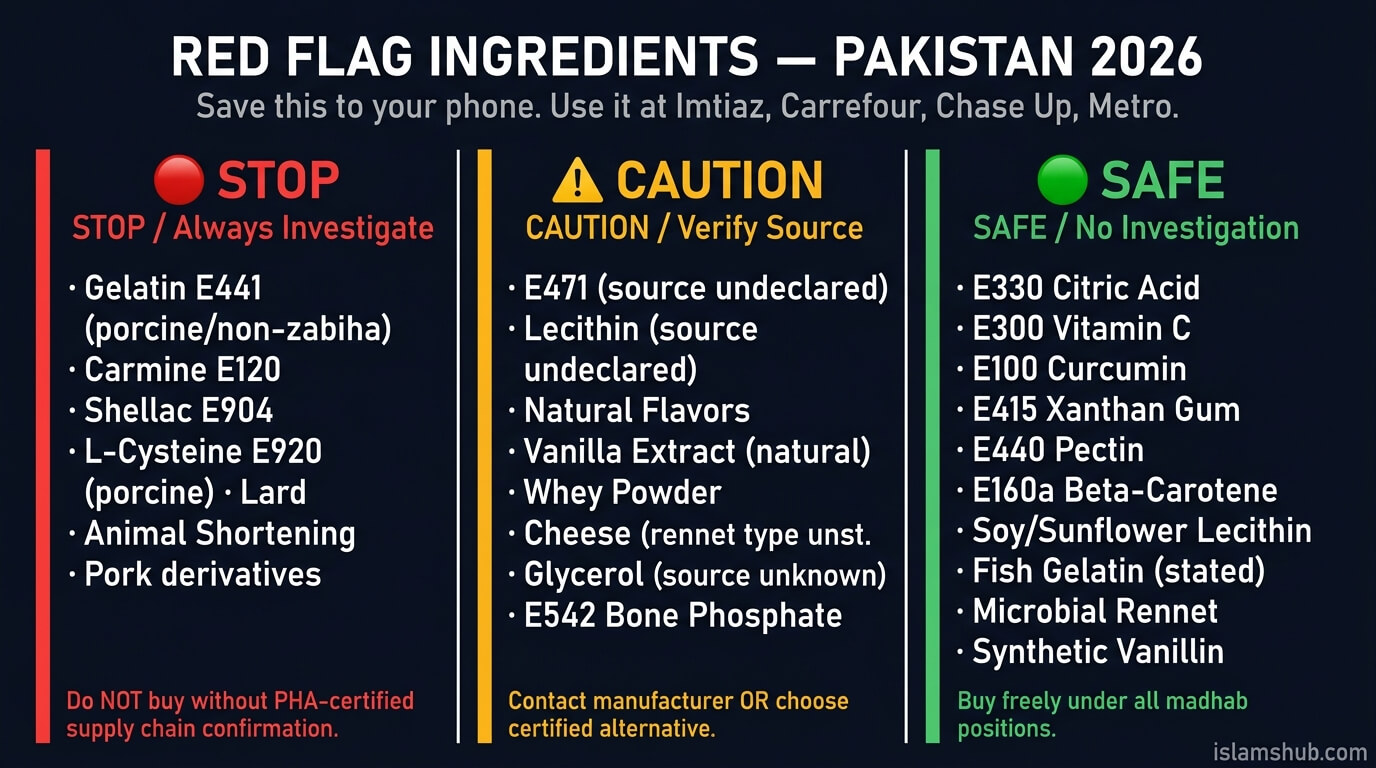
Red Flag Ingredients: Quick Reference Table
| TRAFFIC LIGHT | INGREDIENTS | WHY IT’S A FLAG | WHAT TO DO |
|---|---|---|---|
| 🔴 STOPAlways Investigate | Gelatin (E441) — porcine / non-zabihaE120 Carmine / CochinealE904 ShellacE920 L-Cysteine (porcine)Lard / Animal ShorteningPork or pig (any form)Non-zabiha slaughter derivatives | Either haram li-dhatih (intrinsically forbidden — pork, carmine) or haram li-ghayrih (forbidden due to non-zabiha slaughter). No madhab consensus permitting these without verified halal sourcing. | Do NOT purchase without confirmed PHA-certified supply chain. |
| 🟡 CAUTIONVerify Source | E471 (source undeclared)Lecithin (source undeclared)Natural FlavorsVanilla Extract (natural)Whey PowderCheese (rennet type unstated)Glycerol / Glycerine (source unknown)E542 Bone PhosphateE422 Glycerol | Mushbooh — may be halal or haram depending on source. Cannot determine without manufacturer confirmation or halal supply-chain certification. | Contact manufacturer OR choose PHA-certified alternative OR apply ihtiyat. |
| 🟢 SAFENo Investigation | E330 Citric Acid / E300 Vit CE100 Curcumin / E140 ChlorophyllE415 Xanthan Gum / E440 PectinE160a Beta-Carotene / E410 Locust BeanSoy/Sunflower Lecithin (stated)Fish Gelatin (stated)Microbial Rennet / FPC ChymosinVegetable-origin E471 (stated)Synthetic Vanillin (‘Vanilla Flavor’) | Plant-derived, mineral, or fermentation-sourced. Halal across all four madhabs. No animal connection. | Buy freely under all madhab positions. |
Practical Tools and Apps for Pakistani Halal Shoppers
Halal Scanner Apps
- Halal Check (various platforms): Scan barcodes against community-maintained halal databases. Useful for quick checks but note that coverage of Pakistani products is incomplete as of April 2026. Treat as a starting point, not a definitive authority.
- HalalScan / IsItHalal apps: International barcode databases — best for imported products (US, European, Australian brands). Confirm the certification body shown in the app against the PHA/PNAC registries.
- Malaysia JAKIM ‘myHALAL’ app: For verifying JAKIM-certified imported products. Highly reliable for JAKIM-certified Malaysian brands available in Pakistan.
Official Verification Portals
- pakistanhalalauthority.gov.pk: PHA list of recognised and accredited certification bodies. Use to verify whether a certifier logo on your product is PHA-recognised.
- pnac.org.pk: PNAC list of accredited conformity assessment bodies. Cross-reference for double verification.
- pfa.gop.pk: Punjab Food Authority — mandatory notification details, enforcement updates, and consumer complaint mechanisms.
Manufacturer Contact Template (Ready to Send)
| Subject: Halal Ingredient Verification Request — [Product Name] Dear [Brand] Customer Service,I am a Pakistani Muslim consumer. I would like to request halal verification for your product [Product Name, Batch No.]:1. What is the source of [ingredient name] — plant-derived or animal-derived?2. If animal-derived: was the source animal slaughtered according to Islamic zabiha requirements?3. Which halal certification body has audited this product’s full ingredient supply chain?4. Please provide the certificate number and expiry date.JazakAllah Khair / Thank you. |
Frequently Asked Questions — 15 High-Intent Pakistani Questions
Q1. How do I know if a food product is halal certified in Pakistan?
Check the packaging for a certification body logo with the certifier’s name clearly visible — not just a self-printed ‘Halal’ text. Verify the named certifier at pakistanhalalauthority.gov.pk (PHA list) or pnac.org.pk (PNAC list). A self-declared ‘Halal’ label without a certifier name carries no regulatory weight under PS:3733-2022(R).
Q2. Is all locally made Pakistani food automatically halal?
No. Many Pakistani manufacturers source imported emulsifiers (E471), flavours (‘natural flavors’), and enzymes (E920) from non-halal-verified international suppliers. A ‘Made in Pakistan’ label addresses production location only — it says nothing about individual ingredient halal status. Only recognised halal certification covering the full ingredient supply chain provides meaningful assurance.
Q3. What is PS:3733-2022(R) and does it apply to the food I buy?
PS:3733-2022(R) is Pakistan’s national halal food standard, adopted from the OIC/SMIIC 1:2019 international standard. It mandates zabiha slaughter for all animal ingredients, no cross-contamination with haram substances, and full ingredient traceability. The Punjab Food Authority made it mandatory for specified food categories in Punjab in its 2024 notification. However, compliance requires certified auditing — the standard’s existence does not mean every product on shelves has been verified.
Q4. Is gelatin in Pakistani food halal?
It depends entirely on the source. Fish gelatin (from halal aquatic species) is halal per all four madhabs. Bovine gelatin from zabiha-slaughtered animals is halal. Porcine gelatin is haram per mainstream Hanafi (subcontinent), Shafi’i, and Hanbali positions. Non-zabiha bovine gelatin is also haram per these positions. In Pakistani supermarkets, look specifically for ‘fish gelatin’ or ‘halal bovine gelatin’ explicitly stated, or choose products with halal supply-chain certification.
Q5. Is E471 halal in Pakistani biscuits?
E471 is unambiguously halal when derived from vegetable or plant-based fats (palm, sunflower, soy) — and haram or mushbooh when animal-derived. In Pakistani packaged foods, the source is frequently not declared on the label. All four madhabs require source verification before animal-derived E471 can be considered permissible. Look for products explicitly stating ‘vegetable-origin emulsifier’ or ‘palm-derived E471’, or choose products with halal supply-chain certification from a PHA-recognised body.
Q6. Is carmine (E120) halal for Hanafis? I found it in my kids’ strawberry yogurt.
No. The majority Hanafi position — dominant among subcontinent scholars at Darul Uloom Deoband and Jamia Binoria — holds that land insects other than locusts (which are explicitly permitted by authentic hadith) are not permissible as food. E120 is extracted from a land insect (cochineal) and is therefore haram per this mainstream subcontinent position. Across all four madhabs, the mainstream view is that E120 is not permitted. Check pink/red coloured products — yogurts, candies, fruit drinks. Choose products coloured with E160c (paprika extract) or E162 (beetroot red) as halal alternatives.
Q7. Can a Muslim open a gelatin capsule to avoid the haram outer shell?
The scholarly guidance is sequenced: First, verify with your pharmacist whether the same medication is available in tablet or liquid form — both avoid the gelatin capsule entirely. Second, ask whether an HPMC (vegetarian/hydroxypropyl methylcellulose) capsule version exists. If the medication is genuinely available only in gelatin capsule form and is medically necessary, the darurah (necessity) exception applies per mainstream scholarly consensus across all four madhabs, as addressed by the Islamic Fiqh Academy (OIC) and Mufti Taqi Usmani (Hanafi). Consult your pharmacist for alternatives and, for personal certainty, a trusted local scholar.
Q8. Is vanilla extract halal in Pakistan?
Natural vanilla extract contains ethanol used as a solvent during the extraction process. The majority contemporary Hanafi position permits natural vanilla extract as a flavouring agent when the finished product is entirely non-intoxicating. The Maliki position is cautious; Shafi’i and Hanbali scholars range from caution to restriction. ‘Vanilla flavour’ (synthetic vanillin) carries no ethanol concern and is the most straightforward choice for consumers wishing to avoid any doubt. [Reference: Sheikh Munajjid’s ruling on vanilla extract and alcohol as a processing agent]
Q9. Are gummy vitamins with gelatin halal?
Most gummy vitamins on the Pakistani market use porcine gelatin or non-zabiha bovine gelatin. Per mainstream Hanafi (subcontinent), Shafi’i, and Hanbali positions, these are not permissible for food consumption. Look for gummy vitamins explicitly stating ‘pectin-based’, ‘plant-based’, or ‘halal certified’ with a named certifier. Fish gelatin gummies are halal across all madhabs per Al-Ma’idah 5:96.
Q10. Is whey protein powder halal?
Whey protein’s halal status depends entirely on the rennet used in the parent cheese from which it is derived. If the cheese used microbial or FPC rennet — halal across all madhabs. If non-zabiha animal rennet — haram per mainstream Hanafi, Shafi’i, Hanbali positions. Choose whey protein from manufacturers with explicit halal supply-chain certification (certifying the cheese production process, not just the finished protein powder), or contact the manufacturer directly.
Q11. Is cheese from Pakistani brands halal?
Contact local brands (Haleeb, Nurpur) directly to ask: ‘What type of rennet do you use in your cheese production — microbial, FPC, vegetable, or animal?’ Microbial or FPC rennet = halal across all madhabs. Animal rennet requires zabiha verification. For imported cheeses (cheddar, parmesan, mozzarella), the default for most Western-produced cheese is non-zabiha animal rennet unless the product carries explicit halal or vegetarian certification.
Q12. Is L-Cysteine (E920) in bread haram?
L-Cysteine is haram if porcine-derived (a common source in some markets), halal if synthetic or plant-derived, and mushbooh if from poultry feathers (debated). Pakistani consumers purchasing imported bread mixes or eating at fast-food chains should contact the manufacturer or chain directly regarding their E920 source. Only halal certification confirming synthetic or verified halal origin is reliable.
Q13. My product has ‘natural flavors’ listed. Is it safe?
‘Natural flavors’ is a genuinely mushbooh ingredient for Pakistani consumers. Under FDA and international labeling conventions, ‘natural flavors’ may include ethanol-based extracts, animal-derived aromatic compounds, or entirely plant-based compounds — there is no way to determine this from the label alone. The only reliable resolution for imported products: halal certification from a reputable body that specifically audits flavor suppliers, or direct manufacturer confirmation in writing.
Q14. Are imported snacks from Western countries halal if they don’t contain pork?
Not necessarily. Even without explicit pork ingredients, imported products may contain: (1) E471 from animal-derived tallow; (2) Natural flavors with ethanol or animal-derived compounds; (3) Gelatin from non-zabiha animals; (4) Processing aids not listed on the label under the 2% non-disclosure convention. Without halal supply-chain certification from a PHA-recognised or OIC-aligned body, Western-imported products without pork labeling cannot be assumed halal without investigation.
Q15. I see ‘Suitable for Vegetarians’ on an imported product. Does that mean it’s halal?
A vegetarian label means the product contains no meat — but it does not confirm halal status. A vegetarian product may still contain: natural vanilla extract (ethanol-based), non-halal rennet in cheese ingredients, E120 carmine (insect-derived, not animal meat but not halal), E904 shellac (insect-derived), or alcohol-based flavouring agents. A vegetarian label resolves some mushbooh concerns (no meat-derived gelatin, no non-zabiha slaughter) but is not equivalent to halal certification.
Beyond Halal — The Tayyib Dimension
If this guide stopped at E-code analysis and certification checklists, it would be thorough — but it would miss what the Quran actually says. Allah ﷺ does not simply command us to eat halal. He commands us to eat halal and tayyib — and that pairing is deliberate, meaningful, and demanding [Al-Baqarah 2:168].
Tayyib (طيب) carries multiple layers: pure, wholesome, good, excellent, spiritually sound. Imam Ibn al-Sa’di (Taysir al-Karim al-Rahman) explains the Quranic command as requiring food to pass two distinct tests: legal permissibility (halal) AND genuine wholesomeness — encompassing physical quality, ethical sourcing, and freedom from moral contamination.
What Tayyib Raises in Practice
- Animal welfare: Islamic fiqh requirements for zabiha include a sharp blade, a calm animal, water offered beforehand, and the prohibition on slaughtering in sight of other animals. These requirements are not ceremonial — they reflect an Islamic commitment to tayyib treatment of all creatures. Many certified operations meet the legal slaughter requirement while falling short of the broader tayyib ideal.
- Supply chain ethics: A fully tayyib food product would be free from exploitative labour practices, environmental destruction, or unjust trade conditions across its entire production chain.
- Economic consciousness (2026 Pakistan): Classical Islamic scholars discussed tayyib as encompassing not just chemical permissibility but moral and economic integrity. The Pakistani Muslim consumer who considers the ethical dimensions of their purchase choices is engaging in a deeply Islamic practice of taqwa-conscious consumption.
| The Prophet ﷺ said: “Allah is pure (tayyib) and He only accepts what is pure (tayyib).” [Sahih Muslim, No. 1015]A food that is halal does not become haram if it falls short of the full tayyib ideal — but a Muslim seeking taqwa-conscious consumption aspires to both. |
Conclusion
Navigating halal ingredients in Pakistan’s 2026 food market requires three things this guide has aimed to provide: scholarly grounding, regulatory clarity, and practical tools.
- On the scholarly dimension: The Hanafi, Maliki, Shafi’i, and Hanbali madhabs each have coherent, evidenced positions on the most contested ingredients. Where they agree, the consumer has clarity. Where they differ through legitimate ikhtilaf, the consumer has the right — and the responsibility — to follow the scholars of their own madhab. islamshub.com presents these positions as the tradition presents them: each rooted in evidence, each deserving of respect.
- On the regulatory dimension: PS:3733-2022(R), the Punjab Food Authority’s 2024 mandatory notification, and the PHA certification framework provide meaningful tools — but they require active consumer engagement. Verification at pakistanhalalauthority.gov.pk is the starting point, not the finish line.
- On the spiritual dimension: The Prophet ﷺ taught us that what we consume affects our worship, our du’a, and our closeness to Allah. The effort a Muslim makes to eat halal and tayyib is not bureaucratic compliance — it is an act of love for Allah and trust in His guidance.
A Closing Du’a
اَللَّهُمَّ اجْعَلْ مَا رَزَقْتَنَا حَلَالًا طَيِّبًا وَلَا تَجْعَلْ لَنَا إِلَيْهِ حَاجَةً
“O Allah, make what You have given us lawful and pure, and do not create for us need for anything beyond it.”
Explore More at islamshub.com
- The 99 Names of Allah — Complete Guide with Arabic, Transliteration, and Meaning
- Morning and Evening Duas (Adhkar) — With Arabic, Transliteration, and Benefits
- How to Perform Wudu — Step-by-Step Guide with Scholarly References
- Halal and Haram in Food — The Complete Foundational Explainer
Primary Sources and Scholars Referenced
Classical Texts: Radd al-Muhtar ‘ala al-Durr al-Mukhtar (Ibn Abidin, Hanafi) | Ahkam al-Quran (Ibn al-‘Arabi, Maliki) | Al-Muhadhdhab (Imam al-Shirazi, Shafi’i) | Al-Majmu’ (Imam al-Nawawi, Shafi’i) | Al-Mughni (Ibn Qudamah, Hanbali) | Majmu’ al-Fatawa (Ibn Taymiyyah, Hanbali) | Jami’ al-Ulum wal-Hikam (Ibn Rajab al-Hanbali) | Taysir al-Karim al-Rahman (Imam al-Sa’di) | Al-Jami’ li-Ahkam al-Quran (Imam al-Qurtubi)
Contemporary Scholars: Mufti Taqi Usmani (Pakistan, Hanafi) | Sheikh Abd al-Aziz ibn Baz (Saudi Arabia, Hanbali) | Sheikh Munajjid (IslamQA, Hanbali)
Institutional Bodies: Islamic Fiqh Academy / IFA (OIC) | IOMS Kuwait | European Council for Fatwa and Research (ECFR) | Pakistan Halal Authority (PHA) | PSQCA | PNAC | Punjab Food Authority (PFA)
Regulatory Standards: PS:3733-2022(R) — PSQCA/Pakistan (OIC/SMIIC 1:2019 base) | Punjab Food Authority 2024 Mandatory Notification (pfa.gop.pk)