Why Every Muslim Home Cook needs this Guide (And why 90% of Recipe sites are so far wrong about the concept of Halal)
It is easy to find copies of chicken-and-rice in the New York City fashion; just search halal recipes online. None of them describe why these foods are halal or help you verify a single item on the shopping list. That gap between cooking instructions and Islamic dietary law is exactly where mistakes happen.
Halal recipes are made using ingredients that are permitted in the Islamic law. There should be no pork, no alcohol, and all meat sourced from animals slaughtered with Bismillah according to dhabihah. The following have over 15 recipes that are easy to make as a beginner, such as halal cart chicken with white sauce, Ramadan iftar recipes, and the Quranic justification to each rule.
The Quran does not just tell to avoid pork. Allah tells us in Surah al-Baqarah (2:168) that we are to consume foods that are not only halal (lawful), but tayyib (wholesome). This is a two-sided standard disregarded by most recipe websites. Understanding fiqh al-at’imah (Islamic food jurisprudence) transforms your kitchen from a place where you hope things are halal into one where you know they are.
What you will get by continuing to read: a 5-step system of examining ingredients, which no other source of information provides, a list of 27 of the most frequently used ingredients and their halal or haram status as of 2026, complete recipes with halal-compliance notes at every step, and a madhab comparison table on contested foods like shrimp and grocery-store chicken.
Before you cook a single dish, there’s a critical 3-step test you need to apply to every ingredient in your kitchen. Most people skip step 2.
The guide relies on Quranic verses, authentic hadiths of Sahih al-Bukhari and Sahih Muslim along with the perspectives of all the four major schools of Islamic jurisprudence, updated for 2026.
What is it that really Makes a Recipe Halal?
The Quranic Proof that will Transform Your Shopping and Cooking habits.
When a recipe is referred as halal, it does not just involve replacing pork with chicken. The Quran establishes a multi-layered structure which controls the source of food, the process of food and even the spiritual intention behind your meal. Once you understand these layers, grocery shopping and cooking become acts of informed worship rather than anxious guesswork.
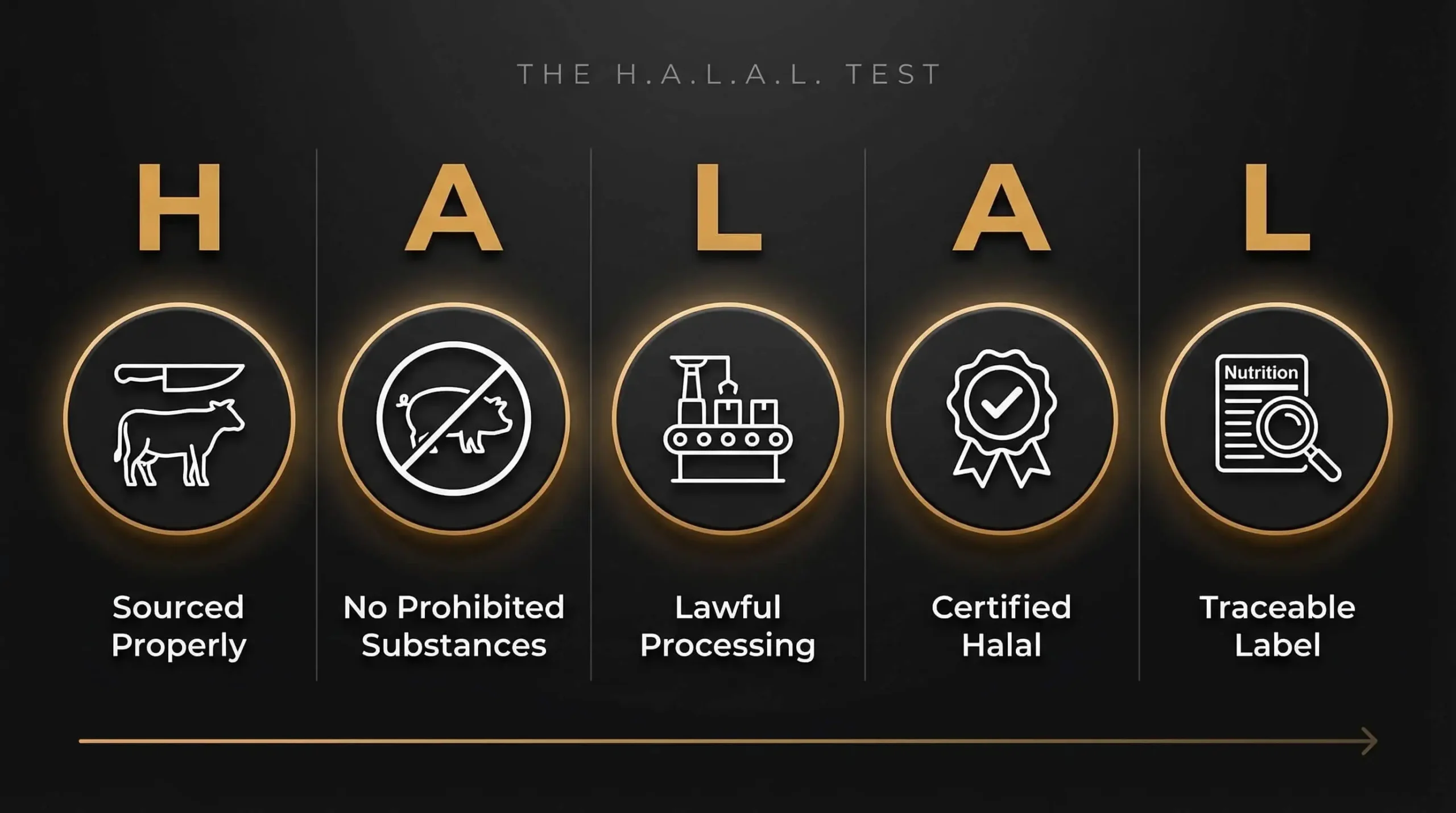
The H.A.L.A.L. Test — A Five Step Guide to Every Component in Your Kitchen
Use this memorable acronym to evaluate any ingredient before it enters your pot:
H — Harvested/sourced properly. Meat should be of dhabihah slaughter. The killing of the animal is done by a rational Muslim (or, as some scholars believe, a People of the Book), who says Bismillah and cuts the throat with a sharp blade. Stunning before the cut is prohibited by most scholars.
A — Absent of explicitly prohibited substances. According to the Quran, there are four major prohibitions named in Surah Al-Baqarah (2:173) and Surah Al-Ma’idah (5:3): dead animals, flowing blood, swine meat and that dedicated to other than Allah.
L — Lawful processing. Even a halal raw ingredient can become impermissible through processing — alcohol-based solvents, haram enzymes, and cross-contamination on shared production lines all compromise halal status.
A — Attested by certification. When you cannot verify the supply chain yourself, look for recognized certification logos of such organizations like IFANCA, the American Halal Foundation, HFA (UK), or JAKIM (Malaysia).
L — Labeled and traceable. Read every ingredient label. Learn how to check food ingredients for halal certification.Other non-halal ingredients can conceal themselves in such vague terms as natural flavours or even enzymes. If the origin is unclear, the item falls into the mashbooh (doubtful) category.
The 4 Forbidden Categories in the Quran That Every Muslim Chef Should Be Aware Of (Surah Al-Baqarah 2:173)
The Quran is explicit. There are four names of categories which are forbidden:
He has only forbidden to you dead animals, blood, the flesh of swine, and that which has been dedicated to other than Allah. (Quran, Surah Al-Baqarah, 2:173)
Surah Al-Ma’idah (5:3) further elaborates and prohibits animals that are strangled to death, dealt a fatal blow, a head-long fall, gored or partially consumed by wild animals — unless you can slay before death. Same basic prohibitions are strengthened in Surah Al-An’am (6:145). Imam Ibn Kathir in his Tafsir points out that the verse establishes a balanced approach: prohibiting what is harmful while allowing exception in cases of genuine necessity.
The kitchen implication of the above is that anything that is of pork-derived gelatin, and lard, blood sausage, or food sacrificed at non-Islamic altars cannot be consumed in any form.
Halal AND Tayyib — Why Good Is Not Good Enough Without Both (Surah Al-Baqarah 2:168)
“O mankind, eat from whatever is on earth [that is] lawful and good and do not follow the footsteps of Satan.” (Quran, Surah Al-Baqarah, 2:168)
Here it is twofold, halal and tayyib. According to Imam al-Nawawi, the renowned Shafi’i scholar and author of Riyad al-Salihin, tayyib refers to purity, wholesomeness and nutrition. A food may be legal and unhealthy such as highly processed junk food produced using halal products and yet is unhealthy.
Surah Al-A’raf (7:31-32) attests to one of the principles of moderation: eat and drink and do not excessively eat and drink. According to scholars, halal and tayyib foodstuffs must be consumed in the right quantity but no more.
The spiritual dimension is more in-depth. Surah Al-Mu’minun (23:51) Allah informs the messengers, saying to them, eat good food and do good deeds. According to scholars, the order of things is important as one must first consume legal food, then perform good deeds, as righteous deeds hold little weight without lawful provisions.
Allah is Good (Tayyib) and He only accepts what is good (tayyib)… (Narrated by Abu Hurairah, Sahih Muslim, Hadith No. 1015, classified as Sahih)
The Prophet ﷺ then mentioned a man who makes a long journey, disheveled and dusty, raising his hands to the sky. He had drunk and partaken forbidden food. How, then, would his supplication be answered? This hadith ties halal eating directly to the acceptance of worship.
Now, that you have the idea, we are going to examine the actual ingredients in your kitchen, in particular, those that may surprise you.
Your Halal Kitchen Checklist: 27 Common Ingredients and Their Halal Status (2026 Updated)
One thing is having knowledge of the rules. Another one is scanning the label on a bottle of Worcestershire sauce at 7 PM on a Tuesday. This section presents 27 typical type of ingredients in the kitchen and whether they are halal or not so that you can go and cook without fear.
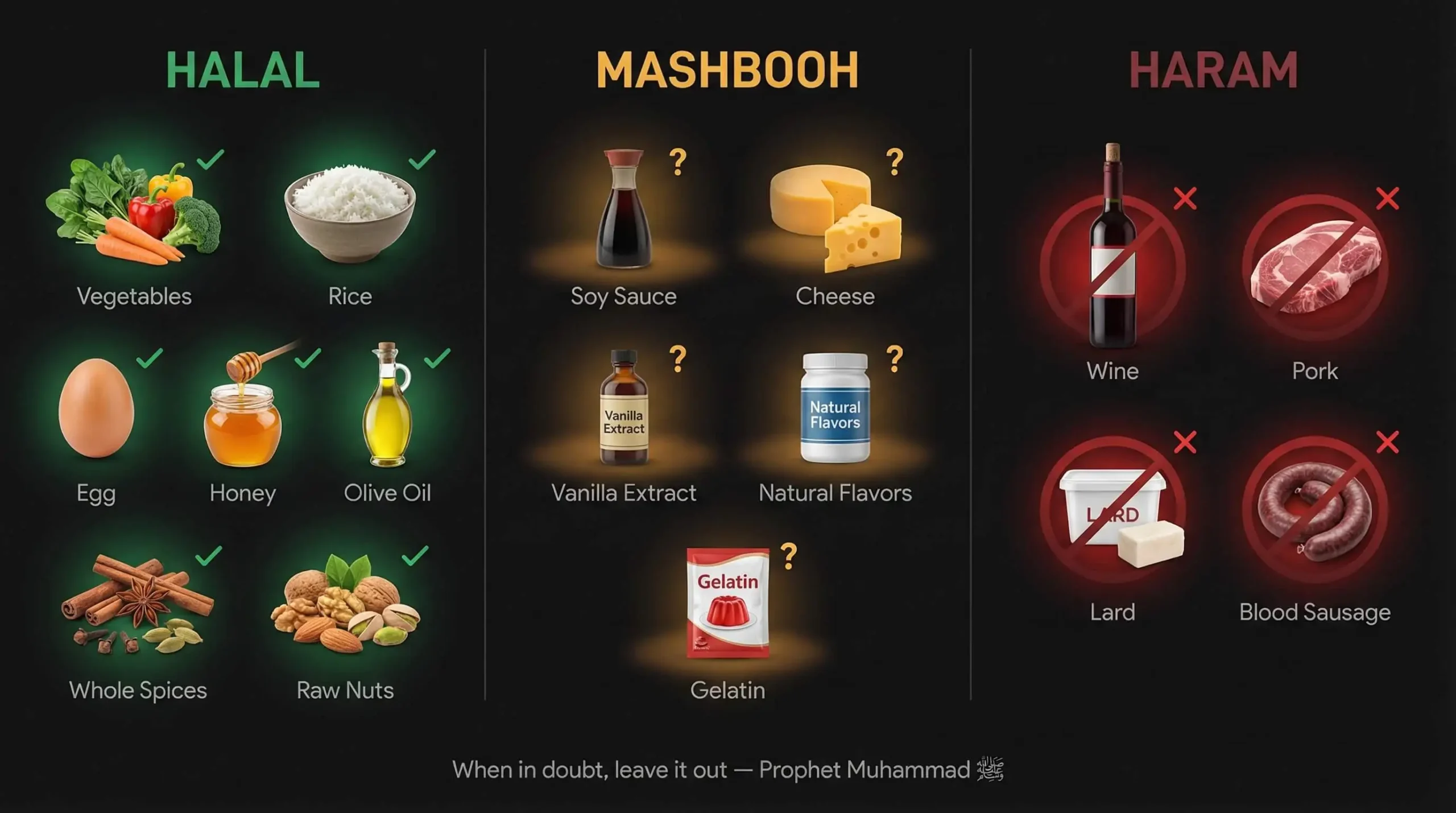
Ingredients That Are Definitely Halal (With Zero Doubt)
These items are inherently permissible, and do not require any certification check:
- ✅ Fresh vegetables and fruits.
- ✅ Whole grains (rice, oats, wheat, barley, quinoa)
- ✅ Legumes (lentils, chickpeas, black beans, kidney beans)
- ✅ Eggs
- ✅ Pure dairy milk (no flavor)
- ✅ Spices (cumin, coriander, turmeric, paprika, cinnamon, black pepper) — pure.
- ✅ Honey
- ✅ Pure olive, coconut oil, sunflower oil.
- ✅ Nuts and seeds (almonds, walnuts, sesame, flax)
- ✅ Plain tea and coffee
No hidden ingredients, no concerns of processing, no discussion. Build your meals around these and you begin on the right foot.
Doubtful (Mashbooh) Ingredients Most Cooks Miss
The Prophet ﷺ warned:
“That which is halal is clear, and that which is haram is clear, and between them are doubtful matters…” (Narrated by al-Nu’man ibn Bashir, Sahih al-Bukhari, Hadith No. 52; Sahih Muslim, Hadith No. 1599, classified as Sahih)
Mashbooh foods are food whose halal is doubted or controversial. They have usually unknown origins or contain ingredients on which scholars disagree, including foods from unknown sources and ingredients subject to differing scholarly interpretation. It is the ones most houses have witnessed:
| Ingredient | Status | Why It’s Doubtful | What to Do |
|---|---|---|---|
| Vanilla Extract | Mashbooh | Contains 35%+ alcohol | Use halal-certified vanilla or pure vanilla powder. |
| Worcestershire sauce | Mashbooh | Fermentation can use alcohol | Check label; use brands certified as halal |
| Cheese (lots of varieties) | Mashbooh | May contain animal rennet that is not halal | Select cheese with microbial rennet |
| Gelatin | Mashbooh / Haram | Often pork based | Use agar-agar or halal bovine gelatin |
| Soy sauce | Mashbooh | Fermented with alcohol using some brands | Use tamari soy or halal-certified soy sauce |
| Mono/Diglycerides | Mashbooh | Can be animal-fat derived | May be plant-sourced or halal-certified |
| L-cysteine | Mashbooh | Can be of human hair or duck feathers | Verify with manufacturer |
| Confectioner glaze | Mashbooh | Shellac (insect secretion) made glaze | Avoid or get halal version |
| Natural flavors | Mashbooh | Vague term; can contain non-halal substances | Contact manufacturer or avoid |
| Brewer yeast extract | Mashbooh | Brewing, diverse views | Check certification |
Be wary of vague words like ‘natural flavors’ or ‘enzymes,’ which can mask non-halal compounds. When in doubt, the Prophetic guidance is clear: leave it.
Haram and Halal Substitutes of Some of the Common Kitchen Ingredients
| Haram Ingredient | Halal Swap |
|---|---|
| Cooking wine / mirin | Halal grape juice + white vinegar, or halal-certified mirin. |
| Pork-based gelatin | Halal bovine gelatin or agar-agar. |
| Lard / pork fat | Vegetable oil, halal butter, or ghee. |
| Bacon | Halal turkey bacon or halal beef bacon. |
| Carmine (red food dye E120) | Beetroot powder or food coloring of halal-guaranteed contents. |
| Non-dhabihah meat | Certified halal meat of a confirmed supplier. |
With your pantry now halal-verified, you’re ready for the recipes. We will begin with the most ordered halal food in America.
15+ Halal Recipes for All Skill Levels — Street Cart Classics to Family Feasts
Every recipe below follows the H.A.L.A.L. Test. Ingredient lists flag potential mashbooh items and provide halal-verified alternatives. Prep times are attainable, skills are apparent and every dish has a Why It’s Halal note to help you cook with confidence.
Best Halal Cart Chicken and Rice Recipe (Better Than NYC Street Carts)
⭐ Simple | Prep: 20 min + 2 hr marinating | Cook: 30 minutes | Serves: 4
Halal chicken and rice is one of the common street foods which can be prepared at home. It is spiced chicken over seasoned yellow rice, finished with crisp vegetables and a signature creamy white sauce. All the ingredients are certified as halal.
Why It’s Halal: All meat is certified to be dhabihah; the marination has no alcohol; the rice is cooked in a halal chicken broth and the white sauce is prepared using halal-certified mayo or a yogurt substitute.
Halal Chicken Marinade
- 1 kg chicken thighs (dhabihah-certified), boneless and skinless.
- 1 cup plain yogurt (be sure to use halal-certified and gelatin-free types)
- 3 tbsp olive oil
- Juice of 1 lemon
- 2 tsp ground cumin
- 2 tsp ground coriander
- 2 tsp paprika
- 1 tsp turmeric
- 4 cloves garlic, minced
- Salt and pepper to taste
Turmeric Yellow Rice
- 2 cups basmati rice, rinsed
- 3 cups halal chicken broth
- 2 tbsp ghee or halal butter
- 1 tsp turmeric
- 1 tsp cumin
- ½ tsp cinnamon
Instructions
- Add all the marinades in a bowl. Add chicken and coat thoroughly. Refrigerate for at least 2 hours (overnight yields the best flavor).
- Rice cooking: Add Ghee, melt it in a pot, and cook over medium heat. Add turmeric, cumin, and cinnamon — toast 30 seconds. Add rinsed rice and stir to coat. Add broth, boil, cover and reduce the heat. Cook for 15 minutes. Remove from heat; let sit covered for 5 minutes. Fluff the rice with a fork.
- Heat a large skillet or griddle, with medium-high heat, and pour 1 tablespoon of olive oil. Cook marinated chicken 5–6 minutes per side till it gets charred on the outside and cooked on the inside (internal temp 74°C/165°F). Rest 5 minutes, then slice or chop into bite-sized pieces.
- Serve chicken over rice and shredded lettuce, tomatoes sliced and white sauce (recipe below).
Pro Tip: To achieve the halal cart flavor, one should cook the chicken over a high temperature with the sides being charred slightly. Do not overcrowd in the pan, cook in batches when necessary.
The Iconic Halal White Sauce Recipe (Tangy, Creamy, 5 Minutes — No Haram Ingredients)
Halal white sauce parts comprise of mayonnaise and yogurt (or sour cream), vinegar, lemon juice, garlic, and modest condiments such as salt, pepper, and parsley. The critical halal concern? Many commercial mayonnaises use wine vinegar or contain questionable emulsifiers.
Ingredients (Classic Version)
- ½ cup halal-certified mayo (read the label: no wine vinegar, no mono/diglycerides of pork sources)
- ½ cup plain Greek yogurt
- 1 tbsp white vinegar (no wine vinegar)
- 1 tbsp lemon juice
- 1 tsp sugar
- ½ tsp garlic powder (or 1 clove minced)
- Salt, white pepper (to taste).
- 1 tbsp fresh parsley, finely chopped (optional)
Instructions
- Whisk all ingredients together in a bowl.
- Taste and adjust salt, lemon, and garlic.
- Chill and serve after 30 minutes in order to get the most flavor.
- Store in fridge of up to 5 days.
Mayo-Free (100% Yogurt): Substitute the mayo with an additional ½ cup of Greek yogurt, add lemon juice to 2 tbsp, and add olive oil to 2 tbsp which adds a good richness. This version removes any mashbooh concern entirely.
Hot Red Harissa Sauce (The Ideal Offering with White Sauce)
🌟 Easy | Prep: 5 min | Cook: 0 min | Makes: ~1.5 cups | Serves:
The complete halal cart experience needs heat alongside the creaminess.
Ingredients
- 3 tbsp harissa paste (read the label to ensure that it is halal — does not contain wine)
- 2 tbsp olive oil
- 1 tbsp lemon juice
- 1 tsp smoked paprika
- 1 pinch cayenne (to taste)
Directions
Combine all ingredients in a small bowl. Pour chicken and rice with the white sauce. Adjust cayenne for your preferred heat level.
One Pan Halal Chicken Shawarma Wraps and Tahini Drizzle
⭐⭐ Intermediate | Prep: 15 min + 1 hr marinating | Cook: 15 min | Serves: 4
This one-pan version captures the warmth of cumin and the tang of lemon without the vertical rotisserie.
Why It’s Halal: Dhabihah-certified chicken; all spices are naturally halal; tahini is pure sesame without additives.
Ingredients
- 700 g boneless, certified halal chicken thighs, cut thin (slices).
- 3 tbsp olive oil
- 4 cloves garlic, minced
- Juice of 1 lemon
- 2 tsp cumin
- 2 tsp paprika
- 1 tsp turmeric
- ½ tsp cayenne pepper
- Salt and pepper
- Pita bread (find a halal-certified, L-cysteine-free one)
- Toppings: pickled turnips, cucumbers, tomatoes, fresh parsley.
Tahini Drizzle
- ¼ cup tahini
- 2 tbsp lemon juice
- 2 tbsp water
- 1 clove garlic, minced
- Pinch of salt
Instructions
- Marinate sliced chicken in olive oil, garlic, lemon juice, and all the spices at least 1 hour.
- Heat a large skillet using the high heat. Roast the chicken single-layered, 3–4 minutes on each side, till it is golden.
- Whisk tahini drizzle ingredients until smooth.
- Load pita with chicken, toppings, and tahini. Serve immediately.
Pro Tip: For the crispiest edges, resist the urge to stir the chicken in the pan. Let it sear undisturbed.
Quick Halal Beef Stir-Fry with Ginger and Garlic (Ready in 20 Minutes)
⭐ Easy | Prep: 10 min | Cook: 10 min | Serves: 3–4
Why It’s Halal: Dhabihah beef; soy sauce verified as alcohol-free (use tamari or brand which is halal certified), and all vegetables and spices are naturally halal.
Ingredients
- 500 g of halal beef sirloin, sliced in thin slices against the grain.
- 3 tbsp halal soy or tamari or halal certified soy sauce.
- 1 tbsp sesame oil
- 2 tbsp neutral oil (sunflower or canola)
- 1-inch fresh ginger, grated
- 4 cloves garlic, sliced
- 2 cups mixed vegetables (bell peppers, snap peas, broccoli, carrots)
- 1 tsp cornstarch, 2 tbsp of water (slurry)
- Served plain steamed jasmine rice.
Instructions
- Combine the beef and 1 tbsp soy sauce and sesame oil. Set aside.
- Heat neutral oil in a wok or large skillet to a high heat. Sear beef in batches — approximately 1 minute on each side. Remove and set aside.
- Add ginger and garlic to the hot pan; stir-fry 30 seconds. Add vegetables and toss for 2–3 minutes until crisp-tender.
- Return the beef to the pan. Add remaining soy sauce and cornstarch slurry. Toss until sauce thickens (about 1 minute).
- Serve over the steamed rice.
Spiced Halal Lamb Kofta with Mint Yogurt Dip
⭐ Easy | Prep: 15 min | Cook: 12 min | Serves: 4
Ground lamb kofta is one of the simplest halal meals for beginners — no complex techniques, no obscure ingredients, and the flavor is extraordinary.
Why It’s Halal: Certified halal lamb; all spices are natural and halal; yogurt dip contains no alcohol or dubious additives.
Ingredients
- 500 g halal ground lamb
- 1 small onion, finely grated
- 3 cloves garlic, minced
- 2 tsp cumin
- 1 tsp coriander
- 1 tsp paprika
- ½ tsp cinnamon
- Salt and pepper
- Fresh parsley, chopped
Mint Yogurt Dip
- 1 cup plain yogurt
- 2 tbsp fresh mint, chopped
- 1 tbsp lemon juice
- Pinch of salt
Instructions
- Add lamb, onion, garlic, spices and parsley. Mix until just combined — don’t overwork.
- Form the mixture into 12 oval patties or thread it into metal skewers.
- Grill or pan-sear over medium-high heat, 5–6 minutes per side.
- Mix yogurt dip ingredients. Serve kofta with dip, warm pita, and a fresh salad.
3 Iftar Recipes to Feed a Family in Less Than 45 Minutes
Ramadan iftar requires nourishing, satisfying meals that come together quickly after a long day of fasting. These are the three halal recipes that provide it.
Palestinian Lentil Soup (Shorbat Adas)
⭐ Easy | 35 min total | Serves: 6
It is a high protein vegetarian soup. Fry 1 small diced onion and 4 cloves of chopped garlic in a small portion of olive oil. Add 2 cups of the red lentils, 1 diced carrot, 1 tsp cumin, ½ tsp turmeric and 6 cups of water or vegetable broth. Simmer through 25 minutes until the lentils become soft. Blend if desired. Finish lemon juice, salt and splash of olive oil. Entirely halal with zero doubt.
Pakistani Haleem (Simplified Stovetop Version)
⭐⭐ Intermediate | 45 min (with presoaked grains) | Serves: 6
Slow-cooked comfort in a fraction of traditional time.
- Soak ½ cup wheat berries, ¼ cup barley, and ¼ cup chana dal overnight.
- Combine the soaked grains, 1 large onion, and a common Pakistani spice mix (cumin, coriander, garam masala, red chili) with 500g of halal beef or lamb and pressure-cook it all together in 20 minutes.
- Continue mashing and stirring until mixture becomes thick. Garnish with fried onions, ginger, green chilies, and lemon.
Quick Chicken Korma
⭐ Easy | 30 min total | Serves: 4
Sauté diced onion in ghee, add dhabihah chicken pieces, cook 5 minutes. Add 2 tbsp korma paste (should be halal — no alcohol) to it, ½ cup yogurt, ½ cup coconut cream, ½ cup water. Simmer for 15 minutes. Top with almonds and fresh coriander sprinkled. Serve with basmati rice.
Eid Celebration Lamb Biryani (How to Make it as a Beginner)
⭐⭐⭐ Advanced | Prep: 30 min | Cook: 1 hr 15 min | Serves: 6–8
Biryani is the crown jewel of Eid recipes — layered rice and meat, fragrant with saffron and whole spices. This beginner-friendly version simplifies the process without compromising authenticity.
Why It’s Halal: Dhabihah lamb; all the whole spices are naturally halal; saffron, rose water, and ghee have no halal concerns; yogurt marinade is clean.
Lamb Layer
- 750 g halal bone-in lamb, cut into pieces.
- 1 cup yogurt
- 2 big onions, cut very thin and fried till golden.
- 2 tbsp ginger-garlic paste
- 1 tsp red chili powder, 1 tsp turmeric, 1 tsp garam masala.
- Salt
- Fresh mint and coriander
Rice Layer
- 3 cups basmati rice, soaked 30 minutes.
- 4–5 green cardamom pods, 4 cloves, one cinnamon stick, 2 bay leaves.
- Salt
Layering
- ½ tsp saffron soaked in ¼ cup warm milk.
- 2 tbsp ghee
- 2 tbsp rose water
Instructions
- Combine lamb, half fried onions, ginger-garlic paste and spices and marinate at least 1 hour.
- Boil the rice with the entire spices in salted water until approximately 70 percent cooked (approximately 6 minutes). Drain the rice.
- In a large pot, spread marinated lamb evenly on the bottom. Layer par-boiled rice on top. Drizzle saffron milk, rose water, and ghee. Add the rest of the fried onions, mint and coriander.
- Cover tightly with foil and then the lid. On low heat cook within 45 to 50 minutes (dum cooking).
- Gently mix layers when serving. The bottom should have a golden crust (tahdig).
Pro Tip: Keep the seal tight. Wrap the lid with a kitchen towel to absorb steam and prevent moisture from dripping back into the rice.
Why Vegetarian Recipes Are the Easiest Way to Cook Halal (Plus 3 Must-Try Dishes)
Vegetarian foods are halal provided that they are not alcoholic and haram additives are absent. There is no need to inspect whether the meat is dhabihah, no certification issues, and there should be no doubts about the meat. For new cooks or anyone living in an area with limited halal meat access, plant-based halal meals are the simplest path.
Lebanese Tabbouleh
Use 2 big bunches of parsley, mint, tomatoes, and green onion, chopped fine. Toss with bulgur wheat (soaked 15 minutes), olive oil, and generous lemon juice. Sprinkle salt to taste. Total time: 20 minutes.
Classic Falafel
First, soak 2 cups of dried chickpeas overnight (not tinned, which is too soft). Blend with onion, garlic, parsley, cumin and coriander. Roll the paste into balls and deep-fry at 175°C (350°F) 3–4 min till golden. Stuffed in pita pockets with tahini. Time: 30 minutes and the soak.
Chana Masala
Sauté onion, garlic, and ginger. Add canned chickpeas, diced tomatoes, cumin, coriander, garam masala and turmeric. Simmer for 20 minutes. Add lemon juice and fresh cilantro. Serve with rice or naan. Total time: 30 minutes.
These three dishes cross cultural boundaries — halal Middle Eastern recipes and halal South Asian recipes that anyone can master on the first attempt.
Maamoul Date Cookies (A Halal Dessert With Zero Questionable Ingredients)
⭐⭐ Intermediate | Ready: 30 min | Cook: 15 min | Serves: ~24 cookies
These traditional Middle Eastern cookies are inherently halal — they have no gelatin, no alcohol, no dubious additives. They’re a staple at Eid gatherings throughout the Arab world.
Ingredients
- 2 cups fine semolina
- 1 cup all-purpose flour
- Melted ½ cup ghee (or halal butter).
- ¼ cup powdered sugar
- ¼ cup rose water
- ¼ cup warm water
- 1 tsp mahlab or ½ tsp cinnamon (optional).
Date Filling
- 250 g pitted dates, mashed
- 1 tbsp ghee
- ½ tsp cinnamon
Instructions
- Combine semolina, flour and melted ghee. Let rest 1 hour (this allows semolina to absorb fat).
- Then add powdered sugar, rose water and warm water. Knead into a smooth, pliable dough.
- Cook date filling: warm mashed dates with ghee and cinnamon until a smooth paste forms. Cool.
- Take a piece of rich dough the size of a walnut, flatten it with the palm, place in the middle of it a small ball of date stuff, and seal. It can be pressed into a ma’amoul mold or simply shaped by hand and scored with a fork.
- Bake at 180°C (350°F) for 12–15 minutes. Cookies should NOT brown on top; the bottoms will be lightly golden.
- Let the cookies cool fully. Dust with powdered sugar.
Halal Certified Chocolate Cake (No Gelatin, No Alcohol)
⭐ Easy | Prep: 15 min | Cook: 30 min | Serves: 12
Standard chocolate cake recipes often hide haram ingredients: vanilla extract with alcohol, gelatin in mousse layers, rum in ganache. All of those are eliminated using this recipe.
Significant Halal Substitutes
- Pure vanilla powder instead of vanilla extract (no alcohol)
- No gelatin (the cake structure relies on eggs and flour — no stabilizers needed).
- Verify: some dark chocolate contains alcohol-based vanilla.
Ingredients
- 2 cups all-purpose flour
- 2 cups sugar
- ¾ cup halal-certified cocoa powder.
- 2 tsp baking soda
- 1 tsp salt
- 2 eggs
- 1 cup whole milk
- 1 cup hot water (or hot coffee with more flavor — coffee is halal)
- ½ cup neutral oil
- 1 tsp pure vanilla powder
Instructions
- Blend all the dry ingredients. Add eggs, milk, oil and vanilla powder. Mix until smooth. Stir in hot water — the batter will be thin (this is correct).
- Pour into two greased 9-inch round pans.
- Bake at 175°C/350°F between 28–32 minutes until a toothpick comes out clean.
- Cool completely before frosting.
Halal chocolate frosting: Whisk ½ cup softened halal butter, 3 cups powdered sugar, ½ cup cocoa powder, ¼ cup milk, and 1 tsp vanilla powder until frosting appears fluffy.
The recipes above cover every meal type — from quick halal dinner ideas to Eid celebration feasts. However, in order to be sure about cooking, it is also necessary to know… cooking with confidence requires understanding one more layer: why scholars sometimes disagree on what’s permissible.
Why Hanafi Scholars Say ‘No’ to Shrimp But Shafi’i Scholars Say ‘Yes’
An explanation of the differences in the four major schools of thought regarding halal food.
We present all four madhab positions without preference. You are to do what your teacher or selected school recommends.
The Quran provides broad regulations. When used in relation to food, scholars of the four major schools — Hanifa, Malik, Shafi’i, and Hanbal — end up making different conclusions in their application of those rules. Understanding these differences helps you cook with clarity rather than confusion.
For a broader overview of how Sunni and Shia perspectives differ, see our dedicated guide.
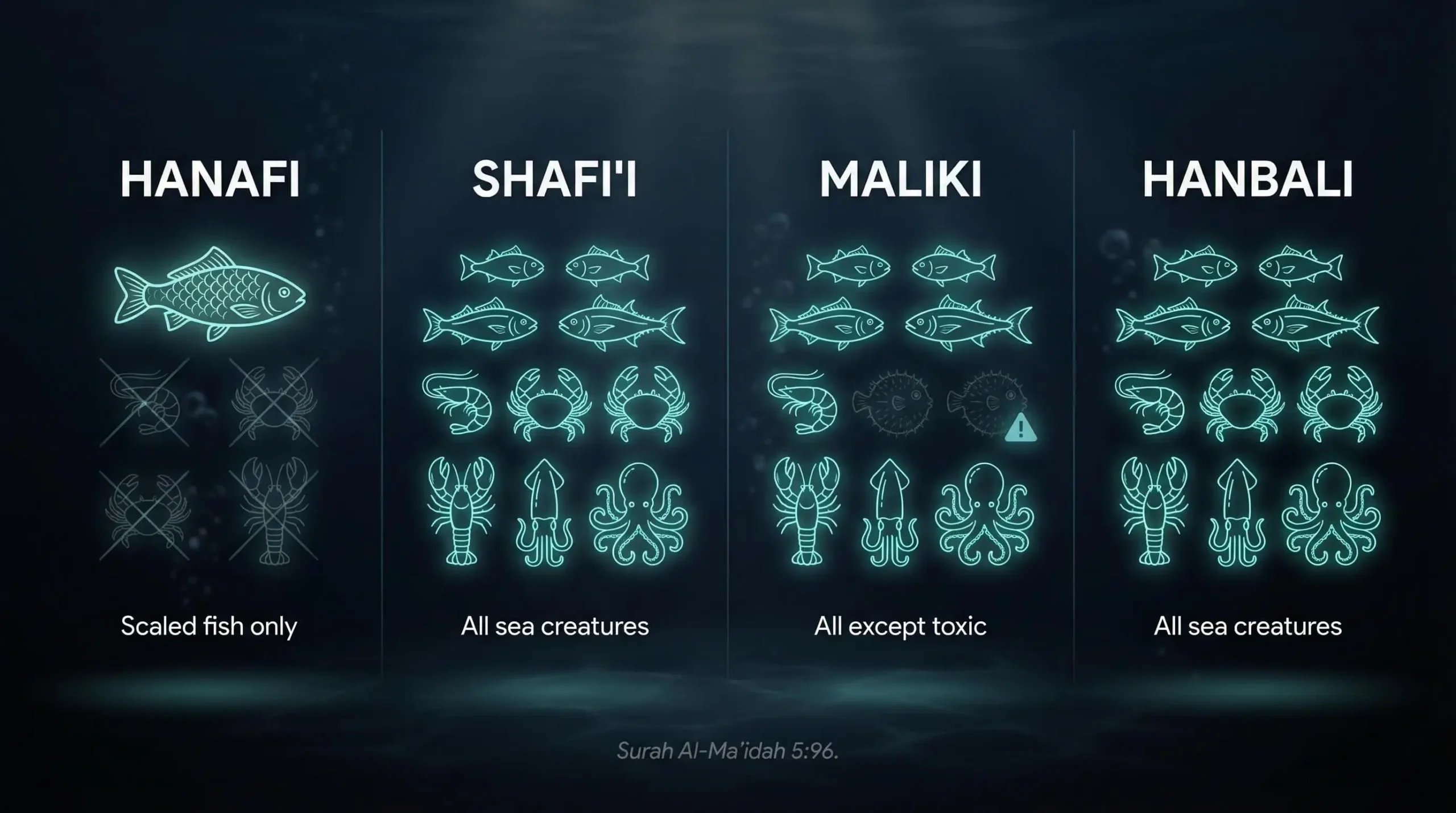
Explanation of Differences Regarding Seafood (With Evidence of Each School)
“Lawful to you is game from the sea and its food as provision for you.” (Quran, Surah Al-Ma’idah, 5:96)
The Prophet also taught that the sea water is pure and dead creatures in the sea are halal. (Sunan Abu Dawud, Hadith No. 83; Sunan al-Tirmidhi, Hadith No. 69, classified as Sahih)
Although this permission appears to be expansive, the schools are varied in its application:
| Madhab | Position on Seafood | Primary Reasoning |
|---|---|---|
| Hanafi | Halal fish only are the fish with scales; crustaceans (shrimp, crab, lobster) are considered makruh (disliked). | Qiyas (analogical reasoning) limits sea permissibility to creatures with scales and fins. |
| Shafi’i | Sea creatures are fine. | Liberal interpretation of Quran 5:96 and hadith on purity of sea. |
| Maliki | All sea animals are fine but those that are dangerous are not. | Broad reading, with an added health-based exclusion principle. |
| Hanbali | Usually, everything that is in the sea is good. | Aligned with the general evidence from Quran and Sunnah. |
What this implies on your cooking: If you follow the Hanafi school, you would consume only scaled fish in the preparation of your halal seafood dishes such as salmon, cod, tilapia and trout. In case you subscribe to one of the other three schools, you may also use shrimp, crab, lobster and other sea animals.
Meat from ‘People of the Book’ — What Every School Claims About Grocery Store Chicken
The most practical food question to Muslims in the west is can you purchase ordinary chicken in a typical grocery store?
“The food of the People of the Book is lawful for you…” (Quran, Surah Al-Ma’idah, 5:5)
The verse is clear that food — specifically the dhabihah — of Christians and Jews is permitted. The question is whether the contemporary factory slaughter is done in the right conditions:
- Hanafi scholars tend to say that Bismillah has to be said and right slaughter conditions have to be established. The majority of the Hanafi scholars prescribe attaining dhabihah meat.
- The Maliki scholars are less strict. Their attention is to the fact that the animal killer is a People of the Book without inspecting every slaughter in person.
- According to Shafi scholars, Bismillah has to be uttered. In case you would not be able to affirm this, it is advisable to be cautious, as many would say.
- According to Hanbali scholars, it is usually allowed under certain conditions. They also tell that the conditions should be checked.
This has been discussed in the Assembly of Muslim Jurists of America (AMJA) and the Fiqh Council of North America (FCNA). AMJA states that as much as possible, it is preferable to use dhabihah-certified meat, and nevertheless, permits the use of People of the Book meat in some circumstances. The FCNA has been arguing on whether chicken which is machine slaughtered is permissible and with positions varying among its members.
Practical advice: The most recommended, practiced in schools, would be to obtain dhabihah-certified meat. It verifies a useful principle mentioned in the hadith in Sahih al-Bukhari (Hadith No. 5507): the Prophet ﷺ said: Mention the Name of Allah and eat when told that some people bring meat and “we do not know whether they mentioned Allah’s name over it or not”. Both Sheikh Ibn Uthaymeen and Sheikh Ibn Baz have cited this hadith in their talks about doubtful sources of meat, though they differ on its precise application.
Understanding the schools helps you cook with confidence. But what then of the errors that the majority commit unconsciously?
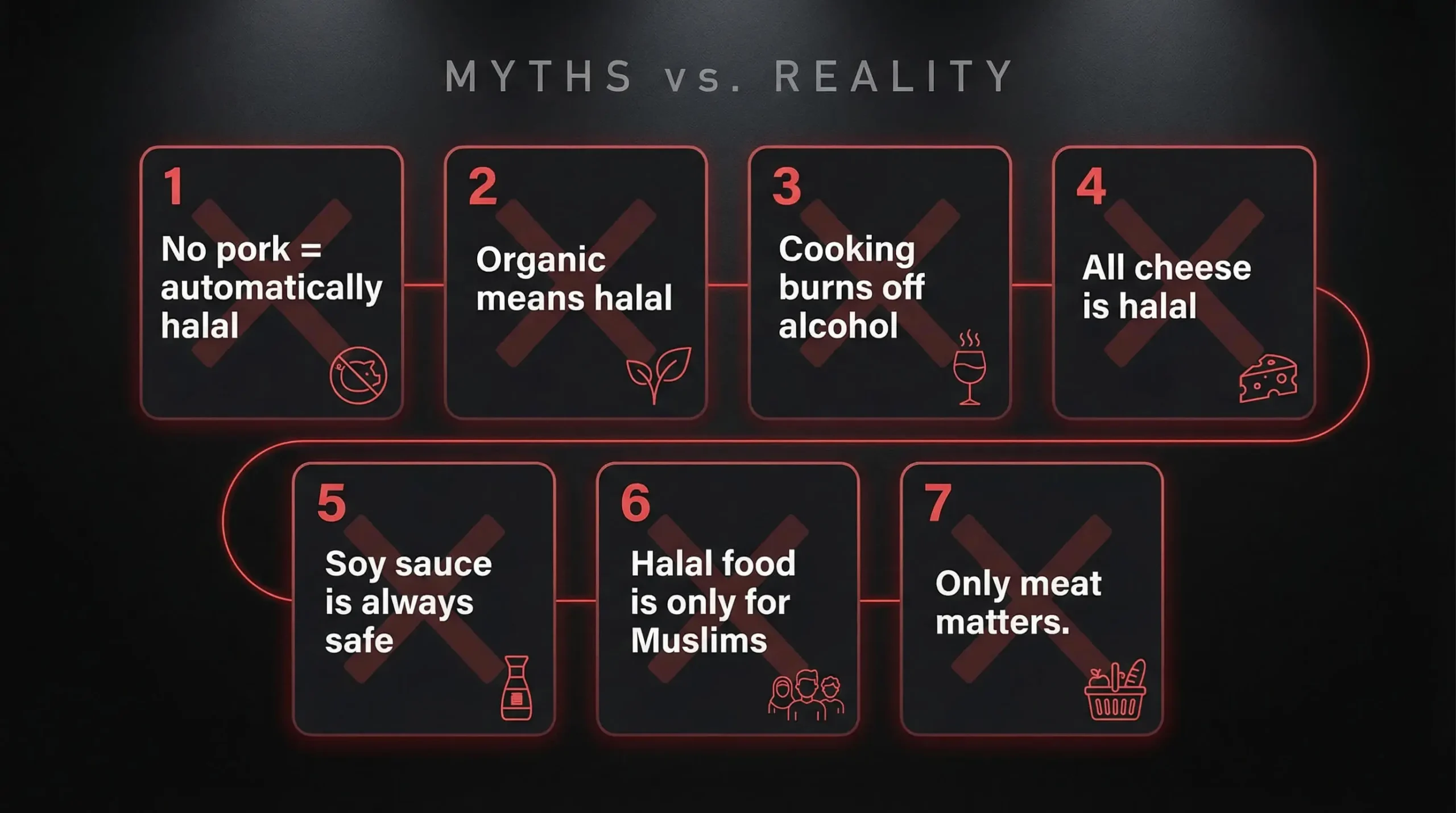
7 Halal Cooking Myths That Could Be Making Your Meals Non-Compliant (Number 5 Shocks Most People)
Misconceptions about halal food are surprisingly widespread — even among practicing Muslims. Each myth below represents a real compliance gap that could affect your kitchen.
Myth 1: “If it doesn’t contain pork, it’s halal.”
This disregards alcohol in sauces, animal enzymes in cheese that are not halal, cross-contamination on the same production line and meat that was not slaughtered as per dhabihah. Pork avoidance is necessary but far from sufficient.
Myth 2: “Organic or free-range automatically means halal.”
Organic certification addresses farming practices — not slaughter method. A free-range chicken raised without antibiotics on open pasture is still not halal if it wasn’t slaughtered with Bismillah by a qualified person.
Myth 3: “Cooking burns off alcohol, so it’s fine.”
Scholarly positions differ on this. Studies indicate that alcohol does not completely evaporate through the cooking process; hence a dish simmered for 30 minutes retains approximately 35% of its original alcohol content. The majority of scholars across all four madhahib prohibit cooking with alcohol, whether or not it evaporates. Dar al-Ifta al-Misriyyah has addressed this directly.
Myth 4: “All cheese is halal.”
A lot of cheeses are made with animal rennet, which is an enzyme harvested from the stomach lining of calves. In case the animal was not slaughtered as per dhabihah, the rennet is considered haram by the majority of scholars. Check for ‘microbial rennet’ or ‘vegetable rennet’ on the label or pick halal certified brands of cheese.
Myth 5: “Soy sauce is always halal.”
There are other brands of soy sauce that are fermented naturally to make alcohol. The amounts are negligible and some scholars believe that naturally fermented products are acceptable, whereas others do not. Halal-certified tamari or explicitly alcohol-free soy sauce removes the doubt entirely.
Myth 6: “Halal food is only for Muslims.”
The rise of halal food reflects a broader shift in consumer behavior. Halal products are being consumed by Muslim and non-Muslim audiences in increasing numbers especially in industries where hygiene, food safety and ethical issues are given priority. In the United States, halal food market will have grown to $20 billion in 2026 — driven by demand from diverse communities.
Myth 7: “You need not worry about anything other than meat.”
Hidden ingredients in sauces, condiments, baked goods, and even candy can render a meal non-halal. Gelatin in yogurt, L-cysteine in bread, confectioner glaze on chocolates and natural flavors in snacks all require questioning.
Now you know what to avoid. But what of the edge cases the cases and exceptions that scholars deal with in reality?
When the Rules Change — Islamic Exceptions Every Halal Cook Should Know (Including the Principle of Necessity)
Islamic dietary law is built on principles, not rigidity. Even the Quran has exception clauses, and scholars have developed frameworks to deal with edge cases that come up in reality.
The Darura (Necessity) Principle — When Haram Becomes Temporarily Permitted
“But whoever is forced by severe hunger with no inclination to sin, then, indeed, Allah is Forgiving and Merciful.” (Quran, Surah Al-Ma’idah, 5:3)
Extreme need under the concept of darura (necessity) can be met by eating haram food in order to sustain life, as long as it is done without desire or transgression beyond what is needed. The preservation of life supersedes dietary limitations. This exception is only applicable in cases where there is no viable alternative that can be adopted and where life is actually in danger.
The complementary weight is given in Surah Al-Ma’idah (5:87) where it says: “Do not forbid the good things Allah has made lawful for you, and do not transgress.” The principle works in both directions — do not eat what is forbidden, or do not forbid what Allah has permitted.
The Scholarly Debate on Vinegar and Gelatin
Istihalah is a term which means that a substance, by undergoing a complete chemical transformation, has turned into a new substance with different properties. The most widely known one: wine naturally changing to vinegar.
- The scholars of Hanafi, Maliki and Hanbali tend to regard vinegar that has naturally transformed from wine as being halal since the original substance no longer exists.
- Shafi’i scholars agree only if the transformation occurred naturally, without deliberate human intervention.
- The Maliki school is the most lenient, accepting both natural and deliberate transformation.
This principle has been studied by the Islamic Fiqh Academy (Jeddah) regarding gelatin used in non-halal sources of animals. The academy’s discussions acknowledge the istihalah argument but have not reached a uniform consensus so far — making gelatin of non-halal sources a controversial question. The safest practical approach remains using halal-certified bovine gelatin or plant-based alternatives like agar-agar.
Sheikh Yusuf al-Qaradawi has also penned many articles dealing with food-related fiqh, generally advocating for a balanced approach that avoids both excessive strictness and careless leniency.
Cooking in Non-Muslim Homes and Restaurants — Guidelines
Many Muslim families in the West face this question during Thanksgiving, work dinners and social gatherings. The academic advice is based on various factors:
Shared utensils: According to most scholars, it is permissible to eat the food on dishes and other utensils used by non-Muslims so long as the dishes are clean. The default assumption is purity (istishab — presumption of continuity).
Restaurant food: Order vegetarian or seafood dishes to avoid meat-sourcing uncertainty. When a restaurant claims it is selling halal meat, verify the certification rather than relying on signage alone.
Food prepared by People of the Book: According to verse 5:5 it is permitted but there is disagreement among scholars on the details. AMJA suggests the selection of clear halal options wherever feasible and good judgment where not.
These exceptions and nuances show that Islamic food law is a sophisticated, evidence-based system — not a list of arbitrary rules. The latest developments in the halal food industry are making compliance easier than ever.
The Trends Reshaping How Muslims Cook at Home
The global halal food market has grown from $1.97 trillion in 2025 to a projected $2.24 trillion in 2026, representing a 13.4% compound annual growth rate. Home cooks receive additional products, more transparent information, and easier access to verified halal ingredients.
Plant-Based Halal Products Are Exploding (32% Growth Since 2022)
Halal-certified vegan and plant-based SKUs increased by approximately 32% globally between 2022 and 2024. Vegan products are witnessing a surge in demand within the halal segment, reflecting broader dietary trends and a growing desire for ethical and sustainable food choices. It implies that halal burger patties, dairy-free cheese, and meat alternatives of vegetable origin can be found in a normal grocery store, not just specialty shops.
Halal Meal Kits and Frozen Meals — Convenience Without Compromise
Major companies are focusing on convenience-driven ready-to-eat and frozen meal solutions. In 2024, Saffron Road launched four new halal-certified, gluten-free frozen meals designed for quick preparation. Al Islami Foods introduced Original Tempura Nuggets, which is a ready-to-eat air-frying product of hand-slaughtered high-protein halal chicken.
Casa Alhambra, the largest food trade show in Dubai 2026, had Halmón, which is a cured turkey leg, inspired by centuries-old Spanish jamón traditions, designed to meet the demands of halal markets, and won the Best Meat & Poultry Product award. These innovations signal a new era where halal food competes at the highest levels of culinary creativity.

How AI and IoT Are Making Halal Certification More Transparent
AI is being used to optimize food production processes, enhance quality control, and detect contamination risks. AI-powered monitoring systems enable manufacturers to maintain strict halal compliance throughout production. IoT technologies are being implemented to monitor storage conditions, transportation environments, and supply chain logistics — ensuring halal compliance isn’t just claimed but verified at every stage of distribution.
Indonesia has announced plans to expand mandatory halal certification to include pharmaceuticals under its Halal Law with enforcement for food and beverages taking full effect by October 2026. This regulatory shift sets a global precedent that will likely influence certification standards worldwide.
…halal certification apps that let you scan product barcodes for real-time halal verification — a tool worth exploring the next time you’re standing in a grocery aisle wondering about that bottle of soy sauce.
Halal Recipes FAQ — Answered According to Islamic Evidence
1. What is a halal recipe?
It utilizes the foods permitted by the Islamic law. The slaughtering of meat should be halal, Bismillah. None of pork, blood, alcohol, and prohibited additives. Fruits, vegetables, grains and dairy are usually halal.
2. How do I know if chicken is halal?
Checks issued by reputable organizations like IFANCA, American Halal Foundation or HFA. The killing of the chicken should be done by a Muslim (or person of the Book, per some scholars) who pronounces Bismillah, using a sharp blade. It is not necessarily halal that it is organic or free-range.
3. Can I prepare the dishes of halal with ordinary store meat?
It is based on the school of thought. The Quran (5:5) permits food from the People of the Book, but scholars differ over the contemporary industrial slaughter. The most secure option is the acquisition of dhabihah-certified meat of a reputable halal provider.
4. Is seafood halal?
The Shafi’i, Maliki, and Hanbali schools declare that all sea foods are halal. The Hanafi school restricts permissibility to true fish, considering crustaceans like shrimp and crab to be makruh. Follow the guidance of your madhab.
For a detailed analysis, see our full guide on whether shrimp is halal.
5. What is the halal chicken and rice good white sauce?
The classic halal cart white sauce combines halal-certified mayonnaise, Greek yogurt, white vinegar, lemon juice, garlic, sugar, and salt. In case you are keen, then substitute all yogurt for the mayo. Avoid any mayo made with wine vinegar.
6. Are all spices halal?
Pure, single-ingredient spices (cumin, turmeric, coriander, etc.) are halal. The spice mixtures can contain additives or flavours of unknown origin. Check the label and choose brands that list only spices.
7. Shall I cook with evaporating wine?
The majority of scholars across all four madhahib consider cooking with wine haram, regardless of evaporation. Research indicates that significant alcohol content remains even after prolonged cooking. Use halal grape juice with vinegar as a substitute.
8. Is cheese halal?
Halal is cheese with microbial rennet or vegetable rennet. Most scholars consider cheese prepared using non-halal slaughter animal rennet haram. Always check the label or buy halal-certified cheese.
9. Why is halal food different to kosher food?
- Both the halal and kosher insist on special slaughtering of animals and they do not allow pork.
- Halal requires Bismillah at slaughter.
- Kosher requires a trained shochet.
- Kosher prohibits mixing meat and dairy; halal does not.
- In the case of seafood, the kosher regulations require that the fish has fins and scales, while most Islamic schools permit all sea creatures.
10. Is it possible to eat halal food by non-Muslims?
Yes. Anyone can eat halal. Halal meat is raised and slaughtered in a specific way that emphasizes animal welfare and hygiene. The growing demand for halal food from non-Muslim consumers reflects appreciation for its ethical standards.
11. What are the most perfect halal recipes to use during Ramadan iftar?
- High-protein, hydrating dishes work best. The good ones include lentil soup, chicken korma, lamb biryani, dates with yogurt and fresh salads.
- Avoid overly fried or heavy foods that can cause discomfort after a full day of fasting.
- You can pre-plan and prepare your meals ahead of time to reduce kitchen time during Ramadan.
12. What is the best way to prepare halal food throughout the week?
- Batch-cook proteins (grilled chicken, kofta, beef stir-fry) on Sunday.
- Prepare rice or grain bases in large quantities.
- Store halal sauces (white sauce, tahini, harissa) in separate containers.
- Assemble meals daily.
- Label all containers with the date and keep halal items stored separately from non-halal items if sharing a refrigerator.
Cook and Eat with Taqwa — Your Halal Kitchen Adventure Begins
Each recipe in this guide combines two things that the vast majority of guides divide — the spiritual foundations of Islamic dietary law and the practical realities of modern home cooking.
The H.A.L.A.L. Test — Harvested properly, Absent of prohibited substances, Lawfully processed, Attested by a certificate, Labeled and traceable — gives you a repeatable framework for evaluating any ingredient, any recipe, any time.
The Quran sets the main ideas. The Sunnah gives the details. The four madhahib offer nuanced application.
And the 15+ recipes above prove that cooking halal is neither restrictive nor difficult — from a 5-minute white sauce to a celebration-worthy Eid biryani.
Your next step: bookmark this guide, run the 5-Minute Halal Kitchen Audit on your pantry this weekend, and try one new recipe.
In Surah Al-Mu’minun (23:51), the Quranic instruction to eat of the good things and do righteous deeds — places your kitchen at the very center of your faith.
Every meal you prepare with intention, with verified ingredients, and with gratitude is an act of worship.
والله أعلم — And Allah knows best.