Have you ever been wondering what is happening when everyone is sleeping Zs? This is the slice of the night with its chill and the whole world just seems a little more silent, the stars have been shining, and Allah just seems to be just too near us to have ever been so near us. It is then that Muslims observe the tahajjud prayer time -and, when you know how blessed the tahajjud prayer time is, you will put an alarm on and never miss it ever again.
I recall that my uncle used to narrate to me how he began to pray Tahajjud when he was experiencing a difficult period at the workplace. This was something that caught my eye: When I began to wake up during tahajjud prayer time to speak to Allah, everything began to transform in my life. That’s the vibe of this prayer. It does not only have to do with the time you pray, it is about appearing when the others did not.
Many Muslims ask what time is tahajjud prayer – and we’ll answer that completely. And so, dissecting all you ought to know concerning Tahajjud prayer time, when you are to offer it, and why all the blessed time of the night has such a fullness of blessings.
What Is Tahajjud Prayer?
Tahajjud is an optional prayer performed by Muslims at night when they get out of sleep. Neither is it among the five daily prayers that all Muslims are required to perform. Rather, it is an additional mission, bonus round, which comes with hefty rewards in case one manages to pull it off.
Understanding Tahajjud time is crucial for every Muslim seeking closeness to Allah. Tahajjud is also known as Qiyam ul Layl (standing in the night). Tahajjud is among the most virtuous Nafl prayers (voluntary prayers) in Islam.
The Tahajjud is an Arabic word which simply refers to sacrificing sleep to pray. And then consider that a moment: you are literally leaping out of your comfortable bed at night and standing before Allah. That takes dedication. That takes love. And Allah regards this effort as such that will blow your mind.
Tahajjud also has a window at night that you can do it, unlike Fajr or Isha that has a fixed time all people are supposed to do. The fact that it is such flexibility is, in fact, a grace of Allah since not everyone can get up at the same time of the day, and the time of night varies according to the season and location.
Also Read: How to pray in Islam | Ultimate Guide
When Does Tahajjud Prayer Time Start and End?
The plain answer to this is this: The tahajjud prayer time starts after ‘Ishā’ and lasts until Fajr. Understanding the time tahajjud prayer should be performed is essential. Tahajjud usually means praying in that time after you have slept. That’s your window. It is good to wake up during the tahajjud prayer time to pray.
But here’s the twist. Although you may pray any time during that window, there is a certain tahajjud prayer time that is the BEST, the most powerful time, the most rewarding time, the most spiritually charged. And the third part of the night is that.
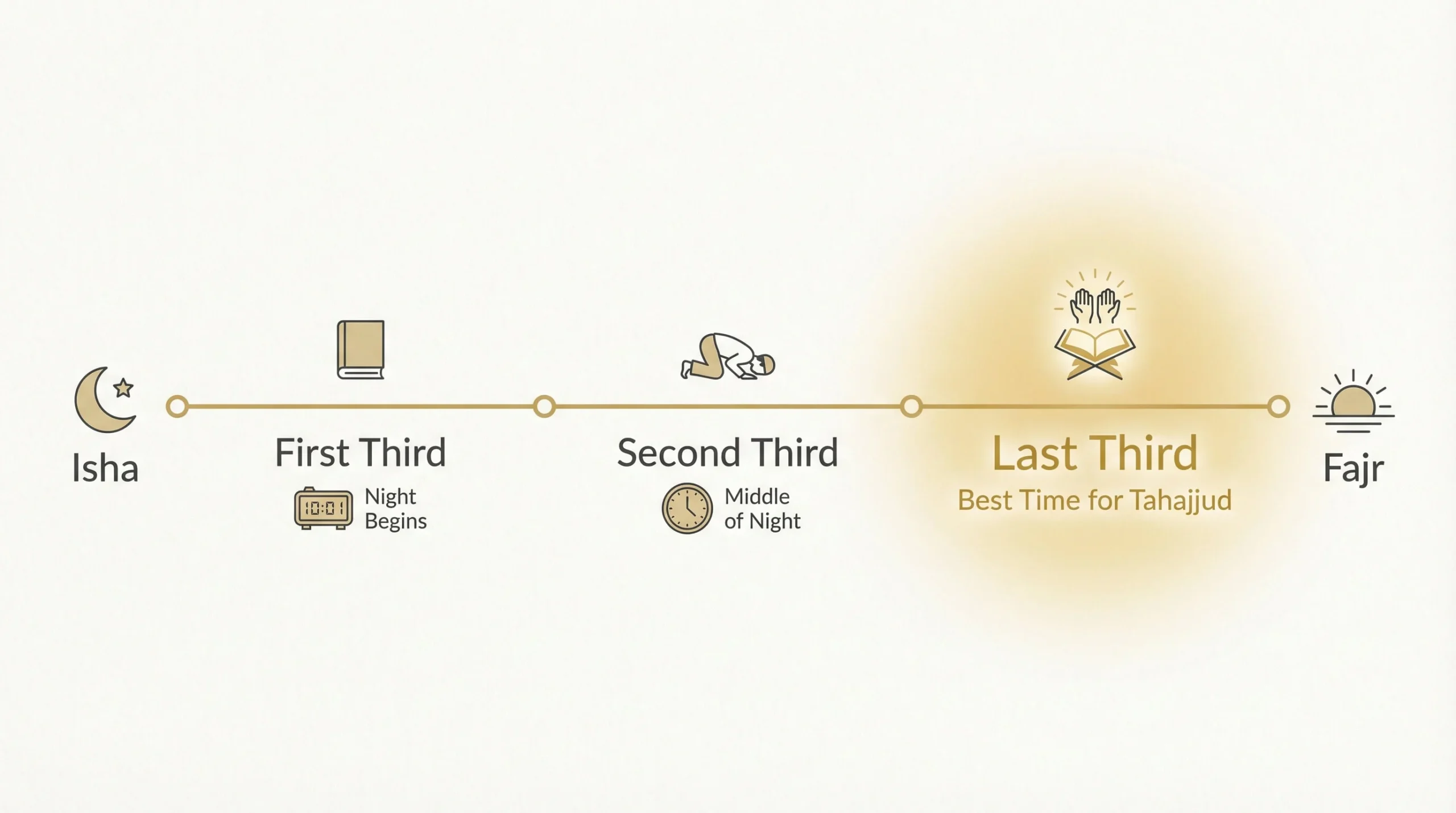
Knowing what time to pray tahajjud depends on your local Isha and Fajr times. The Tahajjud namaz time varies based on your location and season. The best time for Tahajjud is the last third of the night when Allah descends.
To determine the time the third third will fall, do a swift calculation (there is no need to worry). Divide the time between Isha and Fajr into three equal parts and the last one is the period of Tahajjud most rewarding. (Some scholars calculate the “night” from Maghrib to Fajr, but using ‘Ishā’ to Fajr is a practical way to estimate your wake-up time.). Consider the case of Isha being 7 at 00PM and Fajr being 5 at 00AM, you get 10 hours of night. Divide that by three and each one is approximately 3 hours 20 minutes. The third third would begin at about 1: 40 AM and continue until Fajr.
This Tahajjud time calculation method works anywhere in the world. This calculation tells you exactly what time to pray tahajjud prayer in your area. Always complete your Tahajjud before Fajr time begins to avoid confusion with the obligatory prayer.
What is so special about this particular time? This is the time mentioned in the hadith: Allah descends to the lowest heaven in a way that befits His Majesty.
Yeah, you read that right.
The Last Third of the Night Islam Cherishes: When Allah Descends
This is sincerely among the loveliest in Islam. The prophet Muhammad (peace be upon him) told something wonderful that occurs each and every night:
يَنْزِلُ رَبُّنَا تَبَارَكَ وَتَعَالَى كُلَّ لَيْلَةٍ إِلَى السَّمَاءِ الدُّنْيَا حِينَ يَبْقَى ثُلُثُ اللَّيْلِ الآخِرُ يَقُولُ مَنْ يَدْعُونِي فَأَسْتَجِيبَ لَهُ مَنْ يَسْأَلُنِي فَأُعْطِيَهُ مَنْ يَسْتَغْفِرُنِي فَأُغْفِرَ لَهُ
“Our Lord, the Blessed and Exalted, descends each night to the lowest heaven when the last third of the night remains and says: “Who is calling upon Me so I may answer him? Who is asking Me so I may give him? Who is seeking My forgiveness so I may forgive him?” (Sahih Al-Bukhari and Sahih Muslim)
This hadith answers when to pray Tahajjud – during the last third of the night.
Read that again, slowly. One night, not two, not once in a while, not some nights, but EVERY night Allah asks us to ask him whatever we desire. He is more or less asking, Who needs anything? And most of us? We are lying here in bed, and we are missing a great opportunity, night after night.

The moment when I gained a real understanding of this hadith turned my entire perception of those evening moments. That two in the morning wakeup is not only early but it is a place with the King of kings. Who would skip that?
The Rewards of Tahajjud: What the Quran Says
Allah did not simply drop Tahajjud in some hadiths. He discusses it in the Quran and he urges us to take advantage of this blessed period.
وَمِنَ اللَّيْلِ فَتَهَجَّدْ بِهِ نَافِلَةً لَّكَ عَسَىٰ أَن يَبْعَثَكَ رَبُّكَ مَقَامًا مَّحْمُودًا
And during part of the night, pray with it as an additional prayer for you; your Lord may raise you to a praised station.
(Surah Al-Isra, 17:79)
This verse was addressed to Prophet Muhammad (peace be upon him) though scholars argue that it is addressed to all the believers as well. This is the highest rank, the lauded station (Maqam Mahmud) everyone will compliment the one who attains it. And one route to get there? Waking up at night to pray.
Allah also explains those exceptional individuals that leave their beds and worship him:
تَتَجَافَىٰ جُنُوبُهُمْ عَنِ الْمَضَاجِعِ يَدْعُونَ رَبَّهُمْ خَوْفًا وَطَمَعًا وَمِمَّا رَزَقْنَاهُمْ يُنفِقُونَ
They leave their beds to call on their Lord in fear and hope, and they spend from what We have provided them.
(Surah As-Sajdah, 32:16)
Their sides abandon their beds–what a graphic phrase to use of one who prefers prayer to sleep. Their bodies literally get out of the comfort of bed to stand in front of Allah. This is what Allah commends in this verse as a believer.
The time of prayers varies according to the city in which a person is in, and so does the Tahajjud window. Here is a fast method of knowing precisely when to pray in your neighborhood.
Begin by seeing what time Isha settles and Fajr sets in your town. Get a good prayer application or web site and record the times. To illustrate, when the Isha is at 8.30 PM and the Fajr kicks in at 5.30 AM, it will be a good nine-hour night.
All you need to do in case you want the best place the last third of the night is simply to divide those nine hours by three. Each slice is three hours. Subtract three hours of Fajr: 5:30am -3=2:30am. Your ideal tahajjud prayer time would be about 2:30 AM until Fajr begins (leave a few minutes so you don’t accidentally pray into Fajr time).
But all the same, can you not make it round that good window, when you cannot get up, pray Tahajjud right after Isha– that will do. There is no need to bother about the perfect slot. Some people only end up doing some rakahs before going to sleep as an emergency in case they are too exhausted in the future. That’s a smart move.
The duration of nights varies according to the seasons. During the winter the darkness is much more extensive, and you have more space; during the summer it becomes shorter, and the window of the Tahajjud is crowded. Look at what is going on at your local and adjust your plan.
Also Read: Quran Verses About Patience | A Guide Everyone Can Understand
What Is So Special about Tahajjud Prayer Time?
Imagine this: while others pray during daytime, the tahajjud prayer time is different– that is easy, the mosque is open, and they are going, and you are among them. But during tahajjud prayer time? You have it alone in the dark, where your bed calls to you, and nobody knows whether you miss it.
And that is the reason why it is such a big deal.
The Prophet (peace be upon him), informed us of the importance of this prayer:
عَلَيْكُمْ بِقِيَامِ اللَّيْلِ فَإِنَّهُ دَأَبُ الصَّالِحِينَ قَبْلَكُمْ وَهُوَ قُرْبَةٌ إِلَى رَبِّكُمْ وَمَكْفَرَةٌ لِلسَّيِّئَاتِ وَمَنْهَاةٌ لِلإِثْمِ
You should pray Qiyām al‑Layl (night prayer), because it was the habit of the righteous before you. It brings you closer to your Lord, wipes away sins, and helps prevent sin.
(Reported from Abu Umāmah — Jami` at‑Tirmidhi; also recorded in Mishkāt al‑Maṣābīḥ 1227)
Qiyam ul Layl time and Tahajjud time refer to the same blessed night hours. This night prayer time is the most blessed period for worship.
Did you catch all that? Four things are packed into such a one hadith, which it is a habit of the righteous, which brings you closer to Allah, which cleanses your sins, and which protects you against bad things. And all those four rewards as a result of that one action, pretty awesome.
The earnestness factor is enormous as well. When you commit Tahajjud no one is watching but you and Allah. That pure intention is that which Allah loves and it is far more difficult to tear it off during the day when everyone can see.
Closeness to Allah: The Best Voluntary Prayer
Muhammad (peace be upon him) made it very clear that Tahajjud is on the top of the voluntary prayers list:
أَفْضَلُ الصَّلَاةِ بَعْدَ الْفَرِيضَةِ صَلَاةُ اللَّيْلِ
“The best prayer after the obligatory prayer is the night prayer.”
(Sahih Muslim 1163)
The BEST – there is neither second nor pretty good, there is only the BEST. When you want to add additional prayers and do not know where to begin, this hadith will make you know: kick it off with the night prayer.
I even compare deciding between the option of praying more after Dhuhr or simply to alarm myself at Tahajjud. The Prophet states that one is better but both are good. It does not imply abandoning daytime prayers, I only meant that you know which ones are worth doing in case you need to choose.
Tahajjud Prayer Benefits: Wonderful Results of Night Prayer
Tahajjud has far more rewards beyond the spiritual. Tahajjud is a path to Jannah (Paradise) as mentioned by the Prophet (ﷺ). They are involved in all aspects of your life in a manner that you may not be aware of.
Spiritual Purification and Peace of Mind
When you wake for tahajjud prayer time, everything is different. The silence of the world, your thoughts are clear and it is only you, darkness, and Your Creator. There is that peace that lies in your heart which you can never describe. After persevering with tahajjud prayer time, those who persevere attest that they feel less anxious, calmer, and content with whatever is happening.
Consider it–if already you have discussed the Owner of the universe after half past 3 in the morning, then a work-meeting? Not that scary, right? That exam? Not that intense either when you bear in mind that you are in the presence of the One who runs everything. That puts the day to day concerns into perspective.
Forgiveness and Expiation of Sins
We are all getting it wrong all the time, big or small. The best fact about tahajjud prayer time is that forgiveness is built into it. And the last third of the night asks Allah mercy, he hears that, and pardons. This previous hadith even indicates Allah inquiring, Who is seeking my forgiveness that I may forgive. That is not the same atmosphere as day prayers. The fact that it is really hard to get up, makes those moments of repentance even stronger.
There comes a time every night when you can have anything you want–as long as it is good to you. Tahajjud is that chance.
Making Dua During Tahajjud
The Tahajjud dua made during the last third of the night holds special significance. As the hadith mentions, Allah asks ‘Who is calling upon Me so I may answer him?’ This is the perfect time to pour out your heart, ask for your needs, and seek forgiveness. Many Muslims keep a list of duas they want to make during this blessed tahajjud prayer time.
Character Development: Protection from Sin
What is interesting here is that the Prophet (ﷺ) demonstrates to us that the night time prayer makes you more unlikely to sin the next day. It’s like a spiritual shield. When you begin your day having prayed during tahajjud prayer time, that feeling lingers. You will not backbite, lie, cheat, or do anything that will not conform to what you just prayed.

I have completely observed that myself. After observing tahajjud prayer time, I have become more conscious of what I do. I do not want to ruin all that good the night gave me by getting it all messed up in the day. The prayer somewhat insulates you against yourself.
What Happens When You Sleep Through the Night Prayer
There is a hadith that gives a very clear image of what occurs when we miss the night prayer and continue with sleeping, namely:
يَعْقِدُ الشَّيْطَانُ عَلَى قَافِيَةِ رَأْسِ أَحَدِكُمْ إِذَا هُوَ نَامَ ثَلاَثَ عُقَدٍ يَضْرِبُ كُلَّ عُقْدَةٍ عَلَيْكَ لَيْلٌ طَوِيلٌ فَارْقُدْ فَإِنِ اسْتَيْقَظَ فَذَكَرَ اللَّهَ انْحَلَّتْ عُقْدَةٌ فَإِنْ تَوَضَّأَ انْحَلَّتْ عُقْدَةٌ فَإِنْ صَلَّى انْحَلَّتْ عُقْدَةٌ فَأَصْبَحَ نَشِيطًا طَيِّبَ النَّفْسِ وَإِلَّا أَصْبَحَ خَبِيثَ النَّفْسِ كَسْلاَن
When one of you sleeps, Shaytan ties three knots at the back of your head. On each knot he reads and breathes the words that follow: ‘The night is long, so sleep. One knot is unbound when one wakes up and remembers Allah, and a second is unbound when one is performing ablution and a third when one is praying, and one arises vigorous with a good heart in the morning otherwise one arises lazy and with a mischievous heart. (Sahih Al-Bukhari)
This is the explanation of so much, is it? Why we lack the weight and the sluggishness of some mornings and lack the lightness and the blessing of others. It is simply the distinction between loosening of those three knots by the recollection of Allah, wudu and prayer or by leaving these knots untied overnight.
How Many Rakahs in Tahajjud: Flexibility in Night Prayer
Another good thing about Tahajjud is that it is highly malleable. And there is no established amount of rakahs to do. The Prophet (ﷺ) made variations of it, so that sometimes it was 8 sometimes 11 with Witr, sometimes more or less.
The only minimum is 2 rakahs. That’s it. Not any more than that, is alright. Start with that. You can add more as you get accustomed to waking up and also as you start adoring the night prayer.
The night prayer is prayed two by two (two rak’ahs, then salām, then two more if you want).
(Sahih al‑Bukhari 990; Sahih Muslim 749)
You perform 2 rakah, give salam and repeat it again 2 times. This is based on the hadith in which Prophet (ﷺ) stated that the night prayer is two by two. Some folks do 2, some do 8, some do 12. Find what fits and can stick.
Ensuring consistency is more significant than quantity. The Prophet (ﷺ) loved good acts, which were always consistent and even minute. So it is better to do 2 rakahs per night during a year than 12 rakahs once and never get up again.
How to Wake Up for Tahajjud Prayer Time: Practical Tips
Alright, let’s be real. It is one thing to know what Tahajjud regards as perks. It is another thing to actually drag yourself out of bed at 2 AM. The following are some of the tips that will work.
Form a Powerful Determination to Sleep.
It is a good idea to make it your intention before sleep to wake up for tahajjud prayer time. Say to yourself, Ya Allah help me to wake up to-night and pray to You. Now that true thinking is sometimes super potent I tell you it is true that some folks say they get up without an alarm. But don’t get very optimistic about it; put on an alarm.
Set Multiple Alarms
One alarm isn’t enough. Uninterrupted in pairs or in threes, separated by 5 minutes. Give your phone to the other side of the room where you have to stand and switch it off. Before you know it you are out of bed–do wudu.
Sleep Earlier
Simple maths: you have 7-8 hours of sleep to fall asleep and you want to wake up at 3.AM, you have to fall asleep at 7 or 8.PM. I understand it, Netflix binge-es and scroll-until-late-nights are the moods. But the next episode is not as important as your Tahajjud. Create a school schedule concerning sleep.
Start Small and Build Up
Do not attempt 3 Am at once, if you have never done Tahajjud. Beginning with waking 30min before Fajr. Do 2 quick rakahs. Familiarize oneself with the darkness, the wudu with yawning. As soon as that is a matter of course, move the clock a step backwards.
Get Somebody to Hold You Accountable
Identify a friend or a member of the family who equally desires Tahajjud. Send text messages to one another when one wakes up. It gives one the energy to know that there is one more person awake, and you are not going to be the one who is sleeping as they pray.
Avoid Heavy Meals Before Bed
This is solid life hack. Full belly translates to digesting first thus leaving you even sleepier. Take a light meal and you will feel lighter in getting up early in the morning.
Common Misconceptions About Tahajjud Prayer Time
There are a few needless misunderstandings that people have.
Other people believe that you must sleep before Tahajjud praying. Although technically, Tahajjud is defined as the prayer performed after sleep, scholars disagree on whether or not one must be asleep first or simply recommended. Sleep first would be the safest, but where you cannot stomach the thought, and where you are sure to wake up, it will still be considered as night prayers and then sleep. You can pray Tahajjud after Isha even before sleeping, though sleeping first is preferred.
There are even people who have to believe that Tahajjud must occur at a very specific time. That’s not true. The entire window between Isha and Fajr works. The latter is the finest, but it is an open night.
Others fear that not to take the third part of the prayer the entire prayer is useless. That’s wrong. A bit of Tahajjud beats none. Perfectionism is a thing that should not destroy the mood.
Tahajjud Prayer Time in Different Seasons
This is an interesting fact that most people do not discuss. Depending on your location and the time of the year, time you can do Tahajjud turns into a big deal.
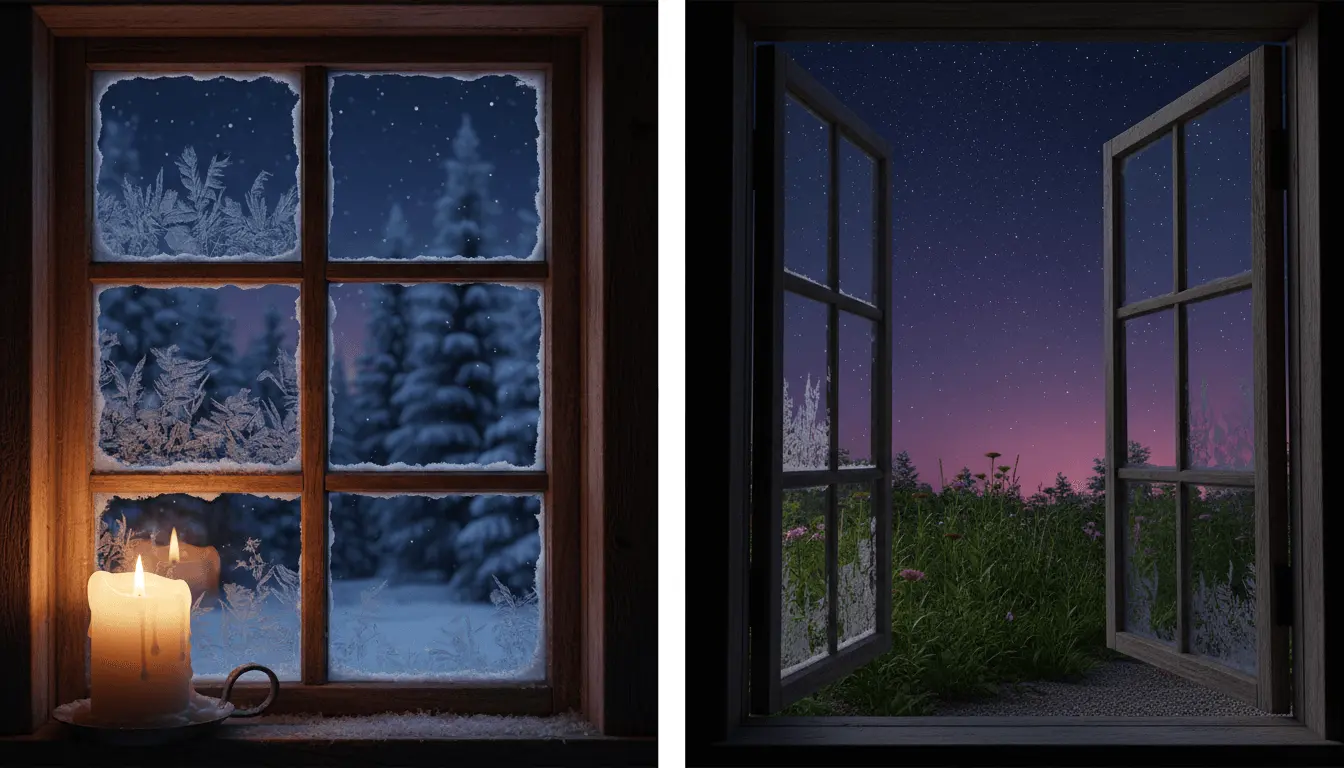
Night in some places stretches 12 -14 hours in winter, and you have all the space you want to pray, and the third one may be monumental. During summer, the time spent in the night is reduced to 5-6 at a few points; your window is minimized and the final third is perhaps only an hour-and-a-half or two.
It is true natural swing is a mercy. You are already sleep deprived in summer since it is short-lived and hot during the night. During the winter when the nights are so long and so cold, you have more time on your hand, yet you still require more zzz. Allah nailed it.
A Path to Paradise: Those Who Stand at Night
In Muslim history, many righteous scholars were known for praying at night regularly. Some reports mention extremely high numbers of voluntary prayers for certain scholars, but the main lesson is simple: they took the quiet of the night seriously, and they kept showing up.
By continuing it on account of Tahajjud, you are putting yourself in-between a procession of righteous persons that stretches 1,400 years back to the companions of the Prophet. You are following footsteps of what they followed. Such a time-travel connection is very epic when you are alone in your room at 3 am.
Must Watch: This Is Why You Should Pray TAHAJJUD | BY Mufti Menk
Nawafil Prayer Times: Beyond Tahajjud
While tahajjud prayer time is the most rewarding, Islam encourages other Nafl prayers throughout the day. These include Ishraq prayer (prayed after sunrise), Chasht or Dhuha prayer (mid-morning), and Awwabin prayer (after Maghrib). However, the Prophet (ﷺ) made clear that night prayer time remains the best voluntary prayer after the obligatory ones.
Make Tahajjud a Habit: Consistency Over Intensity
And that is all: tahajjud prayer time is not a one-time phenomenon when life gets rough, or when you are desperate. It is supposed to be an ordinary thing with Allah.
The Prophet told Abdullah ibn Amr that he had been a good man but he would have preferred to have done Tahajjud. Being even called good would not be enough, Tahajjud would enhance it. Abdullah (may Allah please him) then made sure he never missed it.
Start tonight. Just do it once. Feel how it goes. Feel the night’s calm. Attempt to sacrifice sleep to The One who provided you with everything. You will, I vow, as soon as you experience tahajjud prayer time, you’ll wonder why you ever skipped it.
May Allah be blessed in what He blesses us to remain awake at night, to get out of bed and call to Him. May his blessing be upon our prayers and may He forgive our sins. Ameen.