Why Your Mosque, Calendar, and App Show Different Dates
Every year, millions of Muslims face the same frustrating puzzle. Your Pakistani calendar shows Eid on Tuesday. The local mosque announces Wednesday. IslamicFinder shows Monday. Three different answers. Three trusted sources. One simple question: which Gregorian date is actually correct?
This is not a software bug, a printing error, or a community mistake. It is the natural and predictable consequence of how the Islamic calendar works — and how three fundamentally different conversion methods produce three legitimate sets of dates.
This guide covers hijri to gregorian date conversion in full — not as a math exercise, but as a matter grounded in the Quran, the Sunnah, and the jurisprudence of all four major schools of Islamic law. By the end, you will know which conversion method your madhab authorizes, how to perform accurate day-month-year conversions, and why different Muslim countries can legitimately observe different dates without anyone being wrong.
IslamHub Editorial Note: IslamHub presents all scholarly views without making independent rulings. All positions are attributed to named scholars and institutions. Readers are encouraged to consult a qualified Islamic scholar for personal rulings.
Quick Conversion Summary: Three Methods Compared
Before diving into fiqh and formulas, here is the decision table every Muslim needs. If you only remember one thing from this guide, let it be this:
| Method | Basis | Best For | Religious Validity |
| Tabular (Arithmetic) | Fixed 30-year cycle | Civil documents, software | Not accepted for religious use |
| Umm al-Qura | Astronomical conjunction at Mecca | Saudi civil calendar, ECFR | Civil only; overridden by sighting for Ramadan/Eid |
| Observational (Ru’yah) | Physical crescent sighting | Ramadan, Eid, Hajj dates | Accepted across all 4 classical madhabs |
For religious purposes — fasting, Hajj, Eid, and vow deadlines — the observational method (ru’yah al-hilal) is the only method accepted across all four classical madhabs. For legal documents, software, and civil administration, the tabular or Umm al-Qura methods provide the standardized dates authorities require.
What Is the Hijri Calendar?
The word Hijri derives from the Arabic root h-j-r (hijra), meaning migration — specifically, the Prophet Muhammad’s migration from Mecca to Medina in 622 CE. This event became the epoch of the Islamic calendar, marking the moment the Muslim community established its independent existence as a polity under divine guidance.
The calendar itself was instituted by Caliph Umar ibn al-Khattab (RA), approximately 17 AH (~638 CE), after a formal consultative council (shura) of senior Companions. They selected the Hijra as the foundational epoch because it represented the Muslim community’s collective and independent existence, distinguishing the era before Islam’s consolidation from the era after it.
The universally accepted anchor point across all four madhabs is that 1 Muharram 1 AH corresponds to July 16, 622 CE (Julian calendar). This starting coordinate is the basis of every valid Hijri-to-Gregorian conversion.
The Hijri calendar is purely lunar (al-taqwim al-qamari), consisting of 12 months beginning with the confirmed sighting of the new crescent moon (hilal). A Hijri year contains 354 days (in 19 of every 30 years) or 355 days (in 11 of every 30 years — the Islamic leap year or kabisah). The 30-year repeating cycle forms the mathematical foundation of the tabular Islamic calendar.
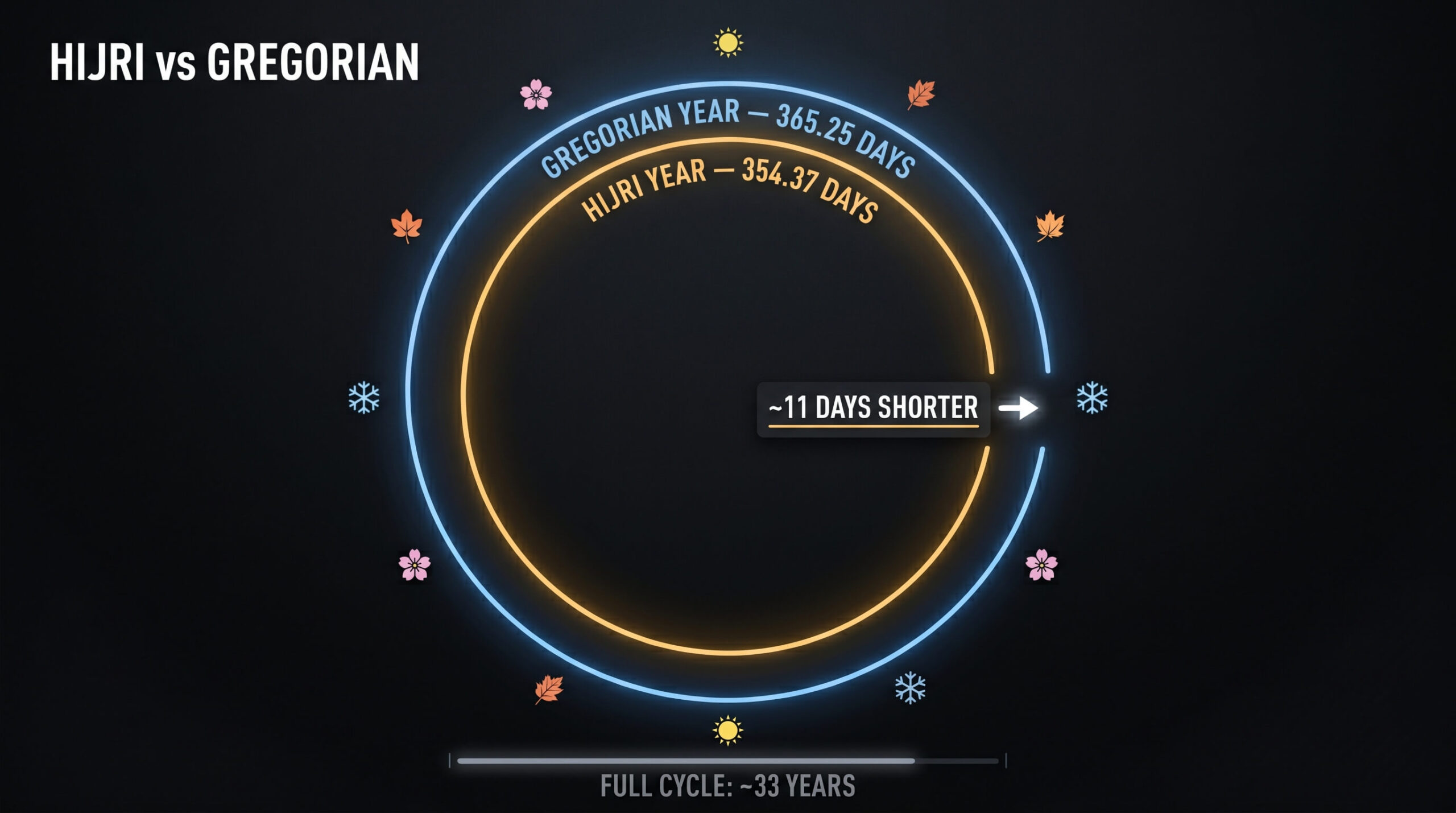
Because a Hijri year (~354.367 days) is shorter than a Gregorian year (365.2425 days), there is an annual deficit of approximately 10.875 days. This means the Hijri calendar rotates fully through all Gregorian seasons over approximately 33 years — not a flaw, but the inherent nature of a divinely ordained lunar calendar.
How to Convert Hijri to Gregorian Date Step by Step
When you open an online Hijri-to-Gregorian date converter, it is using one of three fundamentally different methodologies. The results can differ by up to two days. Understanding which method your converter uses is essential for anyone using date conversion for religious purposes.
Method 1: The Tabular (Arithmetic) Calendar
The tabular Islamic calendar is based on a fixed 30-year mathematical cycle. In this cycle, 11 years are leap years (kabisah) of 355 days and 19 are regular years of 354 days. Month lengths alternate between 29 and 30 days in a fixed, pre-determined pattern.
Advantage: precision and consistency. Given any Hijri date, its Gregorian equivalent can be computed instantly and unambiguously, centuries into the past or future. No astronomical observation is required.
Religious limitation: the tabular calendar is entirely disconnected from actual lunar observation. Because Islamic months begin with the physical sighting of the crescent (hilal) — accepted across all four madhabs — the tabular calendar is not accepted by any classical school as a determinative method for religious obligations. It may produce dates that differ from actually-observed Islamic months by plus or minus 1-2 days.
Best use cases: civil and legal documents, academic historical research, software implementations, calendar printing.
Method 2: The Umm al-Qura Calendar (Saudi Arabia’s Official System)
The Umm al-Qura calendar is Saudi Arabia’s official civil calendar, used for government administration, public holidays, and civil record-keeping. It is based on astronomical conjunction calculations, specifically two criteria: (1) lunar conjunction must occur before Mecca’s sunset, and (2) the moon must set after the sun on that evening in Mecca.
This means Umm al-Qura is a calculated calendar, not an observational one. This is precisely why its pre-printed date for Ramadan, Eid al-Fitr, or Dhu al-Hijjah sometimes differs by one day from the actual Saudi government announcement: for these three religiously critical months, Saudi Arabia maintains its commitment to physical moon sighting (ru’yah al-hilal), which may override the pre-calculated date.
The European Council for Fatwa and Research (ECFR) has adopted a methodology aligned with Umm al-Qura parameters for Muslim communities in Europe.
Best use cases: civil administration in Saudi Arabia, ECFR-aligned community guidance, standardized international reference.
Method 3: The Observational Calendar (Ru’yah-Based)
The observational calendar — grounded in ru’yah al-hilal — is the method all four classical madhabs accept as Islamically authoritative. The month begins when the crescent moon is physically sighted by qualified witnesses, with rules for witness number and geographical scope varying by madhab.
This method produces dates that may not be known more than 1-2 days in advance, may vary by region and atmospheric conditions, and cannot be pre-printed with certainty. Its religious validity, however, is uncontested across classical scholarship.
Best use cases: determining Ramadan, Eid, and Hajj dates; all religious obligations tied to the lunar month.
Method Comparison Table
| Feature | Tabular | Umm al-Qura | Observational |
| Basis | Fixed arithmetic cycle | Astronomical conjunction at Mecca | Physical crescent sighting |
| Scholarly Acceptance | Civil use only | Civil use; debated for religious use | Accepted by all 4 madhabs |
| Accuracy | Exact mathematically | Exact astronomically | Depends on visibility + witnesses |
| Predictability | Known centuries in advance | Known years in advance | Confirmed 0-2 days before |
| Regional Variation | None | None | Yes (ikhtilaf al-matali’) |
| Best Use Case | Passports, legal docs, software | Saudi civil admin, ECFR guidance | Ramadan, Eid, Hajj, all worship |
Step-by-Step Conversion Guide
Two levels of accuracy are available: a year-level approximation for quick estimates, and the Julian Day Number (JDN) algorithm for precise day-month-year conversion.
The Approximation Formula (Quick Year-Level Estimate)
Hijri Year to Gregorian Year (approximate):
Gregorian = (Hijri Year x 0.97) + 622
Gregorian Year to Hijri Year (approximate):
Hijri = (Gregorian Year – 622) x 1.03
Worked Example: To find the approximate Gregorian year for 1447 AH:
- 1447 x 0.97 = 1403.59
- 1403.59 + 622 = 2025.59 = 2025-2026 CE
This confirms that Hijri year 1447 falls across 2025-2026 CE. However, this formula is accurate only to within plus or minus 1-2 years and cannot determine the correct month or day.
The Julian Day Number (JDN) Method — Precise Conversion
The JDN is a continuous count of days from January 1, 4713 BCE (Julian calendar), used in astronomy and precise calendar conversion. It serves as a universal bridge between any two calendar systems.
Formula: JDN = int((11H + 3) / 30) + 354H + 30M – int((M – 1) / 2) + D + 1948440 – 385
Where H = Hijri year, M = Hijri month (1-12), D = day.
Worked Examples: Birth Dates, Ramadan, and Historical Events
Example 1: Converting 17 Ramadan 2 AH (Battle of Badr)
Step 1: Identify H = 2, M = 9 (Ramadan), D = 17.
Step 2: Apply the formula:
= int((22 + 3) / 30) + 708 + 270 – int(8/2) + 17 + 1948440 – 385
= 0 + 708 + 270 – 4 + 17 + 1948440 – 385 = JDN 1,949,046
Step 3: Convert JDN to calendar date = 13 March 624 CE (Julian calendar).
Critical note: For any date before 15 October 1582 CE (when the Gregorian calendar was adopted), the result is expressed in the Julian calendar, not the Gregorian. The proleptic Gregorian equivalent differs due to accumulated day-offset between the two systems.
Example 2: Converting a Hijri Birth Date for Legal Documents
Date: 15 Sha’ban 1400 AH. Using tabular conversion via a verified tool:
Result: approximately 28 June 1980 CE (tabular method).
For legal authorities, note the conversion method used: per tabular Islamic calendar. This ensures transparency and allows independent verification.
Example 3: Finding the Gregorian Date for Ramadan 2026
Ramadan 1447 AH is expected to begin approximately 18 February 2026 CE (Umm al-Qura/Tabular estimate). However, the actual observed date may differ by 1-2 days depending on moon sighting confirmation in your region. Always await your local mosque announcement.
Note: Ramadan 2027 dates will be updated soon.
Example 4: Converting Today’s Date
As of May 2026, the approximate Hijri date is mid-Shawwal 1447 AH. For an exact conversion, use a verified JDN-based tool such as islamicfinder.org or the dralshehri/hijridate Python library.
Example 5: The Islamic New Year (1 Muharram)
1 Muharram 1447 AH corresponded to approximately 7 July 2025 CE (Umm al-Qura). 1 Muharram 1448 AH will correspond to approximately 26 June 2026 CE.
Madhab Rulings on Moon Sighting and Date Conversion
The Hijri calendar is not a single uniform system. Across the four major schools of Islamic jurisprudence, there are substantive differences in witness requirements for moon sighting, the validity of sightings from distant lands (ikhtilaf al-matali’), and the permissibility of astronomical calculation (hisab). These differences are not errors — they are the product of legitimate scholarly ijtihad within each school’s tradition.

Summary: The Four Madhabs on Moon Sighting
| Fiqh Dimension | Hanafi | Maliki | Shafi’i | Hanbali |
| Witnesses (clear sky) | Large number (istifadah) | Two trustworthy | One trustworthy | Two (Shawwal); one (Ramadan) |
| Witnesses (cloudy) | One sufficient | Two still required | One sufficient | Same as clear sky |
| Local vs Global | Global (ittihad) | Global for confirmed | Local only (~116 km) | Global (entire Ummah) |
| Role of Hisab | Rejected | Rejected | Minority pro-hisab | Rejected |
| Bukhari 1906 “estimate” | Complete 30 days | Complete 30 days | Some: use calculation | Complete 30 days |
The Hanafi Position
According to Hanafi scholars, the Hijri month begins when the crescent moon (hilal) is reliably sighted and reported. In clear weather, the sighting requires a large number of witnesses (istifadah) — because clear skies afford widespread opportunity for observation, meaning that a single or very small number of reports becomes suspicious. In overcast conditions, one trustworthy (adl) Muslim witness is sufficient.
The Hanafi school holds ittihad al-matali’ — unity of horizons — meaning that once the crescent is confirmed sighted anywhere on Earth, the new month begins for the entire Ummah. Ahmad ibn Muhammad al-Hamawi stated: For us, the condition for fast and breaking fast is sighting; calculations of stargazers cannot be followed. Contemporary Hanafi-aligned institutions in South Asia generally follow governmental or community moon-sighting committees.
The Maliki Position
The Maliki school requires two trustworthy Muslim witnesses (adl) to confirm crescent sighting under normal circumstances. This requirement is maintained stringently even in cloudy conditions, making the Maliki position one of the most demanding on witness testimony.
Imam Malik (d. 795 CE) stated in Al-Muwatta that if an imam were to follow astronomical calculations (hisab) over physical moon sighting, he would not be obeyed in the prayers he leads. Imam al-Qarrafi (d. 1285 CE) articulated that the entire Muslim world must commence fasting if a sighting is reliably confirmed from any location, provided it meets the two-witness standard.
The Shafi’i Position
The classical Shafi’i position, articulated by Imam al-Nawawi (d. 1277 CE) in Rawdat al-Talibeen (2/384), holds that each locality has its own moon sighting: distant countries are not bound by another country’s confirmed sighting when the observable horizon differs significantly — approximately 116 km is the threshold An-Nawawi identifies. This is the doctrine of ikhtilaf al-matali’ (difference of horizons), grounded directly in the Kuraib hadith (Sahih Muslim, No. 1087).
The Shafi’i school also houses the earliest minority pro-hisab tradition. Abu al-Abbas ibn Surayj (d. 918 CE) was the first scholar of any madhab to argue that fa-qdiru lahu in Bukhari 1906 means astronomical calculation. Taqi al-Din al-Subki (d. 1355 CE) upheld this position. However, the classical Shafi’i majority rejected astronomical calculation as the sole determinant.
The Hanbali Position
The Hanbali school holds global moon sighting with differentiated witness requirements. For Ramadan, one trustworthy witness is sufficient. For Shawwal (Eid al-Fitr), two witnesses are required. Once the crescent is confirmed sighted anywhere in the world, fasting becomes obligatory for the entire Ummah (ittihad al-matali’).
Ibn Qudamah (d. 1223 CE) states in Al-Mughni (3/107): If the new moon was sighted by the people of a country, then it is binding on other countries. This is arguably the most expansive position on global sighting unity across the four schools. Astronomical calculation is rejected as a determinative method.
Why This Matters for Date Conversion
Your madhab’s position on moon sighting directly determines which conversion method applies to your religious practice. A Hanafi or Hanbali Muslim may accept a globally confirmed sighting and convert accordingly. A Shafi’i Muslim following ikhtilaf al-matali’ would follow their local sighting, which may produce a different converted date. Neither is wrong — both are following legitimate scholarly positions grounded in primary sources.
The Quranic Mandate for the Lunar Calendar
The lunar calendar is not merely a cultural convention — it is Islamically mandated through explicit Quranic verses. This dimension is entirely absent from competitor content, yet it is the single most important factor for understanding why the Hijri calendar functions as it does.
Verse 1 — Al-Baqarah (2:189)
Arabic: يَسْأَلُونَكَ عَنِ الْأَهِلَّةِ ۖ قُلْ هِيَ مَوَاقِيتُ لِلنَّاسِ وَالحَجِّ
Translation: “They ask you about the new moons (al-ahillah). Say: They are mawaqit (measurements/time-markers) for the people and for Hajj.”
The word mawaqit refers not to arbitrary markers but to divinely appointed time-measurements. Allah’s answer established the moon’s phases as the system of timekeeping for the entire Ummah. Tafsir Maarif ul-Quran states: “The lunar calendar is a fixed choice in the Shari’ah of Islam, specially in prescribed acts of worship.” Imam al-Qurtubi (d. 1273 CE) emphasizes that the moon’s phases are practically ordained for Islamic calendar timekeeping and for the determination of Hajj.
Verse 2 — Ya-Sin (36:39)
Arabic: وَالْقَمَرَ قَدَّرْنَاهُ مَنَازِلَ حَتَىٰ عَادَ كَالْعُرْجُونِ الْقَدِيمِ
Translation: “And the moon — We have determined for it phases (manazil), until it returns like the old date-palm stalk.”
This verse confirms the divine ordination of the 28 lunar stations, providing cosmological grounding for a predictable, observable lunar calendar. Scholars on both sides of the moon sighting debate cite this verse: those favoring physical sighting argue Allah made the phases observable by design; those favoring calculation argue Allah made the phases mathematically determined.
Verse 3 — Ar-Rahman (55:5)
Arabic: الشَّمْسُ وَالْقَمَرُ بِحُسْبَانٍ
Translation: “The sun and the moon follow courses exactly computed (bi-husban).”
The word husban shares the same Arabic root as hisab (calculation). Scholars favoring the astronomical calculation position argue that the Quran declares the moon’s movements mathematically precise and therefore calculable in advance. Abu al-Abbas ibn Surayj (d. 918 CE) of the Shafi’i school argued this verse provides Quranic permission for astronomical calculation.
Verse 4 — Yunus (10:5)
Arabic: …لِتَعْلَمُوا عَدَدَ السِّنِينَ وَالْحِسَابَ
Translation: “…that you may know the number of years and the reckoning (wa-l-hisab).”
The explicit Quranic purpose of the moon is enabling the reckoning — directly grounding the Hijri calendar’s function in divine intent.
Verse 5 — Al-Baqarah (2:185)
Arabic: فَمَنْ شَهِدَ مِنْكُمُ الشَّهْرَ فَلْيَصُمْهُ
Translation: “Whoever of you sights (shahida) the month, let him fast it.”
The word shahida is the foundation of the entire ru’yah debate. The classical majority interprets it as meaning physical presence in the month — being alive and present when the month is established. A minority reads it as actual visual witnessing of the crescent. This divergence flows directly into madhab-level differences on moon sighting.
The Hadith Evidence: Moon Sighting Commands
The fiqh of Hijri date conversion cannot be understood without the hadith that establish when an Islamic month begins. These texts directly determine whether your converted date is religiously accurate.
Hadith 1 — Abdullah ibn Umar (RA), Sahih al-Bukhari, No. 1906 (Sahih)
“Do not fast until you see the crescent of Ramadan, and do not give up fasting until you see the crescent of Shawwal. But if the sky is overcast, then act on estimation (fa-qdiru lahu).”
This hadith is the single most debated text in moon sighting scholarship. The critical debate centers on fa-qdiru lahu. The overwhelming majority of classical scholars across all four madhabs understood this to mean complete thirty days (ikmaal al-adad): if the sky is overcast, the month is extended to 30 days. A minority position beginning with Ibn Surayj interpreted qdiru as permission for astronomical calculation when sighting is impossible.
Hadith 2 — Abu Huraira (RA), Sahih Muslim, No. 1081b (Sahih)
“Observe fast on sighting it and break on sighting it. But if the sky is cloudy for you, then complete the number (of thirty).”
This narration removes ambiguity regarding the cloudy-sky rule for the majority position: the Prophetic fallback when sighting is impossible is ikmaal al-adad — completing thirty days.”
Hadith 3 — Ibn Abbas (RA), via Kuraib, Sahih Muslim, No. 1087 (Sahih)
This is the most important hadith for understanding why different Muslim countries legitimately observe different dates.
Kuraib reported that while serving Umm al-Fadl in Syria, he personally sighted the new moon of Ramadan on a Friday evening. When he later returned to Medina and informed Ibn Abbas (RA), reporting that Mu’awiyah (RA) and the people of Syria had begun fasting on Friday, Ibn Abbas replied: “We saw it on Saturday in Medina. We will keep fasting until we complete thirty days or sight it ourselves.”
Kuraib asked: “Is the sighting of Mu’awiyah not sufficient for you?” Ibn Abbas responded: “No. This is what the Messenger of Allah commanded us.”
This Sahih narration is the foundational evidence for the Shafi’i position that each locality has its own moon sighting (ikhtilaf al-matali’). Ibn Abbas, a senior Companion, explicitly declined to accept Syria’s confirmed sighting for Medina’s calendar — because the observable horizon differs. This explains why Pakistan and Saudi Arabia can legitimately observe different Eid dates.
Hadith 4 — Abu Huraira (RA), Jami’ at-Tirmidhi, No. 687 (Hasan)
“Count the days of Sha’ban for the sake of Ramadan.”
This narration demonstrates the Prophetic emphasis on active lunar month tracking — the very practice that underpins meaningful date conversion. Monitoring Sha’ban carefully was not merely a preference but a Prophetic directive.
Contemporary Institutional Positions
The debate between ru’yah and hisab continues in the modern era:
- Fiqh Council of North America (FCNA): In August 2006, FCNA shifted to a pre-calculated calendar based on global sightability. In 2007, this was revised to align with ECFR using Mecca-based conjunction criteria.
- European Council for Fatwa and Research (ECFR): Uses Umm al-Qura parameters — conjunction before Mecca’s sunset, plus moonset after sunset.
- Darul Ifta Jordan: Maintains that each country has its own legitimate moon sighting, and regional ikhtilaf is fiqhically valid.
- Sheikh Muhammad Salih al-Munajjid (IslamQA): Physical moon sighting is obligatory; calculations are impermissible as the sole determinant.
- Diyanet (Turkey): Since November 21, 1979, Turkey has used a calculated Islamic lunar calendar — the earliest Muslim-majority government to formally adopt this policy.
- Shaykh Sohail Hanif (SeekersGuidance): Recommends following the local mosque or Islamic authority as the most practically accessible guidance.
Why Your Hijri Converter May Show Wrong Date
The gap between a date converter’s output and your community’s actually observed date is not a software error. It often reflects one of these fundamental misunderstandings.
Misconception 1: All Online Converters Give the Same Answer
Reality: Tabular, Umm al-Qura, and observational methods can produce results that differ by plus or minus 1-2 days. A tabular converter may show Eid on Monday; Umm al-Qura may show Tuesday; your country’s actual announced Eid may be Wednesday. None is categorically wrong — they reflect different methodologies with different scholarly bases.
Misconception 2: Saudi Arabia’s Announcement Is Automatically Correct for My Country
Reality: This is actively debated across madhabs. The Shafi’i school holds, on the basis of the Kuraib hadith (Sahih Muslim, No. 1087) and ikhtilaf al-matali’, that each locality determines its own moon sighting. An-Nawawi (d. 1277 CE) and Darul Ifta Jordan hold that regional differences are fiqhically valid. A Hanafi or Hanbali Muslim may look to a globally confirmed sighting as binding.
Misconception 3: The Hijri Calendar Has Leap Years Like the Gregorian
Reality: The Islamic kabisah works very differently. The Gregorian adds one day to February every four years. The Islamic tabular calendar adds one day to Dhu al-Hijjah — making it 30 days instead of 29 — in 11 of every 30 years. The leap years in the standard cycle fall on years: 2, 5, 7, 10, 13, 15, 18, 21, 24, 26, and 29.
Misconception 4: A Simple Formula Gives the Exact Date
Reality: The approximation formula provides the approximate year only, with accuracy of plus or minus 1-2 years. It cannot determine month or day. Exact day-month-year conversion requires the JDN algorithm.
Misconception 5: Hisab Is the Islamically Approved Modern Method
Reality: The majority of classical scholars across all four madhabs rejected astronomical calculation as the sole determinant. While contemporary bodies (FCNA, ECFR, Diyanet) have adopted calculated calendars, this represents contemporary ijtihad that is actively debated, not a settled classical consensus.
The Day of Doubt (Yawm al-Shakk)
An important warning no conversion tool provides: when a converter outputs “1 Ramadan = [date],” it does not alert you to yawm al-shakk — the day of doubt — which is the 30th day of Sha’ban when the new crescent has not yet been officially confirmed.
According to scholarly consensus across all four madhabs, it is prohibited (haram) to fast on yawm al-shakk with the intention of Ramadan fasting — because Ramadan has not yet been established. A conversion tool that simply outputs a date without this caveat can inadvertently guide a user into a prohibited act. Always await your local mosque’s official announcement.
FAQ: 18 High-Intent Questions Answered
1. Can I use a Hijri converter for fasting purposes?
No — not as your sole determinant. Use the converter to prepare your schedule, plan suhoor, and inform your workplace. But treat your local mosque’s official moon sighting announcement as the definitive determination. Never begin Ramadan fasting solely on a calculator’s output.
2. Why do Pakistan and Saudi Arabia observe Eid on different days?
Two cumulative factors: geography (different horizons mean the crescent may be visible in Mecca before Karachi), and independent moon sighting committees. According to the Shafi’i school (An-Nawawi, Rawdat al-Talibeen 2/384) and the Kuraib hadith (Sahih Muslim, No. 1087), this difference is not an error — it is a fiqhically valid outcome of ikhtilaf al-matali’.
3. What is the best Hijri to Gregorian converter?
For civil/legal use: islamicfinder.org or the dralshehri/hijridate Python library (JDN-accurate, open-source). For religious purposes: no online converter is sufficient — follow your local mosque or national Islamic authority.
4. How do I convert my Hijri birth date for a passport or visa?
Use tabular conversion via a trusted tool. Legal authorities require a fixed, reproducible date. Note on your form: “per tabular Islamic calendar” for transparency. Example: 15 Sha’ban 1400 AH = approximately 28 June 1980 CE.
5. When will Ramadan 2026 start?
Ramadan 1447 AH is estimated to begin approximately 18 February 2026 CE (Umm al-Qura/Tabular). The actual observed date may differ by 1-2 days based on regional moon sighting. Ramadan 2027 dates will be updated soon.
6. What was the Gregorian date of the Battle of Badr?
17 Ramadan 2 AH = 13 March 624 CE (Julian calendar). For pre-1582 dates, always specify Julian calendar. The proleptic Gregorian equivalent differs due to accumulated offset between the systems.
7. What is ikhtilaf al-matali’?
Ikhtilaf al-matali’ (difference of horizons) is the Shafi’i doctrine that each locality has its own moon sighting. A confirmed sighting in one region does not necessarily bind distant regions with different observable horizons. This is grounded in the Kuraib hadith (Sahih Muslim, No. 1087).
8. What is ittihad al-matali’?
Ittihad al-matali’ (unity of horizons) is the Hanafi and Hanbali position that once the crescent is confirmed sighted anywhere on Earth, the new month begins for the entire Ummah.
9. Does my madhab matter for date conversion?
Yes. Your madhab determines whether you follow local sighting (Shafi’i), global sighting (Hanafi/Hanbali), or two-witness confirmation (Maliki). This directly affects which Gregorian date you will observe for Eid and Ramadan.
10. What is yawm al-shakk and why does it matter?
Yawm al-shakk (the day of doubt) is the 30th day of Sha’ban when the crescent has not been confirmed. Fasting on this day with Ramadan intention is prohibited by consensus across all four madhabs. Converters do not flag this — only your local mosque’s announcement does.
11. Can I trust Umm al-Qura for religious dates?
Umm al-Qura is a calculated civil calendar. Saudi Arabia itself may override its pre-printed Umm al-Qura dates for Ramadan, Eid al-Fitr, and Dhu al-Hijjah based on actual physical sighting. For religious practice, follow your local authority’s sighting-based announcement.
12. What is the 33-year cycle?
Because the Hijri year is ~354.367 days and the Gregorian year is 365.2425 days, there is an annual deficit of ~10.875 days. Over approximately 32.5 Gregorian years, the Hijri calendar completes one full retrograde cycle through all four Gregorian seasons.
13. Is there a simple formula to convert Hijri to Gregorian?
The approximation formula (Gregorian = Hijri x 0.97 + 622) gives the year only, with plus or minus 1-2 year accuracy. For exact month and day, use the JDN algorithm or a verified conversion tool.
14. What are the 12 Islamic months in order?
Muharram, Safar, Rabi’ al-Awwal, Rabi’ al-Thani, Jumada al-Ula, Jumada al-Akhira, Rajab, Sha’ban, Ramadan, Shawwal, Dhu al-Qa’dah, Dhu al-Hijjah. Four are sacred (al-Ashhur al-Hurum): Muharram, Rajab, Dhu al-Qa’dah, and Dhu al-Hijjah.
15. What is kabisah in the Islamic calendar?
Kabisah is the Islamic leap year. In the tabular calendar, 11 years in every 30-year cycle have 355 days instead of 354, with Dhu al-Hijjah extended to 30 days. Leap years: 2, 5, 7, 10, 13, 15, 18, 21, 24, 26, 29.
16. What is the synodic month?
The synodic month is approximately 29.53059 days — the period between one astronomical new moon and the next. Because no month can contain a fraction of a day, Islamic months alternate between 29 and 30 days.
17. Why does the Hijri calendar drift through seasons?
This is not a drift or error — it is the inherent nature of a purely lunar calendar. The annual 10-11 day deficit means Ramadan and other months rotate through all seasons over a Muslim’s lifetime. This is the divine design, confirmed by modern astronomical science.
18. Should I follow my local mosque or an international announcement?
The wali al-amr principle, recognized across all four madhabs, directs the community to follow the rightful Islamic authority’s announcement on communal religious timing. For most Muslims, your local mosque or national Islamic authority is the most practically accessible and fiqhically defensible guidance.
Practical Tools and Recommended Converters
For accurate, reliable Hijri-to-Gregorian conversion in different contexts, here are the tools and resources this guide recommends.
Recommended Online Converters
- IslamicFinder.org (islamicfinder.org): Widely used, provides both tabular and Umm al-Qura outputs. Suitable for civil and legal document conversion.
- Umm al-Qura Official (KACST): The official Saudi civil calendar reference. Useful for government and institutional alignment.
- MoonySighting.com: Provides astronomical visibility maps and prediction data. Useful for understanding crescent visibility windows.
Developer and Academic Tools
- dralshehri/hijridate (Python library): Open-source, JDN-accurate implementation. Available on GitHub. Ideal for researchers and developers building calendar applications.
- Julian Day Number calculators (NASA/NOAA): For historical date conversion and astronomical research requiring maximum precision.
Mobile Apps
- Islamic Calendar apps by verified Islamic organizations: Look for apps that disclose their calculation method (tabular, Umm al-Qura, or observational).
- Moon phase and crescent visibility apps: Useful for personal tracking but not for determining religious dates independently.
What to Check Before Using Any Converter
- Does it disclose which method it uses (tabular, Umm al-Qura, or observational)?
- Does it distinguish between pre-1582 Julian and post-1582 Gregorian dates?
- Does it warn that outputs are estimates for religious purposes?
- Is the source institution transparent about its scholarly methodology?
If a converter answers no to any of these questions, treat its output as a rough estimate only — especially for religious use.
The Spiritual Wisdom of the Lunar Calendar
Beyond the mathematics and the fiqh lies a dimension that no conversion algorithm can calculate: the profound spiritual wisdom embedded in Allah’s choice of the moon as the Ummah’s time-keeper.
The Quran’s use of the word mawaqit in Al-Baqarah (2:189) carries deep significance. The moon’s phases are not merely convenient markers — they are divinely designed instruments of synchronized worship for an Ummah spanning every longitude and latitude. The monthly reappearance of the crescent is a universal sign: visible to a shepherd in Mali, a student in Jakarta, and a worker in London, requiring no technology, no subscription, and no intermediary. It is perhaps the most democratic form of time-keeping Allah could have ordained.
The Prophet said — in Sahih al-Bukhari 1906 — “Do not fast until you see the crescent.” The act of physically looking for the moon, or following one’s community’s verified sighting, is itself a form of tawakkul — reliance on Allah rather than pure human calculation. It roots worship in observable reality rather than abstraction.
Tafsir Maarif ul-Quran notes that the lunar calendar’s connection to the great acts of worship — Hajj, Ramadan, Zakat deadlines — ensures these obligations rotate through all seasons over a lifetime. A Muslim who fasts Ramadan faithfully will experience it in summer’s longest days and winter’s shortest nights, embodying sabr (patience) across the full spectrum of human endurance.
To convert a Hijri date accurately is not merely to perform arithmetic — it is to locate oneself within Allah’s system of time.
Conclusion and Key Rules Summary
Here are the essential rules this guide has established — drawn from Quranic evidence, hadith, and the four madhabs of Islamic jurisprudence:
- The Hijri calendar is divinely mandated — ordained in Al-Baqarah (2:189) as the system of mawaqit for Islamic worship, grounded in the observable lunar cycle.
- The epoch is 1 Muharram 1 AH = July 16, 622 CE (Julian calendar) — established by Umar ibn al-Khattab (RA) by consultative consensus (shura) of the Companions.
- A Hijri year is approximately 354-355 days — roughly 10-11 days shorter than a Gregorian year, completing a full retrograde cycle through all Gregorian seasons every ~33 years.
- Three conversion methods exist — tabular (arithmetic), Umm al-Qura (Saudi conjunction-based calculation), and observational (ru’yah-based). Results may differ by plus or minus 1-2 days.
- For religious purposes, your madhab determines which method applies — all four classical madhabs accept ru’yah al-hilal as authoritative; the majority classical position rejects hisab as the sole determinant.
- For legal and civil documents, use tabular conversion via a verified tool. These provide the standardized, reproducible dates legal authorities require.
- Never fast Ramadan based on a converter alone — await your local community’s official moon sighting announcement.
- Never fast on yawm al-shakk with the intention of Ramadan fasting — this is prohibited by classical scholarship across all four madhabs.
- For historical date conversion (pre-1582 CE), use the JDN algorithm and express results in the Julian calendar.
- Different countries can legitimately observe different Eid dates — the Kuraib hadith (Sahih Muslim, No. 1087) and ikhtilaf al-matali’ establish this. This is not a deficiency — it is the fiqh working correctly.
- When in doubt, follow your local mosque or Islamic authority’s announcement — the wali al-amr principle, recognized by all four madhabs.
May Allah make our worship precise in its time and accepted in its sincerity. For quick date conversions, use verified conversion tools alongside this guide — and consult a qualified Islamic scholar for any personal fiqhi matters.