The Umm al-Qura calendar provides Islamic dates of holidays, which may vary in case the moon is visible in the area. To have religious determinations, inquire of a scholar nearby.
| Most guides provide just the names and dates as a calendar application does. They are lacking the single hadith that depicts the real Islamic holidays being celebrated.Time came when Prophet ﷺ went to Madinah and came upon people celebrating two days that belonged to the pre-Islamic days. He said that Allah had instead sent two days that were better than these: Eid al-Fitr and Eid al-Adha (Sunan Abu Dawud, hadith 1134, graded Sahih). |
There are two official holidays in Islam, Eid al-Fitr (the first of Shawwal) and Eid al-Adha (the 10th of Dhul Hijjah), which were approved by the Prophet ﷺ in Sunan Abu Dawud 1134. Eid al-Fitr will be approximately March 19–20 in 2026 and Eid al-Adha will be approximately May 27. In addition to these, Muslims also celebrate Ramadan, Ashura, and Laylat al-Qadr among other significant Muslim days in the Islamic calendar.
Numerous sources never answer the question of why two days are called Eid and dates like Ramadan, Ashura, Mawlid al-Nabi, and Laylat al-Qadr are called something different — and why that distinction is important to the religiosity of the approximately 2 billion Muslims on the world’s surface.
The following table will contain all of the major Islamic observances in 2026, with confirmed Hijri and Gregorian dates, Quranic support, verified hadith, popular Sunni and Shia stances and a moderate approach to the Mawlid debate. The evidence includes Surah Al-Baqarah, Surah Al-Qadr, and Surah As-Saffat, and the six major collections of hadiths, classical Tafsir works by Imam Ibn Kathir and Imam al-Suyuti as well as the contemporary fatwa authorities of Al-Azhar and ISNA.
What Are Islamic Holidays? The Answer Most Failed to Get Right.
Ask how many Islamic holidays are there and you will come up with a wide range of answers depending on the source. The misunderstanding consists of the confusion between two classes: official Eids and sacred celebrations.
It is two holidays that were established by the Prophet ﷺ. The hadith is self-evident: when he witnessed the people of Madinah honoring their pre-Islamic holidays, he informed them that Allah had brought them something even better: the day of Eid al-Fitr (the breaking of the Ramadan fast) and the day of Eid al-Adha (the Festival of Sacrifice). These two days are the only ones in the Islamic calendar when fasting is strictly prohibited as discussed by the scholars in the Hanafi, Maliki, Shafi’i, and Hanbali schools.
All the rest (Ramadan, Ashura, Laylat al-Qadr, Mawlid al-Nabi, Isra wal-Mi’raj) are based on a scale of holy practices, optional fasting, or locally observed festivals. There are those that are unanimously supported by scholars and those that are controversial.
They can be roughly divided into the S.A.C.R.E.D. model:
- S — Scripturally Mandated (Eid al-Fitr, Eid al-Adha)
- A — Authentically Observed (Ramadan fasting, Ashura fasting, Day of Arafah)
- C — Consensus-Supported (Laylat al-Qadr, observance of Hajj)
- R — Regional Observances (Mawlid al-Nabi, Shab-e-Barat, Isra wal-Mi’raj)
- E — Exclusively Sectarian (Arba’een, Eid al-Ghadir)
- D — Dates Shift Annually (all Islamic holy days — according to the lunar calendar)
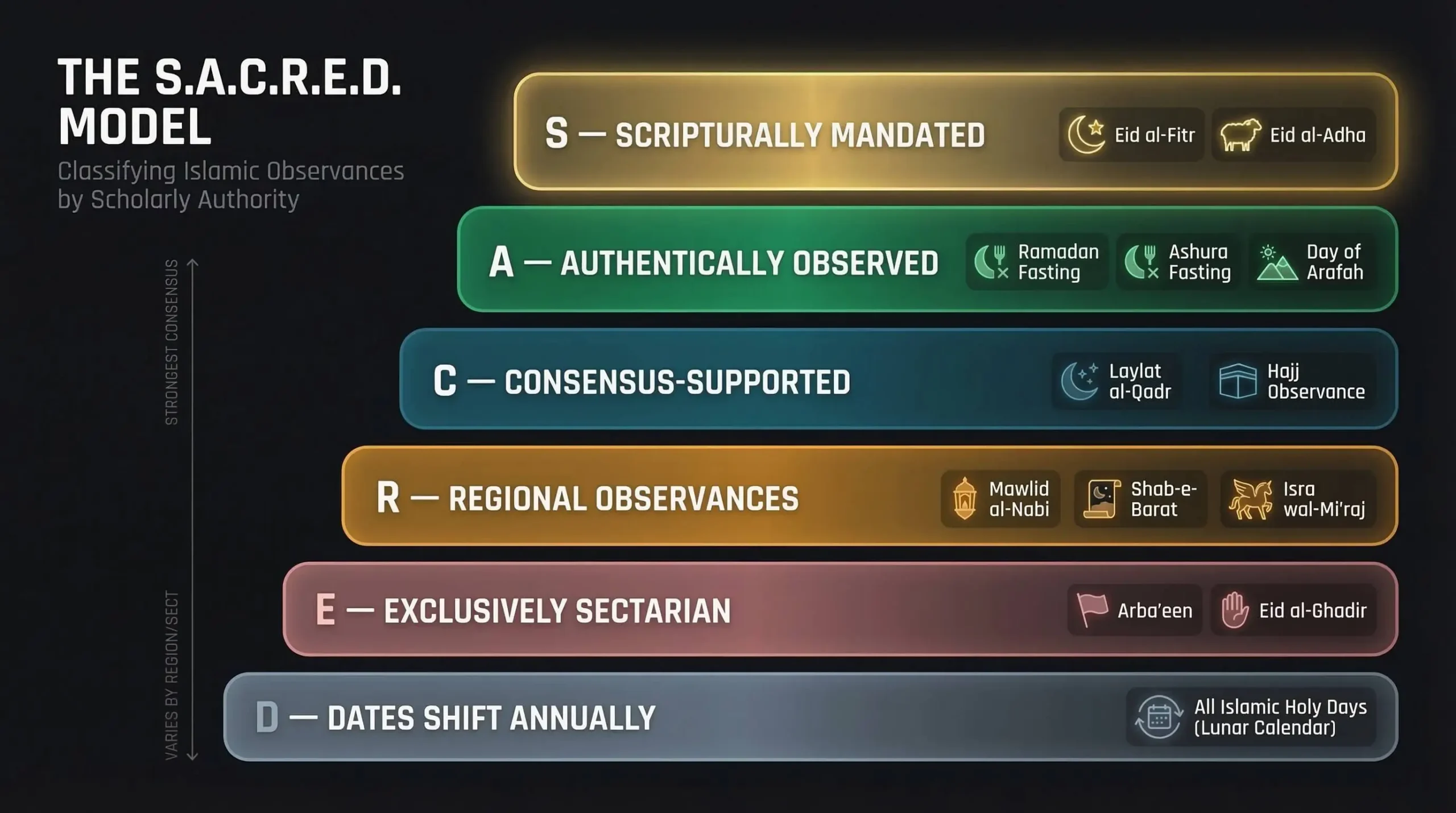
This list is useful in that it allows you to see in a brief time the relative scholarly consensus of each observance. However, what of the actual dates of 2026? The following is the entire calendar, which is checked against the Umm al-Qura calendar.
Islamic Holiday Calendar: The Dates You Need (Updated) 2026.
The year 2026 includes two Hijri years 1447 AH and 1448 AH. All dates in the future are calculated by the Umm al-Qura calendar that is followed by the official time-keeper of Saudi Arabia and can be altered in the event of a local moon sighting.
| Holiday | Hijri Date | Gregorian Date | Significance |
| Isra wal-Mi’raj | 27 Rajab 1447 | January 16, 2026 | Night Journey and Ascension |
| Shab-e-Barat | 15 Sha’ban 1447 | February 2, 2026 | Night of Forgiveness |
| Ramadan Starts | 1 Ramadan 1447 | February 18, 2026 | Start of mandatory fasting month |
| Laylat al-Qadr (most likely) | 27 Ramadan 1447 | March 16–17, 2026 | Better than a thousand months |
| Eid al-Fitr | 1 Shawwal 1447 | March 19–20, 2026 | Official holiday — end of Ramadan |
| Hajj Starts | 8 Dhul Hijjah 1447 | May 24, 2026 | Start of annual pilgrimage |
| Day of Arafah | 9 Dhul Hijjah 1447 | May 26, 2026 | Holiest day of the Islamic year |
| Eid al-Adha | 10 Dhul Hijjah 1447 | May 27, 2026 | Official holiday — Festival of Sacrifice |
| Islamic New Year | 1 Muharram 1448 | June 16, 2026 | Starting of new Hijri year |
| Ashura | 10 Muharram 1448 | June 25, 2026 | Fasting day (Sunni) / Mourning (Shia) |
| Mawlid al-Nabi | 12 Rabi al-Awwal 1448 | August 25, 2026 | Prophet’s birthday (contested) |
Regional difference: Saudi Arabia, UAE, and 13 other states started Ramadan on the same night, but Turkey, Indonesia, and 8 others started one day after. One to two day fluctuations such as these are likely to occur in 2026 dates. Eid al-Fitr 2026 has been confirmed as March 19 in the UAE and France, while other regions may observe it on March 20.
Dates shift every year – why? The solution to this is the lunar calendar that controls the entire Islamic year.
Why Are Islamic Holidays Changing Each Year? Lunar Calendar: The Explanation.
Have you ever wondered why Ramadan is in winter one year and in summer the next, the explanation is the Hijri Calendar — a purely lunar calendar.
The Hijri calendar consists of 12 lunar months and an approximate of 354 days. That is approximately 10–11 days short of the Gregorian solar calendar every year. On a 33 year cycle, each Islamic holiday passes through each of the four seasons, but gets restored to its initial Gregorian location.
The creation of the Islamic calendar was maintained under the rule of Umar ibn al-Khattab (RA). He used the Prophet’s ﷺ migration to Madinah in 622 CE as the beginning of the calendar. A month starts when the crescent moon is visible and therefore the actual dates may vary by one or two days in other countries.
| Prophet Muhammad ﷺ stated that the month of Dhul-Qa’dah, Dhul-Hijjah, Muharram and Rajab are four sacred months (Narrated by Abu Bakrah, Sahih al-Bukhari, Hadith No. 3197, classified as Sahih). During these months, they do not fight, and worship actions are paid special attention. |
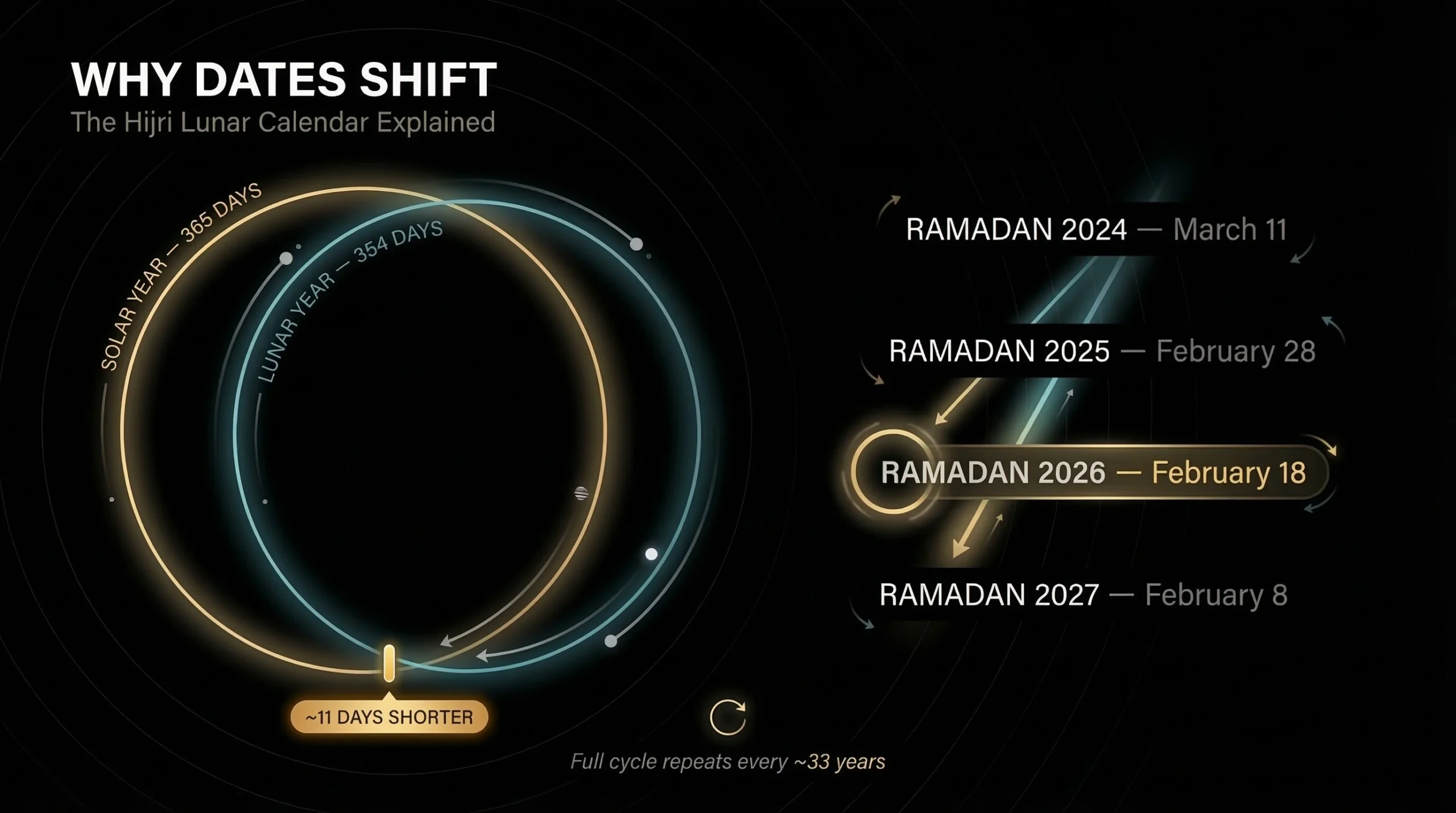
Since the calendar is lunar, each Islamic ceremony is subject to the calendar. The most celebrated one does not begin with one holiday, but with a whole month of worship.
Ramadan — The Holiest Month in Islam (It Is Not Merely a Holiday)
Ramadan is a 29 or 30 days month. In this period, Muslims are required to fast from morning to evening, pray more, read the Quran and cleanse their spirits. One of the Five Pillars of Islam is fasting during Ramadan and thus all adults of the Muslim faith are required to fast.
Ramadan 2026 Dates and Moon Sighting.
Ramadan 2026 began on the evening of Tuesday, February 17 (1 Ramadan 1447 AH), with the first day of fasting on Wednesday, February 18, and will end on the evening of Wednesday, March 18 or may extend to March 19 depending on whether the month is 29 or 30 days. Fasting hours in winter are approximately 11–13 hours in such cities as London and New York, whereas in summer they may go up to 17–18 hours.
Command to Fast in the Quran — Surah Al-Baqarah 2:183–185.
The Qur’an says:
يَـٰٓأَيُّهَا ٱلَّذِينَ ءَامَنُوا۟ كُتِبَ عَلَيْكُمُ ٱلصِّيَامُ كَمَا كُتِبَ عَلَى ٱلَّذِينَ مِن قَبْلِكُمْ لَعَلَّكُمْ تَتَّقُونَ
“O you who have believed, decreed upon you is fasting as it was decreed upon those before you that you may become righteous.” (Quran, Surah Al-Baqarah, 2:183)
It further states:
شَهْرُ رَمَضَانَ ٱلَّذِىٓ أُنزِلَ فِيهِ ٱلْقُرْءَانُ هُدًۭى لِّلنَّاسِ وَبَيِّنَـٰتٍۢ مِّنَ ٱلْهُدَىٰ وَٱلْفُرْقَانِ ۚ فَمَن شَهِدَ مِنكُمُ ٱلشَّهْرَ فَلْيَصُمْهُ
“The month of Ramadan [is that] in which was revealed the Qur’an, a guidance for the people and clear proofs of guidance and criterion. So whoever sights [the new moon of] the month, let him fast it; and whoever is ill or on a journey — then an equal number of other days.” (Quran, Surah Al-Baqarah, 2:185)
According to Imam Ibn Kathir, Ramadan is particularly a special month since during this month the Quran came. The Prophet ﷺ added:
| “Whoever fasts during Ramadan out of sincere faith and hoping to attain Allah’s rewards, then all his past sins will be forgiven.” (Sahih al-Bukhari, Hadith No. 38) |
He also said:
| “When the month of Ramadan starts, the gates of heaven are opened and the gates of Hell are closed and the devils are chained.” (Sahih al-Bukhari, Hadith No. 1899) |
Ramadan Sunnah Practices a Great Deal Are Missed.
- Suhoor (pre-dawn meal) — The Prophet ﷺ emphasized eating Suhoor and delaying it close to Fajr.
- Iftar — Break the fast at sunset, preferably with water and dates.
- Taraweeh prayers — Conducted every night with 8 to 20 rak’ahs based on your school of thought.
- Additional reading of the Quran — Many people strive to read the entire Quran during Ramadan.
- I’tikaf — The Prophet ﷺ would seclude himself in the masjid during the last ten nights of Ramadan (Sahih al-Bukhari, Hadith No. 2026).
- Extra charity — Muslims have been characterized as being very generous during Ramadan.
The final ten nights of Ramadan contain something even more extraordinary — a single night whose worship outweighs a thousand months.
Laylat al-Qadr — Why This Night Is Better Than a 1,000 Months.
The night of the most sacred on earth is Laylat al-Qadr. It is a night where the Quran was first received by the Prophet ﷺ by Angel Jibreel.
When Is Laylat al-Qadr in 2026?
It is observed on one of the odd nights during the final ten days of Ramadan. It is most likely the 27th of Ramadan, or approximately March 16–17 or 17–18, 2026, depending on the local beginning. It can also be prayed by the Muslims on any odd night during the last ten days.
Surah Al-Qadr — The Verse That Characterizes This Night.
إِنَّآ أَنزَلْنَـٰهُ فِى لَيْلَةِ ٱلْقَدْرِ وَمَآ أَدْرَىٰكَ مَا لَيْلَةُ ٱلْقَدْرِ لَيْلَةُ ٱلْقَدْرِ خَيْرٌۭ مِّنْ أَلْفِ شَهْرٍۢ
“Indeed, We sent the Qur’an down during the Night of Decree. And what can make you know what is the Night of Decree? The Night of Decree is better than a thousand months. The angels and the Spirit descend therein by permission of their Lord for every matter. Peace it is until the emergence of dawn.” (Quran, Surah Al-Qadr, 97:1–5)
Imam al-Nawawi reports that on this night, the same has been 83 years and 4 months of continuous worship. The Prophet ﷺ prayed more, made dua and remembered Allah during these nights and requested the family to do the same.
The first day of the Islamic two official holidays is the morning following the last day of Ramadan — a day of absolute joy and thanksgiving.
Eid al-Fitr — The First Official Islamic Holiday (1 Shawwal)
Eid al-Fitr is celebrated as the last day of Ramadan and the first day of Shawwal, the 10th month of the Islamic calendar. Its name translates to Festival of Breaking the Fast, and it is a joyful occasion, prayer day, charity, and gratitude day, which is an end of the month long fast.
When Is Eid al-Fitr 2026?
In 2026, Eid al-Fitr is expected to fall on March 19–20, 1 Shawwal 1447 AH. Eid al-Fitr 2026 has been confirmed as March 19 in the UAE and France, while other regions may observe it on March 20. Due to the reliance on sighting the moon by Islamic date, the precise day could be different across geographical places.
The 7 Sunnah Acts of Eid Morning That Every Muslim Should Know.
Eid al-Fitr has certain special things that the Prophet ﷺ did that distinguished it among other days:
- Perform a complete ritual bath (ghusl) prior to attending the Eid prayer.
- Use your finest clothes — new ones as far as you can.
- Break the fast with one date or an odd number of dates before the prayer (this is a Sunnah of Eid al-Fitr, and not Eid al-Adha).
- Give Zakat al-Fitr prior to the prayer — an obligatory donation which purifies the fasting person and is used to support the poor.
- Recite the Takbeer — Allahu Akbar, Allahu Akbar, la ilaha illallah… — throughout the night before, up until the prayer of Eid.
- Participate in a large open field Eid prayer, according to the Sunnah.
- Use other walks to and out of the prayer ground.
Eid al-Fitr Traditions in the USA, UK and the Gulf Countries.
The Eid celebrations appear differently in other locations. In the Gulf states, meals are consumed en masse by such dishes as harees and luqaimat. South Asian sweet vermicelli pudding known as khurma is the Eid food. Turkish families prepare baklava, and in Egypt, kahk (shortbread cookies) are exchanged among neighbors.
In America in certain districts schools now close on Eid. In 2015, New York City was the first major U.S. city to declare both Eids school holidays and local governments in Maryland, Massachusetts, Michigan, Minnesota, and Virginia have since adopted school holidays.
Essentially all Muslims also fast six voluntary Shawwal fasts after Eid al-Fitr and the Prophet ﷺ likened this to year-long fasting.
The second official Eid is approximately two and half months after that. The preparation of it includes what the scholars refer to as the ten best days of the entire year.
Hajj and The First 10 Days of Dhul Hijjah — Why Scholars Refer to Them as the Best Days of the Year.
The 12th month, called Dhul Hijjah, begins with ten days but these days are quite important spiritually. The Prophet ﷺ said:
| “There are no days on which righteous deeds are more beloved to Allah than these ten days.” (Sahih al-Bukhari, Hadith No. 969) |
Many scholars of Tafsir, including Imam Ibn Kathir, identify these as the “ten nights” referenced in Surah Al-Fajr:
وَٱلْفَجْرِ وَلَيَالٍ عَشْرٍۢ
“By the dawn. And [by] the ten nights.” (Quran, Surah Al-Fajr, 89:1–2)
Day of Arafah: The Most Sacred Day of the Islamic Calendar.
The most sacred day in the Islamic year is the 9th of Dhul Hijjah, the Day of Arafah. Pilgrims performing Hajj — one of the Five Pillars of Islam — stand on Mount Arafah in supplication. To non-pilgrims, fasting on this day is rewarded highly:
| “Fasting the Day of Arafah expiates the sins of two years: the past year and the coming year.” (Sahih Muslim, Hadith No. 1162) |
This Day of Arafah will happen in 2026 approximately on May 26 (9 Dhul Hijjah 1447).
Hajj 2026: What Changes This Year?
Hajj 2026 will be during the later part of spring, so it will be cooler than the heat of summer that several pilgrims have been experiencing over the past years. This practicality of the cycle of 33 years of Hijri calendar with Gregorian seasons is the seasonal change. Pilgrims who will enter Ihram in May 2026 will find the weather much more bearable.
The following day, the Arafah day, is followed by the second (and, based on scholarly opinion, the most sacred) of all official Islamic holidays.
Eid al-Adha — The Greater Eid, the Festival of Sacrifice (10 Dhul Hijjah).
Eid al-Adha is a reminder of the way Prophet Ibrahim (Abraham) offered to sacrifice his son under the command of Allah. The Muslims believe it is the most sacred of the Islamic calendar, a 3–4 day (10th to 13th of Dhul Hijjah) festival known as the Ayyam al-Tashreeq.
When Is Eid al-Adha 2026?
Eid al-Adha this year will take place on May 27 (10 Dhul Hijjah 1447).
In the Quran (Surah As-Saffat 37:102–107) There Is the Story of the Sacrifice of Ibrahim.
The Quran narrates the story:
فَلَمَّا بَلَغَ مَعَهُ ٱلسَّعْىَ قَالَ يَـٰبُنَىَّ إِنِّىٓ أَرَىٰ فِى ٱلْمَنَامِ أَنِّىٓ أَذْبَحُكَ فَٱنظُرْ مَاذَا تَرَىٰ
“And when he reached with him [the age of] exertion, he said, ‘O my son, indeed I have seen in a dream that I [must] sacrifice you, so see what you think.’ He said, ‘O my father, do as you are commanded. You will find me, if Allah wills, of the steadfast.’ And when they had both submitted and he put him down upon his forehead, We called to him, ‘O Ibrahim, you have fulfilled the vision.’ Indeed, We thus reward the doers of good. Indeed, this was the clear trial. And We ransomed him with a great sacrifice.” (Quran, Surah As-Saffat, 37:102–107)
The rhetorical meaning of the sacrifice is explained by the Quran too:
لَن يَنَالَ ٱللَّهَ لُحُومُهَا وَلَا دِمَآؤُهَا وَلَـٰكِن يَنَالُهُ ٱلتَّقْوَىٰ مِنكُمْ
“Their meat will not reach Allah, nor will their blood, but what reaches Him is piety from you.” (Quran, Surah Al-Hajj, 22:37)
The Sunnah of Qurbani: Rules, Conditions and Its Distribution.
Qurbani (also known as Udhiyah) is the ritual sacrifice of a livestock animal — in most cases, a sheep, goat, cow or a camel. The meat is shared in a manner that includes the poor and the needy, relatives and friends and finally the family.
The main Sunnah customs during the morning of Eid al-Adha are not similar to those during Eid al-Fitr:
- Do not eat before the Eid prayer (contrary to the Sunnah to eat dates during Eid al-Fitr)
- Repeat Takbeer al-Tashreeq following each Fard prayer between the 9th to 13th of Dhul Hijjah.
- Sacrifice should be performed upon the Eid prayer.
Allah says:
فَصَلِّ لِرَبِّكَ وَٱنْحَرْ
“So pray to your Lord and sacrifice [to Him alone].” (Quran, Surah Al-Kawthar, 108:2)
The Reason Why Eid al-Adha Is the Holiest Festival to Scholars.
| Characteristic | Eid al-Fitr | Eid al-Adha |
| Hijri Date | 1 Shawwal | 10 Dhul Hijjah |
| 2026 Gregorian | ~March 19–20 | ~May 27 |
| Adheres to | Ramadan (fasting month) | Hajj (pilgrimage) |
| Major Practice | Zakat al-Fitr | Qurbani (sacrificing an animal) |
| Duration | 1–3 days | 3–4 days |
| Sunnah Before Prayer | Eat dates | Do NOT eat before prayer |
| Scholarly Rank | Major Eid | The Greater Eid |
The distinction is due to the fact that Eid al-Adha occurs when Hajj, the fifth pillar of Islam, occurs and reflects on a massive test of faith in the Quran. Imam al-Nawawi and other Shafi’i scholars hold Eid al-Adha in higher regard, while all schools affirm the significance of both.
In addition to the two Eids, there are other observances in the Islamic year which are both historical and spiritual. The first which many Muslims fail to notice is:
Islamic New Year (Al-Hijra) — The Day That Most Muslims Ignore.
The first day of the Hijri calendar is 1 Muharram the Islamic New Year. It is not celebrated as much as the Gregorian New Year is: there are no fireworks, no countdowns, no celebrations.
When Is Islamic New Year 2026?
The year 1448 AH in the Islamic New Year starts on 1 Muharram that falls approximately on June 16, 2026.
What the Hijra of the Prophet Means to Muslims Today.
It is named on the day of the Hijra — the migration of the Prophet Muhammad ﷺ between Makkah and Madinah in the year 622 CE when he established the foundation of the first Islamic community and state. Its significance made Umar ibn al-Khattab (RA) use it as the beginning of the Muslim calendar.
Islam has four sacred months; Muharram is one of them. According to the Prophet ﷺ, voluntary fasting during the month of Muharram is the best fasting after Ramadan. Most Muslims view the new Hijri year as a period of reflection, repentance and renewed spiritual goal-setting rather than the occasion to celebrate.
The Islamic day calculation puts the Islamic calendar on a very spiritually charged — and historically sensitive — occasion by merely ten days into the new year.
Ashura (10 Muharram) — Why Sunni and Shia Muslims Celebrate This Day Diversely.
Ashura is celebrated on the 10th of Muharram and the day is celebrated by both the Sunni and Shia Muslims, although in varying fashions.
The Sunni Observation: Fasting in Thankfulness.
To most Sunni Muslims, Ashura is a day that Prophet Musa (Moses) was rescued by God through the help of God, and he got through a Red Sea that was now open. The Prophet Muhammad ﷺ came to Madinah and found Jewish people fasting on this day and he said, we have more right to Musa than you. He then fasted, and urged his companions to do likewise. To differentiate the Muslim fast, he included the 9th Muharram:
| “If I happen to live till the next year, I will fast on the 9th too.” (Narrated by Ibn Abbas, Sahih Muslim, Book of Fasting, Hadith No. 1134) |
The Sunni Muslims are accustomed to make 9th and 10th (or 10th and 11th) of Muharram a voluntary act of thanks and devotion.
The Shia Commemoration: Karbala Remembrance.
To the Shia Muslims, Ashura is mostly in remembrance of the martyrdom of Husayn ibn Ali (RA), the grandson of the Prophet during the battle of Karbala in 680 CE (61 AH). They also practice mourning rituals, which can involve a procession, passion plays (ta’ziyah), reading of elegies, and in other locations, expressions of grief.
Karbala has emotional and theological significance that influences the Shia perception of Muharram as a sombre period of remembrance and not a celebration.
The Sunnah of Fasting Ashura (Using the Authentic Hadith).
In June 25 (10 Muharram 1448), Ashura 2026 is anticipated. Fasting on this day is highly encouraged in all the four Sunni schools. The Prophet ﷺ used to fast it and linked its reward to the expiation of the previous year’s minor sins.
Diversity in the practice of Ashura is great — but there is no Islamic event that is more discussed by academicians than the event that celebrates the birthday of the Prophet ﷺ.
Mawlid al-Nabi — The Most Controversial Holiday in Islam (What Scholars Are Saying)
Mawlid al-Nabi is the day of birth of Prophet Muhammad ﷺ on the 12th of Rabi al-Awwal (most Sunni positions). The legality of celebrating Mawlid has been a controversial subject among Muslim scholars, and has been called one of the most controversial debates in Islamic law.
There are actually varying views concerning this issue by scholars. The following positions derive out of famous schools of Islamic law. The readers might desire to have a personal consultation with a qualified scholar.
When Is Mawlid al-Nabi 2026?
The Mawlid al-Nabi will be celebrated on about Tuesday, August 25 in 2026 (12 Rabi al-Awwal 1448).
The Scholars Who Authorize Mawlid: Testimonies and Stipulations.
One of the most important texts on the topic was a particular fatwa on the Mawlid written by great scholars such as Imam Jalal al-Din al-Suyuti (d. 911 AH), a famous Shafi’i teacher. Imam Ibn Hajar al-Asqalani (d. 852 AH), who wrote Fath al-Bari (a commentary on Sahih al-Bukhari), too had a favorable opinion of it — when it is a worship, such as reading the Quran, sending blessings to the Prophet ﷺ and feeding the poor, he called it a Bidah Hasanah (praiseworthy innovation).
It is argued based on:
وَذَكِّرْهُم بِأَيَّىٰمِ ٱللَّهِ
“And remind them of the days of Allah.” (Quran, Surah Ibrahim, 14:5)
— which means that the birth of the Prophet is one of the most important days of Allah. They also refer to the hadith in which the Prophet ﷺ was requested to say whether he should fast on Mondays and he responded: That is the day I was born. (Sahih Muslim, Hadith No. 1162, graded Sahih).
Hanafi, Maliki and Shafi’i schools are considerably open to Mawlid celebrations, but with a condition. Majority of the Maliki jurists consider it as permissible or advisable. Mawlid is practiced in most parts of the Muslim world including North and West Africa, South and Southeast Asia and Turkey.
The Scholars Who Are Against Mawlid: The Evidence and Reason.
Opponents of Mawlid say that the Prophet ﷺ, his companions and early converts never did so. They quote the hadith: all newly-invented things are innovations (Bid’ah) and every innovation is misguidance.
The Hanbali school and the Salafi movement, as well as the Deobandi scholars, regard the Mawlid as an objectionable Bid’ah and forbid its practice. Even former Grand Mufti of Saudi Arabia, Sheikh Abdul-Aziz ibn Baz, and Sheikh Muhammad ibn al-Uthaymeen issued fatwas against the commemoration of the Mawlid because they said it had no foundation in the Sunnah or the example of the righteous predecessors (Salaf). Ibn Taymiyyah (d. 728 AH) is more subtle in his view, he admitted that there are those who celebrate in earnestness, although he thought it was an innovation.
What Are the Countries That Observe the Mawlid as a Public Holiday?
Most of the Muslim-majority countries accept the Mawlid as a national holiday, except Saudi Arabia and Qatar. The Shia Muslims also observe it extensively. That is why it is one of the most observable Islamic events in the whole world even though there is an active scholarly controversy regarding its permissibility.
| Madhab / Position | Decision on Mawlid | Main Evidence | Main Scholars |
| Hanafi | Generally permissible (mustahabb) | Quran 14:5 | Imam Ibn Hajar al-Asqalani (d. 852 AH) |
| Maliki | Authorized / Recommended | Majority of Maliki jurists approved it | Majority of Maliki jurists |
| Shafi’i | Valid in the presence of good practices | Fatwa on Mawlid by Imam al-Suyuti (d. 911 AH) | Imam al-Suyuti (d. 911 AH) |
| Hanbali / Salafi | Reprehensible innovation (Bid’ah) | Hadith on innovations | Ibn Taymiyyah (d. 728 AH), Sheikh Abdul-Aziz ibn Baz |
| Shia | Widely observed | Love of Ahl al-Bayt; gladness that the Prophet was born | — |
Other Significant Islamic Celebrations You Need to Know About.
Isra wal-Mi’raj — The Night Journey and Ascension (27 Rajab)
It is a celebration of one of the most remarkable incidents in the Islamic history. Prophet Muhammad ﷺ has had this miraculous Night Journey of Makkah to Jerusalem (Isra) and Ascension through the heavens (Mi’raj) on the 27th of Rajab, where the declaration of the five daily prayers was given to him, the pillar of Salah.
Isra wal-Mi’raj in 2026 is a holiday on or around January 16 (27 Rajab 1447). Certain scholars positively suggest voluntary fasting and additional worship, but others caution due to the controversy in the hadith evidence of certain observances.
Shab-e-Barat — The Night of Forgiveness (15 Sha’ban)
The night of forgiveness and mercy, it is also called Laylat al-Bara’ah, and it is now celebrated on the 15th of Sha’ban, or around February 2, 2026. It is popularly celebrated in South Asian, Turkish and some of the Arab Muslim culture by means of night prayers and supplication. Some scholars, including Sheikh Yusuf al-Qaradawi, believe that this night should be used to perform worship, and others particularly the adherents of the Salafi school observe that some of the hadith related with it is weak.
Arba’een — The Shia Observance 40 Days After Ashura
Within the Shia Muslim community, Arba’een is a night of remembrance of the martyrdom of Husayn ibn Ali (RA) and happens on the 40th day following Ashura. The Muslim tradition is to mourn forty days. Karbala is also the focus of the annual pilgrimage that attracts millions of visitors in the Arba’een pilgrimage held in Iraq every year, thus it is one of the largest pilgrimages in the world.
The Six Days of Shawwal — The Bonus Fast After Ramadan.
The Prophet ﷺ recommended six days of fasting in Shawwal after Eid al-Fitr. These fasts in combination with Ramadan rank with the same value as fasting a whole year, as reported in the hadith. This is Sunnah in all the four madhabs, although the initial Maliki scholars argued whether to observe them on the spot or to spread them in the month.
Having discussed all the major and secondary observances, a number of constantly held misconceptions about Islamic holidays continue to spread — and they should be corrected.
The 6 Most Popular Misconceptions About Islamic Holidays (Debunked With Facts).
Misconception 1: “There are two holidays in Islam.”
Yes, Islam has two main Eids. However, there are numerous other occasions like Ramadan, Night of Power, Ashura and Arafah Day. These are also extremely important but they do not mean the same as the official holidays.
Misconception 2: “Islamic holidays have the same date every year.”
They begin on the same day annually in the Islamic calendar, whereas on the Gregorian table the day is some 10 or 11 days earlier annually due to the moon cycle.
Misconception 3: “Ramadan is a holiday.”
Ramadan is a month of mandatory fasting and prayer not a holiday. The post-Ramadan holiday is Eid al-Fitr. It is not right to declare the entire month as a holiday.
Misconception 4: “Every Muslim observes Mawlid.”
Celebration of Mawlid is generally permitted in the schools of Hanafi, Maliki and Shafi’i, whereas it is not permitted in the Hanbali school and Salafi movement. It is not a holiday in Saudi Arabia and Qatar.
Misconception 5: “Ashura is a purely Shia celebration.”
The Ashura is observed by both the Sunni and Shia Muslims. Sunnis voluntarily observe it as a fast whereas Shia carry out mourning observances in remembrance of the events at Karbala. The Sunnis are recorded to fast during Ashura based on hadith.
Misconception 6: “Saudi Arabia defines Islamic holidays.”
Umm al-Qura calendar is referred to frequently, although each nation, each community and even each local mosque is free to exercise its own moon-sighting jurisdiction. In the U.S. and Canada the FCNA and ISNA provide their own news of the moon sightings.
The issue of the real determining of dates is in itself something to be given special attention.
Determination of Islamic Holidays: Moon Sighting vs. Calculation.
The new crescent moon is the major determiner of the dates of Islamic holidays. It may be difficult to forecast dates precisely because of various rules, opinions, politics and weather.
Two main approaches exist:
Moon sighting — Existing methods of observing the new crescent using either the naked eye or the use of a simple telescope. The method is employed by classic scholars and countries, including Saudi Arabia (which also practices some astronomy), Pakistan, and most of the local communities.
Astronomical calculation — The calculation of the time of the crescent coming with math. ISNA, FCNA and the European Council of Fatwa and Research are in favor of this way of determining dates in the western world and they say that modern science is no less reliable than the eyesight.
The discussion employs higher concepts of the law such as Qiyas (comparison) and Maslaha (public good). Due to this fact other people in the same city can begin Ramadan or want to celebrate Eid on various days, depending on which group they belong.
The most common predicted dates, including the 2026 dates in this guide, were obtained with the Umm al-Qura calendar which is maintained by the Institute of Astronomical Research of the Umm al-Qura University in Mecca.
It is important to know how the holidays are determined as a Muslim in a place where Islam is not the mainstream religion since there is an additional burden on working and attending schools.
Islamic Holidays in U.S. and U.K. Recognitions, Rights and Workplace Advice
According to the 2020 U.S. Religion Census there are approximately 4.5 million Muslims in America. There are over 3.9 million Muslims in the U.K. These individuals also experience special challenges in handling Islamic holidays in the western schools and at work.
Increasing number of schools are beginning to recognise the holidays. In 2015, the city of New York established both Eids as school holidays and the same was done by schools in Maryland, Massachusetts, Michigan, Minnesota, and Virginia. Other schools in the U.K. where a significant number of Muslims reside also allowed students to skip classes in honor of Eid.
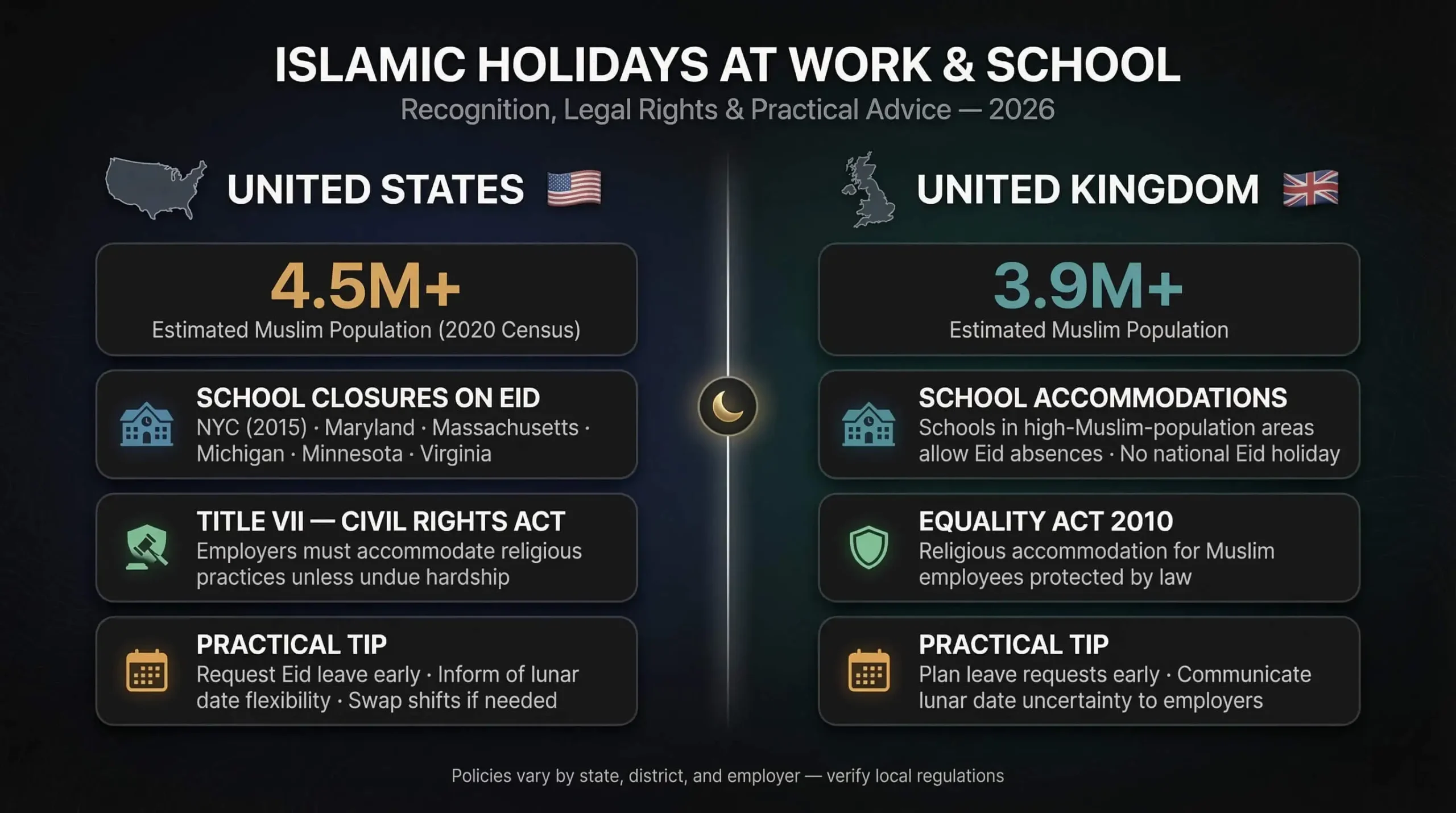
Job protections vary according to region, though they typically include the religious accommodation regulations. Title VII of the Civil Rights Act in the U.S. provides that it is the duty of the employer to permit religious practices unless it is a major problem. This law protects Muslim employees who wish to take a holiday during Eid al-Fitr, Eid al-Adha, or Friday prayer.
In real life, it is the planning ahead. Most Muslims in the U.S. and U.K. ensure that they take Eid leave early on, inform their bosses of the probable days (the lunar calendar may change), and can even swap shifts or alternate days.
Both the Assembly of Muslim Jurists of America and Dar al-Ifta al-Misriyyah have indicated that Muslims must play a complete role in their societies but retain their religious obligations such as celebration of Islamic holidays.
Frequently Asked Questions on the Islamic Holidays.
What are the number of Islamic holidays?
Islam has two official holidays, Eid al-Fitr, and Eid al-Adha, both of which are reported in reliable sayings of the Prophet ﷺ (Sunan Abu Dawud 1134). Moreover, the Muslims have their own sets of holy periods, such as Ramadan, the Night of Power, Ashura, the Day of Arafah and Islamic New Year. There are also groups that celebrate the birthday of the Prophet, the Journey and Ascension, and Shab-e-Barat.
What are the two important Islamic holidays?
The largest are Eid al-Fitr on the first day of Shawwal commemorating the conclusion of Ramadan and Eid al-Adha on the tenth day of Dhul Hijjah, the Festival of Sacrifice in relation to Hajj and the story of the Prophet Ibrahim (AS). Some academics refer to Eid al-Adha as the Greater Eid.
When will Eid 2026 be?
Eid al-Fitr is to be around March 19–20 (1 Shawwal 1447 AH), and Eid al-Adha is to be around May 27 (10 Dhul Hijjah 1447 AH). These days are based on the Umm al-Qura calendar and may change one or two days according to the sight of the moon in the area.
How come Islamic dates of holidays vary annually?
The Islamic holidays are founded on the Hijri lunar calendar that possesses approximately 354 days. That is 10–11 days short of Gregorian calendar. Due to this fact, each year an Islamic date shifts towards the beginning of the Gregorian calendar. The seasons repeat after approximately 33 years with the dates returning to the same point.
Are there common holidays of the Sunni and Shia religions?
Eid al-Fitr and Eid al-Adha are both observed among both Sunni and Shia Muslims. They also regard Ashura in a different way: Sunnis may voluntarily fast on that day, but Shia Muslims have mourning. Shia also celebrate Arba’een and Eid al-Ghadir which Sunnis do not. Both groups also mark the birth of the Prophet, Mawlid al-Nabi.
Is Mawlid an Islamic official holiday?
Mawlid al-Nabi is not among the two Eids, which the Prophet ﷺ established. Its status is debated. It is generally permitted by the Hanafi, Maliki and Shafi’i schools. The Hanbali school and Salafi movement consider it as innovation, hence they do not authorize it. It is a national holiday in many Muslim-majority countries but not Saudi Arabia and Qatar.
Which things are prohibited on Islamic holidays?
All four Sunni schools forbid fasting during the two Eids. The days of Tashreeq (11th–13th of Dhul Hijjah) on Eid al-Adha also prohibit fasting as most scholars indicate. In addition to this, the Eids are festive days. Muslims are urged to feast, rejoice and give thanks.
Is it allowed that non-Muslims can wish Muslims their holidays?
A non-Muslim is not prohibited to say greetings at Eid or Ramadan by Islamic rule. It is welcome to say Eid Mubarak (Blessed Eid) or Ramadan Kareem (Generous Ramadan). These acts of benevolence are promoted as good social conduct.
What is the difference between Eid al-Fitr and Eid al-Adha?
The breaking of Ramadan at Eid al-Fitr is followed by a special charity, Zakat al-Fitr. Eid al-Adha is the climax of Hajj pilgrimage which is based on Qurbani (animal sacrifice). They also vary in the timing of their occurrence, the duration of their occurrence (1–3 days as opposed to 3–4 days), special prayers preceding the main prayer and other practices.
What and when is Laylat al-Qadr?
Laylat al-Qadr or the Night of Power is a night during which the Quran was first revealed. According to the Quran it is superior to one thousand months. It is among the odd nights during the final ten days of Ramadan. Several individuals believe that it occurs on the 27th night, yet the night is not predetermined.
Are Islamic holidays Federal holidays in the US or UK?
They do not have any national public holidays of the Islamic festivals in either the United States or the United Kingdom. In some of the U.S. school districts and city governments school or office closures on Eid days are permitted. Muslim employees in the U.K. are entitled to seek religious accommodation under the Equality Act 2010.
On what calendar is the Islamic calendar based?
The Hijri calendar is a lunar calendar of Islam. Every month a new crescent moon (hilal) is seen. It contains 12 months that amount to approximately 354 days. The calendar started in 622 CE and this is the year that Prophet Muhammad ﷺ left Makkah and moved to Madinah (Hijrah).
Your Total Islamic Holidays Quick Guide.
Islamic system of holidays is not as complex and enriched as many guides tend to mention. The Prophet ﷺ had two formal Eids: Eid al-Fitr and Eid al-Adha. Nearby, there are an entire calendar of holy months, suggested fasts, devotional nights and celebrations that identify Muslims with the Quran, the Sunnah, and the history of the Muslim community.
The point is: not all the crucial Islamic days are a holiday. It is better illustrated by a list of dates that are scripturally obligatory (such as the two Eids) and those that are regionally commemorative (such as Mawlid).
Bookmark this page. All dates will be changed annually depending upon the Umm al-Qura calendar and official moon-sighting calls. Every holiday section is connected with a guide containing evidences, school comparisons, and step by step instructions.
Scholarly opinions on certain observances vary, and all positions presented are based on established schools of Islamic jurisprudence (Fiqh). Consult your local scholars for personal guidance.
Wallahu A’lam (And Allah knows best)