Learning how to pray Taraweeh is essential for every Muslim during Ramadan. Taraweeh is the special night prayer Muslims perform every evening in Ramadan after the Isha prayer. This is a guide in which you can learn every step to Taraweeh in case you have never prayed it before or you want to make sure that you are doing it correctly. It brings you between your will and completion with Witr. You will receive complete Arabic prayers, how to say them, evidence of scholars and rules which vary slightly in the various schools of thought.
Snippet: Taraweeh is the voluntary evening prayer that is only performed during Ramadan and this is after Isha. It includes a lot of pairs of rakah that is typically eight or twenty and closes with the Witr prayer. Prophet ﷺ promoted it by stating that whoever prays in Ramadan with faith and reward expectations will have his/her past wrongs forgiven (Sahih al-Bukhari, 2009). This guide explains how to pray Taraweeh step by step.
This manual represents the views of the majority of Sunni scholars. In the case of an exceptional situation, seek a local scholar who may be qualified to give you a personal ruling.
What Is Taraweeh Prayer?
Taraweeh is a name derived of the Arabic root r-w-h resting or relaxing. It is also used to mean the brevities that the worshippers take after every four rakah in the prayer. In earlier times Taraweeh was also referred to as Qiyam Ramadan by scholars as it is a special form of the ordinary night prayer (Qiyam al-Layl) only performed during the month of Ramadan. Salat Taraweeh (also spelled salat al-taraweeh) is the Arabic term for this special prayer.

Understanding how to pray Taraweeh begins with knowing its meaning and significance.
According to the Prophet Muhammad, whoever prays during the time of Ramadan, not due to any desire, but because he wishes to pray to Allah, his past sins are pardoned (Sahih al-Bukhari, 2009; Sahih Muslim, 759). This quote demonstrates the significance of Taraweeh and its relationship with Ramadan.
Taraweeh is a Sunnah Muakkadah – a highly recommended practice of the Prophet ﷺ which is strongly recommended but not mandatory. It is unlike the five daily prayers where failure to do the prayer is not a sin but doing it brings a great reward during the blessed month.
Once you understand its importance, learning how to pray Taraweeh becomes more meaningful.
Is Taraweeh Prayer Obligatory or Sunnah?
Before learning how to pray Taraweeh, many ask whether it is obligatory.
The four Sunni schools (Hanafi, Shafi, Malik and Hanbali) do not disagree that Taraweeh is a non-compulsory Sunnah Muakkadah. The scholars classify Taraweeh as Sunnah Muakkadah, which is the highest level of mustahabb (recommended) acts. This consensus (ijma’) rests on the obvious evidence of the practice of the Prophet.
The Prophet ﷺ spent some nights in the mosque offering Taraweeh. He then ceased to lead it in the mosque later and claimed: I was afraid that it would be mandatory to you (Sahih al-Bukhari, 2012). In this hadith, we live to learn that the Prophet preferred Taraweeh but did not intend that people should believe that it was an obligation.
The congregational practice was revived by Umar ibn al-Khattab (may Allah be pleased with him) who appointed Ubayy ibn Ka’b as the imam of the mosque. Upon sitting in front of the people present, Umar replied: This is an excellent innovation. (Here ‘innovation’ refers to the organizational revival, not a new religious practice, as the Prophet ﷺ had already established the prayer itself.) (Sahih al-Bukhari, 2010). He intended the organization rather than the fact that the prayer was new because the Prophet had already initiated it.
The lesson learnt: Taraweeh is highly promoted. It is not a sin to miss it, but forming it into a habit of doing every night of Ramadan is one thing that a Muslim is highly rewarded to do.
Now that you know its status, let’s explore how to pray Taraweeh properly.
Must Watch: Is taraweeh an innovation (Biddah)? – Assim al hakeem
How Many Rakah in Taraweeh? (Madhab Comparison)
One of the questions that are frequently asked regarding Taraweeh is the number of rakah it is supposed to include. The brief answer to this question is that eight and twenty rakah are both fine. All of them have factual support and are observed by millions of Muslims. The evidence is something that you know.
The 8 Rakah Position
The principal testimony of eight rakah is of Aisha (may Allah be pleased with her). She said: The Messenger of Allah ﷺ never prayed more than eleven rakah during the nights of Ramadan or otherwise (Sahih al-Bukhari, 2013). The eleven contains three rakah of Witr which leaves eight rakah of Taraweeh.
Abdullah ibn Umar (RA) was also reported to pray the night prayer in separate sets of two rakah (Sahih al-Bukhari, 1137).
Most scholars, particularly the ones who consider evidence first, consider this hadith as the most important evidence of the way the Prophet used to say prayers. Modern masters such as Sheikh al-Albani et al. who hold this opinion believe that we must remain in the very way of the Prophet.
The 20 Rakah Position
According to narrations reported by al-Bayhaqi in Sunan al-Kubra and referenced in classical fiqh works, Umar brought people together under the leadership of Ubayy ibn Ka’b who led twenty rakah.
The books of Classical Hanafi and Shafi have treated twenty rakah as the established Sunnah according to the way the companions used to do. One of the prominent Shafiite scholars, Imam al-Nawawi, authored a book titled al-Majmu in which he wrote that Taraweeh was a Sunnah Muakkadah consisting of twenty rakah. Ibn Qudamah was a Hanbali authority who wrote in al-Mughni that the companions were of the predominant practice to practice twenty.
Scholarly Reconciliation
The most moderate one, formulated very lucidly by Ibn Taymiyyah in his Majmu’ al-Fatawa, is that this issue is flexible. He replied that being able to say eleven or twenty three, both are fine, so far as prayer is concerned. The quality of prayer itself, the length of the recitation, the earnestness of sujud and ruku, the presence of the heart, is the main point.
Both counts are acceptable in all four schools. Keep that of your local academicians and your mosque locals.
Regardless of the number you choose, knowing how to pray Taraweeh correctly matters most.
Madhab Comparison Table
| Aspect | Hanafi | Shafi’i | Maliki | Hanbali |
| Rakah Count | 20 (8 also valid) | 20 (8 also valid) | 36 (20/8 also valid) | 20 (8 also valid) |
| Witr Method | 3 rakah connected (tashahud in 2nd) | 1, 3, or more (separated) | 1, 3, or more (separated) | 3 rakah (2+1 separated) |
| Congregation Status | Sunnah Muakkadah | Sunnah Muakkadah | Sunnah Muakkadah | Sunnah Muakkadah |
| Primary Evidence | Companion practice | Companion practice + Aisha hadith | Madinan amal + Companion practice | Companion practice + Aisha hadith |
Step-by-Step Guide: How to Pray Taraweeh for Beginners
This section provides the key guidelines to the execution of Taraweeh salah. In Taraweeh, two rakahs of the prayer are taken consecutively. It refers to the fact that you complete two rakah, say salam, and the next two. Continue until you have attained the number you desire four sets to make eight rakah or ten sets to make twenty rakah.
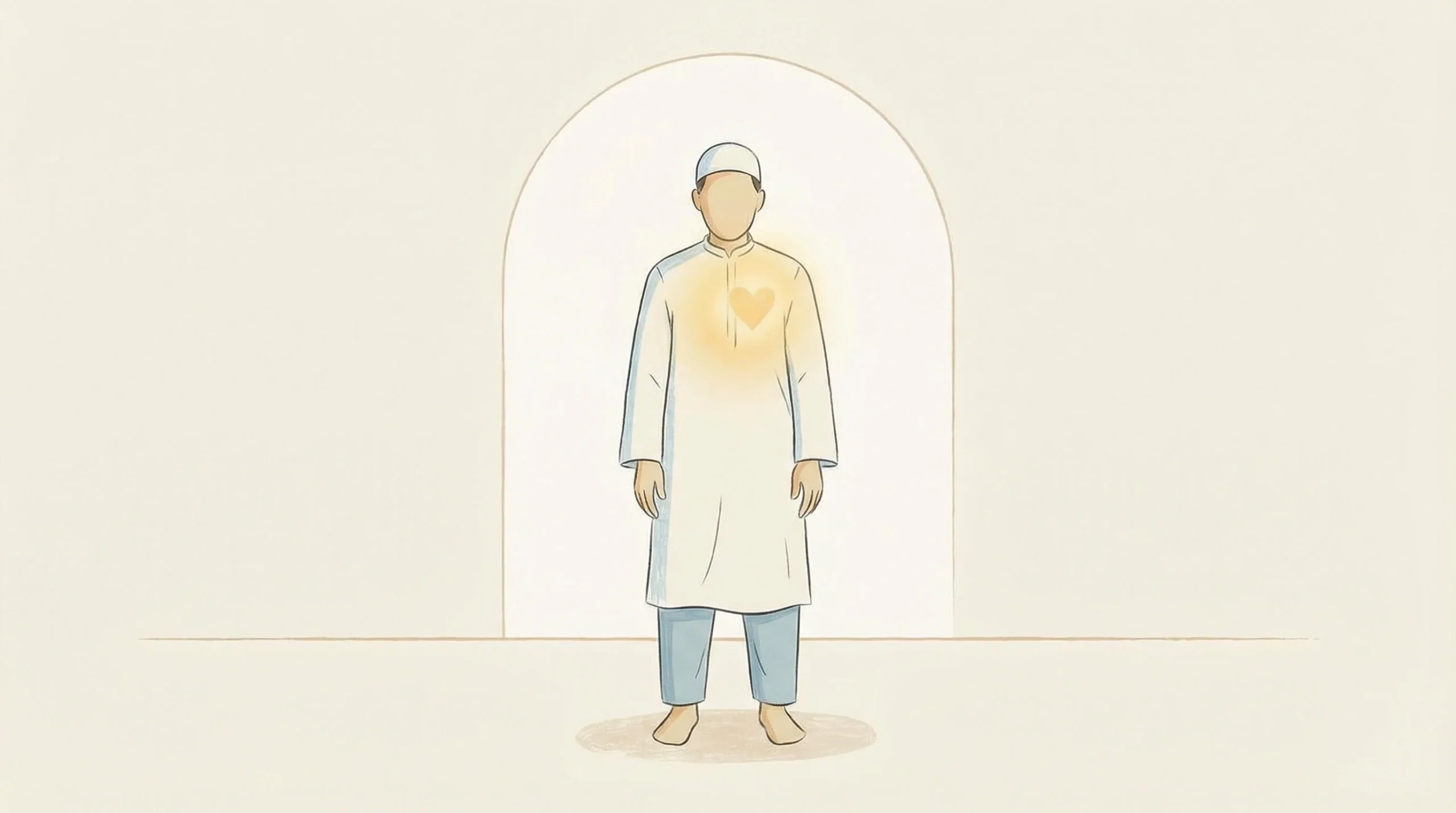
Step 1 — Make Your Intention (Niyyah)
The first step in learning how to pray Taraweeh is making your intention. First of all, in your heart you need to believe that you are praying Taraweeh (Qiyam Ramadan) because of Allah. The point is not a verbal statement but an act of the heart. According to the majority of the scholars, it is not necessary to say it aloud.
✓ Action: Say in your heart with khushu (humility and focus), I am praying two rakah of Taraweeh. ✓ Fallacy: Saying the niyyah out loud when it was not necessary. It is permitted by some of the scholars to provide assistance but it is not binding in any school. ✓ Check up: Answer: Are you aware of the prayer you are doing and the reason.
Step 2 — Undergo Takbiratul Ihram
Stand facing the qiblah. Bring both hands to ear (Hanafi), or shoulder (Shafi, Maliki, Hanbali) and state in a low voice:
اللهُ أَكْبَرُ Allahu Akbar — Allah is the Greatest.
It is a takbir that signifies the commencement of prayer. Once this is done, any form of chatting, eating or unnecessarily moving interrupts the prayer.
✓ Action: Hold up your hands, declare Allahu Akbar and then place your hands on your chest (Shafi’i/Hanbali) or then on your navel (Hanafi). ✓ Fault: Without cessation, one has no option but to begin. Ensure that you have settled your feet and that you are comfortable with your body.
Step 3 — Utter Opening Dua (Dua al-Istiftah)
This is the first dua in taraweeh prayer. Praise be to Allah, when the takbir has been pronounced say this general supplication:
سُبْحَانَكَ اللَّهُمَّ وَبِحَمْدِكَ، وَتَبَارَكَ اسْمُكَ، وَتَعَالَى جَدُّكَ، وَلَا إِلَهَ غَيْرُكَ
Subhanaka Allahumma wa bihamdika, wa tabaraka ismuka, wa ta’ala jadduka, wa la ilaha ghairuk.
Glory be to You, O Allah, and praise. Blessed is Your name, glorified is thy majesty and there is no god that should be worshipped but You.
✓ Action: Recite by heart of the takbir. ✓ Error that is most likely to occur: This dua has been omitted. This is not obligatory, but an authenticated Sunnah.
Step 4 — Recite Surah Al-Fatihah
When learning how to pray Taraweeh, mastering al-Fatihah is essential.
Repeat:
بِسْمِ اللَّهِ الرَّحْمَٰنِ الرَّحِيمِ
(Bismillah ir-Rahman ir-Raheem — In the name of Allah, the Most Gracious, the Most Merciful)
and read out the seven verses. Finally, say آمِين (Ameen) aloud when you are praying in a congregation, aloud when alone at night and quietly when alone in the daytime.
✓ Misunderstanding: Hurrying al-Fatihah without doing it right. It is better recited slowly and deliberately with proper tajweed.
Step 5 — Recite Another Surah
Following al-Fatihah, read in Quran. Novices are allowed to take shorter surahs:
- Surah al‑Ikhlas (112)
- Surah al‑Falaq (113)
- Surah an‑Nas (114)
- Surah al‑Kawthar (108)
Reading may be done using a Mushaf or an app. The majority of them, both the Shafi and Hanbali, allow this in voluntary prayers such as Taraweeh. It was also permitted by Imam al-Nawawi.
✓ Misconception: You have to memorize long passages. Whatever follows al-Fatihah is okay. Recite with tajweed to the best of your ability.
Step 6 — Perform Ruku (Bowing)
Understanding how to pray Taraweeh includes perfecting your ruku. Say اللهُ أَكْبَرُ (Allahu Akbar) and bow down. Bring your hands on your knees, straighten your back and lie parallel to the ground. Maintain tuma’ninah (tranquility) in your ruku for at least the time to say the dhikr three times. In ruku say:
سُبْحَانَ رَبِّيَ الْعَظِيمِ
Subhana Rabbiyal ‘Azeem — Glory be to my Lord, the Most Great.
Do it three times (it is advisable at least).
✓ Pose: Have your back straight with your head straight with your back, and your hands on your knees. ✓ The mistake that is most often made: Rushing destroys khushu — failing to remain in ruku long enough. The ruku of the Prophet was not a brief immersion in water.
Step 7 — Stand from Ruku (I’tidal)
Rise from bowing and say:
سَمِعَ اللَّهُ لِمَنْ حَمِدَهُ
Sami’Allahu liman hamidah — Allah hears the one who praises Him.
When you are all straight up, say:
رَبَّنَا وَلَكَ الْحَمْدُ
Rabbana wa lak al hamd — “Our Lord, everything to Thee belongs praise.”
✓ Checking: Get right on top and proceed to the prostration. To a large number of scholars, this standing is a mandatory pillar (rukn) of the prayer.
Step 8 — Make First Sujud (Prostration)
A key part of learning how to pray Taraweeh is performing sujud correctly. Say اللهُ أَكْبَرُ (Allahu Akbar) and prostrate on seven parts of your body: forehead, nose, both palms, both knees, both toes. Observe tuma’ninah in sujud. In sujud say:
سُبْحَانَ رَبِّيَ الْأَعْلَى
Subhana Rabbiyal A’la — Glory be to my Lord, the Most High.
Repeat three times. Here Sujud is the nearest thing to Allah and put your own supplication here. The Prophet ﷺ said: “The nearest a servant is to his Lord is the time when he is in prostration, hence increase your own supplication there” (Sahih Muslim, 482).
✓ Bad habit: Flat position of the elbows on the ground. Make forearms not touch floor.
Step 9 — Sit Between Prostrations
Rise from sujud, say اللهُ أَكْبَرُ (Allahu Akbar), sit on your left foot in the Sunnah position. While sitting, say:
رَبِّ اغْفِرْ لِي، رَبِّ اغْفِرْ لِي
Rabbighfir li, Rabbighfir li — “My Lord, forgive me. My Lord, forgive me.”
✓ Checking: Sit straight and remain in one position and then proceed to the second prostration. In a hurry sitting destroys peace.
Step 10 — Perform Second Sujud
Say اللهُ أَكْبَرُ (Allahu Akbar) and return to prostration. Remark the same dhikr — Subhana Rabbiyal A’la — thrice.
And now your first rakah is finished.
Step 11 — Finish the Second Rakah
Stand up and say اللهُ أَكْبَرُ following the second rakah. Making the repeat of Steps 4-10 (al-Fatihah, other surah, ruku, i’tidal, two sujud).
Following the second sujud sit down to the last tashahhud. Repeat at-Tahiyyat, and afterwards the Ibrahimiyyah salawat on the Prophet.
Salam, take your head to the right and say:
السَّلَامُ عَلَيْكُمْ وَرَحْمَةُ اللَّهِ
As-salamu ‘alaykum wa rahmatullah — “Peace and the mercy of Allah be upon you.”
Turn to the left then and repeat.
You have now completed the basic cycle. This is how to pray Taraweeh in its simplest form. Begin and take-off the next two. Keep on doing this until you have your desired total.
Also Read: Does Islam Believe in Jesus? A Complete Guide to Islamic Teachings About Isa
Taraweeh Dua: Essential Supplications and Dhikr
Knowing how to pray Taraweeh includes memorizing the essential duas. Being aware of appropriate supplications makes Taraweeh a regular ritual into a heart touching experience. The key recitations of each section of the prayer are presented below.
Dua al-Istiftah (Open Supplication)
Repeat the following one, at the beginning of the first rak and of each set: Subhanaka Allahumma wa bihamdika, wa tabaraka ismuka, wa ta’ala jadduka, wa la ilaha ghairuk.
These supplications are commonly referred to as taraweeh ki dua.
Dhikr in Ruku
Say Subhana Rabbiyal ‘Azeem, at least three times. You may also add: Subhanaka Allahumma Rabbana wa bihamdika, Allahummaghfir li — “The glory and praise be to you, O Allah our Lord. O Allah, forgive me.”
Dhikr in Sujud
Repeat Subhana Rabbiyal A’la at least three times.
Tasbeeh Taraweeh: Complete Dhikr Guide
The tasbeeh taraweeh refers to the dhikr recitations made during and between prayer sets. It is also highly recommended to make a personal dua in your own language since the Prophet ﷺ said:
“The nearest a servant is to his Lord is the time when he is in prostration, hence increase your own supplication there”
(Sahih Muslim, 482).
Dua Between Prostrations
Say:
رَبِّ اغْفِرْ لِي، وَارْحَمْنِي، وَاهْدِنِي، وَعَافِنِي، وَارْزُقْنِي
Rabbighfir li, warhamni, wahdini, wa ‘afini, warzuqni — My Lord, forgive me, have mercy on me, guide me, pardon me, and provide for me.
Tashahud and Salawat
He should recite the complete at-Tahiyyat and then the Ibrahimiyyah salawat at the last sitting of every two-rakah.
Dua upon the Completion of Taraweeh (Recommended)
There is no particular obligatory dua which follows Taraweeh yet the post-prayer time is quite open. A lot of congregations repeat group duas by the imam, particularly on the remaining ten days of Ramadan. You can also pray in any language at all.
The dua e taraweeh includes several key supplications as described above, along with any personal supplication you wish to make.
How to Pray Witr After Taraweeh Prayer
Learning how to pray Taraweeh completely includes understanding Witr. The final prayer of the night is Witr which is also very significant. The Prophet ﷺ said: “Make Witr your last prayer at night” (Sahih al-Bukhari, 998). The Prophet ﷺ also said: ‘Witr is a duty, so whoever does not pray Witr is not one of us’ (Sunan Abu Dawud, 1419). [Note: Some scholars grade this hadith as weak, but it shows the emphasis placed on Witr.]
Number of Rak’ah
Witr may be one or three, five, seven or any number provided that it must always be odd. The most common methods are:
A single rakah — Allowed in the Shafi, Maliki and Hanbali schools. Make one rakkah with tashahud and salam.
Three rak’ah (Hanafi method) — This is to pray three continuous rakkah, like Maghrib, and to say tashahud at the last sitting. In the first recite Surah al-Ala, in the second recite Surah al-Kafirun and in the third recite Surah al-Ikhlas and say Dua al-Qunut before or after the last rakkah.
Three rak’ah (other schools) — 2 rak’ah salam, followed by another third rak’ah.
When you pray Taraweeh together and the imam is leading witr, you had better complete witr with the imam because in this way, you get all the reward of praying all night.
Dua al-Qunut in Witr Prayer
Dua al-Qunut is also said in the last rakah of Witr, before or after ruku (depending on madhab). The most popular supplication is the following:
Primary Dua al-Qunut (The Prophet ﷺ Taught to Hasan ibn Ali):
اللَّهُمَّ اهْدِنِي فِيمَنْ هَدَيْتَ، وَعَافِنِي فِيمَنْ عَافَيْتَ، وَتَوَلَّنِي فِيمَنْ تَوَلَّيْتَ، وَبَارِكْ لِي فِيمَا أَعْطَيْتَ، وَقِنِي شَرَّ مَا قَضَيْتَ، فَإِنَّكَ تَقْضِي وَلَا يُقْضَى عَلَيْكَ، وَإِنَّهُ لَا يَذِلُّ مَنْ وَالَيْتَ، وَلَا يَعِزُّ مَنْ عَادَيْتَ، تَبَارَكْتَ رَبَّنَا وَتَعَالَيْتَ
Transliteration: Allahumma ihdini feeman hadayt, wa ‘afini fiman ‘afait, wa tawallani fiman tawallait, wa barik li fima a’tait, wa qini sharra ma qadait, fa innaka taqdi wa la yuqda ‘alaik, wa innahu la yadhillu man walait, wa la ya’izzu man ‘adait, tabarakta Rabbana wa ta’alait.
Translation: O Allah, direct me among those whom you have directed, forgive me among those whom you have forgiven, befriend me among those whom you have befriended, bless me in that which you have given, and save me especially from the evil that you have decreed. Indeed You oracle and none can oracle on You. Yes and no he is not humiliated whom You befriended, and he is not honored whom You made an enemy. You are blessed, our Lord, and more exalted.
(Sunan Abu Dawud 1425, graded Sahih by al-Albani)
Extended Dua al-Qunut (Commonly Recited in Ramadan Congregations):
اللَّهُمَّ إِنَّا نَسْتَعِينُكَ وَنَسْتَغْفِرُكَ وَنُؤْمِنُ بِكَ وَنَتَوَكَّلُ عَلَيْكَ وَنُثْنِي عَلَيْكَ الْخَيْرَ وَنَشْكُرُكَ وَلَا نَكْفُرُكَ وَنَخْلَعُ وَنَتْرُكُ مَنْ يَفْجُرُكَ، اللَّهُمَّ إِيَّاكَ نَعْبُدُ وَلَكَ نُصَلِّي وَنَسْجُدُ وَإِلَيْكَ نَسْعَى وَنَحْفِدُ وَنَرْجُو رَحْمَتَكَ وَنَخْشَى عَذَابَكَ إِنَّ عَذَابَكَ بِالْكُفَّارِ مُلْحِقٌ
Transliteration: Allahumma inna nasta’inuka wa nastaghfiruka wa nu’minu bika wa natawakkalu ‘alaika wa nuthni ‘alaikal-khair, wa nashkuruka wa la nakfuruka wa nakhla’u wa natruku man yafjuruk. Allahumma iyyaka na’budu wa laka nusalli wa nasjudu wa ilaika nas’a wa nahfidu wa narju rahmataka wa nakhsha ‘adhabaka inna ‘adhabaka bil-kuffari mulhiq.
Translation: “O Allah! We pray You to assist and forgiveness You and believe in You and depend on You and glorify You and we are thankful to You and are not ingratitude to You and we alienate and forsake those whom You do not obey. O Allah! We worship you alone and pray to you and prostrate and we betake ourselves to please you and offer ourselves into the service of you and we hope thy mercy and do fear thy chastisement. Certainly, Your torment is to usurp the unbelievers.”
When to Recite Qunut:
| Madhab | Timing |
| Hanafi | After ruku in the third rakah of Witr |
| Shafi’i | Before ruku in the final rakah |
| Maliki | Before ruku (during Ramadan especially) |
| Hanbali | After ruku in the final rakah |
Laylatul Qadr Dua (Last 10 Nights):
The following is a supplication to be added on the last ten days of Ramadan:
اللَّهُمَّ إِنَّكَ عَفُوٌّ تُحِبُّ الْعَفْوَ فَاعْفُ عَنِّي
Allahumma inna afuwwun tuhibbu olafwa fa afu anni.
O Allah, You are the Most Forgiving and You love forgiveness, forgive me.
(Sunan al-Tirmidhi 3513)
Taraweeh at Home vs. Mosque
Once you know how to pray Taraweeh, you can perform it anywhere. Both alternatives are acceptable and rewarding.
Praying in the mosque — You receive the reward of congregation and the Ramadan community feeling. The prayer is done with the imam and it counts just as though you had spent the entire night praying.
Praying at home — Learning how to pray Taraweeh at home gives you flexibility. The Prophet ﷺ said: The best prayer of any person is the one made at home, except obligatory one. It also allows you to go at your own speed, have longer sujud and customize the experience.
How to Pray Taraweeh with Family
Conducting Taraweeh at home with family is a lovely affair. The husband or father may be the head of the family with other members trailing. In the case of praying together with a spouse, she does not stand next to the imam, but directly behind. Children are welcome to get to learn the practice at a tender age.
How to Pray Taraweeh at Home Alone
Women should also learn how to pray Taraweeh following the same steps outlined above. When praying individually at home, follow the complete step-by-step guide above. You may also use a Mushaf or phone app to recite Quran.
Khatm al-Quran: Finishing the Quran during Taraweeh
Completion of the whole Quran at Taraweeh prayers is one of the most popular Ramadan traditions – Khatm al-Quran (ختم القرآن).
The Tradition:
In most mosques around the world the imam allocates the 30 juz (parts) of the Quran over the Ramadan nights in a way that he is able to get through the entire recitation by the 27th night or 29th night during Ramadan. This is done to relate the worshippers with the month during which the Quran was revealed.
How It Works:
| Night | Approximate Recitation |
| Nights 1-27 | Approximately 1 juz’ per night |
| Night 27 (or 29) | Completion (khatm) with special dua |
For Those Praying at Home:
There is no need that you read the whole Quran. The Prophet ﷺ promoted quality but not quantity in worship. Options include:
Adhere to the schedule of a mosque: In most cases, the mosques can be live-streamed or the schedule of juz they are reading one night can be posted.
Take your own time: Work through one juz every few nights.
Concentrate on memorized sections: It is also correct to recite fewer surahs reflectively.
The Khatm Dua:
After reading the Quran, most communities repeat a communal dua which is chaired by the imam. Although there is no text that is obligatory, most often they contain:
- The request to Allah to be beneficent to us by using Quran.
- Seeking forgiveness
- Praying for the Muslim ummah
- Praying over the dead.
Scholarly Note:
Our completion of the Quran in term of Taraweeh is mustahabb (recommended) and not obligatory. Ibn Taymiyyah observed that the best thing is the quality of the prayer and reflection on the verses and not just the completion of the recitation. A worshipper who does not pray much but with deep reflection will be rewarded more than a worshipper who has gone through the whole Quran in haste.
Special Circumstances: Taraweeh for Women, Travelers, and Elderly
Taraweeh for Women
Women are being urged to pray Taraweeh and they can do it either at home (which according to many scholars is better) or at the mosque. The Prophet ﷺ said: do not withhold the female servants of Allah the mosques of Allah. The same above steps apply to women who are praying at home. In case they are on menstruation they can stop Taraweeh and resume once the period is over without having to compensate the days skipped.
Taraweeh While Traveling
Travelers who know how to pray Taraweeh can shorten it during journeys. Taraweeh is still a Sunnah among travellers. Since it is voluntary, it is not mandatory to maintain it to the full. The academics permit lessening the amount of rakkah or even entirely not attending at all Taraweeh when traveling without sin so the ease of the traveler becomes an essential concern.
Taraweeh of the Sick or the Elderly
The incapable may sit on a chair or on the floor. People who are unable to sit can lie down, and gesture towards ruku and sujud. The Prophet ﷺ was saying: Stand to pray; then, if you can not, sitting; then, on your side (Sahih al-Bukhari, 1117). The elderly people or those who are always sick should pray so far as their bodies can, and the reward will be full depending on the good will. The Islamic Fiqh Council affirms this principle of ease in worship for those with health conditions.
Common Mistakes When Praying Taraweeh (And How to Avoid Them)
Even after learning how to pray Taraweeh, these mistakes can occur. Frequent error can be noticed, preserving the quality and validity of your prayer:

- Rushing through recitation. Rushing destroys khushu — it is important not to rush on al-Fatihah or surahs. Concentrate on what you are saying with proper tajweed and follow the imam when he proceeds.
- Pecking in sujud. A correct prostration involves lying flat on the forehead on the ground. Take enough time.
- Skipping witr. Most of them complete Taraweeh and abandon witr. Witr is highly stressed and some scholars believe that it is necessary. Don’t neglect it.
- More than necessary inter-set talk. Brief pauses are included in the name of the prayer, yet protracted interpersonalizing decreases concentration and spirituality.
- Failure to straighten appropriately between positions. These transitions require tuma’ninah (stillness and calm). Ability to rise up and sit between the prostrations needs maximum calmness. These transitions are not stop and rests.
- Having the feeling that a certain number is compulsory. Pray eight times or twenty times, but pray as you pray with earnestness and sincerity. Four rakah of praying with complete khushu is better than twenty hastened ones.
The Spiritual Rewards of Taraweeh Prayer
Understanding how to pray Taraweeh also means appreciating its spiritual benefits. Quran many times glorifies people who spend their nights in prayers. Allah says:
And at night Fall down unto Him and show praise a little part of the night (Surah al-Insan, 76:26).
And their flanks neglect their beds, and cry to their Lord, hopeful and fearful (Surah as-Sajdah, 32:16).
The mentioned virtue of night worshiping in Ramadan is also determined in the hadith which is already mentioned (Sahih al-Bukhari, 2009): full forgiveness of past sins by whoever stands in prayer with pure faith and hope of reward.
Surah al-Muzzammil starts with a direct command of Allah to the Prophet ﷺ: “O thou wrapst up thyself – rise and pray at night, save a little” (73:1-2). Although the general Muslim community was later relieved of their night prayer duty, the spiritual station is among the supreme worships.
Al-Isra also says: “And a portion of the night, pray along with it, as an extra worship to you, and your Lord may elevate you to a glorified state” (17:79).
Taraweeh is the opportunity that you have each and every night during Ramadan to stand before Allah during the silence of the night, and read His words and ask Allah to forgive. According to scholars, Ramadan nights are even more valuable than days.
Taraweeh Prayer FAQ: Your Questions Answered
How many rakah is Taraweeh?
When learning how to pray Taraweeh, this is the most common question. There are 8 or 20 rakah Taraweeh is usually prayed, depending on what scholars you are adhering to. They both possess legitimate evidence. Hanafi and the majority of Shafi, say 20, and there is a hadith of Aisha which says 8. Ibn Taymiyyah declared that the two are good, and that quality is superior to quantity.
Is it possible to pray Taraweeh at home?
Yes, and this guide shows how to pray Taraweeh at home step by step. Taraweeh could be done individually at home. Prophet ﷺ used to pray numerous optional prayers in his home. Just use the above step-by-step guide and pray Taraweeh by your self and receive the entire reward. During voluntary prayers, you are able to read out of a Quran or phone; this is allowed by most scholars.
What is the dua in Taraweeh?
Knowing how to pray Taraweeh includes learning these essential duas. The dua e taraweeh includes several key supplications: the first part (dua al-istiftah), dhikr during ruku (Subhana Rabbiyal ‘Azeem), dhikr during sujud (Subhana Rabbiyal A’la), and tashahud. Most mosques incorporate Dua al-Qunut in witr. One can say a personal supplication in any language after Taraweeh.
Are Taraweeh and Tahajjud similar?
Both involve night prayer, but how to pray Taraweeh differs in timing and context. Both are optional night prayers that are performed in two-rakah but each is of a different context. Taraweeh is still in Ramadan and it is normally prayed immediately after Isha, and often jointly in a mosque. Tahajjud refers to any night prayer that has taken place after sleeping and then waking up during the third third of the night. During Ramadan they are able to provide such incentives. Qiyam al-Layl encompasses both forms of voluntary night prayer.
[Internal Link: Tahajjud vs. Taraweeh — What’s the Difference?]
Is it permissible to read Quran using a Mushaf or electronic device during voluntary prayers?
Most of the scholars permit reading during the Taraweeh such as Shafi and Hanbali. Imam al‑Nawawi allowed it. Ensure that the gadget does not bother you with features and animations, turn off airplane mode or use a specific Quran application.
Will I miss Taraweeh?
Missing Taraweeh is no sin since it is a Sunnah. It is not predetermined to make it up. You may offer the Tahajjud praying at any hour to receive such a reward. Attempt to pray as much as possible at night particularly during the final ten nights of Ramadan.
Are women allowed to pray Taraweeh in the mosque?
Yes. Prophet ﷺ used to say that women must not be prevented by going to the mosque (Sahih al-Bukhari 900; Sahih Muslim 442). There are numerous mosques with special prayer rooms of women. Nevertheless, most researchers indicate that a woman can receive the same or more compensation by praying at home as long as she prefers it.
What is the duration of Taraweeh?
The duration is very changing. A 20–30 minutes 8 rakah Taraweeh at home can last. An average 20 rakah of Taraweeh at a mosque with moderate Quranic recitation normally takes 60-90 minutes. During the past ten days when mosques attempt to read through the entire Quran, the prayers might take up to two hours.
Conclusion
Now that you know how to pray Taraweeh, you can make the most of Ramadan nights. One of the most loved pieces of worship during Ramadan is Taraweeh prayer — a nightly offer to bow down before Allah, recite his Book and repent during the most blessed month. You may say eight or twenty, you may be praying when you are alone at home or in a mosque, but the truth of your heart and the calmness of your praying are what is important.
Whether you’re learning how to pray Taraweeh for beginners or reviewing for accuracy, this guide is a resource that can be used throughout Ramadan. Begin with what you have and develop consistency and aim at quality of each rakah and not the number. All schools of scholars declare that no other thing is as important as devotion in prayer — Qiyam Ramadan with sincere heart is among the greatest acts of worship in the blessed month.
Bookmark this guide on how to pray Taraweeh and return to it throughout Ramadan.
The scholars might disagree with certain details here. Consult Dar al-Ifta, your local Islamic center, or a qualified scholar who has local advice which is applicable to your circumstances and to your school of thought.