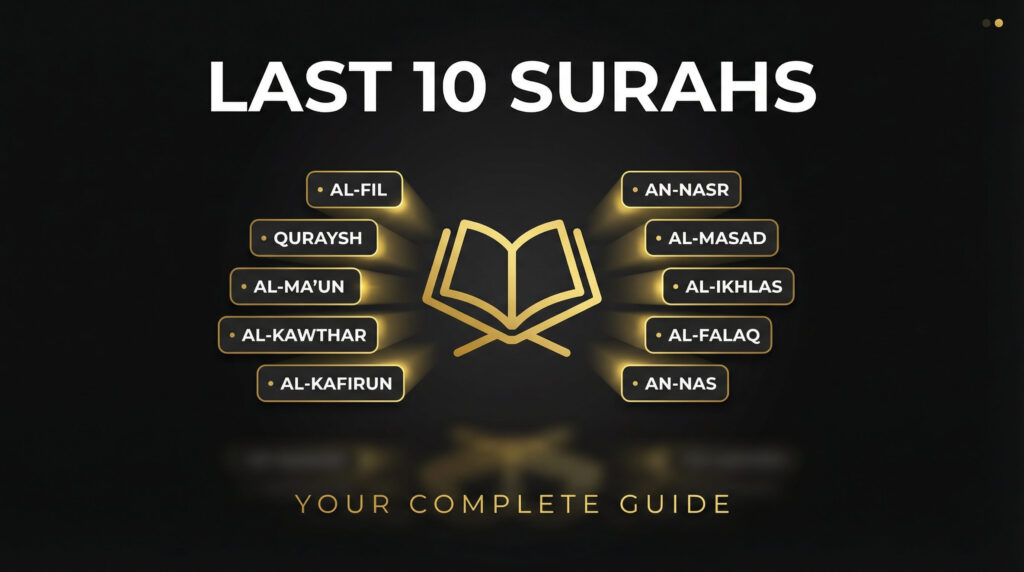
Did you know what is really cool about the Quran? The last 10 surahs of Quran are a sort of gift package, small and easy to remember yet loaded with meaning that it could consume volumes of books to explain the content therein. These surahs are the best places to start, in case you have just embarked on learning the Quran, or even when you want your kids to do so, since they are very short and sweet, but the last 10 surahs of Quran have messages that you will never forget.
I recall that when I was approximately 10 years of age, my grandmother would sit with me every night after the Maghrib prayer, and she would also be teaching me the last 10 surahs of Quran one after another. It was not like she forcefully made me memorise the words, but she narrated to me the stories that were behind the words, and frankly speaking, that is what I remember all these years later. That is just what I wish to do to you today. The last ten surahs Quran contains are perfect for beginners.
What Are the Last 10 Surahs of Quran?
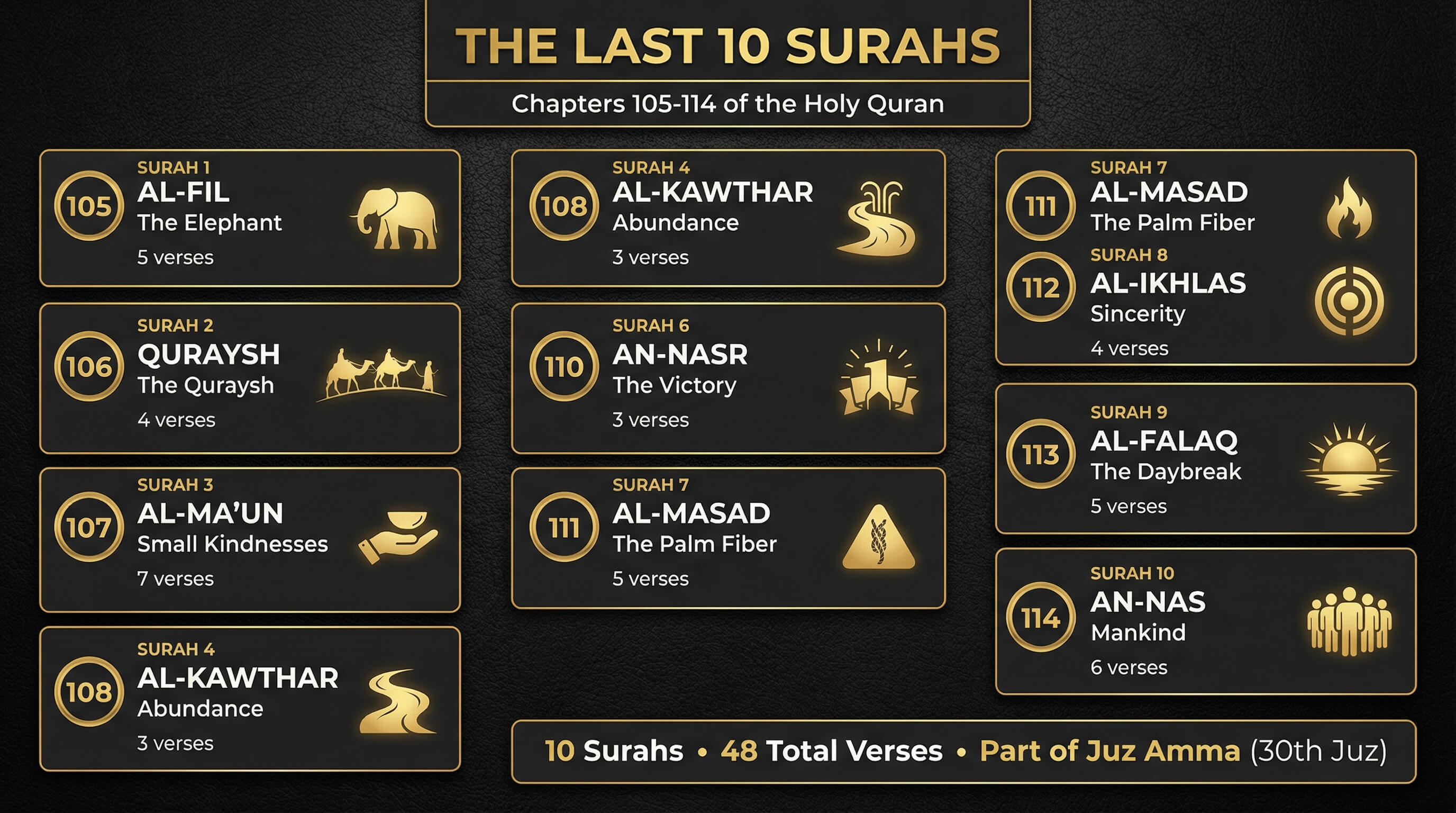
The Quran contains 114 chapters, and the last 10 surahs of Quran are located at the very end. The first surah is Surah Al-Fil (The Elephant) and the last surah is Surah An-Nas (Mankind). These are all part of the Juz Amma surahs, the 30th and final part of the Quran. Most of these surahs were primarily revealed in Mecca during a very difficult period of the early Muslims and each of them has a certain lesson which Muslims can still enjoy today.
The 10 last surah of Quran form a complete spiritual package. These 10 last surahs of Quran cover everything from stories to protection.
This is what makes the last 10 surahs of Quran special. They are not too long, and a child can memorize them within weeks, yet the meanings are profound enough that even the most experienced scholars continue to find out new things about them. This is the reason why the majority of Muslims repeat these surahs during their prayers and that is one of the reasons why Allah created them so simple to memorize.
The beautiful thing about the last 10 surahs of Quran is that when you combine them they make a story, a story of Prophet Muhammad (ﷺ), his struggles, his message and the victory which Allah promised him. They also educate us on what Allah is, how we should guard ourselves against evil and what kind of people we need to be.
To Read Full Quran Visit: Quran Page
Surah Al-Fil Meaning: The Astounding Story of the Elephant
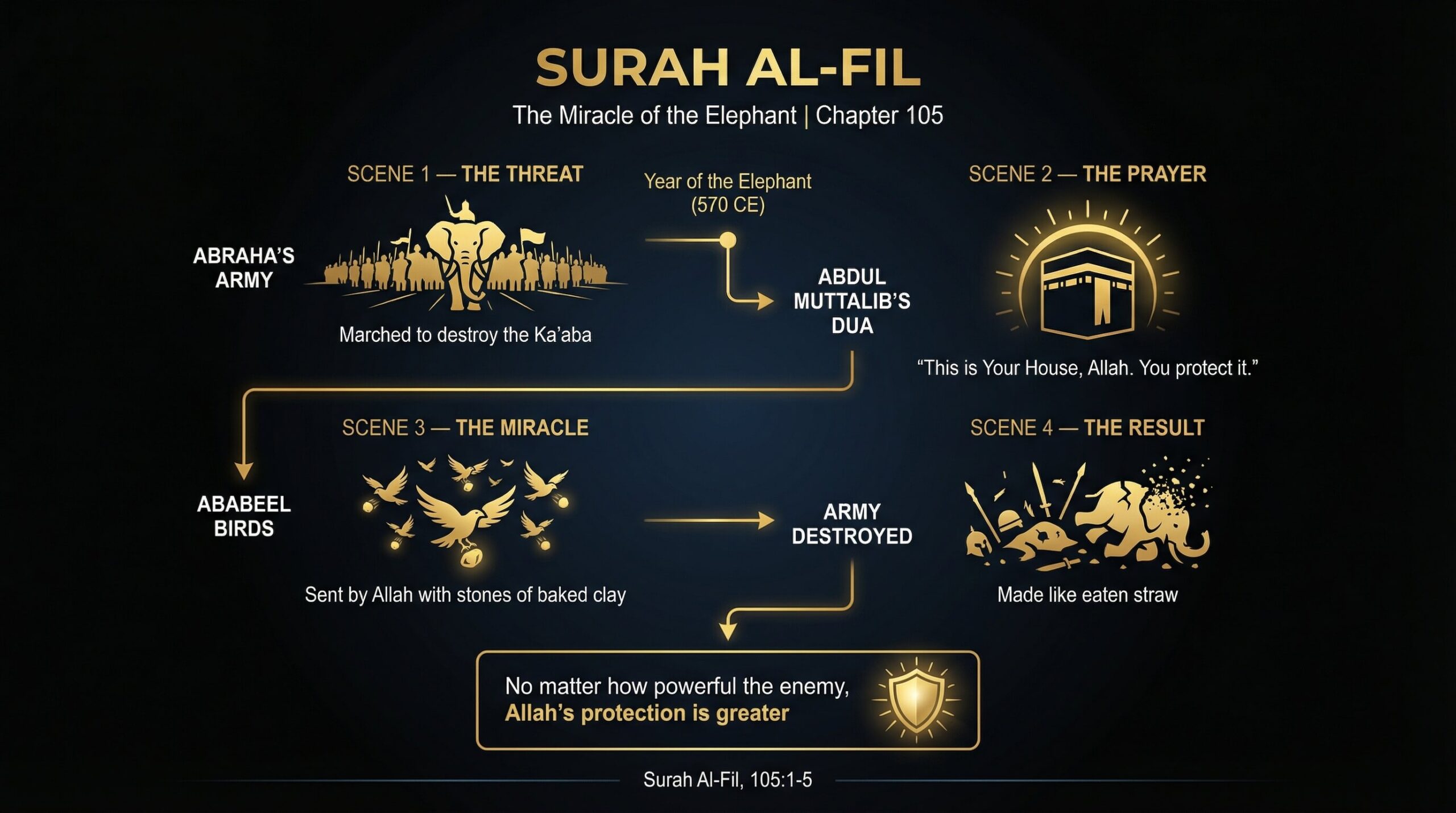
First of all, there is Surah Al-Fil, or The Elephant. This is part of the last 10 surahs of Quran, and it narrates one of the greatest tales of the history. The novel was set in the same year Prophet Muhammad (ﷺ) was born, thus it is a special one.
One such man was called Abraha, and he was a Christian ruler and constructed a large fancy church in Yemen since he wanted people to visit his location rather than the Kaaba in Mecca. The Arabs were not interested in his church, but went to the Ka’aba. This left Abraha extremely enraged and he assembled a huge army with elephants (which Arabs had never heard of) and waged war on Mecca, in order to demolish Ka’aba.
But how frightened the people of Mecca must have been? They had no army to fight back. The Kaaba was guarded at that time by Abdul Muttalib, the grandfather of Prophet Muhammad (ﷺ) and he uttered a very powerful dua to Allah. This is Your house, Allah,he basically said. You protect it.”
Something wonderful occurred then. Allah sent small birds known as Ababeel and these birds would carry little stones in their beaks and claws. The soldiers were entirely demolished when they launched these stones to the army of Abraha. Even the great elephants could not help them. Allah says in the Quran:
أَلَمْ تَرَ كَيْفَ فَعَلَ رَبُّكَ بِأَصْحَابِ الْفِيلِ أَلَمْ يَجْعَلْ كَيْدَهُمْ فِي تَضْلِيلٍ وَأَرْسَلَ عَلَيْهِمْ طَيْرًا أَبَابِيلَ تَرْمِيهِم بِحِجَارَةٍ مِّن سِجِّيلٍ فَجَعَلَهُمْ كَعَصْفٍ مَّأْكُولٍ
Did you not see how your Lord treated the companions of the elephant? Did He not bring their scheme to nothing? And He made flocks of birds and struck them with hard clay stones and He made them as eaten straw.
(Surah Al-Fil, 105:1-5)
The lesson here is massive. It does not matter how strong your opponent is – when Allah is on your side nothing can do you harm. The last 10 surahs of Quran teach lessons to any who feel weak or frightened that Allah can take care of you in a manner that you have never thought.
Surah Quraysh: The Blessings of Allah
Surah Quraysh which immediately follows Surah Al-Fil is actually related to it. When the army of Allah was destroyed by Allah against the army of Abraha, the Quraysh tribe (the tribe of Prophet Muhammad ﷺ) was further respected in the whole of Arabia. It was a known fact that Allah had preserved Ka’aba to them.
In this surah, Allah reminds the Quraysh about all the blessings that He gave them. They were able to travel safely both seasons, during winter to Yemen and during summer to Syria in order to trade. People revered the Quraysh as those who preserve the Ka’aba as they left the Quraysh alone in a time when there was danger and tribal wars in Arabia.
This surah is merely the Allah saying, Hey, I did so much to you. Does not the thought of your worshipping me alone, and being thankful, arise?
The message applies to us too. Consider everything Allah has provided to you; the family, the food, your safety, your health. When you give it a real consideration, there is so much that we should be thankful about. And the most fitting way of giving gratitude is to glorify Allah and obey His commandments.
Each last 10 surah of Quran carries unique lessons for believers
Surah Al-Ma’un (Small Kindnesses): Are You Really a Good Person?
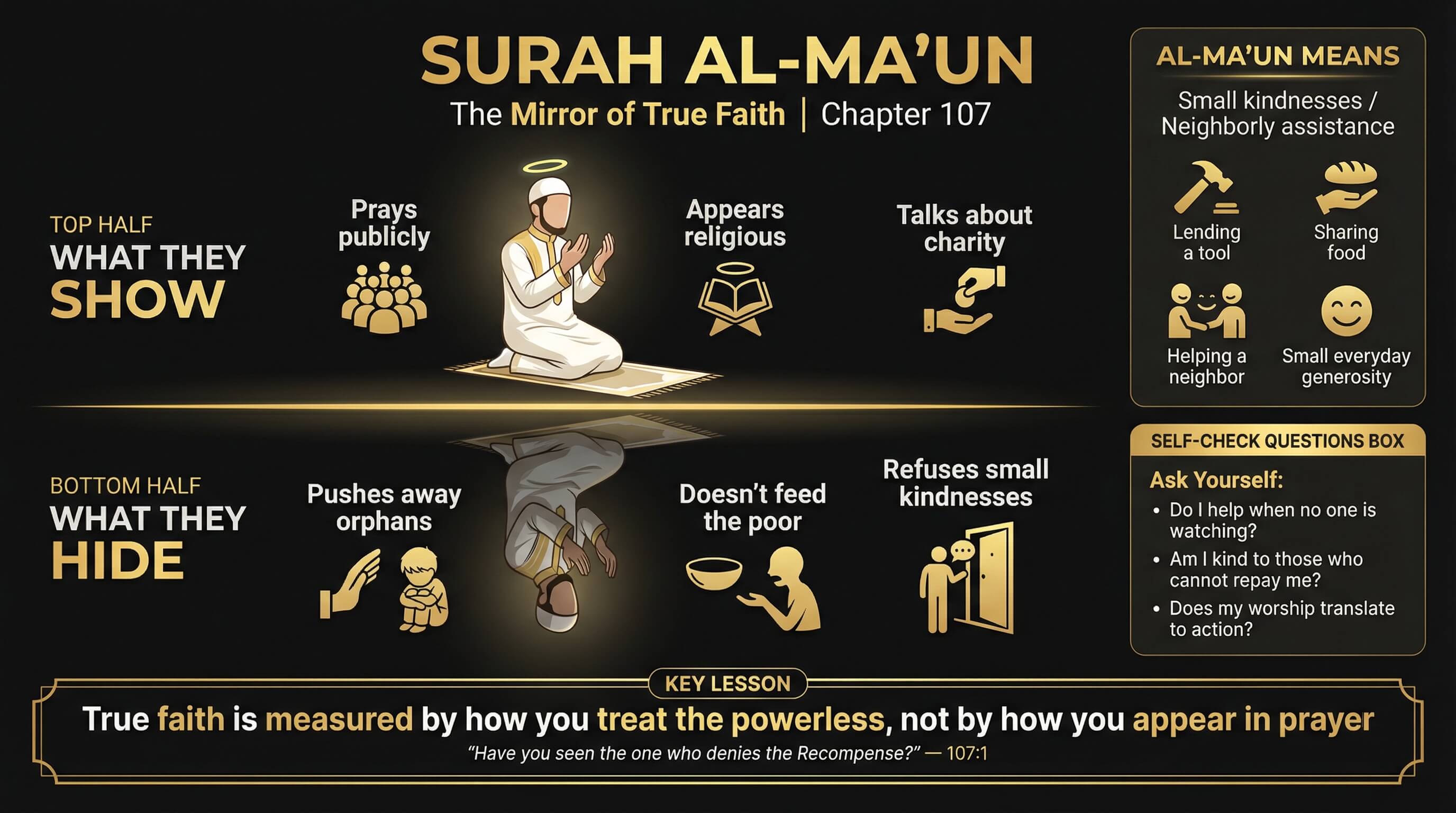
This surah, Surah Al-Maun is a surah that will make you take a turn to the mirror and pose some hard questions to yourself. It is about people, who pray and are engaged in religious activities yet their hearts are empty.
Allah talks about individuals who reject orphans, rather than supporting them, those who do not seek to feed the poor, and those who pray with the aim of displaying pride to the people. Ouch. It is an ugly thing to listen to but it is called.
Ma’un is the term that would say little favors- extending a plate or a building supply to someone when he or she requires. The questions that the surah is essentially posing are; if you are not even willing to do these small favors to others, why are you praying at all? Allah is informing us that worship does not entail moving your body to pray but the way you treat people, particularly those less powerful than you are.
I believe this is what we should keep in mind in 2026. It is easy to share on social media about the charity, discuss the issue of being a good person, but the challenge is to demonstrate what you can do even when no one is watching you. Do you assist the school child who has none as a friend? Would you share your lunch with a person who has forgotten his or her? It is these tiny favors that do count a great deal more than we believe.
Surah Kawthar Story: A Proclamation to the Prophet
Among the last 10 surahs of Quran, Surah Al-Kawthar is the shortest in the whole Quran, only 3 verses. However, its size is not a trick, this surah was revealed when Prophet Muhammad (ﷺ) was experiencing unbelievable suffering.
The opponents of Prophet would ridicule him due to the demise of his sons. They referred to him as abtar, or one without sons and whose name is destined to die out. How painful must that have been indeed?
Thus Allah sent this surah to console his beloved Prophet. Allah informed him that he has bestowed upon him, Al-Kawthar, a river in Paradise (Jannah), that is, plenty of goodness. It is the enemies of the Prophet who would be cut and forgotten, rather than the Prophet himself, all of which is the promise of Allah.
And look at history. Does anybody remember the names of those individuals who ridiculed the Prophet? Nobody. However, the name of Muhammad (ﷺ) is called upon millions of times every day in the adhan, prayers and in the discussions of Muslims all over the world. Allah kept His promise.
Surah Kafirun Meaning: No Amalgamation of Faith
Surah Al-Kafirun is a statement that is audacious. It is Allah informing Prophet Muhammad (ﷺ) to be absolutely clear to the non-believers with regard to there being no compromise when it comes to worshipping Allah alone.
Quraysh attempted to reach an agreement with Prophet. They would tell them such things as, Worship our gods one year, and we will worship your God one year. It seems to be an amicable consensus, does it? Wrong. In the case of faith in One God, it is all or nothing.
قُلْ يَا أَيُّهَا الْكَافِرُونَ لَا أَعْبُدُ مَا تَعْبُدُونَ وَلَا أَنتُمْ عَابِدُونَ مَا أَعْبُدُ
Say: O disbelievers, I do not worship what you worship, nor are you worshippers of what I worship.
(Surah Al-Kafirun, 109:1-3)
The surah concludes with: لَكُمْ دِينُكُمْ وَلِيَ دِينِ such that: To thee is thy religion, and to me is my religion. It is not about being nasty to others who practice other religions, it is simply being strong in what you believe in and understand that people have their own decision as well.
This surah is a good reminder in the current world whereby individuals at times coax you to dilute your faith to be accepted. It does not mean that you cannot be respectful and kind to all people and at the same time stand by what you think.
Surah An-Nasr (Victory/Help): Victory is Coming
Once the battle between faith and unbelief is established by Surah Al-Kafirun, Surah An-Nasr is the promise that is given with a gorgeous promise. Victory will come.
This surah discusses when people will come into Islam in great numbers and the Prophet (ﷺ) is asked to praise Allah and request his forgiveness on this occasion. According to some scholars, this surah was actually an indication that the Prophet mission on earth was nearly over since the victory was achieved.
The moral of the story is humility. And even in victory–even in the others–do not be proud, arrogant. Repent to Allah by thanking Him and request him to forgive you since without Him, none of your success would have been achieved.
Surah Al-Lahab/Masad: A Prophecy Against Abu Lahab
This surah is also special as it is the only surah in the Quran, which speaks of a certain enemy of the Prophet by name, that is, Abu Lahab. Abu Lahab was the uncle of the Prophet though; he was among the worst enemies of Islam. His wife would put thorns on the way that the Prophet was going to.
In this surah, Allah denounced Abu Lahab as well as his wife by saying that his riches and all his gains would not rescue him from Hellfire. This surah was unveiled when Abu Lahab was still living and it is a miracle that he never converted to become a Muslim just to show the Quran to be wrong. Had he had converted to Islam even to render the Quran false, it would have been a great issue. But Allah was aware that he never would–and he was not.
The surah acts as a threat to whoever goes against the truth with such hatred. Your fortune, your position, your friends–all this will not assist you in the Day of Judgment.
Surah Al-Ikhlas (Sincerity): Who is Allah?
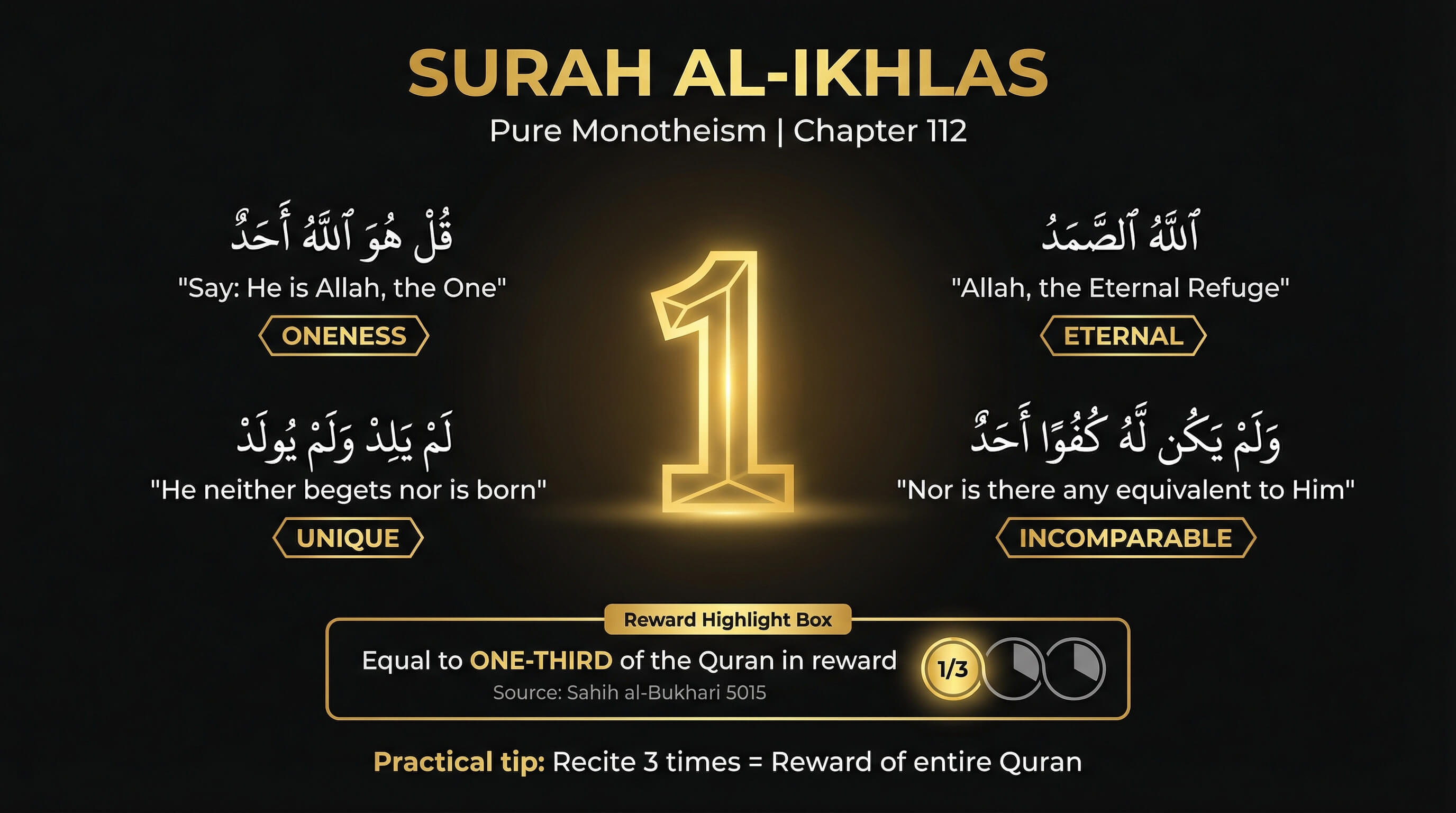
In case somebody presents to you, the question, Who is Allah?–this surah from the last 10 surahs of Quran provides you with the ideal answer. The surah Al-Ikhlas is known as the surah of pure monotheism, and the definition of who Allah is is stated in a mere four verses.
قُلْ هُوَ اللَّهُ أَحَدٌ اللَّهُ الصَّمَدُ لَمْ يَلِدْ وَلَمْ يُولَدْ وَلَمْ يَكُن لَّهُ كُفُوًا أَحَدٌ
“Say: He is Allah, the One. Allah, the Eternal Refuge. He begets not, is not born, and there is in Him no analogousness.
(Surah Al-Ikhlas, 112:1-4)
This surah disallows that Allah has any partners, children and parents. It clarifies that Allah is one without any similar thing. This surah, which is a summary of the greatest idea in Islam- Tawheed, the Oneness of Allah, was taught to us by the Prophet (ﷺ) to be in reward equivalent to a third of the Quran.
It has a saying concerning this:
The Prophet (ﷺ) said: “أَيَعْجِزُ أَحَدُكُمْ أَنْ يَقْرَأَ ثُلُثَ الْقُرْآنِ فِي لَيْلَةٍ؟” فَشَقَّ ذَلِكَ عَلَيْهِمْ وَقَالُوا: أَيُّنَا يُطِيقُ ذَلِكَ يَا رَسُولَ اللَّهِ؟ فَقَالَ: “اللَّهُ الْوَاحِدُ الصَّمَدُ ثُلُثُ الْقُرْآنِ”
Does any of you not have the capacity to recite a third of the Quran in a single night? They struggled with this and told them, Who of us can do that, O Messenger of Allah? He said, [Surah Ikhlas] of the Allah, the one, the self-sufficient Master, one-third of the Quran.
(Sahih al-Bukhari 5015)
The Surah Ikhlas benefits include reward equal to one-third of the Quran.
Surah Al-Falaq (Daybreak) and Surah An-Nas (Mankind): Protection Against Evil
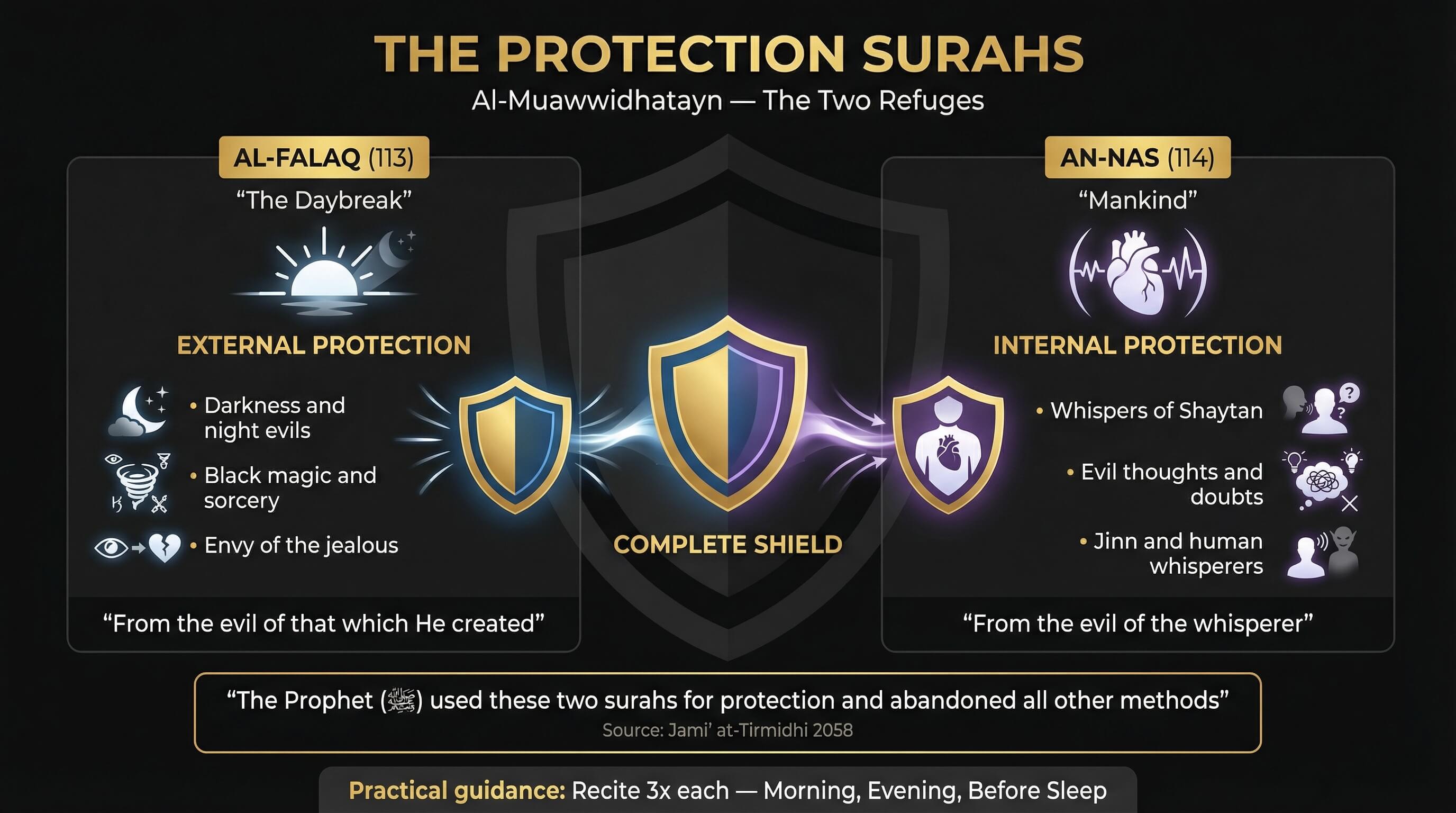
The last two surahs of the last 10 surahs of Quran go hand in hand, and they are known as Al-Muawwidhatayn – the Mu’awwidhatayn meaning is “the two surahs of seeking protection.” They were handed out to the Prophet (ﷺ) as insurance against any type of evil.
The Surah Al-Falaq is an appeal to the protection of Allah against the outer evils including the darkness, the black magic and envy of the jealous individuals. Surah An-Nas is a request that we be spared of inner evils, that is the whispers of Shaytan that penetrate our heart and mind.
Consider it in the following manner: Surah Al-Falaq safeguards the bad things which happen to you, and Surah An-Nas safeguards the bad thoughts which happen in your very self. Next to each other, they create a full shield. The Surah Falaq and Nas protection covers both external and internal evils. These are among the most powerful protection duas from Quran that every Muslim should know.
Abu Sa’id Al-Khudri (may Allah be pleased with him) has said:
كَانَ رَسُولُ اللَّهِ صَلَّى اللَّهُ عَلَيْهِ وَسَلَّمَ يَتَعَوَّذُ مِنَ الْجَانِّ وَعَيْنِ الْإِنْسَانِ حَتَّى نَزَلَتِ الْمُعَوِّذَتَانِ فَلَمَّا نَزَلَتَا أَخَذَ بِهِمَا وَتَرَكَ مَا سِوَاهُمَا
Until Surah Al-Falaq and Surah An-Nas were revealed the Messenger of Allah (ﷺ) used to take refuge against the evil of jinn and the evil eye. Once they were uncovered, he resorted to them as a way of seeking the protection of Allah and abandoned all other things other than them.
(Jami’ at-Tirmidhi 2058)
This hadith reveals why the last 10 surahs of Quran include these powerful chapters. They were used by the Prophet (ﷺ) himself and therefore we should practice the same habit by reciting them in the morning, evening and before going to sleep.
Protection from Jinn: Virtues of Reciting Last 10 Surahs
One of the greatest virtues of reciting the last 10 surahs of Quran is protection from jinn and evil forces. As mentioned in the hadith of Abu Sa’id Al-Khudri, the Prophet (ﷺ) specifically used Surah Al-Falaq and Surah An-Nas as protection duas from Quran against the evil of jinn.
Also Read: Surah Mulk Benefits: Complete Guide to Virtues & Protection
Why the Last 10 Surahs of Quran Are Ideal to Start With
Now, I would like to tell you why I believe that all people should begin with the last 10 surahs of Quran. To begin with, they are not long, and thus they do not necessitate the process of climbing a mountain when memorized. Second, once you comprehend their meanings, they are also more beautiful and become easier to memorize. These are the easy surahs to memorize because of their short length and rhythmic verses. These short surahs of Quran are perfect for children and new Muslims to memorize.
Each surah has its own flavor. There are story telling Surahs(such as Surah Al-Fil). You have surahs that make you reflect on your actions (such as Surah Al-Ma’un). There are some surahs that console you in time of sadness (such as Surah Al-Kawthar). And there are some surahs that guard you against evil (Surah Al-Falaq and An-Nas).
When the last 10 surahs of Quran are added together they will have almost everything a Muslim will be in need to know such as who Allah is, how the Prophet (ﷺ) was supported, what type of person you should become, and how to avoid evil. It is everything under one roof, within 10 small chapters.
How to Memorize the Last 10 Surahs of Quran
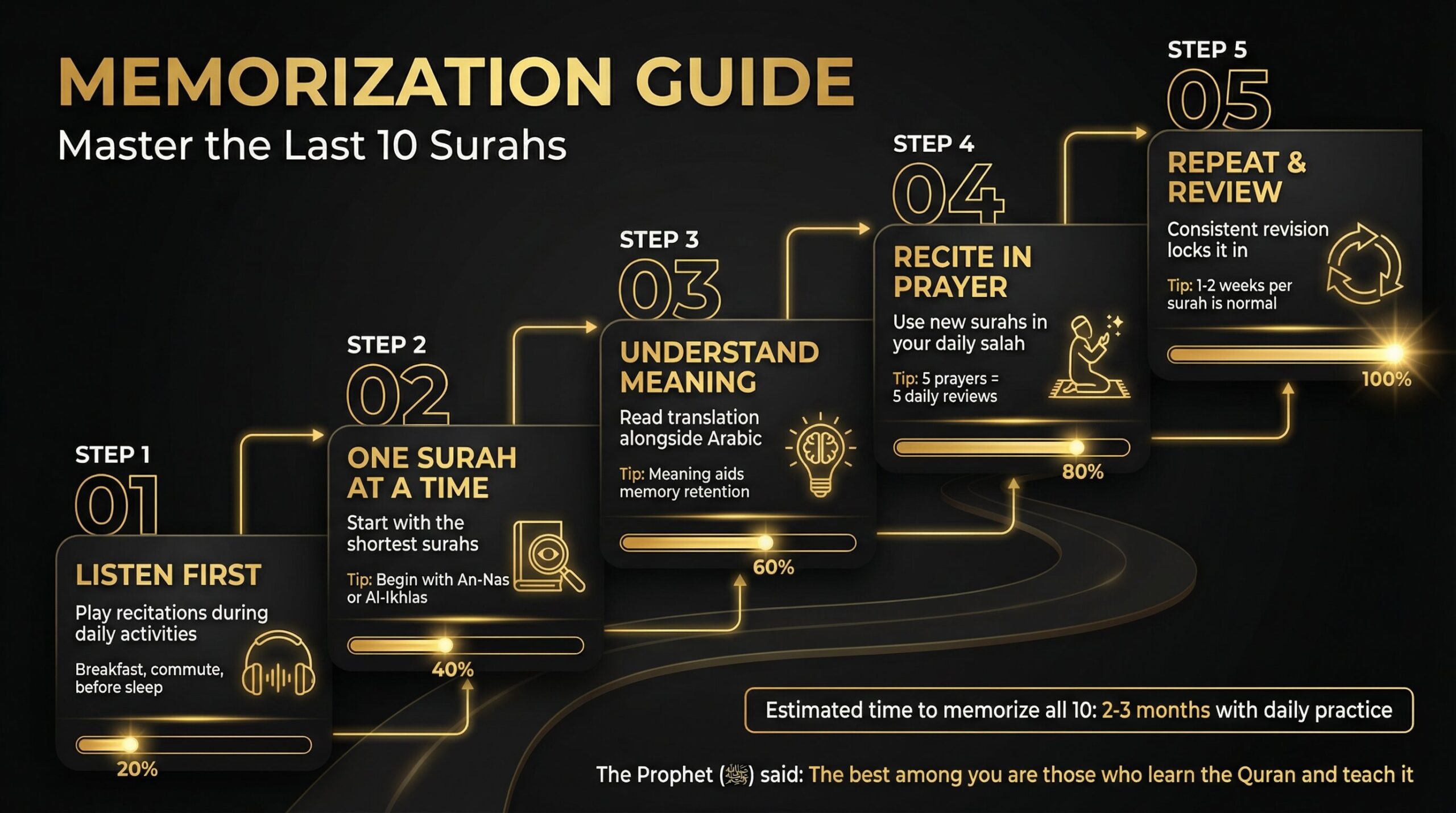
I am not going to lie- everything requires memorization. But the good news is this, the last 10 surahs of Quran are made easy. These are some of the tips that have worked and may work with you as well.
Start with listening. You are to put on a recitation of your favorite qari (reciter) and you are to listen. Do so during your breakfast, in the car or when going to bed. Even before you attempt to memorize the words, your ears will be beginning to pick them up.
Then learn one surah at a time. Don’t try to tackle all 10 at once. Begin with Surah Al-Ikhlas or Surah An-Nas as it is the shortest one and then proceed backwards. No hurry, devote a week or two to each of the surahs.
Read the translation. Speak deliberately and you remember what you have said. Added to that, it makes your prayer more meaningful as you do know what you are reciting. You can also download the last 10 surahs of Quran PDF for offline study and memorization. Many Muslims keep the last 10 surah of Quran PDF on their phones for easy access.
Recite in your prayers. These surahs are best memorized by using them in your daily salah. You have to repeat them several times a day, and they become second nature.
Quran memorization for kids should start with these surahs as they are short and meaningful.
The Beauty That Links the Last 10 Surahs of Quran
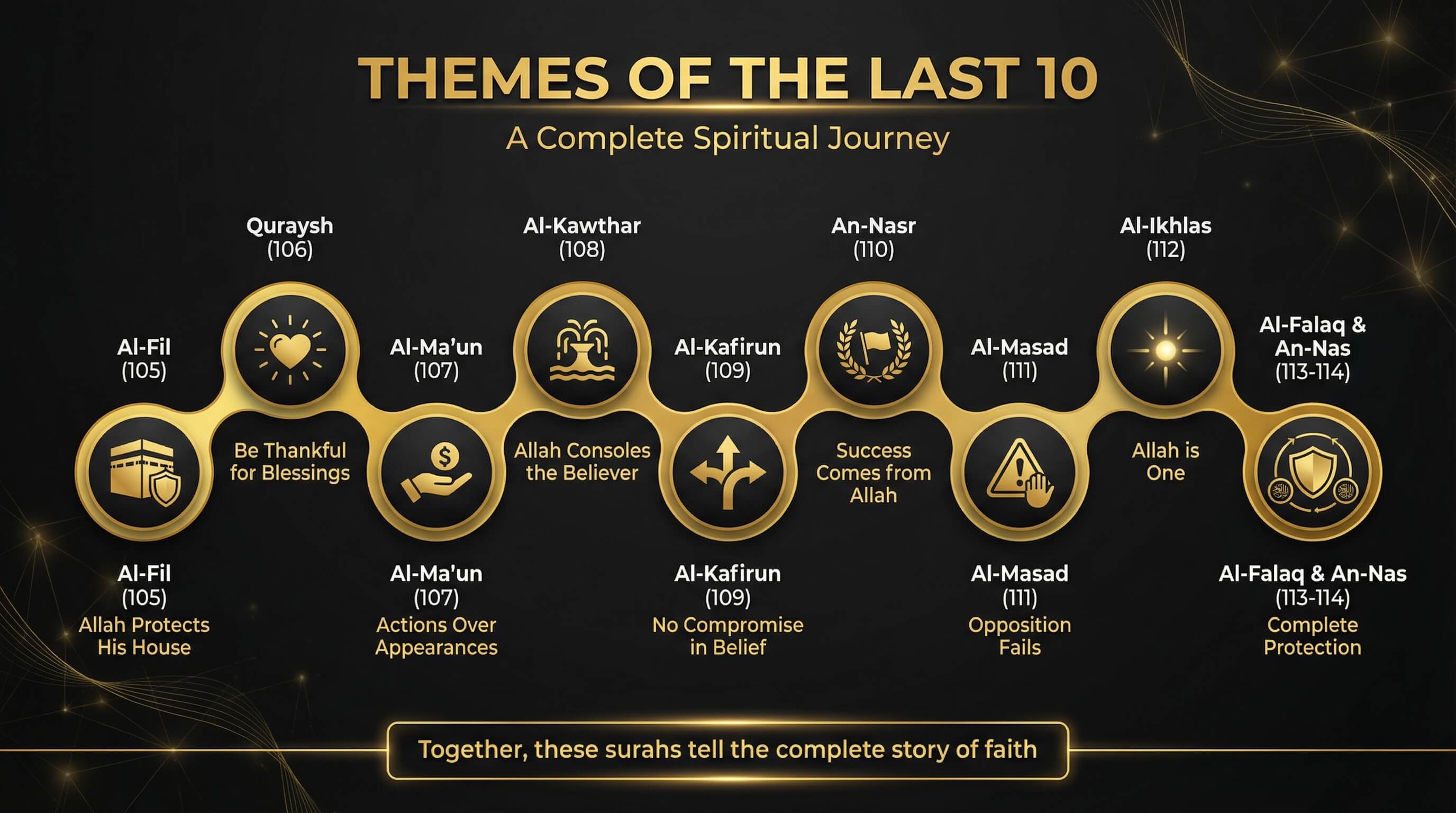
Here is one observation that scholars have made about the last 10 surahs of Quran – they are not randomly arranged. In fact there is so beautiful a flow and connection between them which makes sense when you consider them in detail.
Surah Al-Fil is obviously well matched to Surah Quraysh wherein the former describes how Allah punished an adversary of the Ka’aba and the latter reminds Quraysh that they should be thankful of that security. Surah Al-Ma.Un and Surah Al-Kawthar depict two categories of people; that is, stingy and fake people, and those who are generous and honest. Surah Al-Kafirun sets the war, Surah An-Nasr increases the war, and Surah Al-Masad demonstrates what to do with those who refuse to surrender.
Then, the last three Surahs – Surah Al-Ikhlas, Surah Al-Falaq and Surah An-Nas – sum it all up because they teach us that there is oneness of Allah and provide us with the means of safeguarding ourselves against all kinds of damage.
Almost like the story of Islam itself, these surahs narrate how Allah was perceived as having the need to protect the future of Islam prior to the birth of the prophet, the struggle that ensued in the process of his mission, the victory that followed and the beliefs and practices that Muslims are supposed to cherish.
Last 10 Surahs Benefits: Spiritual Bounties of Recitation
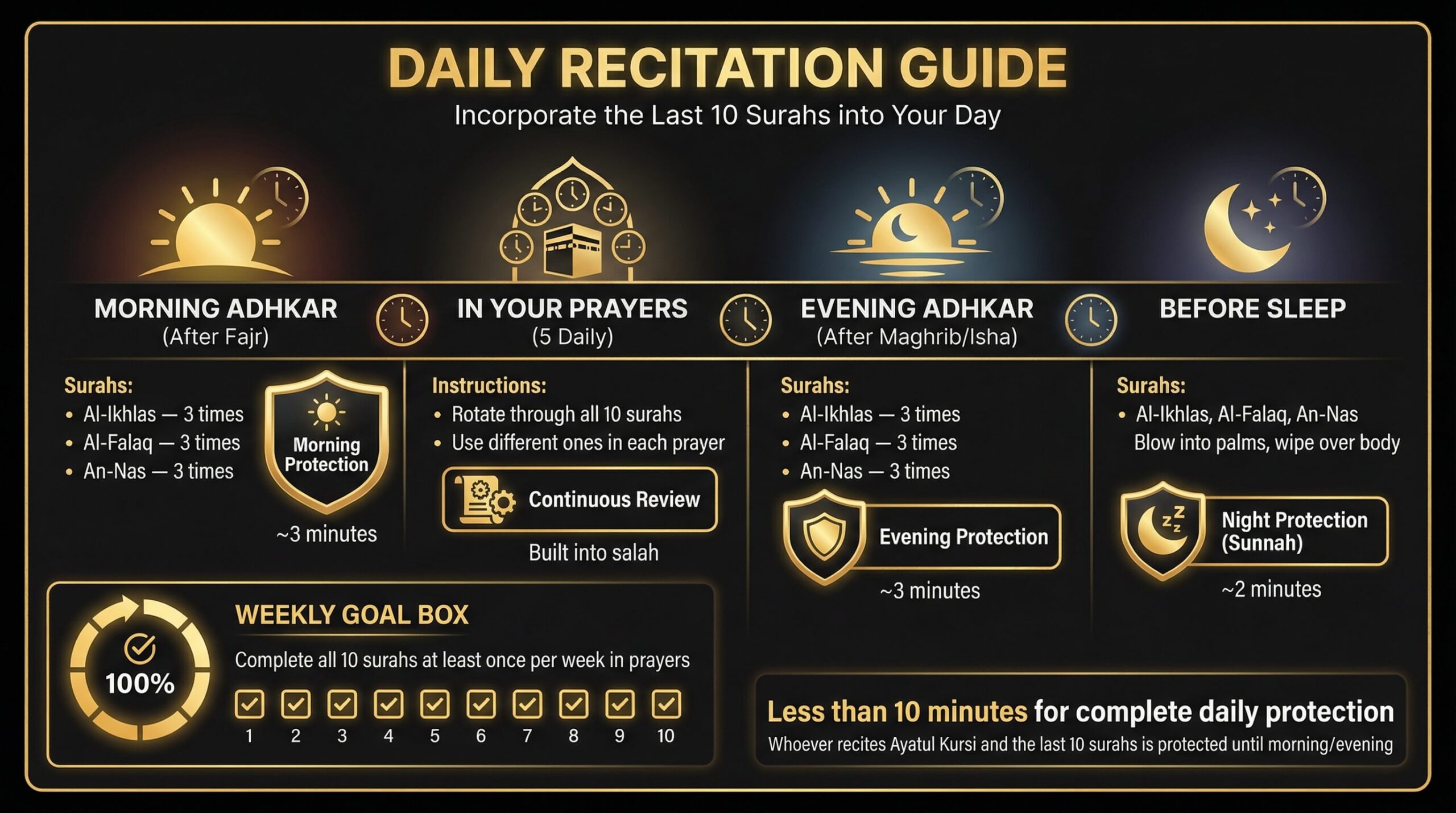
It is more than just memorizing, but having something special in your heart when reciting the last 10 surahs of Quran regularly. They bring peace. They do not forget to remind you of your purpose. They also identify you with a succession of believers who had been saying the same words before you by more than 1,400 years.
Surah Al-Ikhlas, Al-Falaq, and An-Nas are particularly the ones that are encouraged to be recited on a daily basis. According to many scholars, it is important to say them three times every morning and three times every evening to protect yourself during your day. The advantages are enormous, and it is possible to achieve them in just a few minutes.
And here is a thought that never leaves me silent, when you read these surahs you are reading the very words that Prophet Muhammad (ﷺ) read. The exact same Arabic. The exact same letters. It is a time connection that is quite special and should not be presumed upon.
Must Listen and Read: Last Ten (10) Surahs of the Holy Quran | Mishary bin Rashid Alafasy
Making the Last 10 Surahs of Quran Part of Your Life
So here’s my challenge to you. And even now, in case you are not learning these surahs, begin learning them this week. In case you already have them yet are not aware of their meaning, you should spare some time and go through the translation and reflect on what Allah wants to convey to you by these words.
These surahs are not to flaunt the amount of Quran you have memorized. They are supposed to transform your way of life. Surah Al-Ma’un ought to cause you to be kind. The Surah Al-Ikhlas is expected to increase your faith in Allah. The Muawwidhatayn must reassure you and safeguard you.
You should have these surahs as your daily companions. When you are afraid repeat them. repeat these surahs, being thankful. Give them out when you are at a loss of what to say. They are available when you need them, a blessing to Allah believers that continues to multiply.
May Allah ease the burden of everyone to memorize the last 10 surahs of Quran and the entire book of Allah, comprehend its meanings, and practice its teachings. May He save us every evil and bring us to that which He delighteth. Ameen.