Zakat is an obligatory annual payment of 2.5% of qualifying wealth, distributed to eight categories of recipients defined in Surah At-Tawbah (9:60). Sadaqah is voluntary charity with no fixed amount, timing, or recipient restrictions. Both purify wealth and earn divine reward, but they are not interchangeable — and the distinction matters more than most Muslims realize.
While this distinction seems straightforward, there is a critical nuance most resources miss: the Quran itself uses the word “Sadaqah” to mean Zakat in multiple verses, as verified by Imam al-Qurtubi in his tafsir. Understanding this historical overlap — rooted in the Arabic root ص-د-ق — is the key to reading charity verses correctly. In this guide, we provide complete Quranic and Hadith evidence, a unified four-madhab comparison, the 2026 FCNA/AMJA fatwa redefining Zakat eligibility, and an original PURIFY framework you can use immediately.
The four most common schools of Islamic law have a different jurisprudential stand on different technical issues. This guide presents all major positions together; however, scholars recommend seeking personal guidance from a qualified local scholar.
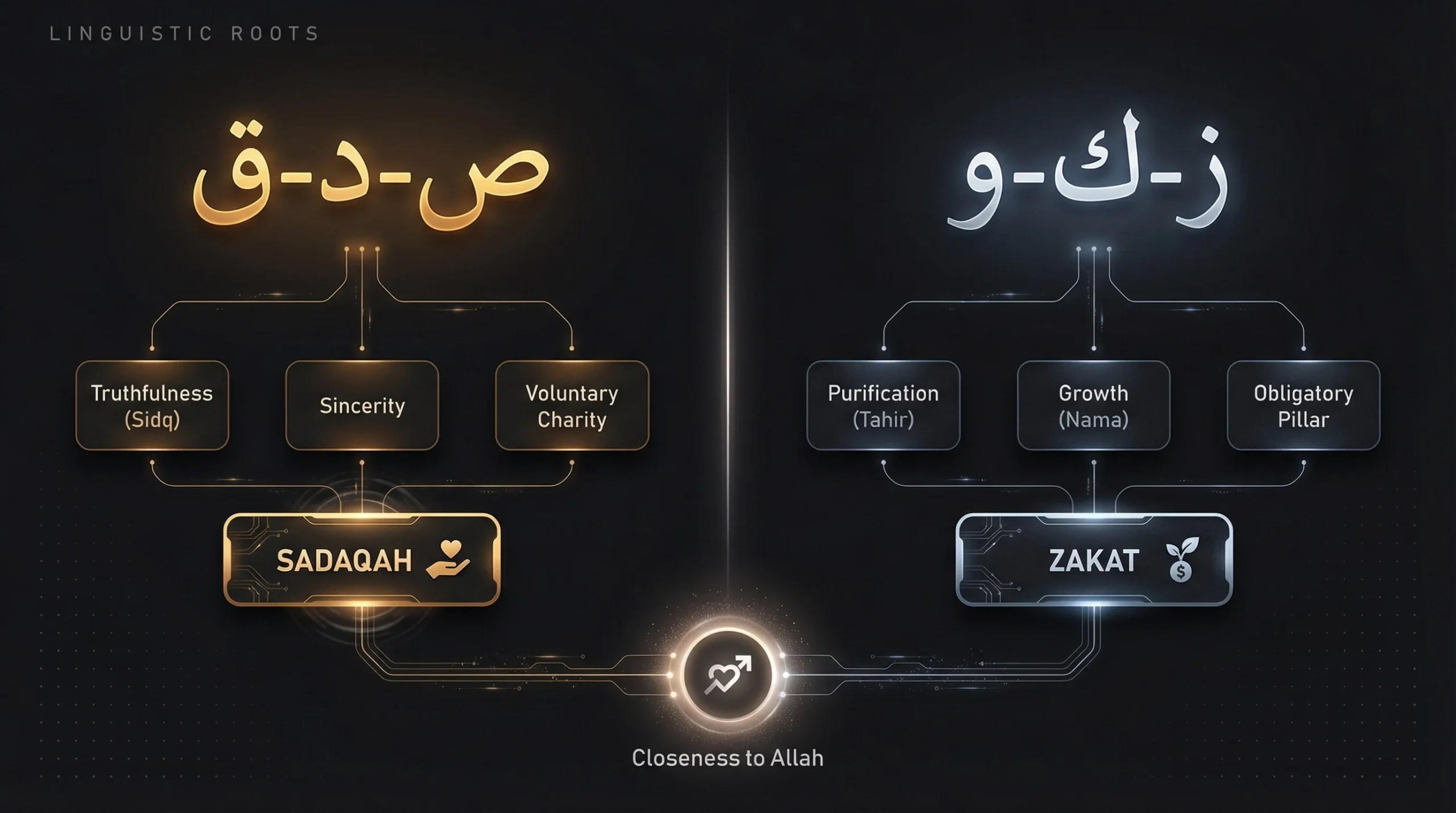
A significant percentage of current literature does not contain the etymological connection between the Arabic roots: Sadaqah (Related to Sidq), which then has the meaning of veracity, and Zakat (Related to Zaka), meaning purification and growth. It is these linguistic roots which help us see the spiritual aims behind every institution, but this is often obscured where surface-level comparisons are used. This exposition therefore offers complete Quranic and Hadith sources, a unified comparative tabular listing of the 4 Madhabs, the 2026/AMJA fatwa redefining Zakat eligibility and an instantly usable PURIFY model.
We also surface a verse from Surah Maryam (19:31) that fundamentally changes how you understand Zakat’s origins — and that nearly every other guide overlooks.
What Are Sadaqah and Zakat? (The 40-Second Answer Most Sites Get Incomplete)
Two different Arabic words, one of which is connected with one responsibility, and the other one is related to the other, but with the goal of a believer moving closer to Allah with the help of generosity.
Zakat, meaning the root ز-ك-و, is focused on such concepts as cleansing, prosperity, and luxury. As the third Pillar of Islam, it is a mandatory obligation (fard) on every Muslim whose wealth meets the Nisab (minimum wealth threshold) and continues over a continuous lunar year (Hawl). The standard rate of 2.5% applies to qualifying wealth, being paid to the eight divinely designated recipients.
Sadaqah is a word that carries the root ص-د-ق, which contains truthfulness and sincerity. In today usage, it refers to any voluntary alms, whether monetary or non-monetary, large or small, at any time to any one who is in need. A smile, a kind word, or removing an obstacle from someone’s path — all of these are Sadaqah.
The key difference, which most analyses fail to recognize, is the fact that when the Quran uses the term Sadaqah in an absolutist, unqualified form, it is always referring to compulsory charity, i.e. Zakat. The contemporary habit of looking at Sadaqah as the voluntary act only is a linguistic shortening that developed throughout centuries; what is needed is to get the picture of the breadth of the term to correctly interpret the passages in the Quran which refer to charity.
Now we shall see the exact Quranic events of every word, the verse, which nearly 90 per cent of guides omit.
The Quranic Evidence for Zakat and Sadaqah (Including the Verse Most Guides Miss)
The Quran addresses charity extensively — for broader Quranic wisdom, see our collection of Quran quotes about life.
Charitable provision is obligated in the Quran no less than thirty times. Some of the verses are notable in their clear definition of requirements, the kind of beneficiaries, and the spiritual motivation of both Zakat and Sadaqah; the list that follows is arguably the most comprehensive list of verses in one source.
Zakat as a Pillar Paired With Prayer
The Quran on several occasions associates Zakat with Salah by confirming that it is mandatory:
“وَأَقِيمُوا۟ ٱلصَّلَوٰةَ وَءَاتُوا۟ ٱلزَّكَوٰةَ ۚ وَمَا تُقَدِّمُوا۟ لِأَنفُسِكُم مِّنْ خَيْرٍ تَجِدُوهُ عِندَ ٱللَّهِ”
“And establish prayer and give Zakat, and whatever good you put forward for yourselves, you will find it with Allah.”
— (Quran, Al-Baqarah 2:110)
This thematic connection is found in over twenty four verses. In his renowned commentary, Ibn Kathir mentions that this regularity of association indicates that Zakat is not something optional but it is in equilibrium with Salah as a pillar of the religion.
The Purification Verse: Where “Sadaqah” Means Zakat
“خُذْ مِنْ أَمْوَٰلِهِمْ صَدَقَةً تُطَهِّرُهُمْ وَتُزَكِّيهِم بِهَا”
“Take from their wealth a charity (Sadaqah) by which you purify them and cause them increase.”
— (Quran, At-Tawbah 9:103)
Even though Quran also makes use of the term Sadaqah, it is agreeable by scholars that this term is used in regards to obligatory Zakat. The tafsir exegesis elaborates how Zakat, which is often described as tahir (purification), purges the giver of such spiritual defilements as greed and attachment.
The 8-Category Verse: Zakat’s Recipient Blueprint
“إِنَّمَا ٱلصَّدَقَـٰتُ لِلْفُقَرَآءِ وَٱلْمَسَـٰكِينِ وَٱلْعَـٰمِلِينَ عَلَيْهَا وَٱلْمُؤَلَّفَةِ قُلُوبُهُمْ وَفِى ٱلرِّقَابِ وَٱلْغَـٰرِمِينَ وَفِى سَبِيلِ ٱللَّهِ وَٱبْنِ ٱلسَّبِيلِ ۖ فَرِيضَةً مِّنَ ٱللَّهِ ۗ وَٱللَّهُ عَلِيمٌ حَكِيمٌ”
“Zakah expenditures are only for the poor and for the needy and for those employed to collect [Zakah] and for bringing hearts together [for Islam] and for freeing captives [or slaves] and for those in debt and for the cause of Allah and for the [stranded] traveller — an obligation [imposed] by Allah. And Allah is Knowing and Wise.”
— (Quran, At-Tawbah 9:60)
Al-Qurtubi observes that such eight groups are fixed by God — the All-Knowing, the All-Wise — no man can change it. This verse forms the basis of all the Zakat distribution decisions of the four Madhabs.
The Verse Most Guides Overlook: Prophet Isa and Zakat
“وَأَوْصَـٰنِى بِٱلصَّلَوٰةِ وَٱلزَّكَوٰةِ مَا دُمْتُ حَيًّا”
“And He has enjoined upon me prayer and Zakah as long as I remain alive.”
— (Quran, Maryam 19:31)
This verse is very dramatic as it puts the burden of Zakat on Prophet Isa — whose name was uttered as a miracle, as a baby. Allah ordered all the prophets to pay Zakat before Muhammad ﷺ and this made it a general command of God, rather than an institution of this Ummah.
The Makkan Origin: Zakat Before Madinah
“وَأَقِيمُوا۟ ٱلصَّلَوٰةَ وَءَاتُوا۟ ٱلزَّكَوٰةَ”
“And establish prayer and give Zakah.”
— (Quran, Al-Muzzammil 73:20)
Ibn Kathir used this verse to demonstrate that the element of Zakat was already enforced in the early days of the Islamic faith in Makkah. In this early time no special Nisab or measure was prescribed. Anything that a Muslim possessed above the necessity was to be used in the way of Allah. The rates and thresholds were particular following the Hijrah to Madinah.
There are two additional verses which complete the image. Surah Fussilat (41:6-7) includes one of the stern warnings:
“وَوَيْلٌ لِّلْمُشْرِكِينَ ٱلَّذِينَ لَا يُؤْتُونَ ٱلزَّكَوٰةَ”
“And woe to those who associate others with Allah — those who do not give Zakah.”
— (Quran, Fussilat 41:6-7)
While Surah Al-Hashr (59:10) provides a Quranic foundation to seeking forgiveness and making dua on behalf of the deceased:
“رَبَّنَا ٱغْفِرْ لَنَا وَلِإِخْوَٰنِنَا ٱلَّذِينَ سَبَقُونَا بِٱلْإِيمَـٰنِ”
“Our Lord, forgive us and our brothers who preceded us in faith.”
— (Quran, Al-Hashr 59:10)
A verse that will be the focus of the Sadaqah Jariyah discussion below.
Having the Quranic basis, there is a well-known Hadith, which opens up a form of charity that most people underrate — but knowledge of the ruling is only half the picture.
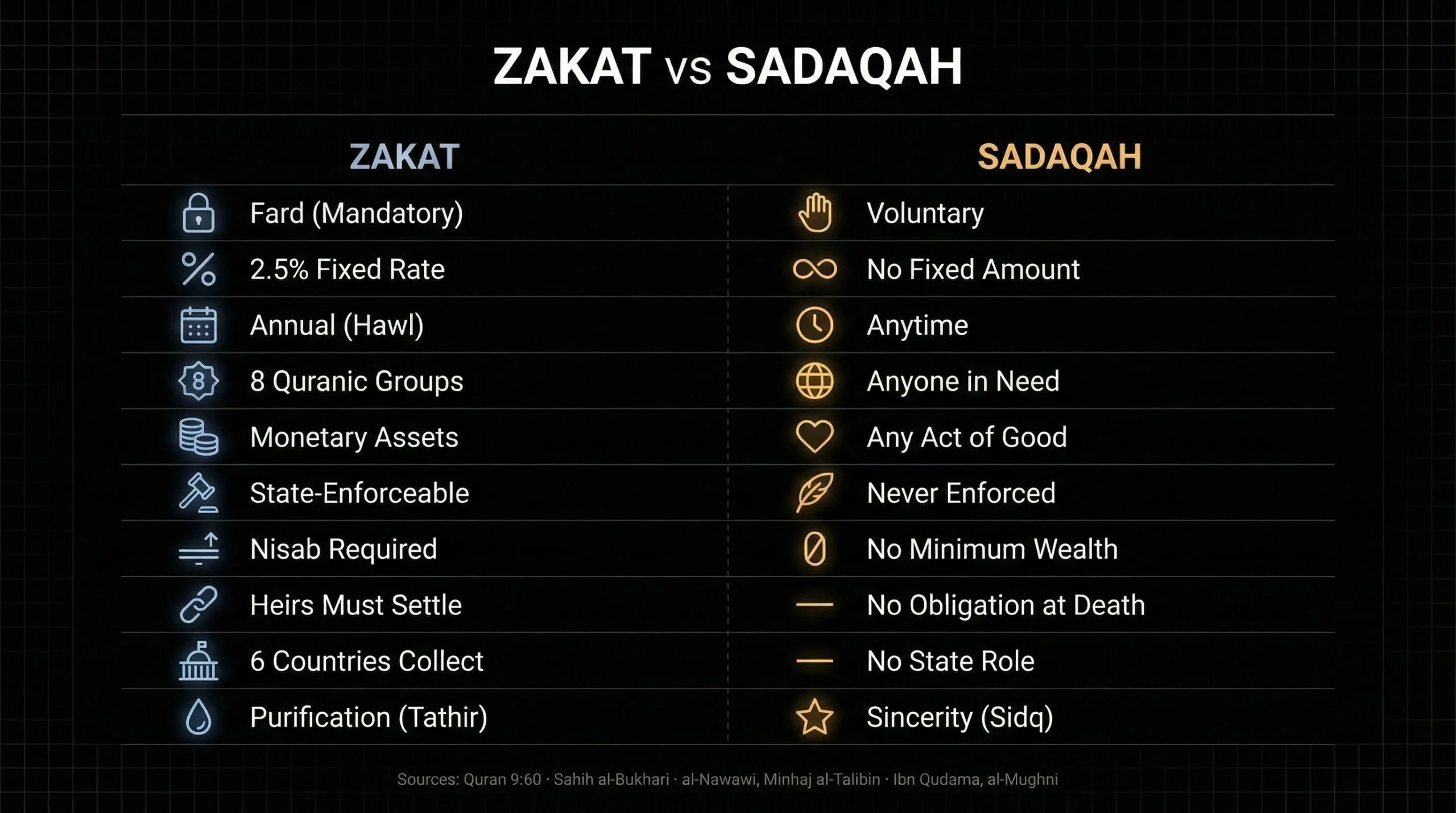
10 Key Differences Between Sadaqah and Zakat (Side-by-Side Comparison)
The distinction between Zakat and Sadaqah is not simply the one concerning obligation and choice. These two types of Islamic charity vary in terms of quantity, time of enforcement, beneficiaries, implementing, and spirituality. The following table represents the most complete side by side comparison that can be found online, and the sources of each differentiation.
| Characteristic | Zakat | Sadaqah | Source |
| Obligation | Fard (mandatory) — one of the Five Pillars of Islam | Sunnah / Mustahabb (voluntary and recommended) | Al-Nawawi, Minhaj al-Talibin; Ibn Qudama, al-Mughni |
| Value | 2.5 per cent of qualifying wealth (most asset types) | No amount specified — any amount will be accepted | Sahih al-Bukhari 1395; Sahih Muslim 19 |
| Timing | Once in every lunar year (Hawl) when the wealth has reached Nisab | Any time — no limitations to when or how often | Ibn Qudama, al-Mughni; al-Kasani, Bada’i al-Sana’i |
| Receivers | Limited to 8 groups, as stated in Quran (9:60) | Unlimited — to any person, Muslim or non-Muslim, rich or poor | Quran 9:60; Tafsir al-Qurtubi |
| Form | Must be of a legitimate type of wealth (monetary) | Monetary and non-monetary (a smile, a kind word, removing harm) | Sahih al-Bukhari 2989; Sahih Muslim 1009 |
| Enforcement | Can be enforced by an Islamic state with punishments on non-payment | Never enforced; purely voluntary | State Zakat in 6 countries today; Ibn Qudama, al-Mughni |
| Wealth Threshold | Must meet Nisab (minimum wealth level) to be obligatory | No threshold — anyone can give | Al-Nawawi, Minhaj al-Talibin; al-Marghinani, al-Hidayah |
| Unpaid at Death | Heirs should pay the amount of any unpaid Zakat on behalf of the deceased | No outstanding obligation upon death | Sahih al-Bukhari 1953; Ibn Qudama, al-Mughni |
| State Role | Collected by the state in Libya, Malaysia, Pakistan, Saudi Arabia, Sudan, and Yemen | No state role | Modern models of governance |
| Spiritual Purpose | Tathir — purification of wealth and soul, growth (Zaka) (9:103) | Sidq — expression of truthfulness, sincerity and closeness to Allah | Quran 9:103; Quran 2:245 |
The key point here is that Zakat has a very strict legal framework. Sadaqah has no limit, no limit, and no limit on whom it can benefit. The two cannot in any way be used interchangeably, when the individual is paying Zakat, it is a certain obligation with certain rules and conditions, not a Sadaqah.
Another aspect that several guides overlook: Niyyah (intention) has a different role in each. Your Zakat Niyyah should include that you are obligatory giving Zakat, but not charity. In the absence of this deliberate differentiation, the money might not allow you to meet your Zakat even when it gets to the appropriate individuals.
Such differences of structure are depicted in this table — but the real question is: Who exactly can be the recipients of which type of charity? The answer that was given in the Quran is surprisingly precise.
The 8 Categories of Zakat Recipients (Surah At-Tawbah 9:60 Explained)
Allah never left the act of Zakat to human being. According to Surah At-Tawbah (9:60) there are eight (and no more than eight) types of qualified recipients, known as the Asnaf. Understanding each category requires both classical tafsir knowledge and awareness of modern applications.
Who Are the “Poor” (Fuqara) vs. the “Needy” (Masakin)? al-Tabari’s Clarification
The initial two categories — Fuqara (the poor) and Masakin (the needy) — are seemingly identical at that. In his Tafsir al-Tabari Imam al-Tabari made a distinction: the Faqir has nothing or very little, and the Miskin has something but not enough to make his daily needs. The practical distinction is important since the two categories of people can qualify in their own right: a person with partially received income but yet in need is a Miskin and a right recipient of Zakat.
The third branch, Amilin (or those employed to collect Zakat) encompasses the administrative system. One of hadiths reported by Abu Musa al-Ash’ari and included in Sahih al-Bukhari confirms the fact that a good Muslim who is a collector of Zakat and carries out his duty with faithfulness will be provided with his share in the money he will have collected.
The “Those Whose Hearts Are Reconciled” Debate: Why Hanafi Scholars Differ
The most controversial category is the fourth one, which is called Mu’allafat al-Qulub (those, whose hearts are to be reconciled). The Hanafi school holds that this category was suspended because its legal cause (‘illah) ceased after the strengthening of Islam during the caliphate of Umar ibn al-Khattab, and is therefore no longer a valid outlet to channel Zakat. The Shafi’i school permits Zakat under this category to be given to sinful Muslims to strengthen their faith, but not to non-Muslims.
The Maliki and Hanbali traditions of jurisprudence suggest that the applicable category has survived and that it can be applied in case of an actual need appearing; the divergence has direct and concrete consequences on modern Zakat institutions.
The fifth one, Riqab (freeing captives or slaves), is interpreted by the modern scholars as covering the attempts to free the people who are in bondage or captivity. The sixth, Gharimin (those in debt), refers to people whose debts were not spent sinfully.
“Fi Sabeel Allah” in 2026: The Category Scholars Disagree About Most
Fi Sabeel Allah (in the cause of Allah) is the seventh category and it is the seat of the most burning academic debate of the present day. Only Hanafi school restricts this to a Mujahid (one who engages in defense) and who is not able to do so because of the lack of means, or someone who is not able to afford Hajj. The Shafi’i school has a wider interpretation, which engulfs the knowledge-seekers and the students of Islamic sciences. A wider reading is also preferred by the Hanbali school.
The type assumed pre-eminence in the joint fatwa of January 2026 issued by the FCNA/AMJA a process examined in the 2026 update section below.
Can Refugees Receive Zakat? (Ibn al-Sabeel in the Modern World)
Ibn al-Sabeel (the stranded traveller) is the eighth type and it has a great topicality nowadays. Classical jurists such as Imam al-Nawawi termed this as a person disconnected with his or her wealth whilst traveling. The modern-day thinkers, such as the Dar al-Ifta al-Misriyyah and the Al-Azhar Fatwa Committee, have asserted that the refugees and displaced people, especially those who have escaped war-torn countries, qualify well under this classification. A Syrian family that is marooned in its neighbouring nation with no access to their property fits into the jurisprudence of all the four schools as Ibn al-Sabeel.
Understanding who receives Zakat leads to an equally important question: what kind of Sadaqah never ceases to reward you — even when you are already dead.
What Is Sadaqah Jariyah? The Charity That Outlives You
One particular prophetic account has had a significant influence on the way of Islamic thinking about the legacy, possibly more than any other.
“When an individual dies, his actions cease except three: Sadaqah Jariyah, good knowledge or a pious child that prays on his behalf.”
— (Narrated by Abu Hurayrah, Sahih Muslim 1631, graded Sahih)
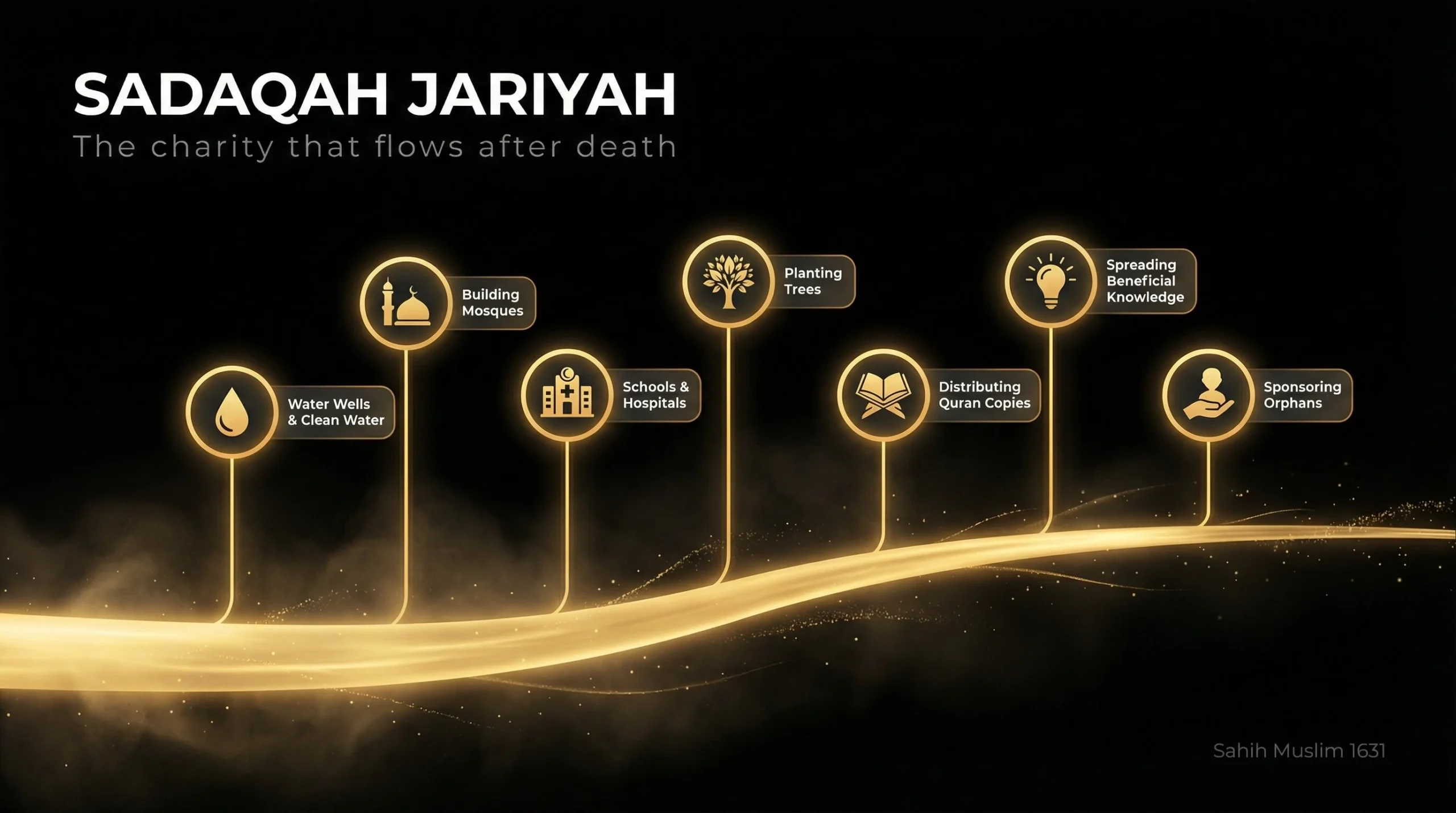
Sadaqah Jariyah literally translates to “running” or “flowing” charity — that is, charity that will long remain of benefit to the recipients and rewarding to the giver of the charity long after the act has taken place. This hadith is also found in Riyad al-Salihin (Hadith No. 1383) which was compiled by Imam al-Nawawi, which confirms its core in the Islamic charity.
The thing is that Sadaqah Jariyah does not just appear to be a popular idea, and it does possess a legal definition. Imam al-Nawawi replied: Continued charity is a form of Waqf (endowment). This was repeated by the famous Shafi’i jurist al-Khatib ash-Sharbini in Mughni al-Muhtaj: “The continued charity, according to the scholars, means the Waqf.” This taxonomy is significant in the sense that it identifies Sadaqah Jariyah as part of the known Islamic law system of endowments, and of assets whose principal is held back, but the benefits of which run in perpetuity.
The definite forms are extended under a supporting hadith contained in Sunan Ibn Majah 242 (classified as Hasan):
“Knowledge, a righteous child, a Quran left as a legacy, and a mosque constructed, a house to wayfarers, a stream excavated, charity given when in health, all these and the rest of the good works whose benefit flows to a believer after death: of these good works I say that, although they may have these benefits, they cannot be counted with other good works.”
— (Sunan Ibn Majah 242, classified as Hasan)
According to these reports, there are seven major types of Sadaqah Jariyah as identified by scholars:
- Water wells and clean water projects — The Prophet ﷺ was questioned and said, which charity is the best? He responded, “[Providing] water” (Sunan Abu Dawud 1681, graded Sahih).
- Construction of mosques — “Whoever constructs a mosque in the name of Allah — even if it be as small as the nest of a sand grouse — Allah will construct for him a house in Paradise” (Musnad Ahmad 3413, classified as Sahih).
- Schools, hospitals and educational institutions.
- Planting of trees — “Any Muslim who plants a tree or sows a field and people or animals or birds feed on it is counted as charity” (Sahih al-Bukhari 2320; Sahih Muslim 1553, categorized as Sahih).
- Distributing copies of the Quran — particularly impactful surahs like Surah Yaseen.
- Spreading positive information (books, courses, Islamic education) — including helping others memorize the Quran.
- Sponsorship of orphans with long term care facilities.
The similarity: the great performance continues and its rewards continue to flow.
Before we move on, there’s a form of charity that changes everything — can this flowing charity do good to one that is dead already? The solution — and the fact — may startle you.
Sadaqah Jariyah for the Deceased: Can It Really Reach Them?
A companion, identified in some narrations as Sa’d ibn ‘Ubadah, came to the Prophet ﷺ deeply concerned. His mother had died suddenly, without leaving a will. He asked: “Would she receive reward if I gave Sadaqah on her behalf?” The Prophet ﷺ replied simply: “Yes.” (Narrated by ‘Aa’ishah, recorded in both Sahih al-Bukhari 1388 and Sahih Muslim 1004, graded Sahih.)
This is one of the most comforting teachings of Islam which is based on this hadith, which is of the highest grade of authenticity, has direct and unambiguous nature.
It is proven in academic circles. Imam al-Nawawi used to say that the reward of du’a, charity and Hajj reaches those who die, as the Ahl al-Sunnah wal-Jama’ah agree upon. Sheikh Ibn Baz said it clearly that Sadaqah on the deceased is valid and its benefit accords to them. Sheikh Ibn Uthaymeen also confirmed that it is permissible and is a form of kindness the reward of which goes back to the dead.
The Quran itself outlines a procedural framework via two areas in the Quran:
“رَبَّنَا ٱغْفِرْ لَنَا وَلِإِخْوَٰنِنَا ٱلَّذِينَ سَبَقُونَا بِٱلْإِيمَـٰنِ”
“Our Lord! Forgive us and our brothers who have preceded us in Faith.”
— (Quran, Al-Hashr 59:10)
“رَّبِّ ٱرْحَمْهُمَا كَمَا رَبَّيَانِى صَغِيرًا”
“My Lord! Have mercy upon them as they brought me up when I was small.”
— (Quran, Al-Isra 17:24)
All these verses can be used to express the idea that praying and good action done on behalf of others such as those who are already dead are heeded by the Divine thus forming a theological basis of intercessory acts.
Where the Madhabs Diverge: Does Quran Recitation Reach the Dead?
The difference between the four main Madhabs focuses on the fact that reciting Quran gives reward to the deceased. Although every school is in agreement that Sadaqah Jariyah which is continuous charity paid on behalf of a deceased soul is allowed and even encouraged, some subtle differences can be found in performing certain worship practices like Quran recitation.
It is on this basis that both the Hanafi and Hanbali schools hold that the Quran recitation for the dead is a charity that, when done, actually benefits the deceased. The Maliki school also states that the reward reaches the dead. On the other hand, as per the Shafi’i tradition, the reward of Quran recitation is individual to the reciter; unless there is a clear indication of its transferability, the reward does not reach the dead.
In the development of Sadaqah Jariyah to a parent or a loved one, the scholars of all the schools approve one set of actions that produce long-term benefit. These include:
- Digging a well or starting a project of collecting water in their name;
- Subsidizing the building or endowment of a mosque;
- Donating an educational scholarship or academic endowment;
- Planting fruitful and shady trees to supply generations with shade and fruit, to benefit man and the animals;
- Continuous supplication (du’a) for them.
With these core ideas having been stated, there is a crucial procedural question that follows: what parameters govern the validity of the one who pays Zakat — because failing to meet even one of the parameters can negate the whole duty.
The 6 Conditions That Make Your Zakat Valid (Shuroot al-Wujub)
Zakat is not obligatory to all Muslims and the scholars have outlined six conditions which are mandatory before the obligation is obligatory. Any of these not adhered to makes the Zakat to be not obligatory, but a knowledge of these requirements ensures that one is always aware when the due time has occurred.
- Islam: Zakat is mandatory only to those professed to be Muslims, but not to non-Muslims living in a Muslim country.
- Freedom: In the past, the freedom of a slave never was considered the case since they did not have wealth on their own, even though slavery has stopped being a common practice, the concept remains the same in the classical model.
- Sanity (Aql): According to the Hanafi, one must be sane; a person who has been declared insane is not Mukallaf (legally responsible) and therefore not obligated. However, Imam Malik insists that it does not matter whether one is sane or not; one is obliged to the wealth itself; a guardian would absolve it.
- Maturity (Bulugh): Under the Hanafi jurisprudence, the wealth of the children is not subject to Zakat since a child is not Mukallaf. The Shafi’i, Maliki and the Hanbali schools differ on the aspect that the guardians are required to pay Zakat on behalf of minors when such wealth meets the other requirements.
- Nisab of ownership: The total qualifying assets should be at least equal to Nisab which is traditionally the value of 85 grams of gold or 595 grams of silver. Tamlik or full ownership and possession is obligatory; loans or assets that the other person has borrowed and keep on trust are not considered.
- Hawl (Lunar Year): The fortune has to be at least Nisab during an unbroken lunar year. Should it drop below in the middle of the year and then rise, then the counting is resumed on the opinion of the majority.
Therefore, Zakat is now mandatory to the free, Muslim, of sound mind, adult, absolute ownership and possession of wealth above the Nisab threshold — based on the agreement of the four classical schools.
These circumstances shed light on the fact that Zakat is an act of worship and a juridical obligation: it is not regulated by illusory rules, but through strict control entry requirements. This raises the natural next question: what are the most widespread myths that tend to cloud the practice?
7 Common Misconceptions About Sadaqah and Zakat (That Could Cost You Reward)
The lack of information about Islamic charity may result in the omission of duties or the void of the worship. These seven misunderstandings are very common in the internet and will be analyzed and refuted here using academic evidence.
Misconception 1: “Sadaqah and Zakat Are Interchangeable”
These terms cannot be interchangeably used in the practical jurisprudence under any circumstances. Zakat is not Sadaqah and Sadaqah is not Zakat. Occasionally the Quran terms obligatory charity as Sadaqah (e.g., Surah At-Tawbah 9:103), but in the legal terms of fiqh the two enjoy different legal positions, preconditions and consequences.
Misconception 2: “Sadaqah Must Be Money”
The Prophet Muhammad (ﷺ) had a lesson on Sadaqah, and it is more than money donation. Sahih al-Bukhari 2989 and Sahih Muslim 1009 narrate the following: A charity is due on every joint in every person each day when the sun rises; to do justice is charity; a good word is charity; removing an evil thing out of the path is charity. In the original traditions even smiling over a fellow believer is considered as Sadaqah.
Misconception 3: “Sadaqah Jariyah Counts as Zakat”
Sadaqah Jariyah is not a replacement of Zakat. Even though it is rewarding, Zakat must have a particular Niyyah and must be calculated at the exact rate of 2.5% of assets that qualify and must be given to one of the eight categories in the Surah At-Tawbah (9:60). By contrast, Sadaqah Jariyah like a well construction is usually benefiting a larger community, it is ended by another intention, and is bound by other rules.
Misconception 4: “I Can Give Zakat to My Parents”
As the stand of all the four main Madhabs is categorical, Zakat cannot be given to immediate ancestors or descendants like parents or children. This is based on the fact that the individual already bears a financial responsibility to these immediate family members; redirecting the Zakat to those people would only be a way to fulfill their selfish needs and not a way of fulfilling an independent responsibility.
Misconception 5: “You Need to Be Wealthy to Give Sadaqah”
There is authentic evidence about hadith where even the kind word, smiling or even the removal of a danger somewhere in the path of a person is a Sadaqah. Therefore, the idea that only the people who have disposable income can do a charitable deed is in a stark contrast to the prophetic belief that any charity is Sadaqah by nature.
Giving when you have little requires patience — the Quran addresses this virtue extensively in our guide to Quran verses about patience.
Misconception 6: “Zakat Is Just a Tax”
There must be a distinct analytical difference which is the fact that, Zakat and Sadaqah is a totally different thing compared to taxation whereby they are practiced with an intention of Tathir, purification of the soul of the giver and the wealth. Although some Muslim government states have even adopted the Zakat gathering as a civil action, the state participation does not change the primordial character as a worship practice that needs to be performed with the right Niyyah.
It is also important to note that wealth earned through haram means such as lottery or gambling cannot be purified through Zakat — the source of wealth itself must be permissible.
Misconception 7: “The Eight Categories of Zakat Are Outdated”
All the eight categories have a modern-day relevance. As an illustration, refugees are to be treated according to Ibn al-Sabeel, those already incurred with student or medical debt according to Gharimin and those who have just converted to Islam due to being socially isolated might be treated under the category of Mu’allafat al-Qulub, albeit acknowledged by all the three schools, the Maliki, Hanbali and Shafi’i. The categories are God-created; they are used in the dynamic situations.
Any personal judgment must be done by a qualified local scholar or mufti.
These rectified interpretations form the basis of more in-depth investigation: what actually is the difference between the four schools of Islamic law when it comes to Zakat dispositions.
The Madhab Guide: How Each School of Thought Approaches Zakat Differently
The disagreements between scholars on the issue of Zakat are not a matter of its obligation, which is a part of Ijma. Instead, they come into application: to whom, where, and on whom Zakat should be paid. Both positions on the doctrines are based on valid evidence, and the interpretation is regarded through a specific methodological focus.
| Issue | Hanafi | Shafi’i | Maliki | Hanbali |
| Zakat on child’s wealth | Not obligatory (child is not Mukallaf) | Guardian should pay on behalf of child | Guardian should pay on behalf of child | Guardian should pay on behalf of child |
| Zakat on insane person’s wealth | Not obligatory | Obligatory (from wealth) | Obligatory (from wealth) | Obligatory (from wealth) |
| Mu’allafat al-Qulub | Suspended because its legal cause (‘illah) ceased; not applied now | May be given to sinful Muslims to strengthen their faith, but not to non-Muslims | Category remains applicable when need arises | Category remains applicable when need arises |
| Fi Sabeel Allah | Restricted to a Mujahid with no means, or individual unable to afford Hajj | Military context primarily; some extend to knowledge-seekers | Broader interpretation permitted | Broader interpretation includes knowledge-seekers |
| Quran recitation reward reaching the dead | Reward reaches the dead | Well-known position: reward does not reach the dead | Reward reaches the dead | Reward reaches the dead |
| Sadaqah Jariyah on behalf of the dead | Permissible and recommended | Permissible and recommended | Permissible and recommended | Permissible and recommended |
It is easy to see the difference in the patterns of the table: the Hanafi school is more strict in its requirements of who should pay, stipulating that both children and the insane are not obligated, whereas the Shafi’i, Maliki, and Hanbali schools bind the obligation to the wealth itself, regardless of the legal capacity of the owner. In Mu’allafat al-Qulub, Hanafi view is the only, it is permanently suspended as opposed to other three schools that keep it although it is rarely used.
The Madhab positions are supported by genuine evidence. Researchers ought to urge their readers to follow the directions of local experts.
One of the most interesting lessons of this comparative analysis is that the most controversial area of 2026 is still Fi Sabeel Allah, and a major new fatwa has returned the discussion.
Sadaqah and Zakat in 2026: What’s Changed and What Hasn’t
The basic decisions regarding Sadaqah and Zakat, which are based on the Quran, Sunnah and a thousand years of consensus of the scholars remain valid. However, there are some happenings in 2026 that help in contextualizing further.
The FCNA/AMJA January 2026 Fatwa: Zakat for Political Campaigns
On 30 January 2026, the Fiqh Council of North America and the Assembly of Muslim Jurists of America issued a jointly issued fatwa permitting the Zakat funds to be funnelled to political campaigns specifically in the Gaza setting. Such expenditure was categorized as Fi Sabeel Allah, and was signed by the renowned scholars like Dr. Yasir Qadhi, Dr. Muzammil Siddique, Dr. Jasser Auda, Dr. Hatem al-Haj and Dr. Salah al-Sawi.
Unanimity was not reached in the ruling. Some of the members issued a formal dissent, not only to the given application but also to the extension of methodological scope of Fi Sabeel Allah to political advocacy in general. It is the most important Zakat qualification debate in the Western Muslim scholarship in recent history.
Ramadan 2026 and Zakat Payment Timing
The coming Ramadan is estimated to start on the evening of Tuesday, 09 February 2027 and end on the evening of Saturday, 10 March 2027. For precise iftar and suhoor schedules during this period, see our Ramadan iftar and suhoor timing guide. Several Muslims choose to give their yearly Zakat during the month of Ramadan in a bid to maximize the reward they get during this holy month. Alongside Zakat, many believers also aim to complete the Quran during Ramadan to compound their spiritual rewards.
Note that Zakat al-Fitr, which is paid before the Eid prayer, is a separate obligation from the annual Zakat al-Mal discussed in this guide — see our complete Islamic holidays calendar for key dates.
When your Hawl (lunar year) falls during Ramadan, it is very easy. Otherwise, as Sheikh Ibn Uthaymeen observes, one can pay before your Hawl is completed but cannot pay after.
Some scholars also recommend timing Zakat payments to coincide with Laylatul Qadr for multiplied reward, as worship on that night surpasses a thousand months.
Digital Charity Platforms and Sharia Compliance
Zakat payment has never been a more accessible phenomenon due to the growing popularity of online Zakat calculators and charity platforms that are verified using blockchain. The tools make it easy to calculate Nisab based on current gold and silver prices, trace Hawl, and directly allocate them to verified beneficiaries.
Verified platforms such as the National Zakat Foundation ensure Sharia-compliant Zakat collection and distribution across all eight categories.
The principles of fiqh despite the fact that they are technologically innovative, Niyyah, accurate calculation and proper distribution are exactly the same.
State-Level Zakat Collection in Conflict Zones
According to the legislation, Zakat is gathered by the state in Libya, Malaysia, Pakistan, Saudi Arabia, Sudan, and Yemen. The prolonged civil war in Sudan throws a methodological challenge on the effectiveness and transparency of the Zakat collection efforts by the state in that particular case — a fact that should be closely examined, especially by the scholars and practitioners who channel their Zakat distributions to beneficiaries in East Africa.
Against this backdrop, you will find a framework that will help you make sure that your giving is done in tandem with jurisprudential norms as well as ethical practice.
Your “PURIFY” Checklist: A Practical Framework for Sadaqah and Zakat
Such a systematic, step-by-step course of action can help a great deal in memorising the rules that regulate Zakat and Sadaqah. The PURIFY framework reduces the key processes into six actions:
P — Purpose: Express your Niyyah (intention). Is it an obligatory liability of Zakat or voluntary Sadaqah you are giving? These two kinds of charity require different intentions and the distinction between the intentions of what you are doing will spell out whether you have fulfilled your Zakat duty.
U — Understand: Get to know the requirements of the recipient. Zakat has to be paid to one of the eight types listed in Surah At-Tawbah (9:60). Sadaqah, on the contrary, is not limited to recipient designation, as you can give it to any person or organization.
R — Reach Nisab: Determine whether your total qualifying wealth meets the Nisab threshold (i.e. 85 grams of gold, or 595 grams of silver). In case of the shortage of your riches of this mark, Zakat is not obligatory, but Sadaqah is a continuous suggestion.
I — Interval: Tell me about a full Hawl (lunar year): has your fortune passed the Nisab since its beginning? Provided it has not, then your Zakat duty in this cycle is dormant.
F — Fulfill: Pay 2.5 per cent of all Zakatable assets as Zakat. In the case of Sadaqah, give out whatever you want to give, in whichever measure.
Y — Yield: Present a supplication (du’a) in order that Allah will respond to your charity and multiply the reward thereof. Quran confirms:
“وَمَا تُقَدِّمُوا۟ لِأَنفُسِكُم مِّنْ خَيْرٍ تَجِدُوهُ عِندَ ٱللَّهِ”
“And whatever good you put forward for yourselves, you will find it with Allah.”
— (Quran, Al-Baqarah 2:110)
This structure will apply regardless of whether you are giving out Zakat as a first-time payer or you are offering your thousandth Sadaqah. Print it, save it, share it.
If you are unsure about a specific charity decision or which cause to support, consider performing Istikhara before finalizing your choice.

Frequently Asked Questions About Sadaqah and Zakat
What is the distinction between Sadaqah and Zakat?
Zakat is a compulsory yearly tax of 2.5 per cent on eligible wealth and is strictly restricted to the eight categories of recipients outlined in Surah At-Tawbah (9:60). Sadaqah, in its turn, is a voluntary altruistic action which does not presuppose a predefined amount, time or recipient restriction. Although both cleanse wealth and accumulate reward, the former, Zakat has strict legal requirements, and the latter, Sadaqah does not.
Is Sadaqah mandatory in Islam?
The voluntary meaning of Sadaqah is not compulsory: it is referred to as Sunnah (strongly suggested) and Mustahabb (wishful). The obligatory form is Zakat sometimes known as Sadaqah in the Quran. Sadaqah is voluntary and therefore reflects the content of sincerity (Sidq) and is therefore much sought after.
Can Sadaqah replace Zakat?
No. Sadaqah could not replace Zakat in any case. Zakat is a unique pillar of the Islamic religion and it must be calculated separately with its own conditions and recipients. Even though giving Sadaqah in abundant is admirable, it does not satisfy the Zakat duty; the two should be practiced simultaneously but as independent duties.
What is Sadaqah Jariyah?
Sadaqah Jariyah refers to continuous charity the benefits of which continue even after the death of the donor. It was a kind of Waqf (endowment) according to Imam al-Nawawi. Examples that can be given are construction of wells, mosques, schools, planting trees as well as spreading of knowledge that is useful. This concept is supported by the main hadith that is found in Sahih Muslim 1631.
Is it possible to give Sadaqah Jariyah on behalf of the dead?
Yes. The four Madhabs agree with the fact that endowments done on behalf of the deceased are allowed and encouraged. This act was affirmed by the Prophet (ﷺ) when a companion asked about the giving of charity in memory of his deceased mother (Sahih al-Bukhari 1388; Sahih Muslim 1004). This ruling has also been confirmed by prominent scholars like Sheikh Ibn Baz and Sheikh Ibn Uthaymeen.
How much Zakat should I pay?
The canonical Zakat rate stands at 2.5 percent of all the qualifying wealth that is not below the Nisab during one complete lunar year (Hawl). Qualifying wealth will include savings, gold, silver, investments and trade goods. Farm produce and animals have different rates as indicated in the Sunnah.
Am I able to provide Zakat to the members of the family?
You are not permitted to give Zakat to direct ancestors (parents, grandparents) or to descendants (children, grandchildren) in all four Madhabs. Nevertheless, Zakat can be given to brothers, cousins, uncles, aunts and other family members who qualify in one of the eight possible categories of recipients, in fact, looking after needy family members is reported to earn twice the reward according to some scholars.
Is Sadaqah Jariyah considered Zakat?
No. Sadaqah Jariyah and Zakat are different types which have different intentions, conditions, and rules of recipients. The water well installed as Sadaqah Jariyah can be utilized to serve people who are not categorized in the eight Zakat groups, thus it cannot be taken as a fulfillment of Zakat.
Is it possible to give Sadaqah and Zakat simultaneously?
Yes. Most Muslims give out their Zakat and at the same time give out Sadaqah especially during Ramadan. The important matter is keeping a clear separation between Niyyah in each: it is important to see what part is Zakat, and which part is voluntary Sadaqah.
Does smiling constitute a Sadaqah?
Yes it is, by genuine hadith. The Prophet (ﷺ) said, the smile of your brother is charity (Sunan al-Tirmidhi 1956). This narration broadens the meaning of Sadaqah, which is not just the material giving, but all actions of kindness — an idea that had not been this central in the Islamic charity theology before.
Is it possible that non-Muslims are entitled to Zakat?
This is a question of academic controversy. The vast majority of academic opinion has been that recipients of Zakat must be Muslim, based on the hadith of the sending of Mu’adh to Yemen. However, other Madhabs, especially the Maliki, Shafi’i and the Hanbali schools have a category, the Mu’allafat al-Qulub, which may include non-Muslims whose hearts are turning toward Islam; the Hanafi school provisionally foregoes this provision.
What does it mean by not fulfilling the requirement of Zakat?
The willful omission of Zakat is a heinous crime. The Surah Fussilat (41:6-7) contains the harsh warning:
“وَوَيْلٌ لِّلْمُشْرِكِينَ ٱلَّذِينَ لَا يُؤْتُونَ ٱلزَّكَوٰةَ”
“And woe to those who associate others with Allah — those who do not give Zakah.”
— (Quran, Fussilat 41:6-7)
In a complement to this, a narration of Musnad Ahmad confirms that the charity of every person places an umbrella over him on the resurrection day, and thus suggests that the lack of Zakat takes the umbrella away on Yawm al-Qiyamah. When a person dies without settling his Zakat it is the duty of the progeny to settle the amount on his behalf.
Summary — What Every Muslim Needs to Remember
The acts of Sadaqah and Zakat are not similar, however, they have the same mission amongst them: cleansing money, strengthening social ties, and closeness to Allah. Zakat operates under a carefully structured divine system of percentage requirements, lists of possible categories, inflexible requirements, whereas Sadaqah operates over a wide domain, whereby every act of benevolence is appreciated, whether that act is the building of a healthcare center or extended a helping hand. The charity of Sadaqah Jariyah, which is perpetuating, links these spheres together and offers rewards which go beyond this temporal existence, even to the dead ones to the extent that the consensus that is maintained by Ahl al-Sunnah wal-Jama’ah.
The next step: Use the PURIFY checklist given above to evaluate your own philanthropy critically. Calculate your Nisab, verify your Hawl, pronounce your Niyyah, and pay — be it the obligatory 2.5 per cent Zakat or counter-offered charity of Sadaqah.
Allah is better informed (Allahu A’lam). The treatise is purely educational and it is not a personal fatwa. Any citations of the Quran are verified against Quran.com and citations of the hadith are authenticated in Sunnah.com.
To explore more foundational insights about the faith, browse our 50 interesting facts of Islam.
We pray Allah to accept our Zakat and Sadaqah, cleanse our wealth and enable our continuing charity to give shade to us on the resurrection day — just as Surah Mulk intercedes for the believer in the grave.