How to Perform Wudu Correctly – Step by Step Wudu Guide
Many Muslims perform wudu every single day, yet a quiet, lingering uncertainty often remains: “Did I do it right? Did I miss a spot? Is my prayer valid?” Whether you are a new convert learning the basics for the first time, or a lifelong practitioner confused by conflicting advice on washing once versus three times, or whether cotton socks are permissible — this step by step wudu guide is designed to eliminate that doubt completely.
This guide returns to the primary sources of Islam: the Quran (specifically Surah Al-Ma’idah 5:6 and 4:43), authentic hadith from Sahih Bukhari, Sahih Muslim, Sunan Abu Dawud, and Sunan an-Nasa’i, and classical fiqh texts including Al-Hidayah, Al-Muwatta, Al-Umm, and Al-Mughni. We also draw on contemporary scholarly resources from IslamQA, SeekersGuidance, and Dar al-Ifta for modern cases.
At islamshub.com, we present the positions of all four Sunni madhabs — Hanafi, Maliki, Shafi’i, and Hanbali — fairly and without bias, so you can follow the evidence with full confidence. By the end of this guide, your wudu will be bulletproof. Let’s begin.
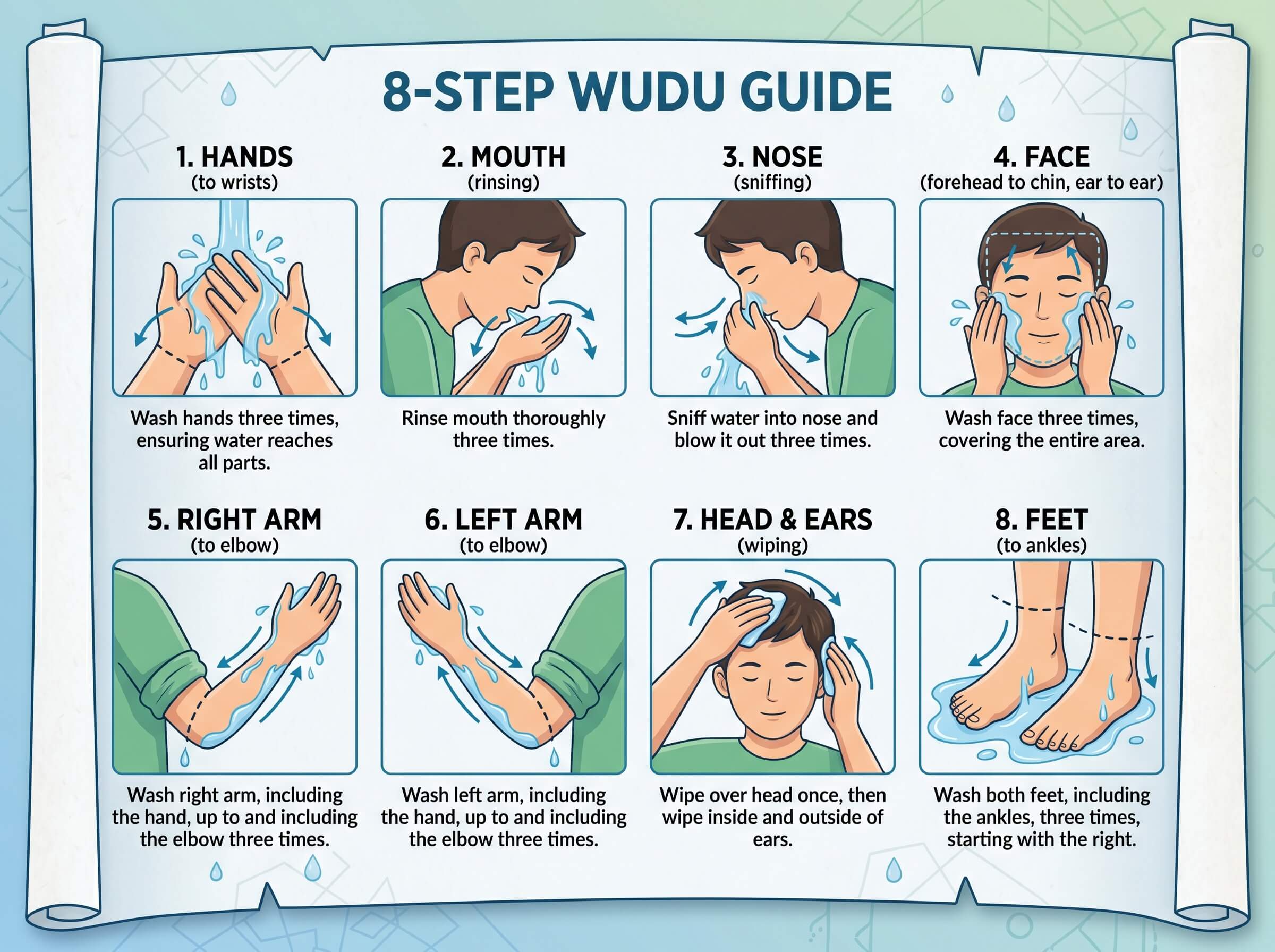
QUICK SUMMARY – 8-Step Wudu Cheat SheetMemorize these 8 steps. Full detail follows below.
|
What Is Wudu? Definition, Meaning & Purpose
Linguistically, the word wudu (وضوء) derives from the root wada’ah (وضاءة), meaning brightness, radiance, and cleanliness — suggesting that ablution brings a spiritual light to the believer.
In the shar’i (legal) sense, wudu is a specific ritual purification using water to wash defined body parts, lifting the state of minor ritual impurity (hadath asghar) and making a Muslim eligible for salah (prayer) and touching the Mushaf.
The Prophet Muhammad (peace be upon him) established the essential link between purification and valid prayer in a foundational hadith: “Allah does not accept prayer without purification.” (Sahih Muslim 224). Wudu is therefore not merely hygiene — it is a divine prerequisite for standing before the Creator.
Wudu vs. Ghusl vs. Tayammum — Know the Difference
- Wudu: Removes minor impurity (hadath asghar). Required before every prayer.
- Ghusl: Major ritual bath required after major impurity (janabah), menstruation, etc.
- Tayammum: Dry ablution with clean earth — used when water is unavailable or harmful.
Understanding these distinctions ensures the correct method of taharah is applied every time.
Quranic Foundation of Wudu
Surah Al-Ma’idah 5:6 – The Primary Command
| يَا أَيُّهَا الَّذِينَ آمَنُوا إِذَا قُمْتُمْ إِلَى الصَّلَاةِ فَاغْسِلُوا وُجُوهَكُمْ وَأَيْدِيَكُمْ إِلَى الْمَرَافِقِ وَامْسَحُوا بِرُءُوسِكُمْ وَأَرْجُلَكُمْ إِلَى الْكَعْبَيْنِ “O you who have believed, when you rise to [perform] prayer, wash your faces and your forearms to the elbows and wipe over your heads and wash your feet to the ankles…” (Surah Al-Ma’idah, 5:6) |
This verse establishes the four obligatory limbs of wudu, forming the backbone of the entire act:
- Face: From the hairline to the chin, ear to ear.
- Arms: Including the elbows.
- Head: Wiping — extent varies by madhab.
- Feet: Up to and including the ankles.
A Note on ‘Feet’ — Key Scholarly Discussion
A notable scholarly difference arises from the grammatical reading of arjulakum (“your feet”). In the accusative reading (nasb), it connects to the verb “wash” (ighsilu). In the genitive reading (jarr), it connects to “wipe” (wamsahu). The majority of Sunni scholars — relying on the mass-transmitted (mutawatir) reading and the explanatory hadith of Uthman ibn Affan — hold that washing is obligatory. Al-Qurtubi, in his renowned Tafsir, confirms this: the Prophet explicitly warned against leaving heels dry, settling the matter for Sunni jurisprudence.
Surah An-Nisa 4:43 – Tayammum Verse
This verse also references purification, addressing cases where water is unavailable and establishing the validity of tayammum as an alternative. It reinforces that purification is always required before prayer, regardless of circumstances.
Step by Step Wudu Guide – Detailed Instructions with Evidence
Each step below follows a consistent structure for maximum clarity: How to Perform It | Quranic/Hadith Evidence | Madhab Positions | Common Mistakes | Pro Tips.
STEP 1 Niyyah (Intention) |
HOW TO PERFORM IT
Form the intention in your heart to perform wudu for the sake of Allah to remove minor ritual impurity. No verbal utterance is required or legislated.
EVIDENCE FROM QURAN & SUNNAH
Hadith: “Actions are but by intentions, and every person will have only what they intended.” (Sahih Bukhari 1; Sahih Muslim 1907, narrated by Umar ibn al-Khattab)
MADHAB POSITIONS
- Hanafi: (Al-Hidayah) Intention is Sunnah for wudu — though it is obligatory for the validity of prayer itself.
- Maliki: (Al-Muwatta) Intention is Fard (obligatory), made at the start of washing the face.
- Shafi’i: (Al-Umm) Intention is Fard; must be present at the very beginning.
- Hanbali: (Al-Mughni) Intention is Fard based on the hadith of actions and intentions.
COMMON MISTAKES
- Verbalising the intention (saying ‘I intend to make wudu…’) is an innovation (bid’ah) not practiced by the Prophet (PBUH) or companions.
- Overthinking what to ‘say’ — the heart’s resolve is the niyyah.
PRO TIPS
- Simply knowing you are performing wudu to pray is sufficient. No formula to memorise.
- If you made wudu to cool down but then decide to pray, the wudu is still valid. (SeekersGuidance)
STEP 2 Saying Bismillah |
HOW TO PERFORM IT
Recite “Bismillah ir-Rahman ir-Rahim” (In the name of Allah, the Most Gracious, the Most Merciful) before beginning the washing. Say it before touching the water with the intention of wudu.
EVIDENCE FROM QURAN & SUNNAH
“There is no wudu for the one who does not mention the name of Allah over it.” (Sunan Abu Dawud 101; graded Hasan by Al-Albani)
MADHAB POSITIONS
- Hanbali: Some scholars consider it Wajib (necessary) based on the apparent (zahir) meaning of the hadith.
- Hanafi, Maliki, Shafi’i: The majority view is Sunnah Mu’akkadah (strongly emphasised sunnah). Forgetting does not invalidate wudu.
COMMON MISTAKES
- Delaying Bismillah until after hands are washed — say it before the first action of wudu.
PRO TIPS
- If you forget and remember midway, say it when you remember — your wudu remains valid.
- Just saying ‘Bismillah’ (without the full phrase) is sufficient.
STEP 3 Washing Both Hands (3 Times, Right First) |
HOW TO PERFORM IT
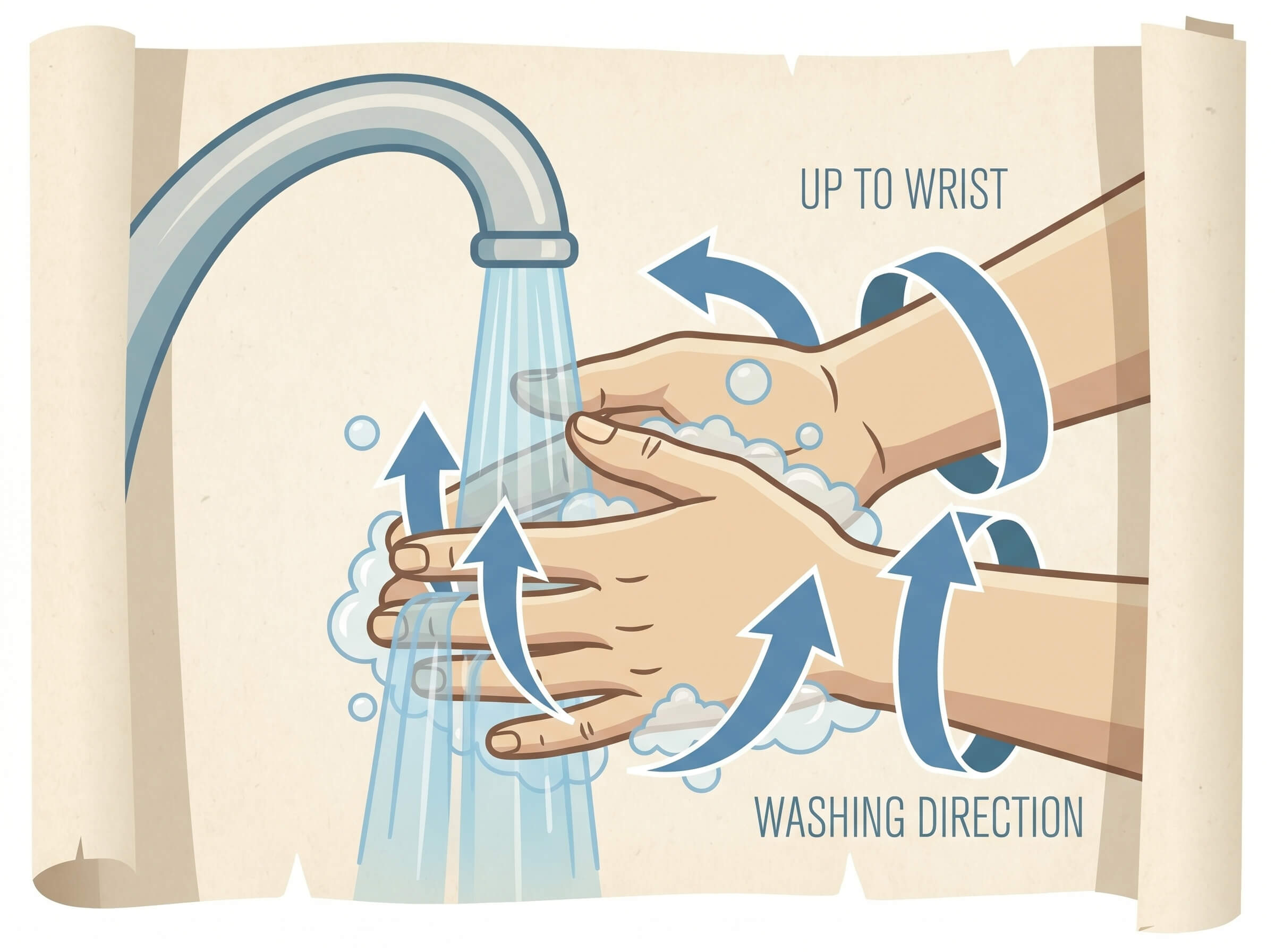
Wash both hands up to the wrists, starting with the right hand. Do this 3 times. Interlace fingers (khilal) to ensure water reaches between them.
EVIDENCE FROM QURAN & SUNNAH
- Uthman ibn Affan’s famous description of the Prophet’s wudu mentions washing hands three times. (Sahih Bukhari 157–159)
- “When one of you wakes from sleep, let him not put his hand into the vessel until he has washed it three times.” (Sahih Muslim 278)
- “Interlace your fingers [during wudu].” (Sunan Abu Dawud 142; Jami at-Tirmidhi 38)
MADHAB POSITIONS
- All Madhabs: Washing hands is Sunnah if they are known to be clean. If waking from sleep, or impurity is suspected, washing becomes obligatory before beginning the fard acts.
- Right before Left: All schools affirm starting with the right side based on the Prophet’s consistent practice.
COMMON MISTAKES
- Washing only the palms — the backs of hands and wrists must be covered.
- Forgetting to interlace fingers.
- Not starting with the right hand.
PRO TIPS
- Rings: If a ring is tight and water cannot flow under it, remove it or move it to ensure water reaches the skin. Loose rings that allow water through — no need to remove.
- Tattoos: Tattoos are ink under the skin — they do not form a physical barrier to water. Wudu is valid over tattooed skin, though tattoos themselves are a separate fiqh discussion.
- Water conservation: The Prophet (PBUH) performed his entire wudu with approximately one mudd of water (~600–700ml, Sahih Bukhari 201). Turn the tap off between steps.
STEP 4 Rinsing the Mouth & Nose (Madmadah & Istinshaq) |
HOW TO PERFORM IT
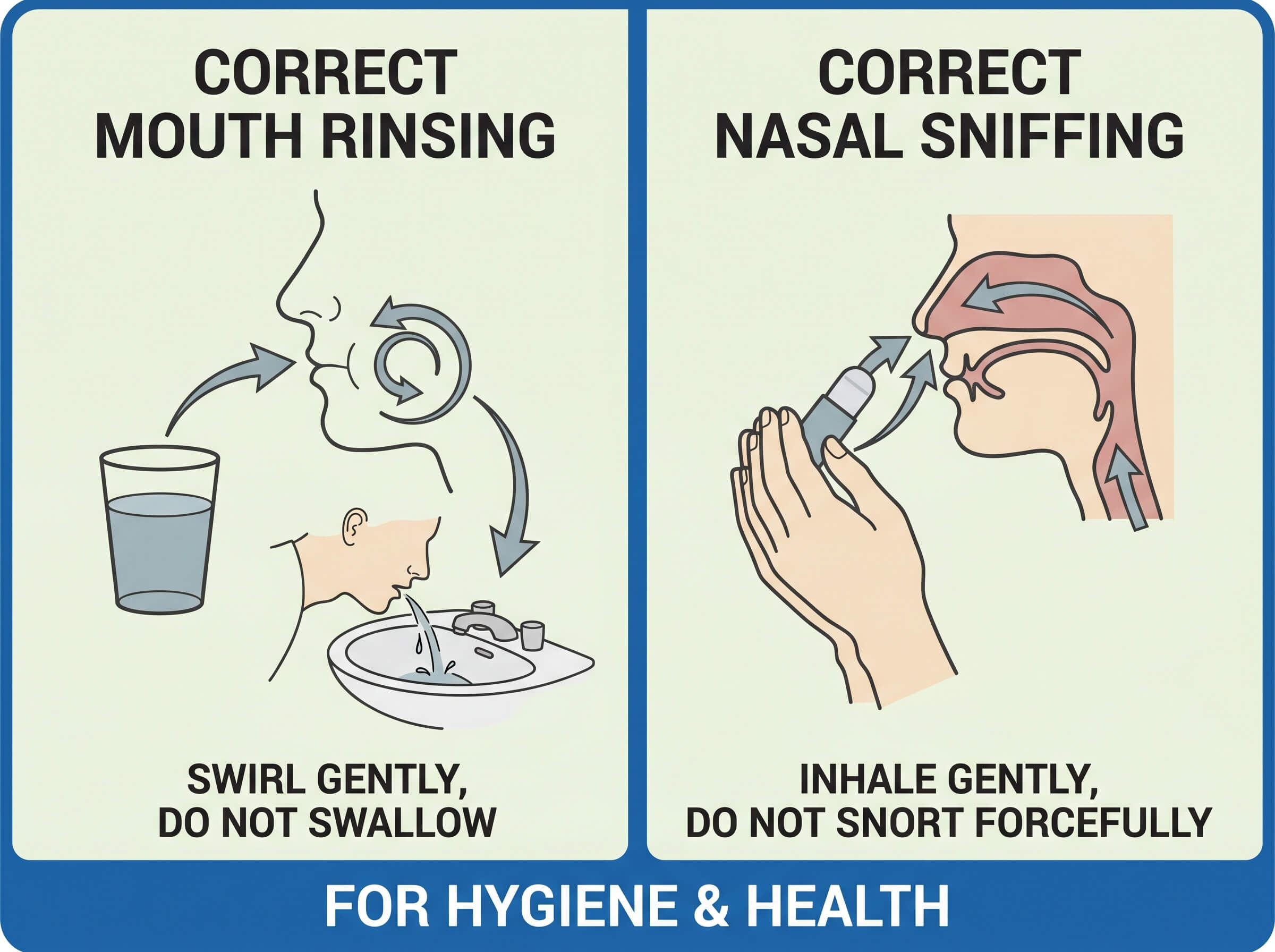
Mouth (Madmadah): Take water into the mouth, swirl it around thoroughly, and spit it out. Repeat 3 times.
Nose (Istinshaq + Istinthar): Sniff water into the nose using the right hand, then expel it using the left. Repeat 3 times. Be thorough — but gentle if fasting.
EVIDENCE FROM QURAN & SUNNAH
- “Exaggerate in sniffing water into the nose — unless you are fasting.” (Sunan Abu Dawud 142; Jami at-Tirmidhi 38)
- The Prophet (PBUH) rinsed mouth and nose with a single handful (scooping with the right hand). (Sahih Bukhari 191)
MADHAB POSITIONS
- Shafi’i: Places these within the washing of the face, emphasising thoroughness (mubalaghah).
- Hanafi & Maliki: Both are Sunnah, separate from the obligatory face wash.
- Hanbali: Both are Wajib (necessary) for wudu to be complete.
COMMON MISTAKES
- Being too forceful when fasting — water reaching the throat or stomach breaks the fast.
- Rinsing only the front of the mouth — swirl water to reach all areas.
PRO TIPS
- Braces/dental work: Water reaching all tooth surfaces is the goal. A gentle swirl should suffice.
- Use the right hand to bring water to the mouth and nose; left hand to expel from nose.
STEP 5 Washing the Face – Complete Guide with Madhab Differences |
HOW TO PERFORM IT
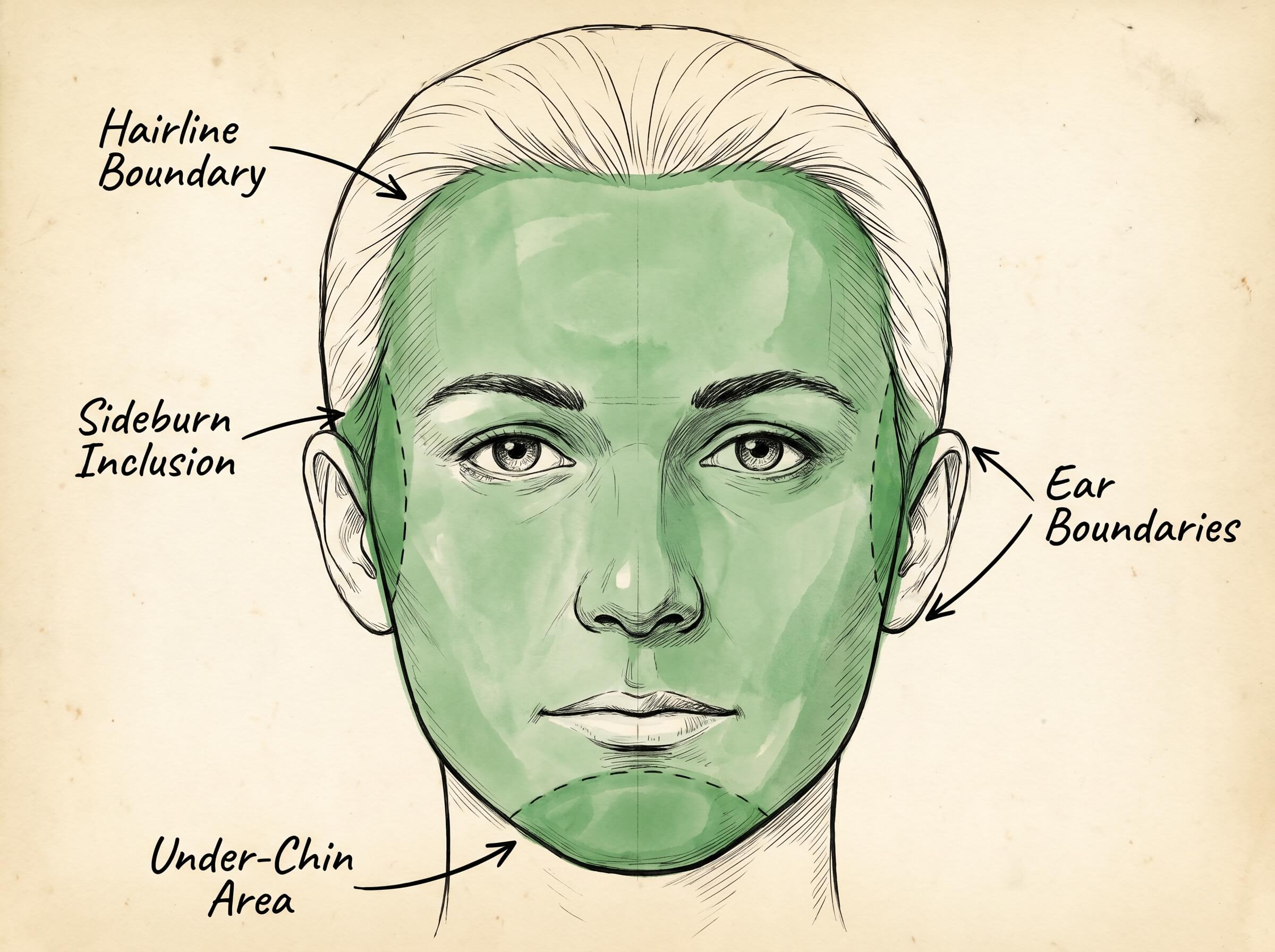
Pour water over the entire face:
- Vertical boundary: From the natural hairline (where hair grows) to the bottom of the chin.
- Horizontal boundary: From one ear to the other — including sideburns, under the chin, and the soft skin near the ear.
Wash once (obligatory), three times is Sunnah. Use both hands to ensure full coverage.
EVIDENCE FROM QURAN & SUNNAH
| فَاغْسِلُوا وُجُوهَكُمْ “…wash your faces…” (Surah Al-Ma’idah, 5:6) |
The Prophet’s wudu described by Uthman ibn Affan confirms thorough face washing. (Sahih Bukhari 157)
MADHAB POSITIONS – BEARD RULINGS (KEY DIFFERENCE)
- Hanafi & Hanbali: Obligatory to wash skin beneath a thin beard. For a thick beard, washing the outer surface is sufficient; running wet fingers through it (khilal) is Sunnah.
- Shafi’i: Water must reach the skin beneath the beard regardless of thickness.
- Maliki: Washing the apparent surface of the hair is sufficient for a thick beard.
COMMON MISTAKES
- Dry spots near the hairline or temples — very common.
- Missing the skin directly under the chin.
- Not covering the sideburn area and the skin where ear meets face.
PRO TIPS
- Men with beards: Khilal (running fingers through beard) is Sunnah. Do it after pouring water.
- Women: Wash the entire face including hairline. Braids need not be undone if water reaches the hairline roots.
- Makeup: Standard makeup (foundation, powder) does not create a waterproof barrier and does not need to be removed. Waterproof makeup, however, can form a barrier — remove it before wudu.
STEP 6 Washing the Arms to Elbows (Right First) |
HOW TO PERFORM IT
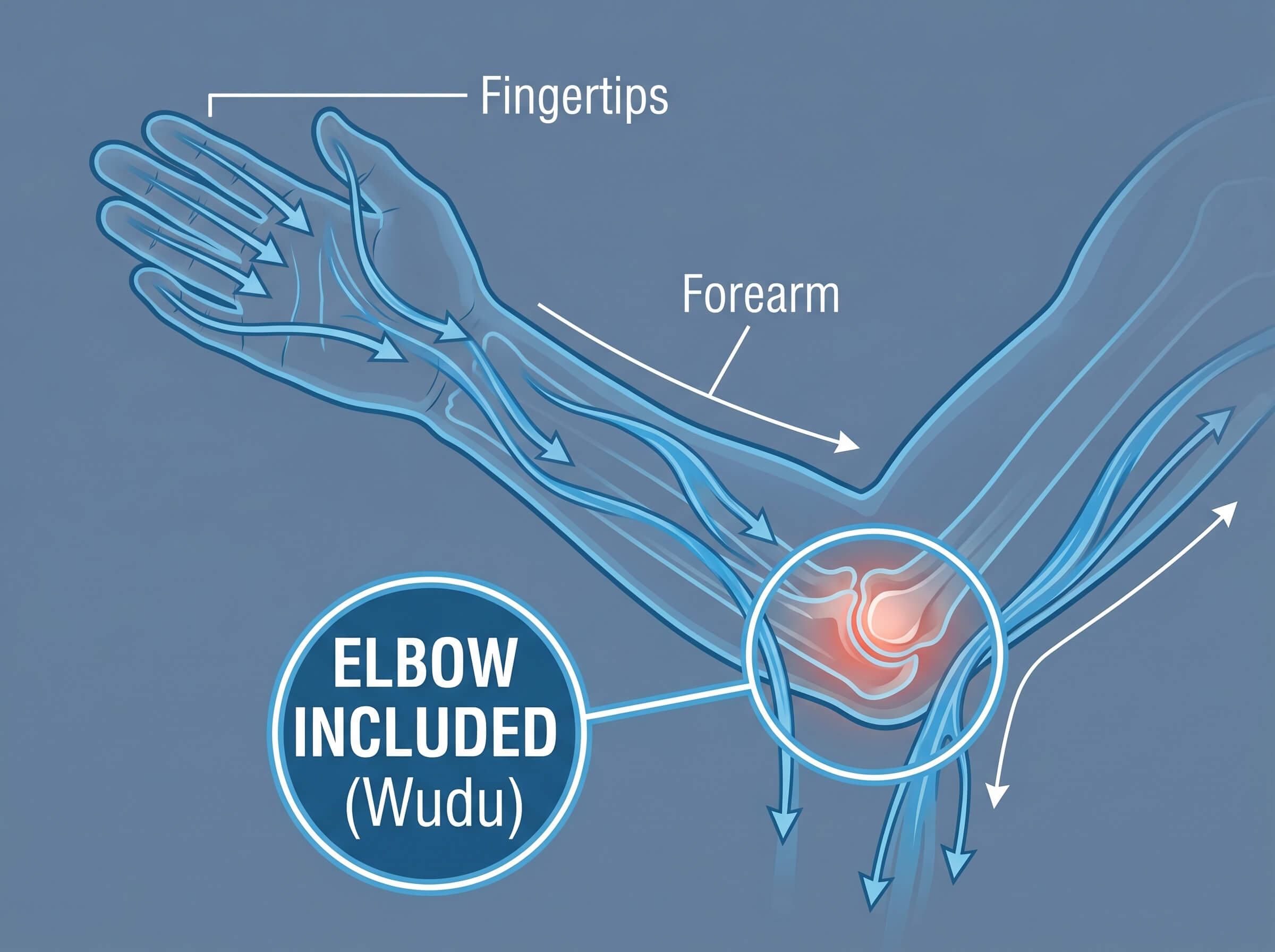
Wash the right arm first, then the left. Start from the fingertips, pouring water up to and including the elbow joint. Wash 3 times each.
EVIDENCE FROM QURAN & SUNNAH
| وَأَيْدِيَكُمْ إِلَى الْمَرَافِقِ “…and your forearms to the elbows…” (Surah Al-Ma’idah, 5:6) |
Abu Hurairah was seen washing his arm up past the elbow, then said: ‘I heard the Messenger of Allah say: The radiance of the believer will reach wherever his wudu reaches.’ (Sahih Muslim 246)
MADHAB POSITIONS
- All Four Madhabs: The elbows are included in the obligation. The preposition ‘ila’ (to) in the verse is interpreted as inclusive based on prophetic practice.
COMMON MISTAKES
- Stopping just short of the elbow — a dry ring of skin around the joint is very common.
- Not pouring enough water to cover the full circumference of the arm.
PRO TIPS
- Watches & bracelets: Remove them — they prevent water reaching the skin.
- Tattoos on arms: Ink is under the skin and does not form a physical barrier. Wudu is valid.
- Medical bandages: Wipe over the bandage with wet hands. See the Modern Situations section for full detail.
STEP 7 Wiping the Head & Ears (Masah) |
HOW TO PERFORM IT
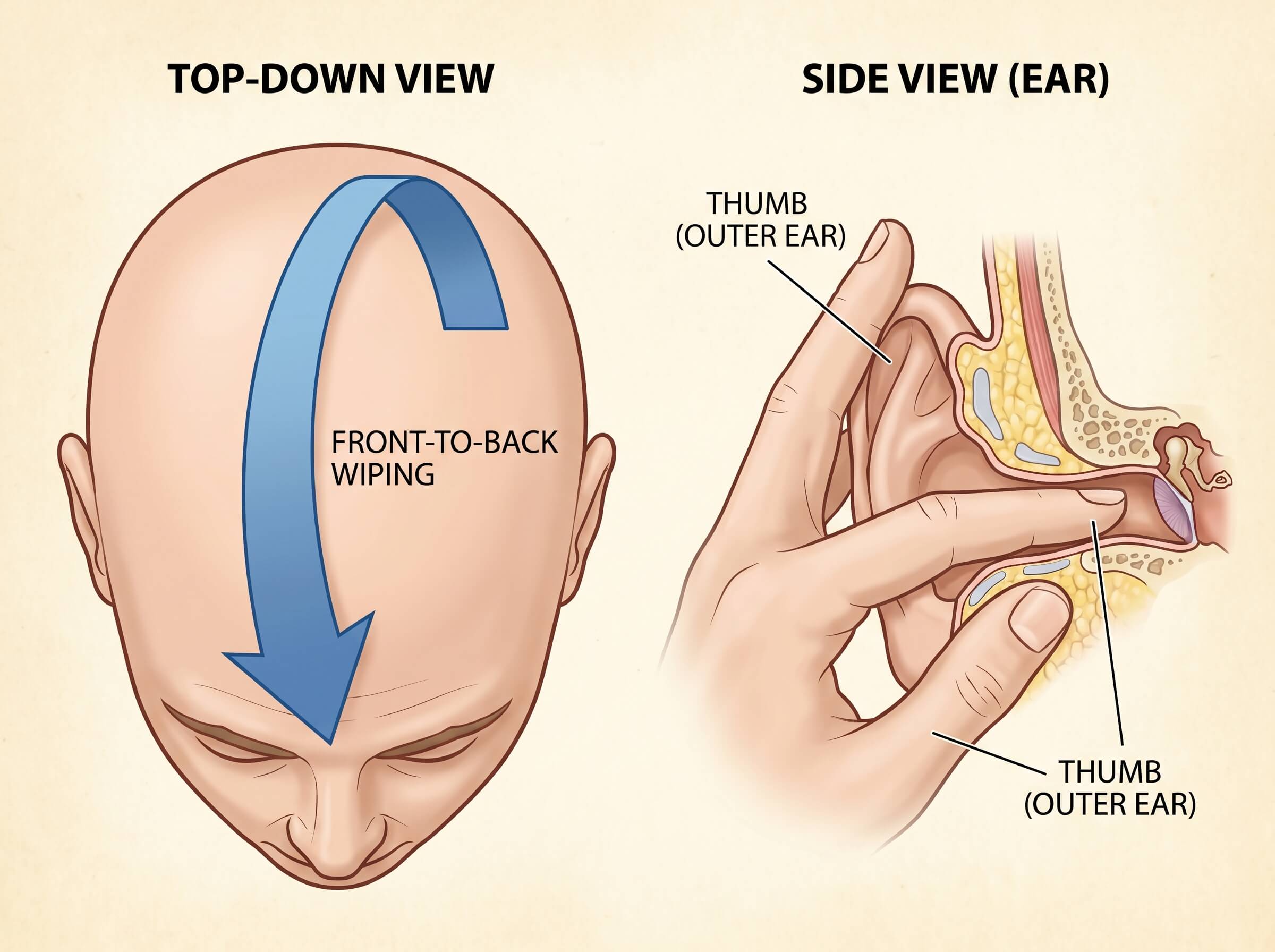
Head: Wet both hands, then run them from the front of the head (hairline) to the back of the neck, and return to the front. This is done once. No need to repeat 3 times.
Ears: Using the same wet hands (or fresh water for Hanbali), insert index fingers into the ear canal and rub the inside, while the thumbs wipe the outer back of the ear. Do this once.
EVIDENCE FROM QURAN & SUNNAH
| وَامْسَحُوا بِرُءُوسِكُمْ “…and wipe over your heads…” (Surah Al-Ma’idah, 5:6) |
The Prophet wiped his entire head in one motion. (Sahih Bukhari 185)
“The ears are part of the head.” (Sunan Abu Dawud 134; graded Hasan)
MADHAB POSITIONS – THE MOST SIGNIFICANT DIFFERENCE IN WUDU
- Hanafi: (Al-Hidayah) Wiping one-quarter of the head is the minimum obligation. The ears are wiped with fresh water, considered separate from the head wipe.
- Maliki: (Al-Muwatta) Wiping the entire head is obligatory, with rubbing (dalk). The ears are part of the head — wiped with the same water.
- Shafi’i: (Al-Umm) Wiping any portion of the head — even a few hairs — is sufficient. Ears are Sunnah, with fresh water.
- Hanbali: (Al-Mughni) Wiping the entire head is obligatory, including the ears. Fresh water for ears is required.
EARS – SUNNAH DETAIL
- Inside: Index fingers enter the ear opening and rub the ridges.
- Outside: Thumbs wipe the back/outside of the ear.
- All four madhabs agree wiping the ears is at minimum Sunnah.
COMMON MISTAKES
- Wiping only the top of the head with fingertips — full front-to-back motion is the Sunnah.
- Wiping over a hijab, turban, or hat without a valid excuse.
- Forgetting the ears entirely.
PRO TIPS
- Women with hijab: The hijab must be removed for masah unless under genuine hardship. Braids do not need undoing — wipe the scalp.
- To ensure validity across all schools: Wipe the entire head. This satisfies Hanafi, Maliki, and Hanbali simultaneously.
- Wet hair: Passing hands over wet hair counts as masah — the water already present transfers.
STEP 8 Washing Both Feet to the Ankles (Right First) |
HOW TO PERFORM IT
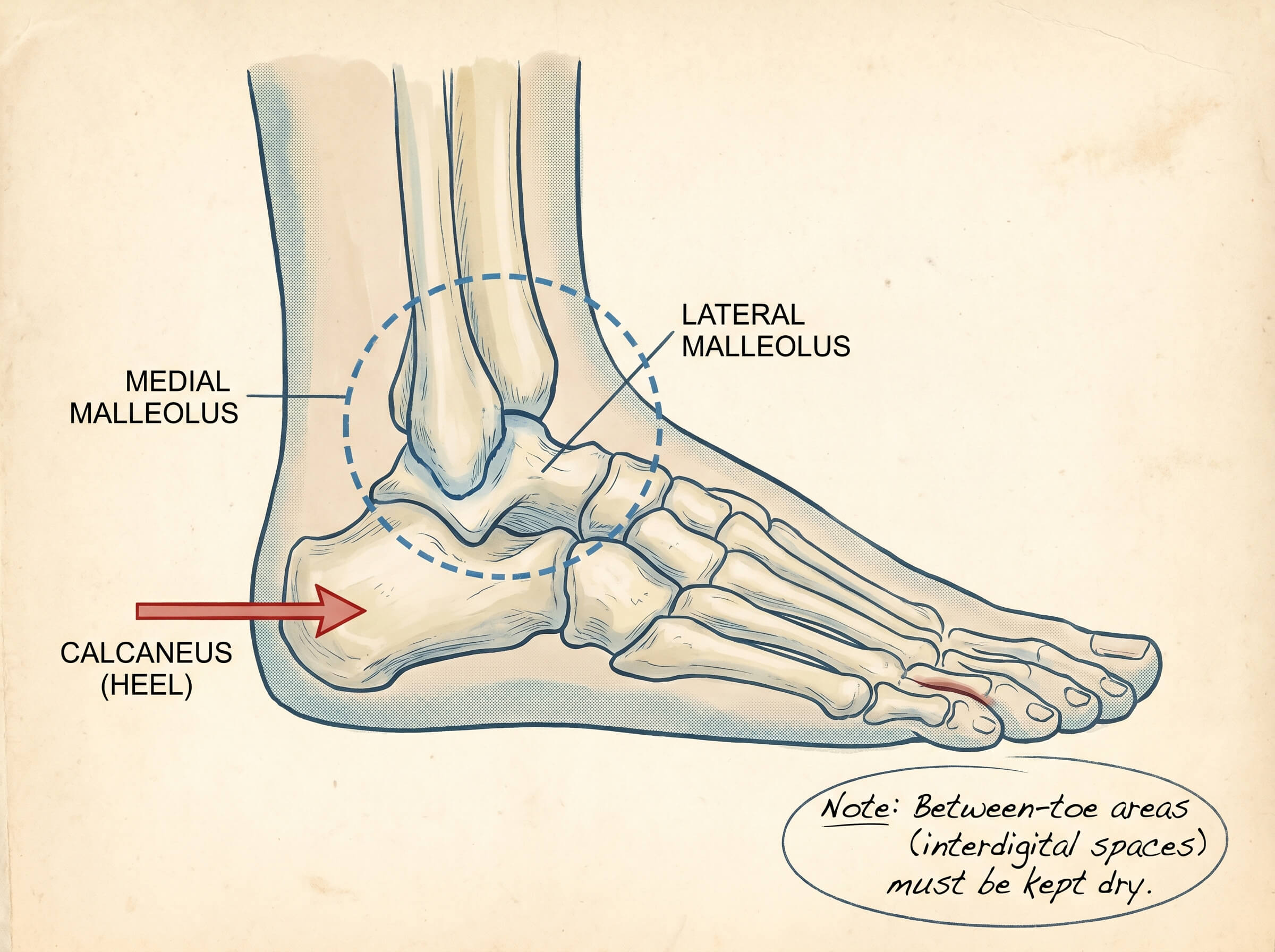
Wash the right foot first, then the left. Pour water over the foot, ensuring coverage from the toes to and including the ankle bones on both sides. Wash 3 times each. Use your left hand’s little finger to clean between the toes (Sunnah).
EVIDENCE FROM QURAN & SUNNAH
| وَأَرْجُلَكُمْ إِلَى الْكَعْبَيْنِ “…and wash your feet to the ankles.” (Surah Al-Ma’idah, 5:6) |
The Prophet (PBUH) saw a man who had left a patch the size of a dirham on his heel dry and commanded: “Woe to the heels from the Fire! Complete the wudu.” (Sahih Bukhari 60; Sahih Muslim 241)
MADHAB POSITIONS
- All Four Sunni Madhabs: Washing the feet is obligatory. The ankle bones (medial and lateral malleolus) must be included.
COMMON MISTAKES
- Leaving the heels dry — the most frequently cited error in hadith.
- Not covering the ankle bones.
- Missing water between the toes.
- Nail polish creating a waterproof barrier — must be removed before wudu.
PRO TIPS
- Nail polish: Standard nail polish is waterproof and prevents water reaching the nail. It must be removed. ‘Breathable’ polishes remain debated — many contemporary scholars advise caution and removal to ensure validity.
- Henna: Henna is a dye that stains, not a coating that blocks water. Wudu is valid with henna.
- Thick calluses/very dry skin: Water must still reach the skin surface. Rubbing helps ensure coverage.
STEP 9 Maintaining Order (Tartib) & Continuity (Muwalat) |
HOW TO PERFORM IT
Perform all steps in the order given in the Quran: Face → Arms → Head → Feet — without lengthy interruptions between limbs.
EVIDENCE FROM QURAN & SUNNAH
The Quran lists the limbs in a specific sequence (Al-Ma’idah 5:6) and the Prophet consistently followed this order in every recorded description of his wudu.
MADHAB POSITIONS
- Shafi’i & Hanbali: Tartib (order) is Fard. Washing feet before the face invalidates wudu.
- Hanafi: Tartib is Sunnah. Wudu is valid out of order, though disliked.
- Maliki: Muwalat (continuity without the limb drying) is Fard. Tartib is Sunnah.
COMMON MISTAKES
- Being distracted by a phone call midway — problematic for Maliki followers if a limb dries.
- Washing feet before arms when in a hurry.
PRO TIPS
- Following the correct order ensures validity across all four schools — no room for doubt.
- In cold weather, work quickly so limbs do not dry before completing the sequence (important for Maliki madhab).
Fard vs. Sunnah in Wudu – 4 Madhab Comparison Chart
The following chart summarises the legal status of each act across all four Sunni schools, based on classical texts including Bidayat al-Mujtahid by Ibn Rushd.
| Action | Hanafi | Maliki | Shafi’i | Hanbali |
|---|---|---|---|---|
| Niyyah (Intention) | Sunnah | Fard | Fard | Fard |
| Bismillah | Sunnah | Sunnah | Sunnah | Wajib (some scholars) |
| Washing Face | Fard | Fard | Fard | Fard |
| Washing Arms (to elbows) | Fard | Fard | Fard | Fard |
| Wiping Head | 1/4 Head (Fard) | Full Head (Fard) | Any Part (Fard) | Full Head (Fard) |
| Wiping Ears | Sunnah (fresh water) | Fard (with head) | Sunnah | Fard (fresh water) |
| Washing Feet | Fard | Fard | Fard | Fard |
| Right Before Left | Sunnah | Sunnah | Sunnah | Sunnah |
| Order (Tartib) | Sunnah | Sunnah | Fard | Fard |
| Continuity (Muwalat) | Sunnah | Fard | Sunnah | Sunnah |
| Rubbing (Dalk) | Sunnah | Fard | Sunnah | Sunnah |
| 3x Repetition | Sunnah | Sunnah | Sunnah | Sunnah |
| Interlacing Fingers | Sunnah | Sunnah | Sunnah | Sunnah |
| Key Takeaway: Performing all the Sunnah acts — washing 3 times, interlacing fingers, wiping the full head — satisfies every school simultaneously. When in doubt, do more rather than less. |
What Breaks Wudu? (Nawaqid al-Wudu)
Knowing how to make wudu is only half the equation. Understanding what invalidates it is equally essential.
Agreed-Upon Nullifiers (Ijma)
- Discharge from private parts: Urine, stool, gas, or any other discharge — breaks wudu by unanimous consensus.
- Deep sleep: Unconscious sleep (lying down or falling fully asleep) breaks wudu. Light dozing while seated firmly generally does not.
- Loss of reason: Fainting, intoxication, or any state that removes consciousness breaks wudu.
Disputed Nullifiers – Madhab Comparison
| Nullifier | Hanafi | Maliki | Shafi’i | Hanbali |
|---|---|---|---|---|
| Bleeding/Discharge from body (non-private parts) | Breaks wudu | Does NOT break | Does NOT break | Does NOT break |
| Vomiting (mouthful) | Breaks wudu | Does NOT break | Does NOT break | Does NOT break |
| Touching private parts (bare skin) | Does NOT break | Does NOT break (unless arousal) | Breaks wudu | Breaks wudu |
| Skin-to-skin touch (non-mahram, opp. gender) | Does NOT break | Does NOT break | Breaks wudu | Does NOT break |
| Eating camel meat | Does NOT break | Does NOT break | Does NOT break | Breaks wudu |
| Laughter during prayer | Breaks wudu | Does NOT break | Does NOT break | Does NOT break |
For the full ruling on camel meat and its Islamic status, see our halal food guides.
Touching Private Parts (Hadith Evidence): “Whoever touches his private part, let him perform wudu.” (Sunan an-Nasa’i 449; graded Sahih by many scholars). The Shafi’i and Hanbali schools act on this hadith directly; Hanafi and Maliki schools interpret it in a different legal context.
Wudu for Women – Special Considerations
Hair & Braids
- Women are NOT required to undo braids or loose their hair for wudu.
- The masah (wiping) is over the scalp/roots at the top and front of the head.
- If braids are so extremely tight that water cannot reach the scalp at all, they must be loosened — but this is rare.
Hijab During Wudu
- The hijab must be removed for masah — wiping cannot be done over it (unlike khuffs for feet, there is no general ruling for head coverings).
- If in public and removal is not possible, a woman may delay wudu until a private space is available, or make tayammum in a genuine case of necessity.
Nail Polish & Henna
- Standard nail polish: Must be removed — it forms a waterproof coating that prevents water reaching the nail surface.
- ‘Breathable’ nail polish: Debated. Some scholars accept it if water genuinely permeates it; many advise removal to be safe. When in doubt, remove it.
- Henna: Fully permissible. Henna is a dye, not a coating — water reaches through it normally.
Makeup
- Non-waterproof makeup (foundation, powder, blush): Does not block water. No need to remove.
- Waterproof makeup: Can form a water-resistant barrier. Best removed before wudu, especially on the face.
Menstruation & Post-Natal Bleeding
- Women in a state of menstruation (hayd) or post-natal bleeding (nifas) are exempt from prayer and therefore do not perform wudu for prayer. Wudu does not lift the major impurity of these states — ghusl is required after they end.
- Istihadah (irregular bleeding) has its own rulings; many scholars advise women in this state to make wudu for each prayer time. Consult a local scholar for personal circumstances.
Wudu in Modern & Challenging Situations
Wiping Over Khuffs (Leather Socks) & Cotton Socks
It is firmly established in the Sunnah that one may wipe over leather socks (khuffs) instead of washing the feet — provided wudu was performed before wearing them.
- Duration: Resident (muqim): 24 hours. Traveler (musafir): 72 hours. The clock starts from the first wipe after wearing.
- Condition: Wudu must have been in a state of purity when the socks were put on.
Cotton Socks — The Disagreement
- Hanafi: Permits wiping over thick, durable cotton socks that stay on without being tied. A minority position within Hanafi but accepted by many contemporary scholars.
- Shafi’i (classical): Generally requires leather or similar material. Contemporary scholars have shown more flexibility.
- Hanbali: Allows wiping over socks of any material if they are thick enough to walk in without tearing.
- See the detailed IslamQA fatwa on wiping over cotton socks for full evidence.
Bandages, Casts & Medical Devices
- Wash all healthy skin that is accessible.
- Wipe over the bandage or cast with wet hands.
- If wiping causes harm, perform tayammum for that specific limb.
- Medical patches, glucose monitors, insulin pumps: Wipe over them if they are firmly attached and cannot be removed without harm. See Dar al-Ifta rulings on medical devices and wudu.
Prosthetics & Implants
- Internal implants (metal pins, pacemakers): Have no effect on wudu whatsoever. They are under the skin.
- External prosthetics (artificial limbs): If removable without harm, remove and wash the stump. If removal causes difficulty or pain, wipe over the attachment area.
Wudu in the Shower
- Fully permissible. Form the intention before beginning.
- Ensure each step is performed intentionally, not just incidentally wet.
- Maintain the correct order (tartib) if following a madhab that requires it (Shafi’i, Hanbali).
Cold Weather & Gym/Sports
- In cold weather, work quickly to maintain muwalat (continuity) — especially important for Maliki followers.
- After exercise, heavy sweat does not break wudu — only the specific nullifiers listed above do.
- If wudu was made before a workout and none of the nullifiers occurred, the wudu remains valid — even after sweating heavily.
Wudu After Touching Opposite Gender
- Hanafi/Maliki/Hanbali view: Skin-to-skin contact alone does not break wudu.
- Shafi’i view: Direct skin contact with a non-mahram of the opposite gender breaks wudu.
- In practice: if you follow the Shafi’i school, renew wudu after shaking hands with a non-mahram.
Du’a After Wudu & The Spiritual Dimension
The Du’a After Wudu
| أَشْهَدُ أَنْ لَا إِلَهَ إِلَّا اللَّهُ وَحْدَهُ لَا شَرِيكَ لَهُ، وَأَشْهَدُ أَنَّ مُحَمَّدًا عَبْدُهُ وَرَسُولُهُ “Ash-hadu an la ilaha illallah wahdahu la sharika lah, wa ash-hadu anna Muhammadan ‘abduhu wa rasuluh.” “I bear witness that there is no deity worthy of worship but Allah alone, He has no partner, and I bear witness that Muhammad is His slave and Messenger.” Whoever recites this after wudu, the eight gates of Paradise will be opened for him, and he may enter through whichever one he wishes. (Sahih Muslim 234) |
Spiritual Reflection – Wudu as Worship
Imam al-Ghazali, in his Ihya Ulum al-Din, describes wudu as far more than a physical cleaning. He explains: when one washes the face, the sins of the eyes and tongue are washed away with the water; when one washes the hands, the sins of the hands depart. This transforms wudu from routine into a profound moment of repentance and preparation for standing before Allah.
The Prophet (PBUH) said: “Purification is half of faith.” (Sahih Muslim 223, narrated by Ali ibn Abi Talib). Maintaining wudu throughout the day is a constant physical reminder of faith and submission — a living act of worship beyond the prayer itself.
The hadith of the ‘radiance of the believer’ (hilyat al-mu’minin) — narrated by Abu Hurairah — states that on the Day of Judgement, a Muslim will be recognised by the shining brightness on the parts of their body they washed in wudu. (Sahih Muslim 246). Every wudu is an investment in that light.
Frequently Asked Questions (FAQ)
These are the 14 most common, high-intent questions about wudu from new Muslims and established practitioners alike.
1. Is washing three times really obligatory?
No. Washing once is obligatory. Twice is recommended. Three times is the Sunnah and brings greater reward. Never wash more than three times — the Prophet (PBUH) forbade exceeding this.
2. Can I make wudu in the shower?
Yes, fully permissible. Make the intention before starting and ensure each part is washed intentionally and in order.
3. I have OCD/waswasa (obsessive thoughts) about wudu — what do I do?
Scholars consistently advise: ignore the doubts. If you are certain you made wudu, a subsequent doubt does not invalidate it. The Prophet (PBUH) said: do not leave prayer unless you hear a sound or smell a scent. Build the habit of certainty rather than re-checking. Consult a qualified Islamic counsellor if waswasa severely impacts your life.
4. Does bleeding break my wudu?
This depends on your madhab. Hanafi: Yes, flowing blood breaks wudu. Maliki/Shafi’i/Hanbali: No, bleeding from the body (other than from private parts) does not break wudu.
5. Can I wipe over cotton socks?
Permitted by the Hanafi school (for thick, durable socks) and the Hanbali school (for socks durable enough to walk in). Restricted to leather by classical Shafi’i fiqh, though some contemporary scholars have shown flexibility. Check with your local scholar.
6. Do tattoos prevent valid wudu?
No. Tattoo ink is under the skin, not on the surface. Water reaches the skin normally. The tattoo itself is a separate fiqh discussion, but it does not invalidate wudu.
7. What about waterproof nail polish?
Standard nail polish creates a waterproof barrier. It must be removed for wudu to be valid. ‘Breathable’ polishes remain debated — many scholars advise removal to be safe.
8. My wudu broke during prayer — what do I do?
Leave the prayer quietly without disturbing others, renew your wudu, and restart the prayer from the beginning.
9. Does touching a woman break my wudu?
Hanafi, Maliki, and Hanbali: no, mere skin-to-skin contact does not break wudu. Shafi’i: yes, direct skin contact with a non-mahram of the opposite gender breaks wudu.
10. I made a mistake in the order — is my wudu valid?
Hanafi and Maliki: yes (order is Sunnah). Shafi’i and Hanbali: no — you must repeat the steps in the correct order.
11. Can I make wudu with very little water?
Yes. The Prophet (PBUH) performed wudu with one mudd (~600–700ml) of water. What matters is that water flows over and covers each obligatory area — not the quantity used.
12. I have a cast on my arm — how do I make wudu?
Wash all accessible skin. Wipe over the cast with a wet hand. If even wiping causes harm, perform tayammum for that specific limb.
13. Is wudu valid after a ghusl?
Yes — a valid ghusl that includes washing all the wudu parts in order (with the intention) contains wudu within it. Many scholars advise making the full wudu before ghusl, then performing the ghusl.
14. My wudu is from the morning — is it still valid hours later?
Yes, wudu remains valid until one of the specific nullifiers occurs — regardless of how much time has passed. Time alone does not break wudu.
Most Common Wudu Mistakes – Identified by Scholars
- Thinking 3 washes are obligatory — only once is fard.
- Dry heels — the most frequently cited error in hadith.
- Dry patches near temples and hairline — very common in face washing.
- Missing the elbows entirely — they must be included, not just reached.
- Forgetting between the toes — use the little finger of the left hand.
- Wiping over a hijab — invalid without a legislated excuse.
- Excessive water use — the Prophet used ~600ml for his whole wudu. Conserve it.
- Long pauses between limbs (Maliki) — the previous limb must not dry before the next is washed.
- Forgetting the niyyah entirely (Maliki/Shafi’i/Hanbali) — intention is fard in these three schools.
Conclusion – Perform Wudu with Knowledge, Confidence & Presence
We hope this step by step wudu guide has given you the clarity, confidence, and spiritual motivation to perform your ablution correctly and with presence of heart.
While genuine differences of opinion exist among the four madhabs — regarding the extent of head wiping, the obligation of order, and some nullifiers — these differences are a mercy from Allah, providing flexibility within the bounds of divine law. The key is to follow your madhab consistently and with knowledge, performing the Sunnah acts whenever possible to ensure validity across all schools.
Remember: every drop of water in wudu is a step towards spiritual purity, the forgiveness of sins, and the radiance of the believer. Approach each wudu with khushu’ (humility) and mindfulness — you are preparing to stand before Allah.
| Bookmark this guide and share it with someone who needs clarity on their wudu. Consult a local scholar for personal circumstances not covered here. |
| About the Author Written by Waqas Ali, researcher in Islamic jurisprudence (fiqh), trained in classical texts including Al-Hidayah and Al-Mughni. |