Islam is a monotheistic religion, which translates to submission to the will of God in Arabic. It is based on Quran and the sayings of Prophet Muhammad ﷺ. The second-largest religion in the world is Islam, which is rapidly expanding and its adherents amount to approximately 2 billion. It has based its practice on Five Pillars and Six Articles of Faith that provides a total way of life.
Why Over 2 Billion People Stand with Islam (and What You Will Learn)
One fourth of the entire world population, consisting of approximately 2 billion individuals identify themselves as Muslim. According to a 2025 Pew report, the population of Muslims increased 21 percent over a decade, with 347 million new adherents coming into the Muslim faith between 2010 and 2020 — more than all other faiths combined. This great amount of people sparks a question: what is Islam, and why does it concern so many people all around?
The Quran shows a direct answer to this:
“Indeed, the religion in the sight of Allah is Islam.”
إِنَّ الدِّينَ عِندَ اللَّهِ الْإِسْلَامُ
The commentary of a scholar states that this verse demonstrates that Islam is the sole submission way accepted by God, and it is the continuation of the message of the prophets, whom God sent to people starting with Adam until the prophet Muhammad ﷺ.
Most of the introductions omit the fact that Islam is not merely a book of rules. In the famous encounter of Prophet Muhammad ﷺ with Angel Jibreel recorded in Sahih Muslim, he said, Islam has three parts, Islam (submission), Iman (faith), and Ihsan (goodness). This paper will describe all three components, the Five Pillars, the Six Articles of Faith, population statistics 2025-2026, and the top 7 myths, each supported by Quran and Hadith evidence.
Some details may be varying between scholars. The view presented in this guide is the major view with some notable differences. Allah knows best.
What the Hadith of Jibreel reveals many others have overlooked: there is a spiritual peak in Islam, which alters your vision of everything around.
Meaning of Islam — What the Arabic Word Really Tells You (Quran 3:19)
Simple translations make Islam be submission or peace. Arabic tells a richer story.
The root of Islam in Arabic is س-ل-م (S-L-M). The origin of that root forms a family of related words:
- Islam (إسلام) — voluntary servitude to God.
- Muslim (مسلم) — one who submits
- Salam (سلام) — peace
- Salama (سلامة) — safety, completeness, healthiness
- Taslim (تسليم) — surrender, acceptance
These words are connected. According to scholars at Al-Azhar and the Islamic University of Madinah, voluntary submission (islam) to the creator is the natural way to achieve true peace (salam). This is not possible without the other.
Why Islam Means Both Submission And Peace — The Connection Most People Overlook
The key word is “voluntary.” It is not forced conversion to Islam. According to the Quran:
“There shall be no compulsion in [acceptance of] the religion.”
لَا إِكْرَاهَ فِي الدِّينِ
(Quran 2:256)
One of the commentaries on this verse reveals freedom of faith as one of the main Islamic principles.
The meaning of submission in Islam is to willingly keep in line with the guidance of God. According to the Arabic word S-L-M, this accordance offers inner peace, security and completeness. In Ihya Ulum al-Din, Imam al-Ghazali described how the soul returned to its natural resting place because of this relation.
The Quranic Name: How Islam is the Only Religion Named by God Himself (Quran 5:3)
This fact often amazes people: it is Islam that, according to scholars, is the only major religion whose name appears in the scripture not once of its founder, but of the place.
“This day I have perfected for you your religion and completed My favor upon you and have approved for you Islam as religion.”
الْيَوْمَ أكْمَلْتُ لَكُمْ دِينَكُمْ وَأَتْمَمْتُ عَلَيْكُمْ نِعْمَتِي وَرَضِيتُ لَكُمُ الْإِسْلَامَ دِينًا
(Quran 5:3)
One of the commentaries indicates that this verse was revealed in the Farewell Pilgrimage of Prophet Muhammad, when divine revelation came to an end. The term chosen demonstrates that the name Islam is not a creation of man but a divine identity of this way.
Now that you have the name, enquire: what is there actually in this religion. This was the most significant narration that Prophet Muhammad responded to when seeking to understand the faith.
The 3 Dimensions of Islam Every Newcomer Should Learn
The Framework of the Hadith of Jibreel
A single dialogue transformed the perception of the Muslims about their entire religion.
The Hadith of Jibreel records the appearance of Angel Jibreel to Prophet Muhammad ﷺ who appeared to him as a man and posed three questions, and it is stated in Sahih Muslim (Book 1, Hadith 1) and Sahih al-Bukhari (Hadith 50). Every question was a segment of the religion:
- The Prophet ﷺ stated that submission (Islam) implies bearing witness, praying, alms giving, fasting and pilgrimage.
- Faith (Iman) refers to a belief in God, His messengers, Books, Messengers, the Final Day as well as divine predestination.
- To do what is beautiful (Ihsan) is to worship God such as to see Him, even when you do not see Him, He sees you. The narration of Umar ibn al-Khattab, Sahih Muslim, Book 1, Hadith 1, is a dependable narration.
Imam al-Nawawi, who is a major Shafi’i scholar and compiled the book Riyad al-Salihin, stated that this hadith is the mother of the Sunnah since it is the entire religion in a single narrative. This hadith is not applied as a primary guide by any other text, but it is the most actual and thorough map of Islam which most people possess.
Imagine you have three circles: the outer circle is Islam (what you are doing), the middle circle is Iman (what you believe), and the inner circle is Ihsan (who you become).
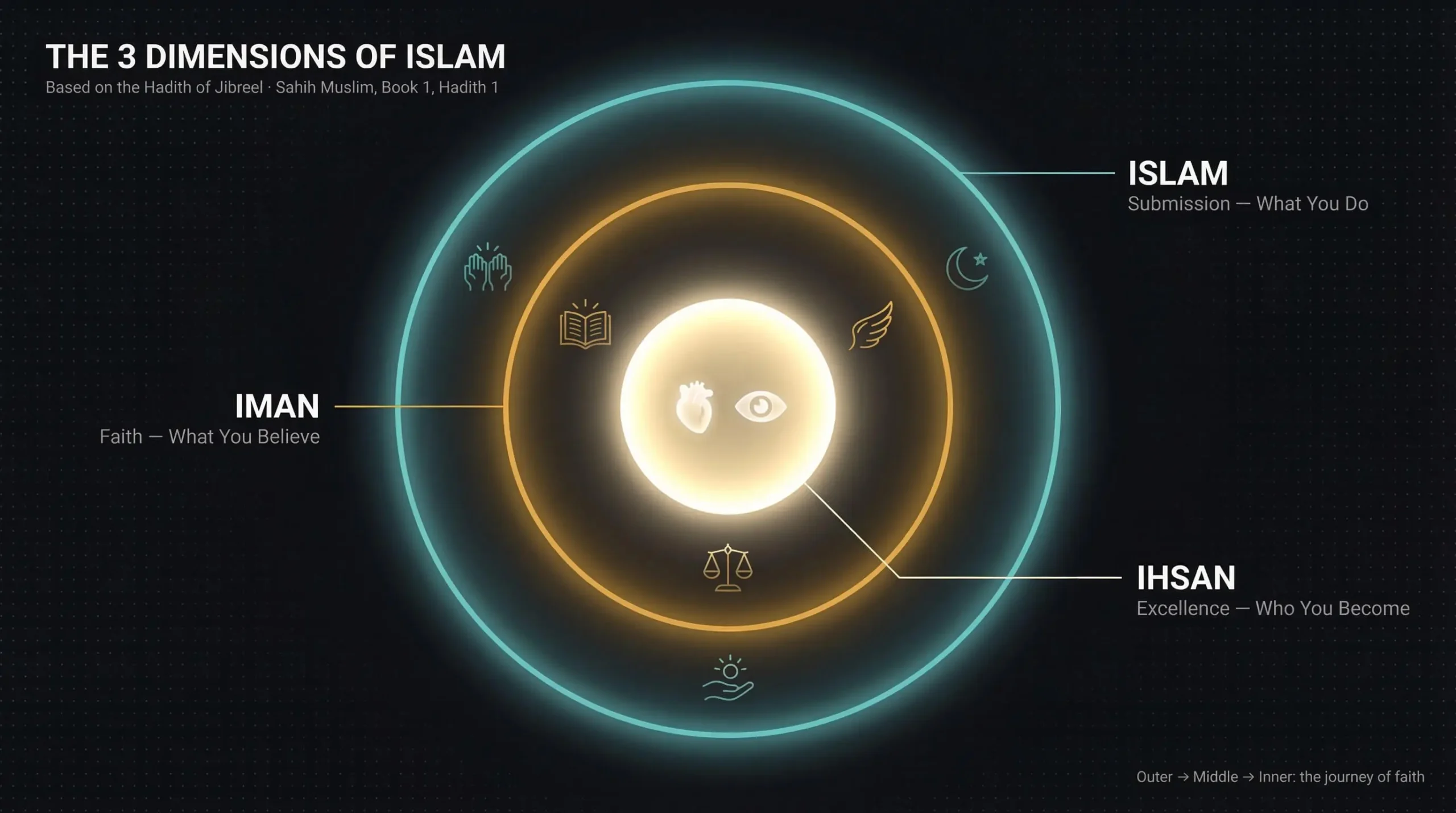
Dimension 1 — Islam (Submission): 5 Pillars Which Form The Life Everyday
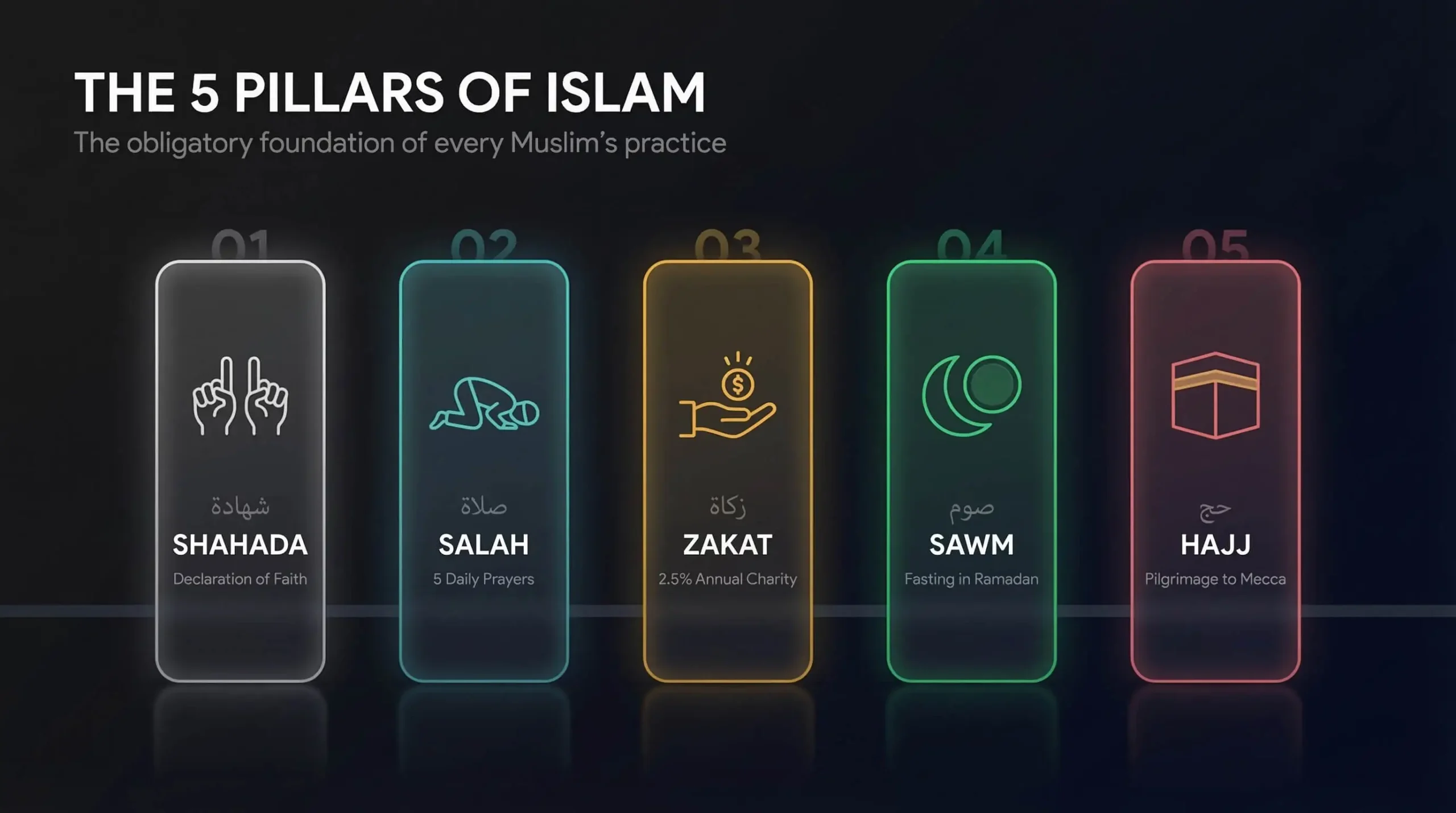
The Prophet ﷺ used to say: “The Islamic religion is based on five pillars.” (Ibn Umar, Sahih al-Bukhari, Hadith 8). These are the five acts of worship that are the daily foundation of all Muslims.
| Pillar | Arabic Name | Meaning | When / How |
|---|---|---|---|
| Shahada | شهادة | Saying: there is no god but Allah and Muhammad is his Messenger | Once with sincerity: that makes a person Muslim |
| Prayer | Salah | Direct address to God | Five times a day (Fajr, Dhuhr, Asr, Maghrib, Isha) |
| Zakat | زكاة | Purification of wealth by giving 2.5% annually | Once a year when savings exceed the nisab |
| Sawm | صوم | Not eating, drinking or having intimacy between dawn and sunset | Every day of the month of Ramadan |
| Hajj | حج | Visiting the Kaaba in Mecca | Once in a lifetime provided that is possible |
The gate is the Shahada, which means, Lā ilāha illallāh, Muhammadur Rasūlullāh. Saying this with conviction, according to every Muslim, Sunni or Shia, and even every school of thought is what causes a person to be a Muslim.
The whole day of a Muslim is structured around five Salah prayers at various times, before sunrise and after the sun goes down. This will respond to the question: who is Islamic worship? All Muslims, irrespective of their gender and affluence, conduct the Salah without a priest. The connection between the God and the worshipper is individual.
Zakat, Sawm and Hajj are worthy of a discussion but the thing is that these five are not the recommendations, they are the poles that hold the faith.
Use our free Zakat Calculator to find your exact amount.
Dimension 2 — Iman (Faith): 6 Articles Which Can Be Called the Belief of Muslims
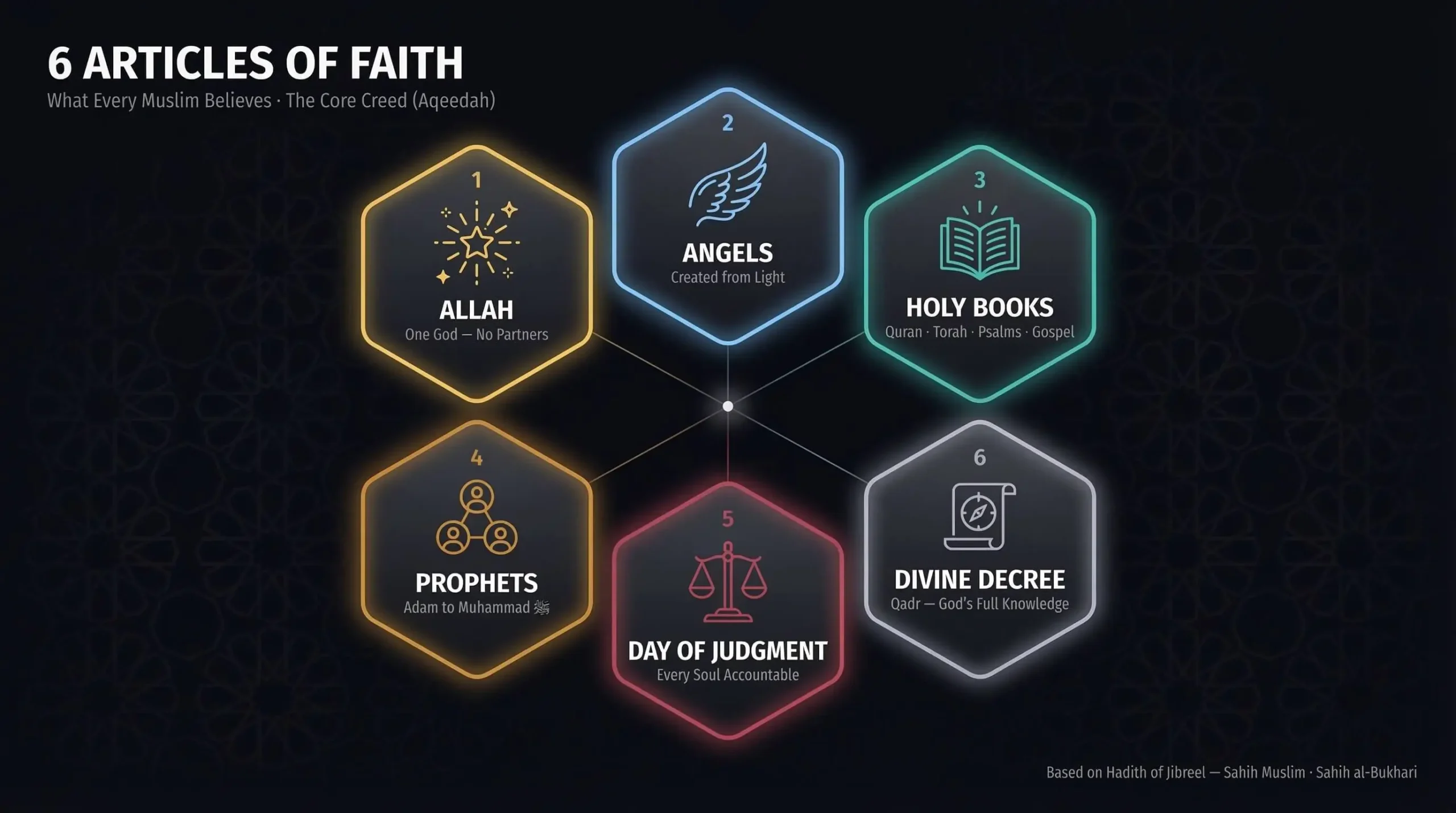
In the event that the Five Pillars demonstrate what Muslims act, the Six Articles of Faith demonstrate what Muslims ideologically believe. The creed stipulates that it must believe in 6 articles which scholars agreed upon in all major schools.
- Faith in Allah — absolute monotheism.
“Say, He is Allah, [who is] One, Allah, the Eternal Refuge. He neither begets nor is born, Nor is there to Him any equivalent.”
قُلْ هُوَ اللَّهُ أَحَدٌ ◝ اللَّهُ الصَّمَدُ ◝ لَمْ يَلِدْ وَلَمْ يُولَدْ ◝ وَلَمْ يَكُن لَّهُ كُفُوًا أَحَدٌ
(Quran 112:1-4)
These verses reveal the purest concept of God.
- Faith in the Angels — these are light creatures that execute the will of God. Jibreel (Gabriel) was the messenger of the Quran.
- Faith in the Revealed Books — Muslims believe that Quran is the last preserved word of God. The Tawrat (Torah), the Zabur (Psalms), and the Injil (Gospel), were the same fundamental message of monotheism but altered with time. Quran is maintained verbatim.
- The Faith in Prophets — Adam to Muhammad ﷺ. According to the Quran:
“Say, [O believers], ‘We have believed in Allah and what has been revealed to us and what has been revealed to Abraham and Ishmael and Isaac and Jacob and the Descendants…’”
قُولُوا آمَنَّا بِاللَّهِ وَمَا أُنزِلَ إِلَيْنَا وَمَا أُنزِلَ إِلَىٰ إِبْرَاهِيمَ وَإِسْمَاعِيلَ وَإِسْحَاقَ وَيَعْقُوبَ وَالْأَسْبَاطِ
(Quran 2:136)
Here is displayed the constant prophetic message. Muslims respect Isa (Jesus), Musa (Moses), Ibrahim (Abraham) and all the prophets.
- The Conviction of the Day of Judgment — a last judgment to be made on the soul in which all souls will be answerable. The main elements of Islamic eschatology are Jannah (paradise) and Jahannam (Hellfire).
- Assurance of Divine Decree (Qadr) — God is aware of everything, but man retains ethical accountability of his decisions.
Sheikh Ibn Uthaymeen, a respected scholar of our time told us that these six articles are not compressed. To reject any of them places an individual beyond Iman.
Dimension 3: Ihsan (Excellence) — The Spiritual Goal All Guides Shy of Mentioning
This is the aspect that most of these “What is Islam” guides overlook.
When Jibreel inquired of the Prophet ﷺ about Ihsan, he responded in a statement that, although not especially lengthy, nonetheless contains, perhaps, the most detailed definition: “To serve Allah as though you can see Him; if not, He sees you.”
Ihsan translates to excellence, beauty and perfection. It is the inward, spiritual aspect of Islam — the building up of Taqwa (God-consciousness) which transforms the dull, formal worship into a vital, breathing contact with the Creator. The second part of his book Ihya Ulum al-Din (Revival of Religious Sciences) was dedicated by Imam al-Ghazali to Ihsan which includes heart purification, sincerity, gratitude and love of God.
This is the field of Tazkiyah (spiritual purification) and Dhikr (remembrance of God). Prophet ﷺ would make repentance to God a hundred times a day (Sahih Muslim, 2702). He did not do this because he had sins but as a demonstration of Ihsan.
The important thing is that Islam is not only a collection of rules. The Jibreel Framework demonstrates it as a route, that is, external compliance (Islam) to internal faith (Iman) to spiritual virtuousness (Ihsan). All three parts are linked. You are not able to enter the inner circle without passing through the outer circles but to stop at the outer circle is to leave out the heart of the faith.
These three sections give answers to the question “What is Islam?” as perceived by the religion itself. But how did all this start? The response brings us back to a cave in a mountain that looks down on Mecca.
When and Where Did Islam Originate? A Brief History (610 CE to Today)
Islam is the history of a man who was in a cave one day and that it was revealed to, and would transform the world.
The First Revelation: The Origin of It All in a Cave Close to Mecca (610 CE)
Muhammad ibn Abdullah was born to Mecca, present-day Saudi Arabia in 570 CE. Being an orphaned young and living with his grandfather and uncle, his reputation of truthfulness was so good that the people of Mecca referred to him as al-Amin (the Trustworthy) and al-Sadiq (the Truthful) long before the revelation of the truth.
At the age of forty, in 610 CE, Muhammad went to the thinking secluded place of Cave Hira on the mountain of Light Jabal al-Nur. It was there that, as recorded in Book of Revelation of Sahih al-Bukhari, the Angel Jibreel appeared and said: “Read!” — and he handed him the first five verses of Surah Al-Alaq (96:1-5). That was the beginning of 23 years of uninterrupted divine revelation which was the Quran.
The Hijrah to Medina: The Migration Which Changed History (622 CE)
Muhammad ﷺ and his followers subsequently relocated to Yathrib — which became known as Medina (the City of the Prophet) in 622 CE after thirteen years of preaching Tawhid in Mecca and being persecuted. This migration is referred to as the Hijrah so significant that it is the starting point of the Islamic calendar.
The Prophet ﷺ was able to establish a successful community in Medina and wrote in the Constitution of Medina, which is considered one of the earliest social contracts in history. It controlled relations among Muslims, Jews, Christians and polytheists of the city and established standards of collective defense, religious tolerance, and collective civil responsibility.
Origins of Islam: From Arabia to the Rest of the World
At the death of the Prophet in 632 CE, Islam had taken root in the majority of the Arabian Peninsula. In a century, the Muslims had conquered the vast region, extending between Spain and North Africa, the Middle East, as well as Central Asia and India, through a new civilization.
It led to the Islamic Golden Age (c. 8th–14th centuries), during which Islamic scholars achieved significant progress in algebra, medicine, optics, astronomy and philosophy. The works of scholars such as Ibn Sina (Avicenna), al-Khwarizmi, and Ibn al-Haytham contributed to the Greek, Persian, and Indian knowledge, and led to the development of innovations that contributed to the revival of the European Renaissance.
The next question that most people ask is quite basic — and is quite misconstrued.
The Differences Between Islam and Muslim. (It’s Not What You Think)
This is among the most sought questions regarding the religion and the perplexity is justifiable. Islam and Muslim are different words that are connected to each other.
Islam Is the Religion — Muslim Is the Person Who Practices It
The simplest analogy: Islam is to Muslim as Christianity to Christian. The religion is Islam and the believer is known as a Muslim.
The complete definition of Islam is that of subjugating to the will of God in order to achieve peace. One who does so is referred to as a “Muslim” — one who is submissive to God. The two words have a common Arabic origin S-L-M, that is why the two are confused.
Even Quran itself draws the distinct line between the outward submission (Islam) and inner faith (Iman):
“The Bedouins say, ‘We have believed.’ Say, ‘You have not [yet] believed; but say [instead], “We have submitted,” for faith has not yet entered your hearts.’”
قَالَتِ الْأَعْرَابُ آمَنَّا ۖ قُل لَّمْ تُؤْمِنُوا وَلَٰكِن قُولُوا أَسْلَمْنَا وَلَمَّا يَدْخُلِ الْإِيمَانُ فِي قُلُوبِكُمْ
(Quran 49:14)
According to Tafsir Ibn Kathir, this verse does not mean that the superficial or outward aspect of Islam is to accept Islam, rather the inward truth of faith. One can be a Muslim (having uttered the Shahada) and yet be progressing towards complete Iman.
And So, What About Islamic and Musulman? Knowledge of the Related Terms
Islamic is an English adjective of anything to do with the Islamic religion: Islamic art, Islamic finance, Islamic history. The term refers to the civilization and its products, rather than the individual believer.
Musulman (Musulmane or Muselman) is a French, Turkish, Persian and Urdu word that translates to Muslim. It means the same, the one who bows to God, but it penetrated the European languages in other ways.
One of the outdated terms to consider: there are old English sources, which refer to Islam as Mohammedanism. This has dropped out of use as it suggests wrongly that Muslims worship Muhammad, which would offend any Muslim as worship is due to Allah only in Islam.
What Is the Holy Book of Islam? Learning the Quran and Hadith
The Islamic guideline system is based on two primary sources, the Quran and the Hadith. To make sense of Islam, it is necessary to understand the way in which they are connected.
The Quran: Why Muslims Think It Is the Word of God, Literally
Muslims believe that the Quran is the verbatim words of God. Not only inspired writing or the explanation of a prophet but the direct and unaltered speech of Allah that was revealed to Prophet Muhammad through Angel Jibreel during 23 years between 610 and 632 CE.
The Quran has 114 chapters and over 6,200 verses. Arabic is given the utmost importance in Islam because the Muslims hold that they are the words of God. Other languages are considered to be translations of the meaning, not the Quran itself.
The Hafiz tradition can be regarded as one of the most outstanding characteristics of the Quran. A whole generation after generation of millions of Muslims have memorized it in entirety. It is an oral preservation that keeps the written text in strong check to ensure that no one has it.
The Hadith and Sunnah: Prophetic Tradition Providing a Complement to the Quran
Hadiths are a documentation of what the Prophet said, did or allowed. Sunnah gives his normal lifestyle. The two are the second pillar of guidance after the Quran.
Not all Hadiths are as reliable. Science of Isnad is a procedure scientists employ to evaluate them by checking the chain of the people who transmitted it to them. They rate them as:
- Sahih (authentic) — the most powerful.
- Hasan (good) — faithful yet not that strong.
- Da‘if (weak) — lacks part of the chain.
Imam al-Bukhari, Imam Muslim, Imam al-Tirmidhi, Imam Abu Dawud, Imam al-Nasa’i and Imam Ibn Majah are the six most reliable collections of Sunni Hadiths. There is another set of four books used by the Shia Muslims.
Past Scriptures: Why the Muslims Are Also Believers in the Torah, Psalms, and Gospel
It is not known to many that the Muslims accept earlier holy books too. According to Islam, God had given Moses the Torah, David the Psalms and Jesus the Gospel. Muslims believe that Quran is the last and unaltered word of God and the previous books were modified later.
Islamic law is based on the Quran and the Hadith. And that leads us to one of the most widely posed — most widely misconceived — subjects regarding the faith.
What Is Haram in Islam? The Meaning of Halal, Haram and the Shariah
When an individual inquires what is haram, he or she wants to know what is unlawful. It is not yes or no, there are many layers in Islamic law.
The Five Categories of Actions in Islamic Law (Fiqh Categories)
| Category | Arabic Term | Meaning | Example |
|---|---|---|---|
| Obligatory | Fard / Wajib | Must be performed; reward for doing, sin for omitting | Five daily prayers (Salah) |
| Recommended | Sunnah / Mustahabb | Encouraged; reward for doing, no sin for abstaining | Voluntary prayers |
| Permissible | Mubah | Neutral, no reward or sin involved | Eating rice, sleeping |
| Disliked | Makruh | Discouraged without being a sin, but avoidable | Wasting water during ablution |
| Forbidden | Haram | Prohibited; sin when done, reward when avoided | Alcohol, pork |
This five tier system shows how Islamic law cannot be the hammer as many people would assume. The entire human activities are in the three intermediate categories of permitted, recommended and disliked and the extremes are Haram and Fard.
Major Prohibitions (Haram): Why and What Islam Prohibits
The most severe ban in Islam is shirk — linking partners with God. This is highly agreeable in the Quran and all four Sunni madhabs. Other than shirk, there are serious prohibitions such as:
- Alcohol and intoxicants — according to most verses of the Quran and Hadith.
- Pork and meat which are not slaughtered correctly — dietary law in Surah Al-Ma’idah.
- Riba (usury) — Interest based financial activities.
- Cheating, theft and injustice — wrongful deeds against others.
- Extramarital sex — safeguarding the nuclear family.
Both prohibitions are the directives of Quranic text, verified by a Hadith and not preference and strained convention.
What Is Shariah? The Misconceived Islamic Law Made Clear
The term Shariah literally translates to “path to water” in Arabic which carries a lot of meaning in the desert where water is life. Shariah is the path to spiritual well being and moral direction.
The Islamic law is involved in almost all spheres of life, in the sphere of banking and finance, as well as in the relationships within the family, welfare, environmental care, and individual ethics. It is not a strict criminal law but a broad system of ethics and law that was created throughout centuries with the help of scholastic reasoning (Ijtihad), analogical inference (Qiyas), and consensus (Ijma).
Emphasizing the fact that Shariah is much more relaxed and liberal than the caricature commonly depicted in the popular media, Sheikh Yasir Qadhi and Dr. Jonathan Brown are two of the most eminent contemporary scholars. The International Islamic Fiqh Academy in Jeddah has been issuing collective fatwas on contemporary issues demonstrating the capacity of the tradition to deal with contemporary issues.
The Way of Life of Islam — Not Sunday Religion
Islam can be said to be a religion but the people who have the faith hold it to be much wider. According to them, Islam is a wholesome and natural lifestyle, which is supposed to place God at the center of the mind of a person at any time and not only in prayers.
The Way Islam Regulates the Worship, Ethics, Business, and Family Life
Islam is also present in all aspects of the life of a person. Spiritually it involves praying, fasting and remembering God. Socially it is promoting good manners, kindness, and support to the community. It requires, ethically, taking care of the poor, representing justice and telling the truth in business.
In one verse the Quran specifies all-inclusive righteousness:
“Righteousness is not that you turn your faces toward the east or the west, but [true] righteousness is [in] one who believes in Allah, the Last Day, the angels, the Book, and the prophets and gives wealth, in spite of love for it, to relatives, orphans, the needy, the traveler, those who ask [for help], and for freeing slaves…”
لَّيْسَ الْبِرَّ أَن تُوَلُّوا وُجُوهَكُمْ قِبَلَ الْمَشْرِقِ وَالْمَغْرِبِ
Tafsir al-Tabari interprets this verse to mean that Islam denies purely ritualistic religion. Faith is expressed in deed; what you do to your neighbor, how you carry on business, how you treat the poor.
This comprehensive vision was strengthened by Prophet ﷺ: “I have been sent to perfect good character” (Musnad Ahmad, Hadith 8939, Hasan). And: “The most perfect of you are the best in character” (Sunan al-Tirmidhi, Hadith 2003, Sahih).
The five prayers are the foundation of the structure of the day of a Muslim, the choice of food is conditioned by the halal and haram rules, the relations are determined by the commandment: “None of you truly believes until he loves for his brother what he loves for himself” (Sahih al-Bukhari, Hadith 13, Sahih).
The Two Eids and the Islamic Festivals That the Muslims Observe
There are two major Islamic religious festivals:
- Eid al-Fitr — this is at the culmination of Ramadan as it is the end of a month of fasting. It is a day of thanksgiving, joint prayers, charity (Zakat al-Fitr) and family meetings. The Fiqh Council of North America (FCNA) recommended updated amounts of Zakat al-Fitr of $10 per individual in 2026.
- Eid al-Adha — the Festival of Sacrifice, in honor of Prophet Ibrahim, who wanted to sacrifice his son as an obedience to God. It coincides with the Hajj pilgrimage and includes communal prayer, animal sacrifice and also giving of meat to the poor.
Both festivals demonstrate the integration of Islam in terms of worship, community and social responsibility — a religion not only practiced but practiced.
What Is Dar al-Islam? Concept of Islamic Territories Explained
Dar al-Islam is a term that is used very often in terms of Islam and international politics. It has changed its meaning drastically to the meaning it is used in the present day.
The Classical Meaning: Abode of Islam vs. Abode of War
The scholars used the term Dar al-Islam (Arabic: دار الإسلام, translated as the home of Islam) to describe the countries which were under the rule of Islamic civilization and which were often perceived as the home of Islam or a land of peace. Conventionally, it was accompanied with Dar al-Harb, meaning house of war, which was areas not under the control of Muslims.
A very important academic observation: The concept of homes or divisions of the world, e.g. Dar al-Islam and Dar al-Harb, is not found in the Quran or the Hadith. Later jurists made them as a practical governing rule rather than through God.
The idea is related but the concept of Allah in the Quran is spiritually different:
“And Allah invites to the Home of Peace (Dar al-Salam).”
وَاللَّهُ يَدْعُو إِلَىٰ دَارِ السَّلَامِ
(Quran 10:25)
Tafsir Ibn Kathir elaborates that Dar al-Salam is the ultimate abode of peace which is paradise.
The Reason Why Most Scholars Claim That This Binary View Has Become Outdated Today
The ideological contrast between Dar al-Islam and Dar al-Harb is widely perceived as being irrelevant by modern scholars. Several people consider the Western world as a section of Dar al-Islam since there people can express and enforce their faith.
Muslim intellectuals disagreed themselves on the definition as it was originally. The Hanafi school did not have a strict opinion between the belief and disbelief and categorized by security and protection. This variety demonstrates that the matter is not a closed law but rather reasonable.
The Assembly of Muslim Jurists of America (AMJA) is an independent Muslim organization in the West which presupposes that Muslims in the West are not inhabitants of enemy territory, but members of those societies.
The History of Dar al-Islam and Islamic Golden Age: Historical Legacy
In the past, Dar al-Islam was a city of scientific, mathematical, medical, and philosophical achievements in the Islamic Golden Age. Such cities as Baghdad, Cordoba, Cairo, and Samarkand became centers of intellectual life which gave algebra, surgical implements, and university systems which defined modern civilization.
Islam by the Numbers — The Important Statistics Every Newcomer Needs to Know (2025–2026 Data)
Data brings clarity. The figures that indicate the world representation of Islam, as they result out of the biggest study ever, convey a tale that most older sources misunderstand.
The Question of How Many Muslims Will There Be in the World in 2026?
By 2025, the world was estimated to have 2 billion Muslims, and Islam was the second largest religion in the world and approximately a quarter of the total population on earth. The religion is spread out widely with the majority of Muslim population in 53 countries:
- Approximately 12 percent of its population in Indonesia (largest Muslim nation).
- In South Asia (Pakistan, India, Bangladesh) 31%.
- Approximately a fifth of the Middle East and North Africa.
- ~15% in sub-Saharan Africa
There are still older reports stating 1.2–1.5 billion. Those numbers are wrong. The June 2025 Pew Research Center study cleared up the score.
The majority of Muslims all over the world are not Arabs, more than 80 percent. The fact indicates that Islam is not a foreign culture to the Arabs — it is a world community that has people of all races, continents and languages.
Why Islam Is the Rapidly Spreading Religion in the World (Pew Research 2025)
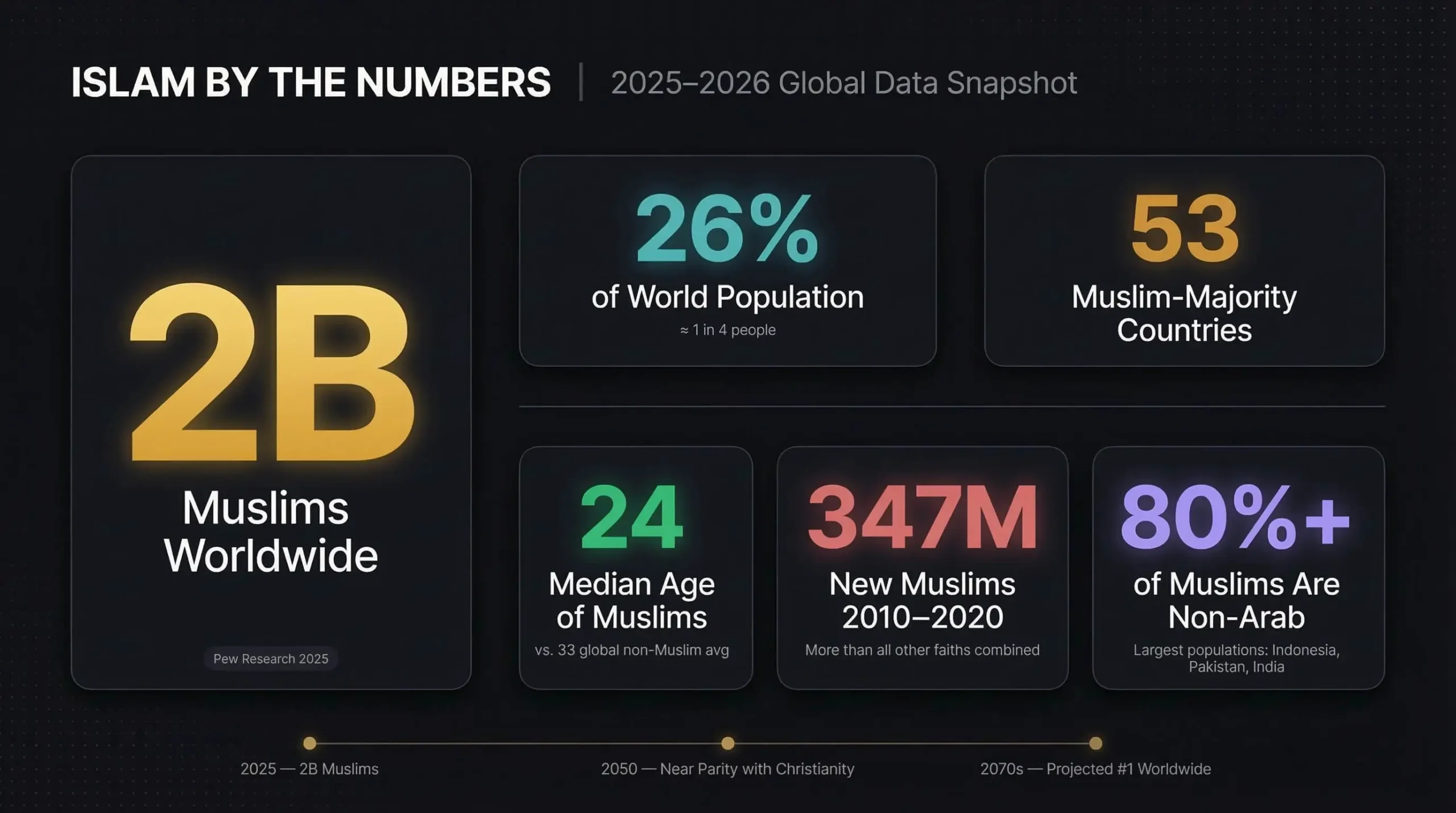
The Muslim population increased at a very rapid pace: overall, during the period between 2010 and 2020, it increased by 347 million individuals, which is more than in any other religion combined. The Muslim population increased two times compared to the rest of the world (21 percent versus 10 percent).
According to Pew researchers, the increase is primarily as a result of three things:
- Younger Muslims — 24 years is the average age of Muslims in the world, the average age of non-Muslim is 33 years.
- More children — Muslim families bear more children than families in most other regions of the world.
- Few leave — very few Muslims abandon their religion as compared to those in other religions.
The most significant growth was recorded in the North America, as the Muslim population grew to 5.9 million in 2020 (compared to 52 percent since 2010). The Muslim number in sub-Saharan Africa increased by 34 per cent to 369 million. In Asia-Pacific, the proportion of Muslims in the total population increased by 1.4 percentage points to 26.
In 2050, according to Pew, the number of Muslims and Christians will be approximately equal, and by 2070s the number of Islam believers will probably be the largest in the world.
Islam at a Glance (2026)
| Metric | Value | Source |
|---|---|---|
| World Muslim Population | 2 billion | Pew Research 2025 |
| Percent of World Population | 26% | Pew Research 2025 |
| Countries with Muslim Majority | 53 | Pew Research |
| Most Populous Muslim Nation | Indonesia | Pew Research |
| Average Age of Muslims | 24 years old | Pew Research 2025 |
| Sacred Text | Quran (114 Surahs) | — |
| Sacred Places | Mecca, Medina, Jerusalem | — |
| Main Branches | Sunni (87–90%), Shia (10–13%) | — |
These facts are anti-stereotypes. However, stereotypes remain and the following section is crucial.
7 Major Myths About Islam — Fact-Busted
Misconception 1: Islam Equals Violence
S-L-M is the Arabic root, which means peace, safety, and whole. Quran states:
“And Allah invites to the Home of Peace.”
وَاللَّهُ يَدْعُو إِلَىٰ دَارِ السَّلَامِ
(Quran 10:25)
To refer to Islam as violent is to miss the definition of the term. According to the Prophet ﷺ “A Muslim is one whose say and action leave other Muslims in security” (Sahih al-Bukhari). One of the definitions of a Muslim is safety.
Misconception 2: Muslims Worship Muhammad
Muhammad is not something that Muslims worship. Worship belongs only to God. The Prophet ﷺ made it very clear that there was no worship that could go hand in hand with loving or respecting him. The Shahada affirms that he is not Allah but only a servant of Allah who passed the message of Allah.
Misconception 3: Only Arabs Are Muslims
Over 80 percent of Muslims are non-Arab. The largest Muslim communities are found in Indonesia, Pakistan, India, and Bangladesh — none of them are Arab states. The Arabic Quran is universal:
“And We have not sent you, [O Muhammad], except as a mercy to the worlds.”
وَمَا أَرْسَلْنَاكَ إِلَّا رَحْمَةً لِّلْعَالَمِينَ
(Quran 21:107)
Misconception 4: Muslims Do Not Believe in Jesus
Muslims think that Jesus (Isa in Arabic) is an extremely significant prophet. He was conceived through the Virgin Mary, had to perform miracles at the authorization of God, and he will come back before the last day. There is a whole chapter in the Quran concerning Mary (Surah Maryam). Muslims do not believe that Jesus is God or a son of God, according to them, he is a human prophet.
Misconception 5: The Misconception of the Sameness of All Muslims
There are two branches of Islam — Sunni (87–90%), and Shia (10–13%). The divide occurred on the successor to the leadership of the Prophet following his death. In Sunni Islam, it has four major schools of law namely Hanafi, Maliki, Shafi’i and Hanbali, which provide varying legal information but concur on the fundamental beliefs. Islam can fulfill the needs of many human beings in a variety of ways as demonstrated by their diversity in terms of culture, law and worship.
Misconception 6: Islam Spread by the Sword Only
War was not the only way that Islam proliferated. It was introduced in the world through trade routes to Southeast Asia (the largest Muslim state in the world) and sub-Saharan Africa as well as Central Asia. According to the Quran:
“There shall be no compulsion in [acceptance of] the religion.”
لَا إِكْرَاهَ فِي الدِّينِ
(Quran 2:256)
A long time of large non-Muslim populations in many places they dominated by Muslims demonstrated that conversion was not always coercive.
Misconception 7: Shariah Means Harsh Punishment
Shariah is simply translated to mean “the way to water.” It addresses personal worship, family rules, business ethics, charity and food rules. Shariah consists of criminal law (hudud) only in a small portion. The materials required in those laws are so stringent to the extent that they are nearly impossible to utilize according to many scholars.
One of the renowned scholars of Hanbali was Imam Ibn Taymiyyah who stated that the primary objectives of Shariah are to ensure the security of life, the safety of the mind, the preservation of faith, the safeguarding of families, and the safeguarding of property. Just about all legal systems have these objectives.
Mercy is found everywhere in the religion as the Quran recounts a tale of mercy:
“Say, ‘O My servants who have transgressed against themselves [by sinning], do not despair of the mercy of Allah. Indeed, Allah forgives all sins. Indeed, it is He who is the Forgiving, the Merciful.’”
قُلْ يَا عِبَادِيَ الَّذِينَ أَسْرَفُوا عَلَىٰ أَنفُسِهِمْ لَا تَقْنَطُوا مِن رَحْمَةِ اللَّهِ
(Quran 39:53)
One of the most promising verses in the Quran according to a scholar known as Tafsir al-Sa’di was this verse and according to him it reveals the perpetual mercy of Allah.
Frequently Asked Questions About Islam
What is Islam in simple words?
Islam is a religion that signifies submission to God. Muslims have a belief in one God (Allah), the Quran is the final book of God and Prophet Muhammad ﷺ is the last messenger. There are five practices (prayer, fasting, pilgrimage etc.) and six main beliefs in Islam and approximately 2 billion people subscribe to it.
Are Islam and Muslim one and the same thing?
No. Islam is the religion; a Muslim is a man who follows the religion. The word Islam is the submission to God and the term Muslim is the one who submits. They are similar in terms of Arabic origin (S-L-M) but yet say different things as is the case with Christianity (religion) and Christian (follower).
What is the Shahada in Islam?
The Islamic confession is known as the Shahada: Lā ilāha illallāh, Muhammadur Rasūlullāh, i.e. “There is no God but Allah, and Muhammad is the Messenger of Allah.” It is also the primary and the most crucial of the Five Pillars. It is something one means with his heart and that he becomes a Muslim.
Who does Islam worship?
Allah is the Only God that Muslims worship because He is the creator of everything. Tawhid in Islam refers to absolute monotheism. Muhammad, angels and saints are not idols of Muslims. Salat (Prayer) is made to Allah five times a day and the most evil sin is to attribute His power as God (shirk).
What is the religious book of Islam?
Quran is the most sacred book of the Islam religion. Muslims consider that it is the direct word of God that has not been changed and was revealed to Prophet Muhammad through the Angel Jibreel during 23 years. The sayings and deeds of the Prophet are documented in the books known as Hadith (such as Sahih al-Bukhari and Sahih Muslim) and honored as well.
When did Islam originate?
The revelation of Islam began in 610 CE when Prophet Muhammad was given the initial verses in a cave located close to Mecca, Saudi Arabia. Muslims assert that all the prophets have accomplished the task of sending the message of a single God since Adam thus making Islam the oldest divine message in its ultimate manifestation.
What is haram in Islam?
Haram means “forbidden.” Big prohibitions are: serving God other than God (shirk); drinking alcohol and eating pork; charging of high interest (riba); lying; theft and intercourse outside of marriage. These regulations are based on the Quran and Hadith and are supposed to defend people and community.
What is Dar al-Islam?
Dar al-Islam (which can be translated as the city of Islam) initially included the territories governed by Muslims where the Islamic law took effect. Today, according to most researchers, it is the place where Muslims can practise their religion without any restrictions, which is Dar al-Islam, and the concept of rigid boundaries has become rather outdated.
Is Islam growing at the quickest rate?
Yes. Stanford, Pew (2025) report indicates that Islam is the fastest-growing major world religion. Between 2010 and 2020, the Muslim population increased by 347 million mainly due to the youthful population and increased birth rates. Scholars believe that Islam can be equal to Christianity in 2050.
What are the Five Pillars of Islam?
The Five Pillars are:
- Shahada – statement of faith
- Salah – five daily prayers
- Zakat – giving 2.5% of wealth
- Sawm – fasting in Ramadan
- Hajj – pilgrimage to Mecca at least once in case possible
These are what are obligatory to any Muslim.
Do Muslims believe in Jesus?
Yes. Jesus (Isa in the Arabic language) is one of the greatest prophets of Muslims. It is told that he was born of the Virgin Mary and he came with some miracles and will return before the Day of Judgment. Muslims never believe that he is the son of God or Godly, the Quran demonstrates that he was a mortal prophet who taught the monotheism (Tawhid).
What is the distinction between Shia and Sunni Islam?
The two branches of Islam are Sunni and Shia. The first division between Sunnis (approximately 87–90%) and the Shia (10–13%) was who should succeed Prophet Muhammad. Their religious laws and rituals later became different. They both adhere to the Quran, the five pillars and the main doctrines, but their differences are in the leadership, legal regulations and some of the practices.
This is the Start of Understanding Islam (But There is So Much More)
It is the key provided in the Hadith of Jibreel: There are three parts of Islam, which are fitting. The first is the external worship referred to as the Five Pillars, the second is the interior beliefs referred to as the Six Articles, and the third is the intention to do goodness referred to as Ihsan, which transforms both. These sections reveal why two billion individuals across the entire globe make use of Islam as a comprehensive guide to life. It is founded on the Quran and the true Sunnah, and it has been developed by scholars during 1,400 years, by Imam al-Bukhari, Imam al-Nawawi, and Imam Ibn Kathir and continues to expand.
Want to learn more? Read these 50 Interesting Facts of Islam.
Most of the scholars representing the four Sunni schools as well as Shia scholars on the essence items share these parts. The fact that they do so demonstrates the richness of an intellectual tradition that is alive, and not a significant point of dispute.
This guide relied on the Quran, Sahih al-Bukhari, Sahih Muslim, 10 classic Tafsir books, and 2025 Pew Research Center data.
In questions of personal faith and practice, one is better to consult an expert scholar.
Wallahu A’lam — Allah knows best.