Stop Guessing — Start Reciting with Full Confidence
The #1 Pain Point You want to recite authentic morning and evening duas — but you’re not sure which ones are genuine, how many to read, exactly when to start, or what to do if you miss the time window. This guide answers every one of those questions definitively. |
Every Muslim deserves protection, barakah, and peace — and the Prophet Muhammad (ﷺ) gave us the precise tool to achieve it: the morning and evening adhkar. Yet millions of Muslims feel paralysed by doubt: “Which duas are authentic?” “Did I miss the time?” “Is using an app acceptable?”
This guide is the single most comprehensive, evidence-based resource on authentic morning and evening duas available. It is built on the Qur’an, Sahih hadith collections (Bukhari, Muslim, Abu Dawud, Tirmidhi, Nasa’i, Ibn Majah), the classical scholars, and the respected views of all four Sunni madhabs — without favouring any one school.
What you will find here: 25 fully authenticated duas with Arabic, transliteration, translation, repetition counts, sources and grading; dedicated Morning and Evening sections; a Quick-Start table; three practical routine tiers; a 15-question FAQ; and a comprehensive madhab comparison table.
Primary keywords: morning and evening duas, authentic morning and evening adhkar, morning adhkar with proofs, evening adhkar sunnah, Hisn al-Muslim duas, daily adhkar routine, protection duas morning evening.
What Are Morning and Evening Adhkar?
The term adhkar (singular: dhikr) linguistically means ‘remembrance’ or ‘mention.’ In Islamic practice, it refers to specific words and supplications from the Qur’an and Sunnah prescribed for particular times — similar to how Istikhara dua is a prescribed supplication for making decisions.
While dua is a general supplication to Allah, the structured morning and evening adhkar are a defined set of remembrances the Prophet (ﷺ) performed consistently — making them one of the most reliably transmitted Sunnah acts.
The Qur’anic command: “يَا أَيُّهَا الَّذِينَ آمَنُوا اذْكُرُوا اللَّهَ ذِكْرًا كَثِيرًا“
“O you who have believed, remember Allah with much remembrance” (Qur’an 33:41)
This divine command, combined with the Prophet’s (ﷺ) consistent practice and explicit teaching, establishes the morning and evening adhkar as a cornerstone of the Muslim’s daily life.
Exact Timing Windows for Morning and Evening Adhkar
Morning Adhkar — When Do They Begin and End?
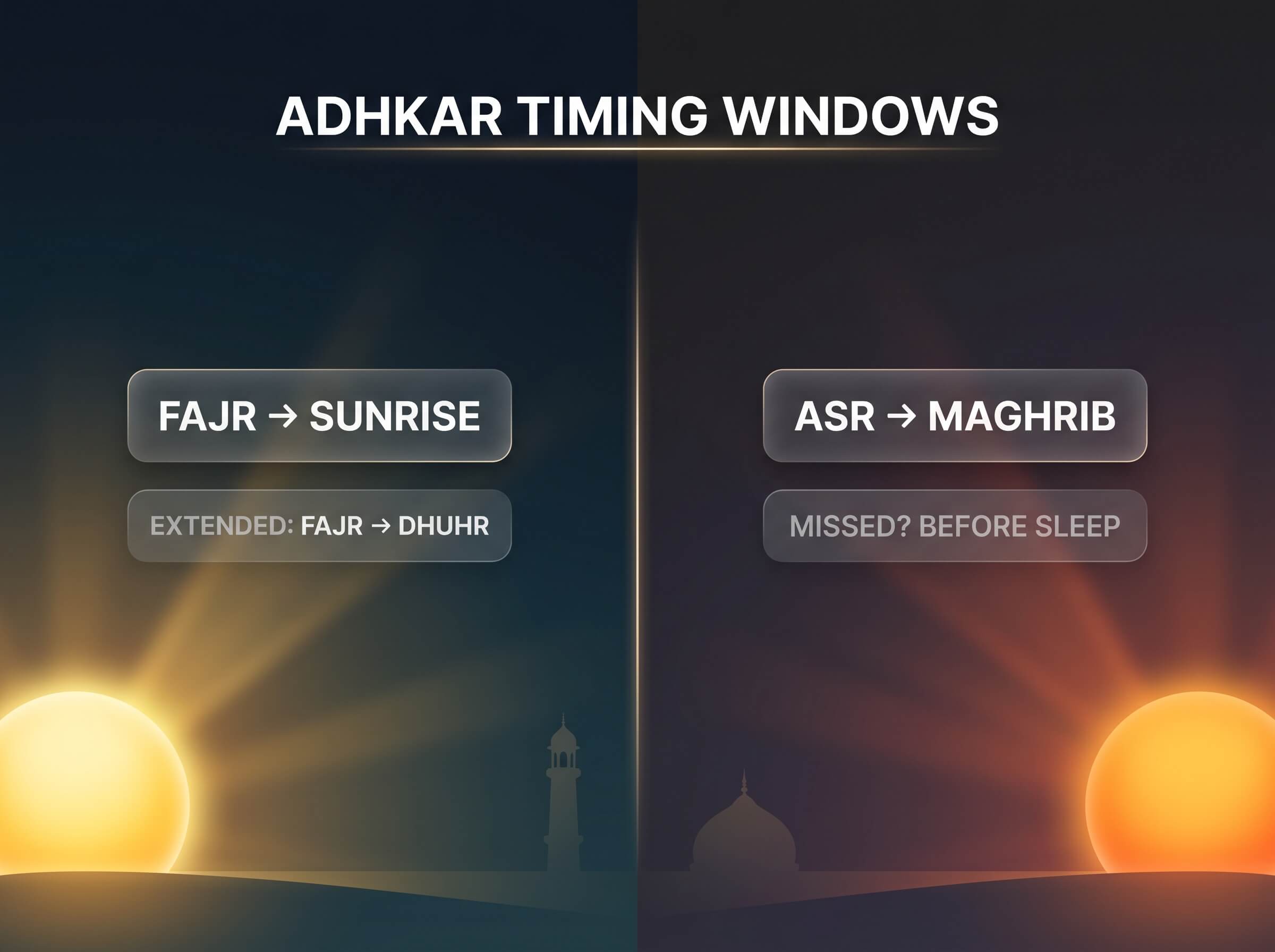
- Primary window: After Fajr prayer → until sunrise (the opinion of the majority, including Imam al-Nawawi in Al-Adhkar)
- Extended window: After Fajr → until Dhuhr (midday prayer) — permitted according to the Hanafi school and some Shafi’i scholars, based on hadith in Sahih Muslim
- The ideal: Recite immediately after the Fajr prayer, before engaging in worldly matters
Evening Adhkar — When Do They Begin and End?
- Primary window: After Asr prayer → until Maghrib (sunset) — the position of Imam al-Nawawi and the majority
- Some scholars, including Ibn al-Qayyim (Al-Wabil al-Sayyib), note that ‘evening’ (masa’) in many hadith begins from late afternoon
- If missed: Recite before sleeping — you still gain significant reward, though the primary window has closed
Key Fiqh PrincipleMissing the ideal time does not mean abandoning the adhkar. Recite them as soon as you remember. Ibn Taymiyyah and others affirm the virtue of making up missed dhikr. Do not let perfect be the enemy of good. |
Quick-Start: The 10 Core Morning & Evening Adhkar at a Glance
New to adhkar? Start here. This table shows the 10 most essential duas — their morning vs evening variation — so you can begin immediately.
# | Morning Version | Evening Version | Times |
1 | Alhamdulillahilladhi ahyana ba’da ma amatana… (Upon waking) | Alhamdulillahilladhi ahyana ba’da ma amatana… (Upon waking from nap / before sleep) | 1× |
2 | Allahumma bika asbahna wa bika amsayna… | Allahumma bika amsayna wa bika asbahna… | 1× |
3 | Asbahna wa asbahal-mulku lillah… | Amsayna wa amsal-mulku lillah… | 1× |
4 | Raditu billahi Rabban, wa bil-Islami dinan, wa bi-Muhammadin (ﷺ) nabiyyan | Same | 3× |
5 | Ayat al-Kursi (Qur’an 2:255) | Same | 1× |
6 | Surah Al-Ikhlas, Al-Falaq, An-Nas (3 Quls) | Same | 3× |
7 | Bismillahil-ladhi la yadurru… | Same | 3× |
8 | La ilaha illallahu wahdahu la sharika lahu… | Same | 10× |
9 | Subhanallahi wa bihamdihi | Same | 100× |
10 | Sayyid al-Istighfar | Same | 1× |
PART ONE: Dedicated Morning Adhkar (After Fajr)
These adhkar are specifically worded for the morning. Recite them after the Fajr prayer, ideally while seated in your prayer place.
M-1. Dua Upon Waking — First Words of the Day [MORNING ONLY] | |
الْحَمْدُ لِلَّهِ الَّذِي أَحْيَانَا بَعْدَ مَا أَمَاتَنَا وَإِلَيْهِ النُّشُورُ | |
Transliteration | Alhamdulillahilladhi ahyana ba’da ma amatana wa ilayhin-nushur |
Translation | “All praise is for Allah who gave us life after causing us to die, and to Him is the resurrection.” |
Recite | 1 time — immediately upon waking |
Source | Sahih al-Bukhari (6312) | Grading: Sahih |
Benefit | This is the first dhikr of the day. It frames the entire morning with gratitude and consciousness of Allah. It is one of the most authentic and universally agreed-upon morning adhkar. |
M-2. Entering the Morning — The Declaration of Tawakkul [MORNING ONLY] | |
اللَّهُمَّ بِكَ أَصْبَحْنَا، وَبِكَ أَمْسَيْنَا، وَبِكَ نَحْيَا، وَبِكَ نَمُوتُ، وَإِلَيْكَ النُّشُورُ | |
Transliteration | Allahumma bika asbahna, wa bika amsayna, wa bika nahya, wa bika namutu, wa ilaikan-nushur |
Translation | “O Allah, by You we enter the morning, by You we enter the evening, by You we live, by You we die, and to You is the resurrection.” |
Recite | 1 time — morning (use ‘asbahna’ version) |
Source | Sahih Muslim (2723/4) | Sunan Abu Dawud (5068) | Grading: Sahih |
Benefit | This dua establishes complete reliance (tawakkul) on Allah for every aspect of one’s existence. The morning version uses ‘asbahna’ (we entered the morning). The evening version uses ‘amsayna’ (we entered the evening). Always use the correct version for each time. |
M-3. The Sovereignty of Allah at Morning — Comprehensive Morning Praise [MORNING ONLY] | |
أَصْبَحْنَا وَأَصْبَحَ الْمُلْكُ لِلَّهِ، وَالْحَمْدُ لِلَّهِ، لاَ إِلَهَ إِلاَّ اللَّهُ وَحْدَهُ لاَ شَرِيكَ لَهُ، لَهُ الْمُلْكُ وَلَهُ الْحَمْدُ وَهُوَ عَلَى كُلِّ شَيْءٍ قَدِيرٌ | |
Transliteration | Asbahna wa asbahal-mulku lillah, walhamdu lillah, la ilaha illallahu wahdahu la sharika lahu, lahul-mulku wa lahul-hamdu wa Huwa ‘ala kulli shay’in Qadir. Rabbi as’aluka khaira ma fi hadhil-yawm wa khaira ma ba’dahu, wa a’udhu bika min sharri hadhil-yawm wa sharri ma ba’dahu. Rabbi a’udhu bika minal-kasali wa su’il-kibar. Rabbi a’udhu bika min ‘adhabin fin-nar wa ‘adhabin fil-qabr. |
Translation | “We have reached the morning and at this very time all sovereignty belongs to Allah… O my Lord, I ask You for the good of this day and the good that follows it, and I seek refuge in You from the evil of this day and the evil that follows it. O my Lord, I seek refuge in You from laziness and the misery of old age. O my Lord, I seek refuge in You from the torment of the Fire and the torment of the grave.” |
Recite | 1 time — morning only |
Source | Sahih Muslim (2723) | Sunan Abu Dawud (5071) | Grading: Sahih |
Benefit | One of the most comprehensive morning duas covering: tawhid, gratitude, seeking good, refuge from evil, laziness, old age, the Fire, and the grave. Use ‘Amsayna wa amsal-mulku lillah’ in the evening. |
M-4. Raditu Billahi Rabban — Contentment with Allah [MORNING & EVENING] | |
رَضِيتُ بِاللَّهِ رَبًّا، وَبِالإِسْلامِ دِينًا، وَبِمُحَمَّدٍ ﷺ نَبِيًّا | |
Transliteration | Raditu billahi Rabban, wa bil-Islami dinan, wa bi-Muhammadin (sallallahu ‘alayhi wa sallam) nabiyyan |
Translation | “I am pleased with Allah as my Lord, with Islam as my religion, and with Muhammad (ﷺ) as my Prophet.” |
Recite | 3 times — morning (and evening) |
Source | Sunan Abu Dawud (5072) | Jami’ al-Tirmidhi (3389) | Grading: Sahih |
Benefit | The Prophet (ﷺ) said: ‘Whoever says this three times in the morning and evening, it is a duty upon Allah to please him on the Day of Judgement.’ (Abu Dawud — Sahih). A profound declaration of faith and gratitude. |
M-5. Allahumma Inni As’aluka al-‘Afwa wal-‘Afiyata — Seeking Pardon and Well-Being [MORNING & EVENING] | |
اللَّهُمَّ إِنِّي أَسْأَلُكَ الْعَفْوَ وَالْعَافِيَةَ فِي الدُّنْيَا وَالآخِرَةِ | |
Transliteration | Allahumma inni as’aluka al-‘afwa wal-‘afiyata fid-dunya wal-akhirah |
Translation | “O Allah, I ask You for pardon and well-being in this world and in the Hereafter.” |
Recite | 1 time — morning (and evening). See full version in Hisn al-Muslim. |
Source | Sunan Ibn Majah (3871) | Sunan Abu Dawud (5074) | Grading: Sahih |
Benefit | Ibn ‘Umar (رضي الله عنه) reported that the Prophet (ﷺ) never left these words. ‘Afiyah (well-being) encompasses physical health, mental safety, protection from fitna, and ease in all affairs. One of the most treasured morning and evening supplications. |
M-6. Allahumma Inni As’aluka ‘Ilman Nafi’an — Seeking Beneficial Knowledge [MORNING ONLY] | |
اللَّهُمَّ إِنِّي أَسْأَلُكَ عِلْمًا نَافِعًا، وَرِزْقًا طَيِّبًا، وَعَمَلًا مُتَقَبَّلًا | |
Transliteration | Allahumma inni as’aluka ilman nafi’an, wa rizqan tayyiban, wa amalan mutaqabbalan |
Translation | “O Allah, I ask You for beneficial knowledge, goodly provision, and accepted deeds.” |
Recite | 1 time — morning only (after Fajr specifically) |
Source | Sunan Ibn Majah (925) | Grading: Hasan (authenticated by Al-Albani) |
Benefit | This is a specifically morning supplication. It asks for the three essentials of a productive Muslim life: knowledge that benefits, provision that is pure (halal and blessed), and deeds accepted by Allah. Imam Ibn Majah places this specifically after the Fajr prayer. |
PART TWO: Dedicated Evening Adhkar (After Asr)
These adhkar are specifically worded for the evening. Recite them after the Asr prayer, or any time between Asr and Maghrib. Where a morning version exists, the evening version is noted.
E-1. Allahumma Bika Amsayna — Evening Declaration of Tawakkul [EVENING ONLY] | |
اللَّهُمَّ بِكَ أَمْسَيْنَا، وَبِكَ أَصْبَحْنَا، وَبِكَ نَحْيَا، وَبِكَ نَمُوتُ، وَإِلَيْكَ الْمَصِيرُ | |
Transliteration | Allahumma bika amsayna, wa bika asbahna, wa bika nahya, wa bika namutu, wa ilayk al-masir |
Translation | “O Allah, by You we enter the evening, by You we enter the morning, by You we live, by You we die, and to You is the return.” |
Recite | 1 time — evening only (note: ends with ‘al-masir’ — the return, not ‘al-nushur’ as in the morning version) |
Source | Sahih Muslim (2723/5) | Sunan Abu Dawud (5068) | Grading: Sahih |
Benefit | The evening mirror of M-2. Note the subtle but important difference: the evening version ends with ‘wa ilayk al-masir’ (to You is the return) rather than ‘wa ilayk al-nushur’ (the resurrection). Using the correct wording preserves the precise Sunnah. |
E-2. Amsayna wa Amsal-Mulku Lillah — Evening Praise and Sovereignty [EVENING ONLY] | |
أَمْسَيْنَا وَأَمْسَى الْمُلْكُ لِلَّهِ، وَالْحَمْدُ لِلَّهِ، لاَ إِلَهَ إِلاَّ اللَّهُ وَحْدَهُ لاَ شَرِيكَ لَهُ | |
Transliteration | Amsayna wa amsal-mulku lillah, walhamdu lillah, la ilaha illallahu wahdahu la sharika lahu, lahul-mulku wa lahul-hamdu wa Huwa ‘ala kulli shay’in Qadir. Rabbi as’aluka khaira ma fi hadhihil-laylati wa khaira ma ba’daha, wa a’udhu bika min sharri hadhihil-laylati wa sharri ma ba’daha. |
Translation | “We have entered the evening and at this very time all sovereignty belongs to Allah… O my Lord, I ask You for the good of this night and the good that follows it, and I seek refuge in You from the evil of this night and the evil that follows it.” |
Recite | 1 time — evening only |
Source | Sahih Muslim (2723) | Sunan Abu Dawud (5071) | Grading: Sahih |
Benefit | The evening counterpart to M-3. Note ‘hadhihil-laylati’ (this night) replaces ‘hadhil-yawm’ (this day). The two versions together — one for morning, one for evening — form a beautiful daily pair that bookends the Muslim’s day with complete tawakkul. |
E-3. Dua Before Sleeping — Closing the Day [EVENING / BEFORE SLEEP] | |
بِاسْمِكَ اللَّهُمَّ أَمُوتُ وَأَحْيَا | |
Transliteration | Bismika Allahumma amutu wa ahya |
Translation | “In Your name, O Allah, I die and I live.” |
Recite | 1 time — upon going to sleep |
Source | Sahih al-Bukhari (6312) | Grading: Sahih |
Benefit | This is recited just before sleeping. It is paired with the waking dua (M-1). Together, they frame sleep as a form of death and waking as resurrection — a profound reminder of our total dependence on Allah. |
PART THREE: Shared Morning & Evening Adhkar
The following adhkar are recited in both the morning and the evening with the same wording. They form the backbone of the daily adhkar routine and are found in Hisn al-Muslim and the major Sahih collections.
S-1. Ayat al-Kursi — The Greatest Verse for Morning and Evening Protection [MORNING & EVENING] | |
اللَّهُ لَا إِلَٰهَ إِلَّا هُوَ الْحَيُّ الْقَيُّومُ ۚ لَا تَأْخُذُهُ سِنَةٌ وَلَا نَوْمٌ ۚ لَهُ مَا فِي السَّمَاوَاتِ وَمَا فِي الْأَرْضِ ۗ مَنْ ذَا الَّذِي يَشْفَعُ عِنْدَهُ إِلَّا بِإِذْنِهِ ۚ يَعْلَمُ مَا بَيْنَ أَيْدِيهِمْ وَمَا خَلْفَهُمْ ۖ وَلَا يُحِيطُونَ بِشَيْءٍ مِنْ عِلْمِهِ إِلَّا بِمَا شَاءَ ۚ وَسِعَ كُرْسِيُّهُ السَّمَاوَاتِ وَالْأَرْضَ ۖ وَلَا يَئُودُهُ حِفْظُهُمَا ۚ وَهُوَ الْعَلِيُّ الْعَظِيمُ | |
Transliteration | |
Translation | “Allah — there is no deity except Him, the Ever-Living, the Sustainer of existence. Neither drowsiness overtakes Him nor sleep. To Him belongs whatever is in the heavens and whatever is on the earth. Who is it that can intercede with Him except by His permission? He knows what is before them and what will be after them, and they encompass not a thing of His knowledge except for what He wills. His Throne extends over the heavens and the earth, and their preservation tires Him not. And He is the Most High, the Most Great.” |
Recite | 1 time — morning AND evening |
Source | Sunan al-Nasa’i (al-Kubra) | Sahih al-Bukhari (2311) for its virtue | Grading: Sahih chain for adhkar use, confirmed by Al-Albani |
Benefit | The Prophet (ﷺ) said: ‘Whoever recites Ayat al-Kursi in the morning will be protected from jinn until the evening, and whoever recites it in the evening will be protected until the morning.’ It is the greatest verse in the Qur’an and the single most powerful protection dua for morning and evening. |
S-2. Surah Al-Ikhlas, Al-Falaq & An-Nas (The 3 Quls) — Comprehensive Protection [MORNING & EVENING] | |
قُلْ هُوَ اللَّهُ أَحَدٌ اللَّهُ الصَّمَدُ لَمْ يَلِدْ وَلَمْ يُولَدْ وَلَمْ يَكُنْ لَهُ كُفُوًا أَحَدٌ | |
Transliteration | (Recite Surah Al-Ikhlas, then Al-Falaq, then An-Nas in full — three times each) |
Translation | “Surah Al-Ikhlas: Say, ‘He is Allah, the One…’ | Surah Al-Falaq: Say, ‘I seek refuge in the Lord of daybreak…’ | Surah An-Nas: Say, ‘I seek refuge in the Lord of mankind…'” |
Recite | 3 times each — morning AND evening |
Source | Sunan Abu Dawud (5082) | Jami’ al-Tirmidhi (3575) | Grading: Sahih |
Benefit | The Prophet (ﷺ) said: ‘Reciting them three times in the morning and evening is sufficient for you in all respects.’ (Abu Dawud — Sahih). They protect against all evil: from sihr (magic), the evil eye, jinn, and shaytan. A complete spiritual shield. For another foundational Qur’anic recitation, read our Surah Al-Fatihah tafsir. |
S-3. Bismillahil-Ladhi La Yadurru — The Fortress Against All Harm [MORNING & EVENING] | |
بِسْمِ اللَّهِ الَّذِي لَا يَضُرُّ مَعَ اسْمِهِ شَيْءٌ فِي الْأَرْضِ وَلَا فِي السَّمَاءِ وَهُوَ السَّمِيعُ الْعَلِيمُ | |
Transliteration | Bismillahil-ladhi la yadurru ma’as-mihi shay’un fil-ardi wa la fis-sama’i, wa Huwas-Sami’ul-‘Alim |
Translation | “In the name of Allah, with Whose name nothing on earth or in heaven can cause harm, and He is the All-Hearing, the All-Knowing.” |
Recite | 3 times — morning AND evening |
Source | Jami’ al-Tirmidhi (3388) | Sunan Abu Dawud (5088) | Grading: Hasan Sahih (Al-Albani: Sahih) |
Benefit | Uthman ibn ‘Affan (رضي الله عنه) reported that the Prophet (ﷺ) said: ‘Nothing will harm the servant who says this three times every morning and evening.’ (Tirmidhi). Imam Ahmad and other scholars considered this one of the most effective protection adhkar. |
S-4. La Ilaha Illallahu Wahdahu — The Tahlil of Great Reward [MORNING & EVENING] | |
لَا إِلَهَ إِلَّا اللَّهُ وَحْدَهُ لَا شَرِيكَ لَهُ، لَهُ الْمُلْكُ وَلَهُ الْحَمْدُ، وَهُوَ عَلَى كُلِّ شَيْءٍ قَدِيرٌ | |
Transliteration | La ilaha illallahu wahdahu la sharika lahu, lahul-mulku wa lahul-hamdu, wa Huwa ‘ala kulli shay’in Qadir |
Translation | “None has the right to be worshipped except Allah, alone, without partner. To Him belongs all sovereignty and all praise, and He is over all things competent.” |
Recite | 10 times — morning AND evening |
Source | Sahih Muslim (2693) | Sunan al-Nasa’i | Grading: Sahih |
Benefit | The Prophet (ﷺ) said: ‘Whoever says this ten times in the morning will have the reward of freeing four slaves from among the descendants of Isma’il, ten good deeds will be written for him, ten sins erased, he will be raised ten levels, and he will be protected from Shaytan until the evening.’ (Muslim). Equivalent in evening. |
S-5. Subhanallahi wa Bihamdihi — The Treasure of Paradise [MORNING & EVENING] | |
سُبْحَانَ اللَّهِ وَبِحَمْدِهِ | |
Transliteration | Subhanallahi wa bihamdihi |
Translation | “Glorified is Allah and all praise is for Him.” |
Recite | 100 times — morning AND evening |
Source | Sahih al-Bukhari (6042) | Sahih Muslim (2692) | Grading: Sahih (Mutawatir) |
Benefit | The Prophet (ﷺ) said: ‘Whoever says Subhanallahi wa bihamdihi 100 times in the morning and 100 times in the evening, no one on the Day of Resurrection will come with better deeds than him except one who said the same or more.’ (Muslim). Light on the tongue, heavy on the Scale, and beloved to the Most Merciful. |
S-6. Allahumma ‘Afini fi Badani — Health of Body, Hearing and Sight [MORNING & EVENING] | |
اللَّهُمَّ عَافِنِي فِي بَدَنِي، اللَّهُمَّ عَافِنِي فِي سَمْعِي، اللَّهُمَّ عَافِنِي فِي بَصَرِي، لَا إِلَهَ إِلَّا أَنْتَ | |
Transliteration | Allahumma ‘afini fi badani, Allahumma ‘afini fi sam’i, Allahumma ‘afini fi basari, la ilaha illa Anta |
Translation | “O Allah, grant health to my body. O Allah, grant health to my hearing. O Allah, grant health to my sight. None has the right to be worshipped except You.” |
Recite | 3 times — morning AND evening |
Source | Sunan Abu Dawud (5090) | Grading: Sahih (Al-Albani) |
Benefit | Abu Bakr al-Siddiq (رضي الله عنه) narrates this dua. It is a specific supplication for physical well-being — body, hearing, and sight — the three primary means through which we engage with the world. A precious dua for the elderly, the ill, and all who rely on their faculties. |
S-7. A’udhu Bikalimatillahit-Tammati — Refuge in Allah’s Perfect Words [MORNING & EVENING] | |
أَعُوذُ بِكَلِمَاتِ اللَّهِ التَّامَّاتِ مِنْ شَرِّ مَا خَلَقَ | |
Transliteration | A’udhu bikalimatillahit-tammati min sharri ma khalaq |
Translation | “I seek refuge in the perfect words of Allah from the evil of what He has created.” |
Recite | 3 times — morning AND evening |
Source | Sahih Muslim (2709) | Jami’ al-Tirmidhi (3898) | Grading: Sahih |
Benefit | The Prophet (ﷺ) said that whoever recites this three times in the evening will not be harmed by any venomous creature during that night. This dua invokes divine protection against all created harms — seen and unseen, natural and supernatural. |
S-8. Hasbiyallahu La Ilaha Illa Huwa — Complete Reliance on Allah [MORNING & EVENING] | |
حَسْبِيَ اللَّهُ لَا إِلَهَ إِلَّا هُوَ، عَلَيْهِ تَوَكَّلْتُ، وَهُوَ رَبُّ الْعَرْشِ الْعَظِيمِ | |
Transliteration | Hasbiyallahu la ilaha illa Huwa, ‘alayhi tawakkaltu, wa Huwa Rabbul-‘Arshil-‘Azim |
Translation | “Allah is sufficient for me. There is none worthy of worship except Him. Upon Him I have placed my trust, and He is the Lord of the Mighty Throne.” |
Recite | 7 times — morning AND evening |
Source | Sunan Abu Dawud (5081) | Grading: Sahih (Al-Albani) |
Benefit | The Prophet (ﷺ) said: ‘Whoever says this seven times in the morning and seven times in the evening, Allah will take care of all that concerns him.’ (Abu Dawud). One of the most powerful dua for tawakkul and relief from anxiety. |
S-9. Sayyid al-Istighfar — The Master Supplication for Forgiveness [MORNING & EVENING] | |
اللَّهُمَّ أَنْتَ رَبِّي لَا إِلَهَ إِلَّا أَنْتَ، خَلَقْتَنِي وَأَنَا عَبْدُكَ، وَأَنَا عَلَى عَهْدِكَ وَوَعْدِكَ مَا اسْتَطَعْتُ، أَعُوذُ بِكَ مِنْ شَرِّ مَا صَنَعْتُ، أَبُوءُ لَكَ بِنِعْمَتِكَ عَلَيَّ، وَأَبُوءُ بِذَنْبِي، فَاغْفِرْ لِي، فَإِنَّهُ لَا يَغْفِرُ الذُّنُوبَ إِلَّا أَنْتَ | |
Transliteration | Allahumma Anta Rabbi la ilaha illa Anta, khalaqtani wa ana ‘abduka, wa ana ‘ala ‘ahdika wa wa’dika mastata’tu, a’udhu bika min sharri ma sana’tu, abu’u laka bini’matika ‘alayya, wa abu’u bidhanbiy, faghfir li, fa’innahu la yaghfiru dh-dhunuba illa Anta |
Translation | “O Allah, You are my Lord, none has the right to be worshipped except You. You created me and I am Your servant, and I abide by Your covenant and promise as best I can. I seek refuge in You from the evil of what I have done. I acknowledge Your favour upon me and I acknowledge my sin, so forgive me, for verily none forgives sins except You.” |
Recite | 1 time — morning AND evening |
Source | Sahih al-Bukhari (6306) | Grading: Sahih |
Benefit | The Prophet (ﷺ) said: ‘This is the Sayyid al-Istighfar. Whoever says it during the day with firm belief in it and dies on that day before evening will be among the people of Paradise. And whoever says it at night with firm belief and dies before morning will be among the people of Paradise.’ (Bukhari). One of the highest-ranking adhkar of all. |
S-10. Allahumma ‘Alim al-Ghayb — Protection from One’s Own Evil [MORNING & EVENING] | |
اللَّهُمَّ عَالِمَ الْغَيْبِ وَالشَّهَادَةِ، فَاطِرَ السَّمَاوَاتِ وَالْأَرْضِ، رَبَّ كُلِّ شَيْءٍ وَمَلِيكَهُ، أَشْهَدُ أَنْ لَا إِلَهَ إِلَّا أَنْتَ، أَعُوذُ بِكَ مِنْ شَرِّ نَفْسِي، وَمِنْ شَرِّ الشَّيْطَانِ وَشِرْكِهِ | |
Transliteration | Allahumma ‘Alimal-ghaybi wash-shahadati, Fatiras-samawati wal-ard, Rabba kulli shay’in wa malikahu, ashhadu an la ilaha illa Anta, a’udhu bika min sharri nafsi, wa min sharrish-shaytani wa shirkihi |
Translation | “O Allah, Knower of the unseen and the witnessed, Creator of the heavens and the earth, Lord and Sovereign of all things, I bear witness that there is no deity except You. I seek refuge in You from the evil of my own soul and from the evil of Shaytan and his polytheism.” |
Recite | 1 time — morning AND evening |
Source | Sunan Abu Dawud (5067) | Jami’ al-Tirmidhi (3392) | Grading: Sahih (Al-Albani) |
Benefit | This dua was taught by the Prophet (ﷺ) to Abu Bakr al-Siddiq to recite in the morning, evening, and upon going to sleep. It is remarkable in seeking refuge from one’s own nafs (self) — a mature spiritual acknowledgement of internal vulnerability. |
S-11. Allahumma Salli ‘ala Muhammad — Salawat Upon the Prophet (ﷺ) [MORNING & EVENING] | |
اللَّهُمَّ صَلِّ وَسَلِّمْ عَلَى نَبِيِّنَا مُحَمَّدٍ | |
Transliteration | Allahumma salli wa sallim ‘ala nabiyyina Muhammad |
Translation | “O Allah, send blessings and peace upon our Prophet Muhammad.” |
Recite | 10 times — morning AND evening (minimum 3 times recommended) |
Source | Sunan al-Nasa’i | Grading: Hasan-Sahih | Endorsed by Ibn al-Qayyim (Jala’ al-Afham) |
Benefit | Ibn al-Qayyim writes extensively on the blessings of sending salawat. The Prophet (ﷺ) said: ‘Whoever sends blessings upon me once, Allah sends blessings upon him tenfold.’ (Muslim). Sending salawat 10 times in the morning and 10 times in the evening is specifically mentioned in an authentic hadith (Nasa’i). |
S-12. Astaghfirullah — Seeking Forgiveness [MORNING & EVENING] | |
أَسْتَغْفِرُ اللَّهَ وَأَتُوبُ إِلَيْهِ | |
Transliteration | Astaghfirullaha wa atubu ilayhi |
Translation | “I seek the forgiveness of Allah and I repent to Him.” |
Recite | 100 times — morning AND evening (or at minimum 3 times as part of adhkar) |
Source | Sahih al-Bukhari (6307) | Sahih Muslim (2702) | Grading: Sahih (Mutawatir) |
Benefit | The Prophet (ﷺ) said: ‘By Allah, I seek forgiveness from Allah and turn to Him in repentance more than seventy times a day.’ (Bukhari). Istighfar erases sins, opens doors of provision, and brings rain of mercy. It is among the most comprehensive acts a Muslim can perform. |
S-13. La Hawla wa La Quwwata Illa Billah — The Treasure of Paradise [MORNING & EVENING] | |
لَا حَوْلَ وَلَا قُوَّةَ إِلَّا بِاللَّهِ | |
Transliteration | La hawla wa la quwwata illa billah |
Translation | “There is no might nor power except with Allah.” |
Recite | 10 times — morning AND evening (or as many as possible) |
Source | Sahih al-Bukhari (6610) | Sahih Muslim (2704) | Grading: Sahih (Mutawatir) |
Benefit | The Prophet (ﷺ) said: ‘It is a treasure from the treasures of Paradise.’ (Bukhari/Muslim). It is a statement of complete powerlessness before Allah and total reliance on His strength — the essence of tawakkul compressed into a few words. |
S-14. Allahumma ‘Afini fi Badani (Extended) — Seeking Comprehensive Well-Being [MORNING & EVENING] | |
اللَّهُمَّ إِنِّي أَسْأَلُكَ الْعَافِيَةَ فِي الدُّنْيَا وَالآخِرَةِ | |
Transliteration | Allahumma inni as’aluka al-‘afiyata fid-dunya wal-akhirah. Allahumma inni as’aluka al-‘afwa wal-‘afiyata fi dini wa dunyaya wa ahli wa mali. |
Translation | “O Allah, I ask You for well-being in this world and the next. O Allah, I ask You for pardon and well-being in my religion, my worldly affairs, my family, and my wealth.” |
Recite | 1 time — morning AND evening |
Source | Sunan Abu Dawud (5074) | Sunan Ibn Majah (3871) | Grading: Sahih |
Benefit | Ibn ‘Umar (رضي الله عنه) reported this as a dua the Prophet (ﷺ) never abandoned. ‘Afiyah — a concept encompassing safety, soundness, protection, and ease — is described by scholars as the most comprehensive single thing one can ask from Allah after taqwa. |
S-15. Allahumma Antal-Awwalu — Beginning and End, Outward and Inward [MORNING & EVENING] | |
اللَّهُمَّ أَنْتَ الأَوَّلُ فَلَيْسَ قَبْلَكَ شَيْءٌ، وَأَنْتَ الآخِرُ فَلَيْسَ بَعْدَكَ شَيْءٌ، وَأَنْتَ الظَّاهِرُ فَلَيْسَ فَوْقَكَ شَيْءٌ، وَأَنْتَ الْبَاطِنُ فَلَيْسَ دُونَكَ شَيْءٌ، اقْضِ عَنَّا الدَّيْنَ وَأَغْنِنَا مِنَ الْفَقْرِ | |
Transliteration | Allahumma Antal-Awwalu fa laysa qablaka shay’, wa Antal-Akhiru fa laysa ba’daka shay’, wa Antadh-Dhahiru fa laysa fawqaka shay’, wa Antal-Batinu fa laysa dunaka shay’, iqdi ‘annad-dayna wa aghnina minal-faqr |
Translation | “O Allah, You are the First and there is nothing before You; You are the Last and there is nothing after You; You are the Most High and there is nothing above You; You are the Most Near and there is nothing closer than You. Settle our debts and relieve us from poverty.” |
Recite | 1 time — morning AND evening |
Source | Sahih Muslim (2713) | Grading: Sahih |
Benefit | The Prophet (ﷺ) used to recite this when going to sleep, but many scholars include it in the morning and evening adhkar. It contains the four supreme Attributes of Allah (Al-Awwal, Al-Akhir, Adh-Dhahir, Al-Batin) and ends with a dua for relief from debt and poverty. |
Fiqh Perspectives on Morning and Evening Adhkar — All Four Madhabs
There is unanimous agreement among all four Sunni madhabs that morning and evening adhkar are a deeply virtuous and important Sunnah act. The differences are in degree and detail — not in substance. Here is a concise summary of each school’s position.
Hanafi View on Adhkar (Mustahabb — Strongly Recommended)
Imam Abu Hanifa and his students, as evidenced in Ibn Abidin’s Radd al-Muhtar, classified the morning and evening adhkar as mustahabb — strongly recommended but not obligatory. This school provides the most timing flexibility, permitting the morning adhkar until Dhuhr if the early window is missed. Contemporary Hanafi scholar Mufti Taqi Usmani consistently emphasises consistency over completeness, advising Muslims to establish a sustainable daily habit.
Maliki View on Adhkar (Sunnah Mu’akkadah — Emphasised Sunnah)
The Maliki school grounds its position in the ‘amal (practice) of the people of Madinah. Scholars like Al-Qarafi in Al-Dhakhirah view the adhkar as Sunnah mu’akkadah. The timing is tied to the prayer windows: after Fajr until sunrise; after Asr until Maghrib. Contemporary Maliki scholar Shaykh Abdullah bin Bayyah frames the adhkar within the maqasid framework of hifz al-din (preservation of faith).
Shafi’i View on Adhkar (Exact Wording Paramount)
The Shafi’i madhab is known for meticulous adherence to the precise prophetic wording (lafz). Imam al-Nawawi’s Al-Adhkar is the definitive Shafi’i reference and remains among the most comprehensive adhkar collections ever written. Contemporary scholar Shaykh Nuh Keller, in his translation of Al-Adhkar, emphasises that the exact wording creates a stable vessel for the believer’s intention.
Hanbali View on Adhkar (Near-Obligatory — Textual Authenticity)
The Hanbali school, represented by Imam Ahmad, Ibn Taymiyyah, and Ibn al-Qayyim, places the strongest emphasis on textual authenticity (isnad) and considers the adhkar a crucial pillar of daily worship. Ibn al-Qayyim’s Al-Wabil al-Sayyib provides the most in-depth treatment of adhkar’s spiritual mechanics, describing them as ‘spiritual medicine’ for the heart.
Summary Comparison of the Four Madhabs
Aspect | Hanafi | Maliki | Shafi’i | Hanbali |
Legal Status | Mustahabb (Strongly Recommended) | Sunnah Mu’akkadah (Emphasised Sunnah) | Sunnah — emphasis on exact wording | Near-obligatory pillar of daily worship |
Timing Flexibility | High — until midday (Dhuhr) acceptable | Moderate — Fajr to sunrise; Asr to Maghrib | Prefers specific windows; some flexibility | Exact windows strongly preferred; exact wording prioritised |
Missing Adhkar | Make up before Dhuhr; still rewarded | Make up before Dhuhr; some reward lost | Recite later for partial reward | Recite as soon as possible; don’t delay |
Key Classical Scholar | Ibn Abidin (Radd al-Muhtar) | Imam Malik; Al-Qarafi (Al-Dhakhirah) | Imam al-Nawawi (Al-Adhkar) | Ibn al-Qayyim (Al-Wabil al-Sayyib) |
Contemporary Scholar | Mufti Taqi Usmani | Shaykh Abdullah bin Bayyah | Shaykh Nuh Keller | Shaykh Ibn Baz; Shaykh Al-Albani |
Primary Emphasis | Consistency and sustainable habit | Community practice of Madinah | Exact prophetic wording | Textual authenticity (isnad) |
Practical Daily Adhkar Routines for Busy Muslims
Choose the routine that fits your life — then commit to it daily. Consistency with a shorter routine is far more valuable than occasional completeness.
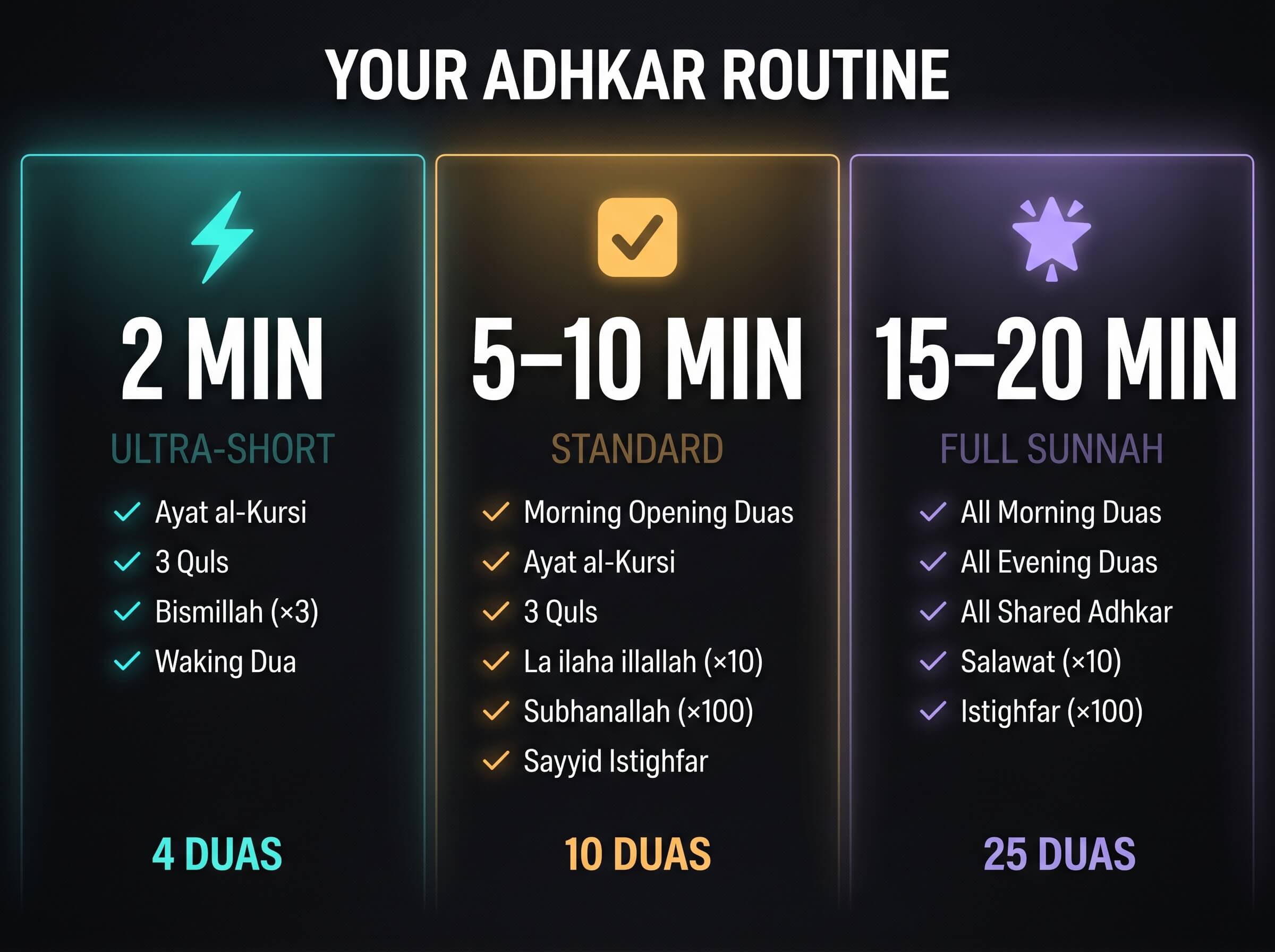
⚡ ULTRA-SHORT VERSION (2 Minutes) — For the Absolute Minimum |
✔ Morning (after Fajr): M-1 (Waking dua) + Ayat al-Kursi (1×) + 3 Quls (1× each) + Bismillahil-ladhi la yadurru (3×) ✔ Evening (after Asr): Ayat al-Kursi (1×) + 3 Quls (1× each) + Bismillahil-ladhi la yadurru (3×) ✔ Total: ~4 duas | ~2 minutes | Covers: protection from harm, jinn, evil, and begins day with Allah’s name ✔ Ideal for: extreme time pressure, new Muslims, children learning adhkar |
✅ STANDARD VERSION (5–10 Minutes) — Recommended Daily Routine |
✔ MORNING (After Fajr): M-1 → M-2 (Asbahna) → M-3 (Mulku lillah) → M-4 (Raditu billah, 3×) → S-1 (Ayat al-Kursi) → S-2 (3 Quls, 3×) → S-3 (Bismillah, 3×) → S-4 (La ilaha illallahu, 10×) → S-5 (Subhanallah, 100×) → S-9 (Sayyid al-Istighfar) ✔ EVENING (After Asr): E-1 (Amsayna) → E-2 (Mulku lillah evening) → M-4 (Raditu billah, 3×) → S-1 (Ayat al-Kursi) → S-2 (3 Quls, 3×) → S-3 (Bismillah, 3×) → S-4 (La ilaha illallahu, 10×) → S-5 (Subhanallah, 100×) → S-9 (Sayyid al-Istighfar) ✔ BEFORE SLEEP: E-3 (Bismika Allahumma amutu) + Ayat al-Kursi + 3 Quls (1×) Note: After completing before-sleep adhkar, consider adding the Tahajjud prayer for maximum night worship. ✔ Total: ~15 duas | 5–10 minutes | Covers all major categories: protection, tawakkul, forgiveness, health, barakah |
🌟 FULL SUNNAH VERSION (15–20 Minutes) — For Maximum Reward |
✔ Complete ALL duas from M-1 to S-15 in the order listed ✔ Morning: Duas M-1 through M-6 + All Shared Adhkar S-1 through S-15 ✔ Evening: Duas E-1 through E-3 + All Shared Adhkar S-1 through S-15 ✔ Include extended salawat (10–100×) and istighfar (100×) ✔ Use a tasbih (prayer beads) or app counter for Subhanallah (100×) and Istighfar (100×) ✔ Best practice: Sit in your prayer place immediately after salah, facing qiblah, using a reliable adhkar booklet such as Hisn al-Muslim (Fortress of the Muslim) ✔ Total: ~25 duas | 15–20 minutes | This is the full prophetic adhkar routine |
🔍 Special Cases & Edge Scenarios
Missed the Morning Adhkar Window — What Now?
If you missed the primary window (after Fajr until sunrise), the Hanafi school permits making them up until Dhuhr. The majority of scholars encourage making them up later in the day regardless — you gain the reward of the dhikr, even if the full timing-specific reward has diminished. Do not abandon them entirely.
Missed the Evening Adhkar Window — What Now?
If the Asr-to-Maghrib window has passed, recite them before sleeping. The before-sleep recitation has its own virtues and overlaps with many evening adhkar. Ibn Taymiyyah and Ibn al-Qayyim both affirm the benefit of making up missed dhikr.
Women in Menstruation (Haydh) or Post-Natal Bleeding (Nifas)
A scholarly consensus exists that women in haydh or nifas may — and should — continue reciting all morning and evening adhkar. These are dhikr and dua, not ritual prayer (salah). The prohibition applies only to formal prayer, fasting, and touching the mushaf (with the direct-touch caveat varying by madhab). Continue your adhkar without interruption.
Travelling — Do Adhkar Change?
The traveller continues morning and evening adhkar as normal. Travel does not reduce or change these remembrances. The Prophet (ﷺ) maintained his adhkar on journeys. You may combine and shorten prayers while travelling, but adhkar are not affected by travel concessions.
Can I Recite Adhkar Without Wudu?
Yes. There is no requirement for wudu (ritual purity) to recite dhikr or dua. While Quranic recitation in the context of Salah requires purity, reading or reciting Quranic verses as part of adhkar (such as Ayat al-Kursi) is permissible without wudu according to the majority of scholars. The exception: one should not touch a physical mushaf while in a state of major impurity (janabah).
Is Reciting in a Language Other Than Arabic Valid?
The structured prophetic adhkar are best recited in Arabic to preserve their exact wording, intended meaning, and full spiritual reward. One may also make personal dua (supplication) in any language at any time. However, for the specific morning and evening adhkar listed in this guide, use Arabic with the transliterations provided until you memorise them.
⚠️ Common Mistakes and Misconceptions About Adhkar
Misconception 1: ‘Missing one word invalidates the entire dua’
FALSE. Using exact prophetic wording is the ideal (especially in the Shafi’i and Hanbali schools), but omitting a word does not invalidate the act. The essence is the remembrance of Allah. Strive for accuracy through memorisation — use this guide as your reference.
Misconception 2: ‘Missing adhkar once is sinful’
FALSE. The morning and evening adhkar are a recommended Sunnah (mustahabb or Sunnah mu’akkadah depending on the madhab), not a fard (obligation). Missing them is not a sin, though it means missing immense reward. Only consistently abandoning the Sunnah out of negligence draws concern from scholars.
Misconception 3: ‘I must complete all 25 duas or none count’
FALSE. Each individual dua carries its own complete reward independently. Reciting even one authentic dua from this list is an act of worship with its own virtue. Start with two or three and build gradually.
Misconception 4: ‘Using an app is the same as memorisation’
Using apps is a valid and recommended bridge for learning. Contemporary scholars widely endorse using technology for reminders and reference. However, scholars unanimously agree that memorisation leads to deeper tadabbur (reflection) and hudur al-qalb (presence of heart) during recitation. Use apps to learn — then strive to memorise.
Misconception 5: ‘Order of recitation is strictly fixed’
There is no single mandatory order for the morning and evening adhkar. The Prophet (ﷺ) and his companions recited them as needed. However, scholars recommend starting with the time-specific adhkar (morning or evening openings) and ending with istighfar and salawat, as this reflects the logical flow of the prophetic practice.
Misconception 6: ‘Listening to audio recitation fulfils the adhkar requirement’
No. The adhkar must be recited by the person themselves. Listening to audio recitations is beneficial for learning pronunciation and filling the environment with dhikr, but it does not substitute for personal recitation. Each person must recite for themselves.
❓ Comprehensive FAQ — Morning and Evening Adhkar (15 Questions)
❓ What is the absolute minimum adhkar to recite each morning and evening? |
At minimum, recite: Ayat al-Kursi (1×), the 3 Quls (1× each), and ‘Bismillahil-ladhi la yadurru…’ (3×) in both morning and evening. Add the waking dua (M-1) upon rising. This 2-minute routine covers the most essential protection adhkar. |
❓ What time does the morning adhkar period end? |
The primary window ends at sunrise according to the majority (Imam al-Nawawi, Shafi’i, Hanbali). The Hanafi school permits making them up until Dhuhr. If you miss sunrise, still recite them — the reward is not entirely lost. |
❓ What time does the evening adhkar period end? |
The primary window runs from Asr until Maghrib (sunset). If missed, recite them before sleeping. Many of the evening adhkar overlap with the before-sleep adhkar anyway. |
❓ Can I recite morning adhkar at night if I work night shifts? |
Scholars base the timing on actual sunrise and sunset, not personal sleep schedules. If you wake at 11pm for a night shift, the morning adhkar window would still be after Fajr. However, the spirit of the adhkar is to begin your ‘day’ with Allah’s protection — contemporary scholars like Shaykh Yusuf al-Qaradawi advise those with unusual schedules to adapt based on the spirit of the Sunnah and consult their local imam. |
❓ Do I need to be in a state of wudu to recite adhkar? |
No. Wudu is not required for dhikr and dua. You may recite all morning and evening adhkar without wudu. Only the physical touching of the Quran mushaf requires purity according to the majority. |
❓ Can a woman in her menses recite morning and evening adhkar? |
Yes, absolutely. There is scholarly consensus that a woman in haydh or nifas continues her adhkar and dua without any restriction. The prohibition during menses applies to formal prayer (salah), fasting, and physical contact with the mushaf according to some madhabs. |
❓ Is it better to use an app or memorise the adhkar? |
Both are valid. Apps like Hisn al-Muslim are excellent reference tools and are endorsed by contemporary scholars as learning aids. However, the goal is memorisation — it enables deeper reflection and ensures you can recite anywhere without a device. Use the app as a stepping stone. |
❓ Can I recite the adhkar in any order I wish? |
There is no strictly prescribed order. Scholars recommend: begin with the time-specific opening duas, then protection duas (Ayat al-Kursi, 3 Quls), then comprehensive duas, ending with istighfar and salawat upon the Prophet (ﷺ). This mirrors the general prophetic practice. |
❓ Does listening to adhkar audio count as reciting them? |
No. Each person must recite the adhkar themselves. Audio recitations are a powerful learning and ambient tool but do not substitute personal recitation. This is the consensus position of all four madhabs. |
❓ What if I combine morning adhkar with other general dhikr (tasbeeh, etc.)? |
Combining is permissible and encouraged. After completing the specific morning and evening adhkar, add as much general tasbih, tahmid, tahlil, and takbir as you wish. The specific adhkar should be completed first; additional dhikr is always welcome. |
❓ Are the duas in Hisn al-Muslim (Fortress of the Muslim) all authentic? |
Hisn al-Muslim by Sa’id al-Qahtani is one of the most widely used and respected adhkar compilations. The vast majority of its duas are from Sahih or Hasan collections. However, scholars note that a small number of its narrations carry some weakness; the compiler often notes grades. All duas in this article are independently graded Sahih or Hasan Sahih by Al-Albani, Ibn Baz, or mainstream hadith scholarship. |
❓ Can children recite morning and evening adhkar? |
Yes, and they should be encouraged from a young age. Children are not obligated, but teaching them the short version (Ayat al-Kursi, 3 Quls, and Bismillahil-ladhi la yadurru) builds lifelong habits. The Prophet (ﷺ) taught adhkar to young companions. |
❓ What if I have severe anxiety or OCD and keep second-guessing whether I recited correctly? |
This is a recognised spiritual challenge. Scholars advise: once you have recited with your tongue and intended the meaning in your heart, it counts — regardless of waswas (whispering of shaytan). Do not repeat indefinitely due to doubt. Ibn al-Qayyim writes that excessive repetition due to doubt is itself a trap of shaytan. Recite once or three times as prescribed, then move on with tawakkul. |
❓ Does reciting adhkar protect against the evil eye and magic? |
Yes. Multiple authenticated hadith affirm that consistent recitation of Ayat al-Kursi, the 3 Quls, and ‘Bismillahil-ladhi la yadurru’ provide protection from jinn, evil eye, and harm generally. However, protection duas do not prevent qadar (divine decree) — they are a means Allah has prescribed, and He protects through them according to His wisdom. |
❓ Is there a special reward for reciting adhkar immediately after salah vs. later? |
Yes. Scholars emphasise that reciting the morning adhkar immediately after Fajr prayer — while still in your prayer place — is the most virtuous timing. The hadith describe the Prophet (ﷺ) sitting in his place after prayer for this purpose. Delaying for worldly activities and then returning to adkhar is still rewarded, but the immediate post-prayer period is considered the most blessed. |
Spiritual Benefits of Morning and Evening Adhkar
The benefits of this practice transcend ritual. As illuminated by Ibn al-Qayyim in Al-Wabil al-Sayyib, the morning and evening adhkar are spiritual medicine for the heart and a fortress against all harm.
- Divine Protection (Hirz): Consistent adhkar create a shield against jinn, evil eye, sihr, and all forms of spiritual and physical harm — as explicitly stated in authenticated hadith from Bukhari, Muslim, Abu Dawud, and Tirmidhi.
- Inner Peace (Sakinah): The Qur’an states: ‘Verily, in the remembrance of Allah do hearts find rest’ (13:28). This is not metaphor — adhkar physiologically and spiritually calm the anxious heart.
- Tawakkul (Reliance on Allah): Each dua anchors the believer’s reliance in Allah rather than in creation — a theme deeply rooted in Qur’anic verses about patience and reliance. The accumulation of daily tawakkul-affirming adhkar transforms one’s fundamental outlook on life.
- Forgiveness and Rank Elevation: Adhkar such as Sayyid al-Istighfar, Subhanallahi wa bihamdihi (100×), and the 3 Quls carry explicit promises of forgiveness, erasure of sins, and elevation of rank with Allah.
- Barakah in Time and Provision: Scholars across all four madhabs affirm that the person who begins and ends the day with the adhkar finds barakah (divine blessing) in their time, health, family, and provision.
- Connection with the Prophet (ﷺ): These are the exact words and practices of the Prophet Muhammad (ﷺ). Every morning and evening, by reciting these duas, you are following the most beloved of creation in a direct, intimate way.
- Purification of the Heart: Ibn al-Qayyim writes that the heart is like a mirror — sin and heedlessness cloud it, while dhikr polishes it back to clarity. The morning and evening adhkar are the daily polish that keeps the believer’s heart alive and receptive to Allah.
🎯 Conclusion — Start Today
The morning and evening adhkar are among the most rewarding, most authenticated, and most practically achievable Sunnah practices in Islam. Every dua in this guide has been verified from Sahih collections. Every madhab position has been accurately presented. Every practical concern has been addressed.
For another high-reward night practice, see our guide on what to read on Laylatul Qadr.
Your action step: Choose the 2-minute routine from Section 9. Commit to it for 7 days. Then add two more duas. Build from there. Consistency is more beloved to Allah than quantity. The Prophet (ﷺ) said: ‘The most beloved deeds to Allah are those that are most consistent, even if they are small.’ (Bukhari, Muslim).
📌 Save This GuideBookmark this page | Share it with family and friends | Download the PDF version [link] | Subscribe to Islamshub for weekly evidence-based Islamic guides |
About the Author Written by Waqas Ali, researcher in Islamic jurisprudence (fiqh), trained in classical texts including Al-Hidayah and Al-Mughni. |