
Why This Guide Exists — And Why It Matters to You
You have heard the hadith hundreds of times: “Allah has 99 names; whoever encompasses them will enter Paradise.” Perhaps you have seen the list printed on a mosque wall, or watched a family member counting a tasbeeh for a specific need. Yet a quiet question lingers:
Am I doing this right?
What does “encompassing” the names actually mean?
Are the specific wazifa numbers I have seen authentic?
This guide on the 99 Names of Allah meanings and benefits in Urdu — Asma ul Husna Urdu mein — exists because no existing resource has answered these questions with the scholarly honesty they deserve. Every claim here is traced to a named scholar, an authenticated hadith, or a cited classical text. Views from all four major Sunni madhabs are presented fairly, without independent rulings.
The Asma ul Husna are not merely a list to recite — they are a living framework for dhikr, du’a, and knowing Allah. If you are new to the foundations of Islamic belief and the Five Pillars, that guide provides the broader theological context within which the Asma ul Husna sits. Understanding ihsa’ — true encompassing — is the key that unlocks the hadith’s paradise promise. This guide will show you precisely what that means, grounded in Ibn Uthaymin, Al-Ghazali, An-Nawawi, and scholars across all four madhabs.
The Hadith of 99 Names — What It Actually Says (And What It Doesn’t)
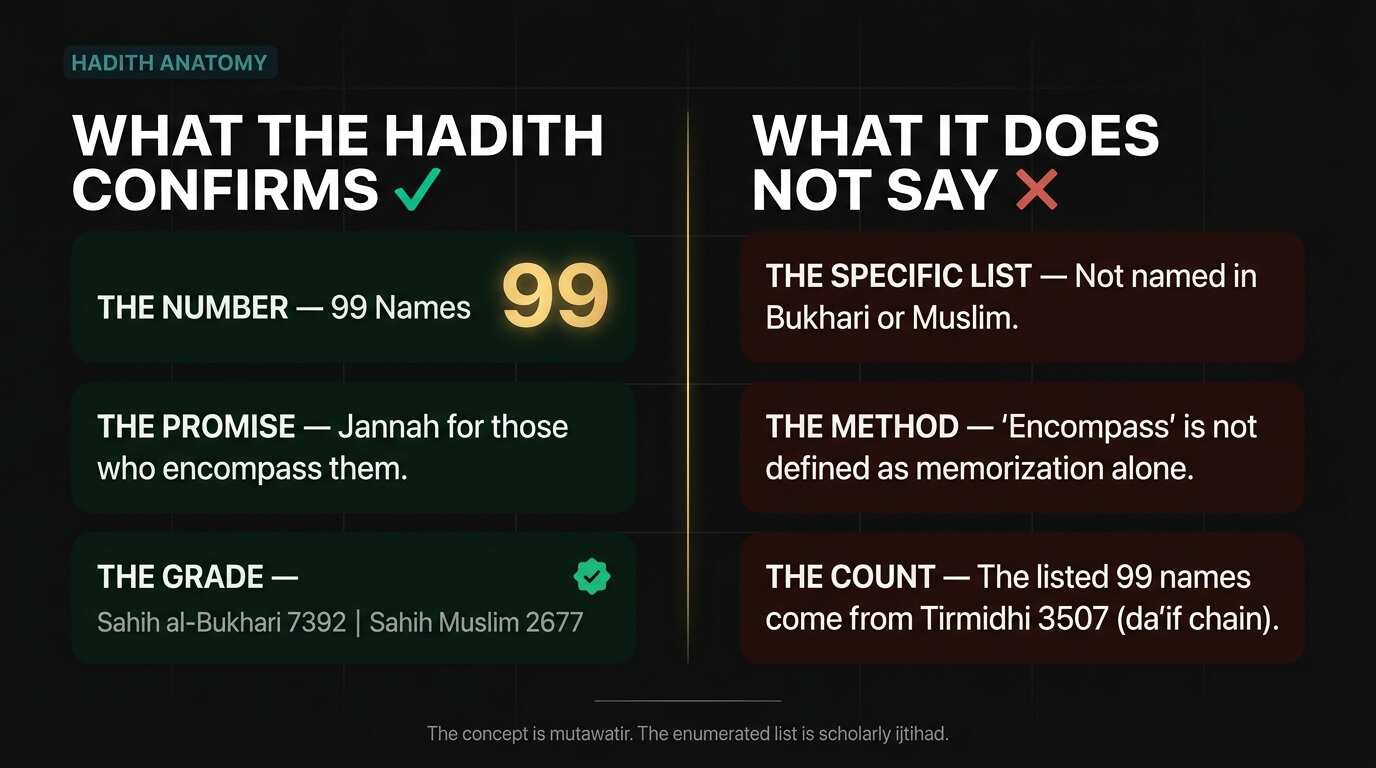
The foundational hadith on the Asma ul Husna is preserved in the two most authoritative hadith collections in Islamic scholarship:
“Inna Lillahi tis’atan wa tis’ina isман, mi’atan illa wahida, man ahsaha dakhala al-jannah.”
“Indeed Allah has ninety-nine names — one hundred minus one. Whoever encompasses (ahsaha) them will enter Paradise.”
— Sahih al-Bukhari, Hadith 7392 (Grade: Sahih) | Sahih Muslim, Hadith 2677 (Grade: Sahih)
The core promise is beyond scholarly doubt. The concept — 99 names whose encompassing guarantees Paradise — is mutawatir in meaning, narrated through multiple reinforcing chains.
Quick Reference: All 99 Names of Allah — Arabic, Urdu Meaning, English, and Practical Benefit
HOW TO USE THIS TABLE: For each name, read the Arabic, then the Urdu meaning for personal connection, then the English, then let the Practical Benefit guide your du’a and reflection. This is Al-Ghazali’s method — each name is a window to know Allah better.
| # | Arabic | Transliteration | Urdu Meaning | English | Practical Benefit / Du’a Note |
| 1 | اللَّهُ | Allah | اللہ — ذاتِ واجب الوجود | The One God | Appears 2,500+ times in Quran; the primary name all others describe. |
| 2 | الرَّحْمَنُ | Ar-Rahman | بے انتہا مہربان | The Entirely Merciful | Al-Fatiha 1:3 — vastness of mercy encompassing all creation; say in every prayer. |
| 3 | الرَّحِيمُ | Ar-Raheem | بار بار رحم کرنے والا | The Especially Merciful | Al-Fatiha 1:3 — ongoing, specific mercy directed at returning believers. |
| 4 | الْمَلِكُ | Al-Malik | بادشاہ، مالک | The Sovereign | Al-Hashr 59:23 — absolute kingship needing nothing beyond itself. |
| 5 | الْقُدُّوسُ | Al-Quddus | پاک، ہر عیب سے منزہ | The Most Holy | Al-Hashr 59:23 — Ibn Kathir: absolute purity, free from all deficiency. |
| 6 | السَّلَامُ | As-Salam | سلامتی دینے والا | The Source of Peace | Al-Hashr 59:23 — greeting of the People of Paradise (Quran 10:10). |
| 7 | الْمُؤْمِنُ | Al-Mumin | امن دینے والا | The Guardian of Faith | Al-Hashr 59:23 — grants security and confirms truth. |
| 8 | الْمُهَيْمِنُ | Al-Muhaymin | نگہبان، محافظ | The Protector | Al-Hashr 59:23 — watches over all affairs with full awareness. |
| 9 | الْعَزِيزُ | Al-Aziz | غالب، باعزت | The Almighty | Al-Hashr 59:23 — might that cannot be overcome; 90+ Quranic appearances. |
| 10 | الْجَبَّارُ | Al-Jabbar | زبردست | The Compeller | Al-Hashr 59:23 — compels by His will; also heals the broken (jabara al-kasr). |
| 11 | الْمُتَكَبِّرُ | Al-Mutakabbir | بزرگی والا | The Supreme | Al-Hashr 59:23 — greatness exclusive to Allah; pride in a servant is condemned. |
| 12 | الْخَالِقُ | Al-Khaliq | پیدا کرنے والا | The Creator | Al-Hashr 59:24 — brings into existence from nothing. |
| 13 | الْبَارِئُ | Al-Bari | بنانے والا | The Originator | Al-Hashr 59:24 — distinguishes and originates created things. |
| 14 | الْمُصَوِّرُ | Al-Musawwir | صورت بنانے والا | The Fashioner | Al-Hashr 59:24 — gives each created thing its unique form. |
| 15 | الْغَفَّارُ | Al-Ghaffar | بہت بخشنے والا | The Repeatedly Forgiving | Surah Taha 20:82 — covers sins repeatedly; root: to cover. Du’a for repeated sins. |
| 16 | الْقَهَّارُ | Al-Qahhar | سب پر غالب | The Subduer | Surah Yusuf 12:39 — all creation is under His complete dominion. |
| 17 | الْوَهَّابُ | Al-Wahhab | بے حساب عطا کرنے والا | The Bestower | Al-Imran 3:8 — gifts without condition. Du’a: “Rabbana la tuzigh qulubana.” |
| 18 | الرَّزَّاقُ | Ar-Razzaq | رزق دینے والا | The Provider | Adh-Dhariyat 51:58 — provision guaranteed for all creation. Du’a for rizq. |
| 19 | الْفَتَّاحُ | Al-Fattah | کھولنے والا | The Opener | Saba 34:26 — opens doors of mercy, provision, and understanding. |
| 20 | الْعَلِيمُ | Al-Alim | سب کچھ جاننے والا | The All-Knowing | Knowledge encompassing past, present, future; most frequent name in Quran. |
| 21 | الْقَابِضُ | Al-Qabid | تنگی دینے والا | The Withholder | Al-Baqarah 2:245 — paired with Al-Basit; both within Allah’s wisdom. |
| 22 | الْبَاسِطُ | Al-Basit | وسعت دینے والا | The Expander | Ar-Ra’d 13:26 — expands provision and ease by Allah’s wisdom. |
| 23 | الْخَافِضُ | Al-Khafid | پست کرنے والا | The Abaser | Lowers whom He wills in His wisdom; paired with Ar-Rafi’. |
| 24 | الرَّافِعُ | Ar-Rafi | بلند کرنے والا | The Exalter | Quran 58:11 — raises in honor whom He wills. |
| 25 | الْمُعِزُّ | Al-Muizz | عزت دینے والا | The Bestower of Honor | Al-Imran 3:26 — grants honor; paired with Al-Mudhil. |
| 26 | الْمُذِلُّ | Al-Mudhil | ذلت دینے والا | The Humiliator | Al-Imran 3:26 — brings low in perfect justice and wisdom. |
| 27 | السَّمِيعُ | As-Sami | سننے والا | The All-Hearing | Hears all including whispered du’a; frequently paired with Al-Alim. |
| 28 | الْبَصِيرُ | Al-Basir | دیکھنے والا | The All-Seeing | Al-Isra 17:1 — sees all including what is hidden. |
| 29 | الْحَكَمُ | Al-Hakam | فیصلہ کرنے والا | The Impartial Judge | Al-An’am 6:114 — judgments are perfect and just. |
| 30 | الْعَدْلُ | Al-Adl | انصاف کرنے والا | The Utterly Just | Absolute justice. Al-Ghazali: believer’s share is fairness in all dealings. |
| 31 | اللَّطِيفُ | Al-Latif | باریک بین، مہربان | The Subtle and Kind | Al-Mulk 67:14 — sees and provides through unseen pathways. Du’a in hardship. |
| 32 | الْخَبِيرُ | Al-Khabir | باخبر | The All-Aware | Al-Hujurat 49:13 — fully aware of all matters, inner and outer. |
| 33 | الْحَلِيمُ | Al-Halim | بردبار | The Forbearing | Al-Baqarah 2:235 — does not hasten punishment; gives time for repentance. |
| 34 | الْعَظِيمُ | Al-Azim | عظمت والا | The Magnificent | Ayat al-Kursi closes: “Al-Aliyy al-Azim” (Al-Baqarah 2:255). |
| 35 | الْغَفُورُ | Al-Ghafur | بخشنے والا | The Forgiving | Emphasizes extent of forgiveness; distinct from Al-Ghaffar (frequency). |
| 36 | الشَّكُورُ | Ash-Shakur | قدردان | The Appreciative | Fatir 35:30 — appreciates even the smallest deed and multiplies reward. |
| 37 | الْعَلِيُّ | Al-Aliyy | بلند | The Most High | Al-Baqarah 2:255 (Ayat al-Kursi) — high in station, attribute, and reality. |
| 38 | الْكَبِيرُ | Al-Kabir | بڑا | The Greatest | Ar-Ra’d 13:9 — greatest in all attributes of greatness. |
| 39 | الْحَفِيظُ | Al-Hafiz | حفاظت کرنے والا | The Preserver | Hud 11:57 — guards His servants. Basis for du’a seeking protection. |
| 40 | الْمُقِيتُ | Al-Muqit | طاقت دینے والا | The Nourisher | An-Nisa 4:85 — Nourisher and Sustainer of all. |
| 41 | الْحَسِيبُ | Al-Hasib | حساب لینے والا | The Reckoner | An-Nisa 4:6 — sufficient as an account-keeper. |
| 42 | الْجَلِيلُ | Al-Jalil | جلال والا | The Majestic | Ar-Rahman 55:27 — combines all attributes of majesty. |
| 43 | الْكَرِيمُ | Al-Karim | کریم، سخی | The Generous | Al-Infitar 82:6. Al-Ghazali: believer’s share is generosity of character. |
| 44 | الرَّقِيبُ | Ar-Raqib | نگہبان | The Watchful | An-Nisa 4:1; Al-Ma’idah 5:117 — watches all deeds. |
| 45 | الْمُجِيبُ | Al-Mujib | قبول کرنے والا | The Responsive | Hud 11:61 — responds to every du’a. Basis of all hope in supplication. |
| 46 | الْوَاسِعُ | Al-Wasi | وسعت والا | The All-Encompassing | Al-Baqarah 2:115 — His mercy and knowledge have no limits. |
| 47 | الْحَكِيمُ | Al-Hakim | حکمت والا | The Perfectly Wise | All creation reflects His wisdom; frequently paired with Al-Aziz. |
| 48 | الْوَدُودُ | Al-Wadud | محبت کرنے والا | The Loving | Hud 11:90 — loves His servants. Du’a basis for love and marriage. |
| 49 | الْمَجِيدُ | Al-Majid | بزرگ، عظیم | The All-Glorious | Hud 11:73 — appears in the Ibrahimi salat recited in every prayer. |
| 50 | الْبَاعِثُ | Al-Baith | اٹھانے والا | The Resurrector | Will raise all creation on the Day of Judgment; basis of akhirah belief. |
| 51 | الشَّهِيدُ | Ash-Shahid | گواہ | The Witness | Al-Ma’idah 5:117 — witness to all things; nothing is hidden from Him. |
| 52 | الْحَقُّ | Al-Haqq | سچا | The Truth | Al-Hajj 22:6 — He alone is real in absolute terms. Profound for reflection. |
| 53 | الْوَكِيلُ | Al-Wakil | کارساز | The Trustee | Al-Imran 3:173 — “Hasbunallahu wa ni’mal wakil.” Du’a in anxiety. |
| 54 | الْقَوِيُّ | Al-Qawiyy | قوت والا | The All-Strong | Al-Hajj 22:40 — power without weakness or limit. |
| 55 | الْمَتِينُ | Al-Matin | مضبوط | The Firm | Adh-Dhariyat 51:58 — absolutely reliable strength. |
| 56 | الْوَلِيُّ | Al-Waliyy | دوست، سرپرست | The Protecting Friend | Ash-Shura 42:9 — guardian and ally of the believers. |
| 57 | الْحَمِيدُ | Al-Hamid | قابلِ تعریف | The Praiseworthy | Ibrahim 14:8 — all praise belongs to Him by right; basis of Alhamdulillah. |
| 58 | الْمُحْصِي | Al-Muhsi | گننے والا | The All-Enumerating | Maryam 19:94 — counts and records all things. |
| 59 | الْمُبْدِئُ | Al-Mubdi | شروع کرنے والا | The Originator | Al-Buruj 85:13 — initiates creation; paired with Al-Mu’id. |
| 60 | الْمُعِيدُ | Al-Muid | لوٹانے والا | The Restorer | Al-Buruj 85:13 — returns creation after death; paired with Al-Mubdi. |
| 61 | الْمُحْيِي | Al-Muhyi | زندگی دینے والا | The Giver of Life | Al-Hajj 22:6 — gives physical and spiritual life through guidance. |
| 62 | الْمُمِيتُ | Al-Mumit | موت دینے والا | The Taker of Life | Al-Hajj 22:6 — paired with Al-Muhyi; both in His absolute command. |
| 63 | الْحَيُّ | Al-Hayy | ہمیشہ زندہ | The Ever-Living | Ayat al-Kursi (2:255). An-Nawawi: prime candidate for Ism-e-Azam. |
| 64 | الْقَيُّومُ | Al-Qayyum | قائم رکھنے والا | The Self-Sustaining | Ayat al-Kursi (2:255) — sustains all creation. Candidate for Ism-e-Azam. |
| 65 | الْوَاجِدُ | Al-Wajid | غنی، پانے والا | The Perceiver | Finds all He wills with no difficulty. (Tirmidhi 3507 list) |
| 66 | الْمَاجِدُ | Al-Majid | بزرگ | The Noble | Generous and glorious. (Tirmidhi 3507 list) |
| 67 | الْوَاحِدُ | Al-Wahid | اکیلا | The One | Ar-Ra’d 13:16 — unique in His essence; foundational name for tawhid. |
| 68 | الْأَحَدُ | Al-Ahad | یکتا | The Uniquely One | Al-Ikhlas 112:1 — pinnacle of monotheistic declaration. |
| 69 | الصَّمَدُ | As-Samad | بے نیاز | The Eternal Refuge | Al-Ikhlas 112:2 — Absolute, upon whom all depend. |
| 70 | الْقَادِرُ | Al-Qadir | قادر | The Capable | Al-Kahf 18:45 — has power over all things. |
| 71 | الْمُقْتَدِرُ | Al-Muqtadir | قدرت والا | The All-Powerful | Al-Qamar 54:42 — exercises power fully over all. |
| 72 | الْمُقَدِّمُ | Al-Muqaddim | آگے کرنے والا | The Expediter | Brings forward whom He wills. (Tirmidhi 3507 list) |
| 73 | الْمُؤَخِّرُ | Al-Muakhkhir | پیچھے کرنے والا | The Delayer | Delays whom He wills in His wisdom. (Tirmidhi 3507 list) |
| 74 | الْأَوَّلُ | Al-Awwal | سب سے پہلے | The First | Al-Hadid 57:3 — before whom there is nothing. |
| 75 | الْآخِرُ | Al-Akhir | سب کے بعد | The Last | Al-Hadid 57:3 — after whom there is nothing. |
| 76 | الظَّاهِرُ | Az-Zahir | ظاہر | The Manifest | Al-Hadid 57:3 — evident through His signs. |
| 77 | الْبَاطِنُ | Al-Batin | باطن | The Hidden | Al-Hadid 57:3 — beyond all comprehension. One verse contains four names (74–77). |
| 78 | الْوَالِي | Al-Wali | والی | The Governing Guardian | Ar-Ra’d 13:11 — guardian of all affairs. |
| 79 | الْمُتَعَالِي | Al-Mutaali | بلند و بالا | The Most Exalted | Ar-Ra’d 13:9 — transcends all creation. |
| 80 | الْبَرُّ | Al-Barr | نیکی کرنے والا | The Source of Goodness | At-Tur 52:28 — source of all goodness and benevolence. |
| 81 | التَّوَّابُ | At-Tawwab | توبہ قبول کرنے والا | The Accepter of Repentance | Al-Baqarah 2:37 — turns toward the servant who has turned back. Du’a for tawbah. |
| 82 | الْمُنْتَقِمُ | Al-Muntaqim | بدلہ لینے والا | The Avenger | Az-Zukhruf 43:41 — just retribution on behalf of those wronged. |
| 83 | الْعَفُوُّ | Al-Afuww | معاف کرنے والا | The Pardoner | An-Nisa 4:99 — pardons and erases sin completely; sin is as though it never was. |
| 84 | الرَّؤُوفُ | Ar-Rauf | نرم مہربان | The Most Kind | Al-Baqarah 2:143 — combines mercy with the deepest compassion. |
| 85 | مَالِكُ الْمُلْكِ | Maliku’l-Mulk | مُلک کا مالک | Owner of All Sovereignty | Al-Imran 3:26 — sovereignty given and withdrawn by His will alone. |
| 86 | ذُو الْجَلَالِ | Dhul-Jalal | بزرگی اور عزت والا | Lord of Majesty and Honor | Ar-Rahman 55:27 & 55:78 — appears twice in one surah. |
| 87 | الْمُقْسِطُ | Al-Muqsit | انصاف کرنے والا | The Equitable | Al-Ma’idah 5:42 — establishes absolute fairness. |
| 88 | الْجَامِعُ | Al-Jami | جمع کرنے والا | The Gatherer | Al-Imran 3:9 — will gather all creation on the Day of Judgment. |
| 89 | الْغَنِيُّ | Al-Ghaniyy | بے نیاز | The Self-Sufficient | Muhammad 47:38 — needs nothing; all creation needs Him. |
| 90 | الْمُغْنِي | Al-Mughni | غنی بنانے والا | The Enricher | Grants sufficiency. Du’a basis in financial difficulty. (Tirmidhi 3507) |
| 91 | الْمَانِعُ | Al-Mani | روکنے والا | The Preventer | Prevents harm through His wisdom. (Tirmidhi 3507) |
| 92 | الضَّارُّ | Ad-Darr | نقصان دینے والا | The Distresser | Brings harm by wisdom and decree; paired with An-Nafi’. (Tirmidhi 3507) |
| 93 | النَّافِعُ | An-Nafi | فائدہ دینے والا | The Benefiter | Yunus 10:49 — all benefit ultimately comes from Him. |
| 94 | النُّورُ | An-Nur | نور | The Light | An-Nur 24:35 — one of the most meditated names in Islamic spirituality. |
| 95 | الْهَادِي | Al-Hadi | ہدایت دینے والا | The Guide | Al-Hajj 22:54 — guides to truth and to Himself. |
| 96 | الْبَدِيعُ | Al-Badi | انوکھا پیدا کرنے والا | The Originator of All | Al-Baqarah 2:117 — unprecedented creation with no prior model. |
| 97 | الْبَاقِي | Al-Baqi | ہمیشہ رہنے والا | The Ever-Enduring | Ar-Rahman 55:27 — while all creation perishes, He alone remains. |
| 98 | الْوَارِثُ | Al-Warith | وارث | The Inheritor | Al-Hijr 15:23 — all returns to Him when creation ends. |
| 99 | الرَّشِيدُ | Ar-Rashid | سیدھی راہ دکھانے والا | The Guide to the Right Path | Guides creation to what is correct and sound. (Tirmidhi 3507) |
Critical Distinction: What the Hadith Does NOT Say
The Bukhari and Muslim narrations give only the NUMBER and the PROMISE — not the specific list of 99 names. This is the single most important fact that most online articles miss entirely.
Where Does the Famous Enumerated List Come From?
The specific list beginning with “Allahu la ilaha illa Huwa, Ar-Rahman, Ar-Raheem…” comes from Sunan al-Tirmidhi, Hadith 3507. However, Imam Muhammad Nasir al-Din al-Albani (d. 1999 CE) graded the chain of this enumerated list as da’if (weak) in his Silsilah al-Ahadith al-Da’ifah (Vol. 1, #203).
What Does “Da’if” Mean Here? Three Essential Points
- Point 1: The da’if grading applies to the CHAIN of the enumerated compilation — not to each individual name’s theological standing.
- Point 2: The vast majority of names in that list are independently confirmed through the Quran directly or through other authenticated hadith.
- Point 3: Imam An-Nawawi (Sharh Sahih Muslim) and Ibn Hajar al-Asqalani (Fath al-Bari) confirm the core hadith is sahih while acknowledging scholarly discussion around the list.
A further dimension: a hadith in Musnad Ahmad — authenticated by Shu’ayb al-Arna’ut — shows the Prophet (ﷺ) supplicating: “I ask You by every name that is Yours by which You have called Yourself, or revealed in Your Book, or taught to any of Your creation, or which You have kept in the knowledge of the Unseen with You.” This establishes that Allah’s names extend beyond 99 — ninety-nine being a specific designated group whose encompassing carries the promised reward.
A Muslim who uses the widely accepted list with sincere intention and understanding is on sound scholarly ground — this is the position of Al-Albani, An-Nawawi, and Ibn Hajar al-Asqalani collectively.
Why Different Websites Show Different Lists
Because the Tirmidhi enumeration is da’if, classical scholars were not bound to accept it as a fixed revelation. Different scholars compiled slightly different lists based on Quranic and authenticated hadith sources — exercising scholarly ijtihad. This is not contradiction; it is honest Islamic scholarship in action.
The Tawqifiyyah Principle and the Case of Ash-Shafi
Tawqifiyyah — the ruling that divine names are restricted to what revelation has established — is the theological backbone of this discussion. Sheikh al-Islam Ibn Taymiyyah (Hanbali, d. 1328 CE) in Majmu’ al-Fatawa (Vol. 5) explicitly holds that one cannot create new names for Allah through logical derivation.
The name “Ash-Shafi” (The Healer) is beloved in many Muslim communities, yet it does not appear explicitly as a divine name in the Quran. It derives from the da’if Tirmidhi list. Many scholars applying strict tawqifiyyah — particularly in the Hanbali-Athari tradition — do not accept it as a confirmed proper name, though the attribute of healing is affirmed through Sahih Bukhari (Hadith 5742). This scholarly position is presented here without independent ruling.
Names of Allah Grouped by Theme — For Better Understanding and Du’a
Scholars have always grouped the names thematically for teaching purposes. Here are key categories to help you connect with the right name for each need:
Names of Mercy (Asma al-Rahmah)
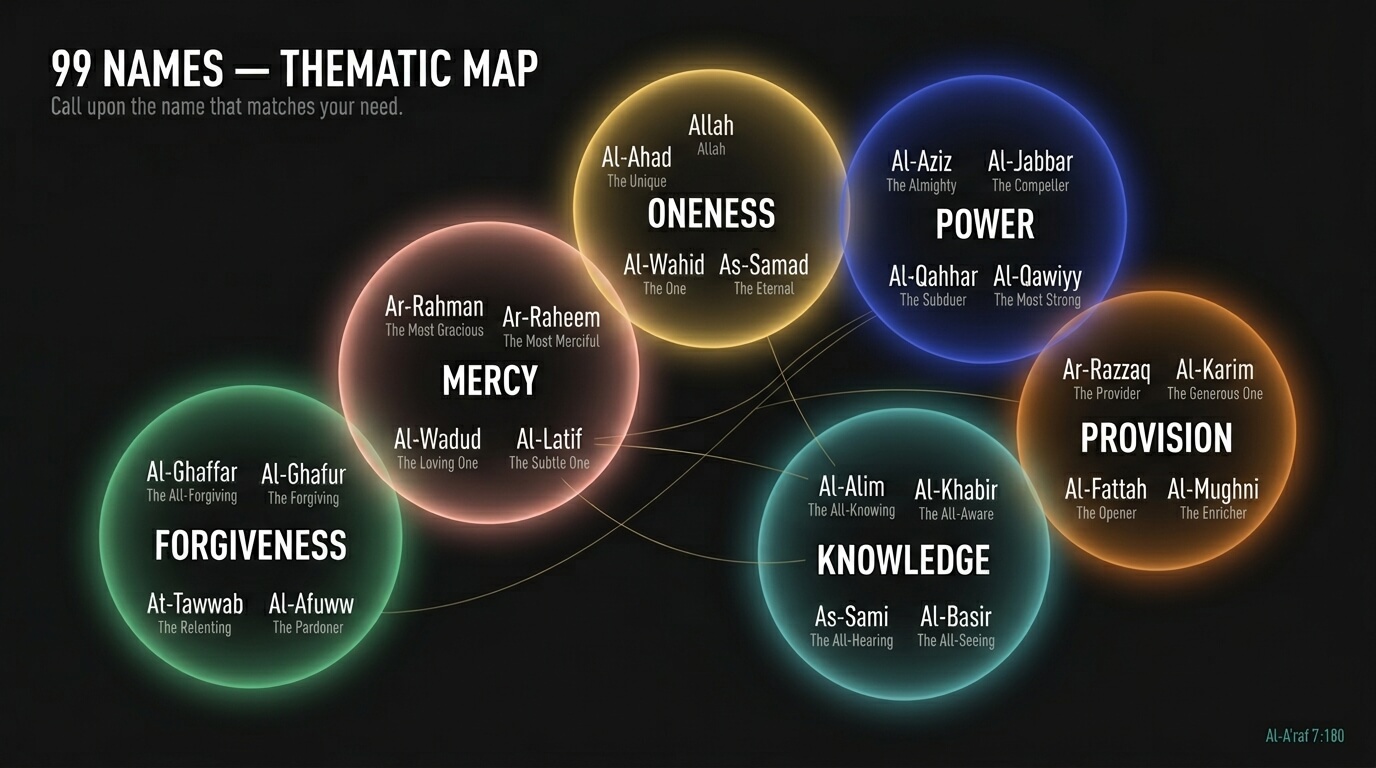
Names: Ar-Rahman (2), Ar-Raheem (3), Al-Wadud (48), Ar-Rauf (84), Al-Barr (80), Al-Halim (33), Al-Latif (31)
Du’a / Reflection: Call upon these in times of distress, guilt, grief, or when seeking divine gentleness. Al-Ghazali: “Your share is to embody mercy toward others.”
Names of Power and Majesty
Names: Al-Aziz (9), Al-Jabbar (10), Al-Qahhar (16), Al-Qawiyy (54), Al-Matin (55), Al-Qadir (70), Al-Muqtadir (71)
Du’a / Reflection: Recite in du’a when facing oppression, injustice, or when needing strength. Affirm His absolute might.
Names of Forgiveness
Names: Al-Ghaffar (15), Al-Ghafur (35), At-Tawwab (81), Al-Afuww (83), Al-Halim (33)
Du’a / Reflection: The full Sayyid al-Istighfar (Bukhari 6306) uses multiple forgiveness names. Nuance: Al-Ghaffar = repeated covering; Al-Ghafur = vast extent; At-Tawwab = turns TOWARD you when you turn to Him.
Names of Tawhid (Divine Uniqueness)
Names: Allah (1), Al-Wahid (67), Al-Ahad (68), As-Samad (69), Al-Haqq (52)
Du’a / Reflection: Surah Al-Ikhlas (112:1-4) contains Al-Ahad and As-Samad — the Prophet called it equal to a third of the Quran. Recite in dhikr to deepen tawhid.
Names of Knowledge and Awareness
Names: Al-Alim (20), Al-Khabir (32), As-Sami (27), Al-Basir (28), Al-Shahid (51), Ar-Raqib (44), Al-Muhsi (58)
Du’a / Reflection: Remember these names in private moments — they affirm He sees what no human sees.
Names of Provision and Sustenance
Names: Ar-Razzaq (18), Al-Karim (43), Al-Mughni (90), Al-Fattah (19), Al-Muqit (40)
Du’a / Reflection: Du’a for rizq: “Allahumma inni as’aluka min fadlika” (Sahih Muslim 1763). Call upon Ar-Razzaq with full trust.
What Does “Ihsa'” Mean? — The Most Misunderstood Word in the Hadith
The Arabic term ihsa’ (أحصاها) is derived from the root h-s-a (ح-ص-ا), meaning to count, enumerate, and encompass completely. Almost every popular resource translates it simply as “memorize” — an incomplete, and sometimes misleading, rendering.
Reducing ihsa’ to mere memorization has led millions of sincere Muslims to believe the paradise promise can be fulfilled by rote repetition in a few weeks. Every major scholar explicitly refutes this. — Sheikh Ibn Uthaymin, Imam An-Nawawi, Imam Al-Ghazali
Ibn Uthaymin’s Four-Part Definition of Ihsa’
Sheikh Muhammad ibn Salih al-‘Uthaymin (Hanbali, d. 2001 CE), in Majmu’ Fatawa wa Rasa’il (Vol. 1/74), provides the most comprehensive scholarly definition:
- Hifz (حفظ) — Memorization: Knowing the names by heart in Arabic. This is the beginning of the journey — not its destination.
- Fahm al-Ma’na (فهم المعنى) — Understanding: Knowing the linguistic depth and theological weight of each name. A name memorized without meaning is a key without a door.
- Al-‘Ibadah biha (العبادة بها) — Worshipping through them: Using the names as the vehicle of worship — making du’a through them, engaging in dhikr, structuring one’s relationship with Allah around the realities they describe.
- Al-Du’a biha (الدعاء بها) — Calling upon Allah by them: Applying each name to specific spiritual need. Hardship → Al-Sabur. Forgiveness → Al-Ghaffar. Provision → Ar-Razzaq.
Imam An-Nawawi’s Shafi’i Perspective
Imam An-Nawawi (Shafi’i, d. 1277 CE), in Sharh Sahih Muslim, explains that ihsa’ encompasses “preserving them, knowing their meanings, and acting upon their implications.” Knowledge and action are inseparable — knowing Al-Ghaffar (The Repeatedly Forgiving) without returning to Allah in tawbah is an incomplete encompassing.
Al-Ghazali’s “Share” (Hazza) Framework — The Transformative Insight
Imam Al-Ghazali (Shafi’i, d. 1111 CE), in his masterwork Al-Maqsad al-Asna fi Sharh Asma’ Allah al-Husna, introduces the concept of the believer’s haz (حظ) — their “share” in each divine name. Every name has a quality the servant can and should embody within human capacity:
- Al-Karim (The Generous): Believer’s share = generosity with wealth, time, and character.
- Al-Sabur (The Patient): Believer’s share = forbearance in hardship and when provoked.
- Al-Ghaffar (The Repeatedly Forgiving): Believer’s share = overlooking the faults of others.
- Al-‘Adl (The Just): Believer’s share = fairness in all dealings, public and private.
- Al-Wadud (The Loving): Believer’s share = love for the community, genuine care for others.
Al-Ghazali’s framework is not about claiming divine attributes. It is the servant reflecting divine qualities within human limitations — a lifelong process of character transformation through the names. This is the actual classical method of benefiting from the Asma ul Husna.
Is “Just Memorizing” the 99 Names Enough for Jannah?
Direct scholarly answer: No — according to the Hanbali position of Sheikh Ibn Uthaymin (confirmed by IslamQA.info, Fatwa #188229), the Shafi’i position of Imam An-Nawawi, and the Hanafi position (MuftiOnline Fatwa #129180). Rote memorization alone does not fulfill the hadith’s condition of ihsa’. Memorization is the necessary first step — the ijtihad of all three madhabs converges on this point.
Quranic Foundation of the 99 Names — Verses, Tafsir, and Theological Significance
The Asma ul Husna are not a tradition alongside the Quran — they are embedded within it. Five core Quranic passages form the scriptural bedrock:
Al-A’raf 7:180 — The Command to Call Upon Allah by His Names
وَلِلَّهِ الْأَسْمَاءُ الْحُسْنَى فَادْعُوهُ بِهَا وَذَرُوا الَّذِينَ يُلْحِدُونَ فِي أَسْمَائِهِ
“And to Allah belong the Most Beautiful Names (al-Asma’ al-Husna), so call upon Him by them and leave [the company of] those who practice deviation (ilhad) concerning His names.”
This single verse establishes three foundational principles: (1) The names belong exclusively to Allah — divine ownership placing them in unique reverence. (2) Du’a through the names is a direct Quranic command — fad’uhu biha. (3) There is a prohibited category of ilhad (deviation) — including denial or distortion of meanings. Ibn Kathir (d. 1373 CE) in Tafsir al-Quran al-‘Azim: ilhad includes applying a divine name to a created being.
Al-Hashr 59:22–24 — Eleven Names in Three Verses
The most name-dense passage in the entire Quran. Eleven divine names in rapid, majestic succession: Al-Ghayb, Al-Malik, Al-Quddus, As-Salam, Al-Mu’min, Al-Muhaymin, Al-‘Aziz, Al-Jabbar, Al-Mutakabbir, Al-Khaliq, Al-Bari’, Al-Musawwir. Ibn Kathir’s tafsir of Al-Jabbar notes it carries the meaning of One who is supreme in power AND who repairs the broken — a nuance missed in simple translations.
Al-Isra 17:110 — All Names Point to the Same One
Imam Al-Tabari (d. 923 CE) in Jami’ al-Bayan explains: this verse was revealed in response to the mushrikeen who questioned why the Prophet (ﷺ) called upon “Ar-Rahman” if he worshipped one God. The profound answer: all beautiful names refer to the same One. The multiplicity of names does not imply multiplicity of the Named — this is a foundational tawhid principle.
Al-Baqarah 2:255 — Ayat al-Kursi
The most widely recited verse of the Quran contains two names of extraordinary standing: Al-Hayy (The Ever-Living) and Al-Qayyum (The Self-Sustaining Sustainer). Every recitation of Ayat al-Kursi is simultaneously an engagement with two of Allah’s most majestic names — and prime candidates for Ism-e-Azam according to Imam An-Nawawi.
Names That Appear in Quran vs. Names Found in Hadith — A Tiered Understanding
- Tier 1 — Explicitly Quranic Names: Names that appear literally as divine designations in the Quran. Strongest evidential foundation. Examples: Allah, Ar-Rahman, Al-Malik, Al-Quddus (all in Al-Hashr 59:22-24).
- Tier 2 — Authenticated Through Sahih Hadith: Names in sahih/hasan hadith used as divine designations even if not explicitly named in Quran. Examples: Al-Witr (Bukhari/Muslim), Al-Jamil (Sahih Muslim 2563).
- Tier 3 — Present Only in Da’if Tirmidhi List: Names lacking strong independent confirmation. Ash-Shafi is the primary example. Used with sincere intention on sound scholarly ground; the naming question remains a scholarly discussion.
How the Four Madhabs Approach the Names in Du’a, Dhikr, and Wazifa
Scholars of all four madhabs agree that du’a through the names is a Quranic command — established by Al-A’raf 7:180. They differ in positions on specifically structured dhikr practices (wazifa). All four perspectives below are presented with equal care. Islamshub.com presents scholarly positions without independent rulings — readers are encouraged to follow the guidance of a qualified scholar of their own madhab.
Hanafi / Maturidi View — Most Relevant for Urdu-Speaking Readers
On Wazifa Permissibility: According to Mufti Zakaria Makada (Hanafi, MuftiOnline Fatwa #129180), using names of Allah as a wazifa for specific challenges is generally permissible. Conditions: the practice must not contradict established shari’ah, and no guaranteed worldly outcomes should be claimed without authenticated hadith support.
The Maturidi Theological Framework: Founded by Imam Abu Mansur al-Maturidi (d. 944 CE, Kitab al-Tawhid), the Maturidi school affirms divine names exactly as described in Quran and Sunnah — neither denied (ta’til) nor given physical interpretation (tashbih). When reciting “Ya Noor,” the Maturidi framework affirms this as Allah’s attribute befitting His majesty, without asking “how” (bila kayf). This is the framework of Deoband, Barelvi, and most South Asian scholarly institutions.
Mufti Taqi Usmani (Hanafi, Deoband) has consistently affirmed structured dhikr through divine names as legitimate worship within the broader framework of supererogatory worship (nawafil).
Maliki View
Theological Position: Imam Malik ibn Anas (d. 795 CE) stated regarding ambiguous divine attributes: “Al-istiwa’ is not unknown, the kayf (how) is unknown, belief is obligatory, and asking about it is innovation.” Maliki scholars apply this same principle broadly to divine names — affirm what the text states, do not probe beyond it, do not liken to creation.
On Wazifa: Maliki scholars, given their strong emphasis on preventing bid’ah, approach highly specific wazifa formulas with caution — particularly prescriptions lacking authenticated hadith support. Imam Al-Qurtubi (Maliki, d. 1273 CE) in Al-Jami’ li-Ahkam al-Quran provides extensive commentary on names in Al-Hashr 59:22-24, modeling the Maliki preference for Quran-grounded engagement.
Shafi’i View — The Richest Intellectual Engagement
Al-Ghazali’s Full Framework: Imam Al-Ghazali (Shafi’i, d. 1111 CE) in Al-Maqsad al-Asna — the definitive classical commentary on divine names — teaches that the names are primarily mirrors held up to the soul, showing it what it is called to become. They are not instruments for obtaining specific worldly outcomes — they are invitations to character transformation.
The Ash’ari Theological Dimension: The Shafi’i school operates predominantly within the Ash’ari framework — affirming divine names and attributes in a manner avoiding both literal anthropomorphism and allegorical denial. The Ash’ari approach employs either tafwid (entrusting the precise meaning to Allah) or ta’wil (contextual interpretation) when literalism would imply resemblance to creation. This differs methodologically from the Hanbali-Athari approach.
Hanbali / Athari View — The Most Textually Strict Approach
Ibn Taymiyyah on Tawqifiyyah: Sheikh al-Islam Ibn Taymiyyah (Hanbali, d. 1328 CE) in Majmu’ al-Fatawa (Vol. 5) explicitly establishes that Allah’s names are tawqifiyyah — their authorization is restricted to Quran and authentic Sunnah. One may not derive new names through logical inference, however coherent the derivation seems.
Ibn al-Qayyim on Dhikr: Ibn al-Qayyim al-Jawziyyah (Hanbali, d. 1350 CE) in Madarij al-Salikin emphasizes hudur al-qalb — presence of the heart during dhikr. Mechanical recitation without attention and understanding has significantly diminished spiritual value. This aligns powerfully with Ibn Uthaymin’s ihsa’ framework.
Sheikh Ibn Uthaymin’s Caution: Sheikh Ibn Uthaymin specifically cautioned against inventing recitation formulas — prescribed counts for specific outcomes — without authenticated hadith evidence. Such practices risk falling into bid’ah, which the Hanbali tradition views with particular concern.
All three theological orientations — Athari, Ash’ari, Maturidi — are represented within the four madhabs and have been held by scholars of immense learning throughout Islamic history. Each represents a legitimate scholarly methodology.
Special Focus: Ar-Rahman and Ar-Raheem — Why Two Names Both Mean “Merciful”?
Every Muslim recites these two names a minimum of seventeen times every day — in the opening of every rak’ah of salah. Both share the Arabic root r-h-m (رحم). Yet their grammatical forms carry profoundly different weights:
| Ar-Rahman (الرَّحْمَنُ) | Ar-Raheem (الرَّحِيمُ) | |
| Arabic Pattern | Fa’lan (فعلان) — indicates the highest degree; vast, encompassing, flooding | Fa’il (فعيل) — indicates a constant, enduring, specifically directed quality |
| Scope | Encompasses ALL of creation — believer, disbeliever, animal, seen and unseen | Specific, ongoing, targeted mercy toward servants who return to Allah |
| Scholar | Al-Tabari (Jami’ al-Bayan): “The mercy that encompasses all creation.” Ibn al-Qayyim: “The name of the attribute in its fullness.” | Ibn al-Qayyim (Bada’i’ al-Fawa’id): “The ongoing exercise of that mercy in action toward the servants.” |
| Du’a Use | Call upon “Ya Rahman” — you are calling upon the entire ocean of divine mercy | Call upon “Ya Raheem” — you are calling upon the mercy that sees YOU specifically |
Asma ul Husna Ke Fayde aur Wazifa — A Fiqh-Verified Du’a Map for Life’s Challenges
Calling upon Allah by a name related to one’s specific need is a Prophetic practice documented in authenticated hadith — not an invented tradition. The Prophet (ﷺ) himself used specific names in du’a for specific situations. This is the Sunnah principle of al-du’a bi-asmaihil-husna (Al-A’raf 7:180).
This is NOT a wazifa list with prescribed recitation counts. It is a Sunnah-grounded du’a map using authenticated hadith. Use these du’a with full understanding of their meaning.
| Challenge | Name(s) | Evidence | Du’a (from Sunnah) | Note |
| Financial Hardship / Rizq | Ar-Razzaq, Al-Karim, Al-Mughni | Adh-Dhariyat 51:58; Sahih Muslim 1763 | “Allahumma inni as’aluka min fadlika.” | Trust in Ar-Razzaq is itself a form of ibadah; provision is guaranteed for all creation (51:58) |
| Illness / Recovery | Al-Qadir; attribute of Ash-Shafi affirmed | Sahih Bukhari 5742 | “Allahumma rabbi an-nas, adhhib il-ba’s, ishfi anta ash-shafi, la shifa’a illa shifa’uka, shifa’an la yughadiru saqama” | The du’a is sahih and unambiguous; the naming question of Ash-Shafi is separate (see Section 9) |
| Forgiveness / Guilt | Al-Ghaffar, Al-Ghafur, At-Tawwab | Quran 39:53; Sahih Bukhari 6306 | Full Sayyid al-Istighfar: “Allahumma anta Rabbi la ilaha illa anta…” | Three forgiveness names, three distinct meanings — call upon all three for completeness |
| Marriage / Righteous Spouse | Al-Wadud, Al-Latif | Quran 30:21; Al-Furqan 25:74 | “Rabbana hab lana min azwajina wa dhurriyyatina qurrata a’yunin wa’j’alna lil-muttaqina imama” | Al-Latif — the Subtle — provides through pathways you cannot see |
| Anxiety / Fear | Al-Wakil, As-Salam, Al-Hafiz | Al-Imran 3:173 | “Hasbunallahu wa ni’mal wakil” — the companions said this when facing great fear | Al-Wakil = Trustee of your affairs; As-Salam = the Source of peace itself |
| Injustice / Oppression | Al-‘Adl, Al-Muntaqim, Al-Qahhar | Al-Tawbah 9:129 | “Hasbi Allahu la ilaha illa Huwa, ‘alayhi tawakkaltu wa Huwa Rabb al-‘arsh al-‘azim” | Al-Qahhar — the Subduer — is invoked when seeking justice against wrong |
| Seeking Guidance | Al-Hadi, Al-Hakim, Al-‘Alim | Quran 22:54 | “Allahumma ihdina fi man hadayt…” | Al-Hadi guides not only to truth but to Himself — the deepest guidance |
| Gratitude / Shukr | Ash-Shakur, Al-Hamid | Fatir 35:30; Ibrahim 14:8 | Morning/evening dhikr: “Alhamdulillahi rabbil alamin” | Ash-Shakur appreciates even the smallest deed and multiplies its reward |
On Popular Wazifa Numbers — An Honest, Balanced Acknowledgment
Hanafi position (Mufti Zakaria Makada, MuftiOnline Fatwa #129180): Using names of Allah with specific counts as a wazifa is generally permissible, provided no claim is made that these counts are from the Prophet (ﷺ) when they are not, and provided the practice does not contradict established shari’ah.
Hanbali caution (Sheikh Ibn Uthaymin, Majmu’ Fatawa Vol. 1/74): Prescribing specific counts for specific results without authenticated hadith evidence is an area of concern. If claimed to be prophetic without evidence, this is impermissible. As a personal devotion without such claims, the evaluation differs.
Readers are encouraged to consult a qualified scholar of their own madhab on this question.
Ism-e-Azam — The Greatest Name of Allah: Scholarly Positions
“Which of the 99 names is Ism-e-Azam?” — among the most searched questions about the Asma ul Husna. The companions asked versions of it, and the hadith literature engages it through multiple narrations.
The Hadith Foundation
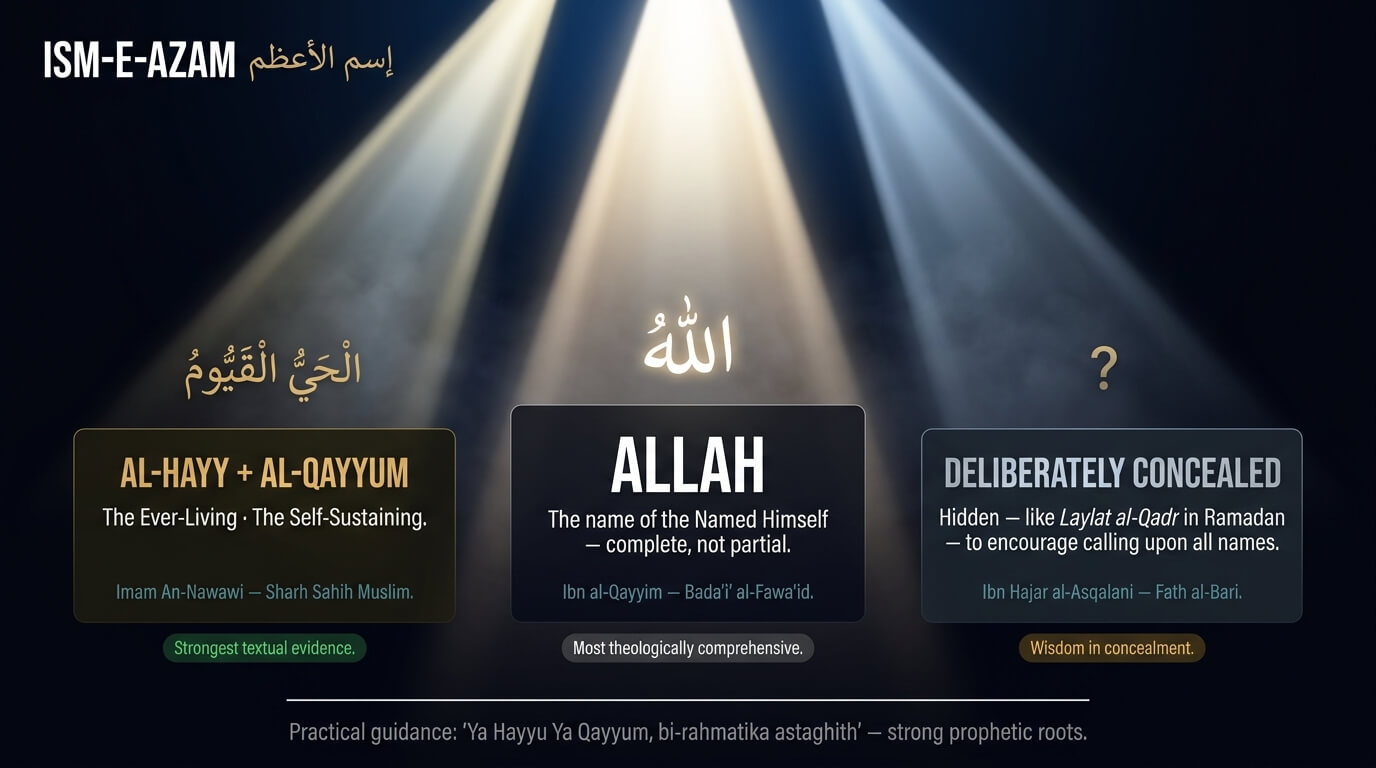
The concept derives from hadith in Musnad Ahmad and Ibn Majah (graded hasan) indicating that Allah has a name by which, if He is called upon, He responds, and if asked through it, He gives. The hadith establishes the concept authentically, though it does not name the name explicitly.
The Three Scholarly Positions
| Position | Name Suggested | Scholar | Argument |
| Position 1 | Al-Hayy and Al-Qayyum | Imam An-Nawawi (Shafi’i) | Based on narrations where du’a was made using these names and answered. The Prophet (ﷺ) affirmed: “Ya Hayyu Ya Qayyum, bi-rahmatika astaghith” — strong textual grounding. From Ayat al-Kursi (Al-Baqarah 2:255). |
| Position 2 | “Allah” itself | Ibn al-Qayyim (Hanbali, Bada’i’ al-Fawa’id) | All other names describe Allah from the angle of a particular attribute; “Allah” is the name of the Named Himself in His completeness. Most theologically comprehensive argument. |
| Position 3 | Deliberately Concealed | Ibn Hajar al-Asqalani (Shafi’i, Fath al-Bari) | Concealment serves divine wisdom analogous to concealing Laylat al-Qadr within Ramadan — encouraging the believer to call upon Allah through ALL His names rather than seeking a shortcut. |
Practical Guidance Across Madhabs: Scholars across all traditions advise calling upon Allah through multiple names with full presence of heart (hudur al-qalb) rather than searching for a single “greatest name.” The most reliable textual evidence supports Al-Hayy and Al-Qayyum — using “Ya Hayyu Ya Qayyum, bi-rahmatika astaghith” in du’a has strong prophetic roots.
Asma ul Husna Memorization Guide — Grounded in Ibn Uthaymin and Al-Ghazali
This method flows directly from Ibn Uthaymin’s four-part ihsa’ framework. Memorization is the first stage — not the destination. A 99-day personal practice directly implements the third and fourth components: worshipping Allah through the names and calling upon Him by them.
Stage 1 — Hifz (Memorization): Start Where You Already Are
- Begin with names already embedded in your daily worship: Ar-Rahman and Ar-Raheem (in every prayer), Al-Hayy and Al-Qayyum (in Ayat al-Kursi), and the eleven names of Al-Hashr 59:22-24.
- Learn in thematic clusters of ten: Just as the Quran was revealed nujuman — in portions — learning incrementally is a Quranic principle (Al-Furqan 25:32). If you are also working on Quran memorization alongside learning the names, our guide on how to memorize the Quran fast shares memorization techniques from classical scholars that apply equally well to the Asma ul Husna.
- Cluster suggestion: Week 1 = Names 1-11 (Al-Hashr cluster). Week 2 = Names of Mercy (Ar-Rahman, Al-Latif, Al-Wadud, Al-Halim…). Week 3 = Names of Power. And so on.
Stage 2 — Fahm al-Ma’na (Understanding): Go Deeper Than Translation
- Go beyond Urdu translation to the nuance: The distinctions between Ar-Rahman vs Ar-Raheem, Al-Ghaffar vs Al-Ghafur vs At-Tawwab are the substance of what makes each name unique.
- Primary resource: Imam Al-Ghazali’s Al-Maqsad al-Asna fi Sharh Asma’ Allah al-Husna — the premier classical guide (accessible summaries available in Urdu and English).
Stage 3 — Al-‘Ibadah biha (Living the Names): The 99-Day Practice
The 99-day personal practice — one name per day, three components each day:
- Recall: The Arabic name and its Urdu meaning — say it aloud, write it down.
- Du’a: A supplication to Allah using that name in your own words, in your own language. Before beginning your daily practice, ensure your state of ritual purity — our step-by-step wudu guide with pictures and common mistakes covers everything you need to know.
- Action: One practical action that reflects that name’s quality. Al-Ghazali’s “share” framework — embody it as a human being.
An honest note from the scholars: No specific timeframe is promised in the Sunnah for this process. A Muslim who spends ten years genuinely encompassing the names is closer to the hadith’s promise than one who memorizes the list in a week and never returns to it. The names are a lifetime’s companionship.
For Urdu speakers: Learn the Urdu meaning first for comprehension, then the Arabic for du’a and dhikr. Both are necessary for true ihsa’. See also our guides on: Morning and Evening Duas | Building a Daily Dhikr Practice | Understanding Wudu for Salah.
Common Misconceptions About the 99 Names — Corrected by Scholars
Misconception 1: The list of 99 names is fixed and universally agreed upon.
Scholarly Correction: The specific enumerated list comes from Tirmidhi 3507, graded da’if by Al-Albani (Silsilah, Vol. 1, #203). Al-Ghazali (Al-Maqsad al-Asna) and Ibn Hazm (Al-Muhalla) compiled slightly different lists. The concept of 99 names is sahih; the specific enumeration is scholarly ijtihad, not a divinely fixed text.
Misconception 2: Reciting a specific count guarantees a specific worldly result.
Scholarly Correction: According to Sheikh Munajjid (IslamQA.info Fatwa #188229) and Mufti Zakaria Makada (MuftiOnline Hanafi Fatwa #129180): the reward is tied to full ihsa’. No specific worldly guarantee is attached to specific counts without authenticated hadith evidence. Most count prescriptions come from Khawas ul Asma and similar popular texts, not hadith collections.
Misconception 3: You can create names for Allah based on His attributes, even without textual evidence.
Scholarly Correction: Ibn Taymiyyah explicitly ruled in Majmu’ al-Fatawa (Vol. 5): divine names are tawqifiyyah — restricted to revelation. Logical derivation from confirmed attributes does not establish a proper divine name. A name requires explicit statement in Quran or authentic Sunnah. Consistent across all four madhabs.
Misconception 4: “Ash-Shafi” (The Healer) is a fully confirmed name equal in standing to Quranic names.
Scholarly Correction: Ash-Shafi appears only in the da’if Tirmidhi list as an enumerated name. The attribute of healing IS affirmed — the Prophet (ﷺ) addressed Allah as “anta ash-shafi” in Sahih Bukhari 5742. Whether this usage constitutes an established formal ism (proper name) of Allah is a scholarly dispute, particularly in the Hanbali-Athari tradition.
Misconception 5: All 99 names are equally emphasized — there is no hierarchy of significance.
Scholarly Correction: Classical scholars distinguished names of especially high spiritual significance. Al-Hayy and Al-Qayyum from Ayat al-Kursi, along with “Allah” itself, are among the strongest candidates for Ism-e-Azam according to Imam An-Nawawi (Sharh Sahih Muslim) and Ibn al-Qayyim (Bada’i’ al-Fawa’id).
Edge Cases and Practical Questions — Answers Competitors Missed
Can Women Recite the Names During Menstruation?
Hanafi position (Mufti Zakaria Makada, MuftiOnline): Reciting the names of Allah as dhikr — not as an act of Quranic recitation — is generally permissible for women during menstruation. The prohibition applies to tilawah (Quranic recitation with the intention of Quran). Saying “Ya Rahman, Ya Raheem” as dhikr and du’a does not fall under this prohibition in the Hanafi position. However, reciting Al-Hashr 59:22-24 specifically as a Quranic passage (tilawah) is a separate question with different parameters.
The Shafi’i madhab has more detailed parameters on Quranic verses recited as du’a versus tilawah. Shafi’i readers are encouraged to consult a qualified Shafi’i scholar for a personal ruling.
For personal religious guidance on this matter, please consult a qualified scholar of your own madhab.
Can I Name My Child “Rahman” Without “Abd” Prefix?
The Prophetic foundation: “The most beloved names to Allah are Abdullah and Abdur-Rahman.” (Sahih Muslim, Hadith 2132)
Hanafi position: Using names that belong exclusively to Allah — such as “Allah” itself or “Rahman” (which in its full sense describes mercy belonging uniquely to God) — for a human being is generally impermissible or strongly disliked (makruh). Names that are shared — “Malik” (a king is also a malik), “Karim” (a generous person is karim) — may be used for humans. Mufti Taqi Usmani aligns with the position that the safest practice is “Abdul” + divine name for names of divine exclusivity.
The Sunnah-recommended practice is “Abdur-Rahman” — praised by the Prophet (ﷺ) explicitly. This is safe, beautiful, meaningful, and carries prophetic endorsement.
Are There More Than 99 Names of Allah?
Yes — according to authenticated hadith and classical scholarly positions. The Musnad Ahmad hadith (authenticated by Shu’ayb al-Arna’ut) indicates names “kept in the knowledge of the Unseen with You” — meaning Allah’s names are potentially beyond human enumeration. Imam An-Nawawi (Sharh Sahih Muslim) interprets accordingly: the ninety-nine are a specific designated group whose encompassing carries the promised reward — not the totality of Allah’s names.
Ibn Taymiyyah’s nuance: The existence of unrevealed names does not license creating new names through human reasoning. Tawqifiyyah still applies fully. We may not invent names based on what we imagine unrevealed names might be. The practical implication: the ihsa’ that earns Jannah applies to the revealed ninety-nine. Knowing they may be a subset deepens rather than diminishes our awe.
Frequently Asked Questions (FAQ) — Asma ul Husna Ke Bare Mein 15+ Sawaal
These are the most commonly searched, most sincere questions asked by Muslims about the 99 Names. Each answer is sourced from named scholars.
Q1. What is the easiest method to memorize all 99 Names of Allah?
Begin with names already in your daily worship: Ar-Rahman, Ar-Raheem (Al-Fatiha), Al-Hayy, Al-Qayyum (Ayat al-Kursi), and the eleven names of Al-Hashr 59:22-24. Then learn in thematic clusters of ten. The 99-day practice (one name per day) is the most sustainable method — it directly implements Ibn Uthaymin’s ihsa’ framework: memorize, understand meaning, make du’a with it, reflect its quality in your day.
Q2. What is the fastest way to enter Paradise through the 99 Names?
The “fastest way” framing itself reflects the common misconception. According to Ibn Uthaymin, An-Nawawi, and Al-Ghazali across all madhabs: ihsa’ is a living, ongoing practice — not a one-time achievement. Memorization is the first step. Understanding, worshipping through, and calling upon the names are the remaining three. Start today with the eleven names of Al-Hashr.
Q3. Is Ash-Shafi a confirmed name of Allah?
This is a genuine scholarly dispute. The attribute of healing is confirmed — “anta ash-shafi” appears in Sahih Bukhari 5742 in a Prophetic du’a. Whether this usage establishes Ash-Shafi as a formal divine name (ism) is the question. Scholars applying strict tawqifiyyah — particularly in the Hanbali-Athari tradition — do not accept it as a confirmed proper name because it appears only in the da’if Tirmidhi chain as an explicit enumeration. A Muslim who uses it in du’a with sincere intention is on reasonable ground.
Q4. Which name of Allah is best for rizq (provision)?
The Quranic basis is Adh-Dhariyat 51:58 — “Verily Allah is Ar-Razzaq, the Lord of Strength, the Firm.” The authentic du’a for rizq is: “Allahumma inni as’aluka min fadlika” (Sahih Muslim 1763). Call upon Ar-Razzaq, Al-Karim, and Al-Mughni. Trust — tawakkul — is itself a condition for the promise of provision.
Q5. Which name is best for forgiveness?
Call upon all three forgiveness-related names together: Al-Ghaffar (repeated covering of sins), Al-Ghafur (vast extent of forgiveness), and At-Tawwab (turns toward you when you turn toward Him). The full Sayyid al-Istighfar (Sahih Bukhari 6306) is the most comprehensive prophetic forgiveness supplication.
Q6. What does the da’if grading of Tirmidhi 3507 mean practically?
It means the specific chain of the COMPILED LIST is weak — not that the individual names are unauthentic. The vast majority of names in the list are independently confirmed through the Quran or other sahih hadith. A Muslim using the commonly circulated list with sincere intention is on sound scholarly ground — this is the consensus position of Al-Albani, An-Nawawi, and Ibn Hajar al-Asqalani.
Q7. Can women recite Asma ul Husna during menstruation?
According to the Hanafi position (Mufti Zakaria Makada, MuftiOnline): reciting as dhikr and du’a is generally permissible. Reciting specific Quranic passages (like Al-Hashr 59:22-24) with the intention of tilawah is a separate question. Consult a qualified scholar of your own madhab for a personal ruling.
Q8. What is Ism-e-Azam and can I find it in the 99 Names?
Ism-e-Azam (The Greatest Name) is a name by which, if Allah is called upon, He responds. The strongest candidate according to Imam An-Nawawi is Al-Hayy and Al-Qayyum (from Ayat al-Kursi). Ibn al-Qayyim argues for “Allah” itself. Ibn Hajar notes it may be deliberately concealed — just as Laylat al-Qadr is hidden in Ramadan — to encourage calling upon Allah through all His names. Use “Ya Hayyu Ya Qayyum, bi-rahmatika astaghith” in du’a.
Q9. How do I use the 99 Names in my morning and evening dhikr?
Al-A’raf 7:180 establishes calling upon Allah by His names as a Quranic command. Practical method: select a name each day that matches your spiritual state or need. Make du’a using that name. For morning and evening, the authenticated adhkar (from Hisnul Muslim) are the most important framework — specific names appear throughout them. See our Morning and Evening Duas guide.
Q10. Are specific recitation counts (786 times, 1000 times) for specific names authentic?
Most specific count prescriptions circulate from Khawas ul Asma and similar popular texts — not authenticated hadith collections. Hanafi position (MuftiOnline): permissible as personal devotion without claiming prophetic authority. Hanbali caution (Ibn Uthaymin): concern about claims of guaranteed results without hadith evidence. Consult a scholar of your madhab. What is definitively authentic is calling upon Allah by His names in du’a.
Q11. Is there a printable PDF of all 99 Names with Urdu meanings?
[Download: Printable PDF Chart of 99 Names with Urdu Meanings — Available on islamshub.com]. The chart includes Arabic, transliteration, Urdu meaning, English meaning, and Quranic reference for each name.
Q12. Where can I listen to an audio recitation of all 99 Names?
[Audio: Full Recitation of Asma ul Husna — Available on islamshub.com]. Multiple reciters available. Recommended: listen while following along with the meanings — this implements the fahm al-ma’na (understanding) component of ihsa’.
Q13. Why do different websites show different sets of 99 Names?
Because the Tirmidhi 3507 enumerated list is da’if, classical scholars were not bound to accept it as fixed. Different scholars — Al-Ghazali, Ibn Hazm, and others — compiled slightly different lists based on their own analysis of Quranic and hadith sources. This variation is honest Islamic scholarship, not confusion. The concept of 99 names is mutawatir; the specific enumeration is scholarly ijtihad.
Q14. Can I name my child with a divine name like “Rahman” or “Aziz”?
The Hanafi position distinguishes between exclusively divine names (Rahman, Allah — impermissible/makruh for humans) and shared names (Aziz, Karim, Malik — permissible as human names since created beings can share these qualities in limited ways). The most recommended practice is “Abd” + divine name: Abdur-Rahman, Abdul-Aziz, Abdul-Karim. The Prophet (ﷺ) explicitly praised Abdullah and Abdur-Rahman as the most beloved names to Allah (Sahih Muslim 2132).
Q15. What is the best scholarly book on the 99 Names in the classical tradition?
Al-Maqsad al-Asna fi Sharh Asma’ Allah al-Husna by Imam Al-Ghazali (Shafi’i, d. 1111 CE) is the definitive classical commentary. For contemporary scholarship accessible to English readers, Majmu’ Fatawa wa Rasa’il Vol. 1/74 by Sheikh Ibn Uthaymin provides the most practical framework for ihsa’. For Urdu readers, summaries of both works are available from major Islamic publishers.
Q16. What is the difference between Al-Ghaffar, Al-Ghafur, and Al-Afuww?
Al-Ghaffar (Name 15): Repeated covering of sins — the frequency of forgiveness. Al-Ghafur (Name 35): The vast extent and completeness of forgiveness — sins forgiven thoroughly. At-Tawwab (Name 81): Turns toward the servant who has turned back in repentance — a relational name. Al-Afuww (Name 83): Pardons completely — the sin is erased as though it never was, beyond even covering. Call upon all four when seeking forgiveness for fullness.
Q17. What is the Tawhid al-Asma wa’s-Sifat and why does it matter?
Tawhid al-Asma wa’s-Sifat (Oneness in Names and Attributes) is one of three categories of tawhid in Islamic theology. It holds that Allah’s names are unique to Him, perfectly befitting His majesty, and cannot be fully comprehended by human minds. Without this framework, the names risk becoming a mere list. Within it, they are windows into divine reality — each one a different angle of light from an infinite Source.
Spiritual Reflection — What the Names Are Really For
Imam Al-Ghazali opens Al-Maqsad al-Asna with a purpose that towers above the functional: the purpose of knowing the names of Allah is ma’rifatullah — not knowing about Allah, but knowing Him. Every name is a window. And windows are not meant to be studied; they are meant to be looked through.
Ar-Rahman opens a window showing you a mercy so vast it preceded your existence, accompanied your birth, sustained every breath you have taken, and will be present at your death. Looking through that window, the believer does not analyze mercy — they bathe in it.
Al-Ghafur opens a window showing a forgiveness complete enough to cover everything — every sin you are ashamed to name, every failure you have hidden. That window exists not to make you comfortable in sin, but to make you willing to return after it. Shame keeps people away from Allah. Al-Ghafur demolishes the argument for staying away.
Ibn al-Qayyim (Hanbali, d. 1350 CE), in Madarij al-Salikin, describes the heart truly present in dhikr through the divine names as experiencing ittisal — connection with Allah — the nearest thing available in this world to the direct vision of Allah promised in the Hereafter. This is not metaphor — it is the documented testimony of generations of scholars who practiced what they taught.
And then there is Al-Qarib — The Near. “We are closer to him than his jugular vein” (Quran 50:16). This name shatters the feeling of spiritual distance that afflicts so many Muslims — the sense of being far from Allah, of prayers not reaching, of du’a disappearing into empty air. Al-Qarib does not allow for that distance.
The Prophet (ﷺ) taught — as recorded in Musnad Ahmad — to call upon Allah through all His names, revealed and unrevealed:
اللَّهُمَّ إِنِّي أَسْأَلُكَ بِكُلِّ اسْمٍ هُوَ لَكَ، سَمَّيْتَ بِهِ نَفْسَكَ، أَوْ أَنْزَلْتَهُ فِي كِتَابِكَ، أَوْ عَلَّمْتَهُ أَحَدًا مِنْ خَلْقِكَ، أَوِ اسْتَأْثَرْتَ بِهِ فِي عِلْمِ الْغَيْبِ عِنْدَكَ، أَنْ تَجْعَلَ الْقُرْآنَ رَبِيعَ قَلْبِي، وَنُورَ صَدْرِي، وَجَلَاءَ حُزْنِي، وَذَهَابَ هَمِّي.
“Allahumma inni as’aluka bi-kulli ismin huwa lak, sammayta bihi nafsak, aw anzaltahu fi kitabik, aw ‘allamtahu ahadan min khalqik, aw ista’tharta bihi fi ‘ilm al-ghayb ‘indak — an taj’al al-Qurana rabi’ qalbi…”
“”O Allah, I ask You by every name that is Yours, by which You have named Yourself, or revealed in Your Book, or taught to any of Your creation, or kept in the knowledge of the Unseen with You — to make the Quran the spring of my heart…””
— Musnad Ahmad — Authenticated by Shu’ayb al-Arna’ut
The names are not a list to complete. They are an ocean to enter.
Conclusion — Three Insights to Carry With You
First: The promise of Jannah for encompassing the names is authentic, resting on Sahih al-Bukhari (Hadith 7392) and Sahih Muslim (Hadith 2677) — but the ihsa’ that earns that promise, as Ibn Uthaymin, An-Nawawi, and Al-Ghazali confirm across madhabs, is memorization plus understanding plus worship through the names plus calling upon them — not merely recitation.
Second: The specific enumerated list comes from a weak chain (Tirmidhi 3507), but the individual names are overwhelmingly confirmed through the Quran and authenticated hadith. Understanding this distinction builds a more honest and more confident relationship with the names — not anxiety, but precision.
Third: Scholars across all four madhabs agree that calling upon Allah by His names in du’a is a Quranic command and a Prophetic practice — differing only in their caution about specific wazifa counts without hadith evidence. The practice itself is universal.
Your one concrete step: Begin with the eleven names of Surah Al-Hashr 59:22–24. Memorize them. Learn their Urdu meanings. Call upon Allah by them in your next du’a. Let that be your beginning.
This article presents scholarly views without issuing independent rulings. For personal religious questions, please consult a qualified scholar of your own madhab. Bookmark this guide | Share with family | Consult your local scholar.
Sources and References
Primary Hadith Sources
- Sahih al-Bukhari, Hadith 7392 — Grade: Sahih (Core 99 Names hadith)
- Sahih Muslim, Hadith 2677 — Grade: Sahih (Core 99 Names hadith)
- Sunan al-Tirmidhi, Hadith 3507 — Grade: Da’if (Al-Albani, Silsilah al-Ahadith al-Da’ifah, Vol. 1, #203)
- Musnad Ahmad — Hidden Names Hadith — Authenticated by Shu’ayb al-Arna’ut
- Sahih al-Bukhari, Hadith 5742 — Healing Du’a (anta ash-shafi) — Grade: Sahih
- Sahih al-Bukhari, Hadith 6306 — Sayyid al-Istighfar — Grade: Sahih
- Sahih Muslim, Hadith 1763 — Du’a for Provision — Grade: Sahih
- Sahih Muslim, Hadith 2132 — Most Beloved Names to Allah — Grade: Sahih
- Sahih Muslim, Hadith 2563 — Allah is Beautiful — Grade: Sahih
Classical Scholarly Works
- Al-Ghazali (Shafi’i, d. 1111 CE) — Al-Maqsad al-Asna fi Sharh Asma’ Allah al-Husna
- Ibn al-Qayyim al-Jawziyyah (Hanbali, d. 1350 CE) — Madarij al-Salikin; Bada’i’ al-Fawa’id; Al-Kafiyah al-Shafiyah
- Ibn Taymiyyah (Hanbali, d. 1328 CE) — Majmu’ al-Fatawa, Vol. 5
- Imam An-Nawawi (Shafi’i, d. 1277 CE) — Sharh Sahih Muslim
- Ibn Hajar al-Asqalani (Shafi’i, d. 1449 CE) — Fath al-Bari (commentary on Sahih al-Bukhari)
- Sheikh Ibn Uthaymin (Hanbali, d. 2001 CE) — Majmu’ Fatawa wa Rasa’il, Vol. 1/74
- Imam Al-Qurtubi (Maliki, d. 1273 CE) — Al-Jami’ li-Ahkam al-Quran
- Ibn Hazm (d. 1064 CE) — Al-Muhalla
- Imam Al-Tabari (d. 923 CE) — Jami’ al-Bayan fi Ta’wil al-Quran
- Ibn Kathir (d. 1373 CE) — Tafsir al-Quran al-‘Azim
- Imam Abu Mansur al-Maturidi (d. 944 CE) — Kitab al-Tawhid
- Muhammad Nasir al-Din al-Albani (d. 1999 CE) — Silsilah al-Ahadith al-Da’ifah, Vol. 1, #203
Contemporary Scholarly Sources
- Mufti Zakaria Makada (Hanafi) — MuftiOnline/IslamQA.org, Fatwa #129180
- Sheikh Munajjid (Hanbali) — IslamQA.info, Fatwa #188229
- Mufti Taqi Usmani (Hanafi, Deoband tradition) — positions on structured dhikr
- Shu’ayb al-Arna’ut — authentication notes on Musnad Ahmad narrations
External Verification Resources
- IslamQA.info, Fatwa #188229: https://islamqa.info/en/answers/188229
- MuftiOnline, Fatwa #129180: https://islamqa.org/hanafi/muftionline/129180/
- Abu Amina Elias (hadith text and grading): https://www.abuaminaelias.com/dailyhadithonline/2011/11/11/99-names-allah-asma-al-husna/




2 thoughts on “99 Names of Allah Meanings and Benefits in Urdu Simple Guide”
Thank you so much, i was looking for Names with meaning and details, and your guide is really good.
I got everything i needed.
Just desire to say your article is as astonishing. The clearnewss to
your publish is just great and i could suppose you’re a professional in this subject.
Welll along with your permissiin let me to grab your feed to stay updated with drawing close post.
Thannks a million and plase keep up the gratifying work.