The first chapter of Quran is Surah Al-Fatihah. It is a brief prayer containing seven verses. It is read by every Muslim in every unit of their daily prayers. The verses exalt Allah, remind us of his mercy and his power and request that we be shown the right way. It is referred to the Mother of the Book (Umm al-Kitab) due to the fact that it has the central word of the entire Quran: faith in the one God, worship, mercy, justice, and a supplication of the divine referent.
Snippet In this verse Surah Al-Fatihah (The Opening) is the opening chapter of the Quran and consists of seven verses. It is what Muslims repeat in every part of their prayer. It glorifies Allah, recognizes his lord-ship and desperately begs to be shown the right way. It is the best chapter of the Quran, according to the Prophet Muhammad ﷺ.
You are a new Muslim, you are reading the Quran, you are a parent, and you are just wondering what is the most-repeated chapter of the Islamic faith, Surah Al-Fatihah, and, as such, this guide will take you through its meaning, translation, explanation (tafsir), rules of law, and benefits and common use of this chapter.
What Is Surah Al‑Fatihah? Definition, Names, and Significance
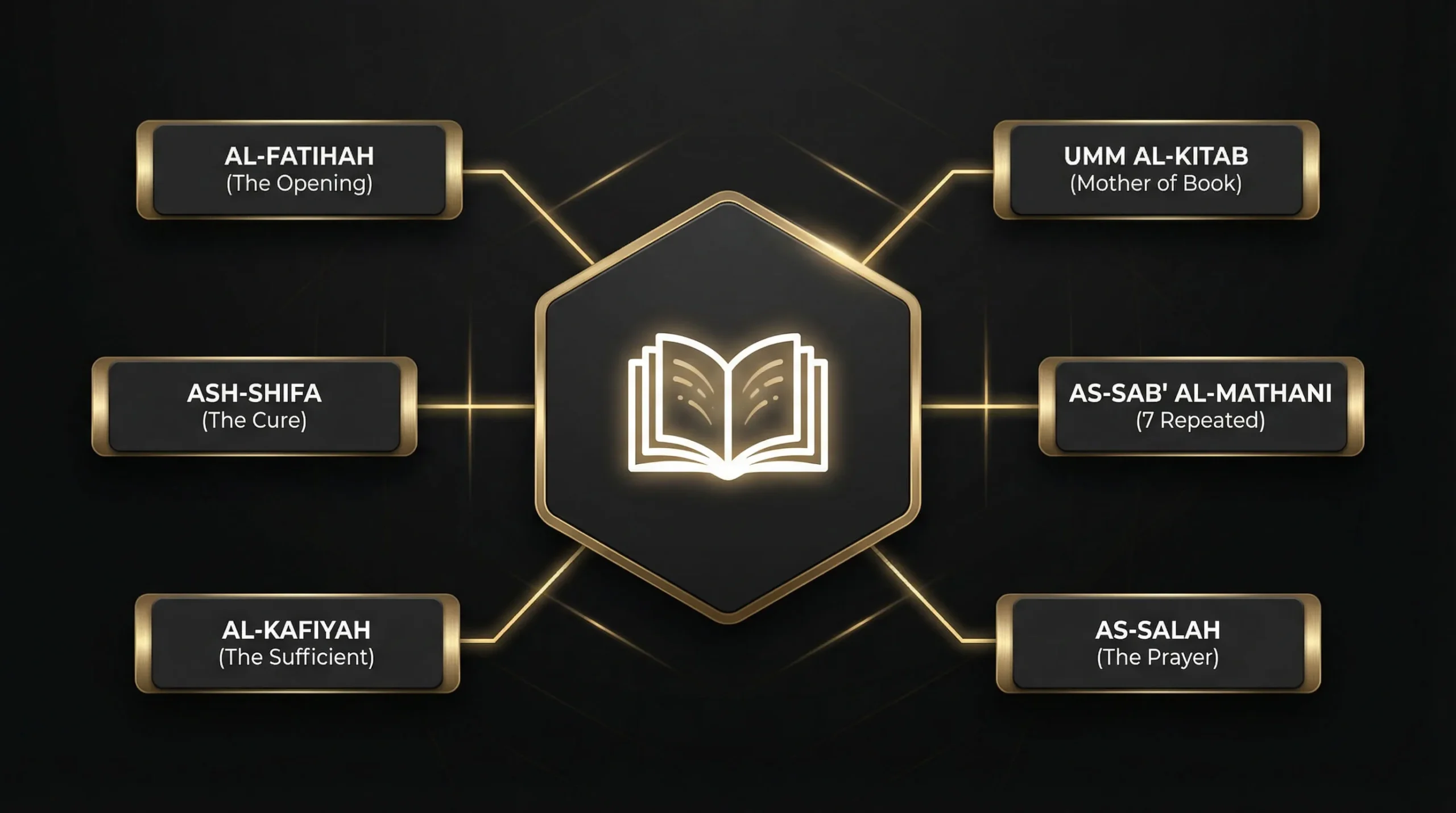
The word Fatihah (فاتحة) means The Opening. It initiates the Quran, the prayer and opens the heart of a believer to talk to Allah. It is named by numerous names, each of them demonstrating its significance:
- Al-Fatihah (The Opening): The key to the Quran and all prayers.
- Umm al-Kitab (The Mother of the Book): It is the center of the message of the Quran, recorded in Sahih al-Bukhari.
- As-Sab’ al-Mathani (The Seven Repeated Verses): Cited in the Quran (15:87).
- Ash-Shifa (The Cure): It assists the healing of the spirit and is applied in ruqyah.
- As-Salah (The Prayer): No prayer is valid without it, as stated in Sahih al-Bukhari 756.
- Al-Kafiyah (The Sufficient): Suffices as a complete supplication.
(Note: Imam Al Qurtubi wrote over a dozen names for this surah, indicating its unique significance and frequent reading.)
Historical History and Revealing (Makki/Madani, Asbab al-Nuzul)
The majority of scholars, among them Imam Al-Tabari and Ibn Kathir, indicate that Surah Al-Fatihah is a Makki surah — revealed in Mecca when the Prophet was still in Mecca before he relocated to Madinah. It was disclosed earlier to educate the faithful on the ways to address Allah and then later regulations, narratives and verdicts were conveyed.
Other scholars such as Abu al-Layth al-Samarqandi believe it was revealed twice, once in Mecca and once in Madinah and so is called Al-Mathani (the oft-repeated). It demonstrates its special significance.
Its history is attached with the establishment of the five daily prayers. Surah Al-Fatihah was adopted as the essence of any salah when prayer was made obligatory.
Positioning in the Quran and Organization
Chapter 1, verses 1 to 7 is Surah Al-Fatihah. Its position is purposeful. It serves as a preface as well as a key:
- It provides a little overview of the Quran before the information sets in.
- It demonstrates the association that exists between the Creator and the creation.
- It switches between the acclaim of Allah (verses 1-4) and a cry of a human being (verses 5-7), with verse 5 being the center.
- The Structure is based on a Hadith Qudsi (Sahih Muslim 395): “I have divided the prayer between Me and My servant into two halves, and My servant shall have what he asks for.”
- The first half (verses 1-4) is praise of Allah.
- The middle verse (Iyyaka na’budu…) is shared between Allah and the servant.
- The latter half (verses 6-7) is the request of the believer.
Text, Translation, and Transliteration
Surah Al-Fatihah Arabic Text
بِسْمِ ٱللَّهِ ٱلرَّحْمَـٰنِ ٱلرَّحِيمِ
ٱلْحَمْدُ لِلَّهِ رَبِّ ٱلْعَـٰلَمِينَ
ٱلرَّحْمَـٰنِ ٱلرَّحِيمِ
مَـٰلِكِ يَوْمِ ٱلدِّينِ
إِيَّاكَ نَعْبُدُ وَإِيَّاكَ نَسْتَعِينُ
ٱهْدِنَا ٱلصِّرَٰطَ ٱلْمُسْتَقِيمَ
صِرَٰطَ ٱلَّذِينَ أَنْعَمْتَ عَلَيْهِمْ غَيْرِ ٱلْمَغْضُوبِ عَلَيْهِمْ وَلَا ٱلضَّآلِّينَ
Read More: Last 10 Surahs of Quran: Complete Guide with Meanings & Benefits
English Translation (Several Academic Versions)
Dr. Mustafa Khattab (The Clear Quran): In the Name of Allah—the Most Compassionate, Most Merciful. All praise is for Allah—Lord of all worlds, the Most Compassionate, Most Merciful, Master of the Day of Judgment. You ˹alone˺ we worship and You ˹alone˺ we ask for help. Guide us along the Straight Path, the Path of those You have blessed—not those You are displeased with, or those who are astray.
M.A.S. Abdel Haleem: In the name of God, the Lord of Mercy, the Giver of Mercy! Praise belongs to God, Lord of the Worlds, the Lord of Mercy, the Giver of Mercy, Master of the Day of Judgement. It is You we worship; it is You we ask for help. Guide us to the straight path: the path of those You have blessed, those who incur no anger and who have not gone astray.
A different nuance is emphasized in each version. Khattab underlines compassion, Abdel Haleem underlines belonging. They both are founded on classical Arabic scholarship.
Transliteration in a Nutshell
To those who cannot read the Arabic of it, the following is a typical transliteration:
Bismillāhi r‑Raḥmāni r‑Raḥīm
Al‑ḥamdu lillāhi Rabbi l‑ʿālamīn
Ar‑Raḥmāni r‑Raḥīm
Māliki yawmi d‑dīn
Iyyāka naʿbudu wa iyyāka nastaʿīn
Ihdinā ṣ‑ṣirāṭa l‑mustaqīm
Ṣirāṭa l-ladhīna an’amta ‘alayhim ghayri l-maghḍūbi ‘alayhim wa la ḍ-ḍāllīn
Live Speech Recitation and Pronunciation Guide
Sound is very important. Such errors as a wrong pronunciation of strong letters (ṣ, ḍ, ṭ) and mispronunciation of short vowels are common. The beginners would listen to the reciters like Sheikh Mishary Rashid Al-afasy or Sheikh Abdulrahman Al-Sudais and they would practice with an experienced teacher.
The Surah Al-Fatihah: Step-by-step Guide to memorizing the text
Verse-by-Verse Explanation (Tafsir)
Verse 1: The Bismillah — In the Name of Allah, the Most Compassionate, Most Merciful.
The initial step is the Bismillah. Whenever an individual begins anything, uttering words or planning to do something by the name of Allah, he demonstrates that all things are under God. Ibn Kathir explains that, Bismillah means I start with the name of Allah and we say that to seek Allah blessing and protection.
Ar‑Rahman and Ar‑Rahim are words of the Arabic root r-ḥ-m (ر-ح-م), which means mercy, however, they are not identical. Ar-Rahman explains the mercy of God which is gracious to all living things. Ar-Rahim talks of a special, continuing mercy, but principally to believers. Al-Tabari and al-Qurtubi note that such differences indicate that mercy is the prime mode in which God manifested himself.
Verse 2: All Praise Is for Allah, Lord of All Worlds
Al‑ḥamdu lillāhi Rabbi l-ʿālamīn
Praise or al-Hamd is not the same as gratitude or shukr. Praise is rendered in any case, since it acknowledges perfection of Allah. The appreciation of gratitude comes after a certain favor. When an individual begins by saying al-hamd, he means that Allah is to be praised at all times.
Rabb al-Alamin, which translates to Lord of all worlds demonstrates that Allah controls all things; humans, angels, jinn, animals, plants, stars and even places that we cannot see. Ibn Kathir explains that the word ‘alamin (العالمين) is the plural of ‘alam (عالَم), meaning “world,” and therefore refers to the totality of creation in time and space — humans, angels, jinn, animals, and all that exists.
Verse 3: The Most Compassionate, Most Merciful
Ar‑Raḥmāni r‑Raḥīm
It is not accidental to repeat the word mercy after the opening verse. According to al-Baghawi, the repetition indicates that the rule of Allah is always accompanied with mercy. It is not a distant, cold-hearted creator; He is ever compassionate.
Verse 4: Lord of the Day of Judgment
Māliki yawmi d‑dīn
Responsibility is introduced in this verse. Then, three verses concerning mercy and praise remind a person about the day of judgment. The term Malik refers to the absolute power. All the power claims are vanished on the Judgment Day, and the rule of Allah remains.
One of the most discussed points is the two authentic recitation variants: Maliki (مَلِكِ — King) versus Māliki (مَالِكِ — Owner/Master). Both are valid Qira’at and provide complementary meanings — one emphasizing sovereignty, the other absolute ownership.
Verse 5: You Alone We Worship and You Alone We Seek Help
Iyyāka naʿbudu wa iyyāka nastaʿīn
This marks the turning point of the chapter. The prior four verses discuss Allah. Since verse 5, the worshipper addresses Him personally. Alternating speech address of Allah by the third person to the second person is a rhetorical device known as iltifat, which generates intimacy.
Iyyāka na’budu translates to We worship only you — it is monotheistic and claims that there is no other person other than Allah who is worshipped. Iyyāka nasta’īn: We ask only you — we are dependent on no one, just Allah.
This has been proved by a Hadith in Sahih Muslim (395): Allah says, This is between me and my servant and my servant will receive what he demands.
Verse 6: Guide Us to the Straight Path
Ihdinā ṣ‑ṣirāṭa l‑mustaqīm
A person asks to be guided after saying that he or she worships and relies on Allah. Hidayah refers to demonstrating, guiding and maintaining the course. Even the Prophet ﷺ was instructed to consult guidance which indicates that guidance is required not once but constantly.
According to Ibn Kathir, the companions interpreted the straight path in complementary ways: Ali ibn Abi Talib said it is the Quran, Ibn Mas’ud said it is Islam, and Jabir ibn Abdullah said it is the way of the Prophet ﷺ. All agree that the straight path is the complete life-guidance that Allah provides through His Book and His Messenger.
Verse 7: The Path of Those You Have Blessed — Not of Those Who Earned Anger, nor of Those Who Went Astray
Ṣirāṭa l-ladhīna an’amta ‘alayhim ghayri l-maghḍūbi ‘alayhim wa la ḍ-ḍāllīn
This verse defines the narrow way out showing good examples and warnings. Prophets, truthful people, martyrs, and righteous people are those blessed by Allah (Quran 4:69).
Al-Maghḍūbi ‘alayhim refers to those who provoke the wrath of Allah and Ad-Dallin refers to those who fall astray. They are not certain individuals; they are stereotypes. Al-Tabari and Ibn Kathir indicate that those who deserved anger were people who were aware of the truth and they were willing to renounce it. Those who stumbled were honest seekers who did not have the correct knowledge and were without a guide.
This interpretation is consistent with the universal moral order in the Quran and does not lead to the local or combative interpretations. At any one time, anyone can fall in either of the two categories and this prayer is timeless.
Thematic and Linguistic Analysis
Main Themes: Monotheism, Worship, Guidance, Mercy, Justice
The entire Quran has been encapsulated in seven verses in Surah Al-Fatihah. The primary themes of it are: Tawhid — verse 5, we serve Allah alone. Mercy: Allah informs us of Ar-Rahman and Ar-Rahim before informing us of anything. Responsibility — verse 4 makes us aware of the Judgment Day. Guidance — the final three verses request and uphold the correct direction. Justice — the distinction between the blessed and the deviants demonstrates the fairness of Allah.
Literary Beauty, Structural Beauty (Symmetry, Rhyme, Iltifat)
The chapter is in a distinct ring structure. The verses 1–3 discuss the attributes of Allah. Responsibility comes in verse 4. Verse 5 is the middle-point — where God and the believer come together. The prayer, the human response, is verses 6–7.
The author uses an effective literary device in Arabic by the transformation to the second person at verse 5. It demonstrates how a worshipper gets to know about God first, and then is moved, addresses him in a direct manner.
Semantic Density and Challenges of Translation
All the words in Surah Al-Fatihah are meaningful. The term hamd on its own has attracted numerous researches. Its translation normally loses some subtleties. The emphatic al- in al-hamdu is, as an example, a way of demonstrating that all praise in every form is solely the prerogative of Allah. This can not be translated into any English.
A Side-by-side Comparison: Classical and Contemporary Tafsir
There are linguistic, historical and hadith explanations in older commentaries, including Tafsir al-Tabari and Tafsir Ibn Kathir. These concepts have been modified by modern scholars such as Dr. Yasir Qadhi and Dr. Nouman Ali Khan to fit the contemporary audience, who talk about pluralism, science, and personal spirituality. The two are effective and complementary.
Madhab and Jurisprudential (Fiqh) Perspectives
Is the Bismillah a Verse? (Shafi’i, Hanafi, Maliki, Hanbali Perspective)
The Bismillah is one of the most discussed fiqh questions regarding Surah Al-Fatihah — whether it is considered the first verse. Scholar opinions:
| Issue | Shafi’i | Hanafi | Maliki | Hanbali |
| Bismillah as Verse | Yes, it is verse 1 | No, independent introductory phrase | No, not a verse | No, not a verse |
| Recitation in Prayer | Obligatory in each rak’ah (aloud in audible prayers) | Obligatory, but recited silently | Obligatory, recited silently (Bismillah omitted) | Obligatory in each rak’ah |
| Saying Ameen | Sunnah, aloud in audible prayers | Sunnah, silently | Sunnah, silently | Sunnah, aloud in audible prayers |
Both opinions have foundation on strong hadith and logical arguments. The variance indicates the abundance of Islamic law, and not inconsistency.
Prayer: Recitation and Obligations and Differences
According to the Prophet ﷺ, nobody is praying without reciting the opening of the Book (Sahih al-Bukhari 756). The four madhabs share that it is necessary to recite Surah Al-Fatihah. They vary on whether the rule applies or not in case you pray behind an imam in an assembly.
The Hanafi school indicates that the imam has sufficient recitation. According to the Shafiite and Hanbali schools, all people are obliged to recite it even in the presence of the imam. The Maliki opinion is more comprehensive and differs depending on the form of prayer.
Ameen Saying: Sunnah or Obligation?
When the Surah of Al-Fatihah is completed, Muslims bless it by saying Ameen — the meaning of the word being O Allah, grant me my prayer. All madhabs do not declare it obligatory (wajib), however, they all affirm that it is a confirmed sunnah. The issue is whether to pronounce it, or to keep silent during prayers in groups.
Practical Rulings: Introduction
When you are new to Islam or are new to praying, concentrate on:
- Learning Surah al-Fatihah correctly in the Arabic language.
- Reading it during all the rakaah (units) of prayer.
- You say Amen after it is finished.
- Adhering to the tradition of your local community or your teacher on the Bismillah and its loudness.
Virtues, Goods, and Spiritual Teachings
Hadith of the Merits of Surah al-Fatihah
Hadith of the Merits of Surah al-Fatihah
Prophetic traditions affirm that Surah Al-Fatihah is superior to all other surahs:
- “Shall I not teach you the greatest surah in the Quran? It is Al-Ḥamdu lillāhi Rabbi l-‘Ālamīn — the seven oft-repeated verses and the Grand Quran (al-Qur’an al-‘Aẓīm)” — Sahih al-Bukhari 4474.
- Sahih Muslim 395 of the Hadith Qudsi records the direct dialogue between Allah and the worshipper during its recitation, which is a unique privilege.
- “The Opening of the Book is a cure for every illness” (narrated by al-Darimi).
- Note: This hadith is graded differently by scholars; the related incident of healing a scorpion sting with Al-Fatihah is recorded in Sahih al-Bukhari 5007.
The Two Unique Lights
Abdullah ibn Abbas (رضي الله عنه) has quoted the words of the Prophet ﷺ: The angel came to me and announced:
Rejoice then in two lights coming to you that have never come to a prophet before you, the Opening of the Book (Surah Al-Fatihah) and the verses which close Surah Al-Baqarah. You never will repeat a word written by them unless you will be handed it.
Sahih Muslim 806
This hadith confirms the fact that Surah Al-Fatihah is a gift in itself – something that no other prophet was gifted with before. It not only makes the surah higher than it being the first chapter but a divine gift bestowed upon the ummah of Prophet Muhammad ﷺ.
Surah al-Fatihah as Healing (Ruqyah)
Surah Al-Fatihah was the ruqyah (spiritual healing) of the Prophet. A renowned story in Sahih al-Bukhari 5007, is a companion simply reciting it over a man who was stung by a scorpion, and the man was healed. This was approved by the Prophet ﷺ as he said, How did you know it was a ruqyah?
Ruqyah with Surah Al-Fatihah refers to reciting with faith, sincerity and belief that Allah is the ultimate healers. It is not magic; it is prayer.
Mental Health and Psychological Advantages
Modern studies have validated that the recitation of Surah Al-Fatihah enhances psychological well-being through the following mechanisms:
- Mindfulness and Focus: Reciting Al-Fatihah demands concentration and contemplation, which fosters awareness of the present moment. Mindfulness interventions are known to yield beneficial effects on stress, anxiety, depression, and emotional regulation.
- Gratitude and Positive Outlook: Starting with Al-Hamdu lillāh (All praise is for Allah) develops a sense of gratitude. Psychology research indicates that gratitude correlates with higher happiness, less stress, and a more positive approach to life.
- Hope and Resilience: The message of mercy (Ar-Raḥmān, Ar-Raḥīm) is repeatedly reinforced, which psychological research suggests provides people with hope and optimism, leading to more positive mental health outcomes and greater resilience to adverse events.
- Anxiety Minimization (Clinical Evidence): A 2018 randomized controlled trial on earthquake survivors in Lombok, Indonesia, revealed that reflective-intuitive Al-Fatihah reading training was significantly effective in minimizing levels of post-traumatic anxiety (p = 0.002). Respondents reported feeling calmer, having better emotional control, and becoming more patient and thankful.
- Neurological Effects: Studies using EEG indicators suggest that Quran recitation induces alpha brain waves, which are associated with a state of relaxation and calm. This state can help trigger the release of endorphins, decrease negative emotions, and lower stress levels.
- Sense of Purpose: Recognizing Māliki yawmi d-dīn (Master of the Day of Judgment) provides an existential guideline. Psychology confirms that a strong sense of purpose is linked to increased life satisfaction and overall well-being.
Everyday Living and Life lessons
In addition to praying, Surah Al-Fatihah instructs:
- Begin all with the name of Allah — it makes us remember to think of him first.
- Thank-you, first of all, before you demand anything, worship Him.
- Mercy is a precursor of judgment — be kind first to others.
- Take advice everywhere — we never cease to learn; we are still on our way.
- Take wise friends, of good companions, — walk with them, walk with those who are in the way of blessing, — do not be carelessly proud.
The Most Asked and Misconceived Questions (FAQs)
What Is the Reason Surah Al-Fatihah Is the Mother of the Book?
It is referred to as Umm al-Kitab due to the fact it includes the best part of the Quran in a concise version: faith in a single God, mercy, accountability, worship, and direction. Al-Fatihah is the start and the conclusion of the entire scripture just as a mother looks after the baby.
Is the Bismillah of Surah Al-Fatihah?
It depends on the madhab. The Bismillah is taken as the first verse of the Shafiite school. The Hanafi, Maliki and Hanbali schools allege that it is an independent introduction and not a numbered verse of the surah. Both opinions are of genuine scholars.
What Is the “Straight Path”?
The way of Islam is the Sirat al-Mustaqim (straight path) — adhering to Quran, Sunnah, as well as the example of the prophets. According to a narration from Ibn Mas’ud (recorded by Imam Ahmad), the Prophet ﷺ described the straight path as a road with walls on both sides, doors in the walls with curtains, and callers warning against straying. He ﷺ explained: the path is Islam, the walls are Allah’s boundaries, the doors are His prohibitions, and the caller at the head of the path is the Quran.
Who are those who deserved to be angry and those who went wrong?
Rather than associating such groups with certain religions or peoples, scholars tend to state that they are universal concepts: those who consciously deny the truth (incurring anger) and those who attempt to do so honestly but still have not acquired the right knowledge (going astray). This is appropriate to the universal moral message of the Quran.
Is it possible to Recite Surah al-Fatihah to heal?
Yes. Its use is permissible by Prophet ﷺ as ruqyah (spiritual healing), which can be found in Sahih al-Bukhari. Recite it with sincere faith. It is not a replacement of medicine but can be a spiritual aid.
Strategy of Teaching Surah Al-Fatihah to the children
Begin with brief and frequent sessions of 5–10 minutes of repetition a day. Apply sound recitations through vocal melodious reciters. In simple terms, verse by verse. Monitor progress with the help of visual tools (colorful charts and stickers). Turn it interactive and give it a soft quiz and reward system.
The Divine Discussion: The Response of Allah to every Verse
The ultimate thing about Surah Al-Fatihah is that Allah answers all the verses that you recite during a prayer. This has been documented in Sahih Muslim 395:
Allah Almighty said: I have partitioned the prayer between Myself and My servant in two parts, and My servant will get what he demanded.
| You Say | Allah Responds |
| Al-ḥamdu lillāhi Rabbi l-ʿālamīn (All praise is due to Allah, Lord of the worlds) | “My servant has praised Me” (Ḥamidanī ʿabdī) |
| Ar-Raḥmāni r-Raḥīm (The Most Compassionate, Most Merciful) | “My servant has extolled Me” (Athnā ʿalayya ʿabdī) |
| Māliki yawmi d-dīn (Master of the Day of Judgment) | “My servant has glorified Me” (Majjadanī ʿabdī) |
| Iyyāka naʿbudu wa iyyāka nastaʿīn (You alone we worship, You alone we ask for help) | “This is between Me and My servant, and My servant will have what he asked for” (Hādhā baynī wa bayna ʿabdī) |
| Ihdinā ṣ-ṣirāṭa l-mustaqīm… (Guide us to the straight path…) | “This is for My servant, and My servant shall have what he asked for” (Hādhā li-ʿabdī wa li-ʿabdī mā sa’ala) |
It implies that all individual prayers are a live conversation with Allah not a monologue but a conversation in which he is listening and responding to each word.
Vocabulary Guide and Glossary
Important Words in Arabic and their meanings
| Arabic Word | Transliteration | Translation/Meaning | Verse No. |
| بِسْمِ | Bismi | In the name (of) | 1 |
| ٱللَّهِ | Allāhi | Allah (God) | 1 |
| ٱلرَّحْمَـٰنِ | Ar-Raḥmāni | The Most Compassionate (Universal Mercy) | 1 |
| ٱلرَّحِيمِ | Ar-Raḥīm | The Most Merciful (Specific Mercy) | 1 |
| ٱلْحَمْدُ | Al-Ḥamdu | All the praise (unconditional) | 2 |
| لِلَّهِ | Lillāhi | Is for Allah (God) | 2 |
| رَبِّ | Rabbi | Lord, Maintainer (of) | 2 |
| ٱلْعَـٰلَمِينَ | Al-ʿālamīn | The Worlds (all creation) | 2 |
| ٱلرَّحْمَـٰنِ | Ar-Raḥmāni | The Most Compassionate | 3 |
| ٱلرَّحِيمِ | Ar-Raḥīm | The Most Merciful | 3 |
| مَـٰلِكِ | Māliki | Master, King, Owner (of) | 4 |
| يَوْمِ | Yawmi | Day (of) | 4 |
| ٱلدِّينِ | Ad-Dīn | The Judgment/Recompense | 4 |
| إِيَّاكَ | Iyyāka | You Alone | 5 |
| نَعْبُدُ | Naʿbudu | We worship | 5 |
| وَ | Wa | And | 5 |
| إِيَّاكَ | Iyyāka | You Alone | 5 |
| نَسْتَعِينُ | Nastaʿīn | We ask for help/seek aid | 5 |
| ٱهْدِنَا | Ihdinā | Guide us | 6 |
| ٱلصِّرَٰطَ | Aṣ-Ṣirāṭa | The Path | 6 |
| ٱلْمُسْتَقِيمَ | Al-Mustaqīm | The Straight/Upright | 6 |
| صِرَٰطَ | Ṣirāṭa | Path (of) | 7 |
| ٱلَّذِينَ | Al-ladhīna | Those who | 7 |
| أَنْعَمْتَ | An’amta | You have bestowed favor/blessed | 7 |
| عَلَيْهِمْ | ‘Alayhim | Upon them | 7 |
| غَيْرِ | Ghayri | Not (of) | 7 |
| ٱلْمَغْضُوبِ | Al-Maghḍūb | Those who earned wrath/anger | 7 |
| عَلَيْهِمْ | ‘Alayhim | Upon them | 7 |
| وَ | Wa | And | 7 |
| لَا | Lā | Not | 7 |
| ٱلضَّآلِّينَ | Aḍ-Ḍāllīn | Those who are astray | 7 |
Tips on Pronunciation and Reflection
The emphatic letters should be noted: ṣ (in ṣirāṭ), ḍ (in ḍāllīn), and ṭ (in ṣirāṭ). These do not have exact English equivalents and must be practiced with a qualified teacher. Reflection (tadabbur) refers to stopping, to internalize the meaning of every verse — not to go automatically.
Checklists, Models, and Frameworks

The Fatihah Formula: Praise — Relationship — Request
This structure summarizes the spiritual reasoning in the surah:
Worship (verses 1–4): Admit the perfection, mercy and sovereignty of Allah.
Connection (verse 5): proclaim a solitary worship and reliance.
Request (verses 6–7): Seek instructions in a humble and specific manner.
It is the principle of life: you should not ask anybody anything without recognizing their value, establishing a bond with them and subsequently place your request.
Action Guidance Model: Knowledge to Action
Knowledge (verses 1–4): Learn Allah.
Action (verse 5): devote to fear and faith.
Direction (verses 6–7): take counsel over the way forward.
This is the same reflection of the Islamic teachings: nothing is known without being acted and nothing is acted without being guided.
Checklist of Memorization and Recitation
☐ At least 10 times listen to a qualified reciter.
☐ Repeat the verses one by one until you are fluent.
☐ Connect verses gradually.
☐ Read aloud before a teacher to correct.
☐ Understand the meaning of every verse.
☐ Contemplate the meaning when praying.
☐ Read every day to refresh up the memorization.
Dealing with Misinterpretations and Interfaith Sensitivities
Certain of the antique interpretations of verse 7 have been against particular religious groups. According to modern commentators such as those of Al-Azhar university and the International Islamic University Malaysia, one of the common understood implications of the verse is that it cautions against arrogance in knowledge and irrationality, independent of one’s religion.
New Academic Research and Digital Learning Tools.
Artificial intelligence-driven Quranic recitation applications are now providing real-time pronunciation assistance to non-Arabic speakers, allowing the accurate tajweed to be available to every part of the world. The pioneers of this shift are Quran.com and Tarteel AI. Voice search is also becoming more popular; individuals say such things as What does Al-Fatihah mean? or How do I say Surah Al-Fatihah? using a spoken voice, thus information ought to be written in a simple conversational language.
References, Disclaimers and Further Reading
References to Quran, Scholar and Hadith
All Quranic sources are in the normal Surah:Verse format. The sources of hadiths include the reference to the compilation and the number (e.g. Sahih al-Bukhari 756; Sahih Muslim 395). Scholars are named, such as:
– Tafsir al-Tabari of Imam Muhammad ibn Jarir al-Tabari.
– Imam Isma’il ibn Kathir — Tafsir Ibn Kathir (Tafsir al-Qur’an al-‘Aẓīm)
– Imam al-Qurtubi — al-Jami’ li Ahkam al-Quran.
– Imam al-Baghawi — Tafsir al-Baghawi.
– Tafsir al-Jalalayn of Jalal ad-Din al-Mahalli and Jalal ad-Din as-Suyuti.
– The English translation of the Quran by Dr. Mustafa Khattab (The Clear Quran).
– M.A.S. Abdel Haleem — The Qur’an: A New Translation (Oxford University Press)
Concluding Statement and Disclosure of Education
It is learning only material and does not contain a fatwa. Personal guidance should be taken by the readers with the help of qualified scholars. Islamic thought is rich as evidenced by the diversity of views. May Allah lead us all on the correct path.
Must Watch: Tafseer of Surah Al Fatiha – Mufti Ismail Menk
Conclusion
Sura Al-Fatihah is not just a chapter, it is a living dialogue. It preaches praise, relationship, and request in seven verses. It broadcasts the world vision of the Quran — a compassionate God, a responsible creation, and a righteous way connecting them. And it goes where you are whether you are reciting it the first time or the thousand and thousands, and whether it is a child or a scholar. Its interpretation becomes profound as the recitation, contemplation and acts of worship continue.
It is the best surah in the Quran, which was said by the Prophet ﷺ. It is something unparalleled in the Torah, the Gospel or the Psalms (Sahih al-Bukhari 4474). It is the mother of the book and the cure and the prayer itself.
Ameen.