
Imagine standing in a hotel room abroad, opening three different qibla apps on your phone — and watching the arrows point in three noticeably different directions. Or picture a masjid committee discovering that their mihrab, the focal point of decades of congregational prayers, is reportedly 15 degrees off from the precise direction of Mecca. Panic sets in: Are all those prayers invalid?
These are not hypothetical anxieties. They are questions that reach Islamic scholars weekly. Understanding qibla direction calculation requires both scientific knowledge and fiqh clarity — and this guide provides both.
Here you will find the Quranic command in full, its classical tafsir analysis, the authentic hadith evidence, the distinct positions of all four Sunni madhabs, the mathematics of spherical trigonometry, classical folk astronomy, modern app guidance, prayer validity rulings, and practical home installation steps.
Research Methodology: This guide was compiled by the IslamHub Research Team through analysis of classical fiqh texts (Al-Mughni, Al-Majmu’, Radd al-Muhtar, Al-Mudawwana), contemporary fatwas from recognized scholars, peer-reviewed astronomical research, and verified hadith collections. All positions are presented as scholarly views; IslamHub.com does not issue independent rulings.
Quick-Start Qibla Finder: Major Pakistani Cities
If you need an immediate answer for qibla from Pakistan, use the table below. These bearings are calculated using the great circle method (the mathematically correct spherical path) from true north, clockwise.
| City | Qibla Bearing (True North) | Approximate Direction |
|---|---|---|
| Karachi | 267.7° | West, slight north tilt |
| Lahore | 268.5° | Nearly due west |
| Islamabad | 270.0° | Due west |
| Multan | 268.0° | Nearly due west |
| Faisalabad | 268.8° | Nearly due west |
| Peshawar | 269.5° | Nearly due west |
| Quetta | 266.5° | West, slight north tilt |
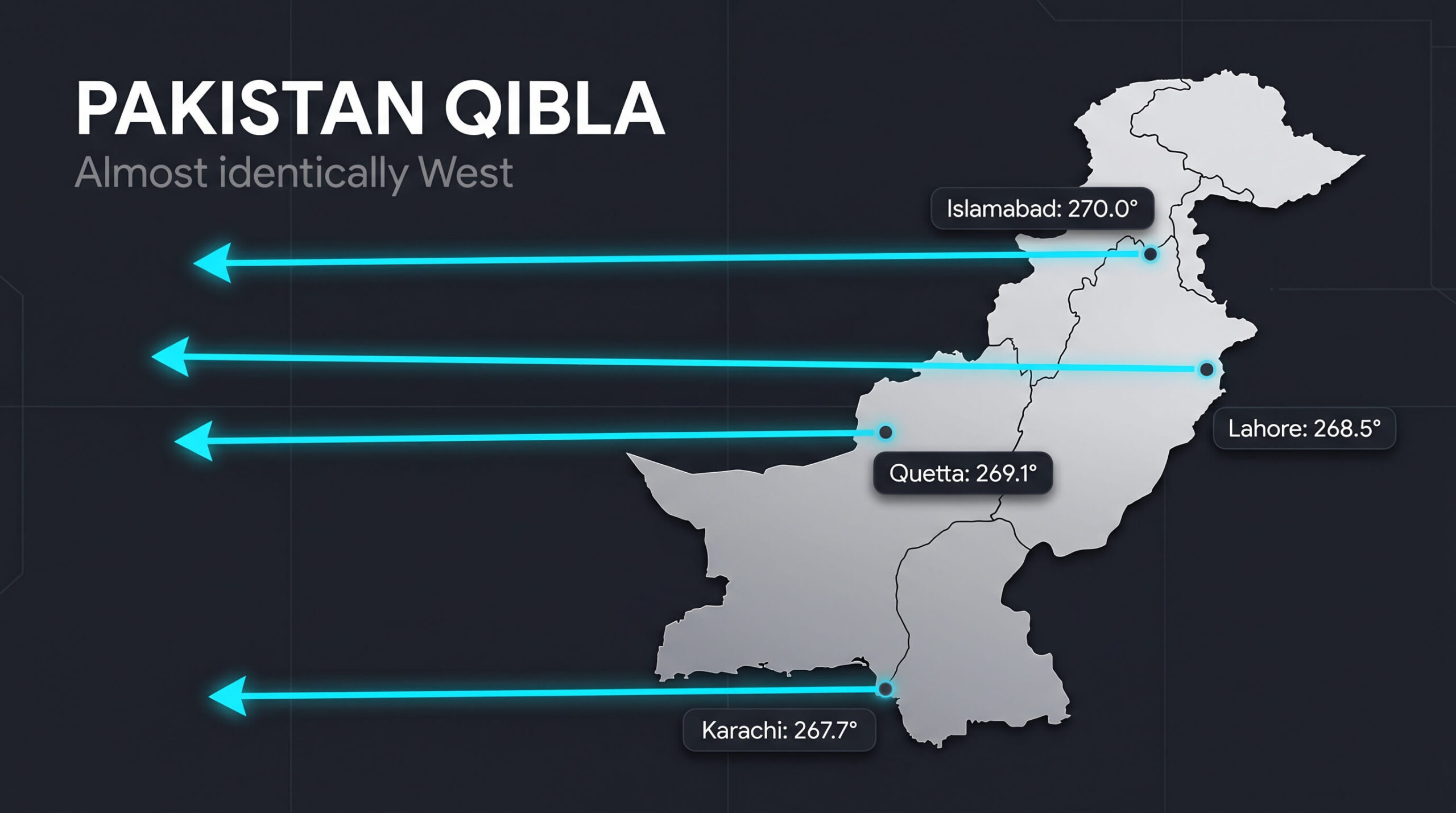
How to read this table: The bearing is measured clockwise from true north (not magnetic north). In Pakistan, magnetic declination is small (approximately 0.5° to 1.5° West as of 2026), so magnetic compass readings are very close to true bearings. For millimeter precision, apply the magnetic declination correction for your exact location.
Key insight for Pakistani Muslims: The qibla is essentially westward across the entire country. Whether you are in Karachi, Lahore, or Islamabad, you are facing broadly west — a simple mnemonic that can guide you when tools are unavailable.
What Is Qibla? Definition, Linguistic Root, and Quranic Foundation
The word qibla (قِبْلَة) derives from the Arabic trilateral root q-b-l (ق-ب-ل), which carries the meanings of facing, encountering, meeting, and turning toward something. Ibn Manzur documents in Lisan al-Arab, the most comprehensive classical Arabic lexicon, that the root conveys an orientation of deliberate confrontation — not a passive turning, but an intentional facing of one thing toward another.
In Islamic legal usage, qibla carries a specific technical meaning: the direction of the Sacred Mosque (al-Masjid al-Haram) in Mecca — and, more precisely, the direction of the Ka’ba at its center — which every Muslim must face during the five obligatory daily prayers. Scholars of fiqh distinguish carefully between two related but distinct concepts:
- Qibla as direction (jihat al-qibla): The general compass bearing toward Mecca from any given location on Earth.
- Qibla as the physical structure (ayn al-Ka’ba): The exact structure of the Ka’ba itself, which only those in its immediate vicinity can directly face.
This distinction, as we will see in the madhab sections below, generates the most significant fiqh debate in this entire topic.
Beyond prayer, the concept of istiqbal al-qibla — facing the qibla intentionally — appears in multiple Islamic contexts. The dying are turned to face the qibla. Animals are slaughtered facing the qibla. Supplications (du’a) are often made facing the qibla. A hadith in Sunan Abu Dawud (#1479, graded Hasan) records that the Prophet ﷺ faced the qibla when making du’a. These multiple uses confirm that the qibla is not merely a prayer convention — it is a comprehensive spiritual orientation.
The qibla is also classified by jurists as a shart al-salah — a condition without which the prayer is not valid — making it one of the conditions of valid prayer alongside ritual purity, covering the ‘awra, and entering the prayer time. Misunderstanding the qibla, therefore, is not a minor technicality; it touches the very foundation of every Muslim’s daily worship.
The Quranic Command: Analysis of Surah Al-Baqarah 2:144
The primary Quranic command regarding the qibla is found in Surah Al-Baqarah, verse 144.
In Arabic:
قَدْ نَرَىٰ تَقَلُّبَ وَجْهِكَ فِي السَّمَاءِ ۖ فَلَنُوَلِّيَنَّكَ قِبْلَةً تَرْضَاهَا ۚ فَوَلِّ وَجْهَكَ شَطْرَ الْمَسْجِدِ الْحَرَامِ ۚ وَحَيْثُ مَا كُنتُمْ فَوَلُّوا وُجُوهَكُمْ شَطْرَهُ
In translation:
“We have certainly seen the turning of your face toward the sky, and We will surely turn you to a qibla with which you will be pleased. So turn your face toward al-Masjid al-Haram. And wherever you [believers] are, turn your faces toward it.” (Quran 2:144)
The critical word requiring careful analysis is shatr (شَطْر). Classical scholars examined this term with great precision, and their conclusions carry direct fiqh implications.
Imam Ibn Kathir explains in his Tafsir that shatr in this context means nahw — “toward” or “in the direction of” — not a demand for absolute geometric precision. Ibn Kathir emphasizes that the command is to orient oneself toward the Masjid al-Haram, not necessarily to calculate an exact degree bearing to the centimeter of the Ka’ba’s structure.
Imam al-Tabari, in his monumental Jami’ al-Bayan, situates this verse within its historical context (asbab al-nuzul): the Prophet ﷺ had been praying toward Jerusalem for approximately 16 to 17 months in Madinah. He longed for the direction of prayer to be changed toward Mecca, and this verse — revealed in Sha’ban of the second year of the Hijra — fulfilled that divine permission. Al-Tabari’s commentary confirms that the entire Ummah was commanded to redirect, demonstrating that the direction of prayer is not arbitrary but a matter of divine decree.
Imam al-Qurtubi, in Al-Jami’ li-Ahkam al-Quran, draws a nuanced fiqh observation: the word shatr carries an inherent flexibility not present in a word like ‘ayn (exact point). He notes that this linguistic choice implies that orientation toward the general direction satisfies the Quranic requirement, though he does not use this as a license for carelessness.
The command is then repeated in two closely following verses — Quran 2:149 and Quran 2:150 — reinforcing its importance across different categories of worshippers: the Prophet himself, and then all believers in every location. This triple repetition (takrar) within four verses signals the gravity of this obligation.
Scholars also frequently cite Quran 2:115:
“And to Allah belongs the east and the west. So wherever you turn, there is the Face of Allah.”
Imam al-Qurtubi and other classical exegetes clarify that this verse does not abrogate the qibla command; rather, it applies specifically to supererogatory prayers while traveling and, according to some scholars, to prayers during extreme fear (referenced in Quran 2:239: “And if you fear [an enemy, then pray] on foot or riding”). This nuance prevents a simplistic reading that would make qibla orientation entirely optional.
The Quranic foundation, therefore, establishes a clear command using the word shatr al-Masjid al-Haram — a direction toward the Sacred Mosque — with the scholarly debate centered on precisely what degree of accuracy that word demands.
The Historical Qibla Change: From Jerusalem to Mecca
The Quranic command of Surah Al-Baqarah 2:144 did not arrive in a vacuum. It dramatically reversed an established practice, and the manner in which the early Muslim community responded offers profound fiqh lessons that scholars have built upon for fourteen centuries.
Al-Bara’ ibn ‘Azib (may Allah be pleased with him) narrates in Sahih Bukhari (#399 and #41):
“We prayed with the Prophet ﷺ facing Jerusalem for sixteen or seventeen months. Then we were directed to face the Ka’ba.”
Parallel narrations in Sahih Muslim add further detail: the change of direction was revealed while the Prophet ﷺ was praying. The news reached the community at Masjid Quba’ in Madinah while they were in the middle of the Fajr prayer — some narrations specify they were in ruku’ (the bowing position). Upon receiving the news, the entire congregation physically rotated 180 degrees, mid-prayer, from the direction of Jerusalem to the direction of Mecca, without interrupting or restarting the prayer.
This incident carries several fiqh implications that scholars have carefully extracted:
- The qibla is determined by knowledge and divine command — when reliable information about the correct direction is received, action upon it is immediate and obligatory.
- Prayer is not automatically invalidated if the direction changes mid-worship due to the acquisition of new, reliable knowledge. The companions continued their prayer rather than restarting it — a precedent that informs later rulings on prayers performed in good faith toward a direction later found to be incorrect.
- This event establishes that ijtihad in determining the qibla is legitimate. The companions had been doing their best to face Jerusalem as commanded; when the command changed, they pivoted immediately. The principle of acting on the best available knowledge, then correcting upon better information, is embedded in this foundational episode.
The Masjid al-Qiblatayn (“Mosque of the Two Qiblas”) in Madinah commemorates this historical turning point to this day, standing as a physical testament to the Ummah’s immediate obedience to divine command.
The Hadith Foundation for Qibla Direction
Beyond the Quranic command, the Sunnah provides additional textual evidence that has generated significant scholarly discussion — particularly regarding how much precision the direction of prayer actually requires.
The key hadith in this discussion is narrated by Abu Hurayrah (may Allah be pleased with him) and recorded in Jami’ at-Tirmidhi (#342) and Sunan Ibn Majah (#1011):
“What is between the east and the west is qibla.”
Imam al-Tirmidhi graded this hadith Hasan Sahih — sound and well-authenticated — giving it significant weight in legal derivation.
The hadith, on its surface, appears to offer extraordinary flexibility: if everything between east and west constitutes the valid qibla, then any direction within a 180-degree arc would seemingly satisfy the obligation. However, scholars have been careful and precise in contextualizing this text.
Contextual Analysis: The Prophet ﷺ is understood to have addressed this statement specifically to the people of Madinah, for whom the Ka’ba lies in a broadly southward direction. When standing in Madinah and facing south, east is to the left and west is to the right — so “between east and west” naturally describes the general southward arc within which Mecca falls. The hadith thus makes eminent geographic sense for its original audience without necessarily extending as a universal declaration.
This contextual reading generates a live scholarly debate that has persisted across madhab traditions:
The Hanafi position, as articulated by Ibn Abidin in Radd al-Muhtar, holds that this hadith validates the principle of jihat al-Ka’ba — general directional orientation — for those who cannot see the Ka’ba. The hadith is read as a statement of principle: a wide arc of orientation satisfies the requirement for those distant from Mecca.
The Shafi’i response, articulated by Imam Nawawi in Al-Majmu’ Sharh al-Muhadhdhab, maintains that this hadith is geographically specific to Madinah and cannot be extrapolated globally. For Nawawi, this text does not negate the obligation of precision where precision is determinable. A Muslim in Southeast Asia, where the Ka’ba lies at a specific calculable angle, cannot invoke this hadith to justify facing an entirely different direction.
This hadith, graded Hasan Sahih by al-Tirmidhi and referenced in Ibn Majah, thus functions as a critical piece of evidence in the madhab debate — validating flexibility in one reading, and requiring geographic specificity in another. The tension between these interpretations is precisely what makes the next section — the four-madhab comparison — so essential.
The Four Madhab Positions on Qibla Precision
This is the section that most online resources fail to deliver adequately. Many articles acknowledge that “scholars differ” on qibla precision, then move on without explaining how they differ, why they differ, and what it means practically for the average Muslim. The four Sunni madhabs have developed internally consistent, evidence-based positions on this matter — and understanding them is not an academic luxury but a practical necessity.
The central fiqh distinction in this entire debate is between two technical terms:
- Ayn al-Ka’ba (عين الكعبة): The exact physical structure of the Ka’ba — its precise walls, its geographic coordinates, its actual building. To face the ayn means to face that exact point on Earth as closely as humanly calculable.
- Jihat al-Ka’ba (جهة الكعبة): The general direction of the Ka’ba — the broad compass bearing “toward Mecca.” To face the jihat means to orient oneself broadly in the direction of Mecca without demanding millimeter precision.
The question of which one is obligatory — and for whom, and under what conditions — is where the madhabs diverge. There is legitimate ikhtilaf (scholarly disagreement) on this matter, and all positions presented below represent valid positions within the Sunni tradition.
Hanafi Position: Jihat al-Ka’ba (General Direction) Is Sufficient
The Ruling: According to Hanafi scholars, the obligation for Muslims who cannot physically see the Ka’ba is to face the jihat al-Ka’ba — the general direction of Mecca. Facing the exact structure (ayn al-Ka’ba) is only required for those who are physically present within the vicinity of the Haram and can directly perceive the Ka’ba with their eyes.
Classical Source: Al-Marghinani in Al-Hidayah, one of the most authoritative Hanafi legal texts, states that the worshipper distant from Mecca is required to orient toward the general direction, and this satisfies the obligation fully. Ibn Abidin in Radd al-Muhtar ‘ala al-Durr al-Mukhtar — the encyclopedic Hanafi reference — elaborates that the jihat is a broad category, and the worshipper should make sincere effort (ijtihad) with the best available tools to identify that direction, after which the prayer is complete and valid.
Contemporary Validation: Shaykh Adib Kallas, as referenced on SeekersGuidance (May 2022), summarizes the Hanafi position concisely: “In the Hanafi school, only two cases exist: if you can see the Ka’ba, face it exactly. If not, general direction suffices.” Mufti Abrar Mirza of DarulIftaa Chicago (January 2025) confirms this position, noting that the Hanafi school does not specify a degree limit for “acceptable deviation” — the concept of jihat is understood broadly.
Prayer Validity If Wrong: According to the Hanafi school, if a worshipper performed sincere ijtihad using the best available tools and methods, their prayer is fully valid even if it is later discovered the angle was somewhat off. The sincerity of effort and the use of reasonable means satisfies the obligation.
Acceptable Deviation: The Hanafi school does not set a fixed degree threshold. The jihat is understood as a hemisphere — that is, any direction within the general half of the compass bearing toward Mecca — though scholars encourage greater precision as a form of devotion and accuracy.
This position is particularly accommodating in practice, reflecting the Hanafi school’s well-documented concern for taysir (ease and accessibility) in matters affecting the general Muslim population.
Maliki Position: Jihat with Validated Folk Methods
The Ruling: Maliki scholars hold that jihat al-Ka’ba — the general direction of the Ka’ba — is the required level of precision for Muslims who are distant from Mecca. Like the Hanafi school, the Maliki tradition does not obligate the exact facing of the Ka’ba’s physical structure for those who cannot see it.
The Distinctive Maliki Contribution: What sets the Maliki position apart is its explicit and detailed validation of folk astronomy methods as legitimate means of satisfying the ijtihad requirement for determining the qibla. This is not a vague permission — it is a codified acknowledgment in classical texts.
Classical Sources: Imam Malik in Al-Muwatta establishes the foundation, and Sahnun in Al-Mudawwana — the comprehensive Maliki legal compilation — elaborates on the methods available to worshippers for determining the qibla. Ibn Rushd (Averroes) in Bidayat al-Mujtahid wa Nihayat al-Muqtasid provides comparative legal analysis, noting that Maliki scholars accepted wind direction, solar position, and star navigation as valid ijtihad tools.
Historical Application: Maliki scholars operating across North Africa — in Morocco, Algeria, Tunisia, and sub-Saharan West Africa — developed a practical tradition of qibla determination using Canopus (known in Arabic as Suhayl), a bright southern star visible in those latitudes. This star-based method was not an informal folk practice; it was legally validated within the Maliki framework as a legitimate tool of ijtihad.
Contemporary Reference: Sheikh Abdullah bin Bayyah, the prominent contemporary Maliki jurist, endorses this position, affirming that the Maliki tradition’s embrace of observational methods reflects the school’s broader concern for practical accessibility across diverse geographic settings.
Prayer Validity If Wrong: As with the Hanafi school, the Maliki position holds that sincere effort using recognized methods validates the prayer even if minor directional errors are later discovered.
This Maliki validation of folk astronomy represents one of the most fascinating intersections of jurisprudence and natural science in classical Islamic scholarship — a recognition that Allah’s creation itself provides the tools for worshipping Him correctly.
Shafi’i Position: Ayn al-Ka’ba Required for Those Who Can Determine It
The Ruling: The dominant position within the Shafi’i school — as articulated by its most authoritative scholars — is that ayn al-Ka’ba (facing the exact structure of the Ka’ba) is obligatory for any worshipper who possesses the means to determine the precise direction. This is the position that most significantly distinguishes the Shafi’i school from the Hanafi and Maliki schools on this question.
Classical Sources: Imam al-Shafi’i himself, in Al-Umm, distinguishes between those who can see the Ka’ba (who must face ayn) and those who cannot. Abu Ishaq al-Shirazi in Kitab al-Tanbih and Imam Nawawi in both Al-Majmu’ Sharh al-Muhadhdhab and Minhaj al-Talibin — the two most referenced texts in the Shafi’i school — develop this position comprehensively.
Imam Nawawi’s Key Statement: In Al-Majmu’, Nawawi articulates the principle that governs the Shafi’i position: a worshipper who has access to reliable instruments or calculations capable of determining the precise direction of the Ka’ba is obligated to use them. For such a person, reliance on general directional orientation (jihat) does not satisfy the obligation. The accessibility of precision tools raises the standard of obligation.
Critical Nuance — The Minority Position: It must be noted that a minority position exists within the Shafi’i school. Imam al-Muzani, a distinguished student of Imam al-Shafi’i himself, narrated a position that permits jihat — general directional orientation — even for those who could theoretically determine greater precision. This view is considered a qawl da’if (weak opinion) within the school but is acknowledged as existing within the tradition. Shaykh Irshaad Sedick, in a fatwa checked by Shaykh Faraz Rabbani of SeekersGuidance (February 2023), confirms this minority Shafi’i view, ensuring readers are aware of the full internal spectrum of the school’s opinions.
Practical Implication of the Dominant View: The rise of GPS-enabled smartphone apps has profound implications for Shafi’i-following Muslims. If the dominant Shafi’i position requires facing ayn for those who can determine it precisely, and modern apps now make that determination readily accessible to nearly any Muslim with a smartphone, then — according to this reasoning — Shafi’i-following Muslims may be obligated to use such tools.
Prayer Validity If Wrong: Imam Nawawi addresses this directly in Al-Majmu’: if a worshipper made genuine effort despite having access to precision tools but still erred, the prayer is valid. However, if negligence is established — if the worshipper had ready access to a reliable method and simply did not use it — some Shafi’i scholars indicate the prayer should be repeated as a precautionary measure. Where genuine effort was made, the prayer stands.
Hanbali Position: Jihat Required, Opposite Direction Invalidates
The Ruling: Hanbali scholars hold that jihat al-Ka’ba — the general directional orientation — is required, and precision down to the exact facing of the Ka’ba’s structure is not obligatory for those distant from Mecca. In this broad framework, the Hanbali school aligns with the Hanafi and Maliki positions.
However, the Hanbali school introduces a distinctive and practically important threshold: a worshipper who prays completely opposite the qibla — for example, facing due north when the Ka’ba is to the south — has prayed an invalid prayer that must be repeated. Minor deviations within the general hemisphere, by contrast, are excused.
Classical Source: Ibn Qudama in Al-Mughni, Volume 1, provides the authoritative Hanbali analysis. He distinguishes between a deviation that keeps the worshipper within the general directional arc (excused) and a deviation so extreme as to constitute praying in the opposite direction (invalidating).
Imam Ahmad’s Permission for Star Navigation: A historically significant element of the Hanbali tradition is Imam Ahmad ibn Hanbal’s explicit permission to use the Pole Star (Polaris) for qibla determination. For worshippers in the northern hemisphere, Polaris sits nearly directly above the Earth’s geographic north pole, making it a reliable fixed reference. Imam Ahmad’s validation of this observational method places the Hanbali school firmly in the tradition of integrating available natural knowledge into religious practice.
Contemporary Application: Hanbali-following scholars and institutions today endorse modern spherical trigonometry calculations and GPS-based apps as superior forms of ijtihad — tools that produce more accurate directional determination than any pre-modern method. Using these tools is considered praiseworthy effort.
Prayer Validity: Within the general hemisphere: valid, even if somewhat imprecise. Completely opposite the qibla: invalid, must be repeated. This threshold — while more defined than the other three madhabs — still provides substantial latitude for good-faith practitioners.
Cross-Madhab Summary Table
Use this table for quick reference on how each madhab approaches qibla precision, validity, and acceptable tools.
| Madhab | Precision Required | Acceptable Deviation | Prayer Valid If Wrong? | Tools That Satisfy Ijtihad |
|---|---|---|---|---|
| Hanafi | Jihat (general direction) for distant; Ayn for those who see Ka’ba | Broadly within general direction; no fixed degree limit | Yes, if sincere ijtihad was made | Stars, sun, compass, apps, landmarks |
| Maliki | Jihat (general direction) | Within general direction | Yes, if sincere effort made | Stars (Canopus), wind, sun, compass, apps |
| Shafi’i | Ayn for those who can determine it; Jihat only for the genuinely unable | Negligence may require repetition; genuine error excused | Yes, if genuine effort; possibly no if means were available and ignored | Instruments, calculations, GPS apps (minority view permits jihat) |
| Hanbali | Jihat required; opposite direction invalidates | Within general hemisphere; opposite direction not excused | Yes (within hemisphere); No (opposite direction) | Stars (Polaris endorsed by Imam Ahmad), compass, apps |
Mathematical Calculation Methods: Spherical Trigonometry Explained
To understand why qibla direction calculation requires mathematics rather than a simple ruler on a map, one must first understand a foundational geometric reality: the Earth is a sphere, not a flat surface.
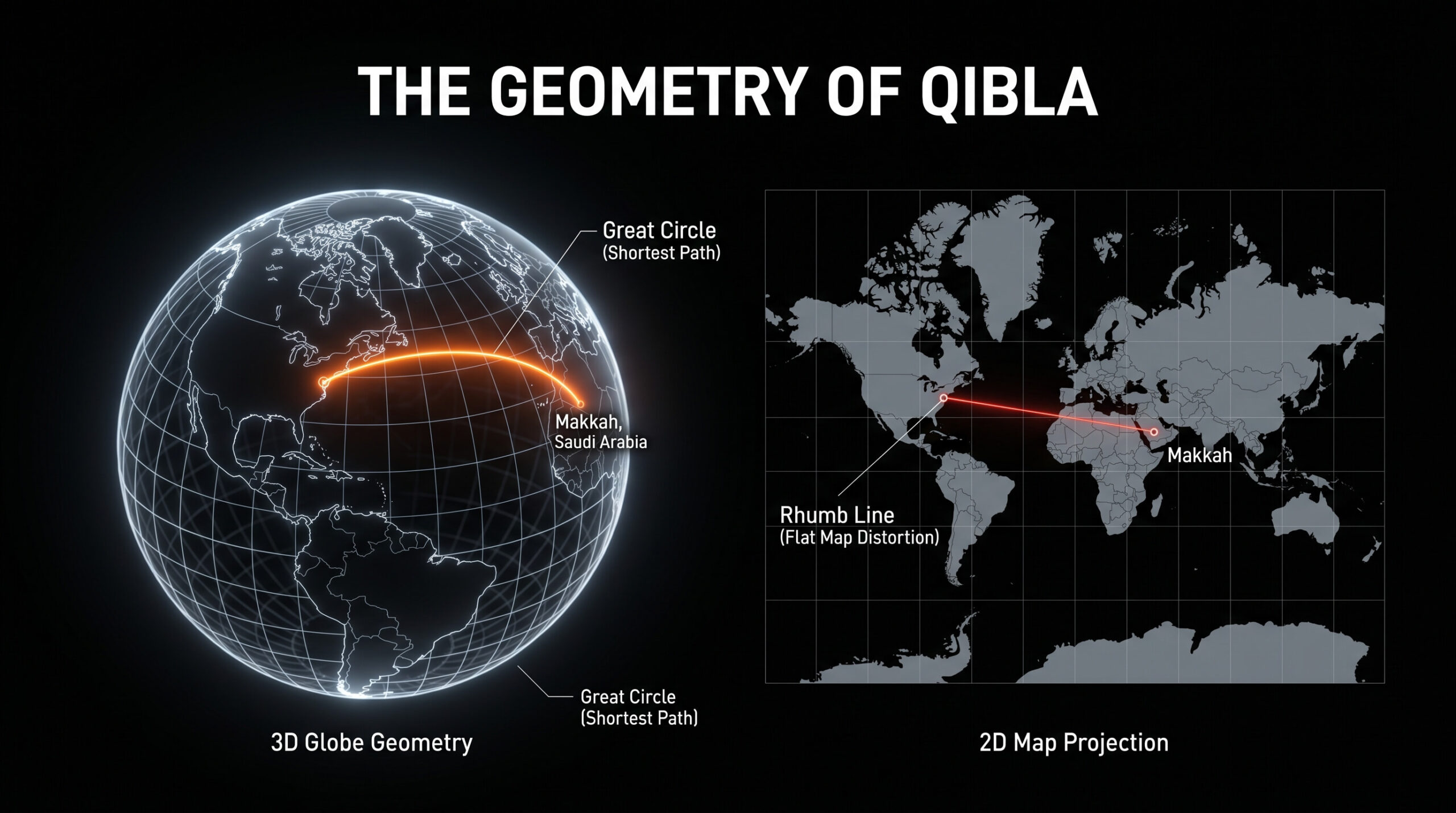
When you look at a standard Mercator projection map — the rectangular world map familiar from schoolrooms — you are seeing a deliberate mathematical distortion designed to preserve shapes but sacrifice accurate distance and direction relationships, particularly at higher latitudes. Drawing a straight line on a Mercator map between two cities does not represent the shortest path between them on the actual Earth. This is why flat-map intuition about qibla direction so frequently produces errors.
The Great Circle Concept
On a sphere, the shortest path between any two points is an arc of a great circle — a circle whose center is the center of the Earth itself. When you physically orient yourself toward Mecca from any point on Earth, the true direction follows this great circle arc, not a straight line on a two-dimensional map projection.
The Rhumb Line (Loxodrome) Contrast
A rhumb line is a path that crosses every meridian at the same angle — what navigators historically called a constant compass bearing. On a Mercator map, rhumb lines appear as straight lines, which is precisely why sailors found Mercator maps useful. However, a rhumb line path is almost always longer than a great circle path between the same two points. For qibla purposes, following a rhumb line bearing means maintaining a constant compass heading toward Mecca — but you would be traveling a longer, curved path on the sphere’s surface, not the true shortest orientation toward the Sacred Mosque.
The Mathematics — The Qibla Formula
The qibla azimuth (the angular bearing from true north) for any location on Earth is calculated using the following formula, derived from spherical trigonometry:
Q = arctan [ sin(Δλ) / ( cos(φ₁) · tan(φ₂) − sin(φ₁) · cos(Δλ) ) ]
Where:
- φ₁ = latitude of the worshipper’s location
- φ₂ = latitude of the Ka’ba (21.4225° N)
- λ₁ = longitude of the worshipper’s location
- λ₂ = longitude of the Ka’ba (39.8262° E)
- Δλ = λ₂ − λ₁ (difference in longitudes)
The Haversine formula provides an equivalent and numerically stable calculation method, particularly useful for computer implementation. The result (Q) gives the true compass bearing in degrees from north, measured clockwise, pointing toward the Ka’ba along the great circle arc.
Historical Islamic Development: This mathematics was not imported from outside the Islamic tradition — it was developed within it, driven by religious obligation. Habash al-Hasib (9th century CE) produced early mathematical solutions for qibla determination. More famously, Al-Biruni (973–1048 CE) devoted an entire treatise — Tahdid Nihayat al-Amakin (The Determination of the Coordinates of Positions) — explicitly to answering the fiqh question of qibla determination with mathematical rigor. Al-Biruni’s work was not pure theoretical astronomy; it was applied scholarship in service of Islamic worship.
Contemporary mathematical formalization is found in S. Kamal Abdali’s paper The Correct Qibla (1997), which remains a standard technical reference, and in Duaa Abdullah’s 2025 ArXiv paper (reference: arXiv:2512.03271v1), which provides updated derivations and computational implementations.
For practical implementation, the formula above — or the equivalent Haversine approach — is what every reliable qibla application running on a smartphone uses. Understanding the underlying mathematics allows a Muslim to evaluate the reliability of any tool they choose to use.
The Great Circle vs. Rhumb Line Debate: A Fiqh Resolution
Of all the technical debates surrounding qibla direction, perhaps none has caused more community confusion — particularly in North America — than the great circle versus rhumb line controversy.
The Geographical Reality: From most locations in North America, the great circle path to Mecca points in a north to northeast direction. On a Mercator map, however, drawing a straight line from, say, Chicago to Mecca points in a southeast direction. Both lines are “toward Mecca” in some sense — but they represent fundamentally different geometric paths on a sphere.
The Fiqh Resolution Through Linguistic Analysis: The answer lies not only in mathematics but in the Quranic word shatr (شَطْر) itself. Returning to Lisan al-Arab (Ibn Manzur), shatr means the direction of encounter — the way you must turn your face to meet something. It is not a navigational bearing in the sense of a constant compass heading; it is the direction your face genuinely points toward that thing at the moment of confrontation.
If you stand in Chicago and want your face to be oriented genuinely toward the Ka’ba — meaning the Ka’ba is in the direction your nose points — that direction is northeast, following the great circle arc. If you face southeast, your face is pointing toward the Indian Ocean and sub-equatorial Africa, not toward the Arabian Peninsula. The great circle is not a mathematical abstraction; it is the physically correct description of which way Mecca is from your location on a sphere.
The Globe Demonstration: Shaykh Nuh Ha Mim Keller, in his landmark 2001 work Port in a Storm: A Fiqh Solution to the Qibla of North America, performed a physical demonstration using a globe and a piece of string — the most honest representation of the Earth’s surface. Stretching a string between North America and Mecca on a globe clearly and visually shows that the shortest path, and thus the true direction of facing, runs northeast from North America. This demonstration, accessible to anyone with a globe and a piece of string, has been widely cited as a decisive practical illustration.
Contemporary Scholarly Ruling: Mufti Abrar Mirza of DarulIftaa Chicago (2025) has issued a clear ruling: “The qibla from North America is definitively north to northeast.” This ruling aligns with the mathematical and linguistic analysis above.
The Implication for Existing Mosques: Many mosques in the United States and Canada that were established decades ago — particularly by South Asian communities relying on flat-map reasoning — face southeast. This is an ongoing community discussion involving scholars, architects, and mosque committees. The scholarly consensus today, drawing on great circle mathematics and the Quranic linguistic analysis of shatr, holds that northeast is the correct direction. Communities are encouraged to verify their mosque’s qibla using contemporary methods and, where correction is needed, to undertake it in consultation with scholars.
Classical (Pre-Mathematical) Methods for Determining Qibla
Before the mathematical astronomy of the 9th century and beyond, Muslims did not leave qibla determination to guesswork. They employed systematic observation of the natural world — methods that the fiqh tradition explicitly validated as legitimate ijtihad with the best available tools of the era.
These classical folk astronomy methods remain practically relevant today. In remote areas, during power outages, on wilderness journeys, or in any situation where electronic technology is unavailable, these methods allow a Muslim to fulfill the obligation of qibla determination through observation of Allah’s creation.
Star Navigation
For Muslims in the northern hemisphere, the most reliable classical method was the Pole Star (Polaris). Because Polaris sits nearly directly above Earth’s geographic North Pole, it maintains an almost fixed position in the night sky throughout the year. Facing Polaris means facing due north — and from there, any direction can be derived by rotating the appropriate number of degrees clockwise. As noted above, Imam Ahmad ibn Hanbal explicitly validated the use of Polaris for qibla determination, giving this method formal Hanbali fiqh endorsement.
For Muslims in North Africa and the Arabian Peninsula, the bright star Canopus (Suhayl) was the preferred reference. Canopus, the second-brightest star in the night sky, has a known position in the southern celestial sphere and was used by Maliki scholars — documented in Al-Mudawwana — as a valid qibla reference for the communities they served.
For Muslims in the southern hemisphere, the Southern Cross (Crux) constellation provides orientation toward the celestial south pole, equivalent to Polaris’s function in the north.
Solar Position Methods
The sun rises in the east and sets in the west — and from these known reference points, north, south, and any intermediate direction can be derived. However, seasonal variation means the sun rises due east and sets due west only at the equinoxes (approximately March 20 and September 22). Classical scholars noted this limitation and advised using solar position as one indicator among several.
At solar noon — the moment when the sun reaches its highest point in the sky — shadows point due north in the northern hemisphere (and due south in the southern hemisphere). This is known as the method of istiwa (solar culmination) and provides a precise north-south reference requiring no instruments beyond a vertical stick.
The Sun’s Overhead Method (Istiwa al-A’dham)
This method deserves special attention for its remarkable precision. On May 27–28 and July 15–16 each year, the sun passes directly overhead the Ka’ba at solar noon (approximately 12:18 PM Mecca local time). At these moments, any vertical object anywhere in the world will cast a shadow pointing in the exact opposite direction of the qibla for that location.
Step-by-step application:
- On May 27–28 or July 15–16, at 9:18 AM UTC (which corresponds to solar noon over Mecca), place a straight vertical stick in the ground.
- Mark the direction of the stick’s shadow at that precise moment.
- The opposite direction of that shadow points directly toward the Ka’ba.
- Mark this direction permanently — it is your precise qibla reference.
This method requires no compass, no app, no calculation — only a clear day, a vertical stick, and knowledge of the correct time. It is both classically grounded and strikingly accurate.
Wind Direction and Landmarks
In the Arabian Peninsula, Maliki scholars documented the use of prevailing wind directions as qibla guides — the shamal (north wind), the janub (south wind), and seasonal winds from known directions provided orientation reference for communities familiar with their local weather patterns. Known mountain ranges, coastlines, and geographic landmarks also served as orientation aids in settled communities.
Fiqh Validation and Modern Relevance
All of these methods represent valid ijtihad — sincere, systematic effort using the best available tools. The legal principle is consistent across all four madhabs: a worshipper who makes genuine effort with available means has fulfilled the obligation, even if the resulting direction is not perfectly precise. These classical methods remain valid and praiseworthy when technology is unavailable.
Modern Tools: GPS Apps, Compasses, and Calibration
Contemporary Muslims have access to qibla determination tools of extraordinary accuracy — but using them correctly requires understanding both how they work and where they can fail.
How Smartphone Qibla Apps Work
A smartphone qibla app integrates three hardware systems:
- GPS (Global Positioning System): The phone’s GPS receiver communicates with satellites to determine the device’s precise latitude and longitude, typically accurate to within 3–5 meters.
- Magnetometer (Digital Compass): A tiny sensor inside the phone detects the Earth’s magnetic field and determines the direction of magnetic north.
- App Software: The app applies the spherical trigonometry formula (described above) to calculate the qibla azimuth from the device’s GPS coordinates to the Ka’ba’s coordinates. It then uses the magnetometer reading — adjusted for magnetic declination — to display the qibla direction on screen.
The Critical Distinction: True North vs. Magnetic North
This is the most important technical concept for any Muslim using a physical compass for qibla determination, and it is the most common source of significant error.
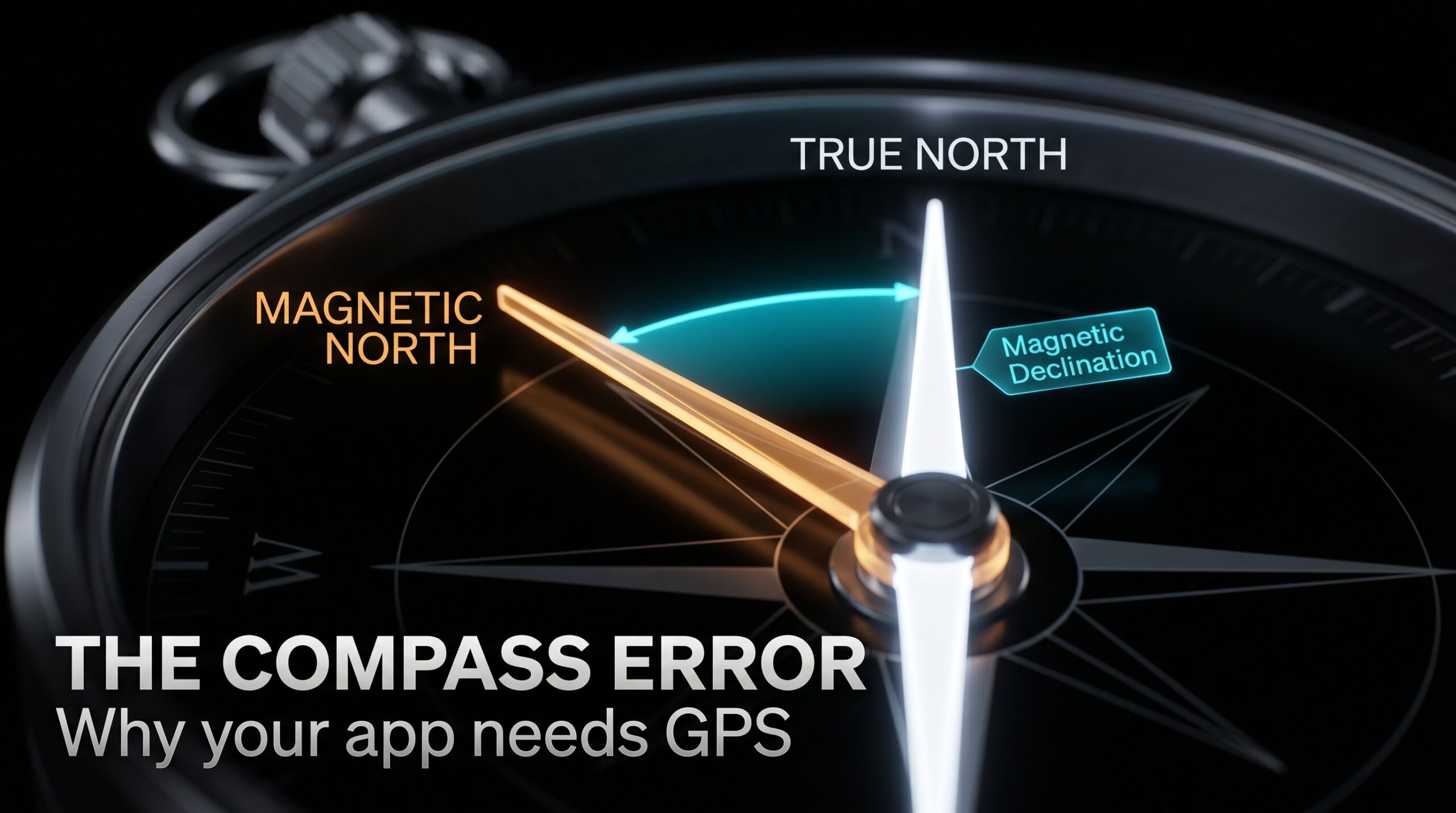
Geographic (True) North is the direction toward the Earth’s geographic North Pole — the fixed point around which the Earth rotates. Magnetic North is the direction toward the Earth’s magnetic north pole — a point that moves over time and is currently located in the Canadian Arctic, approximately 500 kilometers from the geographic North Pole.
The angular difference between these two “norths” at any given location is called magnetic declination (also called magnetic variation). This value:
- Varies significantly by location (e.g., approximately 2° West in the UK, up to 20° West in parts of Canada, approximately 17° West in Alaska, as of 2026)
- Changes gradually over time as the magnetic pole drifts
- Can be east or west of true north depending on location
If magnetic declination is not accounted for, a compass-based qibla determination will be wrong by the declination amount. In Canada, this error could exceed 20 degrees — a substantial misdirection that would matter even under Hanafi and Maliki jihat standards.
App Correction: Most quality qibla apps, when GPS is enabled, automatically retrieve the current magnetic declination for the device’s location and correct for it, displaying the qibla as a true north bearing. This is why GPS-enabled app mode is generally more reliable than manual compass use.
Physical Compass Use: A traditional magnetic compass does not auto-correct for declination. A worshipper using a physical compass must:
- Determine the magnetic declination for their location and date (available from NOAA’s online calculator, updated to 2026 values).
- Add or subtract the declination from the compass reading to obtain the true north bearing.
- Then apply the qibla azimuth from true north.
App Calibration Best Practices
A poorly calibrated magnetometer will give inaccurate directional readings regardless of GPS accuracy. Before using a qibla app:
- Perform the figure-8 calibration motion: move the phone in a figure-8 pattern in the air several times to calibrate the magnetometer.
- Ensure you are away from metal objects, electrical equipment, and large ferrous surfaces (steel desks, reinforced concrete walls), which distort magnetic field readings.
- Verify that the app’s settings are configured to use True North rather than Magnetic North for its display.
Recommended Qibla Apps and Tools (2026)
Several well-reviewed applications are available for qibla direction finder purposes as of 2026:
| App / Tool | Platform | Key Features |
|---|---|---|
| Muslim Pro | iOS / Android | Auto magnetic declination correction; integrated prayer times; clean interface. |
| Qibla Compass (IslamicFinder) | Web / iOS / Android | Dedicated qibla tool; web calculator at islamicfinder.org for azimuth without magnetometer. |
| Qibla Connect | iOS / Android | Compass + map views; globe-like great circle visualization; helpful for understanding northeast qibla from North America. |
For physical qibla compass tools — useful for travel, for Hajj, or for locations where electronic devices are impractical — several manufacturers produce compasses pre-marked with qibla bearings for common cities. These remain reliable tools when properly adjusted for local magnetic declination.
A Fiqh Note on App Use: According to scholars across all four madhabs, using the best available tool for qibla determination is part of valid ijtihad. If reliable digital tools are readily accessible and a worshipper chooses to guess without using them, scholars in the Shafi’i tradition in particular note that this may not satisfy the obligation of sincere effort. Relying on a well-calibrated, GPS-enabled app constitutes sound ijtihad with modern tools.
Practical Guide: How to Permanently Mark Qibla in Your Home
Establishing a permanent qibla reference in your home is one of the most practical steps a Muslim can take for consistent, accurate prayer. The following step-by-step guide applies universally, with Pakistan-specific examples provided for a large portion of our readership.
Step 1: Determine Your Precise Coordinates
Use Google Maps or any reliable mapping app to identify your home’s latitude and longitude. Click on your location and note the coordinates displayed. For example: Karachi city center is approximately 24.8607° N, 67.0011° E.
Step 2: Calculate Your Qibla Azimuth
Enter your coordinates into a reliable online qibla calculator (such as those available on IslamicFinder.org) or use a well-reviewed smartphone qibla app with GPS enabled. The result will be given as a degree bearing from true north (clockwise).
Pakistan-Specific Qibla Angles (True North Bearing, 2026):
- Karachi: approximately 267.7° (almost due west, with a very slight northward tilt)
- Lahore: approximately 268–269° (nearly due west)
- Islamabad: approximately 270° (due west)
- Multan: approximately 268° (nearly due west)
These values confirm that for Pakistani Muslims, the qibla is essentially westward — a useful mnemonic for the region.
Step 3: Account for Magnetic Declination
In Pakistan, the magnetic declination as of 2026 is approximately 0.5° to 1.5° West — a relatively small correction compared to locations at higher latitudes. For most practical purposes in Pakistan, the magnetic compass reading and the true north bearing are very close, but precise users should apply the correction. Check NOAA’s World Magnetic Model calculator for exact current values.
Step 4: Use Your Compass or App to Find the Angle
With your qibla azimuth calculated and declination accounted for, use your compass (adjusted for declination) or a GPS-enabled qibla app to locate the direction in your room.
Step 5: Mark the Direction Permanently
Several methods work well:
- Qibla sticker or arrow: Apply a decorative qibla marker on the wall or ceiling above your primary prayer space.
- Prayer mat alignment: Position your dedicated prayer mat permanently in the correct orientation.
- Furniture arrangement: Align a chair, bookshelf, or other furniture to create a natural visual guide.
- Compass rose on floor: Use low-tack tape to mark the qibla bearing on your prayer room floor.
Step 6: Verify with Sunlight
On the equinoxes (approximately March 20 and September 22), the sun rises due east and sets due west. If your marked qibla for Pakistan is roughly westward, you can verify it by checking that your marked direction aligns with the sunset direction on these dates.
Prayer Validity Scenarios: What If Your Qibla Was Wrong?
The most emotionally charged question in this entire topic is also the most practically urgent: “Are my prayers invalid because I may have been facing the wrong direction?”
This section addresses the most common scenarios with scholarly grounding across all four madhabs.
Scenario 1: You prayed and later discovered the direction was slightly off (e.g., 10–15 degrees)
This is perhaps the most common concern. The answer across the madhabs is broadly reassuring:
- Hanafi: Prayer is valid. Sincere ijtihad with available tools satisfies the obligation; a 10–15 degree deviation remains within the jihat and does not invalidate.
- Maliki: Prayer is valid. The same reasoning applies — general directional orientation satisfies the obligation.
- Shafi’i: If you had access to a reliable tool and used it sincerely, the prayer is valid even with a minor error. If you deliberately ignored available means of precision, some Shafi’i scholars indicate repetition is advisable — but this applies to deliberate neglect, not inadvertent error.
- Hanbali: Valid, as the deviation falls well within the acceptable hemisphere.
Scenario 2: You prayed in a mosque you later learned faces the wrong direction
This scenario causes particular anxiety in communities where a mosque’s mihrab has been discovered to be measurably off.
The general scholarly position across all madhabs is that the congregants’ prayers are valid. As Shaykh Faraz Rabbani of SeekersGuidance states: “The obligation was on those who built the mosque to verify the direction correctly. A worshipper who relies on the mihrab has performed valid ijtihad — they used the best indicator available to them in that context.” The mosque itself bears the obligation to correct the direction going forward, but past prayers offered in good faith upon the mihrab are not invalidated.
This position draws on the foundational principle: ijtihad performed sincerely with the best available indicators satisfies the obligation, even when later information reveals an error.
Scenario 3: You prayed completely opposite the qibla (e.g., facing north when Ka’ba is south)
This scenario, while rare, does occur — particularly in unfamiliar environments.
- Hanbali: Prayer is invalid and must be repeated. This is the clearest and most explicit ruling.
- Hanafi, Maliki, Shafi’i: If done in genuine, complete ignorance with no available means of determination, scholars differ. The safer course in all madhabs is to repeat the prayer when the error is discovered. Where genuine ignorance is established, some scholars in these schools offer leniency — but the standard scholarly advice is to repeat the prayer out of caution.
Scenario 4: You discovered the error mid-prayer
The precedent from the Quba’ mosque incident (Sahih Bukhari #399) is directly applicable: upon receiving reliable knowledge of the correct direction mid-prayer, immediately turn to the correct direction and continue the prayer. The prayer does not need to be restarted. This applies to all four madhabs by analogy with the companions’ behavior.
Scenario 5: Traveling on an airplane or train where the direction keeps changing
Quran 2:239 establishes the principle that circumstances of genuine incapacity modify the standard obligation. The Malaysian Majlis Agama Islam’s 2007 fatwa on prayer during flight serves as an important reference. Most scholars advise: begin the prayer facing the qibla to the best of your ability at the start; if the aircraft changes direction during the prayer, continue to its completion. Hanafi scholars have specific rulings on the permissibility of performing obligatory prayers seated on aircraft when standing is not possible.
For those performing voluntary (nafl) prayers on a moving vehicle, Quran 2:115 establishes broader flexibility — the direction may shift during travel, and the prayer remains valid.
The overarching principle distilled from all four madhabs: sincere effort with the best available tools and knowledge satisfies the obligation. Islam does not demand what is beyond human capacity — but it does expect genuine engagement with the means available.
Edge Cases: Qibla in Space, Polar Regions, Airplanes, and Underground
Islamic jurisprudence has always engaged with the realities of human life in its full complexity. When unprecedented circumstances arise — including those that classical scholars could not have foreseen — the principles of usool al-fiqh (Islamic legal theory) provide frameworks for resolution.
The International Space Station (ISS)
In 2007, Sheikh Muszaphar Shukor became Malaysia’s first astronaut, traveling to the International Space Station during Ramadan. His imminent departure prompted an extraordinary scholarly engagement.
The Malaysian Majlis Agama Islam convened a council of scholars and issued a comprehensive fatwa for his situation. Regarding qibla:
The fatwa established a hierarchy of intent:
- Face the Ka’ba if possible.
- If not possible, face the Earth.
- If not possible (due to orbital mechanics and continuous rotation), face the direction of Mecca at the point of launch.
- If that is not reasonably determinable, face any direction with sincere intention.
This ruling is grounded in the classical usool al-fiqh principle of ma la yutaq — that which cannot be reasonably accomplished is not obligatory. “Allah does not burden a soul beyond its capacity” (Quran 2:286). From the ISS, the Ka’ba passes beneath the station approximately every 90 minutes as the station orbits the Earth; maintaining a fixed orientation toward it is physically impossible. The scholarly response, therefore, engaged the obligation within the framework of genuine possibility.
Polar Regions (Arctic and Antarctic)
At the geographic North Pole, every direction is south. At the geographic South Pole, every direction is north. The concept of a specific compass bearing “toward Mecca” becomes geometrically paradoxical.
Scholars addressing this edge case apply the principle of ma la yutaq and advise: use the last clearly determinable direction of Mecca before reaching the polar zone (at the last location where a meaningful qibla bearing could be identified), or align with the qibla direction used at the nearest inhabited settlement. The obligation to face the qibla does not cease — but it is fulfilled by the best available approximation under genuinely exceptional circumstances.
Airplanes
The qibla direction changes continuously during flight as the aircraft travels great distances. Several practical considerations apply:
- At the start of prayer: Face the qibla to the best of your ability when initiating the prayer.
- During prayer: Most scholars across all madhabs permit continuing the prayer even as the aircraft turns and the precise direction shifts, provided the prayer was begun facing the qibla.
- Nafl (voluntary) prayers on aircraft: Quran 2:115 provides broader flexibility; voluntary prayers may be performed facing any direction during travel.
- Obligatory prayers: The Hanafi school has detailed rulings on whether obligatory prayers may be performed seated on aircraft; scholars generally advise performing them if at all possible, even imperfectly, rather than missing them entirely.
A relevant SeekersGuidance fatwa on this topic advises Muslims to make sincere effort at the start of the prayer and continue to completion.
Submarines and Underground Environments
Where instruments are available (a compass, a smartphone with stored offline data), they should be used. Where no instrument or reference is available and the worshipper has no means of determination, sincere intention in any direction — combined with the ma la yutaq principle — satisfies the obligation. The prayer should not be delayed indefinitely on account of uncertainty when all available means have been exhausted.
Common Misconceptions About Qibla Direction
Islamic practice accumulates misconceptions over generations, and qibla direction is no exception. The following clarifications are grounded in scholarly sources, not in informal community opinion.
Misconception 1: “All madhabs agree that qibla just means roughly facing Mecca.”
This is a significant oversimplification. The dominant Shafi’i position, as articulated by Imam Nawawi in Al-Majmu’, requires facing ayn al-Ka’ba — the exact structure — for those who have the means to determine it precisely. Modern GPS technology arguably places most contemporary Muslims in the category of “those who have the means,” with direct implications for Shafi’i-following worshippers. The four madhabs do not uniformly endorse “roughly” as sufficient.
Misconception 2: “The shortest path to Mecca is a straight line on a map.”
On a flat Mercator map, a straight line between two cities appears to be the shortest path. In reality, the Earth is a sphere, and the shortest path is a great circle arc. The straight line on a Mercator map is actually a rhumb line — a longer path at a constant compass bearing. This is the mathematical reason why the qibla from North America is northeast, not southeast.
Misconception 3: “Magnetic north is the same as geographic north.”
These are distinct. Magnetic declination — the angular difference between magnetic north and true (geographic) north — varies significantly by location. As of 2026, this difference reaches 20° West in parts of Canada and 17° West in Alaska. Using an uncorrected compass in such locations produces a substantial qibla error. Quality GPS-enabled apps correct for this automatically.
Misconception 4: “If my mosque has a mihrab, I don’t need to verify the qibla.”
While relying on the mihrab constitutes valid ijtihad for congregants (as Shaykh Faraz Rabbani notes), the existence of a mihrab does not guarantee accuracy. Documented qibla errors exist in historical mosques across the world — in North Africa, South Asia, and the Americas. Personal verification using modern tools is encouraged, particularly for mosque committees responsible for new construction or renovation.
Misconception 5: “My prayer is definitely invalid if I was slightly off.”
Three of the four madhabs — Hanafi, Maliki, and Hanbali — explicitly do not require invalidity for sincere ijtihad that results in minor directional error. Even the Shafi’i school distinguishes between deliberate negligence (which may require repetition) and genuine error despite sincere effort (which does not). Blanket declarations of invalidity for minor deviations are not supported by the classical fiqh tradition.
Misconception 6: “Modern technology supersedes classical methods, which are no longer relevant.”
Classical methods — star navigation, solar noon shadows, the sun’s overhead dates — remain valid forms of ijtihad when technology is unavailable. On a hiking trip, during a power outage, in a remote rural area, or during Hajj when electronic devices malfunction, these methods allow a Muslim to fulfill the obligation of qibla determination. The fiqh tradition never made the validity of ijtihad contingent on the sophistication of the tools used — only on the sincerity and competence of the effort.
Comprehensive FAQ: Qibla Direction Calculation
The following answers address the most common practical questions Muslims ask about finding and verifying qibla direction.
1. How do I find qibla direction from my location without an internet connection?
Use a pre-downloaded offline qibla app, a physical compass with pre-calculated bearing, or classical methods: Polaris for north-hemisphere orientation, solar noon shadow for north-south alignment, or the sun overhead dates (May 27–28 and July 15–16) for direct shadow-based determination.
2. Is my qibla correct if my app says 267° but my compass says 270°?
Check whether your compass is adjusted for magnetic declination. In Pakistan, the difference between magnetic and true north is only about 0.5–1.5°, so a 3° gap suggests one tool is uncalibrated. Recalibrate your app (figure-8 motion) and verify your compass against true north using the solar noon shadow method.
3. Do I need to face the exact Ka’ba wall or just toward Mecca?
This depends on your madhab. Hanafi and Maliki: general direction (jihat) suffices if you cannot see the Ka’ba. Dominant Shafi’i: exact facing (ayn) is required if you have the means to determine it (e.g., GPS apps). Hanbali: general direction suffices, but facing completely opposite invalidates the prayer.
4. What is the qibla direction from Pakistan — exactly west or slightly north/south?
From most of Pakistan, the qibla is westward with a negligible northward tilt (267–270° from true north). The variation across the country is minimal — Karachi is roughly 267.7°, while Islamabad is approximately 270° (due west). For practical purposes, facing west satisfies the requirement across all major Pakistani cities.
5. Can I use a regular compass app for qibla, or do I need a specific qibla compass app?
A regular compass app shows magnetic north. You must manually add the qibla azimuth and adjust for magnetic declination. A dedicated qibla compass app (like Muslim Pro or IslamicFinder) automates both calculations and is significantly less error-prone.
6. Are prayers invalid if a mosque’s mihrab is 20 degrees off?
For congregants who prayed in good faith relying on the mihrab: prayers are generally considered valid across all four madhabs. The obligation of verification fell on those who built the mosque. Going forward, the mosque committee should consult scholars and correct the orientation if needed.
7. What should I do if I realize I am facing the wrong direction during prayer?
Turn immediately toward the correct direction and continue your prayer. You do not need to restart. This follows the precedent of the companions at Masjid Quba’, who rotated mid-prayer upon receiving news of the qibla change (Sahih Bukhari #399).
8. How do I calculate qibla direction mathematically without an app?
Use the spherical trigonometry formula: Q = arctan[sin(Δλ) / (cos(φ₁)·tan(φ₂) − sin(φ₁)·cos(Δλ))], where φ₂ = 21.4225° N and λ₂ = 39.8262° E (Ka’ba coordinates). Input your location’s φ₁ and λ₁. This can be computed with any scientific calculator, spreadsheet, or programming tool.
9. Is the great circle or rhumb line correct for qibla?
The great circle is correct. It represents the true shortest path on a sphere — the direction your face actually points toward the Ka’ba. The rhumb line is a constant compass bearing that appears straight on flat maps but curves on the globe and does not represent true orientation toward the target.
10. Can I pray facing any direction if I am genuinely lost and have no tools?
Yes — with conditions. The principle of ma la yutaq (that which cannot be done is not obligatory) applies. If you have exhausted all means of determination (no compass, no app, no sun, no stars, no landmarks), face any direction with sincere intention. The prayer is valid. This applies to all four madhabs.
11. Does qibla direction change over time?
The qibla bearing from a fixed location on Earth changes very slowly due to tectonic plate movement and shifts in the Earth’s magnetic field. However, for human lifespans, these changes are negligible (fractions of a degree). The values in this guide remain accurate for decades.
12. What is the best qibla app for iPhone / Android in 2026?
Muslim Pro (iOS/Android) is widely used and automatically corrects for magnetic declination when GPS is active. IslamicFinder’s Qibla Compass provides a clean dedicated tool. Qibla Connect offers both compass and map views. All three are reliable if properly calibrated.
13. How did Muslims find qibla before smartphones and GPS?
Through systematic observation: Polaris in the northern hemisphere, Canopus (Suhayl) in North Africa and Arabia, solar noon shadows, the sun’s overhead dates (May 27–28 and July 15–16), prevailing winds, and geographic landmarks. These methods were not guesswork — they were legally validated ijtihad across all four madhabs.
14. Is there a difference between qibla direction for Fard and Nafl prayers?
The qibla requirement applies to all obligatory (fard) prayers. For voluntary (nafl) prayers during travel, Quran 2:115 provides broader flexibility: “And to Allah belongs the east and the west. So wherever you turn, there is the Face of Allah.” Most scholars apply this verse to nafl prayers in situations of genuine difficulty or movement.
15. Should I repeat years of prayers if I later discover my home qibla was slightly wrong?
No. Across the Hanafi, Maliki, and Hanbali schools, sincere ijtihad with available tools validates the prayer regardless of later-discovered minor error. In the dominant Shafi’i view, genuine effort also validates the prayer. Only deliberate negligence — ignoring available reliable means — would raise a question of repetition, and even then, scholars advise caution and mercy.
The Spiritual Wisdom of Facing the Qibla
Beyond the mathematics, the fiqh debates, and the practical guidance, there lies a profound spiritual dimension to the obligation of facing the qibla that deserves deliberate reflection.
Unity as a Manifestation of Tawhid
At any given moment, hundreds of millions of Muslims across every continent, every time zone, every culture and language, are turning — or have just turned, or are about to turn — to face a single point on Earth. From frozen Arctic tundra to equatorial rainforests, from skyscrapers in New York to villages in Mali, from submarines to space stations, the Ummah orients itself toward one direction. This physical unity is a lived, embodied expression of tawhid — the oneness of Allah — made visible in human bodies aligned toward a common focal point.
Humility and Physical Submission
The act of physically reorienting one’s body is not trivial. It is a small act of submission: the body yielding to divine command, the self overriding its own comfort or habit to face a commanded direction. This outward physical act is, scholars note, designed to cultivate and reinforce the inward disposition of khudu’ (humble submission) that prayer aims to produce.
The Ka’ba as Symbol, Not Object of Worship
It must be stated clearly — as scholars have always emphasized — that Muslims do not worship the Ka’ba. The Ka’ba is a direction, a focal point of unity, a symbol of the covenant between Ibrahim عليه السلام, his son Ismail عليه السلام, and Allah. Quran 2:127 records Ibrahim and Ismail raising its foundations: “Our Lord, accept [this] from us.” Muslims face it not because it is divine, but because Allah commanded a unified direction as a sign of collective surrender.
The Balance of Precision and Sincerity
Scholars across all traditions affirm a final and beautiful principle: precision in qibla direction is an expression of love for Allah and dedication to worship. Striving for accuracy — learning the mathematics, calibrating the app, verifying the home direction — is itself an act of devotion. Yet sincerity and genuine effort matter more than millimeter precision. As the entire tradition of ijtihad teaches: Allah accepts the striving heart. Strive as best you can, and trust His acceptance.
Summary and Actionable Takeaways
This guide has covered the full scholarly and technical landscape of qibla direction. Here are the essential points:
Key Scholarly Points
- The Quranic command (2:144) uses the word shatr — “toward” the Masjid al-Haram — with classical tafsir scholars (Ibn Kathir, al-Tabari, al-Qurtubi) noting this implies directional orientation rather than rigid geometric precision.
- The four madhabs hold distinct positions: Hanafi and Maliki require jihat (general direction); the dominant Shafi’i view requires ayn (precision) for those who can determine it; Hanbali requires jihat but explicitly invalidates prayers facing the opposite direction.
- The great circle method is the mathematically correct and Islamically sound approach for determining qibla from any location on Earth.
- Magnetic declination must be accounted for when using any compass-based tool.
- Classical folk astronomy methods (stars, solar noon, the Ka’ba overhead dates) remain valid ijtihad tools.
Actionable Steps
- Identify your madhab’s position on the level of precision required.
- Use a reliable, GPS-enabled, calibrated app — verify it corrects for magnetic declination automatically.
- Mark your home qibla permanently using the coordinates and bearing calculated for your location.
- Verify your local mosque’s qibla if you have concerns, and raise the matter respectfully with the mosque committee.
- In unusual circumstances (travel, emergencies), apply the principle of sincere effort with available means — Allah accepts genuine striving.
“And to Allah belongs the east and the west. So wherever you turn, there is the Face of Allah. Indeed, Allah is All-Encompassing and Knowing.” (Quran 2:115)
The science of qibla calculation is not a modern imposition on an ancient religion. It is a gift from the scholars of the Islamic Golden Age — from Habash al-Hasib and Al-Biruni to Ibn Qudama and Imam Nawawi — who understood that Islam’s embrace of knowledge and Islam’s demand for worship are not in tension. They are the same impulse.
IslamHub.com is committed to presenting all valid scholarly positions faithfully, drawing on the depth of the Islamic tradition without issuing independent rulings. We hope this guide serves as a lasting reference — one you return to, share with your community, and search for again by name.
If your situation involves specific circumstances requiring personal guidance — a mosque renovation, an unusual travel scenario, or a question about which madhab’s ruling applies to you — please consult a qualified scholar in your local community or reach out to a recognized online fatwa service. The scholars are there to serve, and the seeking of knowledge is itself an act of worship.