Editorial Note: This guide draws from authenticated hadith, classical fiqh texts, and contemporary scholarly fatawa across all four major legal schools. IslamHub presents multiple scholarly views fairly and does not issue independent fiqh rulings. All fiqh positions are attributed to their respective scholars and schools.
It is the first night of Ramadan. The Quran lies open before you, and a quiet question surfaces: “Can I actually finish this?” Almost immediately, a second question follows — one many feel but rarely voice aloud: “Do I even have to?”
These questions carry emotional weight, spiritual aspiration, and genuine confusion about what Islam’s scholars actually say. This guide covers everything a Muslim needs to know about how to complete the Quran in Ramadan — not as a simple reading schedule, but as a grounded, evidence-based journey through authentic Islamic scholarship.
This article draws from Sahih al-Bukhari, Sahih Muslim, Imam an-Nawawi’s At-Tibyan fi Adab Hamalat al-Qur’an, Ibn Rajab al-Hanbali’s Lata’if al-Ma’arif, and contemporary fatawa from Dar al-Ifta Egypt and IslamQA. What follows is the fiqh ruling on whether khatm al-Quran (completion of the Quran) is obligatory, the Prophetic model of Ramadan Quran engagement, what the great Imams and Salaf actually did, the scholarly debate on speed versus reflection, special rulings for women and new Muslims, and seven audience-tailored plans you can begin tonight.
The Ruling on Completing the Quran in Ramadan — Is It Obligatory?
The question most Muslims ask first is this: Is completing the Quran in Ramadan wajib (obligatory) or fard (a religious duty)? According to the scholarly consensus documented in IslamQA (Question 65754) and affirmed by Sheikh Ibn ‘Uthaymeen in Majmu’ al-Fatawa (20/516), completing the Quran in Ramadan is mustahabb (strongly recommended, a praiseworthy sunnah), not wajib (obligatory). This is the position across all four madhabs — Hanafi, Maliki, Shafi’i, and Hanbali — without exception.
Understanding this distinction is critical: mustahabb means the one who performs it is rewarded generously, but the one who omits it is not sinful. This is categorically different from wajib, where omission incurs sin and potential accountability on the Day of Judgment.
This fiqh clarification carries profound emotional relief for many Muslims who feel crushing guilt when they do not complete the khatm. Scholars consistently encourage pursuing khatm al-Quran in Ramadan while simultaneously emphasizing that it must never become a burden that distances a believer from the mercy of Allah. Sheikh Ibn ‘Uthaymeen expressed this balance beautifully, noting that the Quran was revealed as guidance and healing, not as a source of distress or self-reproach.
While the ruling is mustahabb, the virtue of completing the Quran during this blessed month is immense — a reality firmly established in the Prophetic tradition and the practice of the early generations, as we will now explore.
Related: Learn about the proper etiquette of Wudu before Quran recitation.
The Prophetic Foundation — Why Ramadan and the Quran Are Inseparable
Ramadan and the Quran share a bond established by divine decree and Prophetic practice. The primary evidence for intensive Quran engagement in Ramadan comes from two authenticated hadith, each carrying profound scholarly commentary that transforms how we understand the khatm.
The Jibril Mudarasah Hadith
Ibn ‘Abbas (radhiallahu anhu) reported: “Jibril would meet the Prophet (peace be upon him) every night during Ramadan, and they would review the Quran together. In the final year of the Prophet’s life, this review occurred twice.” — Sahih al-Bukhari 4998 and Sahih Muslim 2405 (muttafaqun ‘alayhi)
The word used in the hadith is mudarasah — not simple recitation, but mutual, engaged study. Ibn Rajab al-Hanbali, in his classical text Lata’if al-Ma’arif, notes that this was not a passive reading exercise but an active review session where the Prophet (peace be upon him) and Jibril checked, corrected, and studied the Quran together.
This completely reframes our understanding of the Ramadan khatm: it is not a “reading marathon” to be completed and checked off. It is a sacred study practice, an opportunity to deepen engagement with Allah’s words in the month they were revealed.
The Generosity Connection
The Prophet’s companion reported: “The Messenger of Allah (peace be upon him) was the most generous of people, and he was most generous in Ramadan when Jibril would meet him and they would review the Quran together.” — Sahih al-Bukhari 3554
Ibn Rajab connects this hadith to the first, noting that the Prophet’s generosity was directly linked to his Quran engagement. The implication is spiritually powerful: one who engages deeply with the Quran in Ramadan is embodying the Prophetic model of generosity — generous with time, attention, and devotion to Allah’s Book.
Quranic Evidence
The Quran itself establishes Ramadan as the month of its own revelation:
شَهْرُ رَمَضَانَ الَّذِي أُنزِلَ فِيهِ الْقُرْآنُ هُدًى لِّلنَّاسِ وَبَيِّنَاتٍ مِّنَ الْهُدَىٰ وَالْفُرْقَانِ
Surah al-Baqarah 2:185
“The month of Ramadan in which was revealed the Quran, a guidance for the people and clear proofs of guidance and criterion”
Ibn Kathir, in his tafsir of this verse, notes that the Quran’s initial descent to the lowest heaven occurred during Ramadan, making this month the natural season for intensive Quran study.
The command in Surah al-Muzzammil establishes the manner:
وَرَتِّلِ الْقُرْآنَ تَرْتِيلًا
Surah al-Muzzammil 73:4
“And recite the Quran with measured recitation [tartilan] — deliberate, clear, and reflective.”
The spiritual connection deepens when we consider Surah al-Qadr 97:1 and Surah al-Dukhan 44:3, both of which confirm that the Quran’s revelation began on Laylat al-Qadr (the Night of Decree), a night that occurs within Ramadan. The Quran was born in this month. Returning to it intensively during Ramadan is not arbitrary — it is a divinely appointed reunion.
What the Salaf Actually Did — Authenticated Practices of the Early Generations
The practice of the Salaf (early generations of Muslims) establishes the upper horizon of what is spiritually possible during Ramadan. These accounts are not prescriptions that create guilt, but authenticated historical evidence showing how deeply the early generations valued Ramadan Quran recitation.
As Imam an-Nawawi frames it in At-Tibyan fi Adab Hamalat al-Qur’an (p. 74), the recommended amount of recitation varies per individual — these reports establish possibility, not obligation.
Imam al-Shafi’i — 60 Khatms
Imam al-Shafi’i: Completed 60 khatms during Ramadan — all recited in prayer. This is reported with a sahih (authentic) chain of narration in Adab al-Shafi’i wa Manaqibuh (p. 74).
Imam Abu Hanifa — 61 Khatms
Imam Abu Hanifa: According to classical biographical sources cited by islamonweb.net, he reportedly completed 61 khatms in Ramadan.
Imam al-Bukhari — Daily Khatm
Imam al-Bukhari: Completed one full khatm every single day of Ramadan, plus an additional khatm every three nights after leading Tarawih prayers.
Qatadah ibn Di’amah
Qatadah ibn Di’amah: Completed the Quran every three days during Ramadan, and every single night during the final ten nights. This is documented in Siyar A’lam an-Nubala by Imam al-Dhahabi (5/276).
Al-Aswad ibn Yazid
Al-Aswad ibn Yazid: Completed the Quran every two nights throughout Ramadan. Source: Siyar A’lam an-Nubala (4/51).
‘Uthman ibn ‘Affan (RA)
‘Uthman ibn ‘Affan (radhiallahu anhu): Reported to have completed the entire Quran in a single rak’ah of night prayer.
Imam an-Nawawi, in At-Tibyan (p. 61), provides critical nuance: scholars divided people into categories — the scholar who uses Ramadan for teaching and issuing fatawa, the worshipper who intensifies recitation, the student who focuses on memorization — and each has their appropriate level of engagement. This prevents these extraordinary reports from becoming a spiritual leaderboard that produces shame rather than inspiration.
The Fiqh of Recitation During Khatm — Speed, Tajweed, and the Four Madhabs
Before discussing schedules and plans, it is necessary to understand what the scholars say about how one recites during a Ramadan khatm — because these rulings directly affect what kind of khatm is valid and meritorious.
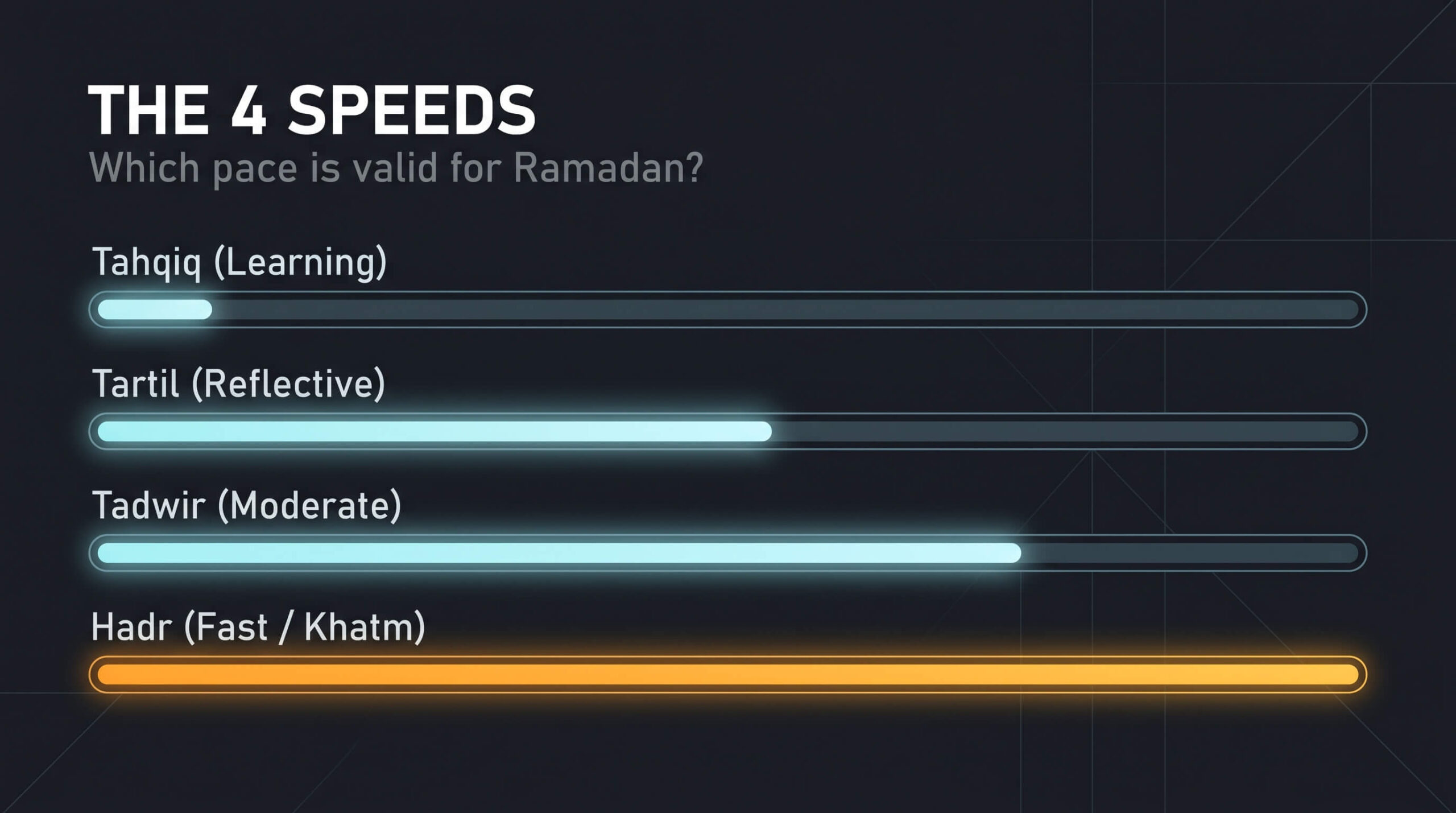
The Four Speeds of Recitation and Which One Applies to Khatm
Classical scholars of Quranic sciences recognized four distinct speeds of recitation, each with its own ruling and application. According to SeekersGuidance, referencing Mu’jam ‘Ulum al-Quran by Jurmi, these are:
- Tahqiq — Extremely slow and deliberate; used for learning, teaching, and mastering pronunciation.
- Tartil — Measured and reflective; this is the Quranic command in al-Muzzammil 73:4. It is ideal for tadabbur (reflection on meaning).
- Tadwir — A moderate pace; balanced recitation that maintains clarity while moving at a steady rhythm.
- Hadr — The fastest permissible speed; still requires observance of tajweed rules, but moves at pace. This is the speed used by the Salaf for khatm purposes.
According to scholars, hadr (the fastest mode) is not sinful, provided the rules of tajweed that affect meaning are observed. This directly addresses the common community concern that “reading fast is disrespectful.” Sheikh Zakariyya al-Ansari held that recitation speed becomes sinful only when it alters the meaning or grammatical structure of the Quran — a position grounded in the principle that the Quran’s message must remain intact.
For the purpose of completing the Quran in Ramadan, hadr is a legitimate and Salaf-practiced method.
Is Tajweed Obligatory During a Khatm? What the Madhabs Say
The fiqh question of tajweed’s obligation level during khatm carries practical importance for readers of all levels. According to the four madhabs:
- Hanafi view: Tajweed is fard al-kifaya (a communal obligation) — if some members of the community observe it perfectly, the rest are not individually sinful for imperfect application.
- Maliki view: Similarly classified as a communal obligation in its full technical application.
- Shafi’i view: Tajweed application is fard al-‘ayn (an individual obligation) specifically for Surah al-Fatiha in prayer; for general recitation outside of prayer, it is strongly recommended.
- Hanbali view: Broadly similar to the Hanafi position — communal obligation with encouragement for individual mastery.
The practical implication for khatm: no madhab rules that imperfect tajweed invalidates the reward of khatm recitation, provided the reader is genuinely trying and the meaning is not corrupted. This reassurance is critical for non-fluent readers and beginners.
The Prophet (peace be upon him) said: “The one who is proficient in the Quran will be with the noble righteous scribes, and the one who recites the Quran and finds it difficult, stuttering or stumbling through its verses, will have a double reward.” — Jami at-Tirmidhi 2910 (sahih)
This is the motivational foundation for every struggling reader: your effort is seen, and your reward is doubled.
The Ramadan Exception — Completing the Quran in Less Than Three Days
One of the most important fiqh nuances — entirely absent from other online guides — is the Ramadan exception to the general prohibition on completing the Quran in fewer than three days. A hadith in the Sunan collections advises against completing the Quran in less than three days as a regular, year-round practice, as this may prevent proper reflection.
However, according to the four madhabs, as well as the explicit position of Imam Ahmad ibn Hanbal, completing the Quran in less than three days is permitted during Ramadan because Ramadan is a time of special virtue, and the Salaf practice establishes this precedent beyond dispute. Imam Ishaq ibn Rahuyah made the same exception for virtuous places such as Makkah.
The scholarly reasoning is clear: the multiplication of reward in Ramadan, combined with the Prophetic model of nightly mudarasah, creates a unique context where accelerated recitation does not carry the same concern as it would in other months.
Khatm al-Quran in Ramadan — The Four Madhab Positions at a Glance
For readers who follow a specific legal school, the following section summarizes the key fiqh positions across all four madhabs on the major questions surrounding Ramadan Quran completion. IslamHub presents each view with its evidence basis — readers are encouraged to consult a qualified scholar of their own madhab for personal application.
The Hanafi Position on Khatm al-Quran in Ramadan
Overall position: Mustahabb (strongly recommended); intensive Quran recitation is encouraged during Ramadan.
On women reciting during haid (menstruation): According to the majority of Hanafi scholars, it is impermissible for a menstruating woman to recite from the Mushaf (physical Quran). However, a nuanced position exists: if she recites with the niyyah (intention) of dhikr (remembrance of Allah) rather than formal Quran recitation — such as saying “Alhamdulillah” as a phrase of remembrance rather than reciting Surah al-Fatiha as Quran — this is permitted. Darul Ifta Birmingham clarifies this distinction in their fatwa database.
Key classical scholar: Imam Abu Hanifa himself — whose own reported practice of 61 khatms in Ramadan stands as the most powerful Hanafi argument for intensive recitation.
Usool (evidence basis): The Hanafi position on women and the Mushaf draws from principles of tahara (ritual purity) applied to handling the Mushaf. The prohibition hadith narrated in Sunan Ibn Majah is relied upon for the Mushaf ruling, even though its isnad (chain of transmission) is classified as weak by many hadith scholars — a methodological choice within Hanafi jurisprudence that prioritizes caution regarding the Quran’s sanctity.
The Maliki Position on Khatm al-Quran in Ramadan
Overall position: Mustahabb; the Maliki school places great emphasis on Ramadan Quran recitation as an act embodying the spirit of the month.
On women reciting during haid: Permitted with precautions — a menstruating woman may recite the Quran but should not touch the Mushaf directly without a barrier (such as a cover, cloth, or gloves). This is one of the more permissive positions among the schools.
Key classical scholar: Imam Malik ibn Anas himself, who was famously reported to have ceased his hadith study circles during Ramadan to devote himself entirely to Quran recitation and reflection. This narration, documented in classical Maliki biographical literature, is powerful motivational evidence for prioritizing the Quran during Ramadan.
Usool: The Maliki permission for women to recite is based on the weakness of the prohibition hadith AND the general principle that the prohibition of recitation for one in a state of janabah (major ritual impurity) applies differently — and less restrictively — to haid.
The Shafi’i Position on Khatm al-Quran in Ramadan
Overall position: Mustahabb; the Shafi’i school is perhaps the most emphatic about Ramadan khatm. Imam al-Shafi’i’s own authenticated practice of 60 khatms in Ramadan — all recited in prayer — is cited within this school as the gold standard of devotion.
On women reciting during haid: Forbidden — a menstruating woman may not recite the Quran or touch the Mushaf during menstruation. This is the strictest position among the four schools.
Tajweed obligation: Individual obligation (fard al-‘ayn) specifically for Surah al-Fatiha in prayer; for general recitation, it is strongly recommended but not individually obligatory.
Usool: The Shafi’i prohibition derives from qiyas (analogical reasoning) with the ruling on janabah — applying strict tahara requirements to Quranic recitation based on the principle of the Quran’s sanctity.
The Hanbali Position on Khatm al-Quran in Ramadan
Overall position: Mustahabb; the Hanbali school follows the explicit precedent of Imam Ahmad ibn Hanbal’s own intensive Ramadan recitation practices and his permission for completing the Quran in less than three days during this blessed month.
On women reciting during haid: Permitted — this is the most permissive position and is grounded in rigorous hadith analysis. The prohibition hadith (“No menstruating woman should recite from the Quran” — Sunan Ibn Majah) is classified as da’if (weak) by scholarly consensus, including Imam al-Albani. Imam Ahmad ibn Hanbal held that no authentic text prohibits menstruating women from reciting the Quran. This position was also held by Sheikh al-Islam Ibn Taymiyyah and Sheikh Nasir al-Din al-Albani. IslamQA (Question 70438) documents this position thoroughly.
Usool: The Hanbali position rests on the principle that a prohibition requires authentic evidence. Since the only hadith prohibiting recitation during haid is weak in its chain of transmission, no valid prohibition stands. This is a textually rigorous position grounded in the science of hadith authentication.
Madhab Comparison Table — Key Fiqh Issues at a Glance
| Issue | Hanafi | Maliki | Shafi’i | Hanbali |
|---|---|---|---|---|
| Overall Ruling | Mustahabb | Mustahabb | Mustahabb | Mustahabb |
| Women Reciting (Haid) | Not permitted | Permitted (no Mushaf touch) | Not permitted | Permitted |
| Tajweed Obligation | Fard kifaya | Fard kifaya | Fard ‘ayn (Fatiha only) | Fard kifaya |
| Less Than 3 Days | Permitted in Ramadan | Permitted in Ramadan | Permitted in Ramadan | Permitted in Ramadan |
| Key Evidence Basis | Tahara principles | Weakness of prohibition hadith | Qiyas with janabah | Hadith authentication rigor |
Quality vs. Quantity — The Scholarly Debate on Tadabbur and Khatm
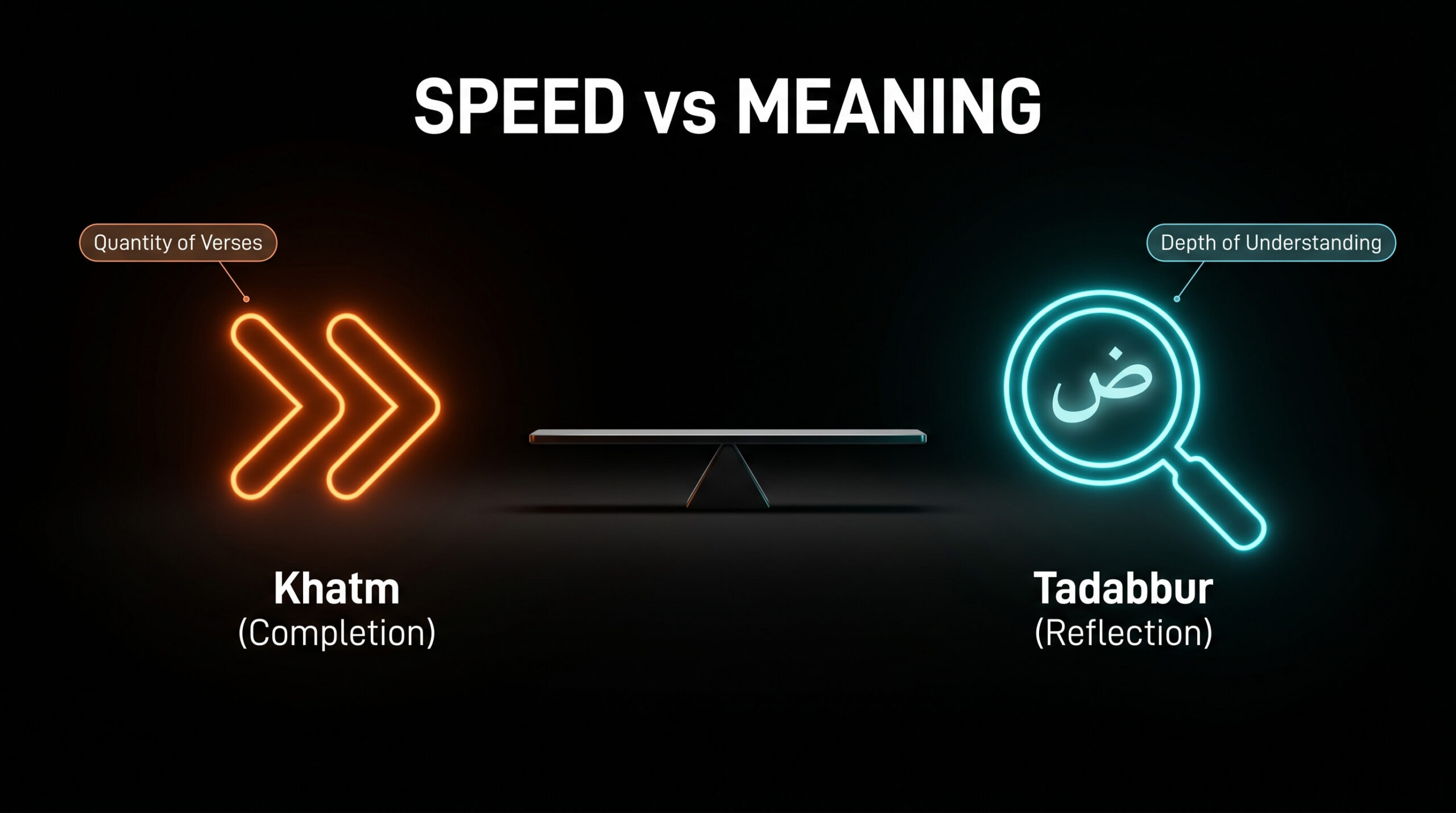
A legitimate scholarly debate exists: is it better to complete the Quran quickly (khatm-focused) or to read slowly with deep reflection and understanding (tadabbur-focused)? Many Muslims have heard respected elders or scholars say “rushing through the Quran without understanding is disrespectful.” This concern is valid and should be addressed with scholarly nuance.
According to Imam an-Nawawi in At-Tibyan fi Adab Hamalat al-Qur’an (p. 61), the answer varies based on the individual’s condition, capacity, and spiritual state. This is not a one-size-fits-all ruling. Imam an-Nawawi outlines the principle clearly:
- For a scholar or advanced student: Tadabbur (reflection) is paramount — reading slowly to extract meanings, connect rulings, and deepen understanding is superior for them.
- For a general worshipper in Ramadan: Khatm is encouraged because the special virtue of Ramadan is tied to the quantity of engagement with the Quran during the month it was revealed.
- For a learner or one reviewing memorization: Balancing hifd (memorization) review with new recitation takes priority.
Drawing on Ibn Rajab’s framework in Lata’if al-Ma’arif, IslamOnline presents three practical approaches:
- Khatm-focused: The primary goal is completion. Recite at hadr speed with tajweed maintained. This was the approach of many Salaf during Ramadan.
- Tafsir-focused: Read with a tafsir text alongside. Fewer pages are covered, but engagement with meaning is deeper.
- Hifz-review-focused: For the hafidh (Quran memorizer), revision of memorized portions — ideally with a study partner — takes precedence.
The Companions (Sahabah) modeled a balanced approach: they would take ten verses at a time, learn their meaning and how to implement them, then move to the next ten. This method honors both khatm and tadabbur simultaneously.
A critical community question arises: “If I finish the Quran without understanding a single word of Arabic, is there still reward?” According to scholars, the answer is yes — emphatically.
The Prophet (peace be upon him) said: “Whoever recites a letter from the Book of Allah, he will be credited with a good deed, and a good deed gets a ten-fold reward. I do not say that Alif-Lam-Meem is one letter, but Alif is a letter, Lam is a letter, and Meem is a letter.” — Jami at-Tirmidhi 2910 (sahih)
The act of recitation itself is ‘ibadah (worship), even without full comprehension. However, scholars unanimously encourage adding at minimum a brief reflection — even just reading a translation alongside the Arabic — to enrich the spiritual experience.
Related: Essential Duas for Every Muslim — supplications to accompany your Quran recitation.
Your Personalized Khatm Plan — 7 Audience-Specific Schedules
As Imam an-Nawawi notes in At-Tibyan fi Adab Hamalat al-Qur’an (p. 61), the “right” amount of recitation varies per individual. IslamHub offers these plans as starting frameworks, not religious prescriptions. Every Muslim seeking to complete the Quran in Ramadan can adapt these to their unique circumstances.
Plan 1 — The Beginner (New to Regular Quran Recitation)
Daily target: 1/2 juz (approximately 10 pages)
Time required: 30–45 minutes per day
Schedule breakdown:
- Post-Fajr: 4 pages (15 minutes)
- After Dhuhr: 3 pages (10 minutes)
- After Isha/Tarawih: 3 pages (10 minutes)
30-day result: 300 pages = approximately 1/2 of the Quran
Tip: For beginners, consistency matters more than quantity. If you complete half the Quran with sincere intention, that is a tremendous achievement. Next Ramadan, aim for a full khatm.
Plan 2 — The Working Professional (9-5 + Commute)
Daily target: 1 juz minimum (approximately 20 pages)
Time required: 60–90 minutes total (split throughout the day)
Schedule breakdown:
- Fajr (4 pages, 10 minutes)
- Commute listening (5 pages listened, 20 minutes)
- Lunch break (3 pages, 8 minutes)
- Following along during Tarawih (4 pages)
- Pre-suhoor (4 pages, 10 minutes)
Total: 20 pages = 1 juz
30-day result: 1 complete khatm
Tip: The Prophet (peace be upon him) said: “The most beloved of deeds to Allah are those done consistently, even if they are small.” (Sahih al-Bukhari). Consistency over heroic single-day sessions is the Prophetic model.
Plan 3 — The Hafidh (Memorization Reviewer)
Daily target: Review 3 juz from memory + read 2 new juz
Time required: 2–3 hours
Schedule breakdown:
- Review 3 juz from memory with Tajweed (1.5–2 hours)
- Verify accuracy with Mushaf or partner
- Complete 2 additional juz of new reading (45 minutes)
30-day result: Full khatm review + reinforcement of memorization
Tip: Prioritize reviewing weakest sections during the first two-thirds of Ramadan, then solidify strongest sections during the final ten nights when spiritual focus peaks. This method combines murajaah with the blessing of the most sacred nights.
Plan 4 — The Menstruating Woman (Following Restrictive Ruling)
Active reading days: Approximately 22 days: 1.5 juz per day = 33 juz
Restricted days (approximately 7–8 days):
- Full listening schedule (sama’) — listen to 1.5 juz per day
- Reading tafsir in translation
- Making abundant dhikr and du’a
30-day result: 1 complete khatm through a combined approach
Tip: For those following restrictive positions, you may make up missed recitation after Ramadan, or intensify recitation before and after your cycle to compensate. The intention for khatm is rewarded even when circumstances prevent completion.
Plan 5 — The New Muslim / Non-Arabic Reader
Daily practice:
- 5–10 verses of slow Arabic recitation (15 minutes)
- 1 juz of listening to recitation with translation (30 minutes)
- 10 minutes of reading translation independently
Total daily time: Approximately 55 minutes
30-day result: Not a full Arabic khatm, but full engagement with the Quran’s meaning and sound — deeply meritorious and appropriate for this stage of the journey.
Tip: The double reward hadith applies directly to you. The Prophet (peace be upon him) specifically promised doubled rewards for those who struggle with recitation. Your effort is seen and multiplied.
Related: Learn how to pray Salah step-by-step — essential guidance for new Muslims.
Plan 6 — The Family (Collective Khatm / Khatm Jama’i)
Concept: Divide the Quran among family members so that collectively, the family completes the entire Quran.
How it works:
- Assign each adult family member 2–3 juz to recite individually
- Children recite smaller portions (1/2 juz each) based on ability
- Gather for 15 minutes after Tarawih to share reflections on the day’s recitation
- Make collective du’a at the end of the month
Scholarly basis: Permitted in the Maliki, Shafi’i, and Hanbali schools. The Hanafi majority holds each participant receives reward for their own portion.
30-day result: 1 complete family khatm + strengthened family bonds through shared worship
Tip: Imam Ahmad ibn Hanbal reportedly stated, “When the Quran is completed, the du’a is answered.” Family du’a at khatm completion carries special barakah.
Plan 7 — The Elder, Ill Reader, or New Reader
Daily practice:
- Listen to 1 juz of recitation (20–30 minutes)
- Recite whatever pages are manageable (even 1 page is rewarded)
- Make du’a with the intention of completing the khatm
30-day result: Engagement at the level of ability — the reward is from Allah according to intention, not merely output.
Scholars have affirmed that the reward of an action is tied to the sincerity of intention. One who is prevented by illness, old age, or inability from completing the khatm but holds the intention in their heart receives the reward, as established in the Quran:
لَّيْسَ عَلَى الْأَعْمَىٰ حَرَجٌ وَلَا عَلَى الْأَعْرَجِ حَرَجٌ وَلَا عَلَى الْمَرِيضِ حَرَجٌ ۗ
Surah al-Fath 48:17
“There is not upon the blind any constraint, nor upon the lame constraint, nor upon the ill constraint.”
Tip: Never underestimate the reward of listening. According to the Hanafi school, listening to the Quran with full attention carries significant reward — Imam Abu Hanifa held it valid as an act of worship.
Quick Comparison — All 7 Plans at a Glance
| Plan | Daily Target | Time/Day | 30-Day Result | Best For |
|---|---|---|---|---|
| 1. Beginner | 1/2 juz (10p) | 30-45 min | ~1/2 Quran | New to recitation |
| 2. Professional | 1 juz (20p) | 60-90 min | 1 full khatm | 9-5 workers |
| 3. Hafidh | 3+2 juz | 2-3 hours | Full khatm + review | Memorization review |
| 4. Women (Restrictive) | 1.5 juz (22d) | 45-60 min | 1 khatm (combined) | Following Hanafi/Shafi’i |
| 5. New Muslim | Verses + listen | 55 min | Deep engagement | Converts/non-Arabic |
| 6. Family | Divided | Flexible | 1 family khatm | Households |
| 7. Elder/Ill | Listening based | 20-30 min | Rewarded intention | Limited ability |
Special Situations — Detailed Fiqh Guidance for Every Muslim
Islam’s scholars have addressed every circumstance in which a Muslim might find themselves during Ramadan. The following section provides fiqh-grounded guidance for specific situations — including scenarios that no other online guide has comprehensively addressed.
For Menstruating Women — A Complete Fiqh Breakdown
This is among the most frequently asked questions, yet it is addressed inconsistently across online platforms. The four madhabs differ on this matter, and each Muslim woman should apply the ruling of her own school or consult a local scholar for personal guidance.
Summary of positions:
- Hanafi: Recitation not permitted; touching Mushaf not permitted. Alternative: dhikr with intention of remembrance only, listening (sama’), reading tafsir in translation.
- Maliki: Recitation permitted; touching Mushaf not permitted without barrier (gloves/cloth).
- Shafi’i: Recitation not permitted; touching Mushaf not permitted. This is the strictest position.
- Hanbali: Recitation permitted; touching Mushaf permitted. Most permissive position based on hadith authentication.
Can a woman who missed 7 days still complete the khatm?
For those following permissive positions (Hanbali/Maliki), no interruption occurred, so the khatm proceeds normally. For those following restrictive positions (Hanafi/Shafi’i), she may make up missed recitation after Ramadan, or intensify recitation before and after her cycle to compensate.
Scholars across all schools recommend:
- Listening to Quran recitation (sama’) with full attention
- Making abundant dhikr (subhanAllah, alhamdulillah, Allahu akbar)
- Engaging in supplication (du’a) — the last third of the night is especially blessed
- Reading tafsir in translation without reciting Arabic aloud
- Studying the meanings of the Quran through English/vernacular resources
For New Muslims and Non-Arabic Readers
Every other major online guide on completing the Quran in Ramadan assumes the reader is fluent in Arabic. This is a glaring omission. For someone who recently embraced Islam or who learned Arabic as a second language, the idea of completing 604 pages in 30 days can feel overwhelming or even alienating. The scholars have addressed this situation with mercy and wisdom.
On reciting transliteration: Scholars differ on this. Some permit it for learning purposes but do not equate it with full Quranic recitation in terms of the ten-rewards-per-letter hadith. Others encourage it as a stepping stone while the new Muslim builds Arabic proficiency.
On listening (sama’): According to the Hanafi school, listening to the Quran with full attention carries significant reward — Imam Abu Hanifa held it valid as an act of worship. The Maliki school similarly affirms great reward for attentive listening. The Shafi’i and Hanbali schools hold recitation superior, but listening is still greatly rewarded and encouraged, especially for those unable to recite.
Reading a translation alongside the Arabic: Scholars across all schools recommend reading a translation of the Quran’s meaning in parallel with the Arabic — this enables tadabbur even for non-Arabic speakers. This approach fulfills the Quranic command to reflect on the verses (Surah Muhammad 47:24).
The double reward principle applies directly here: The hadith in Sahih al-Bukhari and Muslim states, “The one who recites the Quran and finds it difficult, stuttering or stumbling through its verses, will have a double reward.” This hadith was revealed precisely for the new Muslim who struggles with Arabic letters.

For Working Professionals — The Time-Honest Schedule
Many Muslims work standard full-time jobs with commutes, family obligations, and limited free time. Can such a person realistically complete the Quran in Ramadan? The answer, grounded in honest time calculation and Prophetic encouragement, is yes.
A working professional with a 9-5 schedule and commute realistically has the following Quran windows:
- Fajr to sunrise — 30–45 minutes
- Commute (listening) — 20–30 minutes
- Lunch break — 10–15 minutes
- After Tarawih/Isha — 20–30 minutes
- Before suhoor — 10–15 minutes
Total daily Quran engagement: Approximately 1.5–2 hours.
At an average reading speed of 1 page per 2 minutes (for a reader with decent fluency), this yields approximately 45–60 pages per day — equivalent to 1.5–2 juz. Over 30 days, this totals 45–60 juz, which equals 1.5–2 complete khatms, even as a working professional.
For the Hafidh — The Ramadan Review Schedule
The hafidh (Quran memorizer) approaches Ramadan with a different goal: not merely to read, but to review and fortify memorization. This is the practice modeled by Imam al-Bukhari, who reviewed one complete khatm from memory daily while leading separate Tarawih prayers.
The Prophetic precedent for this is the mudarasah with Jibril — checking one’s recitation against a partner is specifically what the Prophet (peace be upon him) did. For a hafidh, the recommended approach during Ramadan is to recite each juz from memory, then confirm accuracy with the Mushaf or with a study partner.
Scholars recommend that the hafidh prioritize reviewing their weakest sections during the first two-thirds of Ramadan, then solidify their strongest sections during the final ten nights when spiritual focus and energy peak. This method combines the review (murajaah) with the blessing of the most sacred nights of the year.
For Families — The Collective Khatm (Khatm Jama’i)
Khatm jama’i refers to the practice of dividing the Quran among family members or a group, so that collectively, they complete the entire Quran. This is a common practice in many Muslim households, but what do the scholars say about it?
Scholarly positions on collective khatm:
- Maliki, Shafi’i, and Hanbali schools: Permit this practice. Each participant receives reward for their own recited portion, and the collective intention unites the effort.
- Hanafi school: The majority of Hanafi scholars hold that each participant receives the reward for their own recited portion. There is internal disagreement on whether each participant receives the full reward of a complete khatm or only their portion’s reward. This ikhtilaf should be acknowledged and respected.
Is the khatm du’a gathering a bid’ah (innovation)?
Imam Ahmad ibn Hanbal reportedly stated, “When the Quran is completed, the du’a is answered.” The narration from Anas ibn Malik (radhiallahu anhu) encourages making du’a at the completion of the Quran. Scholars in the tradition of Imam Ahmad and the majority have held that khatm du’a gatherings have a valid basis in these narrations. Others have been more cautious, noting that it should not be treated as an obligation or formalized ritual. IslamHub presents both views without adjudicating between them.
The Etiquette of Completion — Du’a al-Khatm and What Happens When You Finish
Completing the Quran is not merely closing the final page of Surah an-Nas — it is a spiritual milestone with its own etiquette and recommended practices.
Du’a al-Khatm (Supplication at Quran Completion)
Imam Ahmad ibn Hanbal reportedly stated: “When the Quran is completed, the du’a is answered.” — Authenticated narration
The narration from Anas ibn Malik (radhiallahu anhu) indicates that the Prophet (peace be upon him) encouraged making du’a upon completing the Quran. Some scholars recommend immediately beginning the Quran again — starting with Surah al-Fatiha and the opening verses of Surah al-Baqarah — to maintain an unbroken connection with the Book of Allah.
Is Holding a Khatm Du’a Gathering Bid’ah?
Scholars differ on this question. The majority of scholars who permit group du’a at khatm completion cite the narration from Imam Ahmad and the general evidence for communal supplication. Others have been cautious about formalizing it as a regular, ritualized practice. IslamHub presents both views and encourages readers to consult their local scholars. What is undisputed is the permissibility of making personal du’a upon completing the Quran.
The Spiritual Invitation
The khatm is not a finish line — it is a return point. The Salaf would complete the Quran and immediately begin again. The Prophet (peace be upon him) reviewed the Quran with Jibril every night of Ramadan; the mudarasah itself was the worship, not just the completion. A Muslim who completes the Quran in Ramadan and then begins again has embraced the spirit of the Prophetic model.
Related: Comprehensive guide to Zakat al-Fitr — fulfill your obligation before Eid prayer.
Common Misconceptions Addressed by Scholars
Before concluding, IslamHub addresses five of the most widespread misconceptions about completing the Quran in Ramadan — all drawn from questions circulating in Muslim communities and online forums.
Misconception 1: “Completing the Quran in Ramadan is obligatory (fard)”
Reality: Mustahabb — strongly recommended but not obligatory, as established earlier. There is scholarly consensus (ijma) across all four madhabs on this point.
Misconception 2: “Rewards are multiplied 70x specifically in Ramadan”
Reality: The general multiplication of rewards in Ramadan is firmly established in authenticated hadith. The specific figure of “70 times” appears in narrations whose chains of transmission have been questioned by hadith scholars. Readers should refer to their local scholars for guidance on this specific narration. The principle of increased reward is undisputed; the exact numerical multiplier requires verification.
Misconception 3: “Women cannot touch or read any Quran during their period”
Reality: This is the Shafi’i and Hanafi position — not a universal ruling. The Hanbali and some Maliki scholars permit recitation during menstruation based on the weakness of the prohibition hadith. All positions are legitimate within their respective schools.
Misconception 4: “Listening to the Quran gives the exact same reward as reciting”
Reality: Scholars differentiate between the two. Recitation of the Quran oneself carries the primary reward — ten rewards per letter according to the sahih hadith in Jami at-Tirmidhi 2910. Listening (sama’) carries its own significant reward, particularly in the Hanafi and Maliki schools, which hold it as a valid form of worship. Listening is not inferior — it is simply a different mode of engagement with the Quran, and for those unable to recite (due to illness, illiteracy, or menstruation under restrictive madhab rulings), it is a merciful alternative.
Misconception 5: “Reading fast without perfect tajweed during Ramadan is sinful”
Reality: Hadr (fast recitation) is a legitimate recitation mode recognized by classical scholars. According to Sheikh Zakariyya al-Ansari, sinfulness occurs only when recitation speed alters the meaning or grammatical structure of the Quran. As long as the rules of tajweed that affect meaning are observed, hadr is permitted and was practiced by the Salaf.
Avoiding Burnout — The Sustainable Approach to Khatm
The spiritual danger of any Ramadan goal — whether khatm, qiyam, or charity — is that it becomes a source of anxiety rather than worship. Scholars across all four madhabs have addressed this reality with practical wisdom.
Signs of Quran Burnout to Watch For:
- Dreading your recitation time instead of looking forward to it
- Rushing through pages just to “finish” without any presence of heart
- Feeling guilty for missing a day to the point of despair
- Neglecting other worship (prayer, dhikr, family obligations) to force recitation
- Comparing your progress to others and feeling inadequate
The Scholarly Remedy: Imam Ibn ‘Uthaymeen emphasized that the Quran was revealed as guidance and healing (shifa), not as a source of distress. If khatm becomes a burden, reduce your daily target. If you miss a day, resume the next without self-reproach. The Prophet (peace be upon him) said: “The most beloved deeds to Allah are those done consistently, even if they are small” — this applies to Quran recitation as well.
Practical Strategies:
- Start 3 days early: Begin your khatm 3 days before Ramadan to build momentum without pressure.
- Build in buffer days: Aim to finish by day 27, leaving 3 days for makeup or review.
- Alternate intensity: Some days you will read 2 juz with ease; other days, half a juz is an accomplishment. Both are valid.
- Pair recitation with meaning: Even reading a single verse with understanding carries immense reward.
- Remember the ruling: It is mustahabb — not wajib. Your worth as a Muslim is not measured by whether you complete the Quran in Ramadan.
Frequently Asked Questions (FAQ)
The following questions represent the most common queries Muslims have about completing the Quran in Ramadan, drawn from community questions and online searches.
Q1: Is it wajib to complete the Quran in Ramadan?
A: No. Completing the Quran in Ramadan is mustahabb (strongly recommended) across all four madhabs. It is not wajib or fard. The one who completes it is rewarded generously; the one who does not is not sinful.
Q2: Can I complete the Quran by listening instead of reading?
A: Listening (sama’) carries significant reward, especially in the Hanafi and Maliki schools. However, personal recitation carries the ten-rewards-per-letter hadith specifically. For those unable to recite (illness, new Muslim, restrictive madhab ruling for menstruating women), listening is a valid and rewarded alternative.
Q3: Can a woman recite the Quran during menstruation?
A: This depends on your madhab. Hanbali and some Maliki scholars permit it. Hanafi and Shafi’i scholars prohibit it. Consult a scholar of your school for personal guidance.
Q4: Is it better to read fast and complete the Quran, or read slowly with understanding?
A: According to Imam an-Nawawi, it depends on your capacity. Scholars benefit most from slow, reflective reading. General worshippers in Ramadan are encouraged toward khatm because of the month’s special virtue. The ideal is to combine both: read at a moderate pace with at least some reflection.
Q5: Can I read the Quran in translation to complete my khatm?
A: Reading translation for understanding is highly encouraged alongside Arabic recitation. However, a “khatm” traditionally refers to completing the Arabic text. That said, for a new Muslim unable to read Arabic, engaging deeply with a translation is meritorious and appropriate.
Q6: What is the minimum time to complete the Quran?
A: Generally, scholars advise against completing in less than 3 days outside of Ramadan. During Ramadan, the exception applies — the Salaf completed it in one day. However, for most Muslims, 15–30 days is the practical range.
Q7: Do I get the same reward for listening as for reciting?
A: Scholars differentiate. Recitation carries the ten-rewards-per-letter hadith. Listening carries its own significant reward but is classified differently. Both are beloved to Allah.
Q8: Can I recite from a phone or tablet during menstruation?
A: For those following restrictive positions, digital screens are generally treated more lenientently than physical Mushafs, though scholars differ. Consult your madhab’s ruling on this specific question.
Q9: Is it necessary to recite in order (from Surah al-Fatiha to Surah an-Nas)?
A: No. You may recite in any order. Many Muslims read shorter surahs first to build momentum, or jump between sections for variety.
Q10: What should I do if I miss a day of recitation?
A: Resume the next day without guilt. You may make up missed pages by adding a few extra pages to subsequent days, or simply continue from where you stopped. The goal is consistent engagement, not perfection.
Q11: Can new Muslims count reading translation toward a khatm?
A: While a formal khatm refers to Arabic recitation, new Muslims who engage deeply with a translation are undertaking a profoundly meritorious act. The goal is connection with Allah’s words, not merely checking a box.
Q12: What is du’a al-khatm and when should I make it?
A: Du’a al-khatm is the supplication made upon completing the Quran. It is recommended immediately after finishing the final verse. Imam Ahmad’s narration states that du’a at khatm completion is answered. There are no prescribed words — any heartfelt supplication is appropriate.
Q13: Is it bid’ah to hold a group gathering for khatm du’a?
A: The majority of scholars permit this based on Imam Ahmad’s narration and general evidence for communal supplication. Some scholars caution against formalizing it as an obligation. Both views are valid within Islamic scholarship.
Q14: How can I maintain quality (tadabbur) while reading enough to finish?
A: Read a moderate pace (tadwir), read a translation alongside your Arabic, and take 30 seconds after each page to reflect on one verse that touched your heart. Quality and quantity can coexist.
Q15: What if I start Ramadan with strong intention but cannot finish due to circumstances?
A: The reward of actions is by intention. If you sincerely intended to complete the khatm but were prevented by legitimate circumstances (illness, travel, unforeseen obligations), the full reward of a complete khatm is recorded for you by Allah’s mercy. This is established in the authentic hadith: “Actions are but by intentions.”
Conclusion: Khatm al-Quran in Ramadan — A Gift, Not a Burden
Completing the Quran in Ramadan is mustahabb — deeply recommended by scholars across all four madhabs — but it is never a burden imposed by divine command. The Prophetic model was mudarasah: engaged, attentive, repeated review of the Quran with sincerity and love.
Every Muslim — from the new convert struggling with Arabic letters, to the seasoned hafidh reviewing from memory, to the menstruating woman listening with her heart — has a valid, rewarded path to the Quran this Ramadan.
In the final year of the Prophet’s life (peace be upon him), Jibril reviewed the Quran with him twice. Perhaps Allah’s Most Generous Messenger spent twice as long with His most beloved Book as a mercy to us — leaving us the model of mudarasah, of returning to the Quran again and again, not to reach a final page, but to deepen a living relationship with the words of Allah.
The goal is not perfection. The goal is connection.
Tonight — before Ramadan begins or as it continues — open your Quran, make your niyyah (intention), recite Bismillah, and read whatever you can. According to scholars across all four madhabs, every letter you recite carries at minimum ten rewards (Jami at-Tirmidhi 2910, sahih). Begin. The Quran will do the rest.
Related Guides from IslamHub
- How to Pray Tarawih — Complete step-by-step guide
- Essential Duas for Ramadan — Supplications for every night
- Zakat al-Fitr Guide — Everything you need to know
- Laylat al-Qadr — How to maximize the Night of Decree
- The Etiquette of Wudu — Purification before Quran recitation
Disclaimer
This article draws from classical texts including At-Tibyan of Imam an-Nawawi, Lata’if al-Ma’arif of Ibn Rajab al-Hanbali, Siyar A’lam an-Nubala of Imam al-Dhahabi, and contemporary fatawa from Dar al-Ifta Egypt and IslamQA. IslamHub presents multiple scholarly views and does not issue independent fiqh rulings.