Have you ever questioned how the Ramadan Iftar and Suhoor timing calculation methods Pakistan follows are actually determined during the holy month? It is not a person who is guessing the time of day the sun rises or sets. It has proper science behind it and is being combined with the Islamic teachings that have been in existence for centuries. Millions of Muslims in Pakistan depend on these times on daily basis during this blessed month of Ramadan and knowing how they operate can make your fasting life so much easier.
I will explain it to you, in the easiest manner–do believe me, even a 10-year-old may make this!
What Does Suhoor and Iftar mean?

We should first of all be clear on the meaning of these words before we get into the calculations.
The pre-dawn meal which Muslims take before onset of their fast is known as Suhoor (or Sahur or Sehri). Imagine it is some sort of breakfast, which you have really early in the morning, before even the sun even considers showing up. You have just eaten suhoor and are just ready to start the Fajr prayer when the first light of the morning breaks in the eastern sky.
Evening meal, which is the breaking of fast at sunset is called Iftar. It is what everybody is waiting all day long, being able to finally take that first taste of water and chew on a good date (in adherence to the Sunnah of Prophet Muhammad ﷺ). Iftar occurs exactly when time of Maghrib prayer starts when the sun sets out of the horizon.
وَكُلُوا وَاشْرَبُوا حَتَّىٰ يَتَبَيَّنَ لَكُمُ الْخَيْطُ الْأَبْيَضُ مِنَ الْخَيْطِ الْأَسْوَدِ مِنَ الْفَجْرِ ۖ ثُمَّ أَتِمُّوا الصِّيَامَ إِلَى اللَّيْلِ
And drink and eat till you see the white thread of dawn very plain in you, and the black thread [of night]. Then break the fast till the sunset.
— Surah Al-Baqarah (2:187)
Very simple, easy? Interesting part though is found in this: to define the specific time of these meals, there is a fair amount of very cool calculations involved.
Also Check: Ramadan / Sehri-Iftar Times
Why These Times Changing every Day?
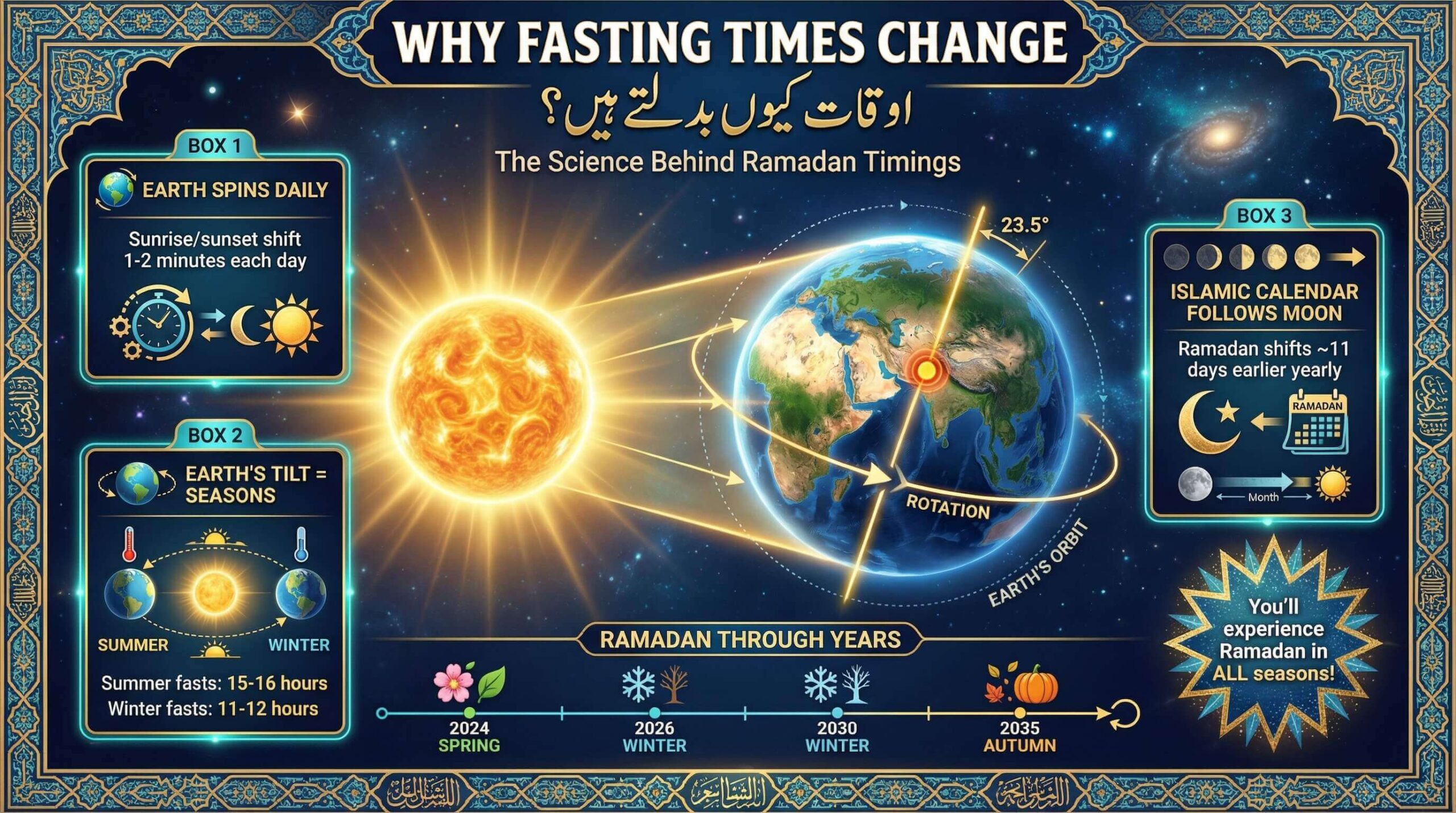
You may have noticed that suhoor and Iftar do not always come on the same day during Ramadan. On some days, you get the privilege to have an extra ten minutes of sleep before suhoor and on some days, you are forced to be up earlier than usual. That’s totally normal!
It is because it is a simple fact; our planet is in constant motion. It spins around its axis (365 days and 365 nights) and spins around the sun (autumn and spring). Due to this daily rotation, the sun sets and rises at a little different time every day. During the summer period, days are elongated, and nights are short. During winter, the reverse is true, the days are shorter and nights are longer.
During the summer months (as during school holidays), Ramadan days are quite long as the sun rises early and sets late. However, when it is winter and Ramadan, the fasting time is much shorter. Because Islamic calendar is lunar (following the moon) Ramadan will move forward about 10-11 days earlier every year, and thus, you will experience Ramadan in all seasons throughout your lifetime!
Pakistan Calculation of prayer times: universities of Islamic sciences, Karachi Procedure
This is an interesting fact about the Ramadan Iftar and Suhoor timing calculation methods Pakistan uses: the majority of cities in the country share a common standard that has been invented in the University of Islamic Sciences in Karachi. It is one of the approaches aimed specifically at South Asian nations such as Pakistan, Bangladesh, India, and Afghanistan.
The Karachi technique makes use of what scientists refer to as angle-based computations. There is no need to worry, you do not have to be a math genius to get this point. I will simplify it in the most basic way.
Also Read: Qibla direction calculation methods for home in Karachi | Ultimate Guide
The Sunset and the Prayer Time
Suppose the sun went flying like a ball in the sky. Noon (Zuhr time), the sun is overhead, and it is the hottest. Later in the day the sun can be seen to lower itself further and further in the sky till it eventually descends the horizon at sunset.
So now that the sun has gone down, and you cannot see him any more, there is a little light in the sky a little bit, right? That’s called “twilight.” It is the same as at sunrise–the sky begins to lighten even before the sun really comes out of the horizon. It is this early morning light which we call dawn.
To compute praying times (and hence suhoor and iftar times), the scholars determine the distance of the sun below the horizon in terms of what is known as degrees. Likely an angle to think of. It is this early morning light which we call dawn. To be precise, the iftar time calculation based on sunset angle Pakistan follows ensures that the disk of the sun has fully disappeared below the horizon before the fast is broken.
The 18-Degree Rule: The Pakistani Standard
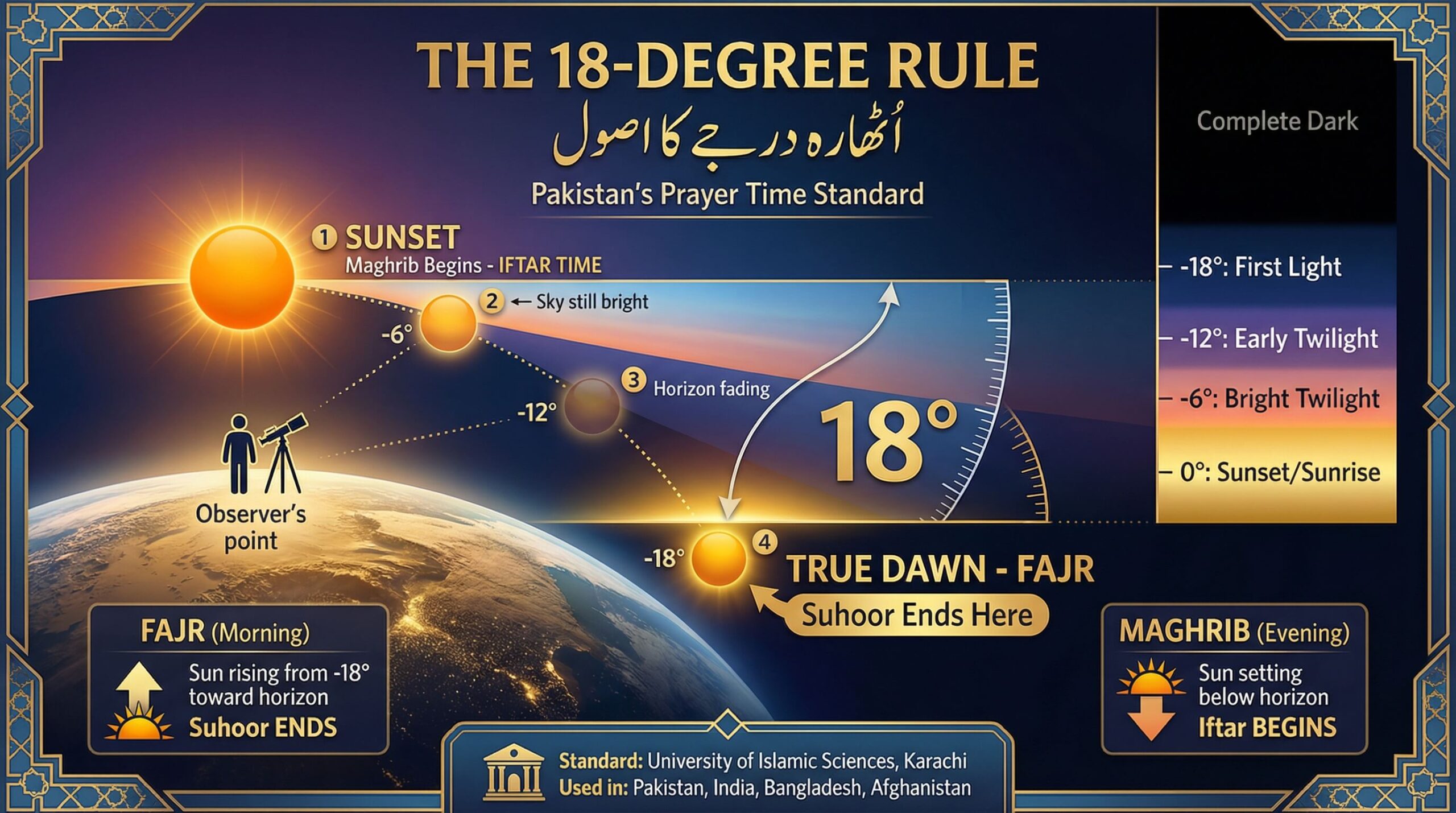
The method used in the University of Islamic Sciences, Karachi provides 18 degrees both in calculating Fajr (dawn) and Isha (night) prayers. However, what exactly is that?
At the time of day when the sun is 18 degrees under the horizon in the morning, then it is the time of true dawn, and Fajr time. It is at this point that suhoor has to terminate. After this, you cannot drink or eat anything in order to make your fast valid.
It is also the same with iftar, we do not use angles, we use real sunset. As soon as the disk of the sun has entirely vanished behind the horizon Maghrib commences and you may break your fast. Easy enough!
And that is why 18 degrees is important: it is the moment when the sky is in total dark and at the beginning of the brightness of the first rays of sunrise. Close observations and study by Islamic scholars have found this to be the time the white thread separates upon the black thread as alluded in the Quran.
Other Methods of Calculation in the World
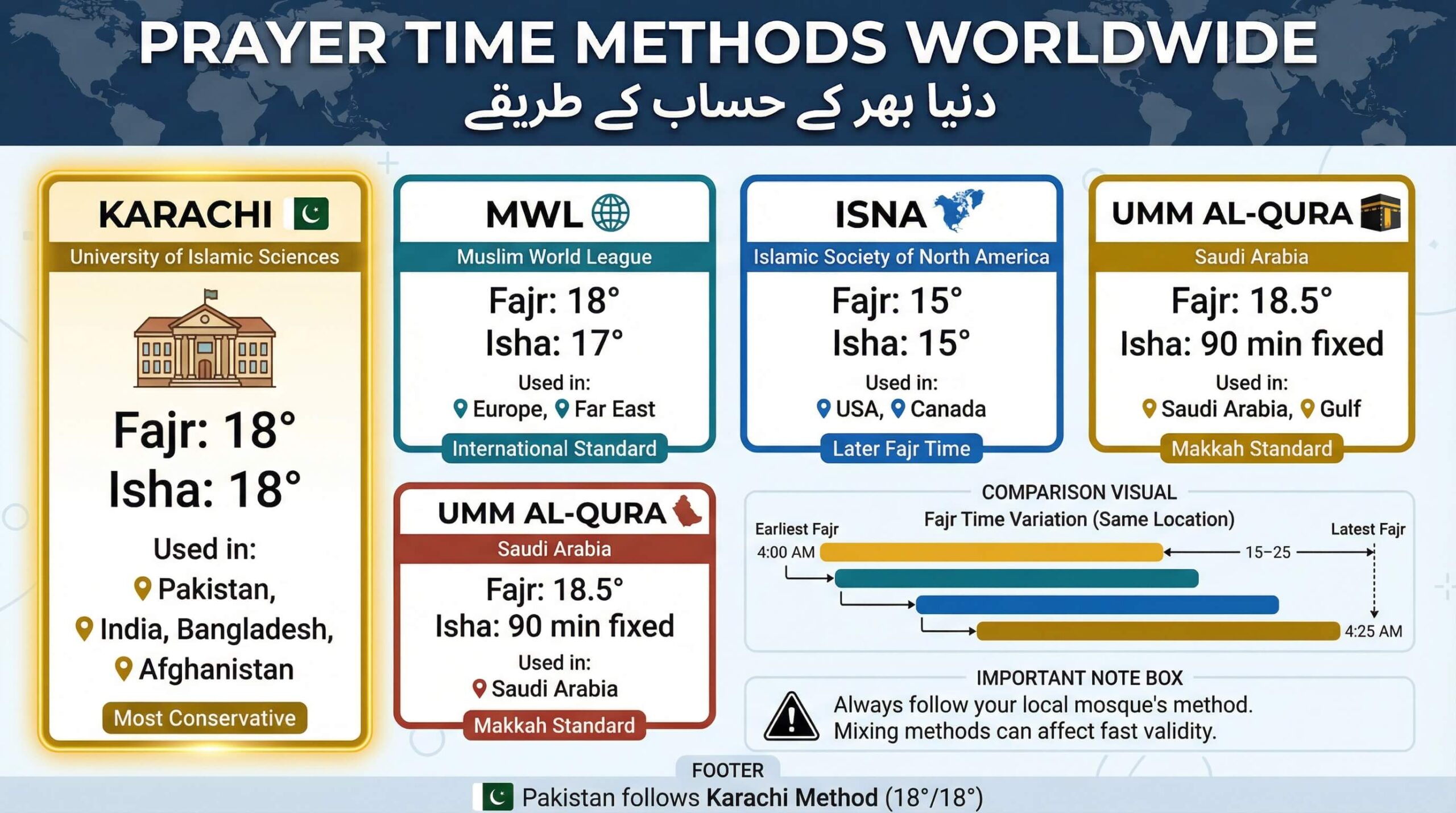
Obviously, the calculation of prayer times is carried out in more than just Pakistan. Various nations and areas have slightly different approaches depending on their own observations and traditions of the scholarship. I will have a brief look around some others of the popular methods:
Muslim World League (MWL): While Pakistan uses the 18-degree standard, the suhoor fajr timing methods Muslim World League suggests utilize 18 degrees for Fajr but 17 degrees for Isha. This is popular in parts of Europe and the Far East.
Islamic Society of North America (ISNA): This is popular in USA and Canada and it applies 15 degrees in both Fajr and Isha. Fajr time is later and Isha is earlier than the Karachi method since it takes lesser angle.
Umm al-Qura: This is the official approach of Saudi Arabia designed by Umm al-Qura University Makkah. It calculates 18.5 degrees to calculate Fajr and 90 minutes after Maghrib to have fixed time of Isha. The reason why many Muslims all over the world prefer using this method is that the sacred city Makkah is the home of this method.
The variation in these methods may vary by up to 5 minutes and up to 20-30 minutes depending on where you are and the time of the year. That is why it is extremely important to get to know which approach is followed by your local mosque and adhere to it!
The Science that goes behind the Calculations
The question now arises: how exactly are these Ramadan Iftar and Suhoor timing calculation methods Pakistan relies on actually formulated? Don’t worry—I’ll keep it simple!
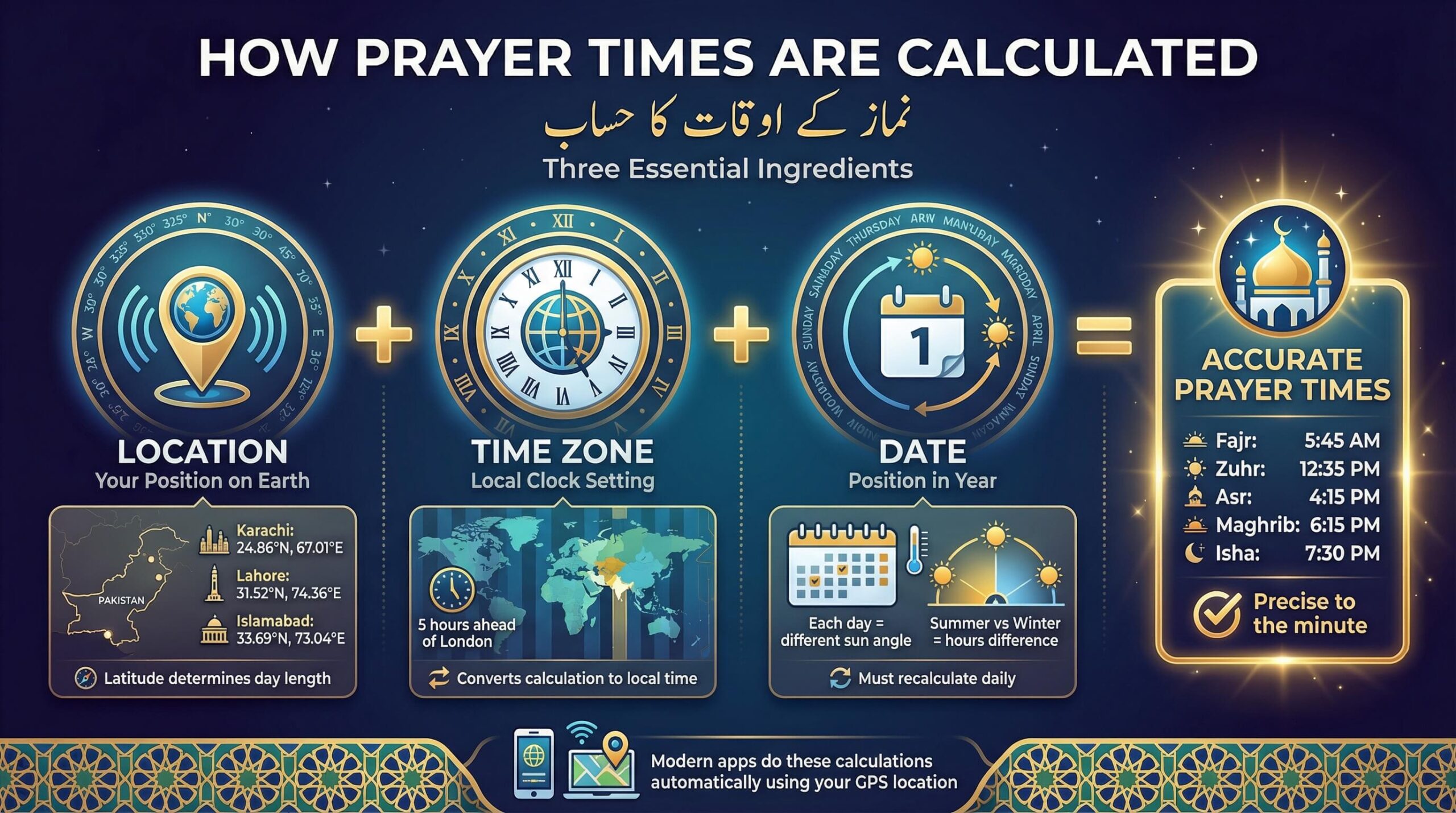
Three Key Ingredients
In order to determine prayer times of any given city in Pakistan we require three primary data:
Latitude and Longitude: The values are the precise geographical position of your city. The latitude of Karachi is approximately 24.86 degrees North and its longitude is approximately 67.01 degrees East. Lahore is located approximately at 31.52 N and 74.36 E. These numbers inform us of the position of a particular city on the surface of the earth.
Time Zone: Pakistan is located on the Asia/ Karachi time zone that is based on UTC+5 (five hours ahead of Coordinated Universal Time). This is used to transform astronomical calculations into the local clock time.
The Date: We should know the exact date as the position of the sun varies all through the year owing to the tilt and rotation of the earth revolving around the sun.
Astronomical Calculations
Formulas based on the fields of spherical trigonometry and positional astronomy are used by the scientists to calculate the time when the sun will be at certain angles below the horizon. They are not mere speculations, but exact mathematical estimations which have been perfected over many centuries.
Two concepts are of importance here;
The Equation of Time: According to this, the sun does not move over the sky at a strictly constant speed all year long. A sundial can be 16 minutes early or 14 minutes late in some instances in relation to a normal clock. This variation is rectified with the equation of time.
Solar Declination: This is the angle of the rays of the sun and the equator of the earth. It is dynamic due to the fact that the earth leans on its axis. It is this tilt that causes us to have our seasons, when the Northern Hemisphere is tilted toward the sun we have summer, and when it is tilted away we have winter.
The computers can compute the precise time when the sun is 18 degrees below the horizon (to Fajr), when it is above the horizon (when Sunrise), when it is above the horizon (when at its lowest point, Zuhr) when the shadows are a certain length (When Asr), when it is setting below the horizon (When Maghrib), and when it is deep enough beneath the horizon, when we can say it is Isha.
Atmospheric Refraction: A Sticky Point
Here is something to think about, which even builds into such calculations: the atmosphere on the earth bends the sunshine! This is referred to as the atmospheric refraction. Due to this bending we do see the sun prior to its physical ascent above the horizon and we see it a little longer than it technically set.
Scientists take this atmospheric refraction into consideration when determining Maghrib time (and hence when determining iftar time) and the geographical elevation of your place. And that is how the calculations are so accurate, taking into account all these minute details!
Local Differences in Pakistan
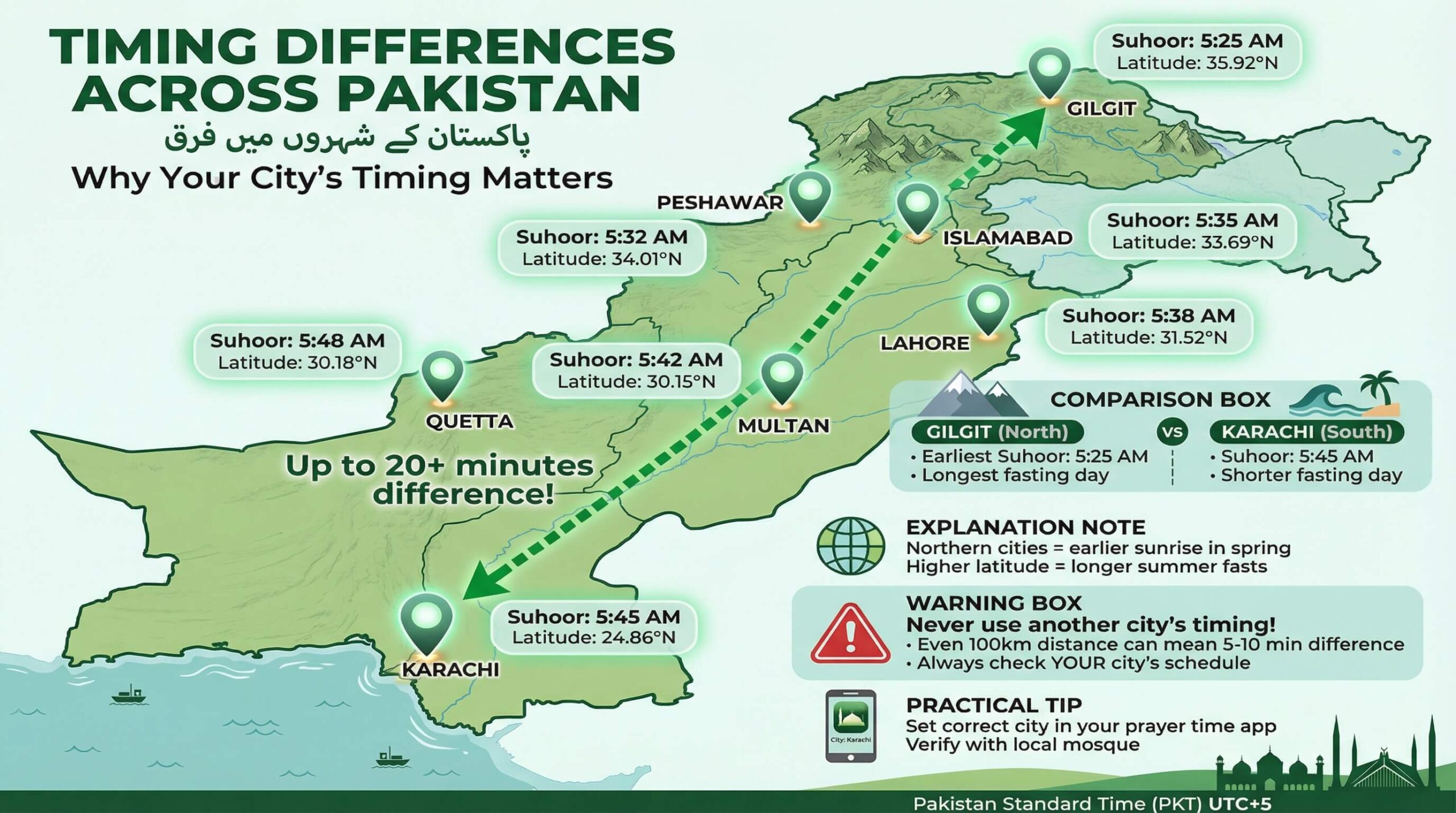
Pakistan is a rather large nation having cities with varying latitudes and heights. This implies that there is a wide range of variation of prayer times depending on the location.
Karachi (southern) has different times than Islamabad (north) that has different times than Quetta (west). In Ramadan 2026 say, Karachi may have suhoor at approximately 5:57 AM and Islamabad may have suhoor at approximately 5:43 AM that is 14 minutes difference! Islamabad may have suhoor at approximately 5:43 AM—that is a 14-minute difference! While we don’t usually face the extreme issues of Scandinavia, a high latitude iftar adjustment northern areas Pakistan (like Gilgit or Skardu) occasionally requires is vital during long summer days to ensure accuracy.
Even in the same city, when you are on a mountain or a high building and the sun rises and sets you are technically raising or lowering in relation to the sea level and thus the sun is actually not rising and setting at the same time. Nevertheless, the majority of the people simply use the standard times that are proclaimed in their city, and they are computed based on an average elevation.
That is why the Islamic scholars never forget to check with your local mosque or to use official timings of your particular city instead of copying the timings of another city even though it is close to your place.
Fiqa Hanafi and Fiqa Jafria: Comparable Schools, Slightly different periods
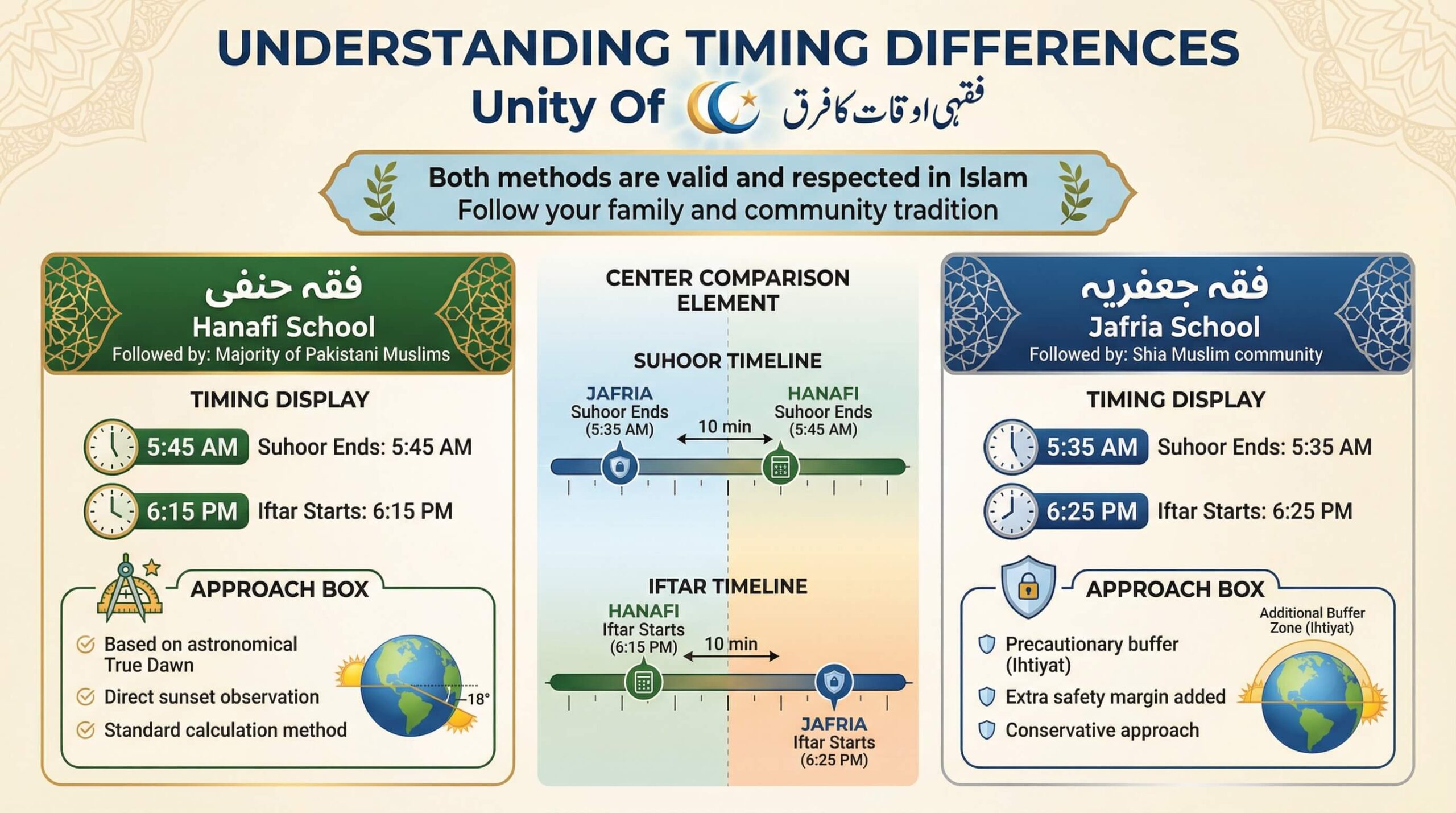
In Pakistan, you will find that Ramadan calendars tend to indicate two times one Fiqa Hanafi (Sunni) and one Fiqa Jafria (Shia). What’s the difference?
The principal distinction is the mode of calculation of Asr prayer time, though that too has a minor influence on other times:
According to Fiqa Hanafi, Asr commences when the shadow of an object would be twice the length of the shadow (on top of the shadow at noon). This tends to make Asr time a little late.
According to Fiqa Jafria, Asr starts when the length of the shadow is equal to the length of the object (including the noon shadow). This is what causes Asr time to be earlier.
This is due to the fact that Jafria scholars are cautious. However, regarding the authentic way to calculate sehri end time hanafi followers observe, the consensus relies strictly on the astronomical “True Dawn” (Subh Sadiq) without the 10-minute precautionary buffer used in the Shia tradition.
In suhoor and iftar, Fiqa Jafria time is normally 10 minutes before suhoor and 10 minutes after iftar than the Hanafi time. This is due to the fact that Jafria scholars are cautious to the point that they are sure that the fast is valid.
The two approaches are honored and legitimate in the Islamic scholarship; the only difference is the school of thought to which your family or community adheres.
The Real Life: The Way Mosques and Apps Track Your Times
Now then you may be asking yourself; how does my local mosque know when to call the Azan to Fajr? How do such apps as IslamicFinder or Hamariweb provide you with the correct timings?
Mosque Announcements
The majority of the mosques in Pakistan depend on the official calculations of the religious authorities or the official prayer time calculators. A significant number of them follow the order of the Central Ruet-e-Hilal Committee or local standards. There are also larger mosques with their own committees who check times by direct observation, particularly at critical times such as the commencement of the Ramadan.
Interestingly, most mosques take an additional small safety margin of the calculated times. They may make the Fajr Azan one or two minutes later than it was calculated to be to ensure that the true dawn has come to pass. On the same note, they may take a minute after the calculated sunset to call the Maghrib Azan. This is practiced due to too much caution that is aimed at safeguarding the worship of people.
Prayer Time Web-Sites and Apps
The need to get correct prayer times has become extremely easy with the modern technology. The websites such as Hamariweb, IslamicFinder, and applications such as Muslim Pro or Athan by IslamicFinder, which utilizes GPS to determine your precise position, and then the correctly appropriate calculation method is used based on your area.
Such apps have the intelligence to use the University of Islamic Sciences, Karachi method when you are in Pakistan. They take into consideration the GPS positioning of your device, do the astronomical calculations mentioned above, correct based on your time zone and then you have accurate prayer times that are applicable at a certain point.
The best part? These apps automatically update on a daily basis as the times vary slightly. You can even make notifications to remind you when suhoor time is almost or when it is almost time to eat iftar!
The One-Minute Prevention Rule
The one-minute prevention rule is a worldly piece of advice, which several Pakistani abide by.
Since astronomical calculations though true, may have infinitesimal error-margins, and since various mosques may sound the Azan a little later or earlier, many adhere to this precaution:
cease to eat suhoor one minute before the determined Fajr time
Begin the eating, one minute after the computed Maghrib time.
This is a deceptive measure which provides you with a buffer of safety. Had you miscalculated by a few seconds, it is alright. You still are good you have a clock a little bit quick or slow. It is a minor precaution and once taken, you will be free to worry no more about the validity of your fast.
The hadith in fact urges one to postpone suhoor to the maximum yet remain on the safe side:
The Sahih Bukhari and the Muslim report the Prophet Muhammad ﷺ saying:
“Take Suhoor, and there does blessings belong.”
And reported Anas bin Malik (RA):
“The Prophet ﷺ and Zaid bin Thabit (RA) took Suhoor together. At the completion of this, the Prophet ﷺ rose to pray. Someone enquired, how long was the gap between the Adhan and Suhoor? He answered, the time of reciting fifty verses.”
This demonstrates that suhoor must be consumed near the Fajr time with a reasonable amount of safety.
Real-world Hypothesis: Karachi Ramadan 2026
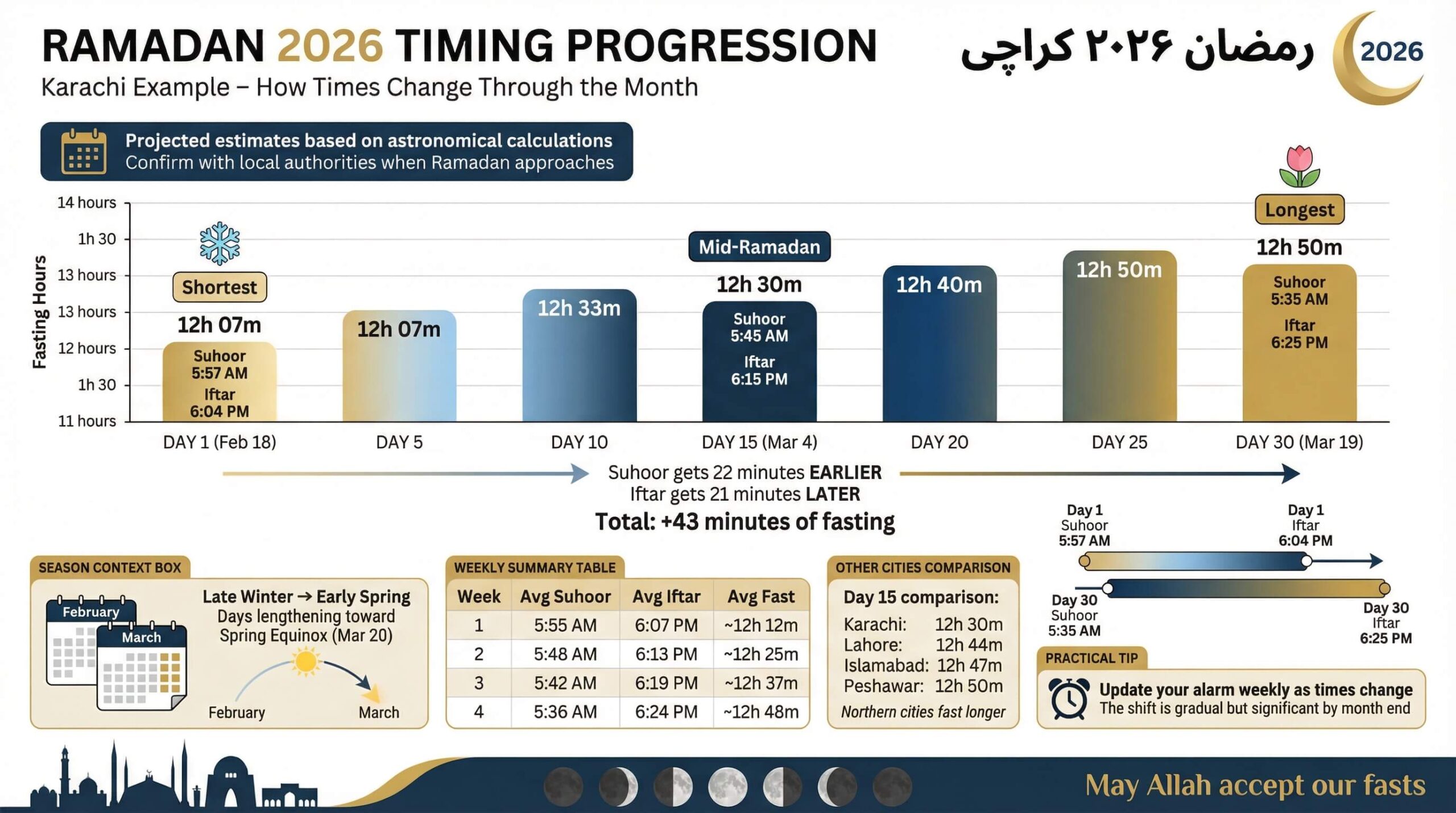
We had better put all these down to Earth with a practical example. If you are looking for a tentative Ramadan 2026 calendar Pakistan with prayer times, let’s project the data assuming Ramadan commences on approximately February 18, 2026.
On day one Ramadan, the time may be calculated:
- Suhoor (Fajr): 5:57 AM
- Iftar (Maghrib): 6:04 PM
This provides about 12 hours and seven minutes of fasting. Not too bad!
Now jump ahead to the 15 th of Ramadan in very early March. Since the days are becoming a little longer in the direction of spring, the times may be:
- Suhoor (Fajr): 5:45 AM (approximately 12 minutes earlier)
- Iftar (Maghrib): 6:15 PM (around 11 minutes later)
This makes the fasting period about 12 hours and half an hour.
By the time Ramadan concludes at the end of March, approximately March 19 th, you may have:
- Suhoor (Fajr): 5:35 AM
- Iftar (Maghrib): 6:25 PM
The number of the fasting hours progressively extends as the days lengthen. This is completely natural and it is automatic because of the movement and tilt of the earth!
Frequently Asked Questions and Misunderstandings
Q: Why do we need specific Ramadan Iftar and Suhoor timing calculation methods Pakistan instead of just looking at the sky?
Great question! At the initial period of Islam, Muslims had actually used plain sight. However, this has a number of issues in the contemporary times. First, there is a lot of light pollution in most Pakistani cities in the form of streetlights, buildings, and vehicles, and, as a result, the time when the true dawn happens is really difficult to grasp. Second, tall buildings and mountains may be in your way when you see the horizon.
Third, the weather such as clouds or smog may render observation impossible. Fourth, and probably the most important thing is that millions of individuals should know the time beforehand to organize the day-you cannot wait till you see the sun rise to know when you should eat and when not.
This is the reason why astronomical science calculations come in handy. They are predictable, consistent and accurate.
Will these calculations be 100 percent accurate?
The calculations are extremely accurate- we are talking that it is within seconds in most instances. Nevertheless, very small changes may occur because of such factors as local weather conditions, precise height, and even air temperature which influence the passage of light through the atmosphere. This is why the rule of one-minute prevention should be suggested. The calculations are not erroneous, it is just that the number of micro-factors as light goes through the atmosphere is so large.
Why are various apps moving the time?
This normally occurs when applications are applying dissimilar calculation techniques. When one of the applications is the Karachi method (18 degrees), and the other one is ISNA (15 degrees), you will find different Fajr times. You should always be conscious of which approach your application is taking and ensure it is the same as the one used by your local mosque. The University of Islamic Sciences, Karachi approach is expected to be adopted by the majority of Pakistani Muslims.
Is it possible to use calculations in some other city?
It is not advisable to, except in the case when the cities are quite near. The time of prayer will depend on your specific geographical position. It is possible that Lahore and Islamabad differ by 10-15 minutes, and using the wrong city time will result in one fasting at the wrong time and eating at the wrong time. Always enter the times that are in your city.
The Spiritual Dimension: More than Numbers
Although we have been discussing the beauty of timing calculations throughout this paper mostly in terms of science and mathematics, the fact that these times have a profoundly spiritual use is worth bearing in mind. Ramadan is not merely following a program, it is rather being connected with Allah (SWT) and building self-control.
The timings are found to ensure that we meet our religious commitments in the right way, however, the true magic of Ramadan lies in the spiritual change that overtakes us as we purify ourselves through fasting.
You are waking up at the pre-dawn hour, quietly, in the dark, and joining millions of Pakistani and billions of Muslims in the world in a worship act. You have a date and water at the time of iftar, you are doing the Sunna of the Prophet ﷺ and you can taste the merit of having your hunger and thirst quenched.
The scientific and computations assist us to worship in the right way, but the worship is the thing which unites our hearts with our Creator.
Most of the best times to make out of Ramadan
With all the knowledge about how these timings are done here are some practical tips that will help your Ramadan run easier:
Turn on several alarms: Do not use only one alarm to suhoor! Put two or three down at various times so that you have a chance to wake up. Eat in time and perform wudu to the Fajr prayer.
Reliable Sources: Use a single source that you can rely on to give your timings, be it the schedule of your local mosque, a reliable app such as IslamicFinder that was configured to use the Karachi method or a real Ramadan calendar of a respected Islamic agency.
Check Daily: Although the daily difference between the days is minimal, you need to check your timings every day in the evening to be aware of when you are going to sleep during suhoor the following day.
Plan Your Meal: It is so because knowing your exact iftar time will assist you in planning how to prepare your meal. Preheat before you come to eat time and have everything cooked by the time you are ready to eat and break your fast.
Account for Travel: When you are travelling during Ramadan in Pakistan, do not forget to change the prayer time in the new city. Various cities are different in terms of time!
Teach Your Kids: This will be a good time to instruct the children on Islamic astronomy, wisdom in our ways of worship and how faith and science go hand in hand in Islam.
Technology Meets Tradition: The Future of Calculations of Time of Prayer
The way Pakistan determines the times of Ramadan is a gorgeous combination of ancient Islamic astronomy and new-fangled astronomy. The University of Islamic Sciences, Karachi approach did not just come overnight, it is a result of decades of research, observation, and scholarly agreement.
The calculators (which today can be found in our phones) are based on the same principles, which were developed in the tradition of Islam and the interpretation of the religious texts by scholars and thinkers. It is an ideal illustration of how the current Muslims can employ the use of technology to facilitate their worship without disrupting the pillars of their religion.
Must Watch: How do we calculate RAMADAN timings?
Final Thoughts
Ultimately, understanding the Ramadan Iftar and Suhoor timing calculation methods Pakistan utilizes helps us admire the accuracy and wisdom of our Islamic traditions. The time when you will rise and eat breakfast to-morrow will be determined by centuries old Islamic learning and centuries old astronomical knowledge.
These estimations assist millions of people daily in Ramadan to accomplish their religious duties in the right way and do so with confidence. In Karachi to Peshawar, Lahore to Multan, all Muslims in Pakistan depend on such exact times to worship Allah (SWT) during the blessed month of Ramadan.
You might be a young student and as such you are hearing about Ramadan the first time, you might be a parent attempting to explain to your children about the same or are simply intrigued by the science behind the Islamic times, I hope this guide has helped you a little bit better understand it. And the next time you look at a Ramadan schedule or listen to the Fajr Azan preceding suhoor you will realize that there is a whole body of astronomical computations, Islamic science and a certain amount of methodology going on behind the scenes to give you the same times.
May Allah (SWT) bless all the fasts of our times, make this month of Ramadan easy and blessed to everyone, and give us the strength and wisdom to utilize the best out of this special month. Ameen!
Note: These calculations are aimed at assisting us to worship properly. Treat them as an aid to improve your ibadah (worship), and not as an end. The real spirit of Ramadan is the pure fasting, the prayerful heart, the charity of the open heart and the closeness to Allah (SWT).
Note: Although this article is accurate in terms of timing calculations, the suhoor and the iftar time should always be checked with the local mosque or a reputed Islamic authority in your locality, who may make some small adjustments depending on the local circumstances and local customs.