Nazar (نَظَر) in Islam means the evil eye (al‑‘ayn). It is real spiritual harm caused when someone looks at another with envy, jealousy, or intense admiration. The Quran (Surah Al‑Falaq 113:5; Al‑Qalam 68:51) and true Hadith (Sahih Muslim 2188) confirm that nazar exists. Islam teaches protection through prayers (du‘a), healing (ruqyah), and Quranic verses, not with amulets or beads.
There is a varying opinion among scholars on this issue. The following information is informed on the four primary schools of Islamic law. Individuals are supposed to consult a specialist in order to seek personal guidance.
Why Every Muslim Needs to Understand Nazar
(And What Most Resources Get Wrong)
The Prophet ﴿ said clearly: “The evil eye is real, and if anything can beat the divine decree, it is the evil eye” (Narrated by Ibn Abbas, Sahih Muslim, Hadith No. 2188, classified as Sahih). This single statement takes nazar from folk belief to confirmed faith (aqeedah) based on the Quran and Sunnah.
A lot of pages on this subject commit an incautious error. They say nazar exists, list a few symptoms, and stop. They never explain the difference between real belief and practices that scholars call shirk (joining partners with Allah). Some sites even sell blue nazar beads with their Islamic information.
The clear line that most articles blur: believing in the evil eye is part of Islamic creed, while wearing evil eye beads for protection is considered forbidden by all four schools of law and may be a form of shirk. This guide breaks it down completely — with 4 key Quranic verses fully explained, over eight authentic Hadith with proper grading, the positions of Ibn Kathir, Ibn al-Qayyim, and Ibn Hajar al-Asqalani alongside modern scholars like Sheikh Ibn Baz and Sheikh Ibn Uthaymeen, and a practical protection plan you can start using today.
Most Muslims do not realize how nazar works. It is so vividly described by Ibn al-Qayyim, as an arrow of the soul, which entirely alters your mode of preventing it.
This guide follows an evidence hierarchy: Quran → Sahih Hadith → Scholarly Consensus → Individual Fatwa.
The Precise Meaning of Nazar
What Arabic Linguistics Reveal That English Can’t
Translating nazar simply as “evil eye” removes many layers of meaning in Arabic. To really understand nazar in Islam, you must see how Arabic words separate similar but different ideas.
“Nazar” vs. “Al‑‘Ayn” — Two Arabic Words, One Concept, Important Nuance
The word nazar (نَظَر) in Arabic literally means “to look” or “a gaze.” In an Islamic context, nazar refers to the harmful effect that comes from an envious, jealous, or deeply admiring look. The term demonstrates the head of the damage the look.
Al-eyn (العين) on the other hand means literally the eye. The Arabic word al‑‘ayn (translated as the evil eye) refers to when a person hurts another with his eye. It starts with a person liking something and then negative emotions fill the individual and he continues to stare at the cause of his jealousy. So while nazar describes the look and al‑‘ayn describes the tool, both point to the same phenomenon in Islamic theology.
Ibn Hajar al‑Asqalani, the famous Shafi‘i hadith scholar and author of Fath Al‑Bari, gave a clear definition: “The evil eye is a glance with jealousy that comes from an evil person to harm another” (Fath Al‑Bari: 10/200). The definition is significant——it singles out three elements, the look, the jealous condition of the beholder, and the impact on the victim.
A key point that many native Arabic speakers miss: the evil eye can come not only from hasad (envy) but also from pure admiration without ill will. Muhammad ibn Abdul‑Wahhab explained the mechanism: “The evil eye only harms because it comes from a bad soul. It is as a snake which can not pour out its poison until it bites. The evil eye takes the shape of hatred, and this hatred brings a poison that affects others.”
How Nazar Differs From Hasad (Envy) — The Distinction Most People Miss
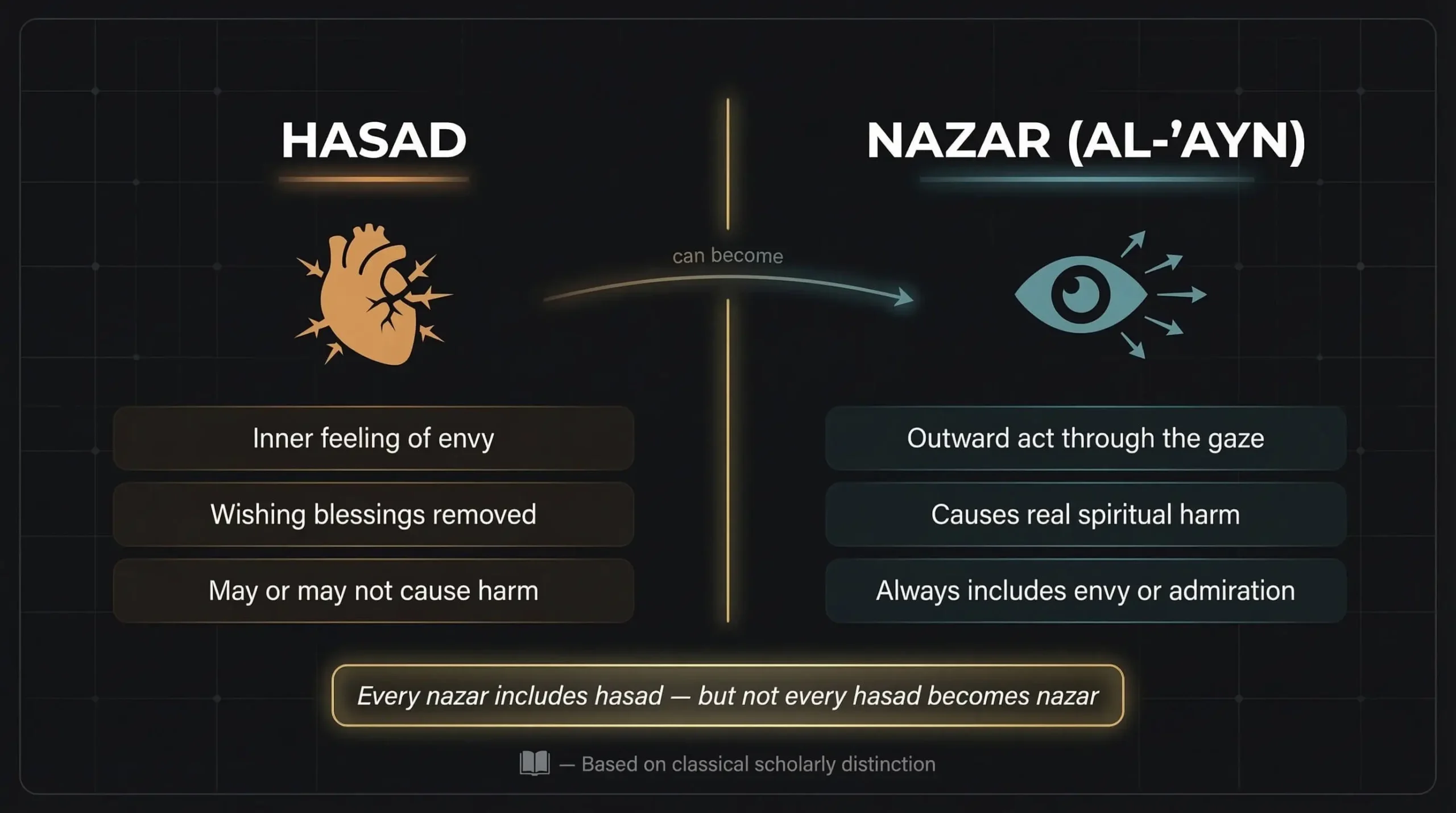
Many Muslims use nazar and hasad as if they mean the same, but scholars point out an important difference. Everyone who puts the evil eye on another is jealous, but not every jealous person puts the evil eye on another. The word “haasid” (envier) is more general than “‘aa’in” (one who puts the evil eye).
Practical terms: hasad is the inner feeling—wishing for another’s good to be taken away. Nazar is the outward act—when that envious or admiring soul actually harms through the look. A person can feel envy without ever doing al‑‘ayn. But every al‑‘ayn includes some form of hasad or intense admiration at its root.
This distinction is significant to protection. Surah Al‑Falaq covers general hasad, while specific Hadith focus on the mechanics of al‑‘ayn, protecting both with a complete shield.
The Quranic Evidence for Nazar
4 Verses Most Articles Only Half-Explain
The Quran says more than just hints about the evil eye; it tells believers to protect themselves from it, shows a Prophet warning against it, and says that non‑believers tried to hurt the Prophet using it. These four verses, when read with their full explanations, show that nazar is real in the Quran, more strongly than most articles claim.
Surah Al-Falaq (113:5) — Allah Commands Us to Seek Refuge From the Envier
وَمِن شَرِّ حَاسِدٍ إِذَا حَسَدَ
Wa min sharri ḥāsidin idhā ḥasad
“And from the evil of an envier when he envies.” (Quran, Surah Al-Falaq, 113:5 — Sahih International)
This verse links envy with the evil eye. Allah instructs believers to take refuge against the evil of the envy. According to the scholars, the evil of the envier incorporates the spiritual harm of al-ayn.
According to classical Islamic scholars, such spiritual disfigurement is condemned and precautionary measures are sought in the verse, as stated by Ibn Kathir, and Al-Qurtubi. It is even considered very solemn by the fact that Allah had put it in one of the two protection surahs. It is not merely an idea of culture but a commandment of God.
Surah Al‑Qalam (68:51) — The Verse That Proves Nazar Targets Even Prophets
وَإِن يَكَادُ ٱلَّذِينَ كَفَرُواْ لَيُزْلِقُونَكَ بِأَبْصَٰرِهِمْ
Wa in yakādu alladhīna kafaroo layuzliqūnaka bi-abṣārihim
“And indeed, those who disbelieve would almost make you slip with their eyes.” (Quran, Surah Al-Qalam, 68:51)
This is one of the most direct Quranic references to nazar. The key phrase is “make you slip with their eyes” — this is the exact proof-text for nazar in the Quran. Ibn Abbas, Mujahid, and others from the early scholars (Salaf) said this means: “They would affect you by looking at you with their eyes (i.e., the evil eye)” out of jealousy and hatred. Ibn Kathir stated in his Tafsir that this verse is a proof that the effect of the evil eye and its affliction by the command of Allah is real (Tafsir Ibn Kathir, 4/410).
If even the Prophet ﴿ — the greatest of all creation — could be targeted by jealous looks, then no one is exempt. Ibn Kathir confirmed that the evil eye is a reality that occurs under the command of Allah. This verse firmly places nazar within divine will, not superstition.
Surah Yusuf (12:67) — Prophet Ya‘qub’s Practical Precaution Against Nazar
وَقَالَ يَا بَنِيَّ لَا تَدْخُلُوا مِنْ بَابٍ وَاحِدٍ
Wa qāla yā baniyya lā tadkhulū min bābin wāḥid
“O my sons, do not enter from one gate but enter from different gates.” (Quran, Surah Yusuf, 12:67)
Why did Prophet Ya‘qub (عليه السلام) instruct his sons to enter Egypt through different gates? Ibn Abbas, Muhammad bin Ka‘b, Mujahid, Ad-Dahhak, Qatadah, As-Suddi and several others said that he feared the evil eye for them, because they were handsome and looked beautiful and graceful (Tafsir Ibn Kathir).
The Ma‘arif ul-Quran supplements that they were young, healthy, tall, and beautiful. He worried others might see they were brothers and try to harm them with the evil eye.
This verse is a lesson of a practical nature that most articles overlook. Prophet Ya‘qub did not pray in vain: he both believed in Allah and took a real precaution. This principle guides how Muslims should protect themselves from nazar today.
Ayatul Kursi (2:255) — The Supreme Shield
اللَّهُ لَا إِلَٰهَ إِلَّا هُوَ ٱلْحَيُّ ٱلْقَيُّومُ
Allāhu lā ilāha illā huwa al-Ḥayyu al-Qayyūm
“Allah — there is no deity except Him, the Ever-Living, the Sustainer of [all] existence.” (Quran, 2:255)
Scholars from all four schools recommend reciting Ayatul Kursi every day to guard against spiritual harms, including nazar. It is referred to as the best verse of the Quran which has been confirmed by the genuine Hadith. It puts you under a divine shield by reciting it at the end of every prayer, before going to sleep.
8 Authentic Hadith About Nazar
With Full References and Grading
No discussion of the evil eye in Islam is complete without looking at the Prophet’s narrations that confirm it, explain its effects, and give its cure. Below are eight authenticated Hadith, each with its source, reference number, and scholarly grading—detail most resources on nazar lack.
1. The Primary Proof — Nazar Could Overtake Destiny
“The evil eye is real and if anything were to overtake the divine decree, it would be the evil eye. When you are asked to take a bath (to provide a cure) from the influence of the evil eye, you should take a bath.”
Narrated by Ibn Abbas — Sahih Muslim, Hadith No. 2188 — Classified: Sahih
This hadith establishes that the evil eye is real and — hypothetically — could even rival divine decree in its effect. It also prescribes a physical remedy: the ghusl (ritual wash) from the person who cast the eye.
2. The Definitive Statement
“The influence of the evil eye is true.”
Narrated by Abu Huraira — Sahih al‑Bukhari, Hadith No. 5740 — Classified: Sahih
It is direct and concise and leaves no question. Imam al‑Bukhari placed it in a chapter dedicated to the evil eye.
3. The Prophet’s Du‘a for His Grandsons — Hasan and Husayn
“I seek refuge for you in the perfect words of Allah from every devil and every poisonous creature and every evil eye.”
Sahih al‑Bukhari, Hadith No. 3371 — Classified: Sahih
The Prophet ﴿ used to recite this over Hasan and Husayn. This narration is the foundation for the Prophetic du‘a parents recite over children — a practice that extends from the Sunnah of Prophet Ibrahim (عليه السلام), who sought similar refuge for Ishaq and Ismail.
4. Ruqyah Specified for the Evil Eye
“There is no Ruqyah except to cure the evil eye and the sting.”
Narrated by Buraydah bin Al‑Husayb — Sunan Ibn Majah; also in Sahih Muslim and Sahih al‑Bukhari — Classified: Sahih
This hadith singles out nazar as one of only two conditions for which Ruqyah (spiritual healing through Quranic recitation) was specifically prescribed.
5. The Prophet Diagnoses Nazar Directly
Narrated Um Salamah: the Prophet ﴿ saw in her house a girl whose face had a black spot. He said, “She is under the effect of an evil eye; so treat her with a Ruqya.”
Sahih al‑Bukhari, Hadith No. 5739 — Classified: Sahih
The Prophet ﴿ did not attribute the mark to sickness or injury — he identified al-‘ayn as the cause and prescribed Ruqyah as the remedy.
6. The Sahl ibn Hunayf Incident — “Why Does One of You Kill His Brother?”
“What is your reason, one of you killing his brother? Why did you not say, ‘May Allah bless you?’ (tabarakallah) The evil eye is true.”
Muwatta Imam Malik, Book of the Evil Eye — Classified: Sahih
Sahl ibn Hunayf was bathing when Amir ibn Rabi‘ah looked at him with admiration and said, “I have never seen such skin.” Sahl immediately collapsed. Amir was rebuked by the Prophet ﴿ and given a certain remedy of ghusl (washing). This incident is the primary evidence for saying “MashaAllah” and “TabarakAllah” when admiring something.
7. The Severity of Nazar’s Impact
“Most of those who die among my ummah die because of the will and decree of Allah, and then because of the evil eye.”
Narrated by Jabir — Al‑Bazzar — Classified: Hasan (by Sheikh al‑Albani)
Note the grading: this hadith is Hasan (good), not Sahih (rigorously authenticated). Other sources refer to it conflatedly – a transparency problem that this guide addresses.
8. Asma bint Umais Seeks Permission for Ruqyah
Asma bint Umais said: “Messenger of God, Ja‘far’s children are readily susceptible to the influence of the evil eye, so may I use a spell for them?” He replied: “Yes, for if anything could get ahead of the decree, the evil eye could.”
Narrated by Asma bint Umais — Sunan al‑Tirmidhi, Hadith No. 2059; also in Musnad Ahmad and Sunan Ibn Majah — Classified: Hasan
The Prophet ﴿ not only permitted Ruqyah for children — he reaffirmed the evil eye’s power while doing so.
A ninth narration is worth mention, on the protection section:
Abu Sa‘id Al‑Khudri reported: “The Messenger of Allah ﴿ used to seek refuge from the evil eye of the Jinns and the evil eye of humans. Then when the Mu‘awwidhatan were revealed, he used them and abandoned everything else.”
Sunan Ibn Majah; also in Sunan al‑Tirmidhi and Sunan al‑Nasa’i — Classified: Hasan
This reveals something surprising: nazar can come from Jinn as well as humans — a point the Quran and Sunnah address together.
Believing in Nazar vs. Wearing Nazar Beads
Why One Is Aqeedah and the Other Could Be Shirk
This is the most critical distinction in this entire guide. The line between correct belief and potential shirk runs directly through the middle of how many Muslims respond to the evil eye — and most resources either ignore it or blur it beyond recognition.
What All Four Madhabs Agree On — Nazar Is Real, Amulets Are Not the Solution
Islamic scholars generally discourage the use of amulets or charms, including the evil eye amulet. They argue that such practices may lead to shirk — associating partners with Allah. The ruling spans all four schools of fiqh (jurisprudence): Hanafi, Maliki, Shafi‘i, and Hanbali scholars hold that non‑Quranic amulets (tameemah) are impermissible.
The evidence is explicit. The Prophet ﴿ said: “Whoever wears an amulet, he has indeed committed an act of Shirk” (Musnad Ahmad, classified as Hasan). And the companion Ibn Masoud narrated: “Indeed Tamaim (amulets), unauthorized Ruqyah, and love‑sorcery are from Shirk.” Tamaim were beads that pre‑Islamic Arabs hung on their children to protect them from the evil eye — a practice strikingly similar to the nazar boncugu worn today.
It is the major scholars who see it as impermissible to wear a blue bead. It is categorized in the same way as putting on amulets. It may even constitute a major or a minor form of shirk, depending on the belief of the person wearing it.
Cultural vs. Islamic Practice: Key Differences
| Issue | Cultural/Folk Practice | Authentic Islamic Teaching |
| Protection Tool | Blue bead, black thread, chili | Du‘a, Quran, Ruqyah |
| Who Protects? | The amulet itself | Allah alone |
| Cure Method | Salt rituals, burning chili | Ghusl remedy, Ruqyah |
| Prevention | Hiding from people | Saying MashaAllah, Adhkar |
| Source | Cultural tradition | Quran & Sunnah |
Madhab Positions on Non-Quranic Amulets (Tameemah)
| Madhab | Position on Non-Quranic Amulets | Primary Evidence | Classical Authority |
| Hanafi | Impermissible; wearing amulets for protection is forbidden | Hadith: “Whoever wears an amulet has committed shirk” (Musnad Ahmad) | Imam al-Kasani (Bada’i al-Sana’i) |
| Maliki | Impermissible; even if containing Quranic text, the majority view prohibits wearing them as amulets | General prohibition of tameemah in Hadith | Imam al-Qurtubi |
| Shafi‘i | Impermissible if non-Quranic; some scholars permitted Quranic amulets with conditions | Hadith of Ibn Masoud on tameemah being shirk | Imam al-Nawawi (Al-Adhkar) |
| Hanbali | Strictly impermissible in all forms, including Quranic amulets (stronger position) | Same Hadith evidence + sadd al-dhara’i (blocking the means to shirk) | Ibn Taymiyyah, Ibn al-Qayyim |
Note: The scholarly difference (ikhtilaf) exists only regarding amulets that contain Quranic verses. On non-Quranic amulets like the blue evil eye bead, there is near-consensus (ijma‘) that they are impermissible. Wallahu a‘lam.
The Turkey Diyanet Ruling (2021) — When a Government Body Declared Nazar Beads Impermissible
Turkey’s top religious authority, the Diyanet, stirred controversy in 2021 by ruling that use of the widespread evil eye symbol is prohibited in Islam. “Islam does not tolerate the disposition of explaining the ultimate impact as belonging to any one but Allah. It is not permissible to seek help from the evil eye bead,” the ruling stated. The Diyanet noted that belief in the concept of the evil eye was permitted in Islam — but wearing the nazar boncugu was not.
The difference between believing in nazar (the evil eye) as a protection and wearing nazar beads is the most important modern rule about evil eye amulets. It continues to be discussed within the Muslim circles around the world.
Major vs. Minor Shirk — Understanding the Scholarly Distinction
Sheikh Ibn Uthaymeen said clearly: “If you wear something and think it can protect you or give you benefits, that is shirk, because it means you are putting partners with Allah.”
The difference between major and minor shirk depends on what the person believes:
- If a person thinks the amulet itself can harm or protect without Allah, that is major shirk. It asserts the divine power as that of the object.
- If a person thinks the amulet is only a tool, and Allah is the one who has real power, that is minor shirk, because Allah did not say blue beads or similar items are a legitimate way to protect.
Sheikh Ibn Baz said the same: amulets are forbidden no matter the intention, and the only real protection is trusting in Allah and saying the du‘as from the Qur’an and Sunnah.
Can a Person Give Nazar to Themselves? What Scholars Say
Here is a fact many Muslims find surprising: a person can cast the evil eye on their own children, possessions, or even themselves through excessive admiration. You do not need an enemy for nazar to occur. Even pious individuals are not immune. It can be caused unintentionally by people who love you — simply by admiring excessively without remembering Allah.
Imam Ahmad ibn Hanbal noted: “Very rarely will a house be found without anyone being affected by the evil eye or jealousy.” Since the phenomenon is that widespread, these protection practices are mandatory in any Muslim family.
The SHIELD Framework
6 Islamic Steps to Protect Yourself From Nazar
Everything we have read so far points to one truth: nazar is real, but Allah has clear, practical ways to protect. The SHIELD framework groups these Sunnah practices into a simple daily system.

S — Say “MashaAllah” and “TabarakAllah” When You Admire Anything
The Sahl ibn Hunayf story (Muwatta Imam Malik) shows the duty. The Prophet ﴿ was working out what had occurred and had thought, when he saw, that he should have not said, May Allah bless you? In practice this means saying MashaAllah (“what Allah has willed”) or TabarakAllah (“blessed is Allah”) every time you admire a person’s health, beauty, children, wealth, or success – including your own.
H — Habitually Recite the Mu‘awwidhatain (Surah Al-Falaq & An-Nas) Morning and Evening
Abu Sa‘id Al-Khudri reported that the Prophet ﴿ used to seek refuge from the evil eye of Jinns and humans. When the Mu‘awwidhatain were revealed, he used them and left everything else. Reciting Surah Al-Falaq (113), Surah An-Nas (114), and Surah Al-Ikhlas (112) three times each morning and evening creates a daily spiritual defense.
I — Invoke Ayatul Kursi Daily (After Each Salah and Before Sleep)
Scholars in all four schools agree that Ayatul Kursi (Quran, Surah Al-Baqarah, 2:255) is the greatest verse and one of the most powerful ways to protect. A repetition at the end of every of the five daily prayers and before going to bed puts you in the protection of God.
E — Exercise Discretion on Social Media — Minimize Public Display of Blessings
Social media makes Muslims more vulnerable to the evil eye. It is now recommended by many scholars that one should be careful in posting pictures of their owners, children and their possessions. The reason comes from Sunnah: Prophet Ya‘qub told his sons to enter through separate gates so they wouldn’t attract jealous attention. The contemporary version is being prudent about what your blessings are displayed to hundreds or thousands of people. This is a 2026‑relevant issue that Dr. Yasir Qadhi and other modern teachers have talked about in English‑language lectures on nazar.
L — Lean on Tawakkul — The Best Protection is Trust in Allah
It is okay to take precautions against the evil eye before it happens, and this does not contradict tawakkul (trust in Allah). In fact, taking these measures is part of tawakkul, because it means putting trust in Allah while also using the ways that are allowed or recommended. This balance is taught by Prophet Ya‘qub – he told his sons to enter separately, then said: “I cannot give you protection against Allah at all.”
D — Du‘a of the Prophet ﴿ for Children and Family
The du‘a the Prophet ﴿ said over Hasan and Husayn (Sahih al-Bukhari, Hadith No. 3371) is a main way to protect family:
أُعِيذُكُمَا بِكَلِمَاتِ اللَّهِ التَّامَّةِ مِنْ كُلِّ شَيْطَانٍ وَهَامَّةٍ وَمِنْ كُلِّ عَيْنٍ لَامَّةٍ
A‘ūdhu bi kalimātillahi al-tāmmati min kulli shayṭānin wa hāmmah, wa min kulli ‘aynin lāmmah
“I seek refuge for you in the perfect words of Allah from every devil and every poisonous creature and every evil eye.”
One of the questions that parents have to ask themselves is: must they say this over their children every day? The scholars suggest that it should be an everyday practice — the Prophet ﴿ used to practice it daily and not just at the time he felt threatened.
What to Do If You’ve Already Been Affected
The Sunnah Cure
Prevention is the priority, but the Sunnah also gives specific ways to help if you think you already have the effects of the evil eye. It is worth reminding that the valuable thing is to distinguish between actual Islamic treatments and folk tricks that do not belong to the religion.
Ruqyah — The Only Legitimate Islamic “Treatment” for Nazar
Ruqyah is healing that uses Qur’anic verses and the Prophet’s supplications. It is the main cure mentioned in the Sunnah. The angel Jibril (peace be upon him) also used Ruqyah on the Prophet ﴿. He said:
بِسْمِ اللَّهِ أَرْقِيكَ مِنْ كُلِّ شَىْءٍ يُؤْذِيكَ
Bismillahi arqeek, min kulli shay’in yu’dheek, min sharri kulli nafsin aw ‘aynin hāsidin, Allāhu yashfeek
“In the name of Allah I perform Ruqyah on you, from everything that harms you, from the evil of every soul or envious eye. May Allah heal you.”
The Prophet ﴿ told people that Ruqyah is only for curing the evil eye and the sting it can cause. You can do Ruqyah for yourself by repeating the Mu‘awwidhatain (the last two chapters of the Qur’an), Surah Al-Fatiha, and Ayatul Kursi, and blowing softly over your body.
The Ghusl Remedy — When the Person Who Gave Nazar Is Known
The story of Sahl ibn Hunayf shows a physical cure. After Amir ibn Rabi‘ah admired Sahl, his eye gave Sahl the evil eye. The Prophet ﴿ told Amir to wash, and pour the water over Sahl. Sahl felt better right away.
So the way to follow this Sunnah is: ask the person who gave the evil eye to wash his hands, just as Amir did. And pour onto the affected person that clean water.
Scholars say that taking the waste (urine or stool) of the person who gave the evil eye is not part of this cure. The concept exists only in part of folk stories and not in actual Hadith.
Folk Remedies Islam Rejects — Salt, Chili, Black Thread, and Other Innovations
Many of the Muslims still practice burning salt, waving chilies, tying black thread and such other folk tricks. According to scholars, these are mere superstitions that can undermine the belief in only Allah. None of them come from the Qur’an, Sunnah, or the companions.
The cure for the evil eye is spiritual, not a ritual. It is also by the same source that leads to the problem and that is the will and command of Allah.
Common Signs of Being Affected by Nazar
What Scholars Actually Say (Not Folk Tales)
Many websites list symptoms of the evil eye without attributing them to any scholarly authority. The following signs have been documented by Shaykh Abd al-Azeez al-Sadhan, who compiled them based on observed cases of people who were treated and cured from the effects of al-‘ayn:
- Moving headaches in different locations of the head
- Yellow pallor in the face
- Sweat is too much and urine is frequently voided
- Weak appetite
- Weakness, heat, or cold of the limbs
- Palpitations in the heart
- Lower back pain and shoulder pains
- Unexplained sadness and anxiety
- Sleeplessness at night
- Health issues that are not explained by any medical factors
Be careful, Islam speaks of being balanced. Do not think every issue is from the evil eye. Seek spiritual assistance and actual medical. A headache is more likely from dehydration than the evil eye. If you have unexplained, long‑lasting symptoms that don’t fit a medical diagnosis, and several of the signs above appear, that may suggest the evil eye.
Ibn al‑Qayyim, in the book Zaad al‑Ma‘aad, said the evil eye is like an arrow that comes from a jealous person towards the person being envied. Occasionally it makes contact, occasionally it does not. The arrow can be harmful, unless the individual has some protection. Should he defend himself, it will not strike. This demonstrates that prevention is better than cure as to the spiritual protection.
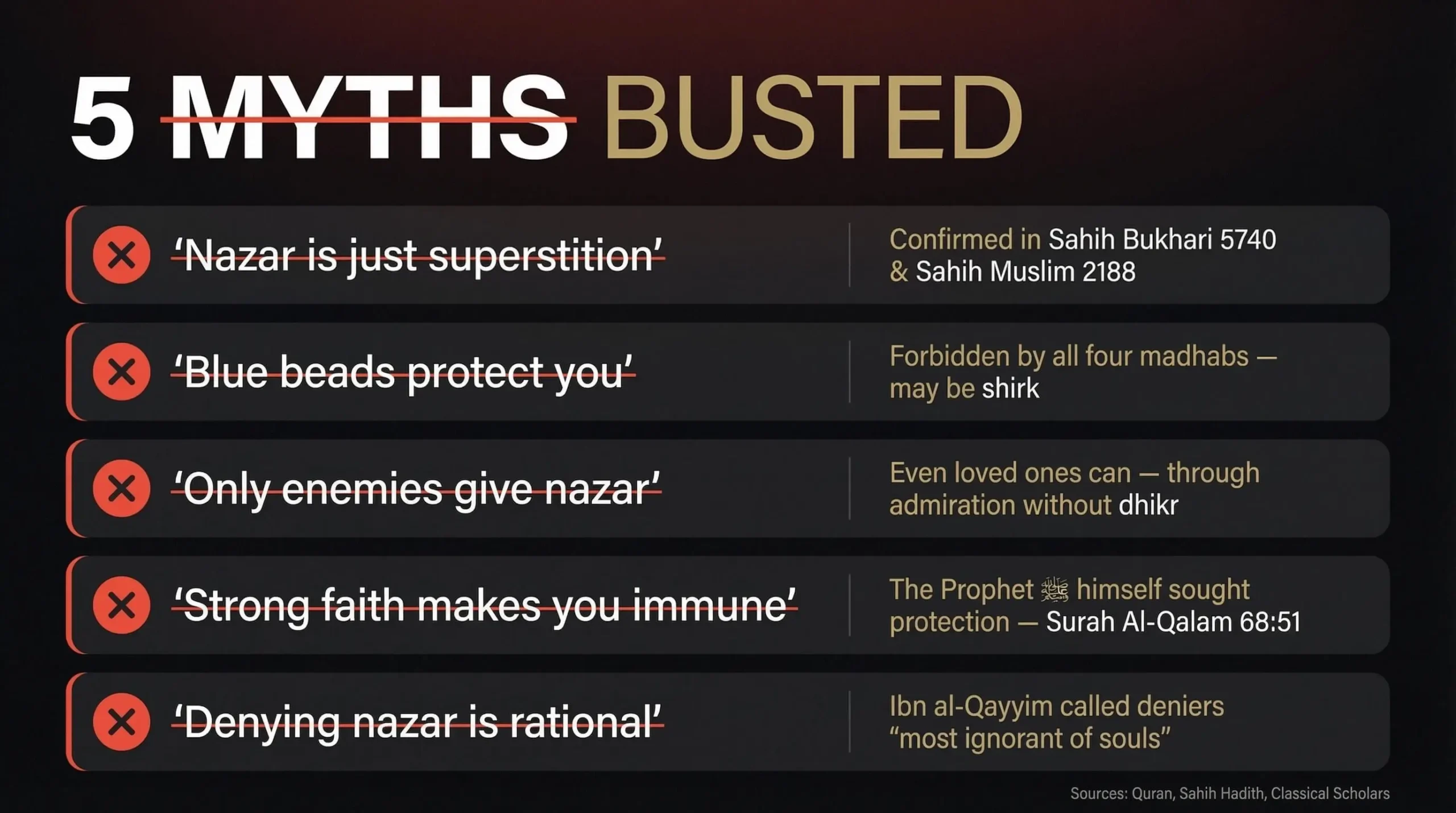
5 Dangerous Misconceptions About Nazar That Could Harm Your Aqeedah
Thinking wrongly about the evil eye does more than leave you unprotected it can damage your faith in two ways. Some erroneous beliefs undermine true faith, whereas others bring on board some traditions that are similar to idolatry.
1. “The evil eye is only superstition.”
That cannot be true, because solid Hadith say that the evil eye is real. The Prophet ﴿ stated clearly that the evil eye is true (Sahih al-Bukhari, 5740). Rejecting it means rejecting an authenticated Prophetic statement.
2. “Blue beads can protect you from the evil eye.”
The main fatwa groups, such as IslamQA, Islamweb, Dar al‑Ifta, and AMJA, say that wearing a nazar (protective amulet) is not allowed. It may turn out to be a form of idolatry when somebody feels that it is effective.
3. “Only enemies can give you the evil eye.”
That is wrong. The Sunnah shows that even friends or one’s own children can give the evil eye from admiration. Amir ibn Rabi‘ah gave the evil eye to Sahl ibn Hunayf because he admired him, not because he was angry.
4. “The evil eye only affects Muslims with weak faith.”
That is wrong. The Prophet ﴿ also sought protection from the evil eye for himself and his grandsons. According to Surah Al-Qalam, people who do not believe attempt to injure him through their eyes. Good faith will not save you, but will assist you in seeking assistance.
5. “Denying the evil eye will make you more rational.”
Ibn al‑Qayyim said: “People with little knowledge deny the evil eye and claim it is made up. These individuals are the most ignorant, as they have no idea concerning spirits, souls, character, behaviour, and consequences.” In Islamic thinking, the correct view is to follow what the Quran and authentic Sunnah teach.
These misconceptions show why a proper understanding of nazar must be based on belief (Aqeedah). This leads to the deeper question of how nazar relates to Allah’s decree.
Nazar and Divine Decree: How They Fit Together
Assuming that all happens by the will of Allah, what harm can a human stare do? This is the question that arises repeatedly among Muslim scholars of belief. Islamic theology has a definite response to it.
Nazar works by Allah’s will. It is the jealous eye that can get a problem going but Allah is the true source of the hurt and the defence. The evil eye does not act by itself; it is one way Allah’s will shows itself. The Prophet ﴿ said: “If anything could overtake Allah’s decree, it would be the evil eye,” using “if” to show that nothing really can overtake it.
Calling the belief in the evil eye shirk is wrong. The world is a cause place where Allah has developed means of outcomes. Fire burns, medicine heals and an envious gaze wounds—all by the leave of Allah. Recognizing these causes is not shirk; it is seeing the order Allah made.
Shirk happens only when someone thinks a cause has its own power—like believing a bead or amulet can protect without Allah. That’s why belief in nazar is part of faith, but using amulets for protection can be shirk. The reason is not imaginary though it is only Allah who can decide.
Ibn Taymiyyah said the same in his talks on monotheism: trusting in what Allah has set (prayers, Quran, remembrances) shows trust in Allah. It is a mistake to put faith in such things as amulets or folk rituals.
FAQ: Answers to Your Nazar Questions from the Quran & Sunnah
Is nazar (evil eye) real in Islam?
Yes. The Prophet confirmed it in Sahih Muslim and Sahih al‑Bukhari. Several verses of the Quran also mention the evil eye. Most scholars say believing in nazar is part of Islamic creed, based on scholarly agreement.
What is the difference between nazar and hasad?
Hasad means general envy or wanting someone’s good to be taken away. Nazar is a specific form of this, where a jealous or admiring glance actually causes harm. Every case of nazar involves envy or strong admiration, but not every envy causes nazar.
Is wearing evil eye jewelry haram?
Scholars say wearing evil eye charms is forbidden. In 2021, the Diyanet of Turkey stated that one should not use such charms. Some scholars call any protection charm shirk. The degree of severity is based on what the wearer believes.
Can you give yourself nazar?
Yes. A person can cast the evil eye on themselves, their children, or their belongings by overly admiring their own blessings without mentioning Allah. Saying “MashaAllah” (God has willed it) is the recommended way to prevent it.
What Quran surah protects from nazar?
Surah Al-Falaq, Surah An-Nas and Surah Al-Ikhlas are considered the key verses of protection. Surah Al-Baqara (Ayatul Kursi) 2:255 is also valuable in protection on a daily basis.
What dua did the Prophet ﴿ say for evil eye?
The Prophet said for his grandsons: “I seek refuge for you in the perfect words of Allah from every devil, every poisonous creature, and every evil eye” (Sahih al‑Bukhari).
Is the blue evil eye bead (nazar boncugu) haram?
Yes. In 2021, Diyanet in Turkey declared that they were not permitted to wear the bead. Many scholars, like Sheikh Ibn Baz and Sheikh Ibn Uthaymeen, agree.
Can nazar cause death?
A hadith says many people die because of Allah’s will, and some also die because of the evil eye. This shows nazar can contribute to serious harm, but everything ends with Allah’s will.
How do you cure nazar in Islam?
The Sunnah says two main ways: Ruqyah—reciting the Quran, especially the protection verses and Surah Al‑Fatiha and Ayatul Kursi; and the ghusl remedy—where the person who cast nazar washes their hands and the water is poured over the person harmed. Islam does not support folk remedies like burning salt or chili.
Is saying MashaAllah enough protection from nazar?
Saying “MashaAllah” is a good Sunnah, especially after the incident with Sahl ibn Hunayf. It should be joined with regular remembrances of Allah, recitation of the protection verses, and other parts of the SHIELD framework for full protection.
Nazar Is Real, But Allah’s Protection Is Greater
The evidence from the Qur’an and the Prophet’s teachings shows that nazar — the evil eye, al‑‘ayn — is a real spiritual thing. It is established through definite sayings of the Prophet and is referred to in a number of verses in Quran. Faith in it is part of our perception of Islam. The best way to protect ourselves is to follow what Allah says: say du‘a, use ruqyah, recite the two Mu‘awwidhatain, read Ayatul Kursi, and say “MashaAllah” when something good happens. These are an action of faith in Allah. Wearing charms, blue beads, or other folk talismans is not allowed by scholars of all major schools and could be a form of shirk.
The SHIELD system helps you remember the real protections: Say “MashaAllah,” recite the Mu‘awwidhatain regularly, recite Ayatul Kursi, use social media carefully, rely on Tawakkul (trust in Allah), and repeat the Prophet’s du‘a. This system is based only on the Qur’an and Sunnah.
Use these six steps every day. Teach them to your family. In case you are not sure of a certain situation, you can seek the advice of a competent scholar on your case.
Wallahu a‘lam — Allah knows best.
Sources & References
This guide uses Sahih al‑Bukhari, Sahih Muslim, Muwatta Imam Malik, Musnad Ahmad, Sunan al‑Tirmidhi, Sunan Ibn Majah, Tafsir Ibn Kathir, Tafsir al‑Qurtubi, Ma‘arif al‑Qur’an, and the rulings of modern scholars and fatwa bodies. Last Updated: 2026.