You Lost Count at 22. Again.
You have just finished Salah. Thirty-three SubhanAllahs. Thirty-three Alhamdulillahs. Thirty-four Allahu Akbars. You were at 22 — then a car horn outside, a thought about dinner, a child calling — and you have no idea where you are. Do you start over? Continue at 25? Give up?
This is the lived experience of millions of Muslims every day. It is the honest reason most people search “digital tasbih counter” or “electronic tasbeeh ruling.” And it deserves a direct, scholarly, and practical answer — not pages of academic hedging before the point.
QUICK ANSWER — Is a Digital Tasbih Counter Permissible?YES — scholars across all four major Sunni madhabs permit the use of counting aids for dhikr. The Hanafi school rules it mubah (permitted), the Maliki school’s leading institution considers it mustahabb (recommended) in some opinions, the Shafi’i school holds it permissible by Companion precedent, and the Hanbali school ranges from makruh (disliked) to conditionally permitted. No madhab classifies it as haram or as blameworthy bidah. |
This guide covers everything: what all four madhabs rule, the authenticated hadith evidence, five scholarly conditions for valid use, seven genuine benefits, an honest comparison with finger-counting, and a 15-question FAQ on real community questions. Read it once; bookmark it.
Is a Digital Tasbih Counter Permissible? 4-Madhab Ruling Summary
Before any lengthy discussion: here is the complete madhab overview at a glance.
| Madhab | Ruling | Key Authority | Status on Digital Tools |
| Hanafi | Mubah (Permitted) | Imam Ibn Abidin (Radd al-Muhtar) | Permitted — same ruling as subha/beads |
| Maliki | Mustahabb (Recommended) in some opinions | Dar al-Ifta Egypt (Fatwa 7783) | Permitted — aids khushoo and accuracy |
| Shafi’i | Permissible | Imam al-Nawawi (Sharh Muslim) | Permitted — supported by Companion precedent |
| Hanbali | Makruh → Conditionally Permitted (spectrum) | Ibn Taymiyyah / Permanent Committee (Q.128914) | Conditionally permitted (same as physical subha) |
The scholarly basis for extending classical rulings on the subha (prayer beads / misbaha) to digital tools is qiyas — analogical reasoning. If physical beads are permitted as a counting aid for dhikr, a digital counter serving the identical function operates under the same jurisprudential logic. Contemporary scholars and institutions have confirmed this extension explicitly — including the Permanent Committee for Scholarly Research and Ifta (IslamQA Q.128914).
Islamshub.com presents these scholarly positions faithfully. For personal rulings applicable to your specific situation, consult a qualified scholar of your own madhab.
Fingers vs Traditional Misbaha vs Digital Counter: Complete Comparison
Not all dhikr counting methods are equal — and not all are equivalent. Here is the honest, scholarly-grounded comparison:
| Feature | Fingers (Sunnah) | Traditional Misbaha | Digital Counter / App |
| Fiqh Ruling | Sunnah (highest merit) | Mubah to Mustahabb | Mubah to Mustahabb (by qiyas) |
| Spiritual Merit | Fingers testify on Day of Judgment (Tirmidhi 3583) | Permitted aid; no testimony | Permitted aid; no testimony |
| Accuracy | Can lose count; good for prescribed formulas | High — bead-by-bead | Highest — preset modes, auto-transitions |
| Portability | Always available | Needs bag; beads can break | Phone always in pocket; hardware very compact |
| Distraction Risk | Minimal | Low | Higher (phone notifications; battery needed) |
| Accessibility | Challenging for arthritis/motor conditions | Moderate challenge | Best — one-touch; voice-activated options |
| Public Use | Visible, natural | Can draw attention in non-Muslim settings | Silent; invisible in professional settings |
| Best Use Case | Post-prayer dhikr; learning for children | Home and masjid dhikr | Commuting; desk breaks; travelers; physical limitations |
| Key Takeaway Fingers hold a unique spiritual status no device can replicate (Tirmidhi 3583). Digital counters are the most accurate and accessible counting tool — but they are an aid to the Sunnah, not a replacement for it. Use each in its appropriate context. |
The Quranic Foundation: Why Muslims Count Dhikr
Three Quranic verses establish the non-negotiable basis for abundant, consistent remembrance of Allah — and each carries direct relevance to the question of counting aids.
Surah Al-Ahzab 33:41–42
| يَا أَيُّهَا الَّذِينَ آمَنُوا اذْكُرُوا اللَّهَ ذِكْرًا كَثِيرًا وَسَبِّحُوهُ بُكْرَةً وَأَصِيلًا O you who believe! Remember Allah with much remembrance, and exalt Him morning and afternoon. (Al-Ahzab 33:41–42) |
The phrase dhikran kathiran — “much remembrance” — carries a deliberate quantitative dimension. Classical exegetes understood this as encouragement toward both quality and quantity of remembrance. Striving for “much remembrance” naturally raises the question of how to ensure that abundance is maintained consistently — which is precisely where a counting aid provides its practical value. Ibn al-Qayyim al-Jawziyyah elaborates extensively on this in Al-Wabil al-Sayyib.
Surah Al-Ra’d 13:28
| أَلَا بِذِكْرِ اللَّهِ تَطْمَئِنُّ الْقُلُوبُ Verily, in the remembrance of Allah do hearts find rest. (Al-Ra’d 13:28) |
The word tuma’ninnah — “rest” — implies a settled, profound inner stillness. Consistent, structured dhikr serves this Quranic promise best. An accurate counting method directly supports this by freeing the worshipper from the anxiety of losing count — so the mind remains on the meaning, not the mechanics.
Surah Al-Baqarah 2:152
| فَاذْكُرُونِي أَذْكُرْكُمْ So remember Me; I will remember you. (Al-Baqarah 2:152) |
This verse articulates a reciprocity of profound spiritual weight: Allah’s remembrance of the believer depends on the believer’s remembrance of Him. A tool that helps a Muslim sustain that remembrance accurately and consistently serves this Quranic promise directly.
None of these verses specifies the method of counting. That question belongs to the Sunnah and to fiqh — addressed in the sections that follow.
What the Hadith Evidence Actually Says: Authenticated Map
Many websites cite a single hadith and misapply it. Below is every directly relevant authenticated hadith — with source, grade, and correct scholarly application.
| Hadith Summary | Source | Grade | Scholarly Application |
| “Count on your fingers, for they will be asked and will speak.” | Jami’ at-Tirmidhi 3583 | Sahih (Al-Albani) | Establishes unique merit of finger-counting; Hanbali basis for caution |
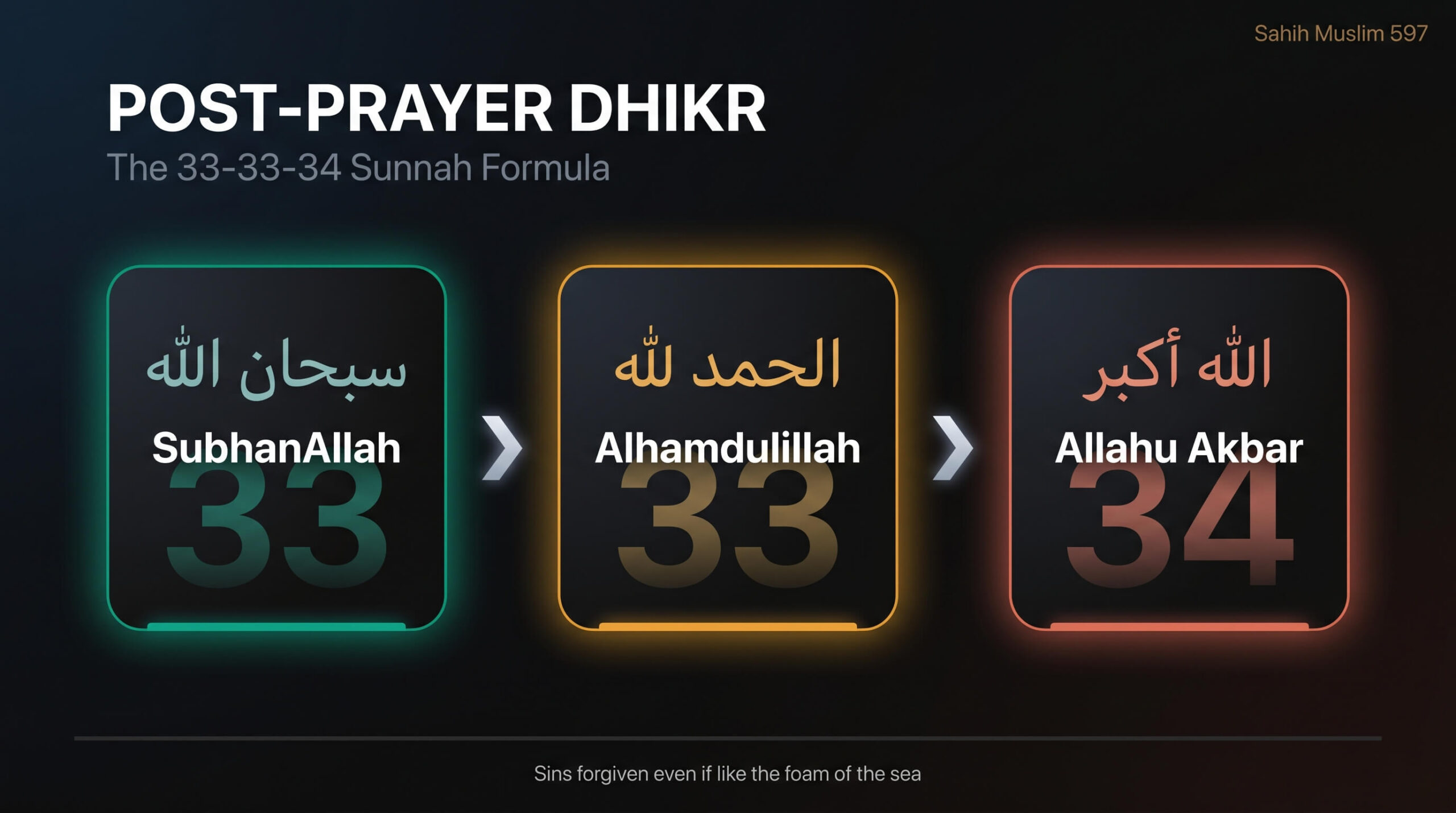
| “Whoever says SubhanAllah 33, Alhamdulillah 33, Allahu Akbar 34 after each prayer — sins forgiven even if like foam of the sea.” | Sahih Muslim 597 | Sahih | Establishes 33-33-34 formula and the Islamic need for precise counting |
| Prophet saw woman using pebbles/date seeds for tasbih and did not forbid it. | Sunan Abu Dawud / Riyad al-Salihin 1442 | Sahih-equivalent | Primary evidence that non-finger counting aids are permitted (taqrir) |
| Abdullah ibn Amr: Prophet counted tasbeeh on right hand. | Sunan al-Nasa’i 1355 / Abu Dawud 5065 | Sahih | Confirms Sunnah of finger-counting; right-hand preference |
| “The most beloved deeds to Allah are those done regularly, even if small.“ | Sahih Bukhari 6464 | Sahih | Basis for consistent dhikr tracking and habit-building in worship |
| “100 tasbeehs = 1,000 hasanat recorded or 1,000 sins erased.” | Sahih Muslim 2698 | Sahih | Precision in counting directly tied to spiritual reward |
| Critical Nuance — Tirmidhi 3583 Is Often Misapplied Many articles cite Tirmidhi 3583 (“Count on your fingers, for they will be asked and will speak”) as support for digital tools. This is incorrect. This hadith establishes the unique spiritual merit of fingers — it is the primary narration Hanbali scholars cite for caution about alternative tools. The actual evidence for permissibility of counting aids is the taqrir (prophetic approval by silence) in Sunan Abu Dawud / Riyad al-Salihin 1442, where the Prophet saw a woman using pebbles for tasbih and did not forbid it. |
4-Madhab Detailed Analysis: What Every School Actually Rules
The Hanafi Position: Mubah (Permitted)
The Hanafi school classifies using a subha or equivalent counting aid for dhikr as mubah — permissible — without reservation.
- Imam Ibn Abidin (Radd al-Muhtar): explicitly states, “There is nothing wrong with using the subha.”
- Imam Abu Yusuf and Imam Muhammad ibn al-Hasan al-Shaybani (the two foundational Hanafi jurists after Abu Hanifa): both ruled counting aids after prayer permissible.
- Mufti Ismaeel Bassa (Askimam.org, Q.81370 / TheMufti.com Q.152751): classified digital counters as mubah, likening them explicitly to the pebbles used by the Companions.
Intra-madhab condition: The counting aid must not be treated as obligatory or elevated to the status of a Sunnah in itself. It is a permitted tool, not a prescribed method.
The Maliki Position: Mustahabb (Recommended) in Some Opinions
The Maliki school offers perhaps the strongest institutional endorsement of counting aids among the four madhabs.
- Dar al-Ifta Egypt (Fatwa 7783): rules the subha mustahabb — recommended — specifically because it helps prevent counting errors and allows the worshipper to maintain khushoo (concentration) on the meaning of the dhikr rather than the mechanics of tracking.
- Imam Malik ibn Anas himself reportedly used counting beads and approved of their use as an aid to dhikr.
- Companion evidence: Abu Darda’ (RA) used date stones arranged in a bag for his morning dhikr — known to those around him, never criticized.
Dar al-Ifta Egypt’s reasoning extends directly to digital tools: if a tool serves the worship without competing with it — as a means, not an end — it operates on the same logical principle as the misbaha.
The Shafi’i Position: Permissible by Companion Precedent
Shafi’i scholars hold that counting aids are permissible, grounded in established Companion practice and Shafi’i usool.
- Imam al-Nawawi (Sharh Muslim): discusses counting methods for dhikr without ruling against aids. In the Shafi’i school, Nawawi’s engagement without issuing prohibition carries significant weight.
- Abu Darda’ (RA): used a bag of date stones for morning dhikr.
- Abu Safiya (RA) — the freed servant of the Prophet: used a palm-leaf basket of small stones, documented in Imam Ahmad’s Al-Zuhd and the Juz of Hilal al-Haffar.
Shafi’i jurisprudence weighs athar (Companion practice) heavily as evidential precedent. Multiple Companions using non-finger counting tools without prophetic prohibition establishes implicit approval — a recognized category of evidence in Shafi’i methodology.
The Hanbali Position: Legitimate Scholarly Spectrum
| Makruh ≠ Haram — A Critical Distinction Imam Ibn Taymiyyah’s position that the subha is makruh (disliked) is frequently misrepresented as haram or as blameworthy bidah. These are categorically different rulings. Makruh means “discouraged” — a Muslim who uses a counting aid while following the Hanbali school is not committing a sin. They are departing from what their school’s leading classical scholar considered the more excellent practice. These statements are not equivalent. |
Imam Ibn Taymiyyah (d. 728 AH): held that the subha is makruh — disliked — and that counting on fingers is the established Sunnah. His reasoning centres on the unique merit of Tirmidhi 3583 and the preference for adhering closely to the prophetic method.
The Permanent Committee (IslamQA Q.128914) — a contemporary Hanbali-influenced body including Shaykh Ibn Baz and Shaykh Abd al-Razzaq Afifi — states explicitly: “If the masbahah is permissible, by the same token this [electronic] program may also be permissible.” Three conditions are attached: (1) heart and tongue genuinely engaged; (2) not used for public display of piety; (3) not creating an impression of religious obligation.
Within the Hanbali school, a genuine and legitimate spectrum exists: from makruh (Ibn Taymiyyah) to conditionally permitted (the Permanent Committee). Islamshub.com presents both positions. Consult a Hanbali scholar for personal guidance.
7 Proven Benefits of Using a Digital Tasbih Counter
With permissibility established, here is what makes the digital tasbih counter genuinely valuable — grounded in Islamic sources and real Muslim experience.
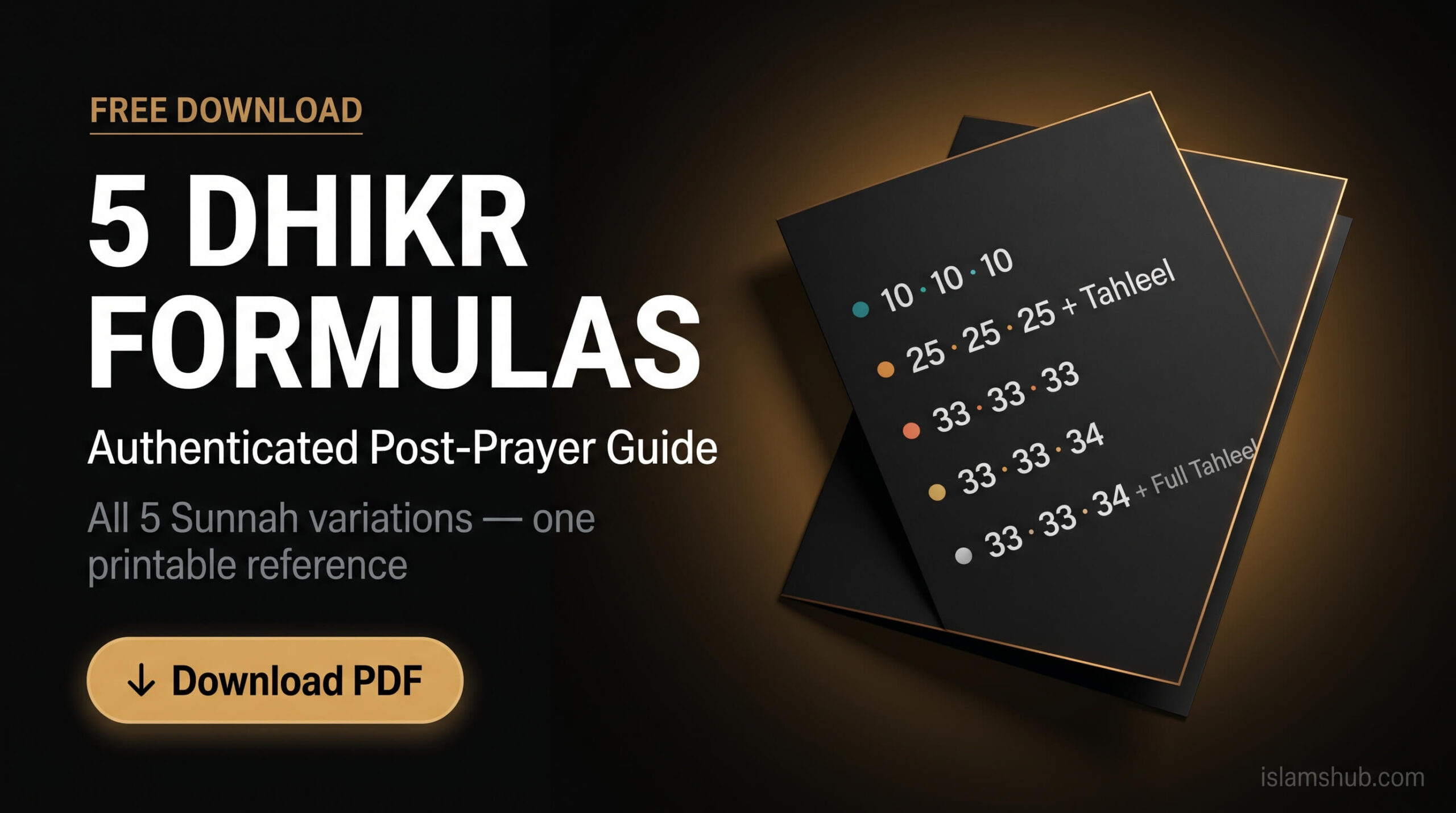
| 1 | Accuracy in Fulfilling the Prescribed Dhikr FormulaThe post-prayer dhikr of 33 SubhanAllahs, 33 Alhamdulillahs, and 34 Allahu Akbars (Sahih Muslim 597) carries enormous spiritual reward precisely tied to the specific count. Dar al-Ifta Egypt explicitly cites “preventing counting errors” as the primary scholarly rationale for the permissibility of the subha and digital tools. Five authenticated post-prayer dhikr variations exist (10-10-10; 25-25-25 with tahleel; 33-33-33; 33-33-34; 33-33-34 + La ilaha illallah). A digital counter with multiple preset modes holds each variation — eliminating confusion and supporting accuracy across all five. |
| 2 | Supporting Consistent Daily Wird (Personal Dhikr Regimen)The Prophet said in Sahih Bukhari 6464: “The most beloved deeds to Allah are those done regularly, even if they are small.” Scholars define dawam (continuity) in good deeds as a hallmark of the sincere worshipper. Progress tracking in a digital counter provides consistent feedback that supports habit formation in worship — not as a secular import but as a practically grounded expression of the Sunnah emphasis on regularity. Scholarly caution applies: tracking supports consistency; it must not produce kibr (pride) or unwarranted guilt. |
| 3 | Accessibility for Muslims with Physical LimitationsThe fiqh principle of raf al-haraj (removal of hardship) is established in: “Allah intends for you ease and does not intend for you hardship” (Al-Baqarah 2:185) and “He has not placed upon you in the religion any difficulty” (Al-Hajj 22:78). For Muslims with arthritis, motor impairments, tremors, or Parkinson’s disease, manipulating ninety-nine prayer beads may be genuinely and significantly difficult. A one-touch hardware counter or voice-activated dhikr app directly serves this Islamic principle — making the digital tool, in these cases, not merely a convenience but an Islamically grounded accommodation. |
| 4 | Silent Dhikr in Professional and Public SpacesA Muslim on public transport, in an office, or in a hospital waiting room can maintain their wird silently — pressing a small button draws no attention. This removes a real social barrier for Muslims who wish to sustain their daily adhkar outside the home. Silent dhikr (dhikr khafi) is well established as valid, and in some classical scholarly opinions carries particular merit for its sincerity — performed for Allah alone without any visible display. |
| 5 | Auto-Transitions Between the 33-33-34 Sunnah FormulaUnlike manual counting — where transitioning from tasbih (SubhanAllah x33) to tahmeed (Alhamdulillah x33) requires both memory and mental tracking — digital counters with a “Sunnah Mode” automatically signal when to shift between the three phrases. This eliminates the cognitive load of tracking both count and transition point simultaneously, freeing the worshipper’s mental attention for the meaning of the words. This directly serves khushoo — the foundational argument of Dar al-Ifta Egypt: the counting tool serves the worship rather than competing with it. |
| 6 | Practical Value for Travelers and Muslims in MotionThe Islamic obligation of post-prayer dhikr does not diminish when traveling. A rechargeable hardware counter or phone-based dhikr app requires no dedicated bag, no risk of losing beads in transit, and no explaining to non-Muslim companions. It directly serves the continuity of the worshipper’s ibadah across all life contexts — reflecting the Islamic principle that obligations of worship travel with the Muslim, and tools that support that worship should be practically accessible wherever the Muslim finds themselves. |
| 7 | Building and Maintaining a Daily Dhikr Habit with Islamic IntentionSahih Bukhari 6464 establishes that consistent, regular deeds are among the most beloved to Allah. Sahih Muslim 2698 establishes that 100 tasbeehs earn 1,000 hasanat or erase 1,000 sins — making consistency in dhikr a matter of profound spiritual consequence. A digital counter that tracks daily dhikr totals, when used with correct niyyah and kept within voluntary status, is a practical tool for the Muslim who seeks to increase remembrance of Allah progressively and sustainably. The goal is a practice to sustain — not an achievement to display. |
5 Scholarly Conditions for Valid Use of a Digital Tasbih Counter
Every scholar and institution that permits digital tasbih counters attaches conditions. These are not restrictions to work around — they are the substance of what makes dhikr spiritually transformative.
| 1 | Presence of Heart and Tongue (Hudur al-Qalb)If the tongue is not moving and the heart is not engaged with the meaning, pressing a button produces no spiritual reward — only a number on a screen. Imam al-Nawawi (Sharh Muslim) and classical Hanafi scholars both emphasize that dhikr performed in ghaflah (heedlessness) is the body of dhikr without its soul. The digital counter counts accurately; it cannot supply the attention, intention, and presence the worshipper must bring themselves. |
| 2 | Correct Intention (Niyyah) for Allah AloneThe niyyah for using the counter must be purely to assist in fulfilling dhikr for the sake of Allah — not to appear pious, not to compete with others, not to display progress. According to Imam Ibn Abidin (Radd al-Muhtar) and the IslamQA Permanent Committee, the tool is morally neutral; the intention of the person determines its spiritual quality. A digital counter used with sincere niyyah is an aid to worship. The same tool used to project religious achievement becomes a pathway to riya — which scholars warn can nullify the reward of the dhikr entirely. |
| 3 | No Showing Off — Avoiding RiyaThe concern about riya is especially acute in the age of streak trackers, public dashboards, and shared dhikr progress features found in some apps. The IslamQA Permanent Committee explicitly conditions permissibility on the tool not being used as a public display of piety. Scholars distinguish sharply between private tracking for self-motivation (permitted, supports dawam) and public display for social recognition (risks converting worship into performance). This is the scholarly answer to: “Is using a streak tracker for dhikr showing off?” — it depends entirely on intention and audience. |
| 4 | The Counter Is an Aid — Not a Replacement for the SunnahThe Sunnah method of counting on the fingers retains its unique spiritual merit that no device replicates. The narration in Tirmidhi 3583 establishes that the fingers will be asked and will speak on the Day of Judgment — a dignity belonging to the fingers alone. The digital counter should be understood as an aid when finger-counting is genuinely impractical: while commuting, at a work desk, or for those with physical conditions. The fiqh principle of raf al-haraj (Al-Baqarah 2:185, Al-Hajj 22:78) provides Islamic grounding for accommodating accessible tools. It is not a permanent replacement for the prophetic method. |
| 5 | Goals Must Not Feel Religiously ObligatoryThe TheMufti.com fatwa (Q.152751) and Askimam fatwa (Q.81370) both explicitly condition permissibility on the tool not being treated as compulsory or as a Sunnah practice in itself. The post-prayer formulas of 33-33-34 carry the status of established Sunnah; voluntary goals beyond these are voluntary and must be treated with corresponding flexibility. If a self-set daily dhikr goal begins to generate guilt equivalent to missing an established Sunnah when missed, that goal has been assigned a religious weight it does not possess. Scholars advise consistent, modest goals pursued with sincerity. |
When Fingers Remain Superior: An Honest Assessment
This guide would be incomplete without acknowledging what Islamic scholarship is unambiguous about: counting dhikr on the fingers holds a unique spiritual status no tool can replicate.
The Unique Merit of Finger-Counting
Jami’ at-Tirmidhi 3583: “Count on your fingers, for they will be asked and will speak.” This establishes that the fingers themselves are witnesses. On the Day of Judgment, the worshipper’s own fingers will testify to the dhikr counted upon them. Ibn Hajar al-Asqalani (Fath al-Bari) comments on the significance of this narration — the bodies of human beings will bear witness to their actions in the next life. This spiritual dimension is unique to finger-counting and cannot be replicated by pressing a button, however accurate the count.
Four Practical Scenarios Where Fingers Are the Better Choice
- Children learning dhikr — The physical, tactile Sunnah of finger-counting should be taught first. The prophetic method is the correct foundation; digital tools may serve as aids later, not replacements from the start.
- No battery, no distraction — A phone used as a dhikr counter requires a charged battery, and carries the ever-present risk of notifications that break concentration. Fingers carry no such risk, ever.
- Tactile mindfulness — The physical sensation of folding finger segments, counting through the joints (Sunan al-Nasa’i 1355), creates an embodied, mindful connection to each word of dhikr that a button-press cannot fully replicate.
- The complete prophetic method — The right hand, the specific finger methodology, the embodied Sunnah — this is the complete prophetic practice as documented in the narrations of Abdullah ibn Amr, and it retains its primacy as the highest choice.
| The Three-Path Framework Scholars articulate a balanced spectrum implicit in multiple fatwas: Fingers (Sunnah — highest merit) → Beads/Misbaha (permitted classical aid) → Digital Counters (permitted modern aid — same logical category as beads). This is a spectrum of permissibility, not a hierarchy of piety. Each level is valid; the finger-counting method carries a spiritual distinction — the testimony of the limbs — that belongs to it alone. |
From Pebbles to Pixels: The Unbroken Islamic Tradition of Counting Aids
The use of physical objects to assist in counting dhikr is not a modern invention. It is a practice traceable directly to the earliest generation of Muslims — and it has never left the Islamic tradition.
The Prophetic Approval — Taqrir
The earliest recorded instance of non-finger counting in Islamic history: the Prophet saw a woman using pebbles or date seeds to count her tasbih (Sunan Abu Dawud / Riyad al-Salihin 1442). He did not forbid the practice. He offered guidance about a more comprehensive form of dhikr — but did not instruct her to stop using the pebbles. In Islamic jurisprudence, this is taqrir — prophetic approval by deliberate silence — a recognized and authoritative category of Sunnah evidence across all four schools. The Prophet’s silence in the face of a practice is evidence of its permissibility.
The Companions’ Own Practices
- Abu Darda’ (RA) — one of the most celebrated Companions in worship — used a bag of date stones for morning dhikr, moving a stone for each recitation. Known among the Companions around him; never criticized.
- Abu Safiya (RA) — the freed servant of the Prophet — maintained a palm-leaf basket of small stones for morning tasbih. Documented in Imam Ahmad’s Al-Zuhd and the Juz of Hilal al-Haffar — classical textual sources of recognized scholarly standing.
The Unbroken Chain
Applied across the centuries, the Islamic jurisprudential principle of maslaha mursala and the scholarly reasoning that has always guided fiqh yield a consistent conclusion: a tool that helps a Muslim fulfill dhikr more accurately and consistently serves the worship — and is not innovation in the blameworthy sense.
| The Historical Chain of Counting Aids Pebbles (Prophet’s era) → Date seeds (Companion era) → Formal misbaha bead string (early centuries) → Mechanical clicker (modern era) → Digital counter (contemporary) → Smartphone dhikr app (present). Each represents the same foundational principle applied to the tools of its era. |
Practical Guide: Choosing and Using a Digital Tasbih Counter Wisely
What to Look for in a Good Digital Counter or App
- Preset modes for all 5 authenticated post-prayer dhikr formulas (10-10-10; 25-25-25; 33-33-33; 33-33-34; 33-33-34 + La ilaha illallah)
- Auto-transition feature — signals when to move from SubhanAllah to Alhamdulillah to Allahu Akbar
- Offline support — dhikr should not depend on a Wi-Fi connection
- Minimal interface — fewer notifications, no social features that encourage riya
- Haptic feedback option — vibration confirmation without sound in public settings
- Hardware option — a dedicated counter button (not a phone) eliminates the distraction risk entirely
Best Practices to Avoid Riya and Maintain Sincerity
- Keep your dhikr progress private — disable or avoid sharing features and public dashboards
- Set realistic voluntary goals — modest consistency beats ambitious targets that produce guilt
- Regularly return to finger-counting when circumstances allow — it keeps the Sunnah alive
- Maintain niyyah before each session — remind yourself this is for Allah, not for numbers
- If a notification pulls you away mid-dhikr, consider a dedicated hardware counter instead of a phone
For Parents: Teaching Children Dhikr
Always teach finger-counting first. The physical, tactile Sunnah is the correct foundation. Let children experience the prophetic method before introducing any counting tool. Digital counters may serve as aids as children grow older — never as the starting point.
Frequently Asked Questions: 15 Community Questions Answered
These questions come directly from Islamic forums, search engine queries, and community discussions — answered in accordance with established scholarly positions cited throughout this guide.
Q1: Is using a digital tasbih counter bidah (an innovation in religion)? |
| The majority scholarly position across the Hanafi, Maliki, and Shafi’i schools — and the contemporary Hanbali-influenced Permanent Committee (IslamQA Q.128914) — is that using counting aids for dhikr is not bidah in the blameworthy sense. This is a practice with established Companion-era precedent. The Hanbali school (particularly Ibn Taymiyyah) holds that fingers are preferred, with some scholars considering alternative tools makruh (disliked) — not bidah, not haram. The tool itself is not worship; the dhikr is. |
Q2: Can I get the same spiritual reward counting on an app as using my fingers? |
| Tirmidhi 3583 establishes that fingers will be asked and will speak on the Day of Judgment — a unique merit fingers alone hold. However, the reward for the dhikr itself (Sahih Muslim 597; Sahih Muslim 2698) accrues based on the dhikr performed with heart and tongue — not on the counting method. The unique distinction of finger-counting is the testimony of the limbs; the reward of the dhikr is accessible regardless of the counting tool when the five scholarly conditions are met. |
Q3: My grandmother says using anything other than fingers is haram — is she right? |
| This view, while sincerely held, does not reflect the majority scholarly position across all four madhabs. No major classical scholar and no contemporary fatwa institution of standing has classified the use of counting aids for dhikr as haram. The Hanbali school’s most critical classical position (Ibn Taymiyyah) is makruh (disliked) — categorically different from haram. The strongest institutional endorsements for counting aids come from Dar al-Ifta Egypt (Maliki) and the IslamQA Permanent Committee (Hanbali-influenced), both of which permit their use under specified conditions. |
Q4: Can a digital counter be used DURING salah to count tasbih in ruku or sujud? |
| No. Scholars across all madhabs hold that introducing extraneous devices into the prayer constituting amal (deliberate physical action, such as pressing a button) is at minimum makruh and may invalidate the prayer. The Sunnah method for counting within the prayer is to use the fingers or to count mentally. This applies equally to physical misbaha — neither digital counters nor prayer beads are appropriate for active use during the prayer itself. |
Q5: Does the digital counter count if I am not focused on what I am saying? |
| The unanimous scholarly answer: no. Mechanical counting without presence of heart and tongue does not fulfill the spiritual purpose of dhikr, regardless of the tool used. Imam al-Nawawi (Sharh Muslim) and classical Hanafi scholars both identify dhikr performed in ghaflah (heedlessness) as the form of dhikr without its substance. An accurate number on a screen carries no spiritual weight if the words were not consciously and meaningfully spoken. This is not specific to digital counters — it applies equally to beads or fingers without presence. |
Q6: Can women use tasbeeh counting apps during menses? |
| Scholars permit women during menstruation to engage in dhikr — SubhanAllah, Alhamdulillah, Allahu Akbar — as these are not considered Quranic recitation in the restricted jurisprudential sense. A digital tasbih counter used to count dhikr during this period is permissible by the same reasoning. Menstrual fiqh is a nuanced area — verify the specific details of what is and is not permitted with a qualified scholar of your own madhab. |
Q7: I work at a desk all day. Is it okay to use a browser tasbih counter during breaks? |
| Yes — using an online tasbih counter during work breaks falls within the permitted use of counting aids as established across Hanafi, Maliki, and Shafi’i schools, and within the conditional permissibility of the Permanent Committee. Conditions remain constant: heart and tongue must be engaged (not mindless clicking), niyyah must be for Allah alone, and it should not be used as a display of piety to colleagues. The principle of raf al-haraj supports contextually accessible tools for Muslims in varied life circumstances. |
Q8: What are the 5 authenticated post-prayer dhikr formulas? |
| According to IslamQA Q.2355 and authenticated hadith: (1) SubhanAllah, Alhamdulillah, Allahu Akbar x10 each (Sahih Muslim); (2) SubhanAllah, Alhamdulillah, Allahu Akbar x25 each + La ilaha illallah x25 (Sahih Muslim); (3) SubhanAllah x33, Alhamdulillah x33, Allahu Akbar x33 (Sahih Muslim); (4) SubhanAllah x33, Alhamdulillah x33, Allahu Akbar x34 (Sahih Muslim 597); (5) SubhanAllah x33, Alhamdulillah x33, Allahu Akbar x33 + La ilaha illallah wahdahu la sharika lahu, lahu al-mulk wa lahu al-hamd wa huwa ala kulli shay’in qadir x1 (Sahih Bukhari and Muslim). A digital counter with multiple preset modes can hold all five. |
Q9: Is setting a daily dhikr goal (e.g., 500 SubhanAllahs) Islamic? |
| Voluntary dhikr beyond the prescribed Sunnah formulas is entirely permitted and encouraged — Sahih Bukhari 6464 establishes that consistent deeds, even small ones, are among the most beloved to Allah. However, voluntary goals must not begin to feel religiously obligatory. If missing a self-set target produces guilt equivalent to missing an established Sunnah, that goal has been assigned religious weight it does not hold. Consistent, modest goals pursued with sincere niyyah — rather than ambitious targets pursued for a sense of achievement — are more aligned with the prophetic spirit. |
Q10: Is it permissible to use a digital tasbih counter while driving? |
| Yes, with important conditions. Dhikr while driving is well established — many authentic supplications are specifically for travel. The key scholarly condition is that safety comes first: your primary attention must be on driving, and the dhikr must not distract from road safety. A hardware counter (not a phone) is significantly safer for this purpose, as it requires only a thumb press without looking at a screen. Dhikr of the heart and tongue while driving does not require the same kind of focused attention as post-prayer seated dhikr. |
Q11: What happens if my digital counter runs out of battery mid-dhikr? |
| Continue on your fingers — or estimate your count and complete the formula as best you can. Scholars note that the dhikr itself is the worship; the counting method is an aid. A missed count due to battery failure is not a sin. This is precisely why scholars advise that the Sunnah of finger-counting should not be entirely abandoned: fingers are always available, charged, and functional. Keep finger-counting as a reliable backup, especially for the prescribed post-prayer formulas. |
Q12: Are streak trackers in dhikr apps permissible? |
| Permissible with caution. Streak trackers that motivate private consistency are permitted — they support dawam (continuity), which is Islamically praised. Streak trackers that are shared publicly, compared competitively, or that generate severe guilt when broken have moved into territory the scholars warn about: riya risk and unwarranted religious obligation. The question to ask yourself: Am I tracking my dhikr for Allah’s sake, or for a number? The answer determines whether the streak tracker serves worship or competes with it. |
Q13: Which madhab allows using tasbih tools and which says it is an innovation? |
| Hanafi: mubah (permitted). Maliki (Dar al-Ifta Egypt): mustahabb (recommended) in some opinions. Shafi’i: permissible by Companion precedent. Hanbali: makruh (Ibn Taymiyyah) to conditionally permitted (Permanent Committee). Critically: no madhab classifies the use of counting aids for dhikr as blameworthy bidah that must be avoided. |
Q14: Can children use digital tasbih counters to learn dhikr? |
| Permitted as a supplementary tool, but not as the primary teaching method. Always teach finger-counting first — the physical Sunnah is the correct foundation. Once the dhikr formulas are memorized and the practice is established, digital counters may serve as aids. Never introduce a digital counter as the first or primary method, as this bypasses the prophetic practice that should form the foundation of a child’s dhikr. |
Q15: What is the best digital tasbih counter or app? |
| Islamshub.com does not endorse specific commercial products or apps. When evaluating any digital tasbih counter or app, look for: preset modes for the 5 authenticated post-prayer formulas; offline functionality; minimal social/sharing features; clean interface free of ads during dhikr; and optional haptic (vibration) feedback. For those who want maximum focus with no distraction risk, a dedicated hardware counter (not a phone) is the superior choice — no notifications, no battery anxiety mid-dhikr, no temptation to check messages. |
Conclusion: A Tool in Service of the Heart
| أَلَا بِذِكْرِ اللَّهِ تَطْمَئِنُّ الْقُلُوبُ Verily, in the remembrance of Allah do hearts find rest. (Al-Ra’d 13:28) |
The digital tasbih counter is not the remembrance — it is a vehicle for reaching it. This guide has established that scholars across all four major madhabs permit its use; that Companion precedent for counting aids extends to the earliest Islamic generation; and that the conditions for its valid use centre on the very qualities that make any dhikr meaningful: presence of heart, sincerity of intention, and continuity of practice.
- If you follow the Hanafi, Maliki, or Shafi’i madhab: scholars from your school permit the use of a digital counting aid for dhikr. Use it mindful of the five conditions, and let it serve your dhikr rather than replace the Sunnah of fingers.
- If you follow the Hanbali school: be aware of the genuine spectrum — from Ibn Taymiyyah’s preference for fingers to the Permanent Committee’s conditional permissibility. Consult a scholar of your madhab for personal guidance.
- Regardless of madhab: the Sunnah of finger-counting (Tirmidhi 3583) retains its unique spiritual merit. Return to fingers when circumstances allow.
| A Final Reminder Allah remembers those who remember Him (Al-Baqarah 2:152). Let every click of the counter be a moment of genuine remembrance — and let the number on the screen be a reflection of a heart turned toward Allah, not an achievement to be displayed. |
Bookmark this guide. Share it with someone who has been uncertain about the ruling. And consult a qualified scholar if you need a personal fatwa for your specific circumstances.