The majority of women seeking many hijab styling suggestions encounter either the possibilities of fashion blogs with no Islamic support whatsoever — or pages laden with fiqh that have no styling guidelines. The difference is colossal and it makes you switch tabs in an attempt to construct a whole picture.
The hijab style, kaftan dress and jilbab are three different items in the Islamic and cultural norms having various origins, rulings and how to wear it. The hijab is worn over the neck and the hair, jilbab is a full body outer wear that is obliged in the Quran and the kaftan is a cultural robe which is glorified by its flowing beauty.
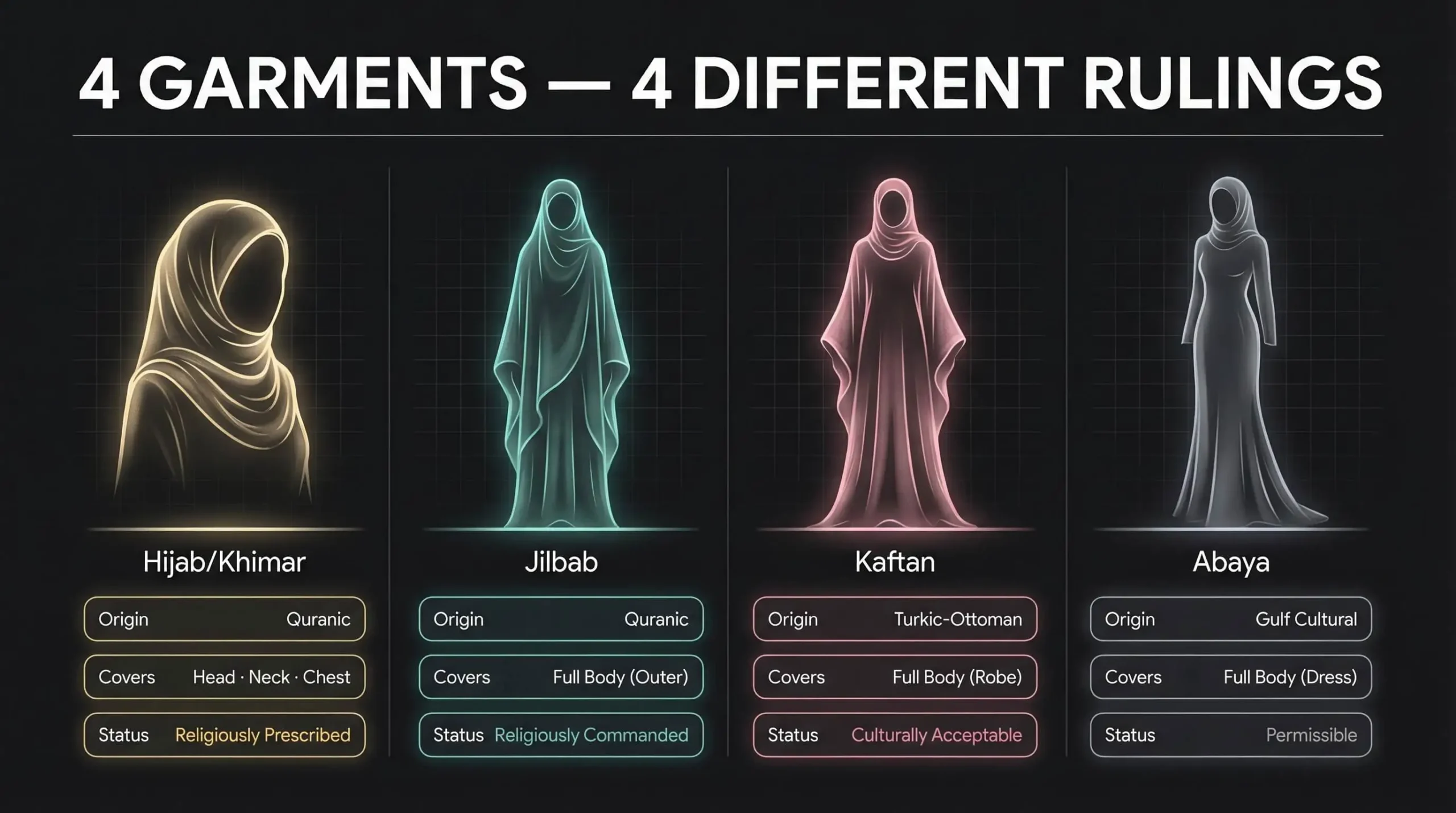
Hijab is a headpiece that covers the neck and hair (Quran 24:31). Jilbab is a loose outer wear which covers the entire body (Quran 33:59). Kaftan is a Turkish/Ottoman cultural robe. Whereas hijab and jilbab have direct Quranic origins, the kaftan meets Islamic requirements of dressing by its loose fitting and covering nature.
⚠️ Scholarly Note: There are also conflicting views between scholars regarding some particulars of Islamic dress. This guide provides the evidence of all the four Sunni madhabs. To get certain personal decisions, a qualified scholar or mufti in your region should be consulted.
The key question most guides do not answer is why some clothes have religious connotations whereas others do not, and why the four madhabs interpret the Quranic verses to have an unexpectedly different practical needs. Understanding Islamic law is the first step. You will learn of the 7 conditions that all schools are now unanimous on, in which they differ on the issue of face and hands, which 3 verses of the Quran are the basis of their ruling (one of which most articles do not discuss at all), and how to use their ruling to build a superior 2026 wardrobe.
The Surah Al-A’raf evidence uncovers a spiritual aspect of dress making the whole discussion to move an inch out of the material and fit.
This guide is based on Tafsir al-Qurtubi, Tafsir Ibn Kathir, Sahih al-Bukhari, Sahih Muslim and Sunan Abu Dawud, which are cross-verified with positions by AMJA, Al-Azhar, Dar al-Ifta al-Misriyyah, Yaqeen Institute and SeekersGuidance.
What Is the Difference Between Hijab, Kaftan, and Jilbab? (The 3 Garments Every Muslim Woman Should Understand)
The misunderstanding of these three clothes goes beyond words. Both of them are in different sections of the Islamic law, the cultural history, and your wardrobe — and their confusion causes confusion of what is religiously obligatory and what is culturally desirable.
Hijab: More Than a Headscarf
The term hijab is never even mentioned in the Quran regarding the dressing of women. Instead, the text uses two terms to be more precise — jilbab (a long, loose-fitting outer garment) and khimar (a headscarf, which covers the head, the neck, and the chest). The Quran does not mean a garment but a barrier or a partition in the word hijab.
In everyday use however, hijab is now understood to mean two things at the same time: the literal headscarf or the more general meaning of haya (modesty) of dressing and behavior. When you go to look up the hijab style, you are usually searching on how to wrap the khimar — the head covering that is required in Surah An-Nur (Quran, Surah An-Nur, 24:31).
Jilbab: The Quranic Outer Garment
Jilbab is a name of an outer garment worn by Muslim women over their normal clothes in order to go out. It wraps the body loosely such that the shape is not seen. The jilbab word is right out of the Quran (Surah Al-Ahzab, 33:59), in which Allah instructs the believing women to draw their jilbabs over themselves.
A dress that is related but not the same is an abaya, a long, loose garment which covers the entire body except the face, hands and feet. No longer an abaya is a black dress, but there are also treated linen fabrics, washed silk, warm earthy colors with patterns, embroidery, and modern cuts. Contrary to the abaya that can slip over, jilbab can have buttons or a zip at the front.
Kaftan: Cultural Elegance, Not Religious Obligation
The kaftan is a cultural not a Quranic garment. The kaftan seems to be the most ancient Turkic dress; this garment is dated as far back as the times of the Hun and the Gokturk. It was the most popular clothing that was used in Turkic states of Central Asia, the Seljuk Turks, and the Ottomans. The kaftan is traditional clothing and has no religious connotations to it, it is a culture.
That distinction matters. A kaftan may quite certainly meet the Islamic conditions of clothing because it must be loose, opaque, and covering enough, but nevertheless, wearing a kaftan is not a religious edict in the same manner that covering with a khimar or jilbab is.
Quick Comparison Table
| Garment | Origin | Covers | Quranic Basis | Status |
| Hijab (Khimar) | Quranic command | Neck, hair, chest | Surah An-Nur 24:31 | Religiously prescribed |
| Jilbab | Quranic command | Whole body (outer garment) | Surah Al-Ahzab 33:59 | Religiously commanded |
| Kaftan | Turkic/Ottoman cultural | Full body (flowing robe) | None — cultural | Acceptable, but not compulsory |
| Abaya | Gulf cultural | Full body (dress form) | None — meets the requirements | Permissible; not mandatory |
Having known what each garment is, the juxtaposing issue is, now, what the Quran and Sunnah actually demand — and which direction are most online manuals incorrect about?
The Quranic Evidence for Islamic Dress (3 Verses Most Articles Overlook)
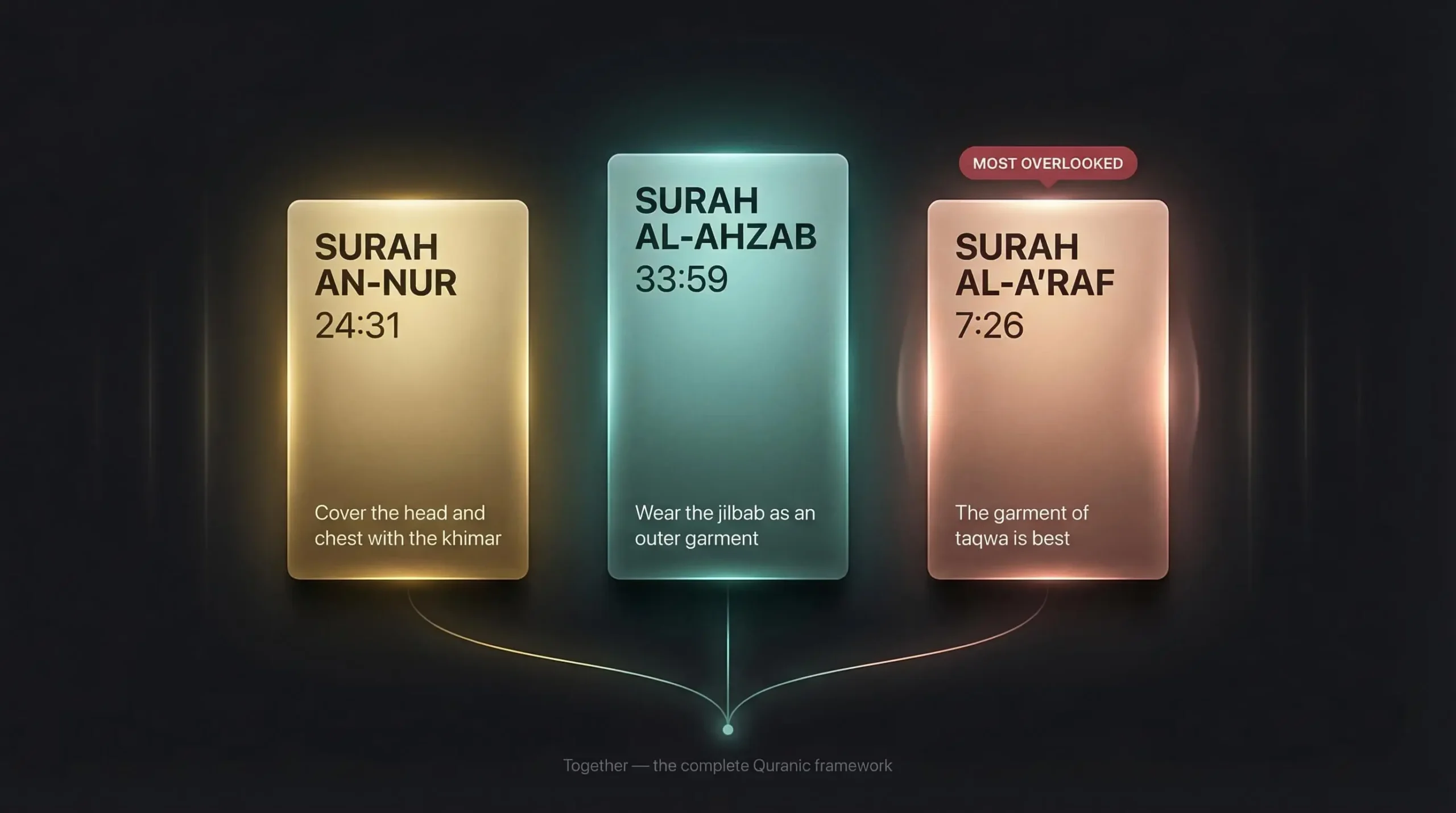
The whole Quranic reference of Muslim women dressing is based on three verses. None of them are cited in the majority of fashion blogs. The majority of fiqh websites quote two out of three, omitting the third — a verse which reinterprets the whole point of Islamic dress code as an outer conformity to inner awareness.
Surah An-Nur 24:31 — The Khimar Command Explained
وَقُل لِّلْمُؤْمِنَـٰتِ يَغْضُضْنَ مِنْ أَبْصَـٰرِهِنَّ وَيَحْفَظْنَ فُرُوجَهُنَّ وَلَا يُبْدِينَ زِينَتَهُنَّ إِلَّا مَا ظَهَرَ مِنْهَا ۖ وَلْيَضْرِبْنَ بِخُمُرِهِنَّ عَلَىٰ جُيُوبِهِنَّ
“And tell the believing women to lower their gaze and guard their chastity, and not to reveal their adornments except what normally appears. Let them draw their khumur (head coverings) over their chests…”
— Quran, Surah An-Nur, 24:31
Arabic dictionary al-Munjid refers to al-khimar as a covering which a woman wraps around her head. The khumur was worn by the women of Medina during the pre-Islamic period such that the two ends were wrapped around the head of the woman behind and had to hang over the back leaving the neck and upper chest open. The verse instructed women to bring the two ends forward by commanding them to place the khumur over the bosoms of the woman over the area of the chest.
The immediate response was Sahabi. At the time of the revelation of this verse, Aisha praised the women who had emigrated early (al-Muhajirahat al-Uwal) and they immediately ripped their thick outer cloths to use as head coverings (Narrated by Aisha, Sahih al-Bukhari, Book 65 (Tafsir), Hadith No. 4758, which is classified as Sahih).
Another narration, by Safiyyah bint Shaybah, who heard Aisha, about the reaction of the women of the Ansar to the verse, is that the women of the Ansar used to appear the following morning, at Fajr prayer, with a covering of black cloth thrown over her head, which made them look like crows. All these reports indicate that the first Muslim women interpreted the command to need a physical alteration not a slight modification but rather a change that was important enough to sew and reuse fabric on-site.
According to Imam al-Tabari, Jami al-Bayan, this verse made the khimar a head-covering and chest-covering garment, and all four madhabs refer to it as the first piece of evidence of obligation of covering the head.
Surah Al-Ahzab 33:59 — Why the Jilbab Was Commanded
يَـٰٓأَيُّهَا ٱلنَّبِىُّ قُل لِّأَزْوَٰجِكَ وَبَنَاتِكَ وَنِسَآءِ ٱلْمُؤْمِنِينَ يُدْنِينَ عَلَيْهِنَّ مِن جَلَـٰبِيبِهِنَّ ۚ ذَٰلِكَ أَدْنَىٰٓ أَن يُعْرَفْنَ فَلَا يُؤْذَيْنَ
“O Prophet, tell your wives, your daughters, and the women of the believers to draw their jalabib (outer garments) over themselves. That is more suitable that they will be known and not be abused…”
— Quran, Surah Al-Ahzab, 33:59
This verse orders an outer garment — the jilbab — on top of what a woman already wears at home. The revelation setting (Asbab al-Nuzul) is the protection and dignity: Umar ibn al-Khattab used to say to the Messenger of Allah, “Screen your wives,” and the wives of the Messenger of Allah would go out at night when Umar recognized Sauda (Sahih al-Bukhari, Hadith No. 6240, classified as Sahih — also in Hadith No. 146 in the Book of Wudu).
What is the jilbab made to look like? Scholars differ. According to Imam al-Qurtubi, Tafsir al-Qurtubi, the jilbab is used to cover the entire body. Ibn al-Arabi (the Maliki judge, not the Sufi — a very important difference), believed that covering a woman to the point that she is recognized as a modest believer is specifically one of the reasons the verse itself states. In his Tafsir Ibn Kathir, Imam Ibn Kathir refers to it as a garment that was worn over the normal garment just like a cloak.
The critical point: the jilbab in Arabic means any outer garment, that is, which covers the entire body, whether it be a rida’, a milhafah, or a mulaa’ah. It is not making reference to a particular style of garment.
Surah Al-A’raf 7:26 — The Forgotten Foundation Verse
يَـٰبَنِىٓ ءَادَمَ قَدْ أَنزَلْنَا عَلَيْكُمْ لِبَاسًا يُوَٰرِى سَوْءَٰتِكُمْ وَرِيشًا ۖ وَلِبَاسُ ٱلتَّقْوَىٰ ذَٰلِكَ خَيْرٌ
“O Children of Adam, We have sent down to you garments to cover your nakedness and as an adornment. But the garment of righteousness (taqwa) — that is best.”
— Quran, Surah Al-A’raf, 7:26
This is the verse that nearly every article in the hijab styling business overlooks, and yet it brings the spiritual context that lends the other two instructions their meaning.
For more Quranic guidance on daily life, see our dedicated collection.
The covering of a body is needed, but the garment of taqwa (God-consciousness) is more important. An outfit that fulfills all the technical requirements and is worn out of half-heartedness, or one that is selected in order to impress and be admired, lacks this principle.
As the research paper published by Yaqeen Institute mentioned in 2026: although head covering was a cultural practice before Islam, it was revealed that it was a divine command as a sign of modesty. The styles and fabrics used in different cultures vary; however, the need will never go away.
The Quran sets the principle. But what are the way scholars interpret these verses into real-life dressing codes? That is what the four madhabs disagree upon — at times quite unexpectedly.
What Each Madhab Says About Women’s Dress (The 7 Conditions That Change Everything)
The Quran provides commands. Those commands are translated into practical requirements using scholarly fiqh (jurisprudence). Here, the four Sunni madhabs have much more in common than most of us think, — but differing on several points of considerable practical significance.
The 7 Universally Agreed-Upon Conditions of Islamic Dress
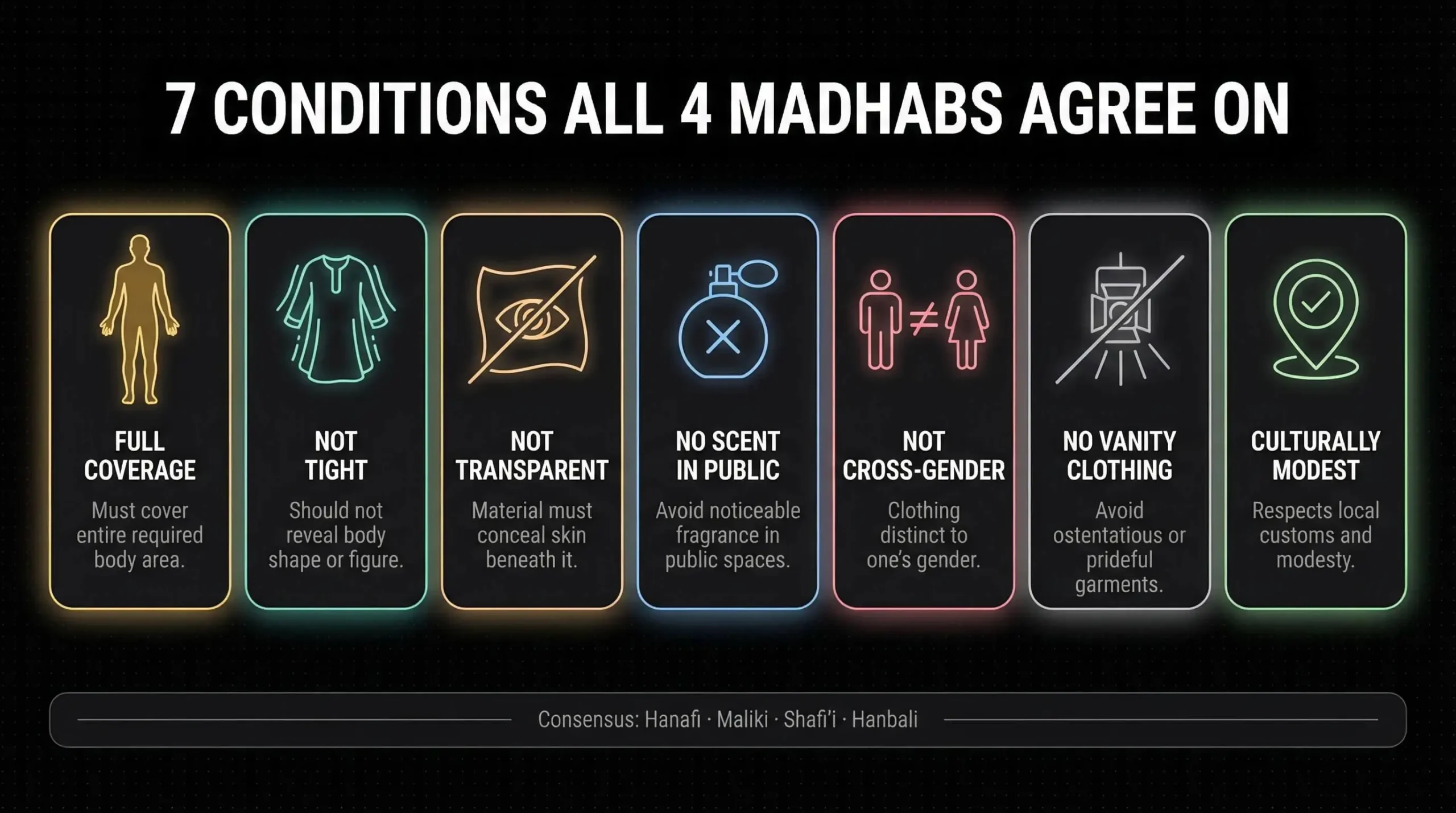
Of the four schools of Islamic jurisprudence (Hanafi, Maliki, Shafi’i, and Hanbali) all unite upon the following shuroot (conditions) of women clothing before non-mahram men:
- Should be covering the whole of the body (there is only disagreement on the face, hands and feet)
- Should not be tight or body-revealing — the clothing is supposed to cover the shape of the body.
- Should not be transparent or see-through — one should not see through to the skin.
- Should not wear perfume or scents when outside.
- Should not be like men’s clothing according to the tradition of the culture.
- Should not be clothing of fame or vanity (libas al-shuhrah) — clothing that one wears with the express purpose of getting attention or being noticed.
- Should be modest and not focus on attention depending on the culture of the region the woman resides.
Sheikh Ibn Uthaymeen and Sheikh Ibn Baz have both stated these conditions in their respective fatwa books. The Assembly of Muslim Jurists of America (AMJA) and Dar al-Ifta al-Misriyyah stipulate that a woman has no particular list of fabrics, styles and colors to wear in order to have a jilbab or abaya, but meet these requirements.
This implies that, it is acceptable to dress loosely, long and not transparent but still being aware of the cultures and clothing traditions of the region. A shalwar kameez and a hijab in Pakistan, a long dress and a headscarf in Europe or the jilbab in Indonesia can be worn to satisfy these requirements.
Where the Four Madhabs Differ — Awrah, Face, Hands & Feet
The terms agreement is wide. The point of contention is what is regarded as the awrah (the parts of the body that should be covered) of a woman:
| Madhab | Stand on Awrah of Women | Jilbab Particularly Necessary? | Primary Evidence | Significant Classical Authority |
| Hanafi | All except face, hands, and feet (Raddu al-Muhtar, Ibn Abidin, 1/405) | No specific cloth; conditions must be met | Quran 24:31, 33:59 | Imam al-Sarakhsi, Ibn Abidin |
| Maliki | All except face and hands; feet are debated | No particular clothing; urf (custom) is a factor | Quran 24:31, 33:59 | Imam al-Qurtubi |
| Shafi’i | All except face and hands are awrah. Some also exempted feet | No particular clothing; must conform to covering awrah | Quran 24:31, 33:59, Hadith of Asma (Hasan li-ghayrihi — debated) | Imam al-Nawawi (al-Majmu’) |
| Hanbali | Strictest: some scholars include full body and face before non-mahram men. Others exempt face and hands | Jilbab or equivalent highly recommended; some view it as obligatory | Quran 33:59 | Ibn Taymiyyah, Ibn al-Qayyim |
The question on whether to require hijab to cover all parts except the face and hands, or to cover the entire body including the face and hands, is at issue between scholars. The hadith of Asma bint Abi Bakr stating that, when a woman reaches the age of menstruation, only her hands and face ought to be exposed, is found in Sunan Abu Dawud (Hadith No. 4104).
According to Abu Dawud himself, the chain is mursal (interrupted), since the sub-narrator Khalid ibn Duraik never met Aisha. Both Shuaib al-Arnaut who verified hadith and Sheikh Jamal al-Afghani graded it Hasan li-ghayrihi (sound due to other supporting chains).
Other scholars, such as Ibn Qudamah and Sheikh Ibn Uthaymeen, claimed that this event preceded the revelation of the verse on the hijab and this would have an impact on its applicability. It is still a major evidence quoted in the Hanafi, Maliki and Shafi’i schools of thought referring to the face and hands as exempt from awrah.
Each of the four positions is based on legitimate academic arguments. The debate is not about the necessity of wearing modest clothing which is universal but rather on the exact boundary and even the fact that there is a specific form that is dictated by the type of clothing.
Is a Specific Garment (Jilbab/Abaya) Obligatory or Are Conditions Enough?
Here the fiqh discourse is at the most useful. The jilbab of the Muslim woman is not about a certain kind of clothing, but has certain requirements that the garment ought to meet in order to be acceptable when it comes to Islam.
The Hanafi school, which is followed by roughly 50 percent of the Sunni Muslims of the world, specifically allows regional forms of clothing. A long coat, a maxi dress, a tunic and wide-leg trousers can all qualify to be considered as meeting the seven conditions as long as they are loose, opaque, and do not appear attention seeking. Hanafi scholars invoke istihsan (juristic preference) to a greater extent to allow the local dress norms.
The Maliki school pays some special attention to the term urf (custom) because what is considered as modest in one place can be considered kaftan, shalwar kameez, or jilbab at another place.
The more robust Hanbali viewpoint, based on the works of Ibn Taymiyyah, suggests a particular outer dress as a full application of the Quran 33:59. The opinion does not dismiss other clothes but believes that a complete outer clothing is the best form.
Stricter scholars apply the principle of sadd al-dhara’i (blocking means to harm) to discourage excessively ornamental or flashy abayas, whereas others apply the principle of maslaha (public interest) to encourage women to have a role in the life of the community through their work and schooling in practical and modest dresses.
With these decisions, the question is transformed into practice. But, what is the right way to wear a hijab, a kaftan, or a jilbab in 2026?
Hijab Styles for 2026 — A Beginner’s Guide to 7 Essential Looks
Faith intersects with the self in the choice of a hijab style. The assortment available nowadays is much greater than the one wrap your grandmother might have put on, and every one of the styles below will satisfy the khimar requirements described in Surah An-Nur when done right.
The Classic Everyday Wrap (Best for Beginners)
One of the most popular and the most iconic hijab styles, the Everyday Wrap is one of the most recognizable and widely-known looks in the world. It can be used with any fabric and any shape of face and that is the reason why beginners are attracted to it.
Here’s a quick step-by-step:
- Put on a hijab and have one side of the hijab longer than the other.
- Secure with a straight pin or magnet hijab pin under the chin.
- Put the longer end over your chest and over the other shoulder.
- Tuck underneath the shoulder or in the garment.
Such a straightforward way of doing things makes sure that all the hair, neck and chest are covered, which is precisely what the Quranic command dictates. There is a cotton or jersey fabric that keeps things slip-free to wear all day.
The Turkish Hijab Style — Effortless Minimalism
The Turkish hijab is a fashionable style in the modest design world, and is a minimalistic dress that displays a sense of effortless beauty. The cloth is usually tightly wrapped around the face in a triangular shape, and it is made of lightweight silk or chiffon.
The distinguishing feature of the Turkish style is the undercap: a bonnet which is worn under the hijab, and as such, it does not require a lot of pinning and the material can lie flat against the head. To update in 2026, combine with a corresponding abaya in neutral colors to achieve the trim appearance that is currently taking over contemporary modest style.
Choosing Hijab Fabric by Season and Occasion
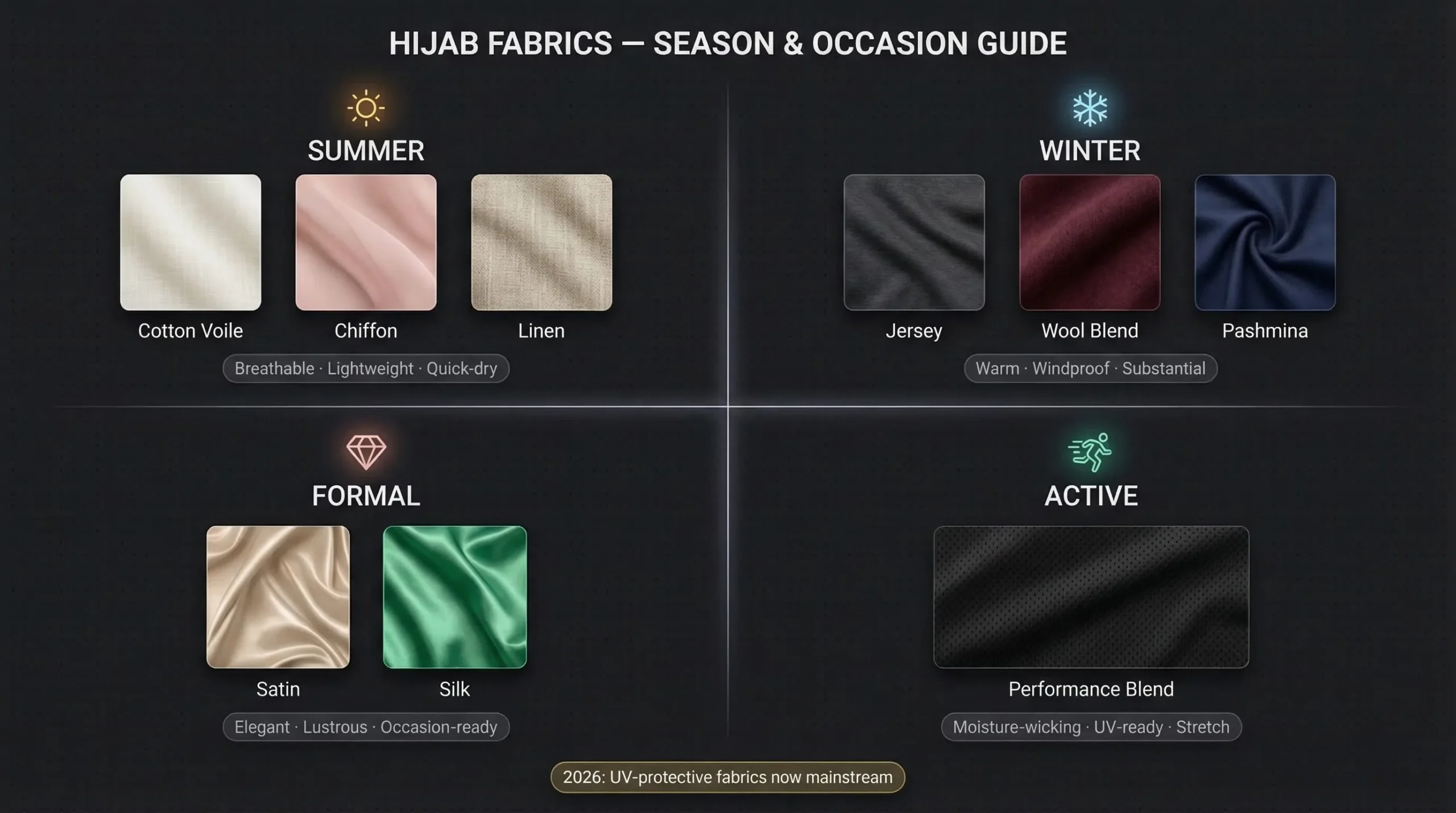
The change to high quality fabrics such as chiffon, satin and nida has entirely changed the way women consider modest fashion. However, even the loveliest hijab is inconvenient when made with the wrong cloth during the wrong time of the year.
- Summer: Cotton voile, chiffon and linen — breathable, light-weight and dry fast. UV protective hijab fabrics are an emerging 2026 technology.
- Winter: Jersey, wool blends, and pashminas — warm, thick, and will not be blown away by the wind.
- Formal events: Satin and silk — shiny and beautiful to wear on Eid, weddings, and celebrations.
- Active wear: Moisture-wicking performance-blend sports hijabs.
Hijab Styling by Face Shape — A Quick Cheat Sheet
Your features are shaped so that you best suit some wrapping method:
- Oval faces are advantaged by asymmetrical styling — any type of hijab is fine, play around with it.
- Round faces are even more elongated with height enhancing methods such as volumized top or a turban-like wrap that gives a vertical extension.
- Angular or square faces are made soft with flowing, curved wrapping techniques that are loosely pulled around the jawline.
- Heart-shaped faces are advantaged by such types of styles that will add width on the jawline, either a side-sweep wrap or a loosely-draped chest portion.
The accessories which make or break a style are hijab pins, magnet hijab clips, brooches and undercaps. The magnet pins especially have revolutionized the common hijab wearing, they secure fabrics without the threat of pricking as with straight pins and cannot be detected by the outward appearance.
The headscarf is not the only thing that is worth attention: the kaftan is a garment covered with a history that is much richer than most people could imagine.
The Kaftan — History, Halal Status & How to Style It in 2026
The kaftan is in a special position: it is solidly rooted in Muslim culture, but it is not found anywhere in the Quran. This difference can be difficult to grasp until you make a purchase — or until you find yourself wondering whether or not you are meeting your Islamic dress code requirements because you have put on one.
The Surprising History of the Kaftan (It’s Older Than You Think)
The Encyclopaedia of Islam says that the kaftan was brought to the Barbary States by the Ottomans. Art historian Rachida Alaoui dates the Moroccan kaftan to the late 15th century. The origins of the garment lie however, much deeper.
They are reported to have been discovered in the Hun tombs in the oldest known specimens and the kaftan was the popular outfit in Turkic states of Central Asia. It was carried across the Seljuk Turks, blossomed under the Ottomans as a state emblem of ceremony and status and was later firmly embedded into the wardrobes of North Africa and the Middle East.
A Moroccan kaftan, a Turkish kaftan and a Gulf-style kaftan appear rather dissimilar to each other — but they have the flowing shape and thick material that inherently becomes modest.
Is Wearing a Kaftan Halal? What Scholars Actually Say
The kaftan is not dictated or forbidden, but is a part of the culture. None of the scholars has declared a fatwa regarding the wearing of a kaftan and neither has any scholar termed it as a religious obligation. It is merely an item of clothing — judged against the seven requirements of the Islamic dress, like any other clothing.
Kaftans have become a symbolic wear among the Islamic women fashion particularly in parties, weddings, and other celebrations. Kaftans are popular because of their flowing silhouettes and elegant nature, making them the perfect balance between modesty and opulence, the garment is inevitably loose and is normally long, and comes in opaque materials.
The qualification: an excessively ostentatious kaftan that would serve as libas al-shuhrah (clothing of fame/vanity) might run counter to condition #6. An embroidered kaftan to a wedding is not the same thing as an expensive showcase gown that is to be worn on a daily outing. The context and intention are important.
2026 Kaftan Trends — Embroidery, Earthy Tones & Sustainable Fabrics
Adorned kaftans with elaborate embroidery designs, beads, sequins and metallic ornaments are in demand in 2026. Designers are also working with luxurious materials like silk, satin, velvet and georgette. Floral, abstract or geometric-motif printed kaftans are also in trend therefore the Islamic kaftan is a versatile addition to any modest wardrobe.
The earthy tone movement came down on kaftans: no longer are the heavy jewel tones used as they had in earlier seasons; sage green, terracotta, sand beige and dusty rose have taken their place. Organic (and recycled) chiffon, bamboo silk, and other fabrics that are environmentally friendly are becoming a standard in the kaftan market, as opposed to a niche.
To style Eid, a kaftan with a chiffon hijab and structured accessories (a geometrical clutch, bold earrings that can be seen under the headscarf) would make up an elegant outfit suitable to the occasion that follows tradition and fashion at the same time.
The kaftan is a masterpiece in culture. The jilbab, in its turn, bears the direct Quranic authority — and its modern versions differ radically throughout the Muslim world.
The Jilbab in 2026 — From Quranic Command to Modern Wardrobe
The jilbab takes the place of a 7th century Quranic edict and the 21st century wardrobe necessity. Knowing its scriptural ground as well as knowing its various modern manifestations will keep you on track with evidence and make sound choices.
What the Prophet ﷺ Said About Women Who Don’t Have a Jilbab
One woman questioned the Prophet ﷺ regarding staying home when she does not have a jilbab. His response was direct:
“Let her sister lend her a jilbab.”
— Narrated by Umm Atiyyah, Sahih al-Bukhari, Hadith No. 351; also Sahih Muslim, Hadith No. 890
This is explicitly stated in the version that is found in Sunan Abu Dawud, which uses the following wording: “What about a person who does not have a jilbab?” and the Prophet ﷺ replied to it, “Let her borrow the jilbab of her companion.”
This narration occurred within the setting of attending Eid prayers and gatherings — Sahih al-Bukhari includes it in the chapter that deals with the necessity to wear the correct clothes to pray. The Prophet ﷺ was stressing that absence of a garment does not serve as the excuse to miss congregational worship.
Two things come out in the narration. To start with, the jilbab was a necessity in terms of social and religious meetings — so significant that the Prophet ﷺ did not simply mention not going out but borrowing one. Second, the solution was practical, not isolating: the aim was not to get isolated, but to participate.
Jilbab vs. Abaya — The Key Differences Explained Simply
In the Islamic culture, abaya and jilbab are both significant pieces of clothing. Women cover bodies decently with them. Nevertheless, despite the resemblance, there is actual difference between the two, as it concerns style, purpose, and the way each of them is worn.
| Feature | Jilbab | Abaya |
| Opening | Often buttons or zip at the front | Tends to slide over the head or wraps open |
| Background | Quranic term (33:59) | Gulf cultural clothing |
| Coverage | Full outer garment, possibly includes head covering | Body only; worn with separate hijab |
| Classical color | Depends on region | Traditionally black, currently varied |
| Construction | Cloak-like, usually single-piece | Dress-like, open-front or pull-over |
The difference between jilbab and abaya is important since the term jilbab in the Quran means a type of outerwear, and not a specific type of clothing. The black abaya, a colored jilbab with front buttons, a long overcoat can all be eligible, however, under the conditions.
Regional Jilbab Styles — Indonesian, Gulf, European
The jilbab styles of Indonesia should be mentioned separately. Jilbab, in Indonesian usage, is a formal but stylish version of hijab. Worn regularly at events, they are influenced by the contemporary trends. There is a large community of young Indonesian women and influencers who post their creative appearance on social media and unite Southeast Asian aesthetics with Islamic modesty demands.
Gulf jilbab is more flowing cloak-like in darker colors, but the open abaya (worn as a long cardigan over matching outfits) has been on a boom in the UAE, Saudi Arabia, and Bahrain.
Jilbabs in Europe are most frequently designed as long coats, maxi dresses, or tunic-and-wide-trousers pairs that can meet the seven requirements and fit in with the Western fashion standards. Darul Uloom Deoband and a number of European fatwa authorities have confirmed regional difference in nature of garment is acceptable provided that the criterion of coverage, looseness and opaqueness of garment is upheld.
Five nagging myths about Islamic dress should be cleared before proceeding to trends and styling, as they impact on how Islamic dress is shopped, how it is worn, and what is known about the evidence.
5 Common Misconceptions About Islamic Dress (And the Evidence That Corrects Them)
False beliefs about modest fashion go viral. There are those that are internal to the Muslim community and others external to the community. They all should be corrected with the real evidence.
Misconception #1: “The Quran says hijab.”
Hijab is not a term that is used in Quran to refer to the women’s clothing. It incorporates the words jilbab and khimar. The term hijab in the Quran (e.g. Surah Al-Ahzab 33:53) means a partition or a barrier. The current association of the term with the headscarf is a linguistic development, and is not a direct usage in the Quran.
Misconception #2: “Abayas must be black.”
No madhab insists on a certain color of clothes to be worn by women. Although abaya dress has always been black in the Gulf cultures, according to the scholars in all four schools, it is permissible to use colors, although the dress should not draw unwarranted attention. A beige abaya, an olive open abaya, or a navy abaya is Islamically acceptable to the women.
Misconception #3: “Modest fashion is no fashion.”
By 2026, hijab has been a symbol in the fashion industry across the world. Islamic wear by women was never simply reduced to the hijab and the burka, the terrain is filled with the abaya, the jilbab, kaftan, and numerous others. Nevertheless, style and modesty have never been the mutually exclusive terms: even in Quran, clothing is mentioned as an adornment and as a covering (Quran, Surah Al-A’raf, 7:26).
Misconception #4: “Kaftan is a religious garment.”
As it has been recorded above, the kaftan has neither Quranic foundation nor religious connotations — it has Turkic and Central Asian cultural roots. Wearing it is not a religious necessity or even a religious practice, even though it can serve the Islamic requirements beautifully.
Misconception #5: “All scholars agree on every point.”
There are very few rules regarding modesty that cannot be interpreted in various ways. The madhabs vary on face, hands and feet. The Hanbali ruling on face-covering differs from the Hanafi ruling. Representing scholarly consensus in the event of actual scholarly dissent is a distortion of tradition.
Those myths made right, the larger picture emerges: modest fashion is not stagnant, and in 2026, the changes have occurred, and the way you shop and dress has changed.
The Modest Fashion Revolution — 2026 Trends, Market & What’s Next
Hijab fashion is doing well not only in Muslim dominated countries. From London to Dubai, New York to Jakarta, modest clothes are turning into one of the potent sources of self-identification, culture and self-confidence. The statistics verify what the streetwear brings into sight.
The market has exploded. Modest dresses in 2024 already had a value of $65.8 billion in the United States and $72.5 billion in Europe that was growing at a rate of 5 percent, which is projected to be at 5 percent through the year 2031. The modest fashion market throughout the world is anticipated to reach $450 billion. They are not niche figures that will be overlooked by the fashion giants.
Islamic 2026 fashion is dominated by sustainability. Eco-friendly fabrics such as organic cotton, bamboo silk, or recycled chiffon, are no longer seen only in the boutique, but are now in the mainstream collections. Innovation is a blend of technology and tradition: thermoregulating fabrics will keep you cool on a prayer day and commute day, non-wrinkle fabrics will keep you looking professional on a long work day, UV protective hijabs will have built-in sun protection.
The aesthetic of minimalism repackaged is the 2026 future: straight lines, neutral color palette, and minimal forms. The dominant visual language includes beige abayas, sets of hijabs and plain kaftans with structured accessories. The modest athleisure industry is steadily expanding, and sports hijabs are now the norm among the sporting brands.
An international setting observation: In June 2024, the Tajikistan parliament approved a bill prohibiting foreign clothing, which also covers the hijab. Such legislation trends highlight the importance of knowing about the facts and history of dressing according to Islam, as well as the scholarly foundation of the issue not only to practice it personally, but also to be able to interact with the world.
The M.O.D.E.S.T. Check: Your Quick Garment Evaluation Tool
Whatever you purchase next in a hijab, abaya, kaftan or jilbab, take it through this framework based on the seven scholarly conditions:
| Letter | Meaning | Question to Ask |
| M | Material | Is the fabric opaque and not see-through? |
| O | Outline | Does the clothing conceal the shape of the body (not tight)? |
| D | Dimensions | Does it cover all the way down to the ankle (face/hands debated)? |
| E | Expression | Does it not appear similar to the opposite sex’s clothing? |
| S | Scent | Does it lack perfume/scent drawing attention in the social scene? |
| T | Temptation | Does it avoid being clothing of fame/vanity (libas al-shuhrah)? |
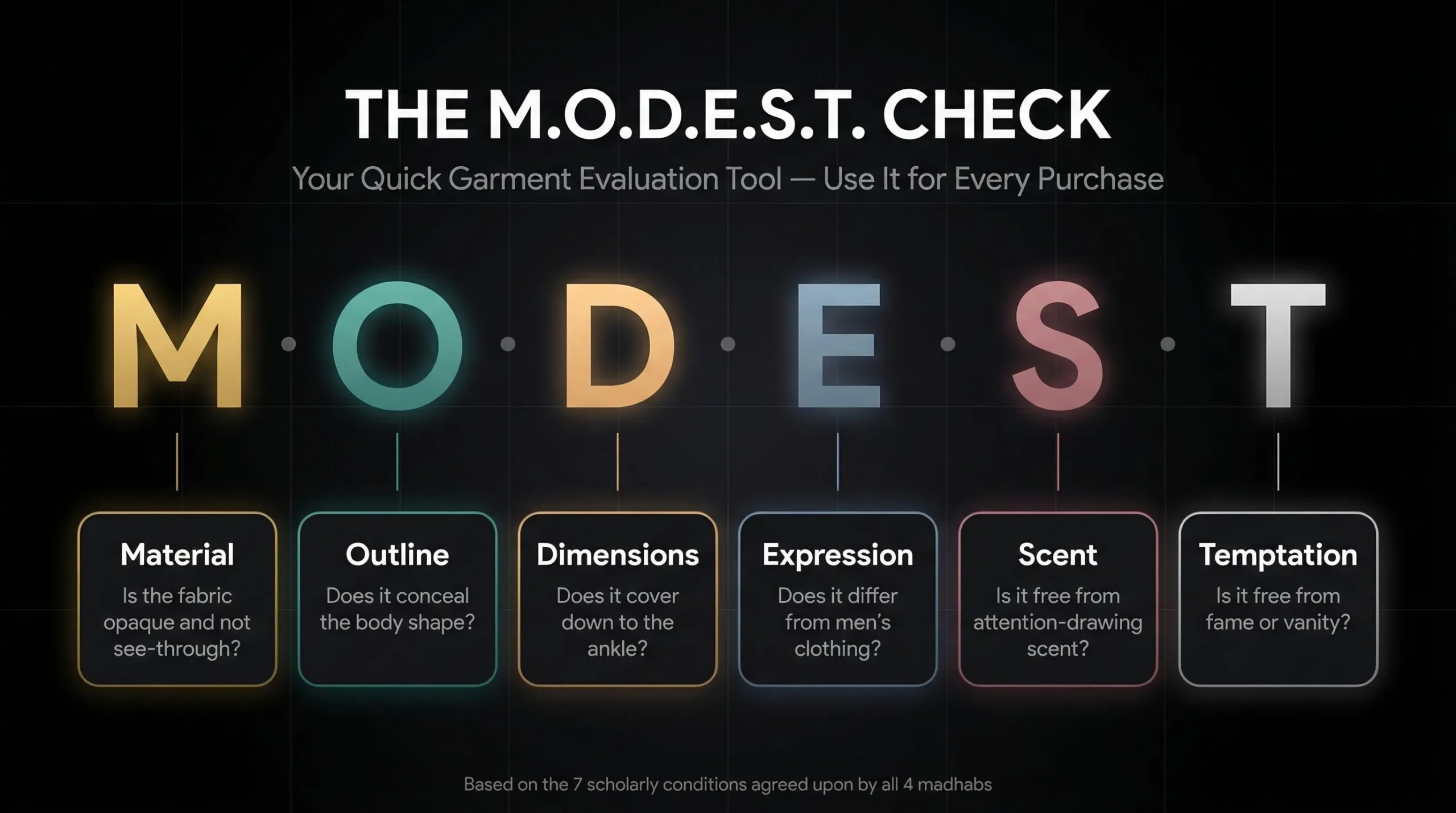
Copy it, keep it in the cell phone, or learn it. Each garment, a loose jersey hijab, and a decorated Moroccan kaftan, can be rated with references to these six letters in a matter of seconds.
Your 2026 Modest Wardrobe Essentials
It is not necessary to spend on dozens of clothes to create a working modest wardrobe. Some of these necessities include those of daily life, work, worship, and special occasions:
- ✅ 2–3 neutral color hijabs (chiffon, jersey, cotton)
- ✅ 1 formal satin or silk hijab for occasions
- ✅ 1 jilbab or abaya in any color for daily use
- ✅ 1 kaftan as an Eid, wedding, or party dress
- ✅ 2–3 undercaps or under-scarves
- ✅ Hijab accessories, such as magnet pins, brooches
- ✅ Seasonal outfits (lightweight cardigans in summer, a wool wrap in winter)
- ✅ 1 sports hijab for active lifestyles
FAQ — Your Questions About Hijab Style, Kaftan & Jilbab Answered
How is hijab different from jilbab?
The hijab (khimar) is a head scarf that covers both hair, neck, and chest which is commanded in Quran 24:31. Jilbab is an outer garment, which is a full-body covering commanded in Quran 33:59. On your head, you have a hijab, a jilbab on your clothes. The majority of Muslim women who cover wear them both — the jilbab on the body, and the head covering hijab/khimar.
Is wearing a kaftan halal?
Yes. Kaftan is a cultural clothing having no Quranic prohibition or obligation. Wearing it is permissible (mubah) as long as it satisfies the requirements of Islamic wear: it should be opaque, loose fitting, full coverage, and not attention seeking. Scholars of all the four madhabs consider that any garment including kaftan is judged by these conditions but not by the name or place where it is made.
How does the Quran address the dressing code of a woman?
It is covered by three major verses: Surah An-Nur 24:31 commands the khimar (head covering over the chest), Surah Al-Ahzab 33:59 commands the jilbab (outer garment) and Surah Al-A’raf 7:26 confirms that while a covering is needed, the garment of righteousness (taqwa) is best. These verses combined create the physical and spiritual foundation of modest dressing.
Is it possible to wear colored hijab and abaya?
All madhabs do not mandate a particular color that women should wear. They can wear colorful abayas and hijabs but only when they do not serve as an attention seeking display (tabarruj). Cultural practices are a factor — what is modest in a certain area would be conspicuous in another place. Sheikh Yusuf al-Qaradawi and Al-Azhar scholars have confirmed that it is a question of cultural suitability that colors are used and not prohibition in religion.
Is hijab in the form of turban permissible in Islam?
The turban hijab is debated. When the turban entirely covers the hair, neck and ears and the garment under the turban covers the chest, then some scholars believe that it is acceptable. Most scholars would find it to be an inadequate khimar, in the event that it reveals the neck or ears, or it does not cover the chest region (the precise command of Quran 24:31). A qualified scholar would give you advice based on your situation.
Which fabrics do you recommend for wearing a hijab during hot weather?
During summer, cotton voile, light chiffon, and linen are the best fabrics. They are breathable, have the ability to absorb moisture and are not clingy. Polyester and thick jersey do not perform well in heat, they trap the heat and are uncomfortable when wearing or when praying. Hijab fabrics that are protective against UV are a 2026 technology that can be considered when it comes to sun-heavy weather.
Am I obliged to put on a specific garment (jilbab) or is it possible to wear any kind of modest clothes?
The majority scholarly view among Hanafi, Maliki and Shafi’i schools of thought is that there is no particular garment obligatory, the conditions are more important than the form. The requirements can be met by a long maxi dress or a coat or a shalwar kameez that is loose, opaque, and covering. A number of Hanbali scholars suggest a specific outer garment by relying on Quran 33:59, though even in the school, focus is made on the conditions to be fulfilled.
What is the ruling on trendy/decorated abayas?
Trendy abayas can be worn provided that they do not turn into libas al-shuhrah (clothing of vanity) or tabarruj (displaying beauty to non-mahrams). Moderate embroidery, tasteful colors, and modern cuts are all acceptable. Excessively flashy style that seeks attention is incompatible with condition #6 — the garment is not to be worn to show off. Sheikh Ibn Uthaymeen made a distinction between beautification (acceptable) and ostentation (not encouraged).
What are the conditions of the Islamic dress that the madhabs agree on?
The four Sunni madhabs are all unanimous on seven main conditions, namely: (1) covering the body, (2) loose and not revealing of the body shape, (3) non-transparent fabric, (4) no perfume when in public, (5) no clothing similar to that of men, (6) no clothing of fame and vanity, and (7) modesty according to cultural norms. It is only the question of whether or not the face, the hands, and the feet have to be covered.
What is the difference between the Indonesian jilbab and the Gulf jilbab?
The Indonesian jilbab can be broadly understood as any hijab or other modest garment but is usually styled like a neatly-shaped headscarf, which is worn together with a long tunic or dress — formal but stylish, and with an influence of the Southeast Asian aesthetics. Gulf jilbab is generally used to signify a full-body cloak of darker colours, which is worn as a separate outer layer over inner clothing. Both serve the Quranic command but with varied cultural interpretation of the same principle under the urf (custom).
Building Your Modest Wardrobe With Confidence and Faith
The Quranic framework on the dressing of women in Islam is based on unambiguous principles — khimar for the head, jilbab for the body, fabric and fitting requirements of the dressing — but provides flexibility to the cultural expression, taste and practical adjustment. Hijab, jilbab, abaya and kaftan are worn on various occasions, they have different roots, they satisfy various needs but they are all filtered in the same way, that is a set of seven conditions which scholars of all four madhabs derived basing on Quran and Sunnah.
You need to build a wardrobe that is modest yet fashionable, whether you are a novice trying your first hijab looks, or you are more advanced and trying to refine your style, the evidence will lead you to confidence instead of bewilderment. Wear what passes the M.O.D.E.S.T. Check, wear in a manner that honors both the letter and the spirit of the command, and have in mind that the highest standard is the garment of taqwa — inner God-consciousness.
This guide is based on Quran, Sahih al-Bukhari, Sahih Muslim, Sunan Abu Dawud, Tafsir al-Qurtubi, Tafsir Ibn Kathir, AMJA, Al-Azhar, Dar al-Ifta al-Misriyyah, Darul Uloom Deoband, SeekersGuidance and Yaqeen Institute positions. In cases of individual decisions according to certain cases, it is always good to seek the advice of a qualified local scholar.
And Allah knows best — Wallahu a’lam.