Verified Sahih al-Bukhari (Kitab al-Hibat), Sahih Muslim, Sunan al-Tirmidhi, Al-Adab al-Mufrad + 2026 fatwas.
Any fancy wrapping is trash if intention or source is wrong. This fixes the Hadiyah/Sadaqah/Hiba mess with real citations, madhab table and bulletproof H.A.D.I.Y. checklist. Updated dates + 2026 products. Consult scholar for your case.
🔄 Updated for 2026: This guide includes corrected Islamic dates for Ramadan and Eid al-Adha 2026, new Islamic gift trends (smart dhikr rings, portable digital Quran gadgets, halal skincare sets), and recent fatwa positions from the European Council for Fatwa and Research and the Permanent Committee for Research and Fatwa. All Hadith citations have been fully verified with collection, book/chapter, Hadith number, and authentication grade.
We are all aware that it is a good thing to give gifts. Not all people know that it is connected to a certain prophetic command, a complex system of fiqh conditions that make a gift invalid, rules of etiquette, which determine whether we merit reward or face sin. Islamic gifts are much more than a cultural trifle — it is a ritual of worship established on the basis of the Quran, Hadith, and centuries of analysis by the scholars.
Islamic presents (Hadiyah) are a legitimate Sunnah of Prophet Muhammad ﷺ who said: Give one another presents and you will love one another (Al-Adab al-Mufrad, Hadith No. 594, graded Hasan by Ibn Hajar al-Asqalani). Giving presents builds stronger relationship, eliminates malice in the hearts and it is even rewarded by Allah when one does it with earnest niyyah to please Allah.
What most sources fail to explain is that Islamic jurisprudence divides giving into three categories, namely, Hadiyah, Sadaqah, and Hiba, and the confusion of them varies the ruling, etiquette, and even revocability. You can see 7 major hadiths that have been fully graded below, the Quranic basis that most of the articles omit, and a concise guide, the H.A.D.I.Y. method, to how to make sure that every gift is up to Sunnah standard. You will also find 25+ valuable Islamic gift ideas in 2026 divided by occasion, and 7 ways in which your reward may be invalidated.
The Surah Al-Baqarah evidence and Sahih al-Bukhari evidence provides dimensions of the concept of Islamic gifting that change the whole perception of generosity to the realm of giving.
There are points that are discussed differently by the scholars. The presented positions are the schools of the Islamic jurisprudence. When it comes to personal fiqh questions ask a qualified scholar. Wallahu a’lam (And Allah knows best).
What Makes an Islamic Gift Truly “Islamic”? The Definition Most People Get Wrong
There is a widespread belief that any of the present that is covered with Islamic-themed paper is an Islamic gift. The reality is more specific. It is not the wrapping that makes a gift Islamic, but all about the intention, origin and make-up.
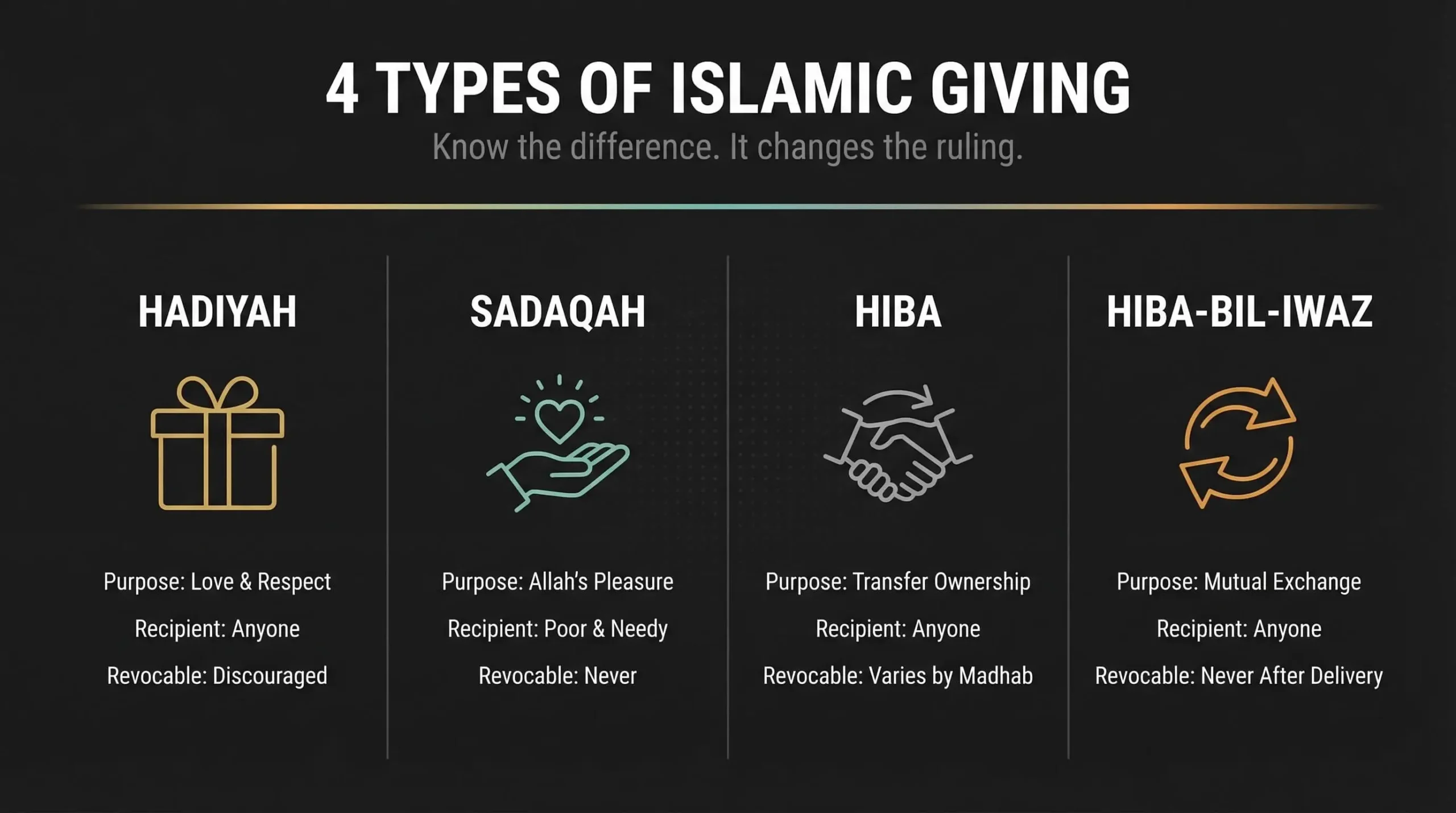
Arabic language has three different terms of various acts of giving, each having its own verdicts:
Hadiyah (present): This is a present which is offered as a sign of love, respect, or to reinforce an attachment. It may be administered to any person be it rich or poor and it is meant to make the recipient honorable. The gift is not always given to a poor person, as the Permanent Committee for Research and Fatwa explained that, the purpose of the gift is to show friendship and to honour the recipient, that is, it can be given to a rich person or a poor person.
Sadaqah (charity): It refers to charity towards the needy and the poor on behalf of Allah. Sadaqah refers to charitable gift awarded to the poor in the name of God, and its reason is Godly reward and not relationship.
Hiba (legal gift): The official term of fiqh is hiba which means voluntary transfer of ownership without anticipation of return. Hiba needs three pillars; Ijab (declaration), Qabul (acceptance), and Qabd (delivery of possession).
There is a fourth category, the Hiba-bil-Iwaz, or mutual exchange of gifts; and has distinct rulings on the revocability.
| Characteristic | Hadiyah (Gift) | Sadaqah (Charity) | Hiba (Legal Gift) | Hiba-bil-Iwaz |
| Intention | Love / respect | Allah’s pleasure for needy | Transfer ownership | Mutual exchange |
| Recipient | Any (poor or rich) | Poor / needy | Any | Any |
| Revocable? | Strongly discouraged | Irrevocable | Varies by madhhab | Irrevocable after delivery |
| Requires | Sincerity | Niyyah to Allah | Declaration + Acceptance + Possession | Registration |
These categories are necessary to understand that the Quran discusses various types of giving in varying promises. Allah says:
وَمَا تُنفِقُوا مِنْ خَيْرٍ يُوَفَّ إِلَيْكُمْ وَأَنتُمْ لَا تُظْلَمُونَ
“Whatever you spend in good, it will be repaid to you in full, and you will not be wronged.” (Quran, Surah Al-Baqarah, 2:272)
This verse is universal, it refers to Sadaqah, Hadiyah and any expenditure made in the name of Allah. The term used (tunfiqū) is intentionally general and theorists like Imam al-Qurtubi in his Tafsir remark that it includes gifting to maintain kinship relationships as much as it includes acts of charity.
However, there exist three kinds of giving in the Islam religion — and most people get them mixed up and this will directly influence whether your gift will get you maximum reward or a grey area. It is the clearest that the distinctions are evident in the hadith evidence below.
The 7 Hadith About Islamic Gift-Giving Every Muslim Should Know
The prophetic tradition concerning gift-giving is far richer than the single narration most articles reference. This is the subject on which Imam al-Bukhari devoted one chapter of his Sahih to, the Kitab al-Hibat (The Book of Gifts). The following are the seven most significant narrations, complete with their citation, grade of authentication and practical implication.
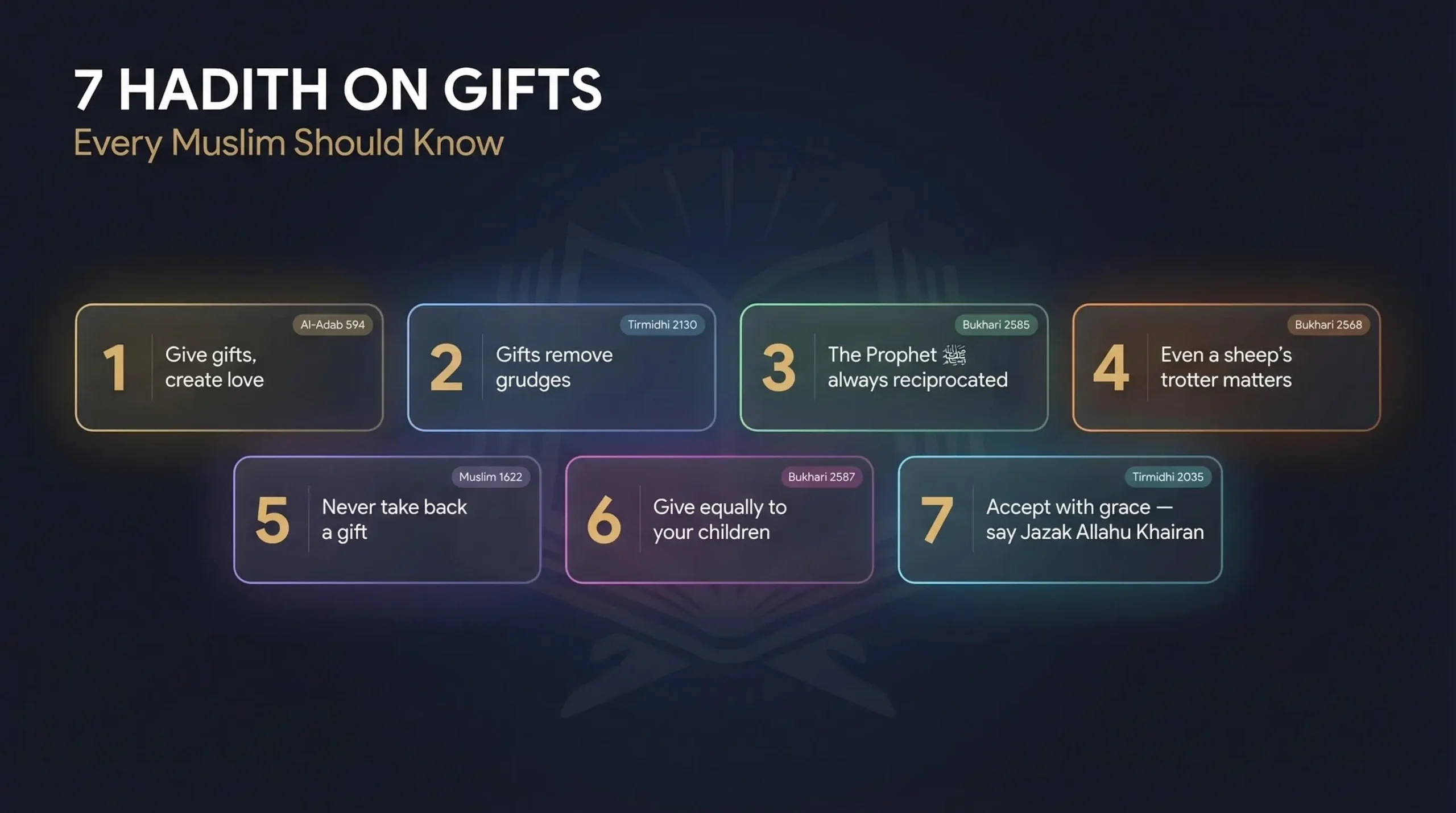
Hadith #1: The Foundational Command
Give gifts to one another and you will love one another. (Al-Adab al-Mufrad 594, graded Hasan — also emphasized in Bukhari’s Kitab al-Hibat; verified sunnah.com March 2026)
This is not a mere suggestion — the Arabic verb tahaddu is in the imperative form, making it a direct command. The act of gift-giving was directly connected to creating love among the people by the Prophet ﷺ. The great Shafi’i scholar Imam al-Nawawi, the author of Riyad al-Salihin, included this narration in the category of deeds that cemented the Muslim brotherhood, and is practically demonstrating early Islamic etiquette to us.
Hadith #2: The Therapeutic Dimension — Gifts Remove Grudges
Exchange gifts with one another. Gifts remove ill-feelings from the hearts. (Sunan al-Tirmidhi, Hadith No. 2130, graded Hasan)
In this case the good extends further than the production of love — gifts have a positive action in eliminating negative emotions. The word employed in the Arabic language (al-ghill) means deep-rooted resentment and this implies that the gift-giving is a spiritual solution to interpersonal conflicts, a point that scholars of Islamic social ethics frequently emphasize.
Hadith #3: The Sunnah of Reciprocating
It was narrated by Aa’ishah:
The Messenger of Allah ﷺ used to accept gifts and to give something in return. (Sahih al-Bukhari, Kitab al-Hibat, Hadith No. 2585)
This narration creates the reciprocity being prophetic practice not an obligation rather Sunnah which respects the giver. The Prophet ﷺ exemplified the way he wanted his ummah to react, an aspect that continues to be a core principle in Islamic ethics.
Hadith #4: The Value Doesn’t Matter — Even a Sheep’s Trotter
Were I invited to partake of a trotter of a sheep, I would accept the invitation; and were a trotter of a sheep offered to me as a gift, I would accept it.(Sahih al-Bukhari 2568; verified sunnah.com)
This Hadith transforms your thoughts regarding the value of a gift fully. The Prophet ﷺ would never hesitate to take the most humble offering, which is the trotter of the sheep, one of the most undesirable portions of meat. It is quite obvious that the real present is the love that inspired the giving, not the financial worth of the given.
Hadith #5: The Prohibition on Taking Back Gifts
Do not buy it back, and do not take back charity, for the one who takes back his charity is like a dog that swallows its own vomit. (Sahih Muslim, Kitab al-Hibat, Hadith No. 1622; also recorded in Sahih al-Bukhari, Hadith No. 2589)
This imagery is severe and it has been intentional. Returning a gift — called Raj’ (revocation) — is so highly denounced, that the Prophet ﷺ made the utmost analogy imaginable of it, a vivid warning that underscores the gravity of this prohibition in Islamic jurisprudence.
Hadith #6: Fairness Among Children — The Gift the Prophet ﷺ Refused to Witness
Nu’man ibn Bashir said: The Prophet ﷺ said, “Have you given such a gift to every son of yours?” He said, “No.” The Prophet ﷺ said, “Then I will not witness it, for it is injustice.” (Sahih al-Bukhari, Kitab al-Hibat, Hadith No. 2587; Sahih Muslim, Kitab al-Hibat, Hadith No. 1623)
The Prophet ﷺ was not willing to see a father gift the child yet the other children did not receive the same. It is based on this narration that the fiqh rulings on fairness in gifting between children are founded — and the Hanbali position on this is notably stricter than the other three schools, as detailed in the fiqh section below.
There are two other narrations which fill out the picture:
On the courtesy of accepting: When a gift is offered to one of you, and he has nothing to give in return, he should accept it, for whoever boasts of a virtue that has not been given him, he is like one who wears two garments of deception. (Sunan Abu Dawud, Hadith No. 4997; Sunan al-Tirmidhi, Hadith No. 2393)
When you must thank someone and you are not able to return it: “Whoever has a favour done for him and says to the one who did it Jazaak Allahu Khairan, he has done the utmost in praising him” (Sunan al-Tirmidhi, Hadith No. 2035, graded Hasan). It is the dua that is used in response to the Sunnah when you cannot afford to recompense the giver, a small but significant consideration in daily practice.
Having this basis of Hadith, the Quranic evidence brings into view a further spiritual side of Islamic gifting, but one that was based on the idea of taqwa (God-consciousness) and ihsan (excellence).
Quranic Foundations of Generosity: The Verses Behind Islamic Gifting
The term gift is not given in isolation in Quran. Rather, it incorporates the concept in an extensive theology of generosity, spending, and ihsan. The Quranic system has five verses that are used by scholars of the four madhabs in discourse of Islamic gifts.
Verse #1: Sincerity in Expenditure
وَمَا تُنفِقُوا مِنْ خَيْرٍ يُوَفَّ إِلَيْكُمْ وَأَنتُمْ لَا تُظْلَمُونَ
“Whatever you spend in good, it will be repaid to you in full, and you will not be wronged.” (Quran, Surah Al-Baqarah, 2:272)
This is the promise of all forms of allowable expenditure — of Sadaqah all the way up to Hadiyah. Allah only insures that nothing in good faith is squandered. The verse puts gift-giving in a spiritual economy where generosity is never a loss, a principle that is foundational to the Islamic understanding of wealth.
Verse #2: Give What You Love — The Spiritual Challenge
لَن تَنَالُوا الْبِرَّ حَتَّىٰ تُنفِقُوا مِمَّا تُحِبُّونَ
“You will never attain righteousness until you spend from that which you love.” (Quran, Surah Aal-Imran, 3:92)
Righteousness (al-birr) here is connected to a particular form of generosity: the giving of things, which have a personal value. This verse brings Islamic giving to the next level of convenient giving — the most rewarding type of giving as per this ayah is a gift that costs you something, not only money, but something that you personally cherish.
For more Quranic guidance on righteous character, see our collection of Quran verses about patience and righteousness.
Verse #3: The Reciprocity Principle
هَلْ جَزَاءُ الْإِحْسَانِ إِلَّا الْإِحْسَانِ
“Is the reward of goodness anything but goodness?” (Quran, Surah Al-Rahman, 55:60)
This verse presents a spiritual reward that is not taken into consideration by many. It creates a divine principle of reciprocity of goodness with goodness that is applied to the relations between humans. Allah Himself provides that when you present the gift with purity, the goodness would come back to you.
Verse #4: No Pressure, No Harm — The Anchor of Islamic Gifting Etiquette
قَوْلٌ مَّعْرُوفٌ وَمَغْفِرَةٌ خَيْرٌ مِّن صَدَقَةٍ يَتْبَعُهَا أَذًى
“Kind words and forgiveness are better than charity followed by injury.” (Quran, Surah Al-Baqarah, 2:263)
Therefore, in essence, when one presents a gift and repeatedly reminds them that he or she is so generous, or attempting to play with their emotions, then it becomes more of an insult than doing nothing at all. This verse is actually the establishment of the rule that your gift must be clean and unconditional.
Verse #5: The Generosity Imperative
وَأَحْسِنُوا ۛ إِنَّ اللَّهَ يُحِبُّ الْمُحْسِنِينَ
“And do good; indeed, Allah loves those who do good.” (Quran, Surah Al-Baqarah, 2:195)
he name of Allah Al-Wahhaab (The Bestower), one of the 99 Names of Allah, is mentioned in the Quran and the process of giving is an expression of this attribute in our relationships. In his classic Ihya Ulum al-Din, Imam al-Ghazali links giving straight to the construction of the improved, Godlike character in us sinners.
These foundations of Quran are not merely abstract theology, but it is the very explanation why the Prophet ﷺ practically lived what he preached in his daily gifting. The Seerah holds plenty of real-life examples of his life.
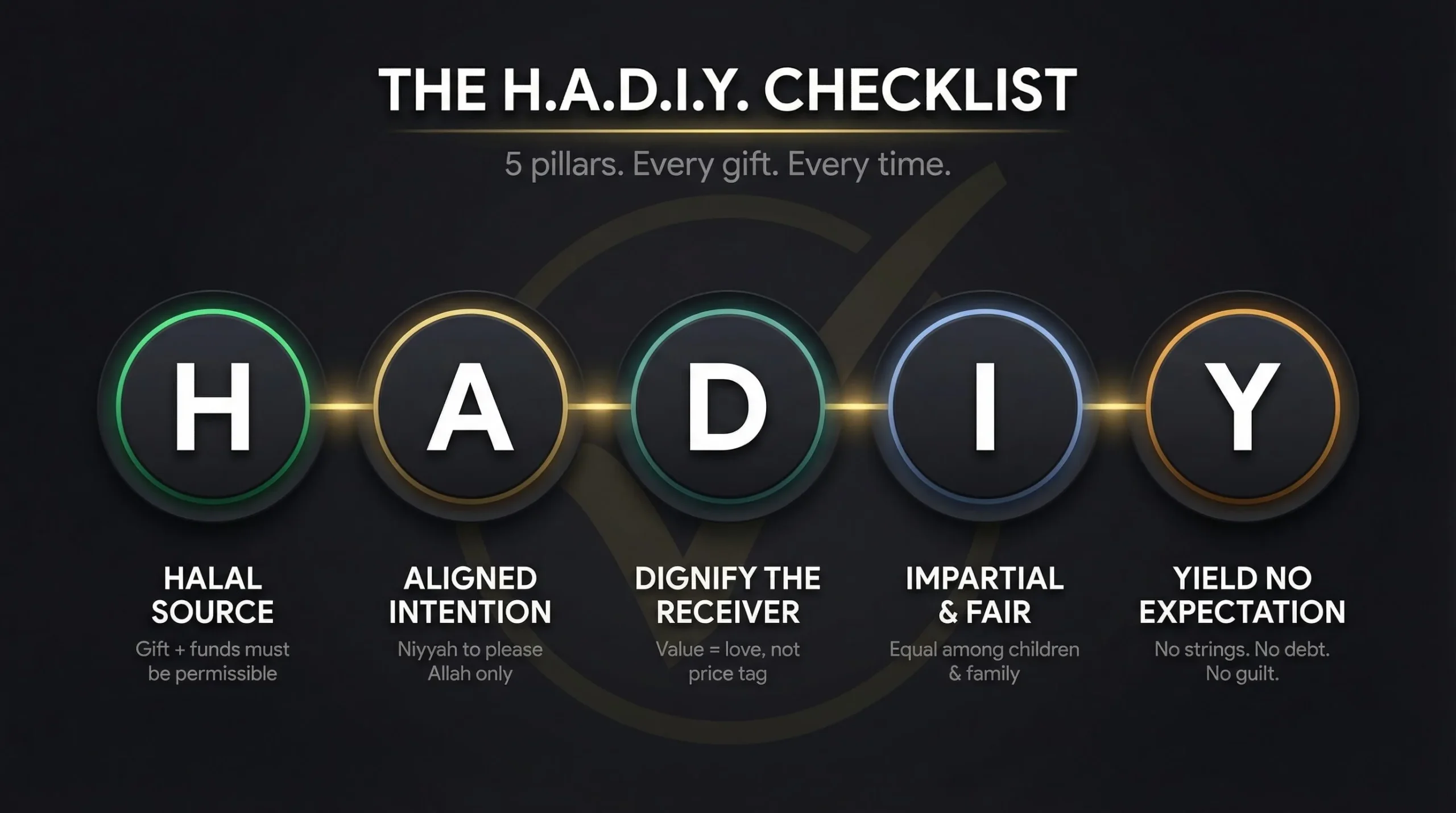
The 5 Pillars of Islamic Gift Etiquette (The H.A.D.I.Y. Framework)
There is no other source to refer to a comprehensive, easy to memorize checklist of Islamic gift etiquette that has their foundation on Hadith and the Quran. The H.A.D.I.Y. Framework bridges that gap, having five principles that are supported by a certain textual source. You may use them every time you pick, give, or take a gift.
H — Halal Source
The source of your gift and the source of the funds must be allowed. Allah warns:
وَلَا تَأْكُلُوا أَمْوَالَكُم بَيْنَكُم بِالْبَاطِلِ
“And do not consume one another’s wealth unjustly.” (Quran, Surah Al-Baqarah, 2:188)
It implies that the present itself, the alcohol, and the money to purchase the alcohol should be halal. The spiritual liability of a gift that is bought using haram profit is liability.
If you’re unsure about food gift ingredients, see our guide on halal certification standards.
A — Aligned Intention (Niyyah)
The motive of an action is just as significant as the action. Here directly applies the well-known Hadith, Actions are but by intentions. A present that is offered to flaunt, coerce or establish a debt is spiritually vacant. The bearable purpose ought to be the desire to please Allah and to enhance human relationships.
If you’re uncertain about a major gift decision, consider the Istikhara prayer for guidance.
D — Dignify the Receiver
Prophet ﷺ took the trotter of a sheep and took it with grace (Sahih al-Bukhari, Kitab al-Hibat, Hadith No. 5178). The love that prompts the giving is the true gift and the price tag does not matter. This is a two-way principle, as one must give in a manner that does justice to the receiver, and must also receive in a manner that does justice to the giver.
Wrap the gift with care. Present it warmly. Say Bismillah and pray for the receiver.
I — Impartial and Fair
The Nu’man ibn Bashir narration in Sahih Muslim (Kitab al-Hibat, Hadith No. 1623) is clear; when the Prophet ﷺ was asked to witness a gift to one child, he refused because the rest were not to receive the same. Then when you give to children, siblings or even in general, give as much as you can: and that too according to open Shariah reason.
Y — Yield No Expectation
A true gift must have no strings attached to it in the form of the giver thinking that the gifting party will feel obliged to pay back. The Imam al-Ghazali addresses this in Ihya Ulum al-Din: a gift with a condition of repayment is no Hadiyah — it is merely a sale in disguise. It is supported by the Quran in Surah Al-Baqarah 2:263: a gift and then emotional harm cancels the value of the gift.
Note: Run every gift through H.A.D.I.Y. or it’s worthless.
Fiqh of Islamic Gifts: Types, Conditions & What All 4 Madhabs Say
On top of the etiquette, there is a legal structure rooted in Islamic laws and jurisprudence. The concept of Hiba (gift) in Islamic law has certain requirements, and the four major schools — Hanafi, Maliki, Shafi’i and Hanbali — have dissimilar approaches to various points.
The Three Pillars of a Valid Gift (Hiba)
The four schools are in agreement that any Hiba must contain three elements, referred to as arkan (pillars):
- Ijab (Declaration): The giver does give the gift expressly.
- Qabul (Acceptance): It is clearly accepted by the recipient.
- Qabd (Possession): The gift is handed over.
The most strict of these is the Hanafi, who say that the gift must actually be delivered, or it will not pass. The Maliki school is more lenient in that it allows it to be counted as delivered provided that the recipient can actually have control over the thing although not necessarily holding it in his hand.
Where the Madhabs Diverge
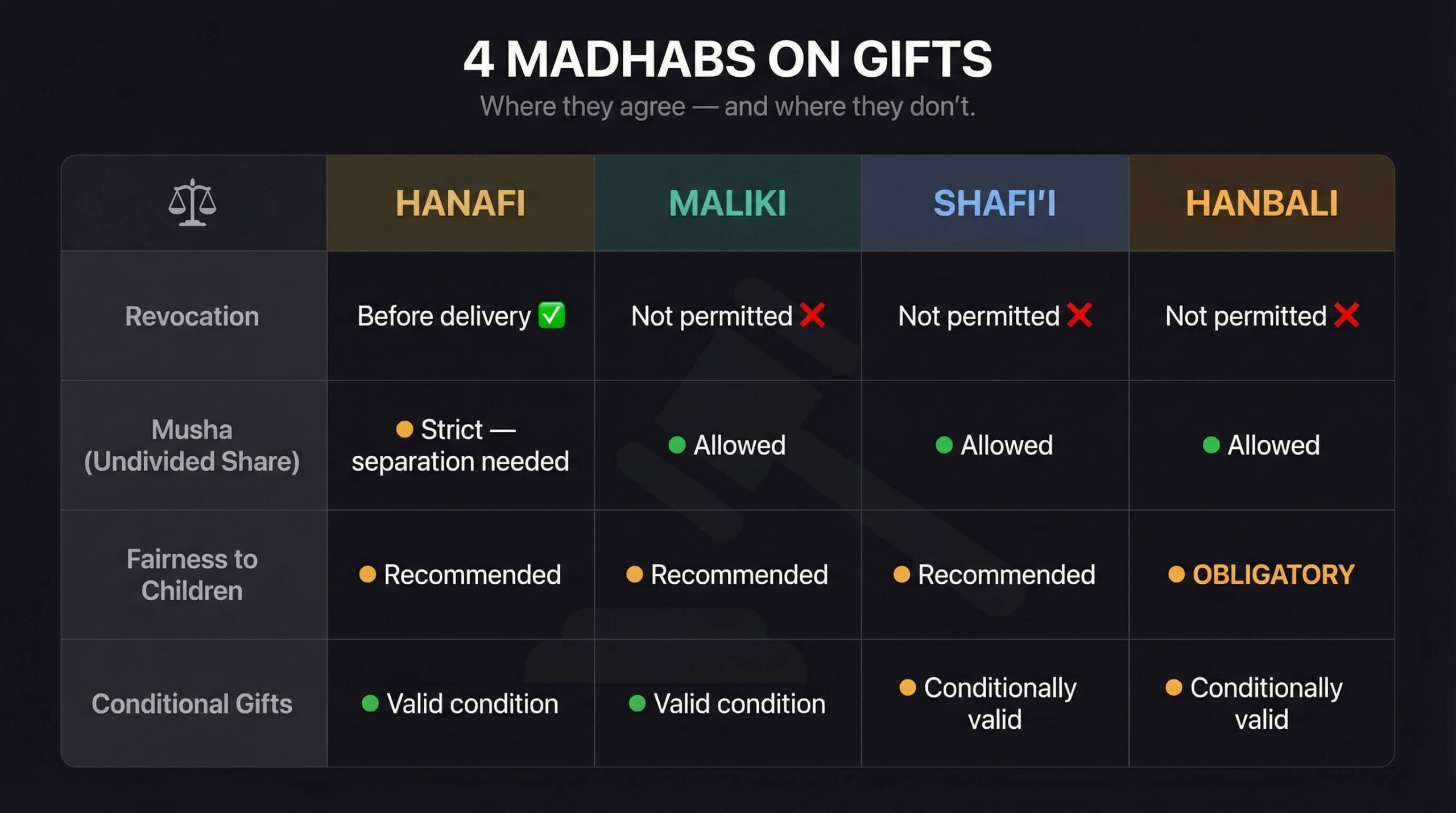
| Topic | Hanafi | Maliki | Shafi’i | Hanbali |
| Revocation of a gift | Permitted prior to delivery (under certain conditions) | Impermissible after delivery | Impermissible according to Hadith | Impermissible according to Hadith |
| Gift of Musha (undivided share) | Strict — physical separation of divisible property required | Less strict — allows undivided shares | Less strict — allows undivided shares | Less strict — allows undivided shares |
| Fairness among children | Strongly recommended | Strongly recommended | Strongly recommended | Obligatory — must be equal |
| Conditional gifts | Can be valid in particular forms (Hiba-bil-Iwaz) | Condition may render the gift voidable | Condition may render the gift voidable | Condition may render the gift voidable |
The Hanbali position towards equity among children leaps out. Where the rest of the schools hold that equal sharing is greatly recommended (mustahabb), the Hanbali school holds it is obligatory (wajib) — relying directly on the refusal of the Prophet ﷺ to witness the unequal gift in the Nu’man ibn Bashir narration (Sahih Muslim, Kitab al-Hibat, Hadith No. 1623).
The Musha Question
The gift of Musha (undivided share) is a special case of fiqh. Imam Abu Hanifa thought that divisible property such as half a piece of land that can be physically divided must be counted only when the section that is being given is physically divided off before the delivery. For indivisible property, Musha gifts are always valid (such as a house or a car), and this applies in any school.
Hiba-bil-Iwaz: When Gifts Become Exchanges
A Hiba-bil-Iwaz takes place when the two parties exchange presents with each other. Hiba is a gift of ownership without a return; when there is a condition it becomes a gift of exchange or a sale. According to the Shafi’i school, a condition which is attached is regarded as a voidance of the gift itself; the Hanafi school admits the Hiba-bil-Iwaz as an independent category — irrevocable when delivery on both sides has been met.
This implies in practice that as long as you gift someone something with you saying, I am giving you this in exchange that you give me that, it is not a Hadiyah according to most madhabs. This is strengthened in the analysis of Imam al-Ghazali in Ihya Ulum al-Din: the spiritual reward of a gift lies in the absence of expectation.
Unanimous ijma (consensus) of the four schools is that gift-giving is Sunnah. As the classical writers pointed out, this not only means that there must be lawfulness of the gifts, but that they must encourage each other to give them to each other.
These fiqh differences will provide you with the law of the land. The question to be answered practically is, what to give.
15+ Meaningful Islamic Gift Ideas for Every Occasion in 2026
Gift-giving in Islam is done as a spiritual practice, though one needs to decide on it carefully. Search results on Ramadan gifts and Islamic gifts were oriented toward products with long-term value and religious connotation and not short-term or decorative purchases. Ramadan decor trends in 2026 will not be a festival of wastefulness, they are more focused on purpose and the objects that support the process of reflection, not distraction.
Eid Gift Ideas (Eid al-Fitr & Eid al-Adha 2026)
Eid al-Adha 2026 is expected to begin evening of Tuesday 26 May or Wednesday 27 May 2026 (Dhul Hijjah 10) — confirm local moon sighting; varies by region (UK sources: 27 May).
For a complete calendar of Islamic holidays and their significance, see our dedicated guide.
Need to convert Islamic dates? See our Hijri to Gregorian date conversion guide.
- Quran gift set — mushaf that is properly bound with tafsir notes.
- Arabic perfume (attar) — in the footsteps of the Prophet ﷺ, who was fond of pleasant scent.
- Customized Islamic jewelry — jewelry that has a Quranic verse or a name inscribed with Arabic calligraphy.
- Premium dates gift box — this is a reference to the Sunnah food par excellence. Pair it with our authentic halal recipes for a complete Sunnah food experience.
- Islamic book gifts — books such as Riyad al-Salihin of Imam al-Nawawi or Ihya Ulum al-Din of Imam al-Ghazali.
Islamic Gifts for Ramadan 2026
Ramadan 2026 expected to start evening of Tuesday 17 Feb (or 18 Feb per Saudi/Asia sighting) and end evening of Wednesday 18 March — always confirm local moon sighting.
- Smart dhikr ring — modernized religious accessories that have stylish designs perfect among the young Muslims that blend technology and religion.
- Arabic calligraphy wall art — minimalistic designs in cool colors and black-and-gold frames, where interior design is combined with spirituality.
- Charity-in-your-name gift cards — giving to food drives, sponsoring an iftar meal or giving to a charitable cause in the name of a loved one.
- Ramadan journal / planner — to keep track of ibadah, goals to complete the Quran in Ramadan, and daily thoughts., and daily thoughts.
- Prayer mat gift — a quality portable musalla with compass. Make sure the compass points right — see our Qibla direction guide.
Islamic Wedding Gifts — Sunnah-Inspired Ideas for Nikah & Walimah
- Framed ayah on marriage — Surah Al-Rum 30:21 in calligraphy.
- Sadaqah Jariyah in the name of the couple — forever gifts that keep on giving blessings.
- Islamic home accessories — a wall mounted Ayat al-Kursi plaque or family dua frame.
- Halal skincare gift set — 2026 trending bridal item category.
- Marriage advice book based on Sunnah — practical sources for newlyweds.
Hajj & Umrah Gifts
- Tasbih (prayer beads) — emerald or oak wood of high quality.
- Zamzam water container — to give back pilgrims to share.
- Portable digital Quran gadget — 2026 trending product; pocket-sized and with option of reciter and translation.
- Travel prayer kit — pocket mushaf, qibla compass, compact mat. New to prayer? Start with our step-by-step guide on how to pray in Islam.
Islamic Gifts for New Muslims & Converts
- A translation of the Quran in easy-to-understand English and with contextual commentaries. Start them with the very first chapter — our Surah Al-Fatihah translation and tafsir.
- Islamic basics book set — Salah, Wudu (see our step-by-step Wudu guide), and basic Aqeedah.
- Individual welcome package — tasbih, bookmark including important duas such as the morning and evening duas, and letter of welcome.
- Gift cards on an online source of Islamic learning — access to the courses at SeekersGuidance, Bayyinah Institute, or other facilities.
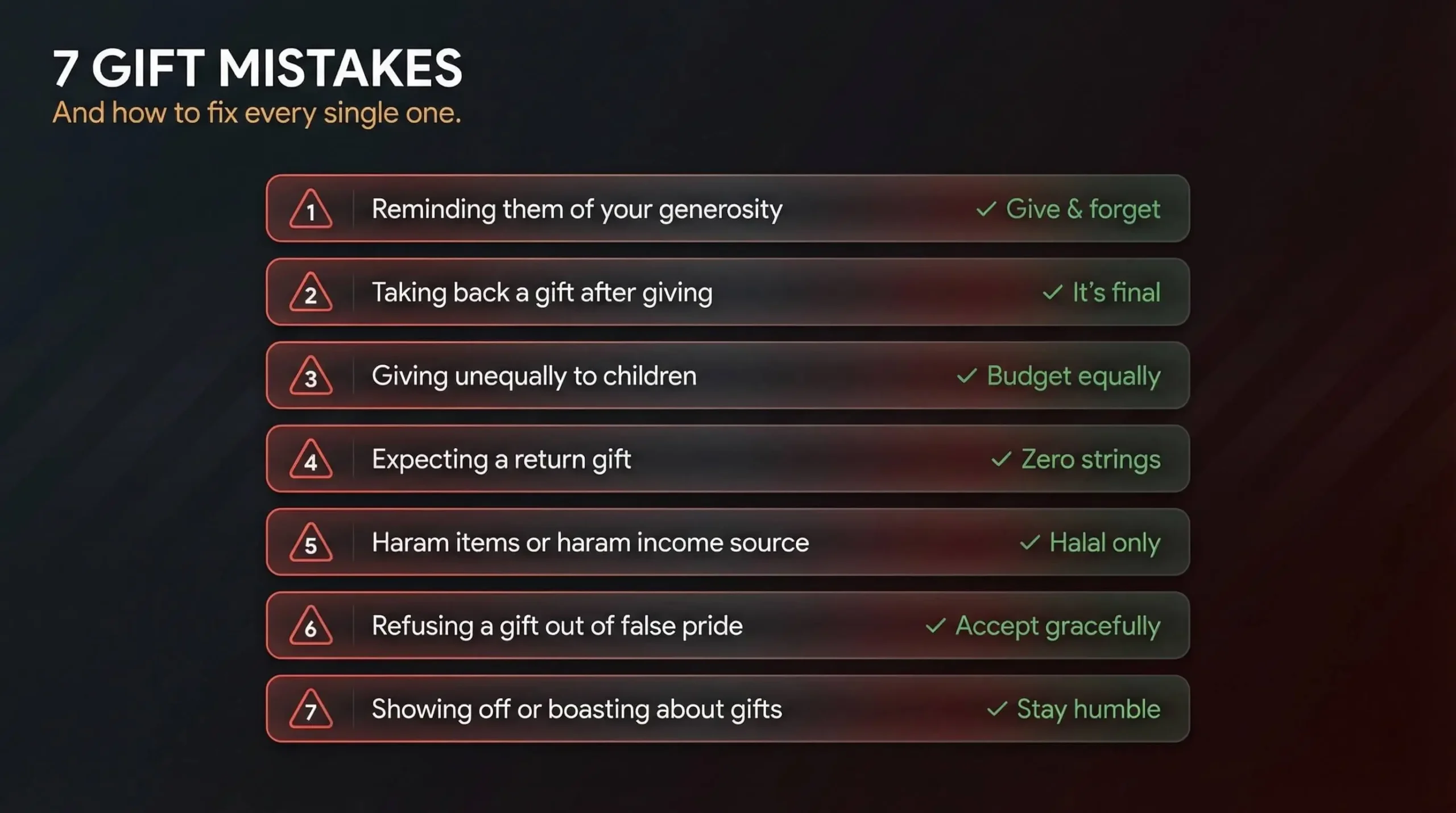
7 Common Mistakes Muslims Make When Giving Islamic Gifts (And the Fix)
Gift-giving appears quite direct but there are a number of common mistakes which are in conflict with prophetic teachings. Each of the errors listed below is accompanied by its correction using the Hadith.
Mistake #1: Reminding the Recipient of Your Generosity
This is covered in the Quran:
قَوْلٌ مَّعْرُوفٌ وَمَغْفِرَةٌ خَيْرٌ مِّن صَدَقَةٍ يَتْبَعُهَا أَذًى
“Kind words and forgiveness are better than charity followed by injury.” (Quran, Surah Al-Baqarah, 2:263)
Talking about your gift to others, raising it in an argument, and taking advantage of it is against the basic adab (etiquette) in giving. The remedy: After you give the gift out of your hands, free yourself of recognition.
Mistake #2: Taking Back a Gift After Giving It
The Prophet ﷺ likened the person who takes back a gift to a dog that swallows its own vomit (Sahih Muslim, Kitab al-Hibat, Hadith No. 1622). Raj’ (revocation) is highly discouraged in all madhabs. The only exception provided by Sahih Muslim is that a father can withdraw a gift to his child when it is against Shariah principles — and even then, it has hard requirements.
Mistake #3: Giving Unequally Among Children
The Nu’man ibn Bashir narration (Sahih al-Bukhari, Hadith No. 2587; Sahih Muslim, Hadith No. 1623) makes this clear. When you purchase an Eid gift for one child and not the others, or you spend a lot more on a favorite child, the Hanbali school would regard this as impermissible whereas the other three schools would highly dislike (makruh) the same.
The remedy: budget on the gifting, to ensure that all the children share the same amount or wait till you can.
Mistake #4: Giving With the Expectation of a Return Gift
Such an error may even cancel the reward. According to Imam al-Ghazali, as he describes in Ihya Ulum al-Din, something that is offered as a gift must not be offered expecting that he or she will give something back. Hadiyah with strings is re-categorized — it is not a high worship act but a transaction.
Mistake #5: Giving Haram Items or From Haram Income
Alcohol, non-halal foodstuffs, products with inappropriate images — these go against the H.A.D.I.Y. Framework’s H. The gift should be halal and even the money one used to buy the gift should be halal (Quran, Surah Al-Baqarah, 2:188).
Mistake #6: Refusing a Gift Out of False Humility
The Prophet ﷺ received all the gifts including a trotter of a sheep (Sahih al-Bukhari, Kitab al-Hibat, Hadith No. 5178). To reject a halal gift, particularly one of a modest kind, is to offend one who is offering it, and is against the Sunnah.
The solution: it only requires saying it with a smile, Jazaak Allahu Khairan, and, hopefully, repaying what you have taken.
Mistake #7: Showing Off or Boasting About a Gift
It is not so nice to display a luxury gift, in front of others, in an attempt to enhance your social status. It eliminates the spiritual atmosphere of the act. One of the hadiths states, an ostentatious person who boasts of a virtue he does not possess is like one who wears two garments of falsehood (Sunan Abu Dawud, Hadith No. 4997; Sunan al-Tirmidhi, Hadith No. 2393).
Scores of us believe that we are good because we avoid haram things but this is not the real gift etiquette since it is all about intentions and balance as well as humility and commitment. The seven tweaks can make an ordinary practice into a real worship practice.
Can You Give Islamic Gifts to Non-Muslims? The Ruling You Need to Know
And therefore you happen to be in a majority-non-Muslim neighborhood, and one of your colleagues invites you to his/her party, should you come with something? And what if they hand you one?
The fundamental principle is provided in the Quran:
لَّا يَنْهَاكُمُ اللَّهُ عَنِ الَّذِينَ لَمْ يُقَاتِلُوكُمْ فِي الدِّينِ وَلَمْ يُخْرِجُوكُم مِّن دِيَارِكُمْ أَن تَبَرُّوهُمْ وَتُقْسِطُوا إِلَيْهِمْ ۚ إِنَّ اللَّهَ يُحِبُّ الْمُقْسِطِينَ
“Allah does not forbid you from those who do not fight you because of religion and do not expel you from your homes — from being righteous toward them and acting justly toward them. Indeed, Allah loves those who act justly.” (Quran, Surah Al-Mumtahanah, 60:8)
This verse in essence declares, and a few scholars interpret it as a green light, that we may be generous, such as in the gift-giving, towards non-believers who are not antagonistic. Even the Kitab al-Hibat of Sahih al-Bukhari includes a chapter devoted to non-Muslim leaders and their presents.
Majority of scholars are fine with this. The European Council for Fatwa and Research stated that it is permissible, and it can soften the hearts. Sheikh Ibn Baz, Sheikh Ibn Jibreen, and Sheikh Salih al-Fawzan are all in support of gifting to non-Muslims.
Exception — it is not any social gift, but a holiday gift. You are not allowed to give gifts that are part of a non-Muslim religious festival, says Ibn Taymiyyah; the European Council clarified that during the holiday, you are not supposed to give gifts that specifically participate in the religious celebration. It is not a simple social gift as one would give to a friend or neighbor.
In practice:
- Offering a non-Muslim neighbor a food basket during Ramadan ➜ permitted and encouraged.
- Receiving a non-Muslim colleague’s birthday gift ➜ okay most scholars agree.
- Gifting that participates in a non-Muslim religious event ➜ disputed — safer to be cautious and perhaps consult a local scholar.
The Permanent Committee for Research and Fatwa said: there is nothing wrong with receiving a gift…. respond with a gift or pray for them. That is regardless of who is the giver.
This includes inter-religious matters, but what of those presents whose origin is dubious? That is a hard position that requires special attention.
Gifts From Haram Sources: What the Scholars Actually Say
Imagine that somebody presents you with a gift and you believe that they might have earned money doing something that you do not approve. Do you refuse? Will accepting it make you complicit?
These edge cases are often omitted by people who do not want to know what is happening. According to the classical position, as represented by Imam al-Suyuti in the work al-Ashbah wa al-Naza’ir, there is nothing haram about doing business with someone who makes a partial haram and a partial halal income so long as it is impossible to determine the former. In case you are not able to determine whether the gift has been purchased using illegal money, then you can receive the gift.
The Quran remains very firm:
وَلَا تَأْكُلُوا أَمْوَالَكُم بَيْنَكُم بِالْبَاطِلِ
“And do not consume one another’s wealth unjustly.” (Quran, Surah Al-Baqarah, 2:188)
And therefore, in case you know that the gift is of stolen goods, usury income you can point to, or of any known illegal funds, you must not accept it.
The scholars present three levels:
- Clear halal source: No doubt — accept.
- Mixed/unknown source: Default to acceptance — the presumption of halal is safer (istishab).
- Known haram source: Decline and explain politely, should you be able.
Upon one occasion when Umar ibn Abdul-Aziz was asked about gifts to officials he replied that it was a gift because the Prophet ﷺ was alive, but today it is a bribe. This statement was referring to presents to officials and not presents between friends. Making regular use of it in a general context misapplies the adage.
That being said, you can respond to the most popular questions about Islamic gifts.
FAQ — Your Top Questions About Islamic Gifts Answered
What does Islam say about giving gifts?
Gift giving is an established Sunnah: the Prophet ﷺ said, give one another gifts and you will love one another (Al-Adab al-Mufrad, Hadith No. 594). Generosity is also loved by the Quran (Surah Al-Baqarah 2:272). The four schools do not disagree on the fact that giving of gifts is advisable and spiritually rewarded when it comes with purity of heart.
Is gift-giving Sunnah in Islam?
Yes, there’s a consensus. Imam al-Bukhari devoted a whole chapter to Kitab al-Hibat. Prophet ﷺ used to give and take gifts on a regular basis and according to Aa’ishah’s account, he never failed to give back (Sahih al-Bukhari, Hadith No. 2585).
What is the Hadith about exchanging gifts?
The principal one: “Give gifts to one another, and you will love one another” (Al-Adab al-Mufrad, Hadith No. 594). Sunan al-Tirmidhi (Hadith No. 2130) continues, “Exchange gifts with one another. Gifts remove ill-feelings from the hearts.” The two present gifts as a means to create love and resolve hatred.
What is the best gift in Islam?
The most Islamic gift is not about the cost, it is all about the intention. The Prophet ﷺ did not concern himself with cost and even accepted the trotter of a sheep (Sahih al-Bukhari, Hadith No. 5178). Following the H.A.D.I.Y. principles as a checklist: it should have a halal origin, have a sincere intention, honor the person who receives it, be presented fairly, and be given without any expectation of return. The examples can be seen through the Quran gift sets, Islamic books, and Sadaqah Jariyah donations. A Quran gift set including Surah Yaseen — the Heart of the Quran — makes a particularly meaningful present.
Can Muslims accept gifts from non-Muslims?
Absolutely. The Kitab al-Hibat in Sahih al-Bukhari depicts the Prophet ﷺ receiving gifts from leaders who were not Muslims. It is confirmed by such scholars as Sheikh Ibn Baz, Sheikh Ibn Jibreen, Sheikh Salih al-Fawzan, and even the European Council for Fatwa and Research. The only grey area is the gifts that are directly related to non-Muslim religious rites and the opinions are divided.
What is the difference between Hadiyah and Sadaqah?
Anyone, whether rich or poor, is presented with a gift (Hadiyah) to honor him/her out of love or respect. Sadaqah (charity) is directed towards the poor and it is geared towards pleasing Allah. A Hadiyah is reciprocal, and it is relational, whereas Sadaqah is solely devotional and is irreversible.
Is it haram to take back a gift in Islam?
It is highly disapproved of a gift that is returned (Raj’). The Prophet ﷺ compared it to a dog swallowing its own vomit (Sahih Muslim, Kitab al-Hibat, Hadith No. 1622). The only exceptions are when a father revokes a gift to his child under certain circumstances and some cases in the Hanafi jurisprudence where they can revoke before delivery.
What gifts did Prophet Muhammad ﷺ give?
The Prophet presented perfume (attar), dates, clothing and food. He would always give back in return as given out in Sahih al-Bukhari, Hadith No. 2585. How inclusive the practice was is also shown by the fact that he accepted gifts from non-Muslim rulers, including al-Muqawqis of Egypt.
What is Hiba in Islamic law?
Hiba refers to the legal term of voluntary transfer of ownership without compensation. It is based on three pillars, namely, Ijab (declaration), Qabul (acceptance), and Qabd (delivery). The Hanafi school emphasizes physical delivery and the Maliki school allows constructive delivery.
Is it mandatory to give gifts equally to children?
According to Hanbali scholars, it is wajib (obligatory), based on the narration of Nu’man ibn Bashir (Sahih al-Bukhari, Hadith No. 2587; Sahih Muslim, Hadith No. 1623) in which the Prophet ﷺ declined to witness inequitable giving. Equal distribution is considered as highly recommended (mustahabb) but not compulsory by Hanafi, Maliki, and Shafi’i schools of thought. The four all concede that favouritism in gifts is reprehensible.
What are good Islamic gifts for weddings?
The best Islamic wedding gifts carry spiritual significance alongside practical value. Top choices include a framed ayah on marriage (Surah Al-Rum 30:21) in calligraphy, Sadaqah Jariyah donated in the name of the couple, Islamic home accessories such as an Ayat al-Kursi wall plaque, a halal skincare gift set, or a marriage advice book based on Sunnah principles. The key is to choose something that benefits both the couple’s household and their akhirah.
What are the best Islamic gifting ideas for Ramadan?
The best Ramadan gifts in 2026 combine spiritual purpose with daily usefulness. Popular options include a smart dhikr ring, Arabic calligraphy wall art, a charity-in-your-name gift card sponsoring an iftar meal, a Ramadan journal or planner for tracking ibadah and Quran reading goals, and a quality portable prayer mat with compass. The Sunnah emphasis is always on gifts that draw the recipient closer to worship rather than distraction.
Planning Ramadan gifts? Don’t miss our Laylatul Qadr worship guide to maximize the last ten nights.
The Gift That Keeps Giving: How to Make Your Islamic Gift a Sadaqah Jariyah
The greatest Islamic present is one which still continues to pay you even after giving. Sadaqah Jariyah transforms one act to a continuous act of Godly good.
A Quran gift set presented to an individual who reads it daily continues to bring reward — the more letters he reads the more spiritual returns. A book on Islam, which shows one how to pray, continues to earn reward each time he or she prays. Teaching someone how to pray Taraweeh through a gifted book earns you reward every Ramadan they pray it. A well, a school or a food program funded by a charity-in-your-name contribution has an infinite benefit.
Three of the rewards that the Prophet ﷺ emphasized to continue after death include perpetual charity, useful knowledge, and a righteous child who prays for the deceased. An intelligent Islamic present may activate all three — knowledge (a Quran), continuous charity (a donation) and inspiring righteous deeds.
This summary reveals the fact that Islamic gifts operate simultaneously at several levels, namely, spiritual (niyyah and taqwa), legal (Hiba conditions and madhhab specifics), social (strengthening relationships and eliminating ill will), and eternal (Sadaqah Jariyah). The overall scholarly opinion views the gift-giving as a strongly recommended Sunnah whose encouragement by the Prophet ﷺ is definite, and the rules governing the subject in fiqh might differ between the Hanafi, Maliki, Shafi’i and Hanbali schools.
The second thing you need to do is practical: what you need to give, you should put it through the H.A.D.I.Y. checklist. Select something that is in accordance with Sunnah, has good intention, and hopefully, it qualifies as Sadaqah Jariyah.
This is the only complete, verified 2026 guide. Run every gift through H.A.D.I.Y. Apply now. Wallahu a’lam — ask your local scholar.