About the Author: Fahad Nawaz is a Multan based Researcher compiling authentic sources from sahih Bukhari, Tirmidhi, and scholars like Ibn Taymiyyah.
For questions about this article or to suggest updates, contact: [email protected]
To convert to Islam, sincerely declare the Shahada: “Ash-hadu an la ilaha illa Allah, wa ash-hadu anna Muhammadan rasul Allah” — meaning “I bear witness there is no god but Allah, and Muhammad is His Messenger.” No witnesses, ceremony, or Arabic fluency is required. Once said with genuine belief, you are Muslim and all past sins are forgiven (Sahih Muslim, Hadith No. 121).
While this answer is technically complete, most conversion guides stop here — and that’s where they fail you. Classical scholars like Hafidh al-Hakami identified seven conditions for the Shahada in his work Ma’arij al-Qabool — yet most popular conversion guides don’t mention a single one.
Those seven conditions will be expounded with supporting verses of the Quran and Hadith, a comprehensive step by step conversion process, a madhhab by madhhab comparison of the positions of the scholars, a list of the pitfalls that many new followers should avoid, and a thirty day guide in the next section. All the claims are based on the Quran, approved Hadith, or titled academic authority.
This guide attempts to bring out the current academic way of thinking. At the points of disagreement, we put emphasis on various opinions. Readers are always encouraged to consult a qualified scholar regarding personal matters.
What Does It Really Mean to ‘Convert’ (or ‘Revert’) to Islam?
The Arabic root lexical s-l-m means submission to God, as well as peace. Being a Muslim means submitting your will to Allah alone — the same timeless message delivered by every Prophet from Adam to Muhammad (peace be upon him).
وَلَقَدْ بَعَثْنَا فِى كُلِّ أُمَّةٍۢ رَّسُولًا أَنِ ٱعْبُدُوا۟ ٱللَّهَ وَٱجْتَنِبُوا۟ ٱلطَّـٰغُوتَ
“And We certainly sent into every nation a messenger, [saying], ‘Worship Allah and avoid Taghut (false gods).'”
(Quran, Surah An-Nahl, 16:36)
To explore more about the depth and beauty of this faith, see these 50 interesting facts of Islam.
What makes Islam unique among world religions is the concept of fitra (innate disposition). The Prophet (peace be upon him) in both Sahih al-Bukhari and Sahih Muslim, said that every child was born upon the fitra which is the natural disposition to the knowledge of the single God. The Quran then asserts:
فَأَقِمْ وَجْهَكَ لِلدِّينِ حَنِيفًۭا ۚ فِطْرَتَ ٱللَّهِ ٱلَّتِى فَطَرَ ٱلنَّاسَ عَلَيْهَا
“So direct your face toward the religion, inclining to truth. [Adhere to] the fitrah of Allah upon which He has created [all] people.”
(Quran, Surah Ar-Rum, 30:30)
Converting to Islam, then, is not adopting a foreign creed — it’s returning to the original state you were born in, before the world led you away from it.
The principle of Dawah (reaching out to other people to the faith) is based on the following premise: all human beings have the ability to perceive Tawhid (Oneness of God) since they were given this ability even before birth.
Convert vs. Revert — Which Term Is Correct (And Does It Matter)?
The two terms are commonly used and there is no individual term that is inherently wrong. The standard English term of a person changing religious affiliation is convert. On the other hand, revert has become an expression of choice among a number of those who are converting to Islam and it is based on the concept of the fitra hadith, which teaches that embracing Islam is actually a return to your original nature, not a departure into something new.
The decision on the use of terminologies is also a matter of choice. There are those who consider the word revert deeper; there are those who appreciate the meaning of the word convert. Sheikh Yasir Qadhi has noted that they are both acceptable and the content of what a person believes is of much more relevance than the name given to the spiritual path taken.
Having learned better the actual meaning of conversion in Islam, the next thing to do is to manoeuvre through the practical process; start with the one most far-reaching sentence you will ever utter.
How to Convert to Islam: The 5-Step Process (With Evidence)
The conversion to Islam is not complex, whereas every stage has a heavy meaning. Here’s the process in a precise manner at every step with evidence being provided at every point.
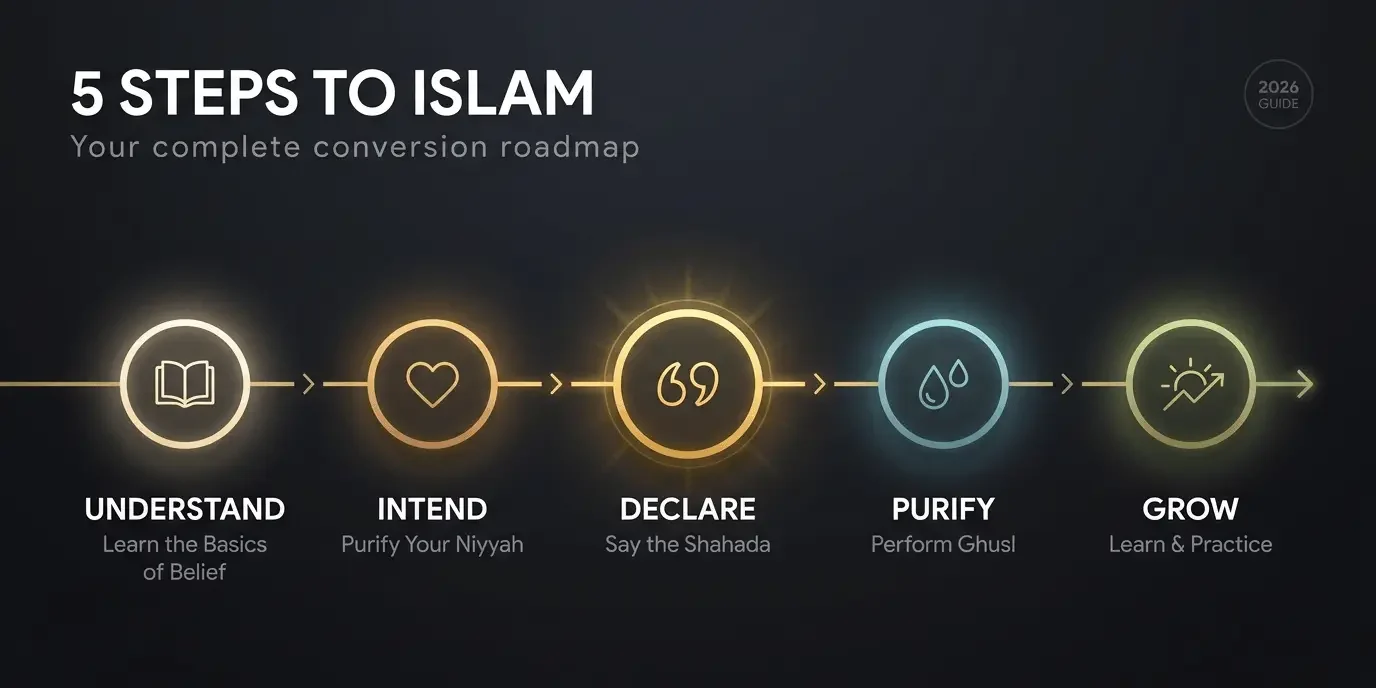
Step 1 — Understand What You’re About to Declare (Islamic Belief Basics)
Before professing the Shahada, it is important to know the principles behind what you are professing. These are not arbitrary requirements but they represent the nature of a Muslim which is spelt out in the form of Aqeedah (creed).
These pillars are outlined in the famous Hadith of Jibril (Gabriel). When angel Jibril appeared in the shape of a man and asked the Prophet (peace be upon him) about Islam, Iman, and Ihsan, the Prophet (peace be upon him) defined Iman (faith) by saying that it was a belief in:
- Allah — One God, no partners (Tawhid)
- Angels — servants of God, performing the will of God
- Divine Books — These are the Torah, Psalms, Gospel and the Quran
- Prophets — From Adam till Muhammad (peace be upon him) Many people coming from a Christian background ask: does Islam believe in Jesus? — the answer may surprise you.
- The Day of Judgment — The Responsibility in the Hereafter
- Divine Decree (Qadar) — The belief that everything, both good and bad is pre-determined by the will of Allah
(Narrated by Abu Hurayrah, Sahih al-Bukhari, Hadith No. 50 and Sahih Muslim, Hadith No. 8 — Sahih)
There is no need to engage in a wholesome encyclopaedic mastery of every point. The thing that is absolute is a pure, basic understanding.
Step 2 — Intend (Niyyah) Sincerely
According to the Islamic jurisprudence, all acts are based on intent; the niyyah is the ethical and theological basis of the action. As narrated by the Prophet ﷺ:
“Actions are judged by intentions, and everyone will be rewarded according to their intentions.”
(Narrated by Umar ibn al-Khattab, Sahih al-Bukhari, Hadith No. 1, and Sahih Muslim, Hadith No. 1907 — Sahih)
As a result, the niyyah of a Muslim to become a Muslim is supposed to be towards Allah, without any other unnecessary desires like marriage, wealth, and worldly recognition. Without pure intention, the Shahada remains just words. With it, those same words become an act of worship.
If you’re seeking divine guidance before making this decision, learn about the Istikhara dua — the prayer of guidance.
Step 3 — Say the Shahada with Conviction
The Shahada is the Islamic declaration of faith, consisting of two testimonies:
In Arabic:
أشهد أن لا إله إلا الله وأشهد أن محمداً رسول الل
Ash-hadu an la ilaha illa Allah, wa ash-hadu anna Muhammadan rasul Allah.
In English:
I testify that there is no god but Allah, and I testify that Muhammad is the Messenger of Allah.
A single sincere recitation of the Shahada is all it takes to become Muslim as per the consensus of classical jurisprudence. The Prophet ﷺ made the profession of faith the first of the five pillars:
“Islam is built upon five [pillars]: the testimony that there is no deity worthy of worship except Allah and that Muhammad is the Messenger of Allah, establishing prayer, giving Zakah, fasting Ramadan, and performing Hajj.”
(Sahih al-Bukhari, Hadith No. 8 and Sahih Muslim, Hadith No. 16 — Sahih)
The issue of witnesses is controversial among the scholars; most authorities in all four Sunni madhabs believe in the fact that the declaration does not necessarily require any external witness, especially in the case of persons in isolation. However, uttering the Shahada in a mosque or in the presence of other Muslims offers the communal approval, a record of documentation and the spiritual unity of the ummah.
Step 4 — Ghusl (Full-Body Purification)
Ghusl — the full-body purification bath — is recommended by the majority of scholars as a symbolic cleansing of past sins and the start of a new spiritual life. An example of the teaching of the Prophet concerning ghusl is the hadith of Thumama bin Uthal (Sahih al-Bukhari, Hadith No. 4372 — Sahih): that the new convert to Islam takes ghusl.
The schools vary in their jurisprudential position:
| Madhab | Position on Ghusl |
| Hanafi | Recommended (Mustahabb) |
| Shafi’i | Obligatory (Wajib) as per the stronger opinion |
| Maliki | Recommended |
| Hanbali | Obligatory as per the stronger opinion |
Although there might be conflicting views of scholars, ghusl is an admirable ritual that marks the new beginning of Islamic life.
After ghusl, daily purification before prayer is performed through Wudu. See our step-by-step Wudu guide with pictures and common mistakes to learn how.
Step 5 — Start Educating Yourself about Your Obligations
When the Shahada is pronounced, a life-long course of learning takes place. Scholars call this your first mission: learning what is personally obligatory (Fard al-‘Ayn). This includes education on performance of Salah, understanding of main tenets of the performance of Salah and knowledge of the five pillars of Islam that form the foundation of the daily life of a Muslim.
You do not have to study all the things at once. The Quran also helps believers to have good news:
يُرِيدُ ٱللَّهُ بِكُمُ ٱلْيُسْرَ وَلَا يُرِيدُ بِكُمُ ٱلْعُسْرَ
“Allah intends for you ease and does not intend for you hardship.”
(Quran, Surah Al-Baqarah, 2:185)
However, prior to hastening passionately along the pillars, scholars determine a list of conditions that are essential to the validity of the Shahada, which is a section that many conversion primers tend to leave out.
The 7 Conditions of the Shahada That Most Guides Completely Ignore
This is an item that is absent in most textbook manuals, but is perhaps the most important one:
To give the statement La ilaha illa Allah is easy, but the classical scholars always emphasize that the statement has presuppositions, which are of Quranic and Sunnah origin and without these presuppositions the words are not enough to perform their duty.
Wahb ibn Munabbih, the distinguished early scholar and Tabi’i, was once asked: “And is the saying La ilaha illa Allah the gateway to Paradise?” Yes, he responded, but all keys are ridged. The door will open to you in case you come with the key that has the right ridges. When you come with a key that is not ridged, the door will not be opened to you.
Al-Bukhari records this in his Sahih (2/71), al-Asma wa al-Sifat of al-Bayhaqi (1/274) and Hilyat al-Awliya (4/66).
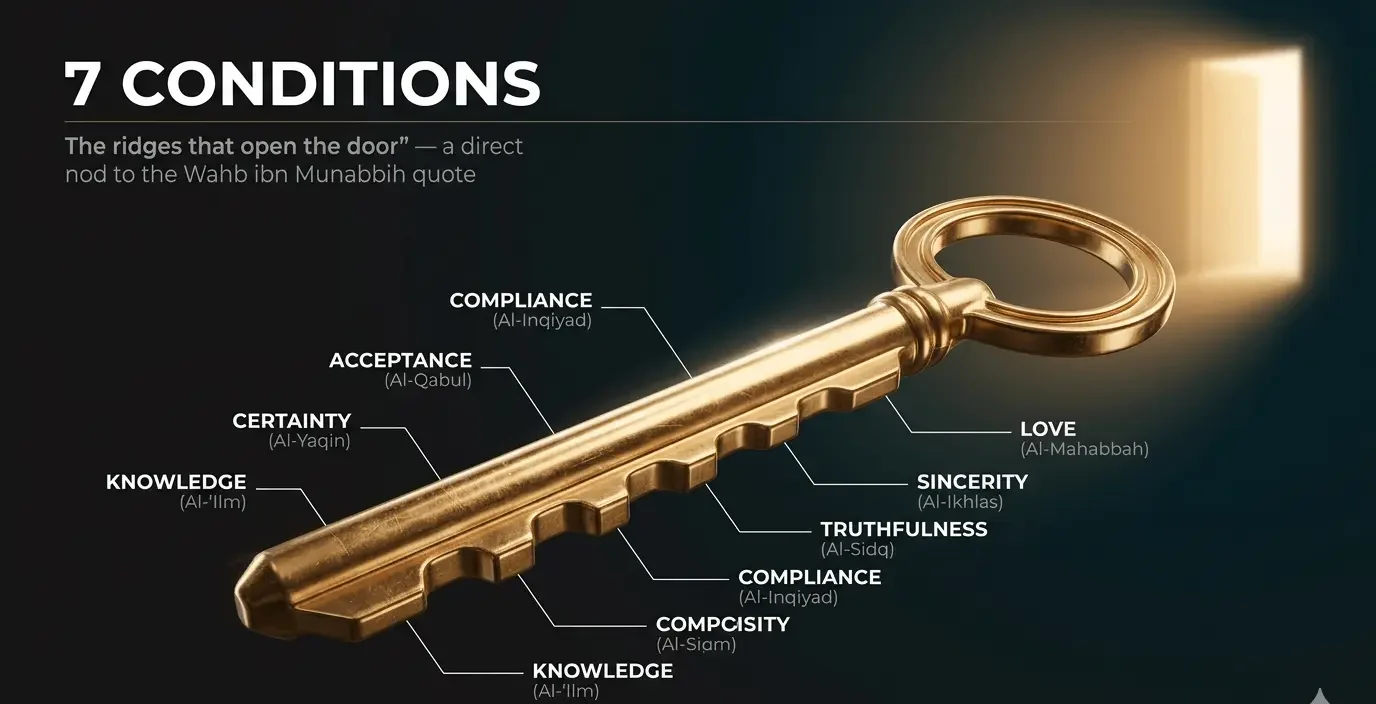
The seven conditions, which were classified by the classical scholar Hafidh al-Hakami in the work called Ma’arij al-Qabool are:
1. Al-‘Ilm (Knowledge)
You should clearly understand what is meant by the term La ilaha illa Allah, which is that nothing is worthy of worship, except Allah. Without knowledge a proclamation is worthless.
فَٱعْلَمْ أَنَّهُۥ لَآ إِلَـٰهَ إِلَّا ٱللَّهُ وَٱسْتَغْفِرْ لِذَنۢبِكَ
“So know, [O Muhammad], that there is no deity except Allah and ask forgiveness for your sin.”
(Quran, Surah Muhammad, 47:19)
2. Al-Yaqin (Certainty)
Once one has come to gain knowledge, he/she has to have a sense of being highly certain—devoid of doubt—that this is a true testament. Imam al-Nawawi uses this verse to prove this condition:
إِنَّمَا ٱلْمُؤْمِنُونَ ٱلَّذِينَ ءَامَنُوا۟ بِٱللَّهِ وَرَسُولِهِۦ ثُمَّ لَمْ يَرْتَابُوا۟ وَجَـٰهَدُوا۟ بِأَمْوَٰلِهِمْ وَأَنفُسِهِمْ فِى سَبِيلِ ٱللَّهِ
“The believers are only the ones who have believed in Allah and His Messenger and then doubt not but strive with their properties and their lives in the cause of Allah.”
(Quran, Surah Al-Hujurat, 49:15)
In Sahih Muslim, the Prophet ﷺ said:
“Whoever you meet behind this wall, bearing witness that there is no deity except Allah, with certainty in their heart, give them glad tidings of Paradise.”
(Sahih Muslim, Hadith No. 31 — Sahih)
3. Al-Qabul (Acceptance)
Awareness and certitude must be with voluntary acceptance—an acceptance of truth done with mouth and heart, without opposing it or denying it.
إِنَّهُمْ كَانُوٓا۟ إِذَا قِيلَ لَهُمْ لَآ إِلَـٰهَ إِلَّا ٱللَّهُ يَسْتَكْبِرُونَ وَيَقُولُونَ أَئِنَّا لَتَارِكُوٓا۟ ءَالِهَتِنَا لِشَاعِرٍۢ مَّجْنُونٍۭ
“Indeed, when it was said to them, ‘There is no deity but Allah,’ they were arrogant. And they said, ‘Are we to leave our gods for a mad poet?'”
(Quran, Surah As-Saffat, 37:35-36)
4. Al-Inqiyad (Compliance)
As long as acceptance is in the heart, the action has to be followed. The Shahada requires a person to conform his or her worship, behavior and priorities to the confession.
وَمَن يُسْلِمْ وَجْهَهُۥٓ إِلَى ٱللَّهِ وَهُوَ مُحْسِنٌۭ فَقَدِ ٱسْتَمْسَكَ بِٱلْعُرْوَةِ ٱلْوُثْقَىٰ
“And whoever submits his face to Allah while being a doer of good has grasped the most trustworthy handhold.”
(Quran, Surah Luqman, 31:22)
5. Al-Sidq (Truthfulness)
It has to be honest, lacking in deception or mere convenience of speech. The hypocrites of Madinah said the Shahada with their lips, but not their heart; Allah led them to their senses.
أَحَسِبَ ٱلنَّاسُ أَن يُتْرَكُوٓا۟ أَن يَقُولُوٓا۟ ءَامَنَّا وَهُمْ لَا يُفْتَنُونَ
“Do the people think that they will be left to say, ‘We believe’ and they will not be tested?”
(Quran, Surah Al-Ankabut, 29:2-3)
6. Al-Ikhlas (Sincerity)
The intention has to be innocent and directed towards Allah only and is devoid of shirk.
قُلْ إِنِّىٓ أُمِرْتُ أَنْ أَعْبُدَ ٱللَّهَ مُخْلِصًۭا لَّهُ ٱلدِّينَ
“Say, ‘Indeed, I have been commanded to worship Allah, [being] sincere to Him in religion.'”
(Quran, Surah Az-Zumar, 39:11)
The Prophet ﷺ has pointed out:
“The one who will be most deserving of my intercession on the Day of Judgment is the one who said La ilaha illa Allah sincerely from his heart.”
(Sahih al-Bukhari, Hadith No. 99 — Sahih)
7. Al-Mahabbah (Love)
Lastly, the Shahada should be motivated by love—love to Allah, love to his Messenger ﷺ and love to the truth—which is above love to anything.
وَمِنَ ٱلنَّاسِ مَن يَتَّخِذُ مِن دُونِ ٱللَّهِ أَندَادًۭا يُحِبُّونَهُمْ كَحُبِّ ٱللَّهِ ۖ وَٱلَّذِينَ ءَامَنُوٓا۟ أَشَدُّ حُبًّۭا لِّلَّهِ
“And [yet], among the people are those who take other than Allah as equals [to Him]. They love them as they [should] love Allah. But those who believe are stronger in love for Allah.”
(Quran, Surah Al-Baqarah, 2:165)
The Prophet ﷺ has stated:
“None of you truly believes until I am more beloved to him than his father, his child, and all of mankind.”
(Sahih al-Bukhari, Hadith No. 15 — Sahih)
These seven conditions do not compel one to scholar status prior to conversion. Instead, they demand the Shahada to be enlightened, heartfelt, full throttle and life changing—more than just words.
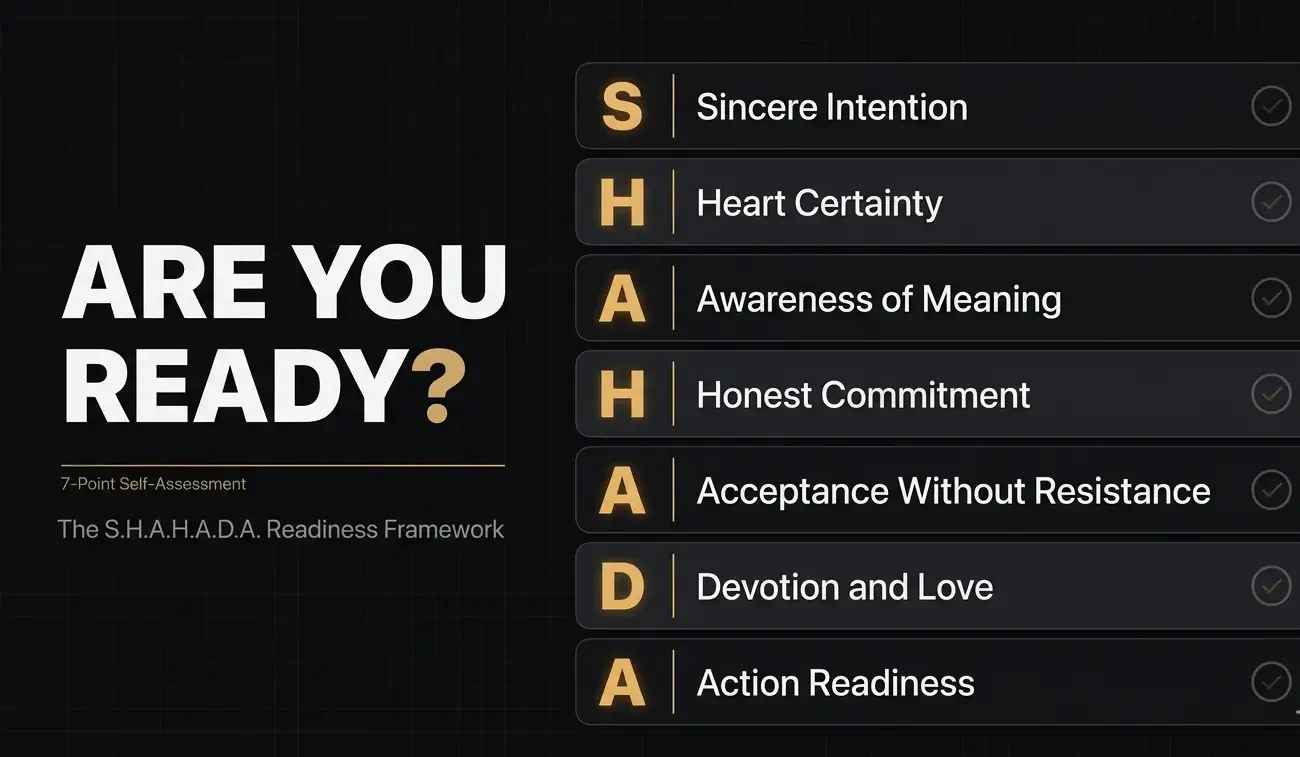
The S.H.A.H.A.D.A. Readiness Framework
Before making your declaration, use this simple framework to assess your readiness:
S — Sincere Intention: Are you converting for Allah alone, not for marriage, social acceptance, or other worldly reasons?
H — Heart Certainty: Do you believe, without doubt, that Allah is the only God and Muhammad ﷺ is His final Messenger?
A — Awareness of Meaning: Do you understand what the Shahada means, not just the words?
H — Honest Commitment: Are you willing to align your life with this declaration?
A — Acceptance Without Resistance: Do you accept Islam’s core teachings without internal opposition?
D — Devotion and Love: Do you feel drawn to Allah, His Messenger ﷺ, and the truth of Islam?
A — Action Readiness: Are you prepared to begin learning your obligations (starting with prayer)?
If you can answer “yes” to these seven points, you are ready. If some feel uncertain, that’s normal — continue learning, and clarity will come.
In the perception of these states, the Shahada becomes not only a statement, but also the life changing covenant. Now that you understand these essential conditions, let’s explore what the Quran itself says about embracing Islam.
What the Quran Says About Converting to Islam (Key Verses Explained)
The Quran is not just a rule book, rather it is what Allah directly spoke to man. Some of the verses specifically speak about the process of embracing faith, the nature of Tawhid and the universalism of the Islamic message.
Those Who Believe in Allah, His Prophets and Messengers, and the Quran Uphold Tawhid
شَهِدَ ٱللَّهُ أَنَّهُۥ لَآ إِلَـٰهَ إِلَّا هُوَ وَٱلْمَلَـٰٓئِكَةُ وَأُو۟لُوا۟ ٱلْعِلْمِ قَآئِمًۢا بِٱلْقِسْطِ ۚ لَآ إِلَـٰهَ إِلَّا هُوَ ٱلْعَزِيزُ ٱلْحَكِيمُ
“Allah witnesses that there is no deity except Him, and [so do] the angels and those of knowledge – [that He is] maintaining [creation] in justice. There is no deity except Him, the Exalted in Might, the Wise.”
(Quran, Surah Al-Imran, 3:18)
In his tafsir, Imam Ibn Kathir discusses that Allah is a witness to his own Oneness and he is the strongest witness. This verse supports Tawhid as well as the Shahada.
There is No Coercion in Religion — Surah Al-Baqarah 2:256
لَآ إِكْرَاهَ فِى ٱلدِّينِ ۖ قَد تَّبَيَّنَ ٱلرُّشْدُ مِنَ ٱلْغَىِّ
“There shall be no compulsion in [acceptance of] the religion. The right course has become clear from the wrong.”
(Quran, Surah Al-Baqarah, 2:256)
Imam al-Tabari in his Jami’ al-Bayan and Imam al-Qurtubi in his tafsir remind the reader that conversion has to be completely voluntary, no force should be applied in Islamic jurisprudence to convert them.
Islam as the Universal Message — Surah Al-Anbiya 21:25
وَمَآ أَرْسَلْنَا مِن قَبْلِكَ مِن رَّسُولٍ إِلَّا نُوحِىٓ إِلَيْهِ أَنَّهُۥ لَآ إِلَـٰهَ إِلَّآ أَنَا۠ فَٱعْبُدُونِ
“And We sent not before you any messenger except that We revealed to him that, ‘There is no deity except Me, so worship Me.'”
(Quran, Surah Al-Anbiya, 21:25)
This verse confirms that Islam is not a creation of the 7th century but a continuation of the same monotheistic message preached by all the Prophets, starting with Adam and ending with Muhammad ﷺ.
The Necessity of Knowledge — Surah Muhammad 47:19
فَٱعْلَمْ أَنَّهُۥ لَآ إِلَـٰهَ إِلَّا ٱللَّهُ وَٱسْتَغْفِرْ لِذَنۢبِكَ
“So know, [O Muhammad], that there is no deity except Allah and ask forgiveness for your sin.”
(Quran, Surah Muhammad, 47:19)
On the basis of the initial command fa’lam (so know), scholars deduce the first requirement of the Shahada—the knowledge before the individual can say faith.
The State of Perfect Devotion — Surah Al-An’am 6:162
قُلْ إِنَّ صَلَاتِى وَنُسُكِى وَمَحْيَاىَ وَمَمَاتِى لِلَّهِ رَبِّ ٱلْعَـٰلَمِينَ
“Say, ‘Indeed, my prayer, my rites of sacrifice, my living and my dying are for Allah, Lord of the worlds.'”
(Quran, Surah Al-An’am, 6:162)
This verse is linked to the sixth requirement of the Shahada—Ikhlas which is the undivided devotion, thus readjusting the goal of life to a single purpose.
The Quran does not simply challenge people to be Muslims—it provides a strict system of evidence which covers the reasons why Islam is the reality and how the heartfelt faith should be demonstrated. It is this piece of evidence that gives the Shahada its solemnity. But perhaps the most comforting question for anyone considering Islam is this: what happens to everything you’ve done wrong up until now?
What Happens to Your Past Sins When You Convert? (The Beautiful Promise)
This is one of the most attractive guarantees of Islamic teaching and is very consoling to the person who considers conversion. When one truly becomes a Muslim, all the sins that one had committed are completely erased. The clarity of this teaching is summed up in the hadith:
“Islam erases what preceded it.”
(Narrated by Amr ibn al-As, Sahih Muslim, Hadith No. 121 — Sahih)
It is not a partial exoneration, a conditional pardon; the classical scholars (in all the great schools) are unanimous that the heartfelt conversion will put one in a condition like that of a newborn child, free of all sins, no matter what their number or character. This principle is emphasized in the conversion of Amr ibn al-As who was a former opponent but converted into a believer. In his commentary on Sahih Muslim, Imam al-Nawawi confirms that it is universal. Whether the person has been a thief, an idolater or has committed unthinkable sins, the moment of the sincere Shahada accounts off all the previous sins.
This act of mercy and clemency is put in a context of Quran in the wider sense of Tawbah (repentance). According to Allah:
وَمَن يَبْتَغِ غَيْرَ ٱلْإِسْلَـٰمِ دِينًۭا فَلَن يُقْبَلَ مِنْهُ
“And whoever desires other than Islam as religion – never will it be accepted from him.”
(Quran, Surah Al-Imran, 3:85)
However, the gate of repentance is always open and the forgiveness of Allah on the authentic conversion to Islam is unconditional.
This promise has an emotional meaning that cannot be exaggerated. A convert goes on his spiritual path without any baggage and this means that he has a direct relationship with his Creator. With this beautiful promise understood, let’s address the practical questions that often hold people back — most of which are based on misconceptions.
Do You Need Witnesses, Arabic, or a Name Change? Common Misconceptions Addressed
Do You Need Witnesses to Become a Muslim?
No. It is just a declaration of Shahada to become Muslim. Witnesses or a ceremonious procedure are not needed. The majority position across all four Sunni madhabs is that witnesses are not required. However, researchers recommend that believers can say the Shahada in the presence of witnesses, preferably in the mosque, to have practical advantages: social solidarity, marriage or Hajj paperwork, and religious enhancement of joint prayer. But the validity of the Shahada is also independent of witnesses.
An individual, in a secluded place, with no Muslim around, can repeat Shahada by himself and can be regarded as a Muslim in the presence of Allah.
Do You Need to Know Arabic?
No. Becoming Muslim depends not on familiarity with Arabic. Arabic is the language of the Quran and it is advised that people learn it but the Shahada can be said in any language one speaks provided that the meaning is understood. The four madhabs concur with this position although Arabic is the better when possible.
Do You Have to Change Your Name?
Changing a name is not mandatory unless your current name carries a meaning that directly contradicts Islamic belief — such as “servant of [a false deity].” This is agreed upon by all the four madhabs. The converts are also given an option of adopting a Muslim name as a way of re-inventing themselves, although this is not compulsory.
Can You Convert to Islam Online or By Yourself?
Yes. Conversion can be carried out privately, via the internet or within the presence of other Muslims. Many organizations such as WhyIslam.org, SeekersGuidance and other local Islamic centres are now offering free guidance sessions where a Shahada can be pronounced over video call with a scholar or mentor. This option has grown rapidly since 2020, making conversion accessible regardless of where you live.
For a deeper understanding of Islamic laws and how they apply to daily life, explore our dedicated guide.
Do You Need to Be Circumcised?
Circumcision is not mandatory to conversion. It is termed as a Sunnah and not a strict requirement contained in the Quran. It is not obligatory when joining the Muslim faith, which is the majority scholarly opinion. Although Shafi’i and Hanbali schools consider it obligatory for men in general, these schools grant grace periods to new converts and do not make it a barrier to joining.
| Issue | Hanafi | Shafi’i | Maliki | Hanbali |
| Ghusl on conversion | Recommended | Obligatory (stronger view) | Recommended | Obligatory (stronger view) |
| Witnesses | Not required, recommended | Not required, recommended | Not required, recommended | Not required, recommended |
| Circumcision | Sunnah (not Wajib) | Wajib (flexible timing) | Sunnah Mu’akkadah | Wajib (time granted) |
| Shahada language | Arabic preferred, native valid | Arabic preferred, native acceptable | Arabic preferred, native acceptable | Arabic preferred, native acceptable |
| Name change | Not necessary (unless un-Islamic meaning) | Same | Same | Same |
Scholarly opinions may vary. The stances offered are well-known opinions of each school of jurisprudence.
With these misconceptions addressed, the most important question is raised: what are the real measures that one has to take after giving the Shahada and becoming Muslim?
What To Do After Converting to Islam: Your First 30 Days As A Muslim
The first month after conversion may be both thrilling and intimidating at the same time. You have just made a monumental decision and now a great ocean of new information is facing you and it might seem like it is nearly endless. Remember: Islam is designed as a system of gradual growth, not instant perfection.
Experienced converts and academics have always emphasized that knowledge and companionship are the most essential factors to any new Muslim. Once these pillars have been put in place, other aspects of practice are automatically brought into place.
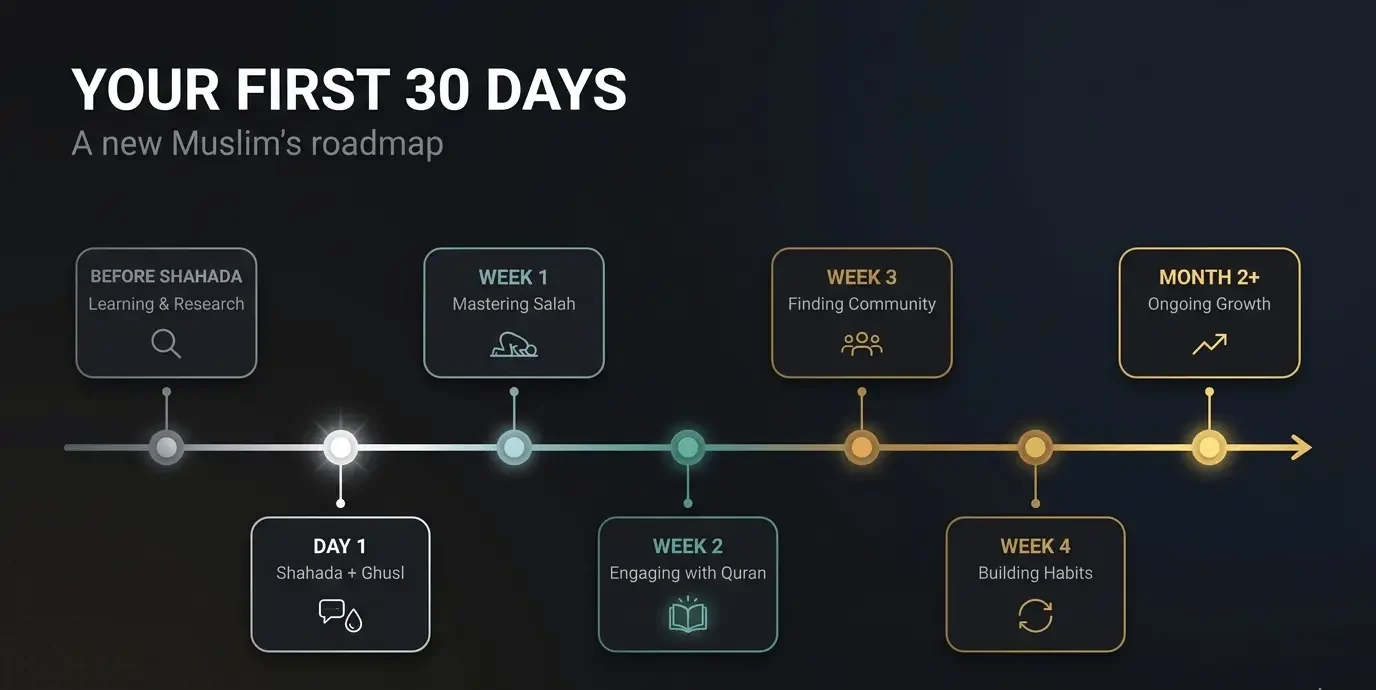
Week 1 — Mastering Salah
Salah (the Islamic prayer) is the core of the Islamic worship. The Prophet ﷺ referred to it as the first thing that an individual would be questioned on on the judgment day. There is no need to be distressed in case you have not yet mastered the Arabic language; you may start by practicing the physical postures, ruku’, sujud, and reciting of short phrases, even in English, until you can memorise Surah Al-Fatiha and the necessary Arabic salutations.
Some of the institutions (Bayyinah Institute and Al-Maghrib Institute) also offer free introductory guides specific to new Muslims.
Week 2 — Engaging with the Quran
Select a printed English translation, with annotations, preferably a recommendation of a scholar, but often the versions of Saheeh International or M.A.S. Abdel Haleem are used by beginners; and start with the short chapters toward the tail of the Quran — you can begin with the last 10 surahs of the Quran from Juz’ Amma. Don’t worry if not everything makes sense right away; understanding will grow with the increase of the knowledge and practice.
- Once comfortable, explore the significance of Surah Yaseen — known as the heart of the Quran and the powerful benefits of Surah Mulk.”
- “For daily inspiration, browse these Quran quotes about life.”
- “When you’re ready to begin memorization, follow our guide on how to memorize the Quran fast.
Week 3 — Building Your Muslim Community
The biggest challenge facing the believers who are new to the faith is isolation. When you start to associate with serious Muslims who practice their relationship with Allah earnestly, Islam becomes easier to practice and far more fulfilling. Visiting a local mosque, joining an online community (through sites like SeekersGuidance or the new-Muslim programmes of ISNA) or contacting organisations (like WhyIslam.org) which specifically support converts are all possible ways to find help.
Week 4 — Developing Sustainable Habits
Total reform cannot happen within a day. Islam promotes good effort, regretting when failures occur (Tawbah), and a continuous quest. One should start with the five mandatory prayers, even though they may be incomplete. Establish a protective daily routine with these authentic morning and evening duas with text, translation and audio. Introduce a routine Quran recitation and commit every day to gaining a new insight about your religion. A digital tasbih counter can help you track your daily dhikr (remembrance of Allah) and build consistency.
First 30 Days Checklist:
☐ Said Shahada with sincerity
☐ Performed Ghusl
☐ Learned Surah Al-Fatiha
☐ Is able to do simple movements of Salah
☐ Said a prayer at least once a day
☐ Participated in a community of a local mosque or through the internet
☐ Started reading from a Quran translation
☐ Studied Six Articles of Iman
☐ Mentor or teacher identified
☐ Said du’a (supplication) every day
Now that you have a roadmap for your first month, it’s important to prepare for the challenges that almost every new Muslim faces — and how to overcome them.
The 4 Biggest Challenges New Muslims Face (And How to Overcome Them)
The conversion to Islam is, in fact, a spiritual victory; but very often it requires the overcoming of material sociocultural obstacles. It is essential to make an open admission of these challenges.
Challenge 1: Family Resistance
The most widespread issue is family resistance. Most of the converts face strong rejection by family members, extensive peer pressure in their social groups, and cultural obstacles that cause an increased sense of isolation. During emotionally difficult moments, these 15 powerful duas for anxiety and stress can bring comfort and spiritual relief. Clearly, the first believers in the Prophet ﷺ suffered persecution due to their strong belief.
Challenge 2: Loneliness and Identity Crisis
Loneliness and lack of identity is a common thing especially when one is not connected to a mosque or a larger community of Muslims. This balance between old friends and a newly formed community belonging is a normal condition that tends to fade away as soon as one can form significant relationships. The Quran offers deep guidance on endurance during trials. Explore these Quran verses about patience for strength.
Challenge 3: Information Overload
Another major challenge is information overload. The market is flooded with large amount of Islamic literature, lectures, multimedia and multiplicity of opinion seeking attention. The wise solution is to give priority to Fard al-‘Ayn—the knowledge which is personally obligatory—and then other matters which are peripheral. Learn the imperative of prayer; master the primal principles of faith; and all the irrelevant will be afterwards.
Challenge 4: Cultural vs. Religious Confusion
Many new Muslims struggle to distinguish between what Islam actually teaches versus cultural practices they encounter at mosques. South Asian, Arab, African, and other cultural norms are sometimes mistakenly presented as Islamic requirements. For example, many questions arise about cultural practices like whether hijab is required and the different styles of modest dress, or about what is halal when it comes to food. Remember: Islam is a universal religion that transcends culture. When in doubt, ask for evidence from the Quran and Sunnah, and consult knowledgeable scholars who can differentiate between religious obligations and cultural traditions.
Practical instructions promoted by seasoned converts and scholars such as Sheikh Omar Suleiman include:
- Find one, reliable mentor; do not be confused with the voices on the Internet.
- Learn self-compassion; the first followers did not grasp the religion in seven days.
- Continuous du’a, with the direct request to the power and direction of Allah.
- Attend an organized and academically sound new-Muslim course in an established institution such as Zaytuna College, Qalam Institute or the Fiqh Council of North America (FCNA).
The Prophet ﷺ said:
“Whoever meets Allah without associating anything with Him will enter Paradise.”
(Sahih Muslim, Hadith No. 93 — Sahih)
Your sincerity matters more than how fast you learn. Speaking of sincerity, you might wonder: why do so many people around the world make this life-changing decision?
Why Do People Convert to Islam? (Real Stories & Statistics)
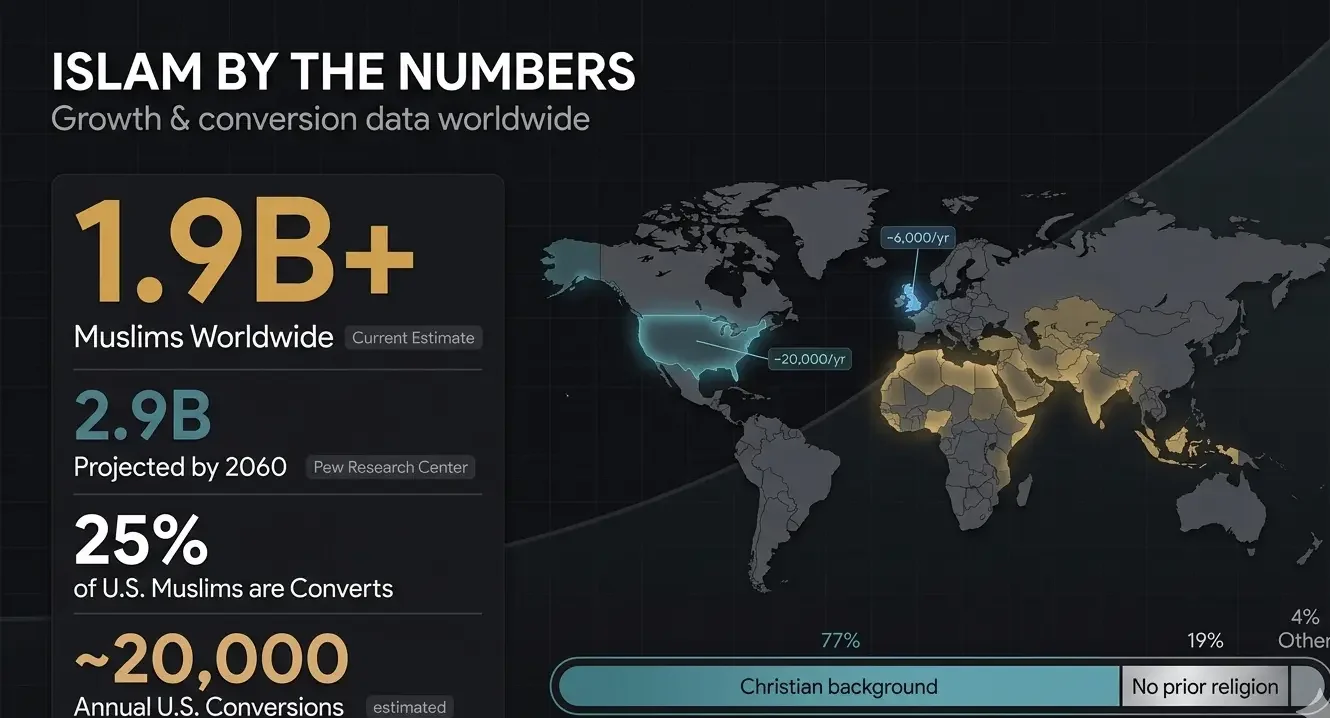
Islam is one of the fastest-growing religions in the world, and, according to current estimates, it has over 1.9 billion Muslims in the world today, and the number is projected to increase to 2.9 billion (31.1 per cent of the world population) by 2060 (Pew Research Center, 2017).
Conversion is a definite source of this meteoric increase: approximately 25 per cent of American Muslims are converts according to Pew Research Center’s 2017 study; up to 20,000 in the United States reportedly convert each year, though again, these are pre-2010 figures, and should be considered in context. The number of conversions in the United Kingdom is about 6,000/year and women constitute the largest group of new members. Three-quarters of those attracted to Islam (77 percent) have a Christian background, but 19 percent entered without any religious background.
The reasons that have made people turn to Islam are numerous and varied, but the common themes keep replicating throughout the convert stories:
Tawhid — the principle of absolute monotheism in Islam, without the theological complexity of other systems of religions, creates a deep echo in the hearts of many seekers.
Quranic Experience — When hearing the Quran first time, many of the converts claim that it was a very transformative experience because the scripture directly answers questions that had lingered in the mind over the years.
Community and structure — the five daily prayers, the institution of charity and the general feeling of the Ummah provide a rationalist system that most people consider foundational.
Intellectual coherence — as described by the works of scholars like Dr. Jonathan Brown of Georgetown University and Dr. Shadee Elmasry, converts are often drawn to the logical coherence of Islam with regards to doubts about the existence of God, the purpose of man and the state of moral order in the universe.
As Allah states in Surah An-Nahl (16:36), this message of Tawhid was sent to every nation — and this universal declaration is an important part of its charm. Once you’ve made the decision to convert, there’s one practical matter you may need to address.
What’s New for Muslim Converts in 2026
The landscape for new Muslims has evolved significantly in recent years. Here’s what’s changed:
Expansion of Online Shahada Services
Since 2020, the ability to convert to Islam remotely has expanded dramatically. Organizations like WhyIslam.org, SeekersGuidance, and ISNA now offer structured online conversion sessions with qualified scholars via video call. This has made the conversion process accessible to people in remote areas, those with mobility challenges, or individuals who feel more comfortable taking their Shahada privately before joining a physical community.
Enhanced New-Muslim Support Programs
Major Islamic institutions have developed comprehensive post-conversion support. Programs like “New Muslim Care” by ICNA, the “Revert Support” initiative by Islamic Relief, and structured mentorship programs through local mosques now provide ongoing guidance for the first year after conversion. Many mosques now assign dedicated mentors to new Muslims.
Updated Population Estimates
The global Muslim population continues to grow. Current estimates place the number at approximately 2 billion worldwide, with conversion remaining a significant contributor to growth in Western countries. The Pew Research Center projects Islam will be the world’s largest religion by 2070.
Digital Learning Resources
Platforms like Bayyinah TV, SeekersGuidance, and Qalam Institute now offer structured courses specifically designed for new Muslims, covering everything from basic prayer to intermediate Islamic studies — all accessible from home.
Certificate of Islam: When and Why You Might Need One
A Certificate of Islam—sometimes known as the Certificate of Faith or Shahada Certificate—is a formal document that confirms that the individual has made the Shahada and has then converted to Islam. Although it is not a prerequisite to being a Muslim, it might be essential in as far as some pragmatics are concerned.
When You Might Need It:
Hajj and Umrah: In case a person will come to perform pilgrimage to Makkah, Saudi governments can demand to be provided with certifiable evidence of being a Muslim. Even though the modern laws have loosened the requirements of this type of certification, the evidence of the length of one’s faith can still be demanded by some of the travel agencies.
Marriage: Islamic marriage certificates might require one to prove his or her faith.
Legal documentation: In most jurisdictions with a majority of Muslim-majority, formal acceptance of Muslim status may be compulsory to issues of personal status law.
How to Acquire One:
The interested parties must approach their local Islamic centre or mosque. The traditional process usually involves the Shahada in the presence of others, official conversion, and acquisition of the certificate with the current date. This can be facilitated by recognised bodies like ISNA, Dar al-Ifta al-Misriyyah, Al-Azhar and the Assembly of Muslim Jurists of America (AMJA).
The fact that one holds such a certificate does not make a conversion any more genuine; instead, the good faith in the presence of Allah is the main consideration. However, legalization can be done to fulfill practical needs and create a form of formal connection among the Muslim community.
Frequently Asked Questions on Converting to Islam
How is the conversion process done?
Conversion into Islam is done by means of the heartfelt utterance of the Shahada: Ash-hadu an la ilaha illa Allah, wa ash-hadu anna Muhammadan rasul Allah. This may be carried out on one’s own, with or without witnesses. True faith is the only requirement, and upon sincere declaration, all past sins are forgiven.
What is the definition of the Shahada?
The Shahada is Islam’s declaration of faith and its first pillar. It consists of two testimonies: that no deity is worthy of worship except Allah, and that Muhammad ﷺ is His final Messenger. For a deeper exploration of core Islamic beliefs, visit our guide on what is Islam — meaning, beliefs and 5 pillars. Scholars like Hafidh al-Hakami identified seven conditions—including knowledge, sincerity, and certainty—that give the Shahada its full spiritual weight.
Is mosque attendance necessary?
Mosque attendance is not necessary to make a valid conversion; the Shahada can be made anywhere—at home, outdoors, or in a mosque. Though attendance is beneficial for communal support, witnessing, and certificate acquisition, it is not a condition for legitimacy.
Can I convert online?
Yes, conversion is valid remotely. Organizations like WhyIslam.org and SeekersGuidance offer free video sessions where a scholar or mentor can guide you through the Shahada. The conversion remains valid as long as it is uttered with genuine belief and understanding.
Do I need to change my name on conversion?
No, changing your name is not required unless it directly contradicts Islamic belief. Many converts voluntarily adopt Muslim names, but this is not compulsory. All four Sunni madhabs agree on this position.
Is circumcision required?
Circumcision is not a conversion requirement. Although considered Sunnah, it has different statuses according to various schools: Hanafi and Maliki consider it recommended, while Shafi’i and Hanbali consider it obligatory—but none make it a barrier to becoming Muslim.
What happens to my past sins?
When a person genuinely converts, all past sins are completely erased. The Prophet ﷺ said: “Islam erases what came before it” (Sahih Muslim, Hadith No. 121). This pardon applies regardless of the nature or number of previous transgressions.
Are witnesses required?
Witnesses are suggested but not compulsory according to scholarly consensus. Their involvement is practical, enabling community support and documentation. Even in isolation, the conversion is valid between the individual and Allah upon sincere pronouncement.
Is the conversion process the same for men and women?
Yes, the conversion process is identical for both genders. Men and women say the Shahada with sincere faith; there are no differences in requirements, statement, or conditions—whether online, in a mosque, or alone.
What are the Five Pillars of Islam?
The Five Pillars are: Shahada (declaration of faith), Salah (five daily prayers), Zakah (obligatory charity), Sawm (fasting during Ramadan), and Hajj (pilgrimage to Mecca for those physically and financially able).
What lessons should I learn after conversion?
Focus on Fard al-‘Ayn—personally obligatory knowledge. Prioritize mastering Salah, internalizing Tawhid (the oneness of God), and reading the Quran with a credible translation. Development should be gradual, not exhaustive.
Is the conversion permanent?
The profession of faith is an eternal covenant, but Islamic theology emphasizes that faith cannot be coerced, as stated in the Quran (2:256). Faith is a personal matter; maintaining it is a continuous process of growth and renewal.
Your Journey Begins Now — And Allah Is With You Every Step
If you’re ready, the words are simple and the door is open. And if you need more time, take it — study, reflect, ask questions, and know that the very fact you’ve read this far is itself a sign of sincerity. Every step you take toward Allah, He takes toward you.
The facts of the Quran, the established Sunnah, and the decision of the ancient and modern scholars all meet at one point: one does not enter the Islamic faith through intricacy, but with the intentions of the heart. It does not matter whether you make the Shahada in a large mosque with many others present, or in your room at 3 a.m.—the only thing that counts is the condition of the heart in the presence of Allah.
Go to the local mosque, speak with the scholars and use good reliable sources like SeekersGuidance, Bayyinah Institute or WhyIslam.org.
And Allah is the Most Knowledgeable (Wallahu A’lam). This article is informative in nature, and it does not substitute individualized scholarly counseling.
Recommended Reading for New Muslims
Continue your journey with these essential guides from IslamShub:
- What is Islam? Meaning, Beliefs & 5 Pillars
- How to Pray in Islam — Complete Guide
- Step-by-Step Wudu Guide with Pictures
- Surah Al-Fatihah: Full Translation & Tafsir
- 99 Names of Allah — Meanings & Benefits
- Sadaqah and Zakat — Understanding Islamic Charity
- How to Pray Taraweeh
- 15 Powerful Duas for Anxiety and Stress
- Authentic Morning and Evening Duas
- Does Islam Believe in Jesus? A Complete Guide
- Why Do Muslim Women Wear Hijab?
- Islamic Holidays — Complete Calendar
- Shia vs Sunni — Key Differences Explained
- Halal Recipes for Everyday Cooking
- Hijri to Gregorian Date Conversion Guide
Sources & Methodology
This guide draws upon primary Islamic sources: the Quran (with tafsir context from Ibn Kathir, al-Tabari, and al-Qurtubi), authenticated Hadith collections (Sahih al-Bukhari, Sahih Muslim, Sunan Abu Dawud), and classical scholarly works including Ma’arij al-Qabool by Hafidh al-Hakami and Sharh Sahih Muslim by Imam al-Nawawi. Contemporary positions reference AMJA, ISNA, and recognized scholars including Sheikh Ibn Baz and Sheikh Ibn Uthaymeen. Statistical data is sourced from Pew Research Center (2017). Last reviewed and updated: January 2026.